With an unbelievable 170 Inns and Public Houses in Carmarthen in the 1850’s its reputation was somewhat tarnished by the level of drunkeness and crime associated with “over indulgence”. The following letter was published in the Welshman newspaper in February 1873 following the verdict of the Jury of an Inquest held in Carmarthen concerning the sudden death of an inhabitant. The phrase “Died by the visitation of God” was used repeatedly in a great many Inquests that were held at the time and clearly – at least to one local individual, was not the correct verdict, and one that should have been explained in simpler terms without the need to involve the Almighty. In basic terms the phrase meant that there were no suspicious circumstances surrounding the death of that individual.
Almost twenty years previously in 1854 one such case came to the same conclusion regarding the death of William Byne, – a “writer” born in Gloucester in 1813, whose frequent visits to the inns and ale houses in Carmarthen were well known, especially to the the “Talbot” which was a well respected coaching Inn in Guildhall Square in the 1850’s. and where the unfortunate Mr Byne breathed his last aged just 41 . He was buried in a Paupers grave in St David’s in May 1854. Five years previous to his demise he was sentenced to twelve days in Carmarthen Gaol for failing to pay for his lodgings at the Red Lion, and the following article appeared…
Carmarthen Small Debts Court – 27th April 1849 page 2 – The Welshman
In the case of Sarah Jenkins, widow, and executrix of the late Benjamin Jenkins, of the Red Lion Inn, Priory Street, plaintiff and Daniel Harries and Charles William Byne, defendants, judgment having been obtained at a former court, a summons after judgment was sought, and defendant Byne was committed to gaol for 12 days in default of obeying the order of the Court, while the other defendant escaped by promising plaintiff to pay a certain sum weekly.
Charles William Byne 1813 – 1854 . Writer.
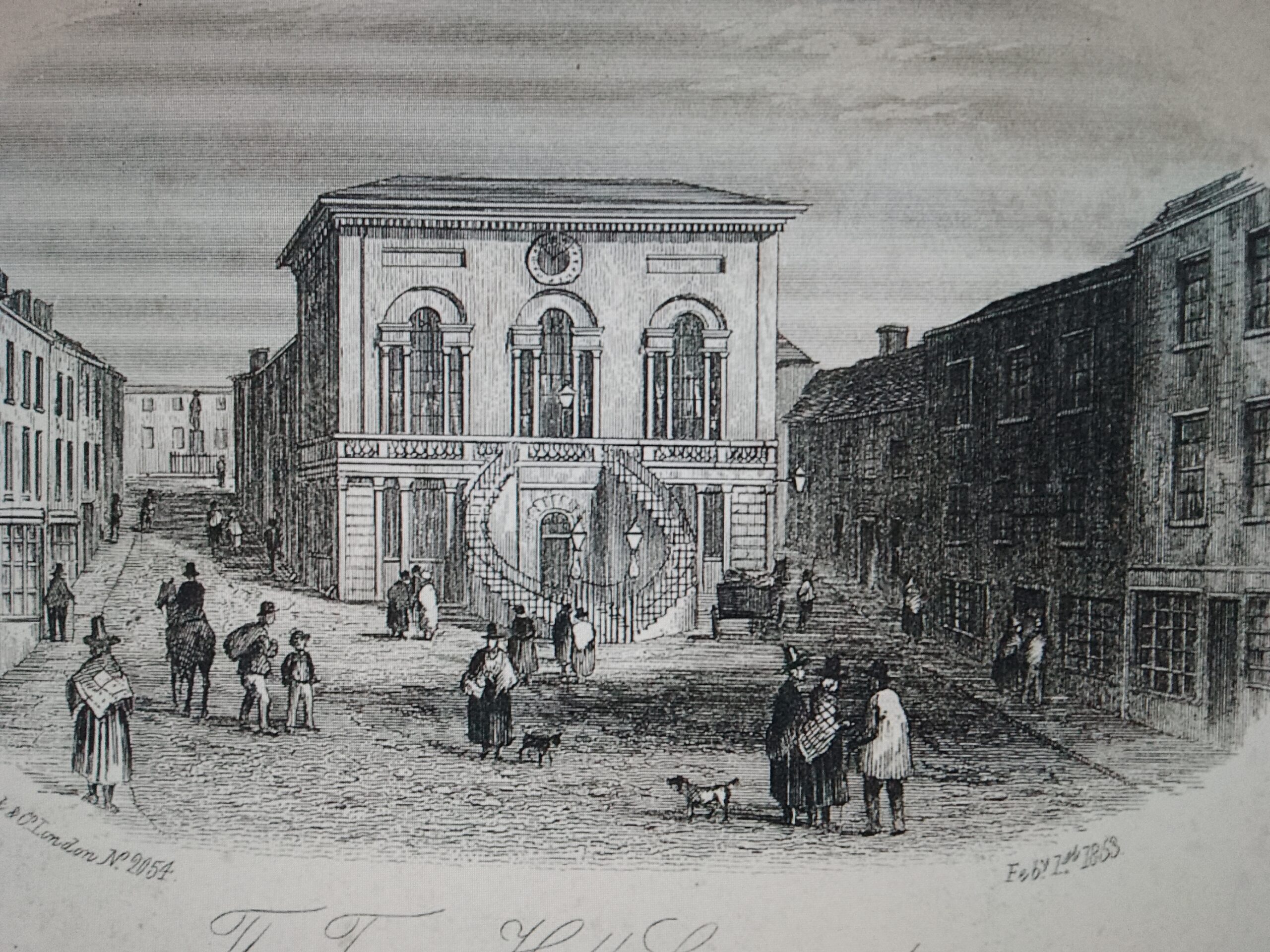
On Tuesday evening, an inquest was held at the Town Hall, before John Hughes, Esq., on the body of Charles William Byne, writer, who died suddenly. From the evidence of several witnesses, it appeared that the deceased lodged at the Talbot Inn during the past week, where he pursued his professional duties for several days, although suffering from excessive debility. On Monday, he was assisted from his bedroom at a late hour in the morning, and in the course of the day took two glasses of brandy, and a little arrow root with some rum. In the evening he grew worse, and after having been put to bed he became delirious. Mr. Thos. Jones and a servant remained with him until eight o’clock in the morning, when, at his desire, he was placed in a chair, where he remained a few minutes and then expired. Mr. Thomas, a medical pupil of Mr. Rowlands, surgeon, saw the deceased on Monday night, and administered to him an effervescent mixture, from an impression that he was under the influence of spirituous liquors. His habits were represented to be those of a dissipated man. After hearing the evidence, the jury gave a verdict of “Died by the Visitation of God.”
The above was published by “The Welshman and general advertiser” MAY 12TH 1854
Charles Dickens witnessed inquests in his capacity as a journalist, and even served on a coroner’s jury. As it happens, the coroner on that occasion was none other than the celebrated Dr Thomas Wakley – who was an english surgeon. He gained fame as a social reformer who campaigned against incompetence, privilege and nepotism. He was the founding editor of the Lancet – a renowned medical journal, and a radical Liberal Member of Parliament and a celebrated coroner. In a trenchant article in Household Words, Dickens castigated the practice of hearing inquests in taverns, but he reserved his most pungent criticism to a scene in Bleak House, published a couple of years later in 1852:
“At the appointed hour arrives the coroner, for whom the jurymen are waiting and who is received with a salute of skittles from the good dry skittle ground attached to the Sol’s Arms. The coroner frequents more public houses than any man alive. The smell of sawdust, beer, tobacco smoke, and spirits is inseparable in his vocation from death in its most awful shapes. He is conducted by the beadle and the landlord to the harmonic meeting room, where he puts his hat on the piano and takes a Windsor chair at the head of a long table formed of several short tables put together and ornamented with glutinous rings in endless involutions, made by pots and glasses. As many of the jury as can crowd together at the table sit there. The rest get among the spittoons and pipes or lean against the piano”.
“DIED BY THE VISITATION OF GOD”. The Welshman 21st February 1873 page 3 (see below)
TO THE EDITOR OF THE “WELSHMAN.”
SIR, “Died by the visitation of God” was the verdict given by the coroner’s jury in a case of sudden death which occurred recently not far from Carmarthen. But what does this verdict mean ? Every one who believes in the existence of an intelligent being, ruler of the universe, looks upon his will as the primary cause of every event which takes place on earth. But every student of natural science believes also that nature is governed by laws, the operation of which may be investigated, and constantly relied on. These he calls secondary causes. And when he enquires into the cause of a man’s death, he invariably refers to the secondary cause as being that with which natural science has to do, and upon which it is incumbent on men to seek information for their guidance in treating human ailments and alleviating pain. If, then, a coroner’s jurymen declare that a man died by the “visitation of God,” they must mean either that they have not the means, or are too ignorant, or careless, to investigate the secondary causes of death; or else that they believe there were no secondary causes, that is to say that the man’s physical constitution was quite sufficiently sound to carry on the functions of life, but a special miracle was worked to terminate it. Yours truly,
J.C.P.
“DIED BY THE VISITATION OF GOD”.
TO THE EDITOR OF THE WELSHMAN – 7th March 1873 page 8
SIR,—J. C. P. asks the meaning of “Died by the Visitation of God,” and without waiting for a reply proceeds to censure the coroner’s jury for recording such a verdict. He reasons that the will of God is the primary cause of all events, and that when the jury refer the death of any one to God’s will, they mean either that they have not the means, or are too ignorant or careless to investigate the secondary causes of death.” J. C. P. would find no difficulty if he asked himself, first of all, what the coroner’s jury are summoned for. It is to inquire, where any person is slain, or dies suddenly, or in prison, concerning the manner of his death,” or, in other words, whether the deceased died from foul play or the carelessness of any one. The jury do not travel beyond this purpose, and as soon as they are satisfied from the evidence, given on oath, that death was not produced either by violence or neglect, they cease their inquiries as to the cause, and the verdict “Died by the Visitation of God” is recorded, and understood by everybody to mean that no one is to blame for the death. It would perhaps at times be advantageous to inquire into the cause of death, when there is no suspicion against any one, but J. C. P. would hardly require the coroner’s jury to do so. A jury of scientific men – surgeons and doctors in medicine would be more likely to carry investigations of the kind to some useful end. On reflection J. C. P. will, I am sure, confess that he has unintentionally done injustice to the coroner’s jury, in charging them with being too ignorant or careless to investigate the secondary causes of death,” when by doing so they would exceed the duty to which they are sworn. Yours truly,
A. Z. I