A tale of two cemeteries, separated by faith. The story of Ellen Buckley aged 1 and her famous father – Police Sergeant Thomas Buckley of the Carmarthen Borough Police Force who was also the“Assistant inspector of nuisances”.

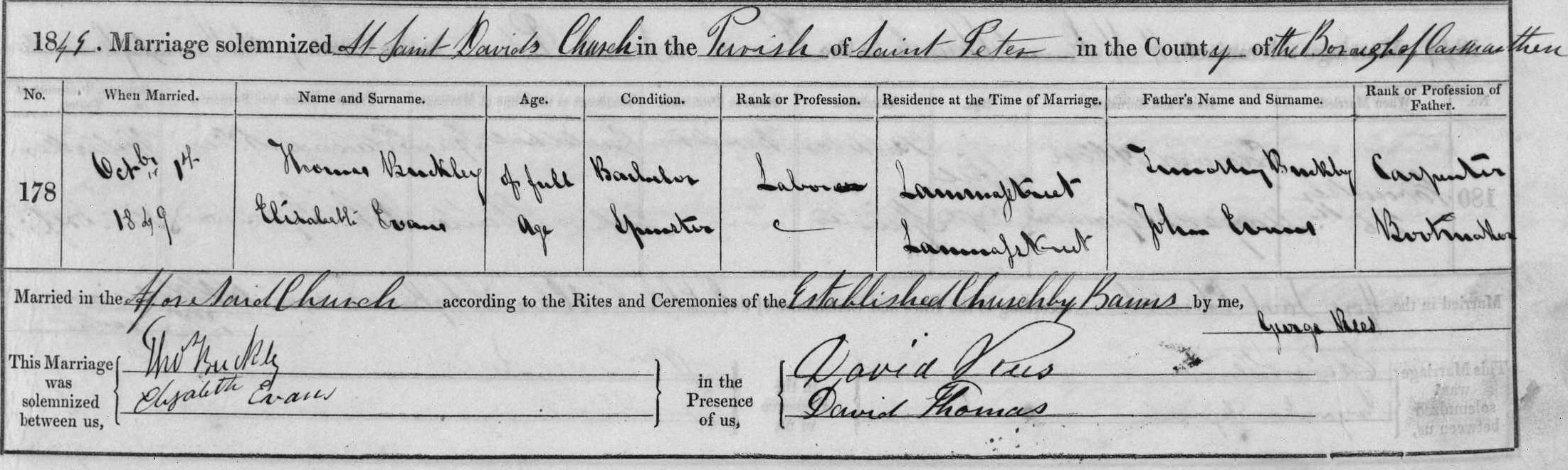
Thomas Buckley, an Irishman, married Elizabeth Evans, a Carmarthen girl, in St David’s Church on October 1st 1849 both living in Lammas Street at the time. Ellen Buckley their only daughter was born in 1853 and died on the 7th June 1854 of whooping cough aged one year old. She was buried in this cemetery – St David’s two days later, attended by many family and friends, her father carrying the coffin to it’s last resting place. There is no grave marker. Less than two years later  on 19th July 1856 Ellen’s father – Thomas was also dead at the age of 35 from Tuberculosis brought on so sudden that only a month before he was giving evidence in Carmarthen Courthouse and four months previously to that, had became the proud father of a son also called Thomas. In August 1868 aged 12 he too also died.

Both father and two sons were buried together in St Mary’s Catholic cemetery – a few minutes walk from St David’s. It is however of some great mystery as to why Ellen was buried in St David’s and not St Mary’s with her father and two brothers especially as the newly consecrated Church of St Mary’s had been open for at least two years before Ellen died. It may also be that Ellen had not yet been baptised due to her very young age meaning that she could not be accepted into the Catholic Church and be buried within it’s newly created cemetery. It is however sad to realise that by virtue of religious beliefs  they became separated for all time. 

Elizabeth herself- Ellen’s mother moved away from Carmarthen in later years, presumably to get away from all the trauma of her earlier life.

Ellen’s father Thomas was a truly remarkable individual and one that I have had great pleasure in researching.His marriage certificate states that in 1849 he was a Labourer so his entry into the Borough Police Force must have been in the early 1850’s.  Every week in the Carmarthen Journal, and Welshman newspapers he would be found somewhere in print having apprehended, arrested, fought, and saved many lives, and, travelling across the country including London, in pursuit of the criminal fraternity. What follows is only a very  small fraction of his exploits as a Police Constable and then Sergeant over a two year period. In truth there are hundreds of stories of his efforts to bring Carmarthen’s unruly and criminal fraternity to the courthouse and also many stories of him apprehending and arresting soldiers that had deserted, having a keen eye for the way they were dressed for example. Living in Lammas Street in the centre of Carmarthen as he did, he saw a great deal, being right in the thick of it when it comes to the number of Public Houses for example ( 140 PUBLIC HOUSES IN CARMARTHEN AT THE TIME ) and also arresting Anne Awbury for her 101st conviction for being drunk and disorderly. He was undoubtedly a real character that brought great credit to the local Borough Police Force for which he was recognised, credited, and thanked for several times, but as was the case so often during this period he was taken away so suddenly and prematurely by TB which manifested itself in days resulting in his sudden demise. Though he is not buried here in St David’s cemetery but in St Mary’s, I felt nevertheless  compelled to write his story as his daughter Ellen would have wanted. Being married here in St David’s Church means he will always have an association with this place.Ellen’s father will always be her father after all wherever he is buried. God bless them all and may they rest in peace and rise in glory.

Carmarthen Town Council Meeting held on November 10th 1854. The Welshman and General Advertiser page 2

The Mayor felt bound to notice the conduct of Sergeant Thomas Buckley, who was an active and exceedingly efficient officer, steady, intelligent, and always at his post. Sergeant Buckley had rendered considerable services to the Town Surveyor as assistant Inspector of nuisances, and the town was now through their combined exertions in a very creditable sanitary condition. 

The Welshman. June 30th 1854

APPOINTMENT OF POLICE SERGEANT. — On Friday last a Watch Committee was held in the Council Chamber, when there were present, the Mayor, Mr. C.Brigstocke, and Mr. S. Tardrew. Sergeant Davies sent in his resignation on the grounds ,of insufficient salary, and excessively heavy duties. The committee appointed P.C. Thos. Buckley to the vacated office, agreeing that he was one of the most active and efficient men in the force; sober, diligent, and particularly attentive to his duties. 

March 14th 1856. The Welshman

ALLEGED EMBEZZLEMENT.—James Davison a foreman during the last six months in the employ of Mrs.Needle, tailor, Queen-street, recently decamped charged with having received, sums amounting to more £40 which he has not accounted for. The following announcement has appeared in the Police Gazette . “LARCENY AND EMBEZZLEMENT—The following is a description of James Davison, a tailor, who absconded on the 1st instant, from from the employment of Mrs Needle, Queen Street, Carmarthen, charged with Embezzlement. He is about 5 feet six or seven inches high 26 years of age and dark complexion and hair, large dark eyes, thin visage, long neck, broad shoulders and chest and a large hair curl on the top of his forehead; when he left he was dressed in a suit of black, his top coat having very long sleeves and his hat lined with cloth inside the brim. He is a member of the Wesleyans. Information to be given to the Borough Police Carmarthen. -Bow Street, March 12th 1856” The police of the Carmarthen Borough hesitate to go in pursuit of him, as, if they do not succeed in capturing him, they have to bear their own. expense, which they are not in a position to do. A subscription has been suggested to guarantee the expenses of P.S. Buckley in the event of failing to apprehend, but nothing has been done. The police have obtained a good deal of information which leads to the expectation that he will not long escape detection, and the punishment which systematic embezzlement, under the guise of religion thoroughly merits.

CHARGE OF STEALING ONE HUNDRED & THIRTY SOVEREIGNS AND TWO TITLE DEEDS. On Monday last, Evan Charles, was brought up in the custody of the police, before the Mayor, and E. H. Stacey, Esq., at the Town-hall, and charged with stealing one hundred and thirty sovereigns, and two title deeds, the property of his father John Charles, landlord of the Cross Keys, public house, Lammas Street. The peculiar circumstances of this case, excited considerable interest and during the examination the court was crowded to excess. Mr. R. A. Thomas, instructed by the prosecutor, conducted the case, and Mr. T. Parry, who was sent for at the request of the accused when the case had been partly heard watched the proceedings for the prisoner. John Charles examined I am the prisoner’s father and keep the Cross Keys, public house, in Lammas-street. The prisoner lived in the house with me. He is married and until Saturday morning his wife lived with him, when she went away on account of his continued ill usage. I believe she went home. It was when I got out from bed that I first knew she had gone away. She was my housekeeper. I then secured the services of a woman to conduct my business. About four o’clock in the afternoon as I was going down Lammas-street, I met William Evans of the Railway Tavern who after a little conversation, asked me if it was true that my daughter-in-law had decamped, plundering me of my money and deeds. I said that she had left but that my property was safe, having seen it in my box the previous night. The box I referred to was kept in my bedroom. There was a lock on it, of which I kept the key. No one had any right to go to it but myself. I saw it on Friday night and it was then safe. I had then one hundred sovereigns in a tin box and thirty sovereigns in a purse. I had some deeds relating to land in Picton Place, and houses in Pendre. It is freehold property. On my return to the house I went upstairs to my room, the door of which I had previously locked, and when I had locked myself in I tried to open the box. At first I experienced some difficulty, caused by the disorder produced in opening it with a false key. When I succeeded I found that my money and deeds had been removed. I then went down and informed those in the house that I had been robbed of all I possessed. I immediately gave information to Sergeant Buckley. I subsequently found that access was obtained into the room through the window, which had been left open, by means of a long ladder against the wall which had not been removed. Mr. Parry at this stage of the proceedings, by permission of the court retired with the prisoner, and on his return recommended that on account of the relationship between the prisoner and the prosecutor a compromise should be permitted, to which the court refused to accede. P.S. Thomas Buckley examined: “In consequence of information I received from the prosecutor, I pursued and apprehended the prisoner. When in the station house I searched him and found on his person the bag now produced. It contained ninety-five sovereigns, and was concealed at the back of his leg sustained by the string which tied his gaiter. I also found another bag which I now produce in his breeches pocket. It contained seventy-six sovereigns. In his pockets there were also 13s. in silver and copper. The private agreement I now produce was also upon him. In an outhouse of the Three Salmons public house Water-street, the two deeds now produced were found by me. Upon the cover of one of them is written “Deed belonging to Mr. John Charles.” The documents were concealed in the house. Howell Howell examined I am landlord of the Three Salmons public-house, Water-street. On Saturday morning last about breakfast time the prisoner came to my house and remained there some time. This morning- the deeds now produced were found on the premises concealed in the roof of an outhouse. This was the whole of the evidence, the prisoner having reserved his defence; and the usual caution having been read, he was committed to take his trial at the next Quarter Sessions for the borough.

The Welshman. October 6th 1854

SANITARY CONDITION OF THE TOWN.—The health of this town has been remarkably preserved during a trying period which has now nearly terminated. Whilst virulent epidemics and diseases have raged with fearful destruction in other places we have been mercifully protected. It was fortunate that early in the season our active Surveyor, with the assistance of P.S. Buckley, adopted all precautionary measures which suggested themselves. The improvement which has been effected under their superintendence is really surprising. Kidwelly fach formerly one of the filthiest and most unhealthy parts of the town has almost been renovated. The public sewer which has recently been constructed, affords a ready outlet to the matter which used to be allowed to accumulate into feculent heaps, and impregnate the atmosphere with noxious particles. The houses are, through the kindness of Mrs. Cross, Abermarlais, white washed, inside and externally, and now wear a clean and healthy appearance, while the senses are not offended with unsightly nuisances or poisonous effluvia. Every part of the town is now. very free from filth, a good protection from epidemic and diseases which are most immediately atributable to sanitary defects. 

18th May 1855 page 5 The Welshman

On Monday, before William Morris, Esq. Mary Ann Thomas, a nymph du pave, was convicted on the evidence of P S Thomas Buckley, of drunkenness and breaking a pane of glass in a widow of a house in Friar’s Park, on the previous night at 12 o’clock. This was her twentieth conviction before the magistrates within a short period. Committed to prison for two months.

No date of publication.

CONCEALMENT OF THE BIRTH OF A CHILD.-On Wednesday last, an inquest was held in the Town Hall, before John Hughes, Esq., on the body of a new born child. The evidence is totally unfit for publication, but the simple facts of the case are these—Elizabeth Williams, a single young woman, residing at Llanddarog came to Carmarthen on Friday morning last, and went to the premises occupied by Methuselah Evans, in Chapel street, with some work for his granddaughter, who is a dressmaker. She was accustomed to take work to Elizabeth Evans, and when she did so remained until it was completed, assisting to sew. On Saturday she complained of being unwell, but refused to see any medical man, stating that it was useless as her pain arose from cholic to which she was subject. Several persons observing her appearance accused her of being enciente, but she stoutly denied it. She did not go to bed on Saturday night and on Sunday morning persons who occupy apartments in the house heard sounds emanating from the room she was in, resembling a person in excessive pain, but they saw nothing. On Monday morning she left the house and returned to Llanddarog in a cart. The alteration in her person excited suspicion, and on Tuesday afternoon Sergeant Buckley instituted a search on the premises, and found the dead body of a new born child in a cesspool, which he washed and conveyed to the station house. He then apprehended Elizabeth Williams, Mr. Rowlands, surgeon, made a post mortem examination of the body, and arrived at the conclusion that the child had never had an independent existence. The jury returned a verdict of “Found Dead.” There is reason to believe that the young woman had at least one accomplice, and as soon as she is sufficiently recovered an examination will be taken before the magistrates.   (No date of publication)

CHARGE OF OBTAINING MONEY UNDER FALSE PRETENCES.– On Monday last, before E. H. Stacey, Esq., John Langton Leach, son of the Venerable Archdeacon Leach, Rector of Egremont, Cumberland, formerly Clerk to the Surveyor of the Post Office for the South Wales District, was brought up I in the custody of the police on a charge of having obtained money from Mr. Matthews, postmaster of this town, under fraudulent pretences. The prisoner is of dissipated habits, through which he lost a lucrative and promising situation. His personal appearance testified to the degrading influence of the life he has led, and excited the deepest commiseration. He was apprehended by Sergeant Buckley in a low house of ill fame at Oxford, and appeared to feel most acutely the position in which he was placed. The only witness was Mr. John Matthews, who on being examined said, I am the post- master residing at Carmarthen. I know the prisoner. He has been in the service of the General Post Office. He held a situation there in May last as Surveyor’s Clerk. He attended the post office here in that capacity. ( No date of publication )

THE POLICE FORCE.—A meeting of the Watch Committee was held on Friday last. There were present-the Mayor, Messrs. W, Morris, E. H. Stacey, Valentine Davis, George Davies, and Samuel Tardrew. A memorial from P.S. Thomas Buckley for an increase of salary and an alteration of duty, was laid before the committee, when, after a discussion, it was ordered to recommend that his salary be increased from 18s. to £1per week, and that, instead of continuing on duty every night from 10 until 6 o’clock, he shall go on duty at 9 o’clock and be relived at midnight by the first-class constable, and that he shall resume duty at 10 o’clock every morning. It was also determined to recommend the council to increase the pay of the first-class constable to 18s. instead of 17s. per week, and that the fees be divided exclusively between the ordinary men, whose salary is to remain the same as at present—16s. per week. 

MELANCHOLY SUICIDE. 

2ND NOVEMBER 1855 WELSHMAN

P.S. Thomas Buckley examined On Sunday morning “I went to the Weaver’s Arms in Water-street, where I saw deceased hanging from the head of the bedstead by a silk handkerchief. I immediately cut him down, but he was quite dead and cold. I now produce the handkerchief. I found ninepence in his pocket. There was no mark of violence on the body. He wore two pairs of breeches.” This was the whole of the evidence, and the coroner having briefly addressed the jury, a verdict of “Hanged himself when in a state of temporary insanity” was recorded.

LIGHT FINGERED GENTS.On Friday night P.S.Thomas Buckley ascertained that four suspicious looking persons in the guise of cattle dealers had arrived in this town by the last train from Narberth fair on the previous day. They played cards in the railway carriage evidently to attract attention, but they were recognised as questionable characters, frequently seen at cattle fairs. Buckley kept a careful watch during the night, but he failed to catch a glimpse of them. Determined that they should not secure any booty if it were possible to prevent them, instead of going off duty,  Sergeant Buckley remained out during the whole of Saturday, a great portion of the time in plain clothes. In the afternoon he heard that Mrs. Thomas, of Guildhall square, had lost from her pocket five shillings, but as she could not identify the thief nor accurately describe him, there was no chance of detection, there being so many strangers in the town. However, from the imperfect description given, Buckley obtained some intelligence of his whereabouts,” and while in pursuit, he was informed that a Mrs. Henry had been robbed of five sovereigns, and that she distinctly saw the person who picked her pocket. From her he obtained additional particulars, and soon afterwards met “his man” in Water-street, and inquired of him where he was going. He replied that he was on his way to the Railway Station. Buckley walked along with him for a few seconds, and then requested that he would accompany him to the station-house, as there was a charge of felony against him. He refused to go with the Serjeant, and attempted to make an escape, but as he was quickly “slipped,” he had no alternative, and was compelled to go to the station-house. On being searched five sovereigns and a half in gold were found in his possession. When questioned by Buckley he said he was a cattle dealer from Cardiff, and having purchased two ponies in the fair he had sent them off, but he refused to tell where he paid for them, and of whom he bought them. He stated that he knew several cattle dealers— a Mr. Johnson, of this town, (there being no such person) and two big fat men’ whose names he could not remember.

22ND JUNE 1855 PAGE 5 THE WELSHMAN

CARMARTHEN POLICE COURT.-In the Town Hall, on Friday last, before the Mayor and E. H. Stacey, Esquire. Ann Awbrey was convicted of drunkenness and disorderly conduct, on the evidence of P.S. Thomas Buckley. This was the hundred and first time she had been similarly convicted. She was again committed to prison for three months.

7th September 1855 page 3 The Welshman

Headstone Inscription

IN

MEMORY OF

THOMAS BUCKLEY

SERGEANT OF POLICE

FOR THE BOROUGH 

OF CARMARTHEN

WHO DIED JULY 19TH 1856

AGED 35

ALSO DAVID WALSH

SON OF THE ABOVE NAM’D

WHO DIED DEC 27 1857

AGED 5 YEARS

AND OF THOMAS WALSH BUCKLEY

THE YOUNGEST SON

WHO DIED AUGUST 22ND 1868

AGED 12 YEARS

MAY THEY REST IN PEACE
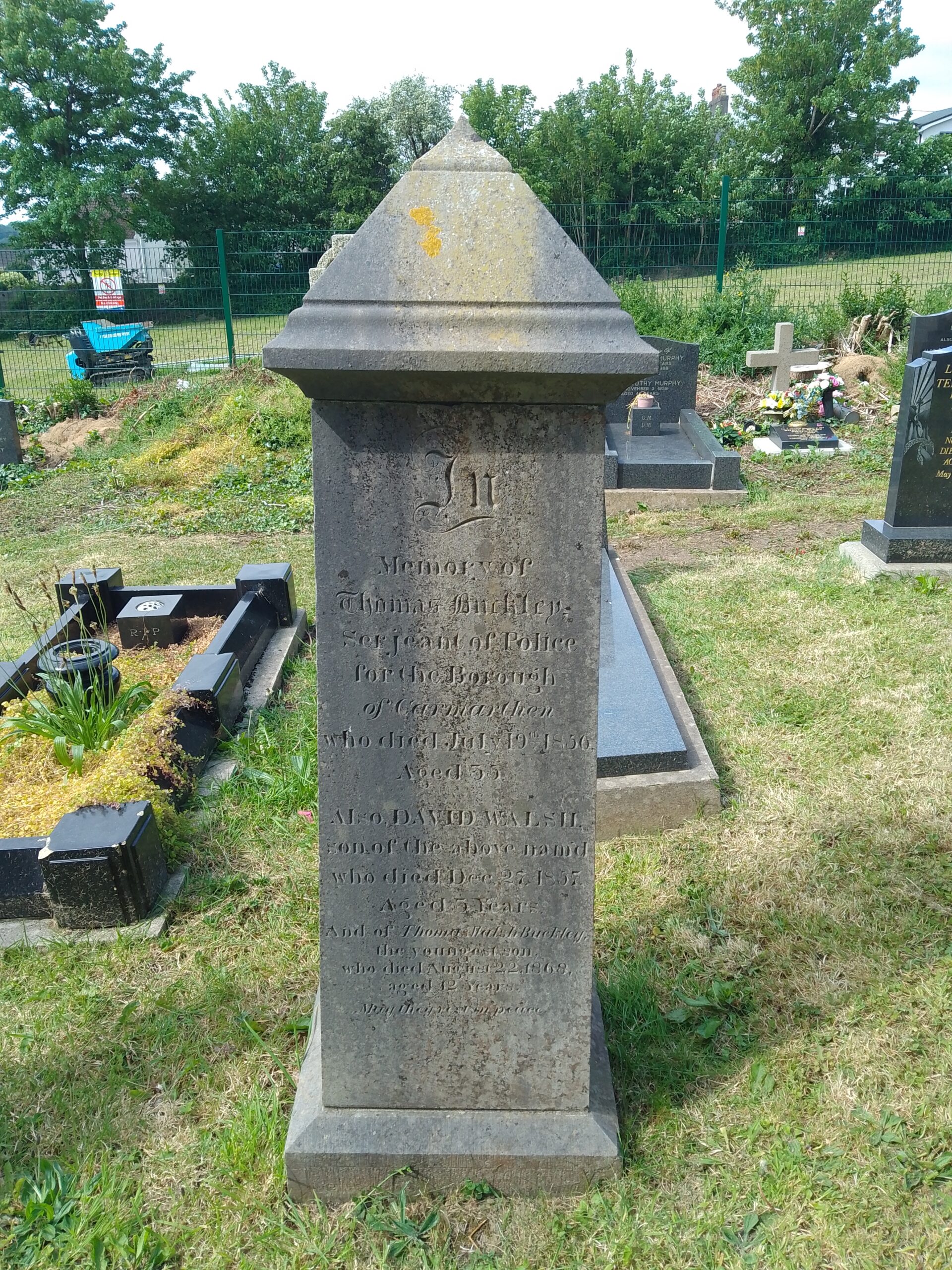
The last resting place of Sergeant Thomas Buckley and his two sons in St Mary’s Catholic Church cemetery Union Street Carmarthen.


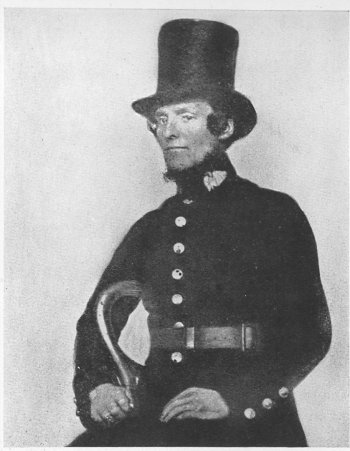
1850’s Police Uniform that would have been worn by Thomas Buckley


Thomas Buckley’s marriage certificate


Burial Register entry for Ellen Buckley.


JAMES DAVIES AGED 10. A VICTIM OF THE CHOLERA EPIDEMIC OF 1849, DESCRIBED AS LIVING IN A SINK OF FILTH AND FECULENCE.

The following story of the sad death of ten year old James Davies, during the height of the Cholera epidemic in Carmarthen sheds new light on  living conditions that had to be endured, especially by those so young. Not only that, but the living conditions that many had to endure was in itself a great hardship that could have been avoided if the necessary precautions, help and support had been put in place by those in authority who had the means to do so. Kidwelly Fach,- (not to be confused with Kidwelly itself- a fine and historic township), was a small but very poor, tight knit community – in an area adjoining the Towy river bank further up from the Quayside close to Dan y Banc, and was described by the local press in the most indescribable and nowadays very offensive terms, provides us with the depth of feeling that existed at the time as to the terrible conditions that had to be endured. Whole families succumbed to the Cholera outbreak within hours of becoming ill, putting huge pressure on St David’s Church and the cemetery. Because St Peters cemetery had closed,St David’s cemetery became the Town cemetery for all burials until the new Town cemetery opened several years later. The following story was published on the 3rd August 1849 (page 2) of the WELSHMAN. Also, at the Coroner’s inquest the Coroner himself refused twice to accept the verdict of the assembled Jury deflecting the responsibility away from those who were truly responsible for the living conditions. May young James, and all those who succumbed to that terrible illness and who are buried here rest in peace.  This then is the story as published at the time…    

                                                                                                                                                                                                                                                                                                                                      THE SANITARY CONDITION of this town is at present generally satisfactory, mortality being at a lower ebb than usual at this period of the year, although occasional cases of severe diarrhoea become apparent. On Tuesday evening a lad named James Davies, aged 10 years, son of a shoemaker residing in that sink of filth and feculence  known as Kidwelly Fach, was attacked with symptoms which were considered indicatory by Mr John  Williams, surgeon to the Union, that he he was the subject of severe Asiatic Cholera. On Wednesday morning coma ensued, and at 8 o’clock the same evening the youth expired. The case excited considerable consternation in the town, and the Coroner instantly summoned a jury to ascertain the cause of death. The inquest (having viewed the body,) was adjourned until Thursday at 12 o’clock, when Mr J. Williams and the woman who had attended deceased in his last hours having been examined, (the former of whom gave his decided opinion that the case was one of Asiatic Cholera) the jury were left to decide upon their verdict. After giving two verdicts which the Coroner refused to accept, and in which a reflection was cast upon the parties who allowed the locality of deceased’s residence to be in such a filthy state as it was proved to be, returned a verdict that the “deceased died of cramp in the bowels,” and this was accepted as their opinion. It  had previously transpired that deceased had been gathering mushrooms all Tuesday, of which he had eaten a quantity in their raw state, as well as unripe apples, having partaken of very little other food, and  that his father and grandmother were suffering from similar symptoms. While on this subject, we may remark that it can hardly be expected that professional gentlemen will gratuitously attend cases whether of diarrhoea or otherwise, and that it is next to impossible that Mr Williams can, single handed, accomplish the herculean task of visiting this description of cases in all the localities in the town, as they require incessant and vigilant attention. It is therefore high time that the Board of Guardians should take up the matter and subdivide the town into districts, appointing to each a paid medical officer. We believe they have this power  under the authority of the orders of the General Board of Health and it is highly necessary they should exercise it, for as we have on previous occasions stated, it is not right, nay it is positively wrong, to expect medical men gratuitously to devote their time and talents to the sick poor. To use a homely adage, “It is riding the willing horse to the death”. We trust this subject will be attended to by the Board of Guardians without delay.

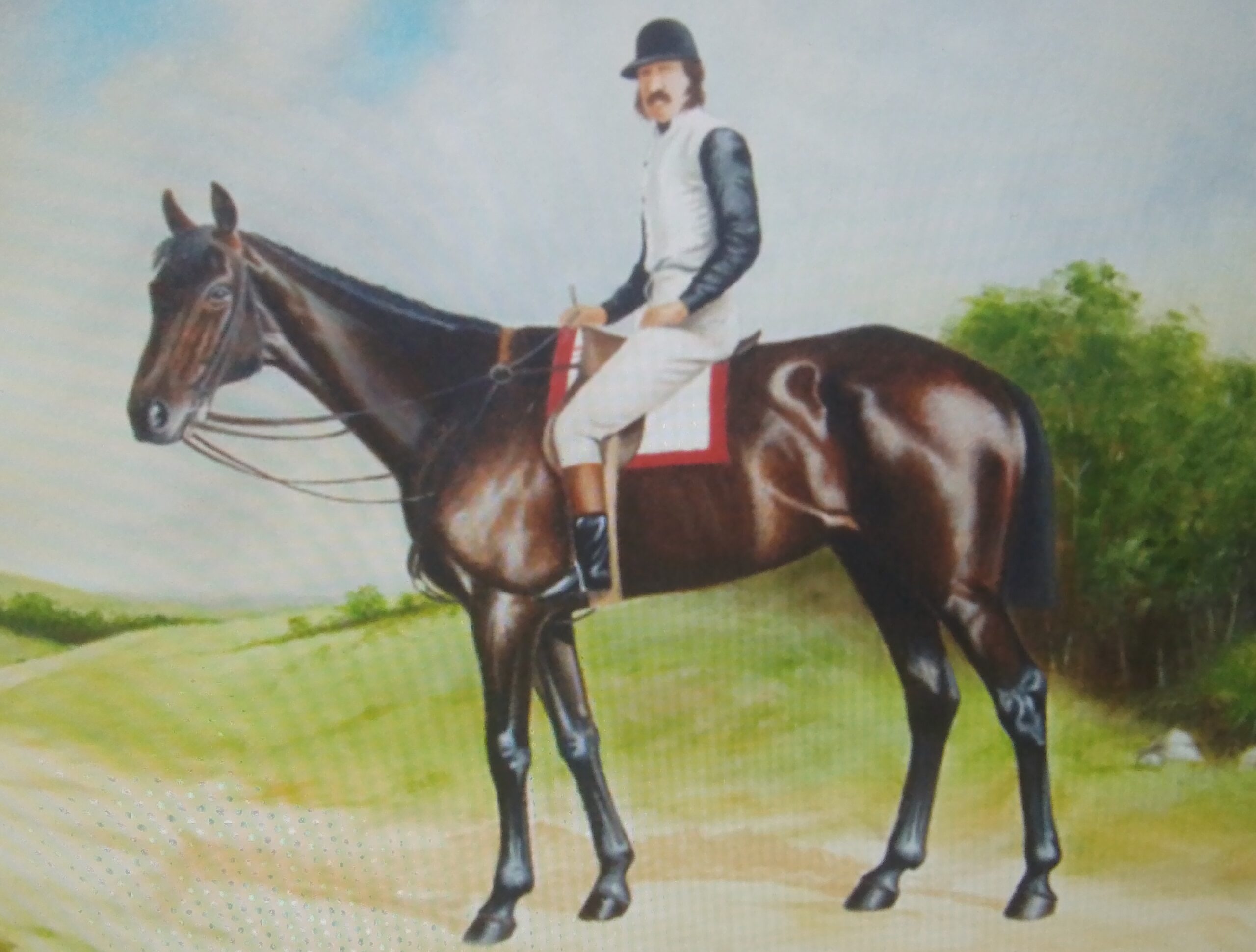
Private John King – 1st Kings Dragoon Guards, and his Commanding Officer – the Grand National winning jockey and owner Captain Josey Little

During the 1840’s and early 1850’s Carmarthen effectively became a “Garrison Town” with over 2000 soldiers stationed here in makeshift tents for the NCO’s and public houses and hotels (for officers) This was largely due to the disturbances caused by the Rebecca Riots resulting in much social unrest over a wide area of West Wales. Such was the Governments concern substantial numbers of troops were stationed here before embarking first to the Crimea and then to India.

During this time no military barracks existed in Carmarthen and as such the conditions that many of the soldiers had to endure were truly terrible which is evident in the large number of burials that took place in St David’s Cemetery between the period of 1847 and 1854, resulting from PULMONARY PHTISIS or Tuberculosis as it is known today, – a chronic infection disease caused by a bacterial infection the lungs, which caused progressive wasting, severe lung tissue damage, chronic cough, and fever commonly known as consumption spread by air droplets from infected individuals. This short story highlights quite a remarkable bond that existed between a soldier and officer despite their different social standings at a time of great uncertainty in the world………Here then is that story, one of which I would have loved to have been longer, but sadly that’s not to be.

Private John King had arrived in Carmarthen in the Autumn of 1847 with a detachment from his Regiment – the famous King’s Dragoon Guards and were stationed in Johnstown in a makeshift camp, full of tents, horses etc. At the end of December 1847 he contracted what is now known as tuberculosis and died three months later in March 1848 aged just 21 years old as can be seen from his death certificate. Also, to give you a wider picture of the suffering, a further two death certificates are published here of two more Private  soldiers both dying from the same disease .In actual fact between 1847 and 1855 the  number of deaths from TB run into three figures. It therefore stands to reason that St David’s Cemetery contains one of the largest number of burials of servicemen anywhere in the United Kingdom with at approximately 50 different Regiments being represented. 

However, there is one most remarkable twist to this particular story, and it is one of great kindness, loyalty and friendship that crossed the boundaries of officialdom……..Captain James Lockhart Little was the officer commanding the detachment of the King’s Dragoon Guards when they were stationed in Carmarthen in 1848, newly promoted, he took great care of his men and whilst a strict disciplinarian always recognised the loyalty of his troops. He was also a great and celebrated horseman in his own right and on the 1st March 1848 took part in the 10th Grand National at Aintree racecourse, and amidst driving rain and atrocious weather conditions he won the race on a horse called CHANDLER. Not only that,  he was also the owner of the horse and as a result won a substantial amount of money enabling him to secure his promotion in the army – by purchase, as was the custom. He became famous overnight but continued to remain in the King’s Dragoon Guards to further his army career. Just over three weeks later, having returned to Carmarthen to command his detachment, young John King died after three months of tortuous illness and was buried in St David’s Cemetery on the 27th March 1848 with full military honours, led by Captain James Little who insisted on being present for the funeral of his subordinate despite having received an invitation to attend a reception at Windsor Castle the same day. Queen Victoria was herself very interested in horses and wanted to congratulate Captain Little on his achievement at winning the Grand National but that was not to be.

This then, concludes that “short story” and how I wish it could have been much much longer for I am sure there is much more to tell. I hope you have enjoyed reading it.

Captain James Lockhart Little and “Chandler” winning horse and jockey of the 1848 Grand National
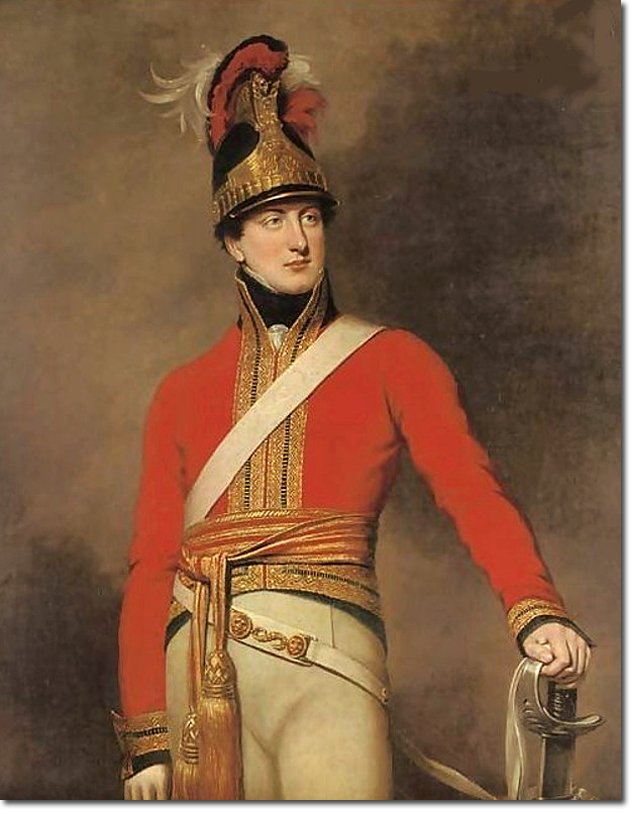
An officer of the Kings Dragoon Guards in the 1840’s. Uniform that would have been worn by Captain Little
Death Certificate of Private John King. 1848 aged 21.
Death Certificate of Private John Clarke.48th Regiment of Foot. 1852 aged29.
Death Certificate of Private John Spiller.14th Regiment of Foot. 1849 aged 21

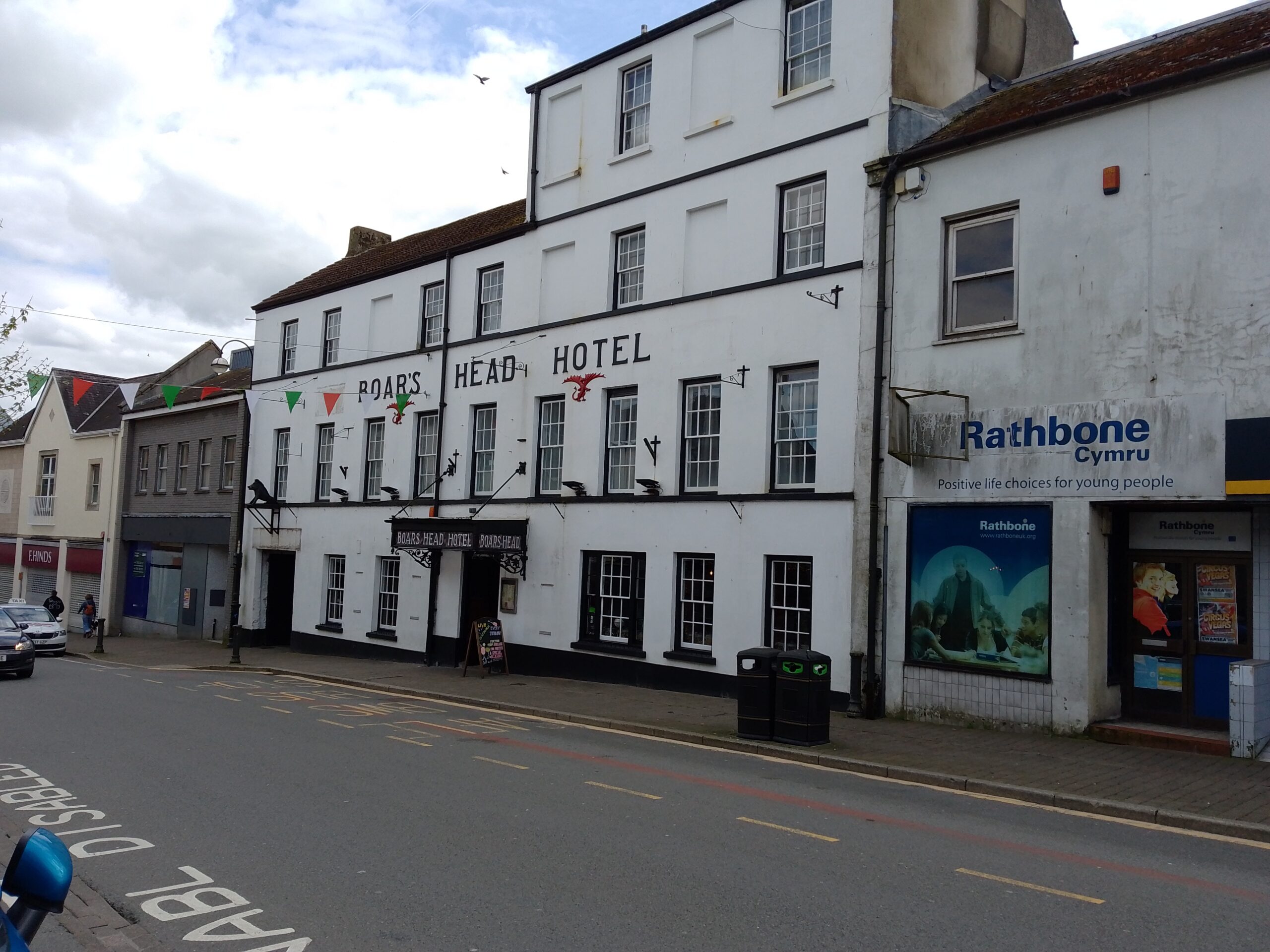
Thomas Evans known locally as Twm Nant y Nanni who was found dead, lying on the banks of a stream in 1848 but had miraculously cheated death 23 years previously in 1825 when presumed dead after an accident at the Boars Head Hotel Carmarthen when over a ton of hay fell off a wagon onto him.

The following story, published exactly as it was printed in 1848 tells the story of the fate of Thomas Evans, who was buried in St David’s cemetery a few days after publication. Sadly his luck run out on that fateful day in December 1848 and he has no known grave.

May he rest in peace.

FATAL ACCIDENT

-On Tuesday last, at half past six in the morning, the body of a man named Thomas Evans, but better known by the soubriquet of Twm Nant y Nanni, was discovered lying partially immersed in the stream which runs from the Tin Works, near the factory, and afterwards empties itself into the Towy, being the surplus water of the works. He was quite cold and dead, having been so apparently for some time. An  inquest was held upon view of the body at four o’clock on Tuesday afternoon, at the Bear Inn, Water street, before John Hughes, Esq., coroner, when the following evidence was adduced in explanation of the cause of deceased’s death. 

Griffith Lewis, a fisherman, deposed:- “At six o’clock this morning, I went to the Tin Works, and at half-past six I returned towards home. As I came to the end of the bridge near the factory, I saw a large black heap on the bank at the right hand side, and as it was not quite light, I could not make out whether it was a dog or man. I went down to it, and put my hand upon the person’s head and shoulder, and found it was deceased. He had a stick in his hand. There were two men belonging to the works standing near, named Thomas Edwards and John Evans, and I called them to my assistance. We lifted him up to the grass, and he was taken home by the direction of Mr. Parcel, while I informed the coroner of the occurrence. Deceased followed no occupation, and was accustomed to go to the works at all hours of the night, and remain there till the morning. When I found him he was immersed in water to his middle, but his feet were not reaching the bottom of the water. The upper part of his body was on the grass bank. His clothes were entirely wet. The water was about nine feet deep, but the bridge was blocked up in consequence of the floods, so that there was no current. Deceased was quite cold and stiff. We could hardly get his arms straight by his side. He was as cold as ice, and I believe he had been dead for some hours. I account for his being found upon the bank, partly out of the water, by observing that the tide and flood had previously been much higher, but it had receded and left him in that position. He had been always weak in his intellect”. Mary Evans, wife of the deceased, deposed that at nine o’clock the preceding night her husband and herself went to bed in their house in Goose street. She awoke about three o’clock and discovered that deceased had risen and left the house. She never saw him alive afterwards. He was accustomed to go out at all hours of the night, and used to say that he had been at the Tin Works. He was weak in intellect, and in the habit of rambling about. She and her husband received 4s. a week parochial relief. Deceased never attempted, or threatened to attempt, to destroy himself. P. C. Miles Davies deposed that he saw the deceased’s body stripped, and could discover no marks of violence upon it. The coroner, in summing up, observed that although it was not strictly evidence, yet he could inform the jury that it was more than probable the deceased fell down from the opposite bank to that on which he was found, as there were deep foot-marks on the rubbish opposite. The height of the bank being at least 12 or 15 feet, the mere force of the fall would naturally project him completely across the stream, which was not many feet wide, and his legs might have become fast in the bushes, which prevented his escape. The jury without hesitation, returned a verdict of “found dead”, but how or by what means he met his death, there was no evidence to determine.” 

It should be mentioned that about 23 years ago, a waggon load of hay was accidentally emptied upon the deceased in the stables of the Boar’s Head Hotel, and he remained in that covered condition for three days and three nights. (A fully loaded wagon, often piled high with loose straw or hay, typically held roughly 1 ton – approx 2000 lbs) When discovered he was supposed to be dead, and carried home in that state, but restoratives being applied, he recovered, and met with the above fatal accident in the 64th year of his age. 

8TH DECEMBER 1848. THE WELSHMAN.


The Boars Head Hotel today. Still a thriving and busy watering hole. The horse and cart entrance can still be seen on the left hand side of the building


Sergeant Major James Wardle RHA. Part 2


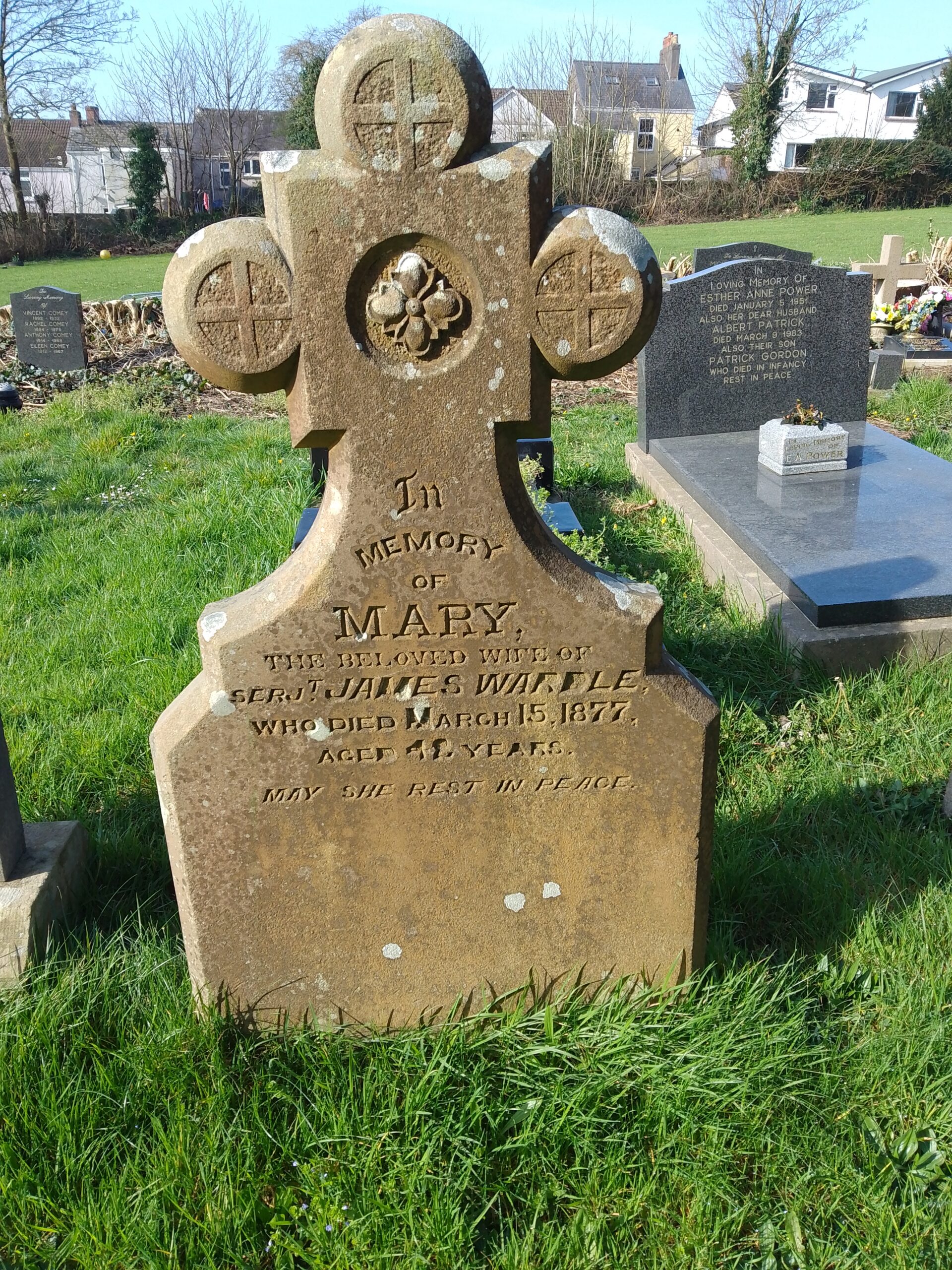
The information below is a “follow up” of the complicated story of James Wardle as previously published. Whilst “Part 1 ” of the story concluded with some brief details of the inquest report this final segment enlarges on that report in some detail. What was not generally known however was that James had married previously and her name was MARY. She was buried in St Mary’s Roman Catholic Church Cemetery in Union Street Carmarthen – a mere stone’s throw from St Davids- the next street in fact. A photograph of the headstone  can be seen below. It also appears from the research I have carried out that there was some concern shown by the Coroner as to the cause of death and this could have been attributed to his second wife Margaret having a very nasty temperament. She is in fact mentioned several times in the local papers as having been brought to court for a number of offences including affray and assault by beating. Little wonder then that James’s son by his first marriage took a great dislike to her as can be seen in the report highlighted below.

Here then is the final instalment of James’s story. May he rest in peace.

Sergeant James Wardle ( Part 2 ) Veteran of the Crimean War and Indian Mutiny who re married after the death of his first wife Mary but never recovered from the trauma of his experiences in India and Russia.

Death of Sergeant Wardle. DOCTOR REFUSES TO CERTIFY. INQUEST AT THE KING’S ARMS, PRIORY- STREET. An inquest was held at the King’s Anns. Priory street, Carmarthen, on Tuesday, at 7pm before Mr Thos. Walters (coroner for the borough), touching on the death of James Wardle, Richmond Terrace who had formerly been on the permanent staff of the Carmarthen Royal Artillery. John Wardle, the son of the deceased, who lives in Little Water-street, a plumber said I did not see my father during his illness until last night, about 8.15 p.m. I had not seen him for a fortnight before that. I knew that he was not well -not up to the mark. On Wednesday fortnight he was rather ill, and complained of the shivers over him he said there was something the matter with his head. He saw people in front of him, and wanted me to drive them away. I saw him in this house on tho previous Tuesday when I went down to the house with him he showed me a bleeding cut on tho side cheek. He told me he did not know where he got it. This was about half past six in the evening, he was not exactly sober then. I do not know how long he had been there that day. I took him to my house: He remained at my house until Wednesday night. He had a house of his own I do not know why be remained with me. He wanted to go home so I took him home. He said that he would stop with me on Tuesday night he gave me no reason for so doing. He had not stayed at my house before I never asked him why he wanted to stay with me I could not make out why he had come to have his face all covered with blood. I am married I was about my work on Wednesday. I left my house on Wednesday between half-past six and seven o’clock to take him home. He asked me three times while I was at tea to take him home. I said, “all right.” I asked him both here and at my house where he had got the wound over the right cheek he said he did not know. I did not ask anyone here how he had received it. I asked up in Waundew and they told me that he had fallen down on Tuesday morning, after coming out of the house of Mrs Thomas. It was yesterday I was told that. They did not tell me why he fell, neither did I ask. They said he fell down right on his face as he shouted out. I should think he had been drinking by the look of his face. It was Mrs Thomas who asked for me to come up here. He was living happily with his wife. When I took him home on Tuesday night, I did not tell his wife. She and I are not very friendly and I keep away from her. He was quite sober when I took him to his own house. He did not complain to me of his treatment at home. The Coroner said that he asked these questions in justice to Mrs Wardle. If these matters were gone into at a public enquiry, there would be no need for people to talk afterwards. Witness, continuing, said “so far as I knew the deceased and his wife lived happily together”. I left them about fifteen months ago. I never saw him so bad with drink as he was on the Saturday of the fair. Margaret Wardle the widow said “It is going on sixteen years since I was married to the deceased. During that time we lived fairly happily together. I had never seen him take to drink so bad as the day he fell. He told me he met some traveller; he said he did not remember where he had been. He had been out all night on Monday. I last saw him on Monday, between 6pm and 7 p.m. He was not very sober .When he went out; he had had a few pints. I saw him next morning, between 10 and 11o’clock. He was all bleeding.” He came in with Miss Thomas, the bakehouse, and another young man, he said he remembered falling on a stone by Mrs Thomas’s, who is a neighbour; he said he did not remember where he spent the night. He had some dinner, and then went out about 2 p.m, I asked him where he was going he said he was going out-, and that, he did not know where he was going, I tried hard to pursuade him to remain but he went. He had a mutton chop and one potato to eat. I heard that he had come here; he used to come back in a short time. I was told that he had gone with Johnnie, his son. I knew where he was. I came home after him at 7 p.m., but he had gone. I did not go after him; I knew he would be safe in Johnnie’s house. I did not go to see him on Wednesday, to let him have a rest to get sober, I fetched a doctor on Friday, I had been bathing his head before, and he said he would not have a doctor. The doctor (Dr R G Price) left him some medication and powders. He told us on Monday that he was getting better. He came downstairs about 7.15 p.m and had his gruel as usual in the chair. He never missed a meal during the whole time he was in bed. He turned white and complained a little, as if he was fainting. I sent someone to fetch the doctor and Johnnie. We put him back to bed, and he spoke and knew both Mrs Thomas and the daughter. He then got up and sat in the chair a second time, he was there when Johnnie came. He spoke twice to Johnnie during that time then he had a second fit, and died in about ten minutes. Dr C. P. Parry spoke to making a post mortem on the deceased, in conjunction with Dr R G Price. They found large haemorrhage on the left side of the brain, about four inches along the back and front. The brain was very much coagulated and soft; there was no evidence of fracture. There was a little external scratch, but no other mark of violence. Death was probably due to rupture of a blood vessel this might be due to natural causes the result of an evacuation. The other organs were not examined, as the cause of had been ascertained. Death was quite consistent with the evidence which had been given. Dr. Price agreed with the evidence given by Dr Parry. He had attended deceased. He was unable to give a certificate, as he was not satisfied as to the cause of death. He was not satisfied whether the death was due to natural causes or to the accident. Deceased had been improving for the last few days but he had suffered a good deal of pain from the injury, more so than the external appearance would wish one to imagine. He showed symptoms of brain irritation during the whole of his illness. The pain was so severe that ho could not sleep. Witness had not attended the deceased or his family for many years; he had never seen deceased drunk—nor noticed any of the physical effects of drink on him, except the fall which was stated to be due to that cause he had no doubt, whatever, now as to death being due to natural causes. Witness had thought it would be advantageous in justice to everyone to have a public inquiry, for if deceased had been buried otherwise, ugly rumours might have got abroad. John Wardle, the son of the deceased, in answer to the Coroner, said that deceased was a pensioner, having served his 21 years in the Royal Artillery, and been through the Crimea War and the Indian Mutiny. He was 70 years of age, had lived 27 years in Carmarthen, and had a pension of 18 shillings a week. The Coroner, having summed up, the Jury returned a verdict of “Death from Natural Causes.”

Mary Wardle. Jame’s first wife and love, buried in St Mary’s Roman Catholic Church Carmarthen


METHUSELAH EVANS 1775 – 1861

METHUSALEM EVANS  1775-1861

On Friday May 18th 1861 the “Welshman” newspaper printed on page 4 of its edition the following story. It started with the headline SUDDEN DEATH OF AN OLD MAN. What is so interesting though with this story is his christian name – METHUSALEM (or METHUSELAH ) a name of huge biblical significance and a name very rarely used. Clearly Mr Evans was an intelligent individual being a clockmaker and repairer but to live your daily life in the middle of the 19th century had its own dangers as one got older. The fact that the “gossipers” in the town were spreading wrongful information  of his demise as suggested in the news article was typical of the period. Methusalem was certainly not starved as the inquest rightly reports as the family clearly cared for him.He was however buried with little ceremony at St Davids cemetery on the same day of the publication of the news article – on May 18th 1861. Today he has no headstone but is not forgotten.. The news headline as mentioned above is therefore somewhat ironic as the real Methuselah as mentioned in the bible is the oldest recorded living person ever mentioned, though in reality and in today’s world an impossibility.  Here then is the report of the inquest…….

Yesterday evening an inquest was held in the Town Hall, before John Hughes, Esq., on the body of Methuselah Evans, clock maker and brazier of Goose Street who died suddenly the previous night.From the evidence given it appeared that the deceased, who was in his eighty-sixth year, was in receipt of three shillings per week from the parish, being unable to do much work. He was in tolerably good health, and on Wednesday walked to Llwynhyr, about a mile from the town, where he repaired a clock, and was afterwards supplied with refreshments, of which he partook. He returned home between 3 and 4 o’clock, and spent the evening much as usual, and about 10 o’clock he and his nephew, who lived with him, took some coffee and bread for supper. On getting up from the table the old man fell against the mantelpiece, bruising his forehead, but he did not seem much injured, and soon afterwards went to bed. About I o’clock in the morning his nephew thought there was something the matter with him, as he seemed very cold and did not reply. He then procured a light, and found the deceased quite dead. This was the substance of the evidence, and the Coroner, in addressing the Jury, referred to the rumours in the town that the deceased had died from starvation, which it was evident could not have been the case, as on Monday he received 3 shillings out of which he paid 8d. for his lodging, and on Wednesday he received one shilling for repairing a clock at Llwynhyr, and, as they had seen, he had food during the day. The verdict of the Jury was, Died by the Visitation of God.”

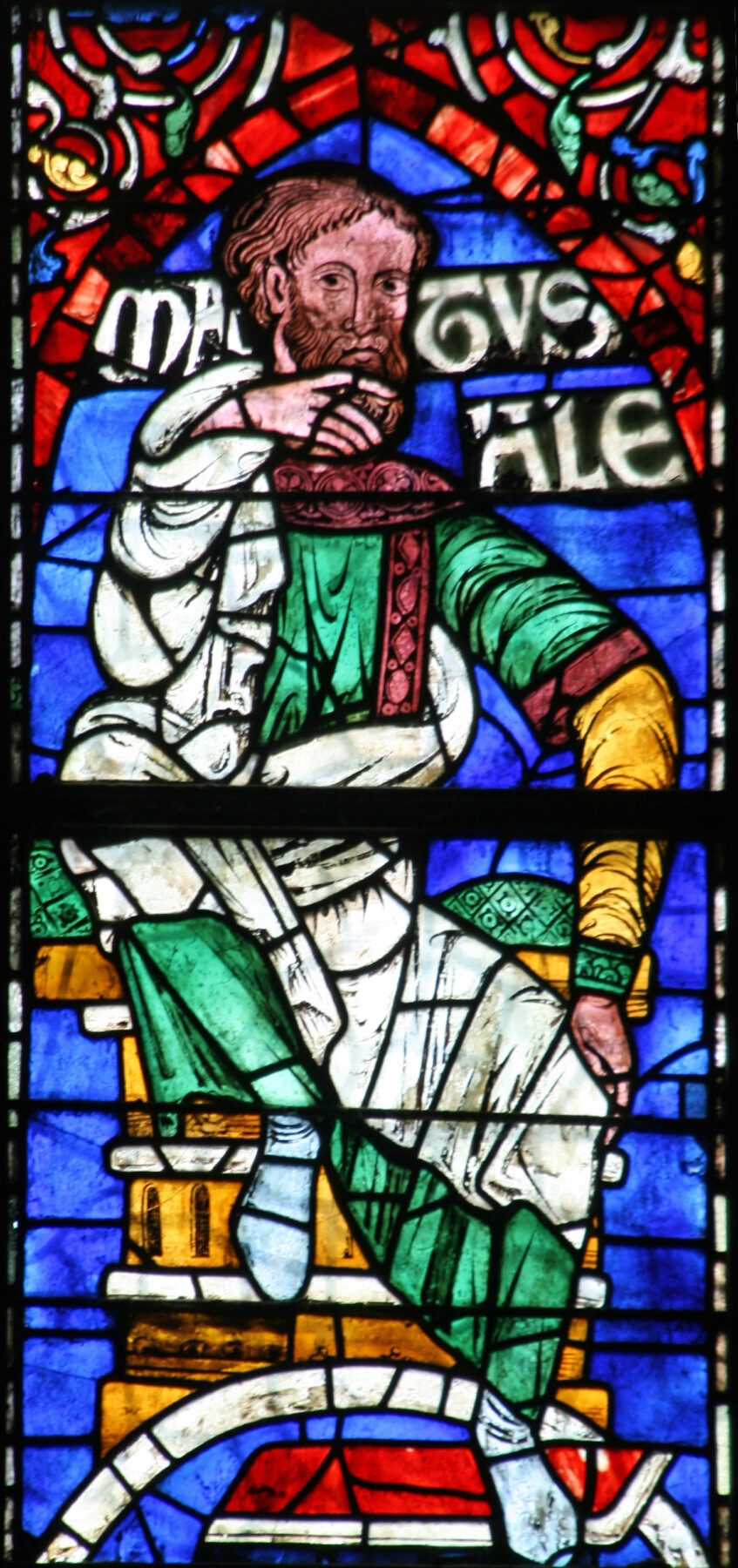
Photograph below of  stained glass window of Methuselah in Canterbury Cathedral. Methuselah was the grandfather of Noah who it is written lived to the age of 967 years of age.

John Davies . Fisherman

Sudden Death in Mill-street. SEVERE STRICTURES BY THE CORONER. “EXTRAORDINARY CASE OF INDIFFERENCE.” Mr T. Walters, coroner for the Borough of Carmarthen, held an inquest at the Guildhall, Carmarthen, on Wednesday, at 7 p.m., concerning the death of John Davies, fisherman, 29, Mill-street. Betsy Davies, the widow, who was very deaf and weak, and who could not speak English, said her husband was a stone breaker to the Corporation during the winter and a fisherman during the summer. He was 64 years of age. He had been ill for some six years ago. He had been attended by Dr. Hughes, Trebersed. He had been breaking stones for the Corporation on Monday. He left the house at 7 a.m. he came home tea-time. She could not undertake to say the time at which he came back. He was brought home by a young man because he was very bad. The young man’s name was Lewis Thomas. Deceased went to bed at once. He died about 2.25 a.m. the following morning. They had been forty years married. He was not insured; they had been insured at one time but had it drop two years ago. He did not drink he was a sober man. Lewis Thomas, labourer, Hawk’s Villa, said he saw deceased sit down on the Quay about 12.30 p.m on Monday. He had some hammers with which he had been breaking stones, He was near a post, close by Mr Bland Davies’ stables. Witness asked him if he was bad he was very white in the face. Deceased said Yes; very bad.” Witness offered to carry home the hammers. The offer was accepted and witness assisted deceased home. When he got to the passage at home, deceased took up the hammers and said he could manage very well, as he felt a bit better. Witness then left him. This was about i p.m. Deceased walked up- stairs by himself. He was a healthy man so far as witness knew. He had been breaking stones in the yard by the “Jolly Tar” and had been going home for dinner before he sat down on the stone. Witness never heard of deceased ailing before. Ha used to fish with the father of witness. Mrs Davies re-called, said that she was ill in bed on Monday afternoon. No one was attending her. Mrs Anna Evans, wife of William Evans, weaver, Mill-street, and a niece of the deceased, said that no one saw deceased go home ill. David Jones, who works in the Foundry, went in about 8 p.m. and saw deceased warming his feet by the fire. Deceased said then that he had not had a fit but had had a pain in his breast. Jones recommended some antibilious pills; but deceased insisted that it was a poultice he needed. Witness went in about 9.30 p.m., after she came home from the Christian Endeavour and found him sleeping in bed. He had had plenty of nourishment; they had had a good dinner on Sunday; and had during the week the usual food of poor people. She did not think it necessary to fetch a doctor when she saw him asleep. Margaret Lewis, widow, 28, Mill-street, a next-door neighbour, said Mrs Davies called her about 2 a.m. on Tuesday, and asked her to come in, as John was very bad.” She went in; and found John Davies dead. Mrs Davies said that she had called him three different times then she lit the candle and, feeling, perceived he was cold. He had then his clothes on; but not his boots. Mrs Evans said she took an overcoat from under deceased when Miss Eliza Vaughan laid him out. Mrs Davies, re-called, said-so far as could be understood from her somewhat complicated statement—that she went out on Monday morning to sell a few pennyworth of herrings. She could not undertake to say the time she came in. She came in after her husband. On being pressed now she said she was going to have a fit—which seemed extremely probable. The Coroner then desisted from further cross-examination. The Coroner commented strongly on the fact that a man in a populous district should come home at 11p.m. ill- so ill that a man on the Quay noticed his condition—and be allowed to remain until he died, more than twelve hours afterwards, without any attention. It was strange that his niece going in at 9.30 p.m. did not notice something out of the way he did not know whether it was the usual thing for people in Mill-street to go to bed with their clothes on, and with an over- coat beneath him, or whether Mrs Evans should not have considered there was some- thing wrong. The conduct of those concerned was not such as to amount to criminal responsibility for the man’s death. It was, however, an extraordinary case of the neglect of and indifference to what common-sense  would have suggested to ordinary people as necessary to be done. He hoped some lesson would be learned from this sort of thing. It was not a question of expense. Any poor person who was ill was entitled to the attendance of the parish doctor. It was not as if the doctor had been sent for and had declined to come in the latter case it would have been the doctor who would be called upon to explain his conduct. Mrs Evans protested that she had no idea of how ill her uncle had been. She was very sorry for what had happened. Had she known of a stranger in such a plight she would have done all in her power for him. The Jury returned a verdict of “Death from natural causes.”

MILITARY BURIALS, THE BURIAL REGISTER & A CLUE TO THEIR IDENTITY.


For anyone carrying out research into their family or local history, there are many pitfalls along the way which can lead to frustration in being unable to find that last piece of the jigsaw that will finally piece together that long lost story eager to be told over nearly two centuries before. As the old saying goes “local knowledge” is by far the most important tool in the toolbox to begin with and none more so than when researching military burials during the mid Victorian era.

Wales and Carmarthen in particular became a place unique in British military history when a large swathe of the British Army ended up being posted here between 1842 until the mid 1850’s resulting from the social upheaval and unrest caused by the Rebecca Riots. Carmarthen for instance was swamped with over two thousand additional personnel together with their horses and equipment, all of which had to be housed as there was initially no barracks in which to place them.

However, as a result of this influx a barracks was eventually built in Picton Terrace (where it still remains and now forms part of the Royal Logistic Corps) which was originally planned for a location in Johnstown where it was originally located in 1842.

Many soldiers that came to be billeted in Carmarthen in the early 1840’s were housed at the local Workhouse as a temporary measure.

Illness and disease was prevalent at this time in the general population in particular Cholera which wiped out entire families in days and the soldiers were equally at risk from such illnesses.

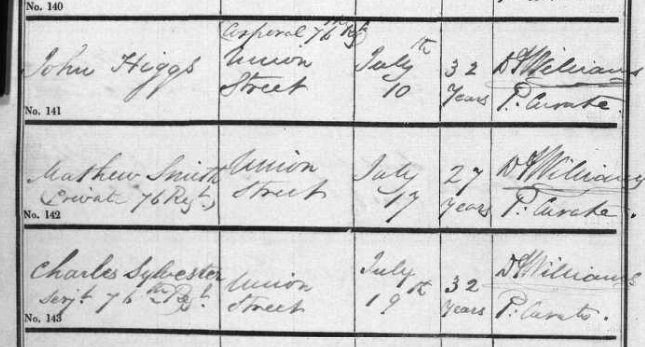
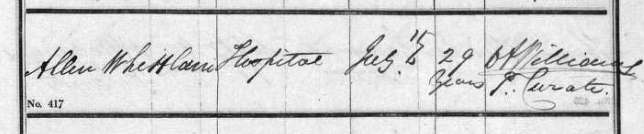
It is likely that the overall number of serving soldiers buried in St Davids Cemetery during this period, that died from illness and disease runs into the hundreds and what makes it especially difficult to ascertain is the fact that many of the burial entries do not contain any reference to their Regimental connection or rank, merely their name and where they died, and it is “local knowledge” in this instance that enables us to understand exactly who are, and who are not serving soldiers. The “secret” is in the location of where the person died, for instance, many burial entries refer to “HOSPITAL” as the place of death, and this is a particular reference to the military hospital at the time set up in Johnstown. In some entries however there is reference to the persons regiment and rank which makes it all the easier for carrying out research. Also you will see that in one week alone, three members of the same Regiment died (all from Pulmonary disease) at an address called Union Street. This is infact a street still very much in existence that lies adjacent to the Cemetery and opposite the present barracks, but what is not generally known is that it also was also the location of the military hospital at the time.

Three soldiers from the same Regiment that died within one week of each other. They are buried side by side but the location remains unknown.


Cross referencing names that appear in the burial register with Regimental records and Army Service Records are another source of research but is very time consuming. Also researching the local newspapers of the day is another avenue to explore.  I dare say that we shall never know the true number of military burials at St Davids performed during this period but they are all none the less remembered.

The following articles that appeared in the local press refer to some of those soldiers buried here. None have any memorial to their name.


SUDDEN DEATH OF A SOLDIER.


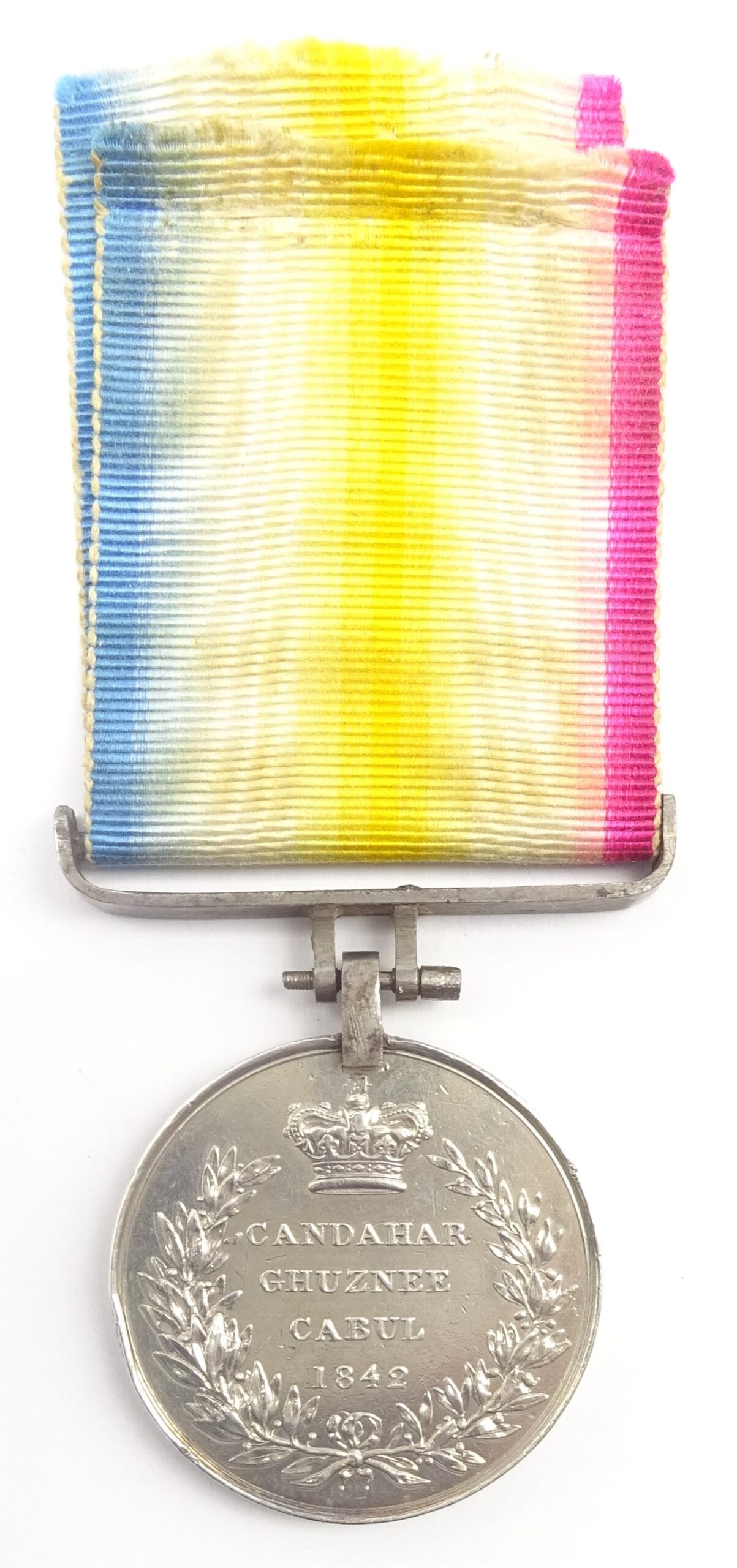
On Tuesday last, a soldier named James Reed belonging to the 41st regiment of foot, stationed at the Carmarthen Barracks, suddenly dropped down dead. Without the slightest sign of illness previously, he was attacked and expired before assistance was available. He was a good soldier and had served under General Nott throughout the Afghanistan campaign. The inquest was held on his body the same evening that he died, before George Thomas, junior, Esq., when a verdict of “Natural death” was recorded. The poor fellow’s funeral took place on the next day, when he was buried in St. David’s Church yard with full military honours, three rounds being fired over his grave. We understand that Reed was held in great estimation by the officers of his regiment.

The Welshman. 13th June 1845 page 2.


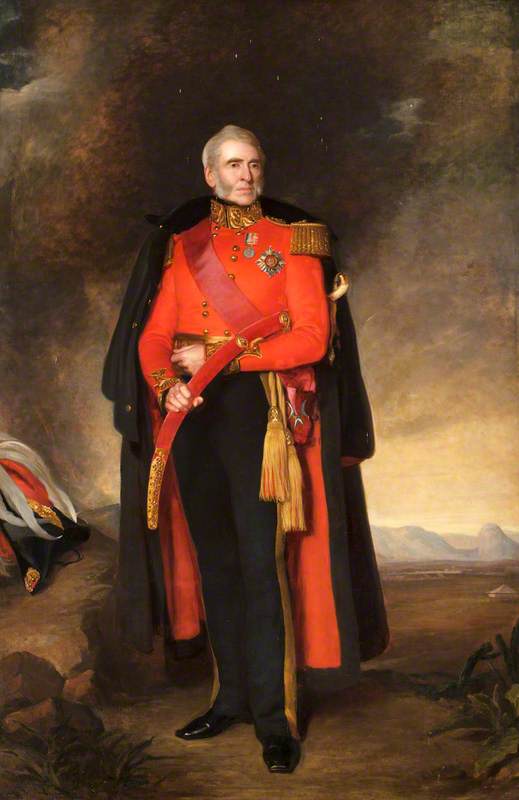
Major General Sir William Nott GCB, Commander  of the Army in the First Afghan war also had strong connections with Carmarthen and in particular the 41st Regiment of Foot – A Welsh Regiment with a large recruitment from Carmarthen. His elder brother George is buried here in St Davids Cemetery, whilst Sir William himself was buried alongside his parents in a nearby church called St Peters in January 1841.

Major General Sir William Nott GCB. A full length painting by renowned Carmarthen artist THOMAS BRIGSTOCKE which still hangs in Carmarthen Guildhall today.


The Afghanistan Medal awarded to James Reede


SOLDIERS FUNERAL.

A military funeral took place in this town yesterday week, and elicited considerable attention from the fact that several novel circumstances occurred to vary the order of the melancholy procession from many of its predecessors. The deceased soldier as a Corporal in the 14th Regiment of foot stationed in this town, named Allen Whittlam, aged 29 years, and much esteemed in the Regiment. The funeral took place in Saint David’s Church, the impressive service being read by the Rev. D. A. Williams. The whole detachment followed the body of their deceased comrade to its last resting place, and each man wore on his left arm a band of black crape tied up with white riband. The muskets of the firing party were in like manner trimmed with black crape. After the body had been lowered the usual rounds of musketry were discharged, and the party marched back to the Barracks.

THE WELSHMAN 14TH JULY 1848


MILITARY MOVEMENTS


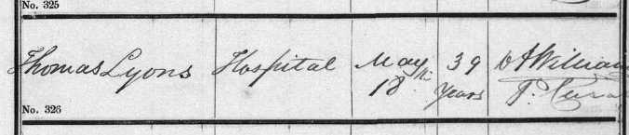
In about ten days the wing of the 87th regiment of foot stationed in Carmarthen under the command of Major Kidd, and also the various detachments of that regiment in Wales, will take their departure for Weedon Barracks in Northamptonshire, and will be replaced by the 43rd regiment, or Monmouthshire Fusiliers. In speaking of the approaching departure of the 87th foot, it is but bare justice to eulogize the conduct of the men since their sojourn in this town and to speak in high terms of the courtesy and urbanity of their officers. During a stay of nearly 12 months, there has been but one trifling disturbance, which was occasioned by the assault of a civilian upon the military, and speedily suppressed by Colour-Sergeant Lyons. With that single exception, the men of this fine regiment, probably the finest corps in the service have behaved in so orderly and decorous a manner and evinced so high a state of discipline that their departure will be regretted.

THE WELSHMAN SEPTEMBER 17TH 1847.


Thomas Lyons died four months previous to this publication in May 1847. See burial register for details.


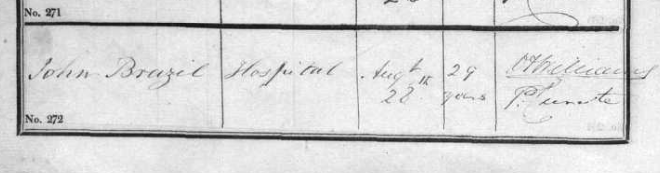
John Brazil (below) was a Private in the 37th Regiment of foot and was buried in 1846, and Private John Windsor 41st Foot in 1845

Alfred Boothroyd Wade & Lewis Davies – who both lost their lives in Railway accidents.

The following two stories, whilst totally unconnected bring to light the fact that a large number of fatalities occurred on the Victorian railways which could have been avoided had the passenger or employee taken more care. A story that is so often repeated across the generations and even today.

Both men are buried here in St Davids Cemetery and have no known last resting place. The stories are however an important piece of our industrial heritage and history. ….here then are their stories

SAD, FATAL RAILWAY ACCIDENT NEAR CARMARTHEN.

A very melancholy accident happened on Friday night, July 26, at Conwil Elfed Station (about six miles from Carmarthen), on the Carmarthen and Cardigan Railway, by which Mr. Alfred B. Wade, one of the company’s most trusted and respected servants lost his life. Mr Wade, who was chief clerk to Mr A K Young, the manager of the Carmarthen and Cardigan line, and who did most of the auditing work at the different stations, left Carmarthen on Friday evening by the train starting thence at 6.45, and after auditing the accounts at Pencader Station, was returning to Carmarthen by the train due at 9. 40 p.m. Having occasion to call on the stationmaster at Conwil, he jumped out at that station as the train was stopping. In doing so he somehow missed his footing and fell back between the train and the platform, in consequence of which he was completely jammed in, and his body fearfully crushed, one -of his legs and some other limbs being at the same time much lacerated. He was conveyed to Carmarthen as quickly as possible, and then carried up on a board to the county infirmary, where no less than five medical men were directly in attendance. Not withstanding that every possible thing was done for him, the poor man expired at 9.20 a.m. on Saturday. It appears that his limbs were so much crushed, as to have lost all power of sensation, for though conscious to the last, he complained of very little pain, and could hardly be persuaded that he was dangerously hurt. There were few men of his rank in life so much respected in Carmarthen as Mr Wade, and his services as an auditor were so frequently sought for that his death may be almost accounted a public loss. Mr Wade was the son of a former borough surveyor at Carmarthen. At the Carmarthenshire Infirmary on Monday evening, Mr. J. Hughes, coroner, held an inquest upon the body of the deceased. A verdict of accidental death was returned. The funeral took place on Tuesday, and, being public, there was a large concourse of people from the town and neighbourhood. The procession was led by Captain Tyler, Mount Gernos, in his carriage. After him followed the Rev. D. Pugh Evans, vicar of St. Peter’s, Mr. Thomas Thomas, Mayor of Carmarthen, Mr A K. Young, manager of the line, and Mr. Cruse, station master. Next came the general inhabitants of the town, and immediately after 24 of the company’s servants, headed by Mr. D. Rees, station-master, Llandysul, and D. Lloyd. The hearse and mourners (including Mr. Ellis and Mr. Webber) brought up the rear. The body was interred in St. David’s Churchyard, and the Venerable Archdeacon Williams read the burial service.

CARDIFF TIMES AUGUST 1878


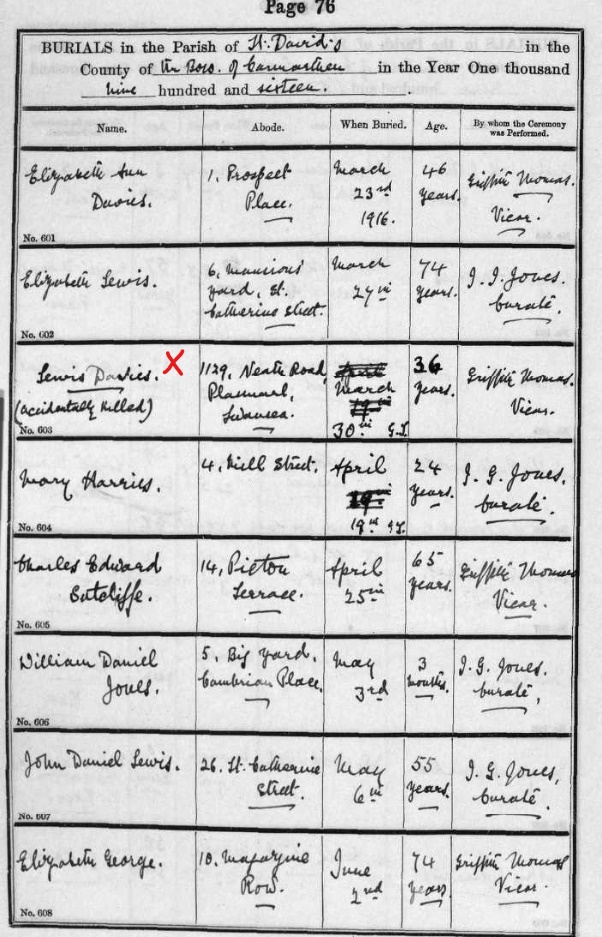
Lewis Davies 1878 -1916. “Accidentally Killed”

The following newspaper article printed in March 1916 gives a vivid description of the terrible fate that befell Lewis Davies on that stormy evening. As the World War raged across Europe, men were still needed at home to carry out important work in the heavy industrial heartlands of Wales and other locations across the country. The burial register for St David’s cemetery gives the first clue as to the “fate” of young Lewis by the insertion of the phrase by the vicar who performed the burial “Accidentally killed”, an insertion rarely seen in burial registers, and a curious phrase to use to say the least. Lewis and his wife have no memorial in the cemetery and their burial place is unknown.

Burial Entry of Lewis Davies


CARMARTHEN MAN KILLED IN THE STORM – BLOWN UNDER MOVING TRUCKS.  FIERCE BLIZZARD IN SOUTH WALES.


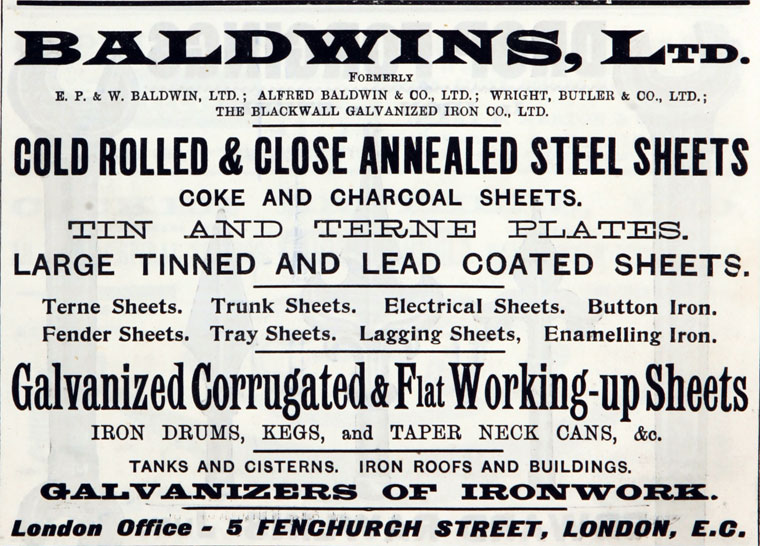
One of the fiercest snowstorms that has occurred within living memory was experienced in South Wales during Monday night and Tuesday morning. It blew a veritable blizzard, and the blinding snow was accompanied by vivid flash of lightning and loud peals of thunder. An enormous amount of damage was done and several lives were lost. Trains were held up, and many collieries had to be at a standstill. Carmarthen, however, did not seem to have experienced the full vigour of the storm, although a strong gale swept over the town, and up to a late hour on Tuesday the borough was isolated from Pembrokeshire and other parts so far as telegraphic and telephonic communication was concerned. In the outlying district a heavy fall of snow was responsible for several motoring difficulties. In the loss of human life was a distressing tragedy of particular interest to Carmarthen. Whilst superintending the moving of trucks near Baldwin’s Works, Swansea** Lewis Davies, a shunter in the employ of the company, met his death.

An advertisement for Baldwins

He was the son of Mrs. Davies, 2, St. Catherine Street, Carmarthen, and of the late Mr. John Davies, butcher. At the time the gale was at its highest, he was blown by a gust clean underneath the wheels of the trucks, which passed over his neck, killing him instantly. He was a widower, 36 years of age, and well known and popular in Carmarthen. His body was taken to the Swansea Mortuary. In a statement to the police, William Llewellyn the driver of the engine said that he was shunting near Baldwin’s coke ovens about 9.30am and Davies was riding on the footplate. He (Llewellyn) advised the deceased to get off the step because of the danger, but he received the reply that deceased was all right. It was blowing hard, and he did not hear or see the deceased, but missing him all at once he stopped the engine and found Davies underneath the wheels, which had passed over his neck, severing his head from his body.

Western Mail March 1916.


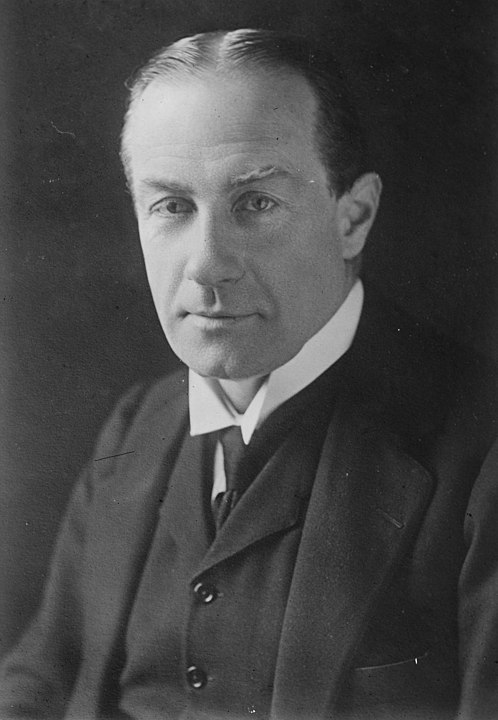
** In 1918 Baldwin’s became known as the British Steel Corporation and was owned by Industrialist Alfred Baldwin MP, father of Conservative Prime Minister Stanley Baldwin. Stanley helped start up the business in 1902.

Stanley Baldwin. Prime Minister. Circa 1920

EVAN HORATIO NELSON DAVIES 1829 -1877 & THE GIBRALTAR STEPS.

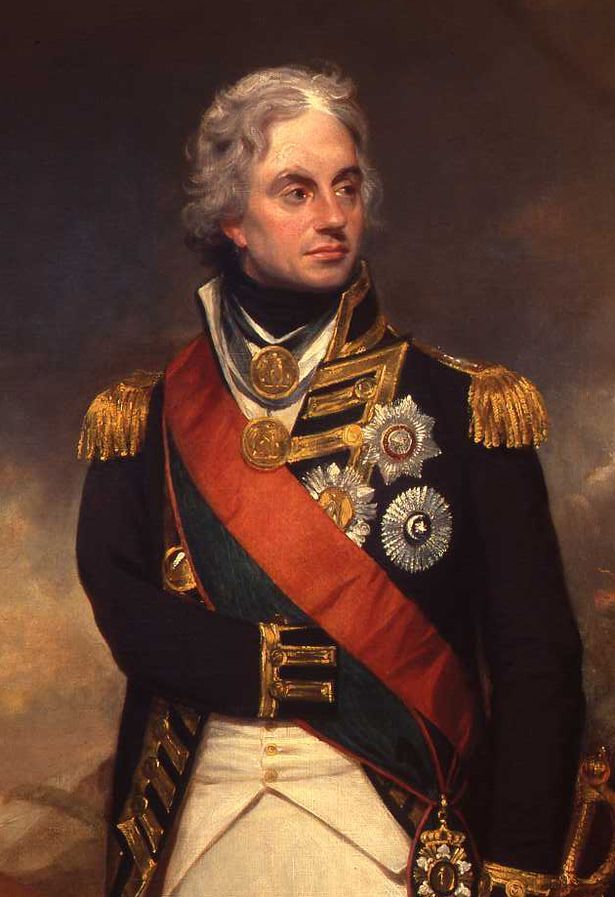
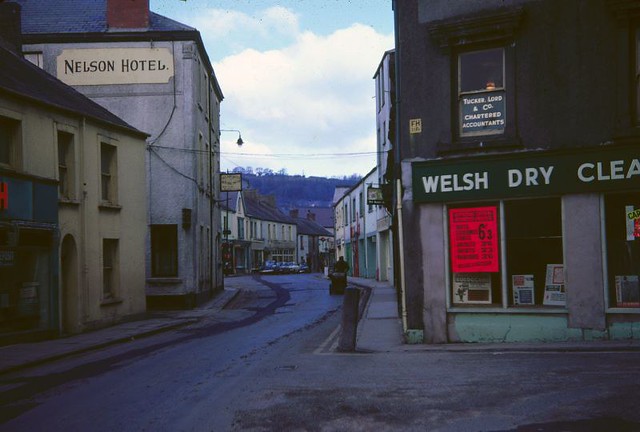
Carmarthen’s maritime past, linked with a strong naval tradition is one that stretches back hundreds of years. Imagine then, as a young boy at the beginning of the Victorian era to be named after this country’s greatest naval hero. Evan “H N” Davies was born in Carmarthen in 1829 in what was then known as the “NELSON HOTEL” re-named by his father Captain E V Davies, in memory of that great and gallant Vice Admiral of Trafalgar fame. Captain E V Davies who owned the hotel together with many other properties in the town seems to have kept a very low profile in local affairs, his wife passing away suddenly in August 1892. However when their son was born in 1829 such was their admiration of the gallant Admiral that they named him after him.

Vice Admiral Lord Nelson KB


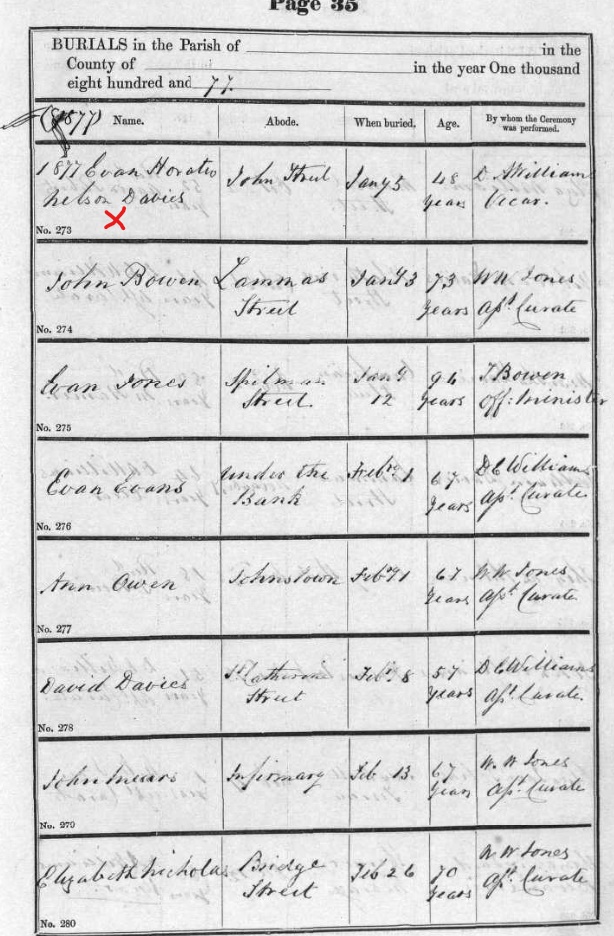
Curiously, in the very few reports mentioning Evan in local affairs during his lifetime, they always referred to him as EVAN H N DAVIES thereby removing any reference to the great hero. It is only when one looks at the burial register that his full name becomes apparent for all to see. Unlike all the previous stories under the “What’s in a Name” series, which has been able to give some insight into the individual, in this case it has proven difficult to provide any meaningful insight into Evan’s rather short life. However, with such a name, I felt it only too right that he should be given a “mention” in these pages. To be christened with such a name in itself deserves a place in history and though he passed away fairly young at the age of 47 in 1877 his name will indeed live on.

A photograph of the Nelson Hotel in the centre of Carmarthen circa 1970. All the buildings in the photograph are now demolished.


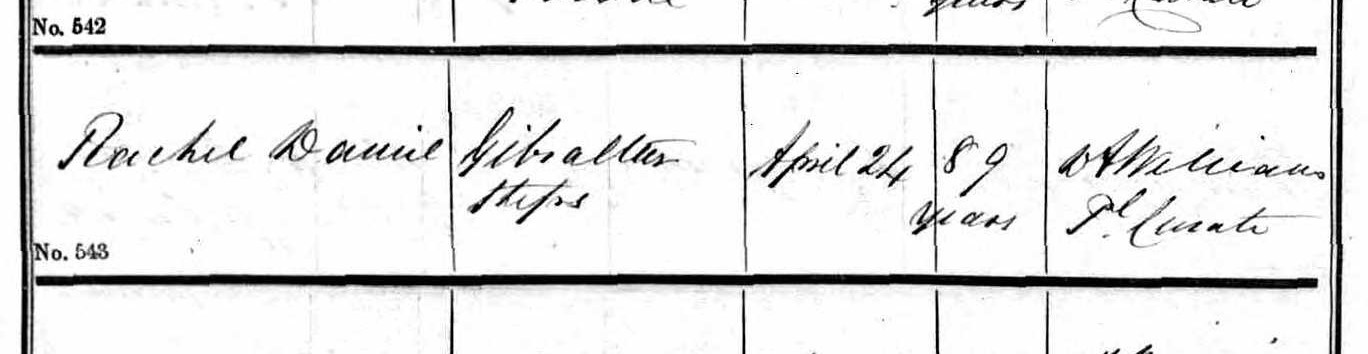
Another Carmarthen connection to maritime history were the rather grandly named “Gibraltar Steps” – a row of old stone cottages, that are mentioned several times in the burial registers over the decades ceasing to appear after 1892 when the buildings were demolished due to becoming inhabitable. They were situated as you would expect close to Carmarthen Quay forming small alleyways linking the riverside to the town itself. Again as the name suggests “Gibraltar” being an important naval outpost of the Royal Navy was perhaps a fitting connection to Carmarthen as an important trading port with many sea going vessels embarking on the long voyage. Rachel Daniel who passed away aged 89 in 1860 was one of the last inhabitants to live in Gibraltar steps but like so many she has no known grave ……..so here ends this rather short story of “names” that appear in the burial register of St Davids cemetery Carmarthen, but names that will continue to live on into the future.

The burial register entry for EVAN HORATIO NELSON DAVIES and below the entry for RACHEL DANIEL who lived at GIBRALTAR STEPS


Translate »