Welcome to the Thomas & Elizabeth Mayhook Charity website, dedicated to the Preservation, Upkeep & Maintenance of the historic St David’s Cemetery Carmarthen
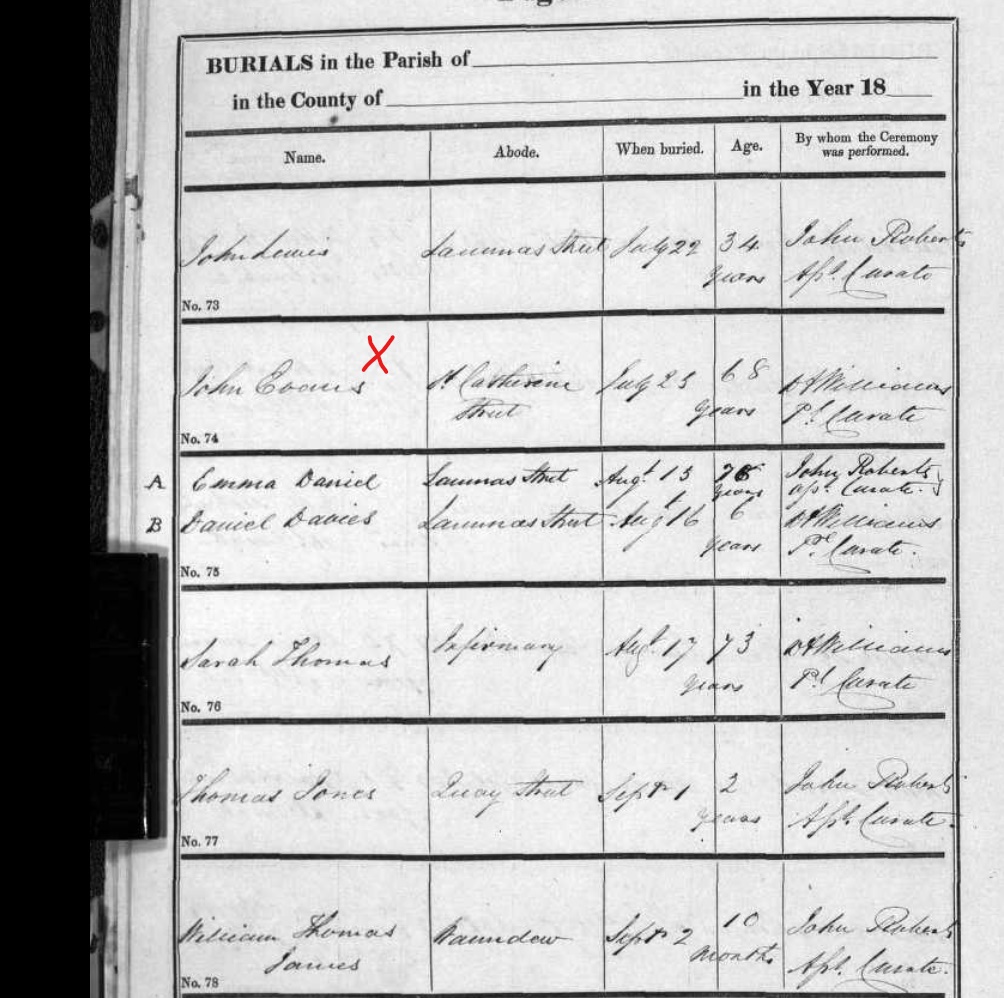
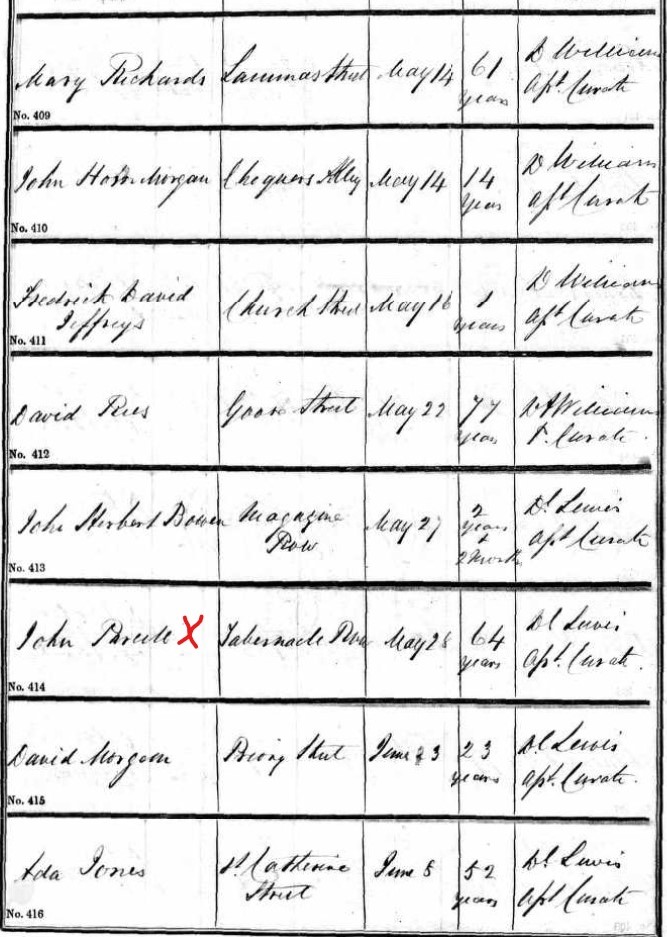
The following sad tale is one that appears all too common in the columns of the local newspapers during the mid Victorian era. Stories of drunkenness’ followed by the inevitable accident and in many cases death by falling into the river. No one can be sure if Mr Evans committed suicide as a result of his illness but now we know his story, brought to life as it were by the local newspaper reports of the time. His name appearing in the the St Davids Burial Register is now just more than a name ………it is a story of human tragedy. May he rest in peace.
About one o’clock on Friday morning last, the body of John Evans, a hatter, who resided at Catherine street, in this town, was picked out of the river, nearly opposite the endowed schools. On Friday evening an inquest was held upon the body, at the Shire Hall, before James Rowlands, Esq., in the absence of J. Hughes, Esq., the coroner, when the following evidence was taken: David Llewellyn deposed: I work in the Tin Works. I was walking on the Quay, below the bridge, between 11 and 12 o’clock last night, when I met a policeman-Sergeant James and another man, who asked me to come with them to search the river, as they had found a hat. We went and discovered the body of a man under the Priory, in the water, on the bank on this side. The face was downwards. He was covered with water. There was about a foot of water over him. We hooked the body out of the water, and laid it on the bank. We then had it taken to his house in Catherine street. One of the men with me recognised the body. The deceased had on dark clothes, but no hat. He was not soiled with mud. His face and hands were very white. When laid on the bank a little water oozed from his mouth; but I am not sure, as it was rather dark. It was moonlight. There were no marks of any violence upon him so far as I could observe. James Davies deposed I live in Goose street, and am a labourer. I was going up the river last night, about half past seven o’clock, in a boat, with two or three persons, and when under the Priory I saw a hat floating on the water. I took hold of it and pulled it out. It was an ordinary black silk hat, with a black band round it. It appeared to be a new hat, and I should think it had been in the water but a short time. I put the hat in the boat, and thought very little of it. I then rowed up as far as the Lead Mine works, and back to the Quay. It was a high spring tide at the time. I showed the hat to P.C Johns, between 9 and 10 o’clock, and shortly before 10 o’clock Eliza Jones came to my house and looked at the hat. She said the hat belonged to John Evans, the deceased. I told her to take the hat away and show it to somebody, in order to be sure of it. She showed it to James Thomas, hatter, who recognised it as one he had made for the deceased. I went down to Thomas’s house, and then I went with David Thomas, his son, and Police Sergeant James to search the river, when we met David Llewellyn. That was about half-past 11 or 12 o’clock. I told them where I had picked up the hat, and we went up to the place, and found the body just in the spot where I had picked up the hat-about four or five yards from the bank. It had about a foot of water over it when we found it. It was moonlight, and I could see so much as that. The other men rose the body to the surface of the water, and I then went into the river, and carried it out in my arms and placed it on the bank. I recognised the body immediately, as that of John Evans. We then took the body home to Catherine street. His hands were clean, and partly closed. He had on black clothes, which were not at all soiled. He had no hat on. We laid it on some chairs in his house. The body was very stiff. We took it home on a stretcher. About four hours and a-half had elapsed between finding the hat and the body. I saw the deceased in the early part of this week. He was then in drink. I saw him in a public house. Margaret Thomas, who resided next door to the de- ceased, deposed: I saw him on Wednesday night. He was then drunk. I saw him last alive about 8 o’clock yesterday morning He was then in his own house. I asked him to breakfast with me. He did not come, and I again went to see after him and found he had left his house and locked the door. He was quite sober. He said he had not much stomach for breakfast, but he did not complain of any illness. He appeared weak and was trembling a good deal. He has been drinking heavily for the last fortnight. I have seen him drunk daily. John Lewis Brigstocke, printer, deposed: Yesterday afternoon, between two and three o’clock, I was coming from the Market-place into Red street, when I met John Evans, the deceased. He was walking very fast, and appeared heated, as if he had walked a great deal. He came and shook hands with me, and said, “I am nearly breaking my heart; I am nearly dying.” I told him not to give up in that way, that he would be better again. In answer to that he said, “No, I am nearly dying.” He then left me and went into the Market. He was drunk, but was not staggering. Police-Sergeant James deposed: I was present when the body of the deceased was found. It was nearly one o’clock this morning. I had the body taken home. I saw no marks or bruises about the body neither were the clothes torn or disordered in the least. I found a door-key and two-pipes in his pockets. There was no money about him. I thought the body had been in the water a long time, as it was quite frigid. When laid upon the bank, a little water run from his mouth or his nose. I have known the deceased for about three weeks, and during that time I have often seen him drunk, or half drunk. Margaret Thomas recalled: The deceased was my brother-in-law. I don’t know his age exactly. He was about 67 years of age. He was a most harmless man. The Jury immediately returned a verdict of “Found drowned.”
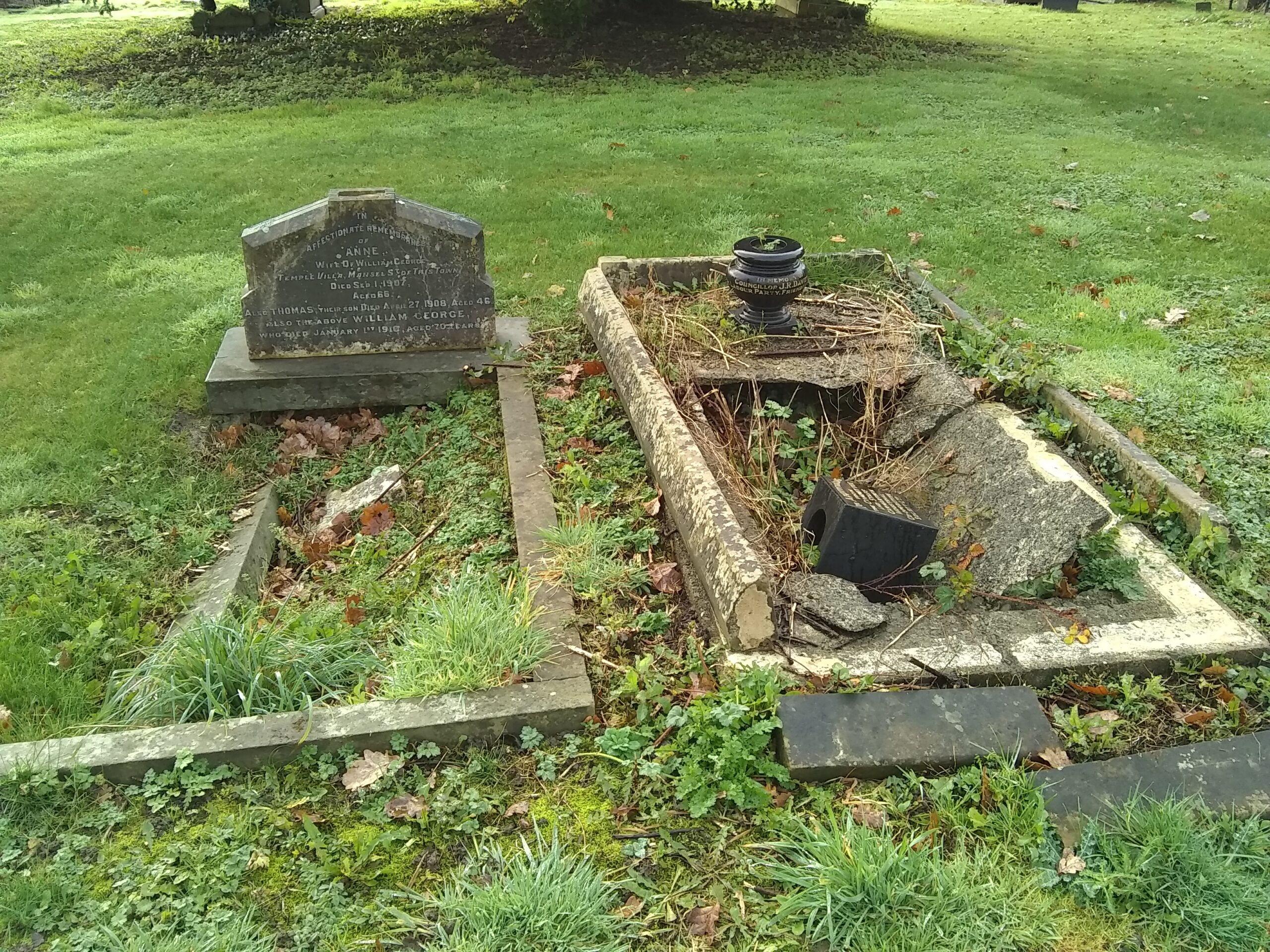
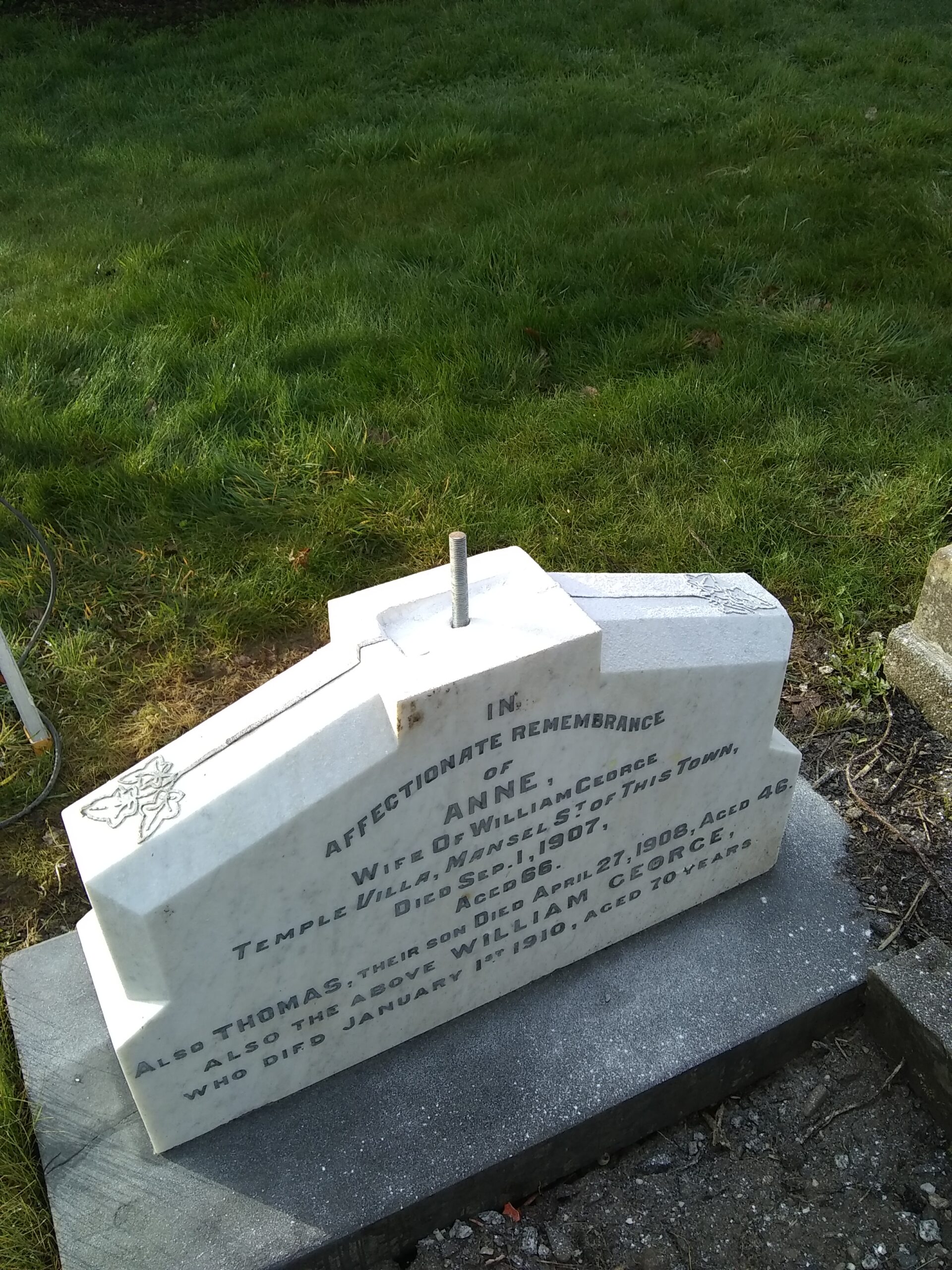
The following photographs of one memorial show just how the transformation from dilapidated and uncared for, to one of dignity and respect can be achieved. The work was carried out by the Trustees themselves, though it took some months to wait for the Italian Carrera Marble “stem” to arrive, the final result is one that we can all be proud of.
In the beginning -derelict with pieces missing.The (almost) finished restoration.The final two sections of marble were fixed into position using a threaded steel bar drilled into positionTHE COMPLETED RESTORATION
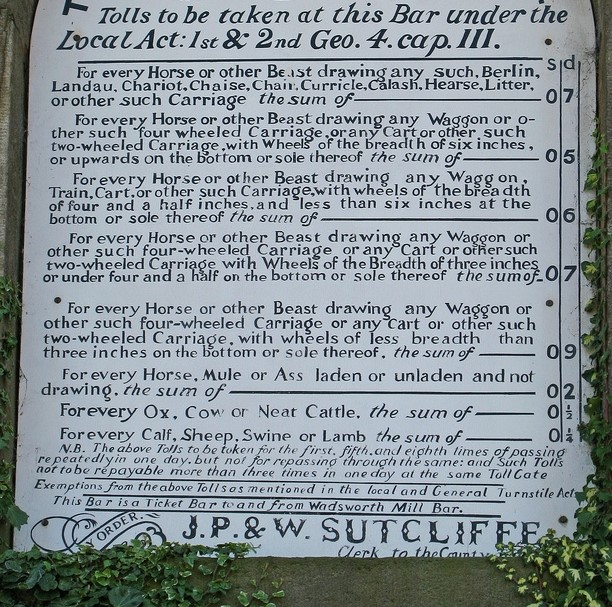
Rees Barrett was the County Surveyor of Roads and Bridges for Carmarthen, -then called “Turnpike Roads” on account of the gates that were placed across them. These highly controversial roads were the cause of much social unrest in the County, indeed the whole Country for many years, and were eventually abolished by act of Parliament.
A turnpike gate was a large gate which revolved on a spike and after the individual had paid his penny to use the turnpike the gate would revolve allowing access to the newly created turnpike road. Typical charges in the 17th Century were one penny for a horse and sixpence for a coach. Exempt from the charges were mail coaches, foot passengers and people in a funeral cortege. Because it was possible for brave horsemen to leap over the gates without paying, the gate was sometimes replaced by what soon became known as a ‘turnpike’: a wooden bar with spikes on top.
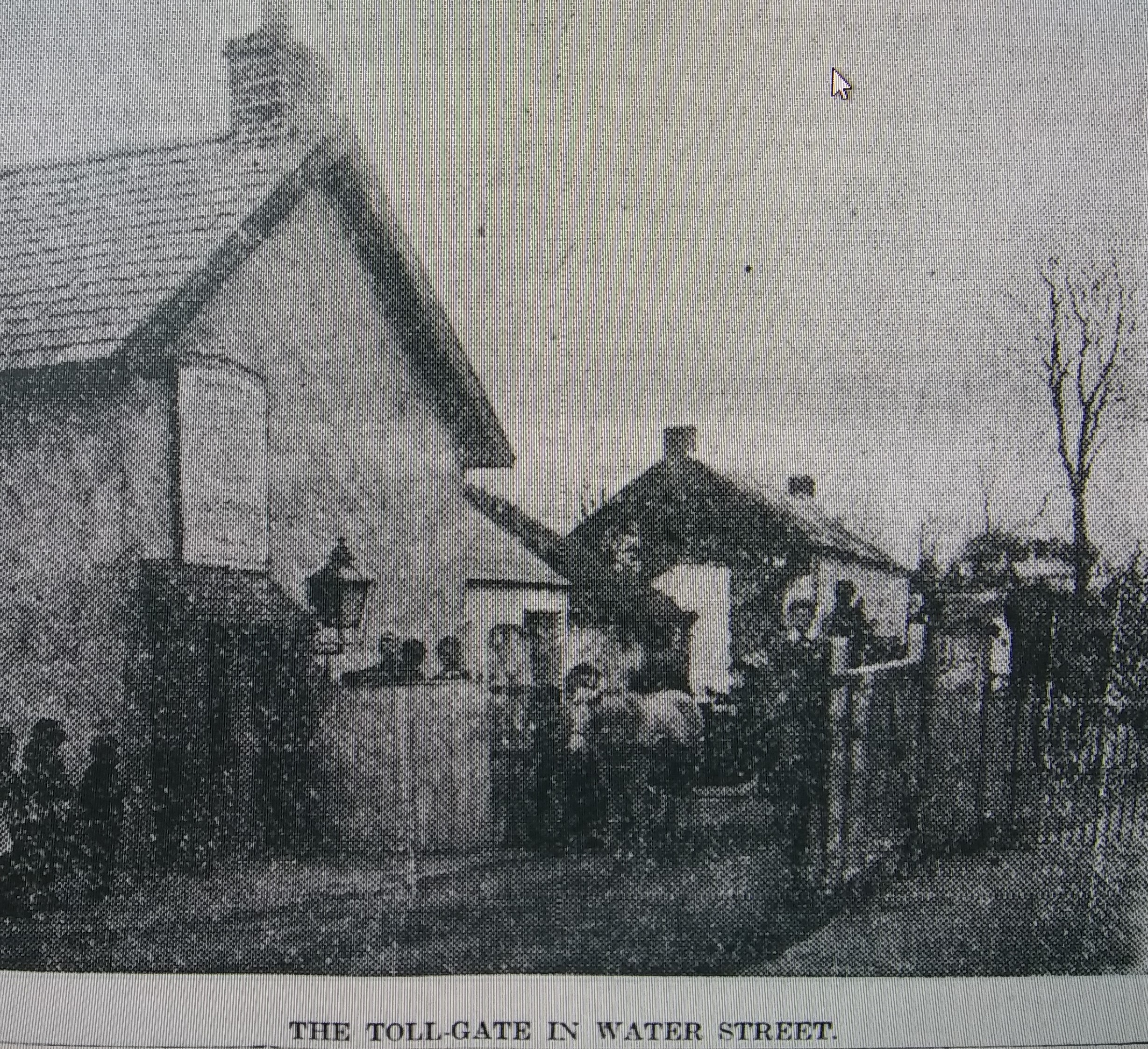
Water Street Toll Gate Carmarthen circa 1860. Note the large sign on the left. This was to show the cost of “passage” through the gate.The Toll Board with prices marked up on the right hand side, similar to Water Street.
Rees Barrett married Mary Parry, who was the daughter of a well known wine merchant from Haverfordwest. She died in April 1869 aged 67 and Rees himself passed away in September 1878 aged 66. As County Surveyor, Rees Barrett courted much controversy and was not afraid to answer his critics through the local press and did so on many occasions when letters appeared to be critical of his efforts. This short story uses extracts from three sources – one of which is a personal letter written to him by a Carmarthen family (sadly we don’t know their names) who emigrated to the plains of North America giving a vivid account of the atrocities and dangers they faced, and which Rees himself evidently felt would be of interest to the local population, and the second is a letter printed in 1861 where Rees vents his feelings on an unsuspecting contributor to the newspaper, and thirdly his appearance at an inquest where he was required to give evidence. All of which shows that Rees Barratt was a man who took his job seriously. Also of interest is the following advertisement appeared in the “Welshman” a few days after Rees died, which must have been rather sudden for he is recorded as having attended meetings only a few weeks before.
APPOINTMENT OF A SURVEYOR.
Notice is hereby given, that the County Roads Board will. at their meeting, to be held in the Grand Jury Room at the Shire Hall, in Carmarthen, on Wednesday, the 16th day of October next, at half past Twelve o’clock p.m., appoint a Surveyor of Turnpike Roads for the County of Carmarthen, in the room of the late Mr Rees Barrett, deceased. The salary of such Surveyor will not exceed £ 220 per annum he will be required to give his whole time to the roads and live at Carmarthen, and he will also be bound to give three months notice before resigning his surveyorship. The appointment will take place from the 1st day of November next, but the Surveyor will be required to be in attendance a fortnight previous to obtain the necessary local information from Mr W. Bowen Davies, the other surveyor. Candidates for the vacant Surveyorship are requested to forward their applications and testimonials (post paid) to me, on or before the 6th day of October next, such testimonials to specify the general character of the candidate as to diligence, intelligence, and trustworthiness, and also as to his specific qualifications for the duties of a road surveyor, to give which testimonials weight it will be necessary that the individuals furnishing the same should be shown to be in a position to be competent judges of the qualifications testified to. Such candidates as may furnish satisfactory testimonials will be required to attend at their own expense at the Shire Hall, in Carmarthen, to be examined as to their qualifications, on the 14th day of October next, at Twelve o’clock at noon, and it is desirable they should bring with them any specimen they may possess of their surveying or plan drawing.
By order of the County Roads Board.
GEO. SPURRELL. Clerk to the said Board.
Carmarthen September 20th 1878.
“TO THE EDITOR OF THE WELSHMAN.”
Union-street, Carmarthen, Jan. 20, 1863.
SIR,—I have just received a letter from a friend of mine, a native of this county, and now residing at Minnesota, U.S., with a short account of the recent massacre of the settlers by the Indians; and if you think the following extract likely to interest your readers, it is at your service for insertion. Yours, &c., REES BARRETT.
“I am sorry to tell you of our recent sufferings on account of the rising of the Indians against the settlers in this State. About the 8th of August we were startled by the news that those surrounding us were being murdered by the Indians, and that at New Elms, a town about eight miles from here, the inhabitants were fighting for their lives in self defence, and that Port Ridgely was in great distress, and the settlers all put to death. On hearing this, and being well aware that the limited number of them settling in this neighbourhood could offer but a feeble resistance to such an enemy, we had no alternative but to decamp, making the beat of our way to the most populous part for safety (a distance of about twenty miles) leaving our stock and crop to take care of themselves, and at the mercy of the enemy. On the 31st of August, hoping that all our troubles were over, we returned to our former homes, and repossessed ourselves of what was left of our property, but alas! our delusions were soon dissipated, for as one of our neighbours was taking his horses to the field, he was wounded in the arm by a shot from an Indian, who, with some others, had been seen prowling about the neighbourhood a few days before. Doubtless their intention was to possess themselves of the horses the unfortunate man had under his care; but irrespective of this incident we continued our labour until we got our corn safe, returning at night after the fatigue of the day to the middle of the settlement for safety, and arming ourselves with pitchforks and other rude weapons at hand for protection. The Indians mostly hide themselves in the woods, and among the grass on the prairies, and shoot us before we can discover their hiding places. In a short time, however, Government sent troops to our aid, and one Company, under the command of Captain Dane, fixed their head- quarters about seven miles from here. After the arrival of the troops we did not retire at night to our usual place of safety, thinking we would be safe, but we were again disappointed, for as one of our men was going to look after the cattle, he discovered one of our neighbours shot dead. We immediately started off to a neighbours house for refuge, and on opening the door found the house deserted, and the body of the murdered man the sole occupant. Six of our neighbours were murdered and two wounded on this occasion, and the remainder of us made the best of our way to the soldiers’ camp, and were again compelled to abandon our homes for another period of ten weeks. We are now again in our homes. We found our cattle all safe on our return, and in good condition, having eaten all the corn. The Indians had stolen all the horses belonging to our neighbours, but in this respect luck favoured us, for the good reason that they could not catch ours. We found them all safe. In consequence of the disturbance many of the settlers have left this State, and such as have remained have suffered very much from losses occasioned thereby, and it is estimated that about 800 have been murdered, and several of the inhabitants, who were taken prisoners by the Indians, have been recovered by the soldiers. General Selby has just passed this way with 370 Indian prisoners, and it is reported that they have confessed being instigated by the Confederates to murder us for a consideration of five dollars a head. We trust that all will be quiet now, and that we shall be allowed to pursue our lawful calling in peace again. Yours &c. “Butternut Valley, Minnesota, Dec. 22, 1862.”
General Joseph Orville Shelby
REES BARRETT – TURNPIKE ROAD SURVEYOR – LETTER TO THE EDITOR OF THE WELSHMAN –JULY 26TH 1861
PARISH HIGHWAYS IN CARMARTHENSHIRE. TO THE EDITOR OF THE “WELSHMAN.”
SIR, – When the intention is to vilify, misrepresent, and make false statements, it is generally convenient to appear in the columns of your paper under a fictitious name, and this is the mode adopted by your correspondent “Ratepayer” in your last. He says, that he is surprised, being a road surveyor myself that I should cast such sarcastic insinuations and ridicule upon my brother surveyors, and accuses me of seeing the mote in my brother’s eye. I deny this, and how any one can put such a construction upon my letter is to me surprising. I proved satisfactorily to myself and to the mind of every impartial reader, in figures, that no improvement can possibly take place with such a limited expenditure. Having had ten years’ experience as road surveyor under one of the Royal Engineers, to whom I am much indebted for much of the knowledge I may possess, is the very reason why I took upon myself to communicate a few remarks, and point out what I considered improper treatment of the Highways in Carmarthenshire, so that my brother surveyors who may not have had the experience, nor the advantage of professional instructions, may benefit thereby if they think fit; and if your correspondent and the surveyor in his district may disapprove of what I may say, and adopt a different system, it matters not to me. Road repairing requires practice, instruction, and experience, like everything else, and has not been considered beneath the notice of scientific men although Ratepayer,” like many others, may think that nothing but bluster is required. He says that he has lately travelled much of the parish roads and has found them very much to his satisfaction. I am sorry to tell him that many of his fellow-ratepayers differ from him in opinion; but if his perambulation, led him to the Llangyndeyrn district, he would find that the Highway Hoard has not disregarded the remarks in my report, and that labour is now employed to form the roads, and that sufficient material is got out of many of them to last for the next ten years, where materials were carried at great expense before; and if the system is persevered in, very great improvements will soon be the result. I complained that the official expenses were too much, being 16 per cent., whilst those of the County Roads only amount to 8 per cent., and I ventured to suggest an amalgamation of the districts, with a view to lessen those expenses, but by this I have unfortunately given offence, and “Ratepayer” begins by saying, Let us examine what good effects dividing one of the three districts of the County Roads Board between two of their surveyors had, &c., &c. but after all this he forgets to enter into just particulars, because he knows it will not suit his object, but as he has omitted doing so I will take the trouble of doing it for him. The South Wales Railway was opened to Carmarthen from Swansea in 1852 and from Carmarthen to Pembrokeshire about 1854, and the dividing of the turnpike roads into two districts did not take place until 1856, consequently no decrease of traffic from the opening of railways has taken place upon the roads under my care since that date…
Rees Barrett
REES BARRETT – TURNPIKE ROAD SURVEYOR and his evidence in a fatal accident enquiry
FATAL ACCIDENT ON THE CARMARTHEN AND LLANDILO RAILWAY WORKS.
On Friday afternoon, about half-past three o’clock, a lamentable accident occurred on the works of this railway by which one man lost his life, and three or four others were more or less seriously injured. Close to the Bishop of St. David’s Palace, at Abergwili, the line of railway will pass under the turnpike road leading from Carmarthen to Llandeilo, and whilst the cutting at that place is being proceeded with a temporary wooden bridge has been thrown across the road. This bridge is constructed by laying three balks of timber, 14 inches square and 43 feet long, across a span of 27 feet. Across these balks were placed two rows of sleepers, which met in the centre, the end of each sleeper being nailed to the middle balk. Over the sleepers was placed about six inches of ballast, composed of small stones. As the beams were 43 feet long, eight feet on each end rested on the rock, or shale, which formed the abutments on either side. From some cause hitherto not explained, the centre beam was heard to crack” twice, the second crack” following closely upon the first, and almost immediately, before the men engaged in removing the earth from under the bridge had time to escape, the beam divided in the centre and fell, the whole of the ballast falling down in a heap into the centre of the outting, completely burying John Jones, a labourer, and a resident in this town, who was unfortunately at work immediately beneath. Three other men were injured by the falling ballast, but are now in a fair way of recovery. Poor Jones remained completely buried for three-quarters of an hour, and when rescued he had of course ceased to exist for some time. There were no bruises or cuts sufficient to cause death, which ensued from suffocation. The body of Jones was taken to the Infirmary, and although the accident occurred without the limits of the borough, Mr. Hughes, the borough coroner, was obliged to hold an inquest, having discovered the body within the limits of his jurisdiction.
Mr. Rees Barrett examined: I am a road surveyor, and reside at Union Street, in this town. I have charge of the turnpike roads in the parish of Abergwili. I have known the temporary bridge over the Llandeilo Road, near Abergwili, since it was first made, about eight or ten weeks ago. It was a timber bridge. I have seen it repeatedly since. I was over it twice yesterday morning- that was back and fore. After I heard of the accident I went there between five and six yesterday evening. The middle balk and all the bridge had fallen down. The two outside balks were standing. All the bridge had fallen into the cutting. I examined the bridge. The bridge was made by laying three balks longitudinally. It was a secure bridge. There was a railing on the two outside balks, as a fence. The flooring of the bridge was composed of sleepers, about five or six inches thick, placed in such a manner that they joined on the centre balk. Each sleeper extended from the outside balk to the centre bilk only. The sleepers were nailed to the outside and centre balks. There was about six inches of ballast over the floor. The balks were forty- three feet long, laid over a span of 27 feet, having 8 feet resting on each end, which was composed of rock or shale. The balks were fourteen inches square. I inspected the bridge with Mr. Harries, the engineer, and he told me it was capable of holding twenty tons. As we had nothing heavier than about eight tons passing over that road, and as the pressure of each wheel of a wagon would not be more than two tons. I considered the bridge sufficiently strong. I calculated, for the thickness of the balks, that it would take sixteen tons to break them. The balks are of red pine. The centre balk is broken near the middle. There seems to be no defect in the timber. I did not know whether the sleepers extended the length of the bridge, or that they met in the centre, until I saw them yesterday evening. I consider the bridge to have been well constructed and sufficiently strong for the traffic on that road. My opinion is that the bridge was damaged by the blasting of powder underneath it, or it was damaged from some cause which I can not explain. By the Jury: I don’t know that it was formerly supported by anything that bad or which had been removed or dislodged. Examination continued. The fibres of the timber had first separated from above. The fracture is deep on the upper side, leading me to suppose the pressure was from below. The lower side was broken off in splinters. By the Jury: I was called upon to examine the bridge and reported it safe. I can’t say how the accident occurred. Examination continued. Each balk ought to bear sixteen tons, according to the span. I have never complained of the bridge being unsafe. Complaints have been made of the railing, of the approaches to the bridge, and of the narrowness of the bridge, but its safety was not questioned. It was considered sufficiently strong for that place.
OCTOBER 30TH 1863 – THE WELSHMAN
The last resting place of Rees Barrett and his wife Mary.
Arthur Davies was a remarkable young man. Having been brought up alongside the riverbank of the river Towy, he lived in what was then an alleyway of stone cottages that ran adjacent to the river called Justices Lane which is still in existence today, though no houses remain. Carmarthen during the latter part of the 19th century had a bustling and thriving port – one of the busiest in Wales, and inevitably there were many accidents as a result, many of them fatal as previous stories reveal. Arthur himself had been involved in an accident himself some years previously requiring the amputation of his right arm, though this did not stop him from his remarkable achievements in saving so many lives from drowning. In one particular case Arthur saved an Irishman from drowning that had only one leg, only for that same person to be imprisoned for 28 days five months later for being drunk and disorderly (see below) Arthur died quietly at home aged 63 in October 1928 at Island Wharf, another stone built cottage alongside the river long since demolished and a stones throw from his exploits over 40 years previously. He is buried in St David’s Cemetery and has no known grave or headstone. As the following stories reveal, Arthur and indeed many others who lived and worked in the vicinity of the river Towy put their own lives at risk many times in the quest to save others from drowning. May they all rest in peace.
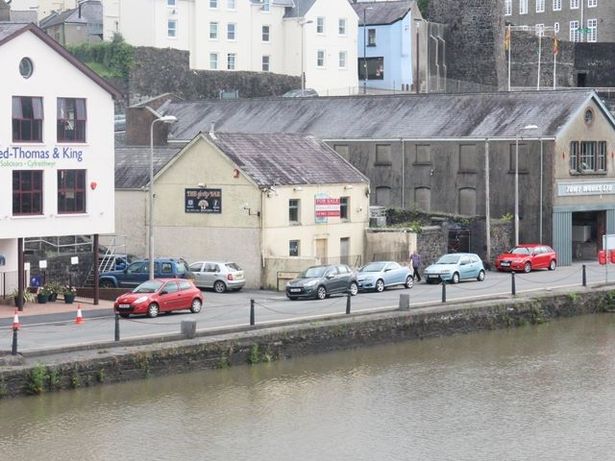
The “Jolly Tar” public house on Carmarthen Quay before demolition (centre) and Justices Lane – where Arthur lived is on the RIGHT of the pub , the entrance being where the red car is situated.
During the evening a very interesting presentation of medals and certificates was made to A J Davies, of Justice Lane, and James Williams, Quay. Mr Brunel White, in explaining the circumstances leading up to the presentations, said that perhaps there were many in that large company assembled who did not know the reasons why such medals and certificates should be distributed upon the heads of the two men who were on the platform. For himself he had not an exact knowledge of what had occurred, but from the information he lad received, it appeared that on the 22nd of June last, when a heavy ebb tide was flowing in the Towy, a youth by some mischance fell off the quay into the river. Alongside the quay was a steam boat called the Teal, and on board were the two recipients of the presentations to be made later on that evening. The cries of the lad fell on Davies’s ears, and immediately on its being known that the lad was in imminent danger of drowning, Davies, without divesting himself of any clothing, came on board from the hold, and in a moment, without any wavering sprang overboard to attempt the rescue of the poor lad (cheers). Now, such conduct deserved the greatest praise, and Davies did not stand before them that evening in such a position for the first time, for he had the satisfaction and pleasure to know that that was the fourth life Davies had saved during the last year (loud applause). Immediately Davies jumped into the river, James Williams, with equal spirit and determination, plunged in after them, for it must be understood that Davies only had one arm, and his fellow workman, seeing the danger both were in, volunteered his own life for his comrade’s (loud cheers). Equal praise therefore was due to Williams for having sprung in at the moment he did. Afterwards a rope was thrown from the Teal, or some other vessel alongside the quay, and the three were brought to land (hear. hear). Deeds such as those were not allowed to pass unnoticed in England, much less in Wales, and he believed it was through the instrumentality of Mrs Olive of the ”Jolly Tar,” who was an eye-witness, and of Mr A J Jones, Reporter Office, that the matter was ventilated, and brought before the notice of the Royal Humane Society (hear, hear). He understood that a letter was written by the latter to the editor of the paper called “Answers”, who also offers a medal and testimonial for such brave deeds. The two medals had come, a bronze one from the Humane Society, and silver one from Answers, and the latter’s testimonial would reach the mayor’s hands in a few days through Dr. Edwards, of Conwil, when Davies would be made the recipient of it. There was also a testimonial, inscribed on vellum received from the Society for Williams for having gone to the rescue of David Thomas, who was in imminent danger of losing his life. He was glad to see that prominent notice was taken of Arthur James Davies’s gallantry and daring, for it was daring to jump into the water handicapped let alone with heavy working clothes. Carmarthen was possessed of a good tidal river, and years ago they had men amongst them who had promoted regattas and swimming matches on the river, in order to learn the noble art of swimming. Where was that stimulus in the town now? (hear, hear). Why did they not have swimming matches as of old? This year was waning, and perhaps it was too late to re-establish the swimming matches and regatta (Voice: Not at all) – but he hoped that next year the swimming matches would be resuscitated on the banks of the good old river Towy (cheers). -Mrs A J Olive, Jolly Tar, then pinned the medals on Davies’s coat, and also presented him and Williams with the testimonial of the Royal Humane Society. Three ringing cheers were given for the two men, who bowed their thanks. The proceeds of the entertainment less expenses will be given to the Infirmary.
CARMARTHEN JOURNAL 26TH AUGUST 1892
The Royal Humane Society Bronze medal for saving life at sea
RESCUE FROM DROWNING AT CARMARTHEN.
A disabled one armed man named Arthur James Davies, a Royal Humane Society medallist, was called from his bed at midnight on Wednesday to rescue a man who had fallen into the Towy. Davies, heedless of the coldness of the night, rushed out without any clothing, and jumped into the river. With the aid of a servant of Mrs Olive, of the Jolly Tar Inn, who had heard groaning and had given the alarm, he hauled out the drowning man with great difficulty. It was then discovered that the poor fellow in the water was also disabled, having only one leg and gave his name as Jeremiah O’Dowd**; he was taken to the above named inn and kindly treated by the landlady.
THE WESTERN MAIL. 14TH OCTOBER 1892 PAGE 5
A WELL-KNOWN CHARACTER SENT TO PRISON.
At a special sessions on Tuesday – before Mr C. W. Jones, chairman, and Mr Howell Howells a travelling shoemaker, of Irish descent, named Jeremiah O’Dowd, well known in this locality as one of the “thirsty fraternity,” blessed with much “gift of the gab” was charged with being drunk and disorderly on Monday. Defendant is disabled and walks with the aid of a crutch. He was also charged with damaging the cell in the lock-up. P.C. Burnhill said that on Monday at 4 30 p.m., he saw defendant in the Square drunk. He was throwing his hat in the air and reeling about. He refused to go away and witness took him in charge. He had great difficulty in getting him to the lock-up. Defendant struggled and struck and kicked at him and witness had to hold him down until he had help. P.S. Harris said he was at the police station about six p.m., and hearing a smash he went to the cell where defendant was. Defendant was smashing the window with a bucket which was in the cell. With another policeman he went in and took defendant’s boots off. He continued to make a noise until near midnight. The glass of the window would cost 4s to replace, and the bucket which he broke was worth about 1s 6d. Defendant, on his own behalf, said that when in the cell he was very thirsty, and because he could not get any water, he smashed the plate glass window in revenge. After he smashed the glass he had some water. Supt. Smith said there was no truth in defendant’s story as, Sergt. Harris’s wife had given him water twice. Defendant – “I hope I shall not come here again in such a condition”. Chairman- You have said that before. You have been here three times previous to this, and the last time you were sent to prison for 28 days with hard labour.—Supt. Smith He is a very violent man he has been working at Porthyrhyd. Defendant “I am working at Croesyceiliog now” -Chairman: You had no property on your person, and so was walking our streets without any visible means of sustenance. — Defendant: No not exactly that.—Defendant put his hand in his ticket pocket and took out sixpence.—Chairman – then the police did not search you properly. —P.C. Burnhill I searched every pocket and could find nothing. — P.C. Thomas Jones: I searched that very pocket and I am positive it had nothing in it then.—Chairman It appears to me you are a dangerous character in your way. —Defendant: Oh, not so dangerous as that, sir. — Chairman: Well, you can use your crutch with wondrous effect. For being drunk you will be imprisoned for 14 days, and 14 days for damaging the cell.—Defendant: Is there no fine to be imposed?—Chairman: I do not see the use of it you have no money. — Defendant But I have friends.—Chairman (after consultation): You say you have friends and we like to treat everybody in the same way. We give you the option of a fine of 10s and 3s including costs for being drunk and disorderly, and 10s for damaging the station, 5s 6d the amount of the damage, and 3s 6d costs. No money forthcoming defendant was removed in custody.
Carmarthen Journal 27th May 1892
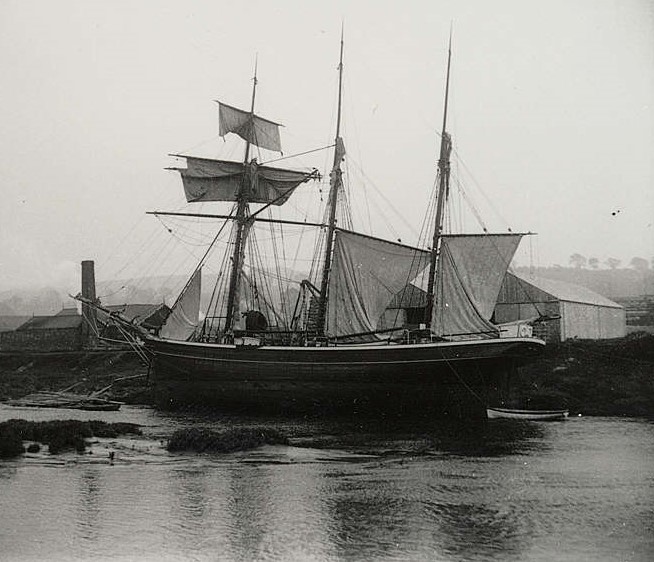
A ship moored at the “Bullworks” on the Towy – opposite the Jolly Tar pub circa 1900 (Carmarthenshire County Council Museum Service)
The burial register entry for Arthur James Davies.
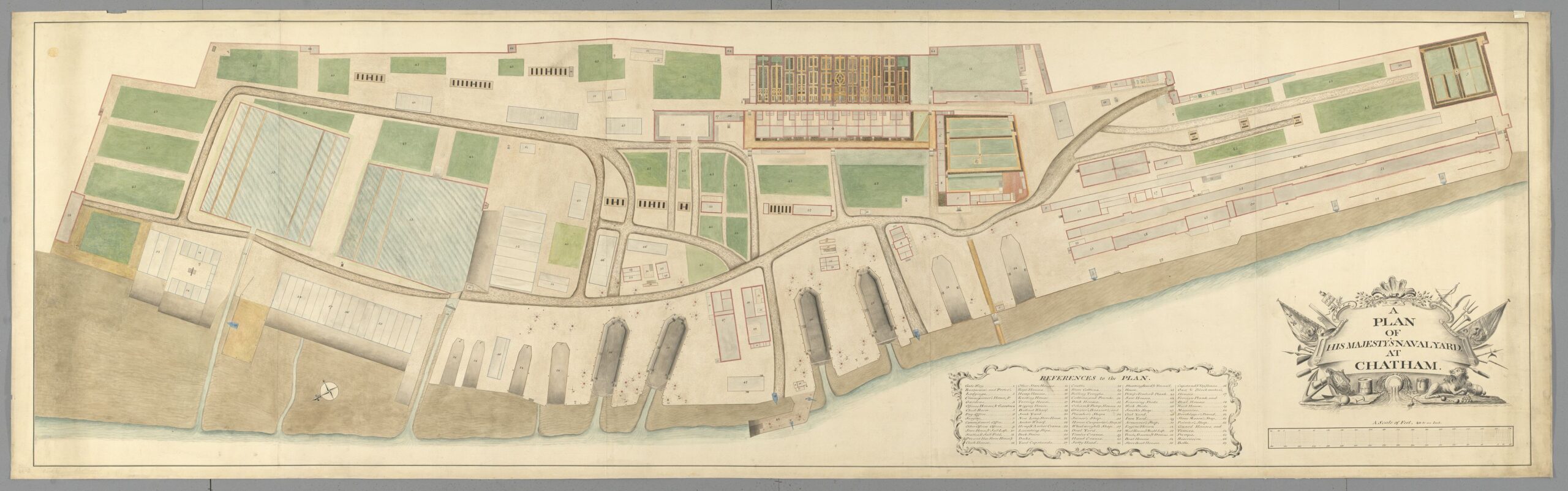
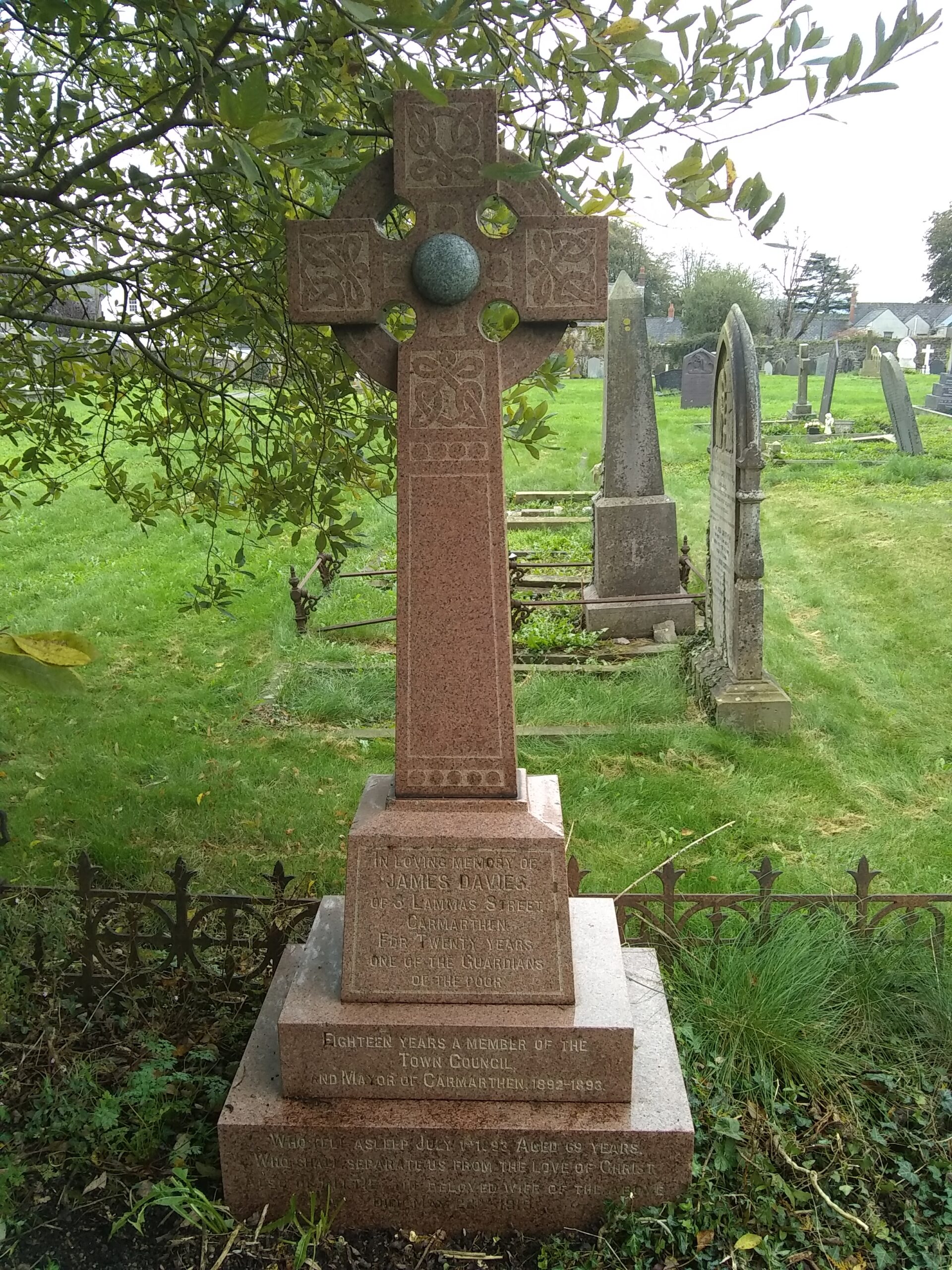
James Davies was a businessman in every sense of the word and took a keen interest in the affairs of Carmarthen, so much so that he became a very successful entrepreneur in the town. Rope was of course an essential commodity in the age of sail in Victorian Britain with a Royal Navy first rate ship of the line needing around 31 miles of it – over 20 for its rigging alone. James Davies during his apprenticeship at Chatham dockyard aged just 16 worked on the very same machinery that was used eighty years previously to make the ropes, sail and rigging for HMS Victory, the famous flagship having been built at Chatham in 1759. Chatham Dockyard was where James began his apprenticeship and it is here that his knowledge and expertise of the rope making process began. The building where he worked had an internal length of 1,135 feet (346 m) and when it was constructed it was the longest brick building in Europe. Hatchellers – semi-skilled artisans combed the raw hemp fibre across hatchels, boards with long iron pins to straighten out the fibres before they were spun into yarn. Whale oil, known as ‘train oil’ was used to lubricate the fibres. This was very hard manual work that took great strength.
A plan of Chatham Dockyard where James Davies worked as a young teenager. Chatham was where HMS Victory was built 80 years previously. The “Ropewalks” are the two very long buildings to the right of the plan .
There are many references to Carmarthen’s maritime past on many of the memorials in St David’s Cemetery as can be seen from the many inscriptions.
The top of the headstone of Master Mariner Fred Cadwallader with a little known but moving tribute to his past with this engraving of a ships anchor.
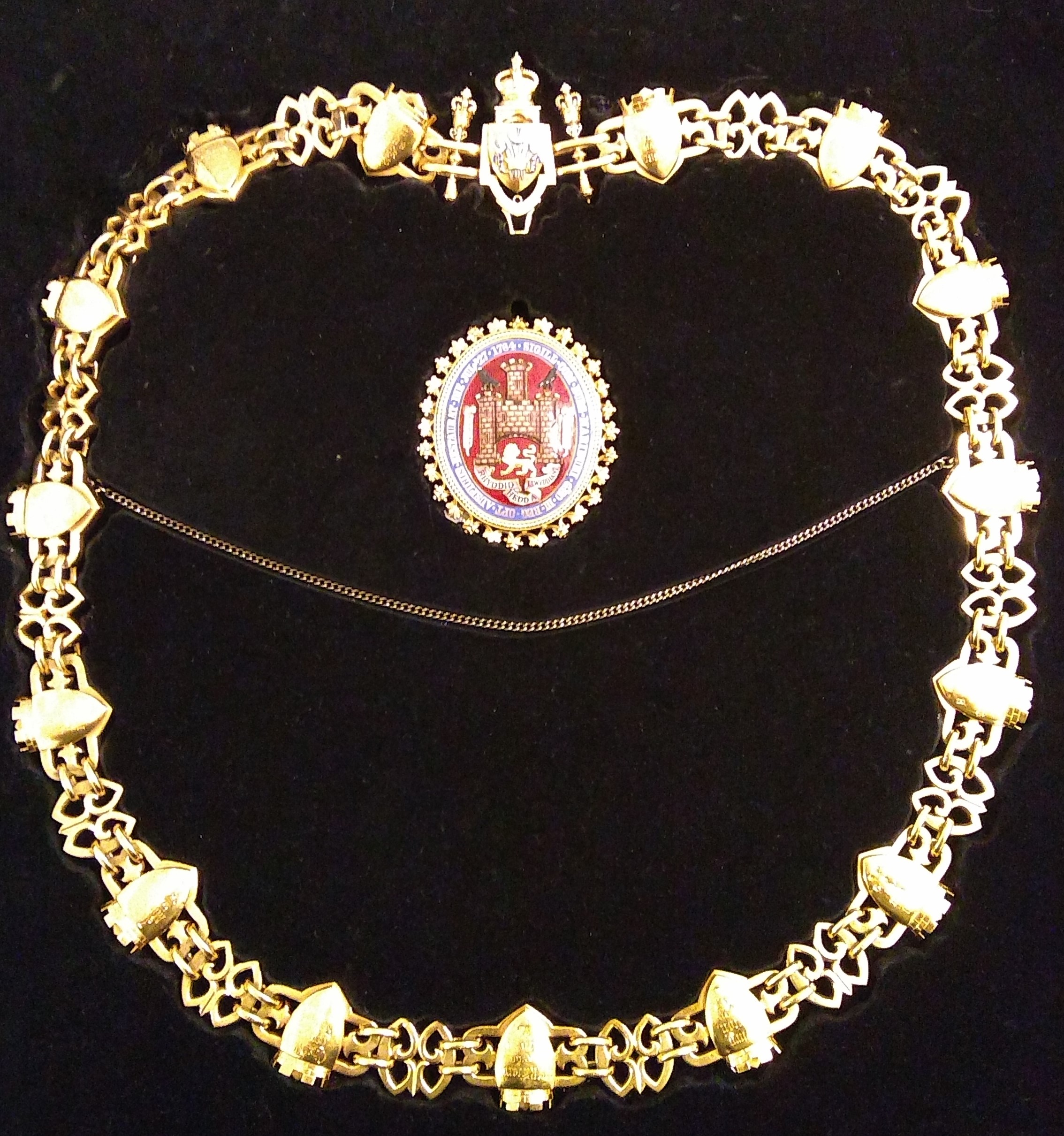
Sadly for James, he died in office after serving 18 years on the Town Council and was never to see the fruits of his labour. It was the first time that the Mayors chain was to be borne on a black crepe cushion. The Mayors chain, made in 1892 which is still in use today does not have his name inscribed on it, one assumes because he died in office. The following extracts are taken from a number of sources at the time which throws some light on a man who was committed to public life but whose life was cut short by illness. May he rest in peace.
The gold Mayoral badge that hangs from the chain showing the towns coat of arms. ( by kind permission of Carmarthen Town Council )
DEATH OF THE MAYOR OF CARMARTHEN
We have to announce with regret the death, after an extremely painful illness, of Mr James Davies, Mayor of Carmarthen, which occurred at half-past one o’clock on Saturday morning. Some two months ago the deceased was obliged to relinquish his civic duties and appoint Mr Howell Howells, Pontgarreg, to act as his deputy. With the hope of recruiting his health, his worship visited the Welsh Wells, but after a brief sojourn only he had to return home and consult Dr. Roberts, of London. That eminent medical gentleman found that the case was a hopeless one, and the Mayor, after much severe suffering, succumbed to a cancerous disease in the stomach. The news, though not unexpected, was the topic on Saturday, and all paid a tribute to the sincerity of the deceased’s actions during his life time. Mr Davies was a St. Peter’s Boy to the core. He was born in the borough on the 12th of September, 1824. Both his grandfather and father (John Davies) were rope makers. After a few years tuition at an elementary school he was apprenticed to his parents. The term was evidently a short one, for when about 16 years of age he was doing a journeyman’s task in H.M. Dockyard at Chatham and when but 17 he married Miss Margaret Walters. Before he was two years older he returned to his native town and set up a business on his own account. By dogged perseverance he became a thriving rope maker and a general merchant. His wife died a few years after the marriage, and 35 years ago he married his present widow, the issue being four daughters and two sons, two of whom (one of each sex) are dead. Some seven years ago Mr Davies retired from business, the rope manufactory being taken over by his son, and the bakery, &c., by two of his daughters, Mrs Sampson and Miss Davies. The deceased had ever shown a keen interest in the town, his solicitude for the poor being of a marked character. For 17 years he had been a poor-law guardian of the parish of St. Peter, and it was his boast that he personally knew every pauper in the borough. For 18 years he was an honoured member of the Town Council and was made Mayor in November last. His policy on the council was “Save the ratepayers’ money,” and on some occasions he stuck to that motto, perhaps with a little too much tenacity. He was also an active member of the Towy Fishery Board, having been elected a representative of the Carmarthen fishermen. At Water-street Calvinistic Methodist Chapel on Sunday evening, the Rev. J. Wyndham Lewis referred to the loss the town had sustained through the death of the Mayor. His Worship had, he said, served his native town for many years, and, with the exception of a short period in his youth, bad always lived in their midst. He was a man of sterling qualities, and the town had lost one of its most loyal and faithful citizens, and the poor a generous and sympathetic friend. The funeral took place at noon on Wednesday, the interment being at St. David’s Churchyard. The cortege was a very large one. The general public came first. Among them being the Revs. C. G. Brown, J. D. Evans, J. Daniel, J. Griffiths, J. Marsden, D. J. Thomas, G. H. Roberts, A. Fuller Mills, W. Thomas, Parkglas; Father Peter, Principal Evans, Professor D. E. Jones, Professor Moore Messrs. W. Morgan Griffiths, J. Howell Thomas, George Bagnall, E. Lewis, Cillefwr; W. R. Edwards, James Brigstocke, D. T. Lloyd, Henry Howell, Lewis Daniel, T. Bland Davies, A. Soppitt, Frederick Jones, C. E. Davies, R. H. Holding, W. Spurrell, Albert Harries, J. P. Carter, Evan Morgan, James Davies, Towy Works; Alcwyn Evans, C. Scott, Rowland Browne, J. Johns, John Williams, watchmaker; J. Burgess, W. Evans, Stag’s Head W. S. Morris, Oliver Jones, T. Smith, D. Rogers, E. R. Evans, J. D. Evans, W. Lewis, saddler; D Phillip, Bradford House; T. Walters, Alma House; C. J. Davies, Sheaf Inn; H. James, Bunch of Grapes; J. Thomas, Penlan; J. B. Arthur, William Arthur, C. Whiteoak, D. Williams, etc. Then followed the borough police force, under Supt. Smith. The council came next, the members present being: Aldermen J. Rowlands, C. W. Jones, R. W. Richards, T. Jenkins, and E. A. Rogers; Councillors Thomas Davies, H. Cadle; H. Howells (deputy-mayor), D. Parcell Rees, E. Colby Evans, D. Griffiths, G. Talbot Norton, Walter Lloyd, Daniel Jones, John Lewis, C. Finch, J. T. Lewis, W. V. George, and John Jones, together with the Clerk of the Peace, Mr J. Barker the Town Clerk, Mr R. M. Thomas; the High Sheriff, Mr David Davies; borough surveyor, Mr J. Morgan; Mr T. Evans, Chapel-street; Mr A. Ll. Davies and Mr John Williams then came the hearse, followed by Mr David Morgan, Chequer’s Alley, carrying the mayoral chain. The first coach conveyed the Rev. T. R. Walters and Rev. J. N. Evans (the officiating clergy), Dr. E. R. Williams and Mr Arthur Lewis, Commerce House, to whom all the funeral arrangements had been entrusted. Mr James Davies is the seventh mayor of Carmarthen who has died in office. Martin Davy died in 1540, Walter Vaughan in 1593, Thomas Muggel in 1624, John Hughes in 1630, Griffith Williams in 1690, and William Brigstocke in 1700. It is worth noting that when Mr Griffith Williams died Mr W. Brigstocke was sworn in his stead; thirty years later Mr William Jones had to take Mr Brigstocke’s place under similar circumstances. A special meeting of the town council will be held on Tuesday to appoint a successor to the mayoralty. It is freely rumoured that Councillor Henry Cadle will be elected, but it cannot yet be authoritatively stated.
THE WELSHMAN – JULY 1893
The grave of James Davies -Mayor of Carmarthen, and his family.
FUNERAL OF THE MAYOR OF CARMARTHEN.
The remains of Mr. James Davies, Mayor of Carmarthen, were interred on Wednesday at St. David’s Churchyard, Carmarthen. At noon the cortège was drawn up in front of the deceased’s residence in Lammas street. The members of the Carmarthen Corporation and its officials, including the borough police force under Mr. Superintendent Smith, took part in the procession. Among the mourners were Mr. G. Davies, the only surviving son of the deceased, and three or four other members of the family. After the hearse was borne the mayoral chain on a roll of crape. The Rev. T. R. Walters, Vicar of St. David’s, assisted by the Rev. J. N. Evans, curate, officiated at the graveside.
WESTERN MAIL 6TH JULY 1893
THE MAYORAL CHAIN AND BADGE FOR CARMARTHEN.
A very elaborate gold chain and badge has been provided for the ancient and distinguished borough of Carmarthen. It is in 18-carat quality gold, hall-marked throughout, and the chain is particularly interesting. There are a series of principal links of a Gothic character, suiting the antiquities of the borough, the centres having Knight Templar shields with castellated crowns, which are also emblems of the mayoral office. Each of the large shields is intended to take the name and year of office of the successive Mayors, the first on each side of the centre link being engraved with the name of Mr Thomas Jenkins, the present Mayor, who has held office for the last two years. Between each of the larger links, connected by double sets of oval chain, comes the Gothic monogram, C.C.—Corporation of Carmarthen, the centre link are two civic maces charmingly wrought, and on the former is a shield with the Prince of Wales’s feathers, relating to the fact that Carmarthen was anciently and justly considered the capital of South Wales. Below the shield are the crossed leeks of Wales in saltire, enamelled and over it, upon a seal of honour, is placed the Royal crown. From this suggestive central emblem of the chain depends the badge—a large oval surrounded by an open wrought border of Maltese crosses and fleurs de lis, representing the coronet of the Principality of South Wales. Next comes the legend of the borough in gold letters on an enamelled ground, and within it is given a magnificent blazon of the Borough arms- the famous Castle of Carmarthen, with river arch and three towers, two ravens upon the side towers, and an ostrich feather on each side, with the lion passant retardant below. The welsh motto of the borough completes the blazon. The following inscription is given on the reverse of the badge:—”This mayoral chain and badge is the property of the Corporation of the Borough of Carmarthen, and was provided in the year 1892 by subscription amongst members of the Town Council and others, £50 being contributed by Peter Hopkins, Esq.” The whole has been carried out in the finest style, the commission having been given to Messrs. T. and J. Bragg, of Birmingham, through Messrs. Jenkins and Sons, of Carmarthen.
SOUTH WALES DAILY NEWS APRIL 2ND 1892
THE MAYORAL CHAIN.
Special meeting of the Town Council held January 29th 1892.
The committee appointed to consider the question of procuring a chain for the mayor re- commended that the chain be not less than twenty ounces in weight, forty inches in length, and of eighteen carat gold. The designs of Messrs. Jenkins & Son, jewellers, Carmarthen, and that of Mr John Williams, jeweller, were submitted to the Council for final selection. Both designs, we should state, are strikingly handsome. Mr Williams showed a chain of eighteen carat gold, twenty ounces in weight, and forty-two inches in length, the design of Messrs. Manton and Mole, Birmingham. The chain is renaissance in style, and the links, which are oblong in form, carry a shield for the initials of the various mayors. The shield is surrounded by the letter “C,” in reference to the town. On the centre link are the arms of South Wales, supported on each side by Welsh dragons, and surmounted by a civic crown. Underneath is a wreath of leeks, and an ancient Welsh harp. This is particularly appropriate, as Carmarthen is held to be the birth-place of Merlin. On the top of the shield is a representation of the Prince of Wales’s coronet, surmounted with the usual plume of feathers. The badge carries the corporation maces and sword, with the Prince of Wales’s plume, civic crown, and goat surrounding the whole. The cost of the chain is £150. The design sent in by Messrs. Jenkins & Son was by Messrs. Bragg, Birmingham. The specification showed that the chain consists of a series of links, having on the front a shield for the names, &c., of succeeding mayors. These links are surmounted by a mural crown typical of civic power, and are connected with another link forming two “C’s”, which refer to Carmarthen Corporation. The centre shield or appendage shows the plumes of the Prince of Wales, the Welsh leek in enamel, and the Royal Crown surmounts the whole. On each side are gold maces, typical of the Royal Authority. The badge, of oval shape, bears the borough arms in correct heraldic colours. Around this is an enamel medallion, bearing an inscription from a seal restored to the borough in the reign of George III in 1774. The border consists of fleur de lis and Maltese crosses, taken from the coronet of the Prince of Wales. The price is £146. 5s, the chain to be of 18 carat gold, weight twenty ounces. It was decided to proceed with the vote by ballot. The result showed that Mr Williams received three votes, and Messrs. Jenkins & Son, 13. It was, therefore, resolved to accept their tender.
FRIDAY FEBRUARY 5TH 1892 CARMARTHEN JOURNAL
The 18 carat gold chain and badge of the Mayor of Carmarthen. ( By kind permission of Carmarthen Town Council )
Henry Brunel White was Mayor of Carmarthen for four consecutive years from 1894 to 1897. This is the earliest known photograph of the Mayors Chain believed to have been taken in 1894 – two years after it’s manufacture.
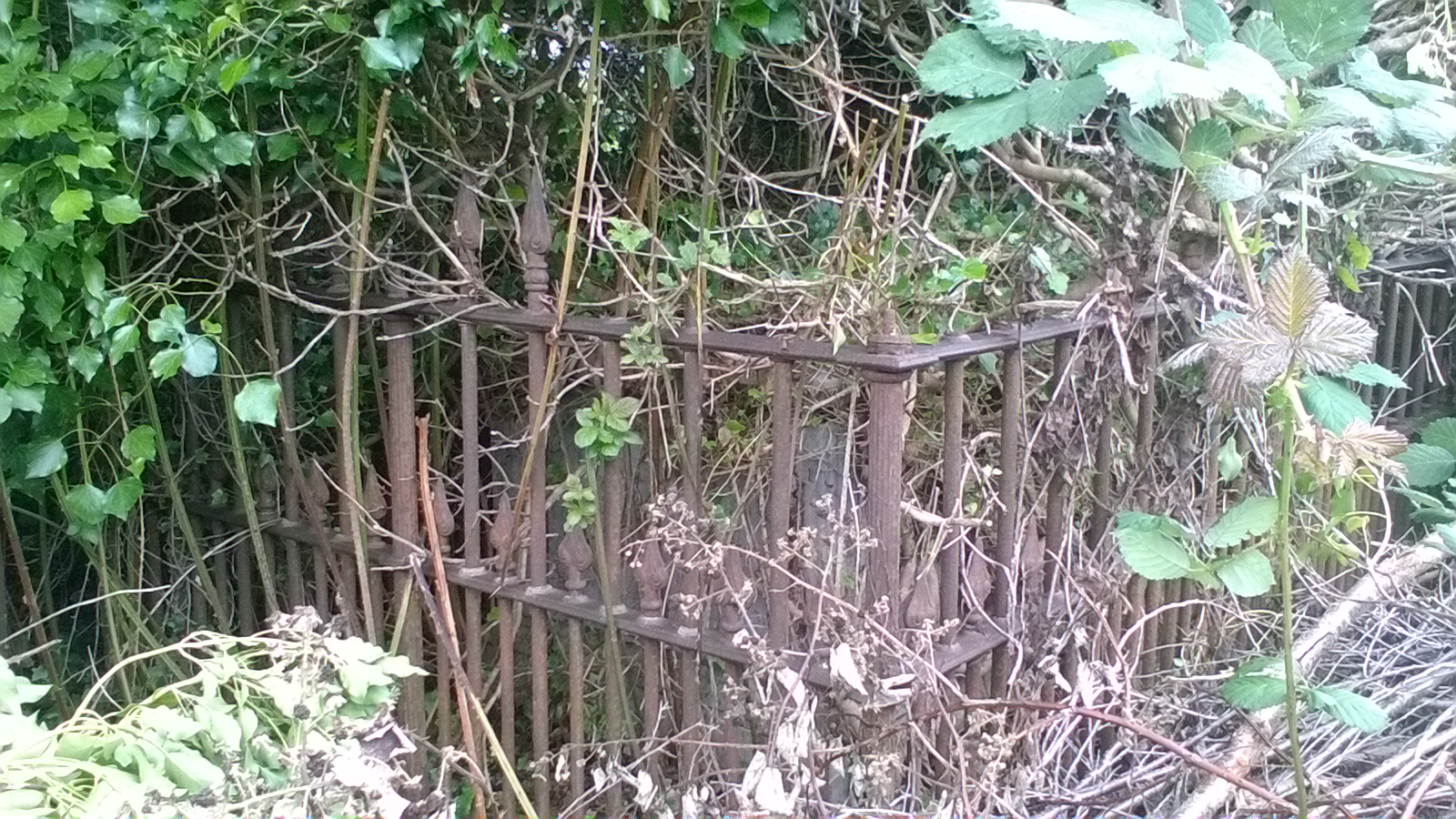
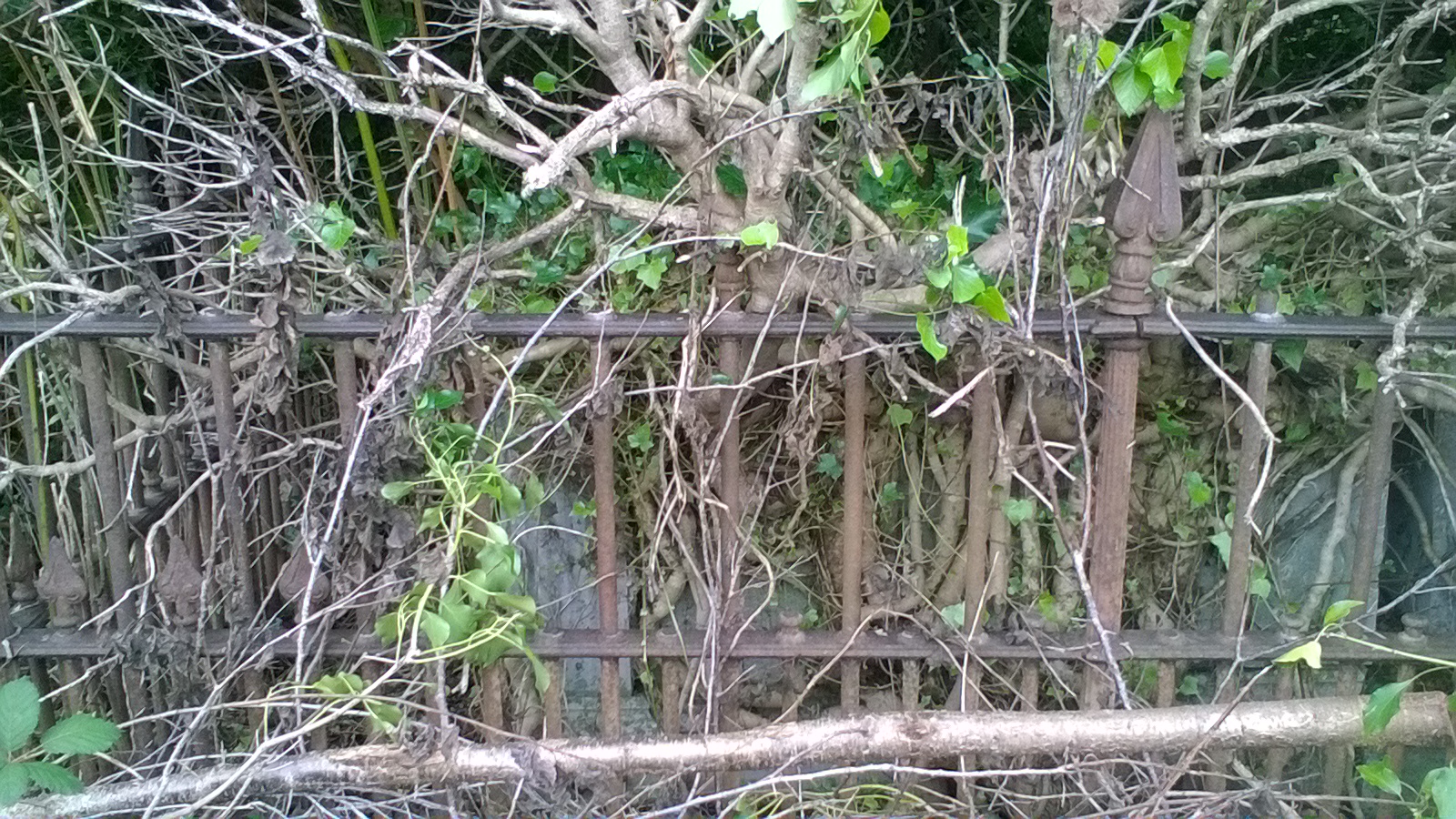
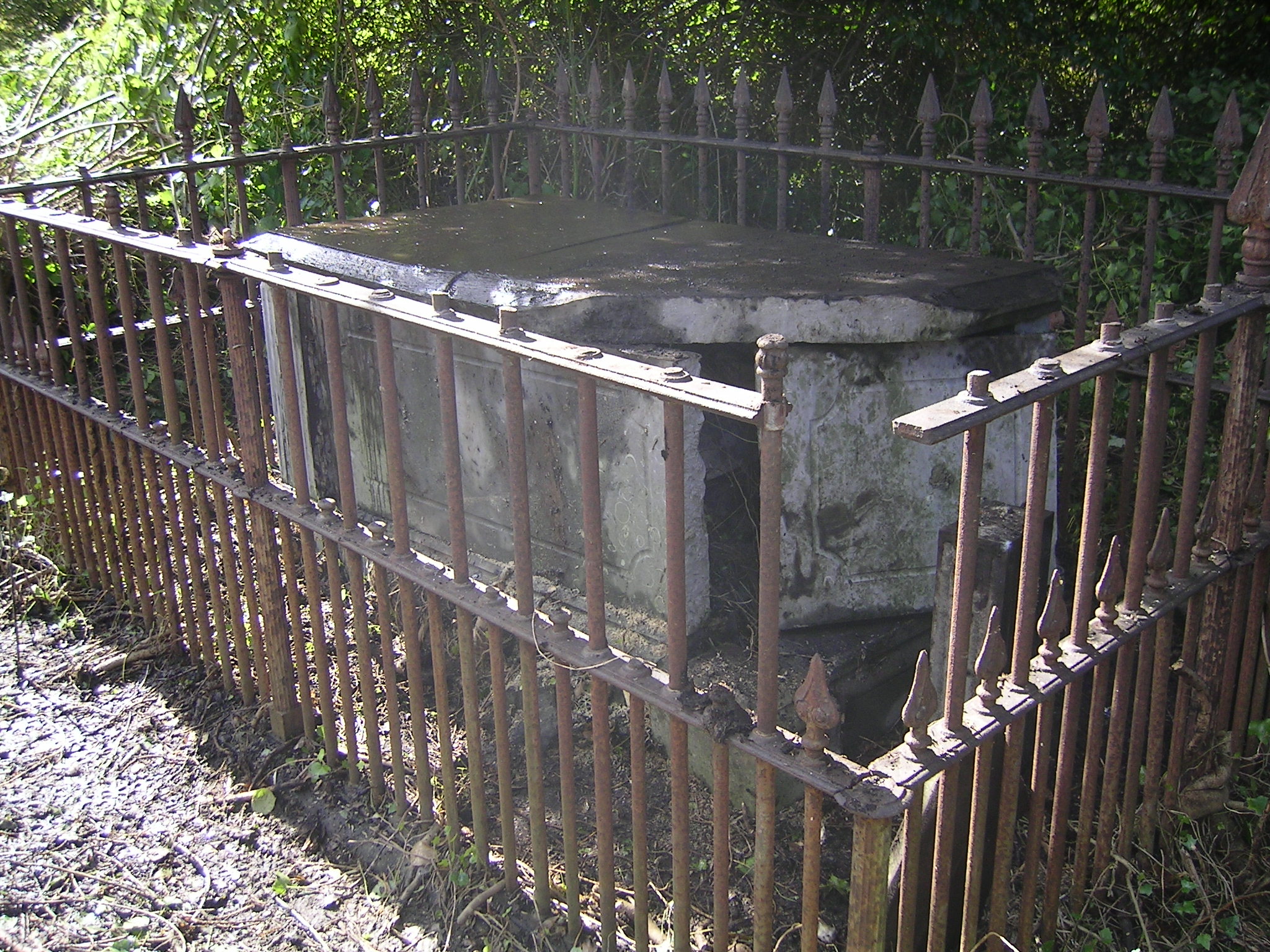
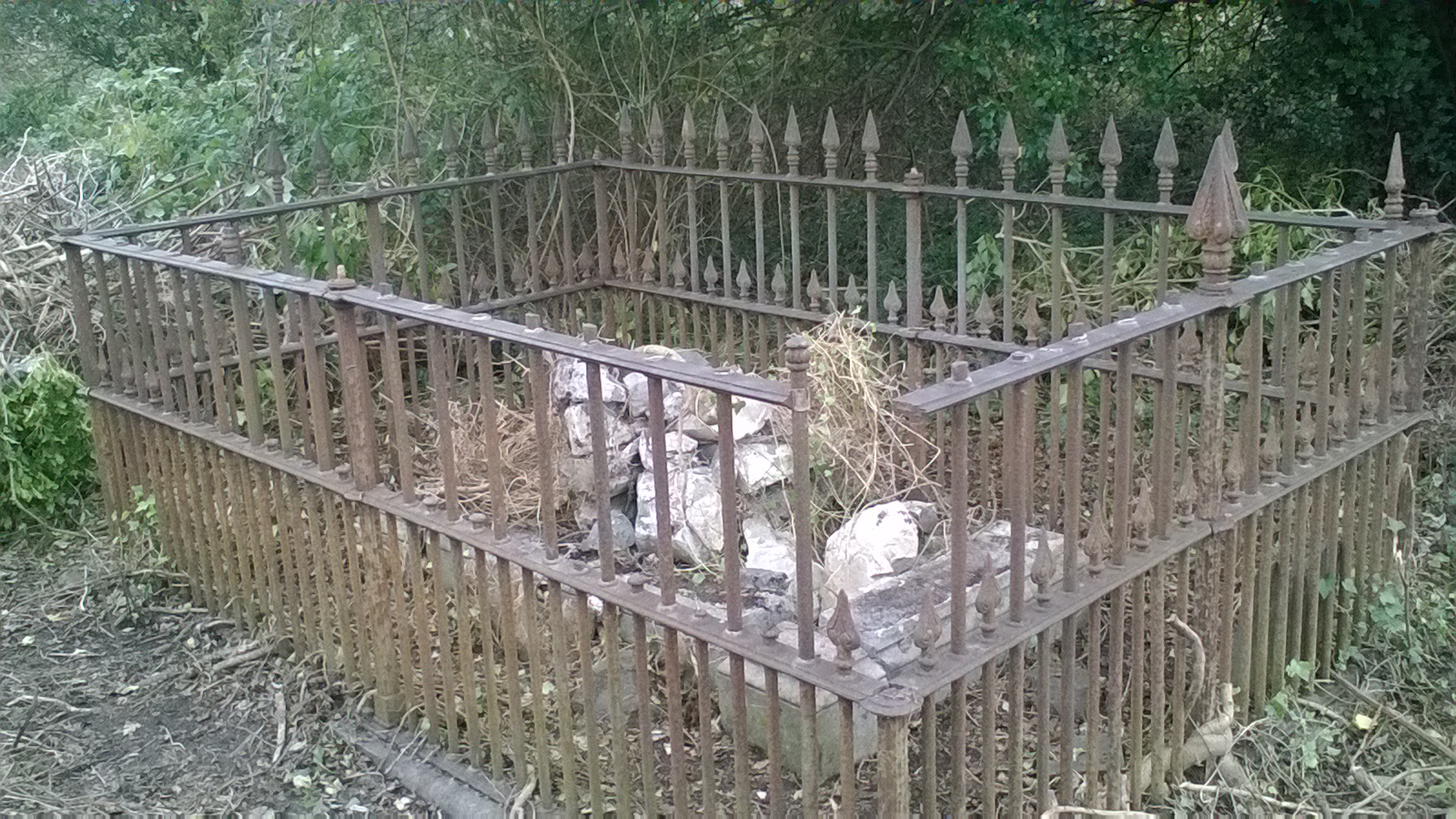
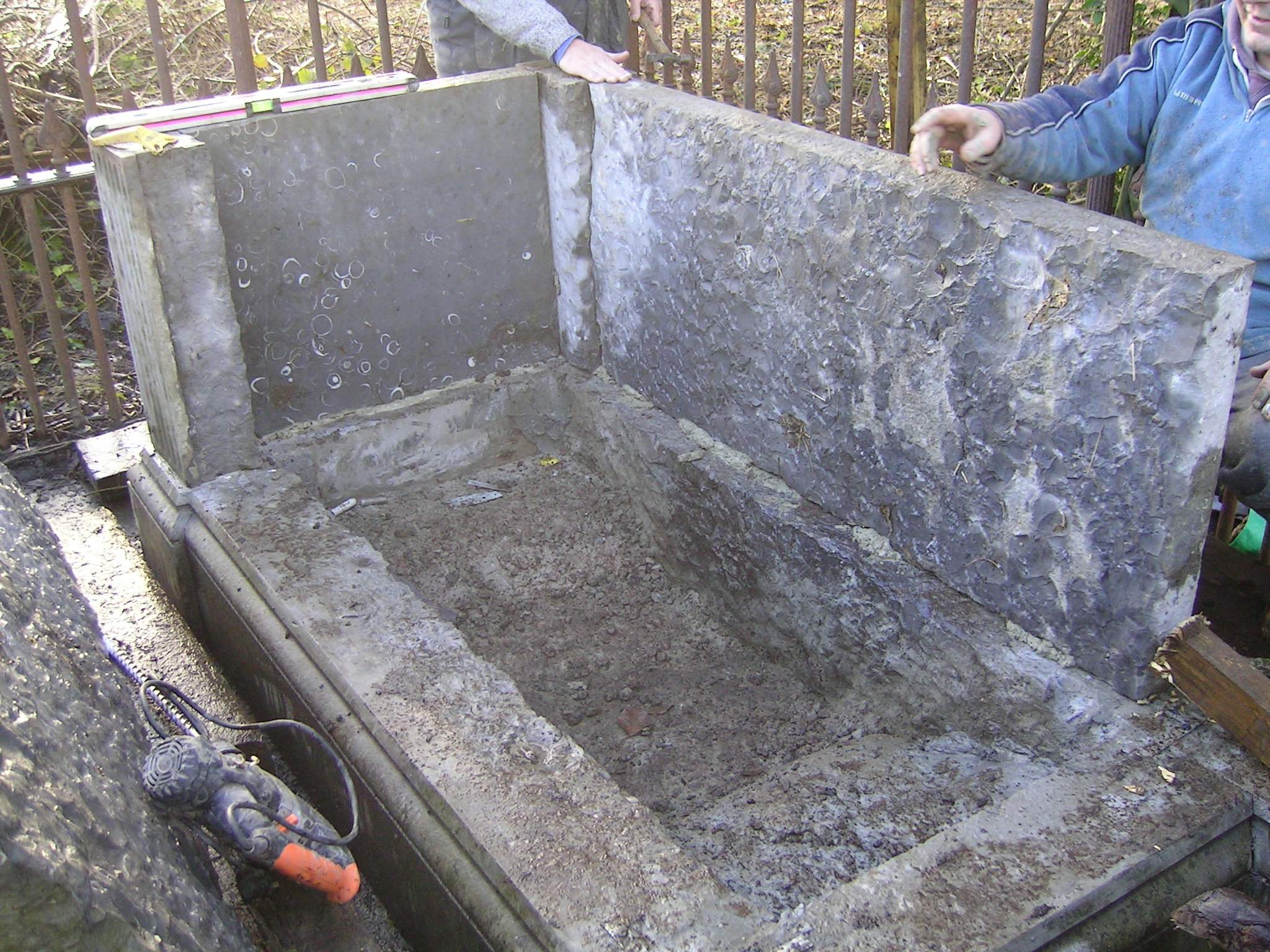
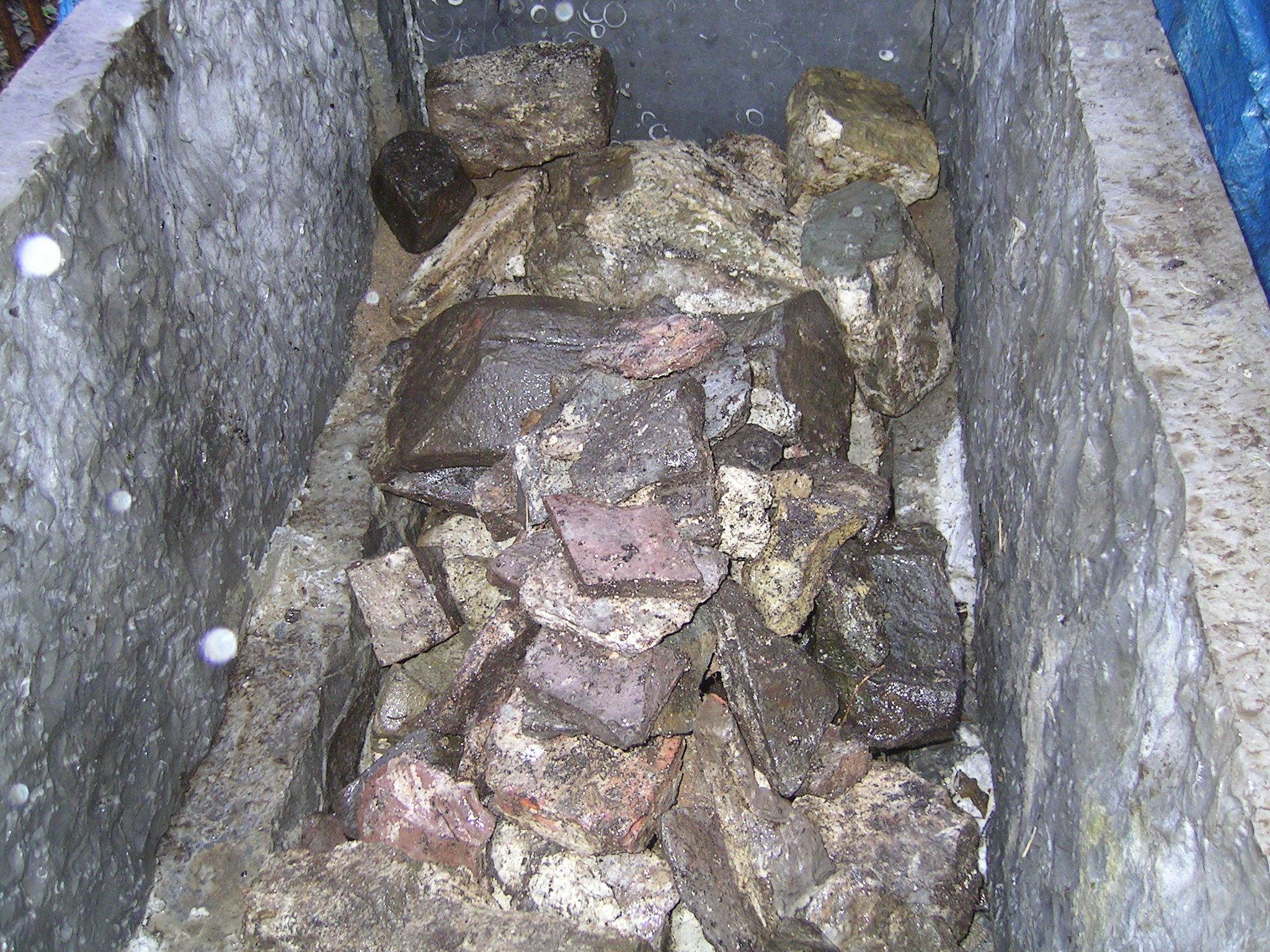
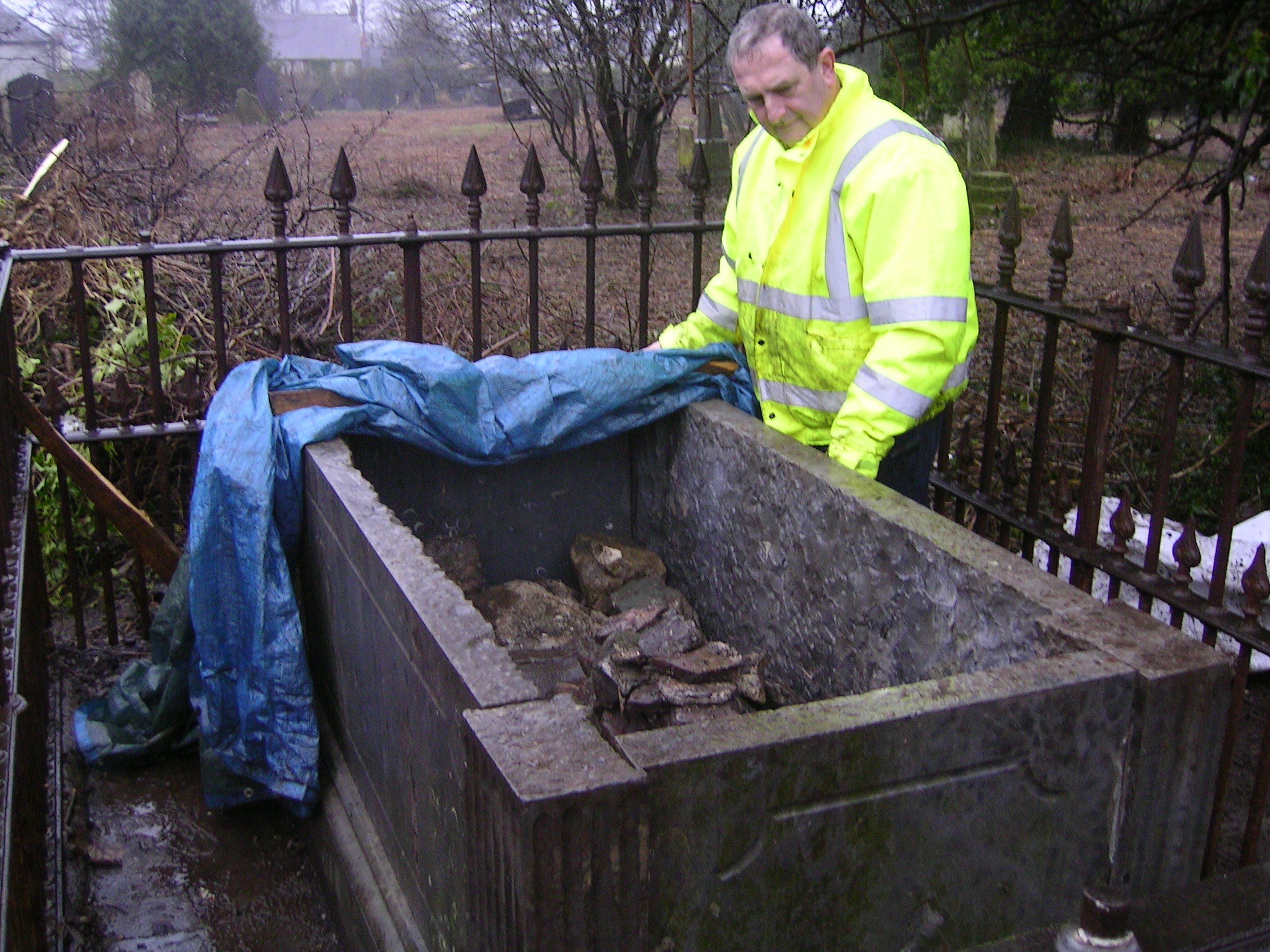
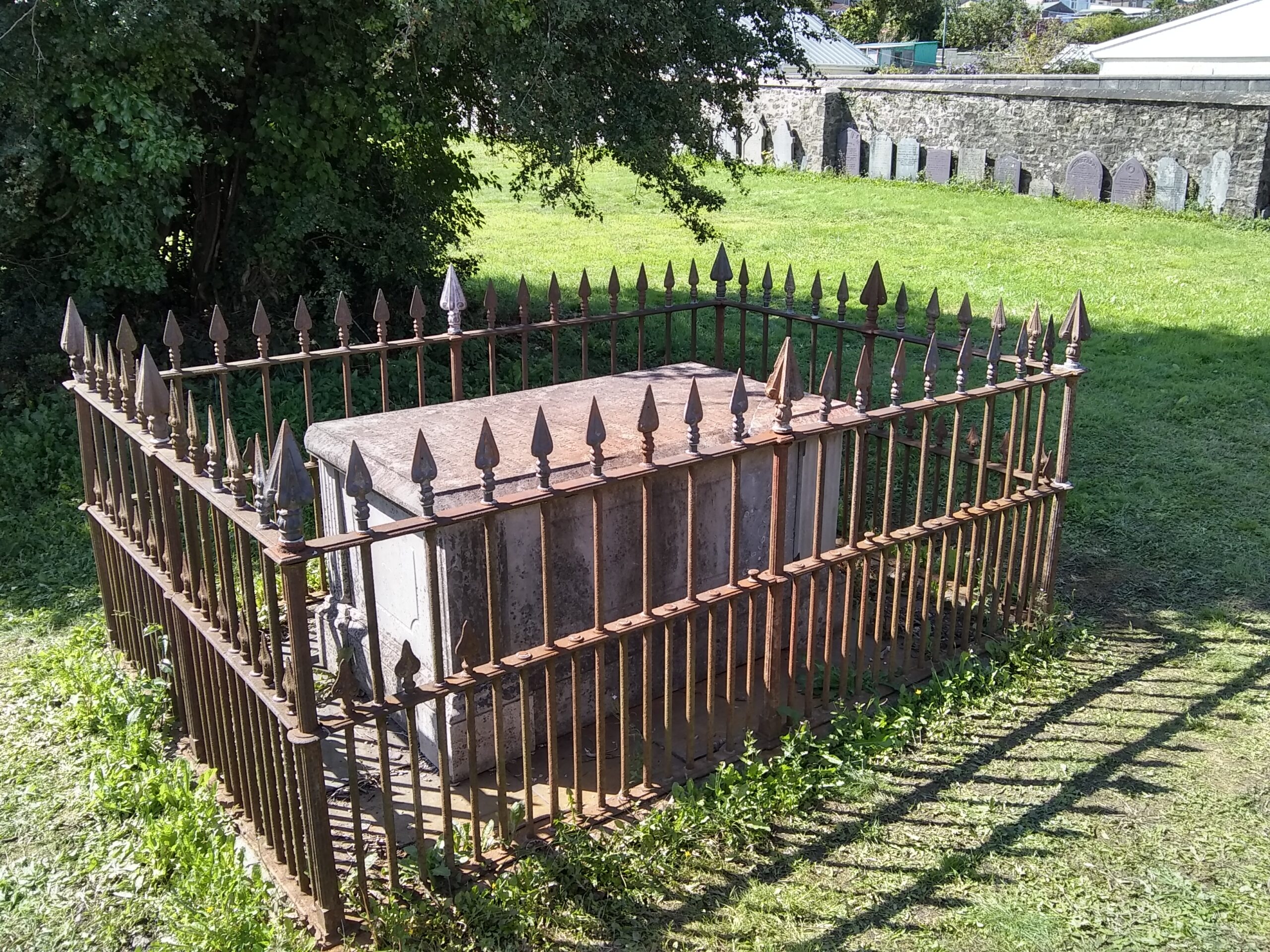
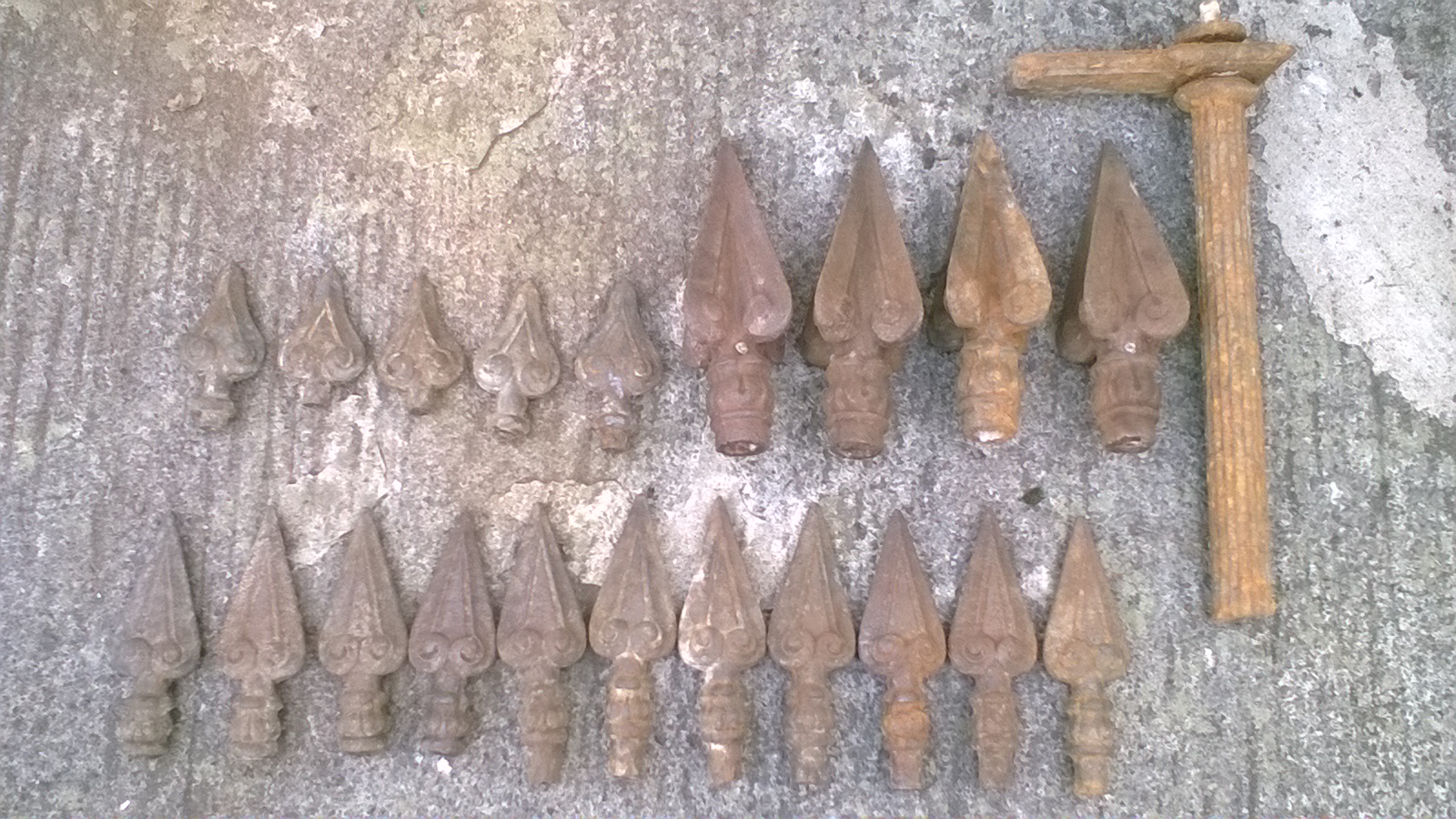
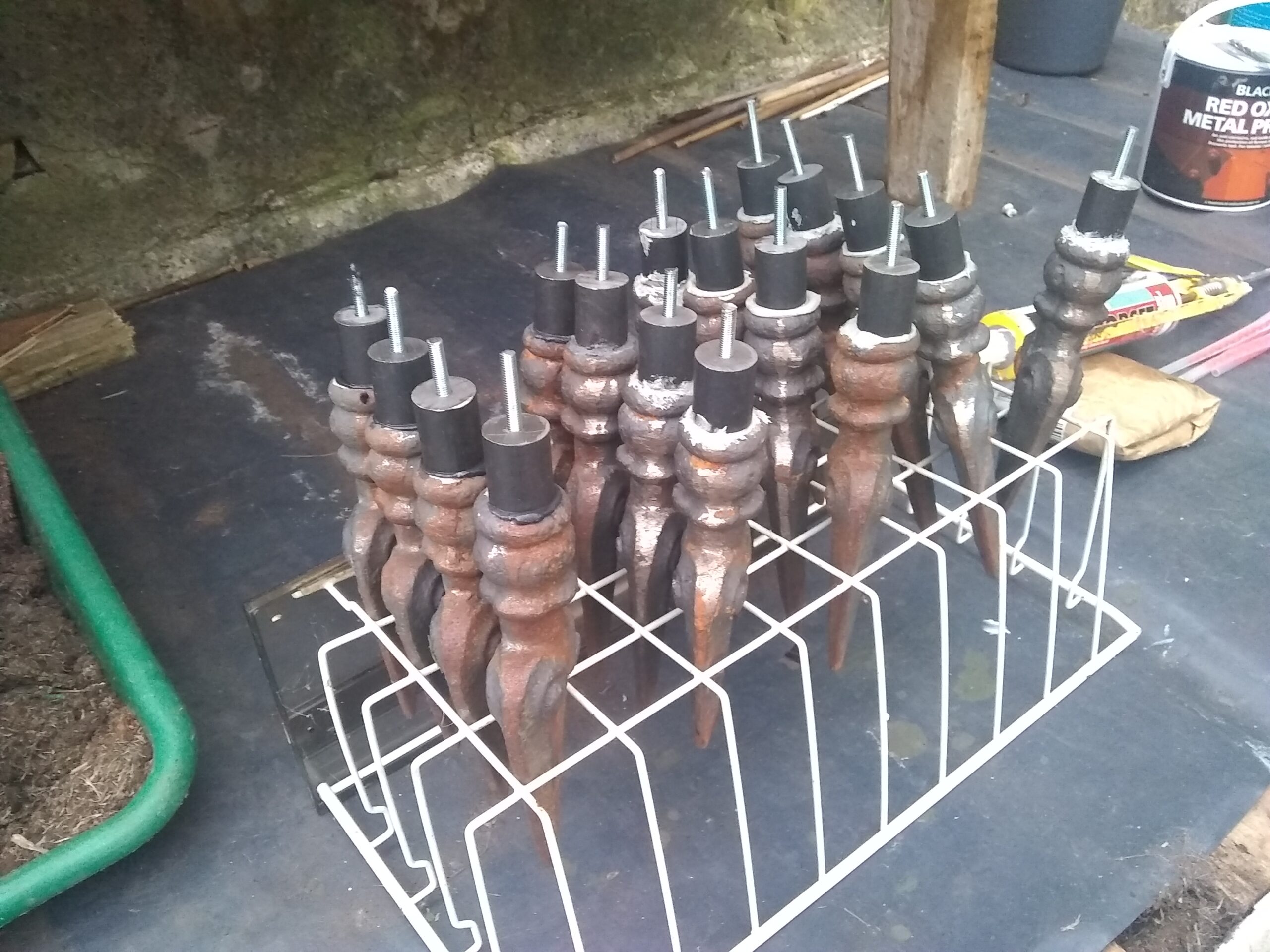
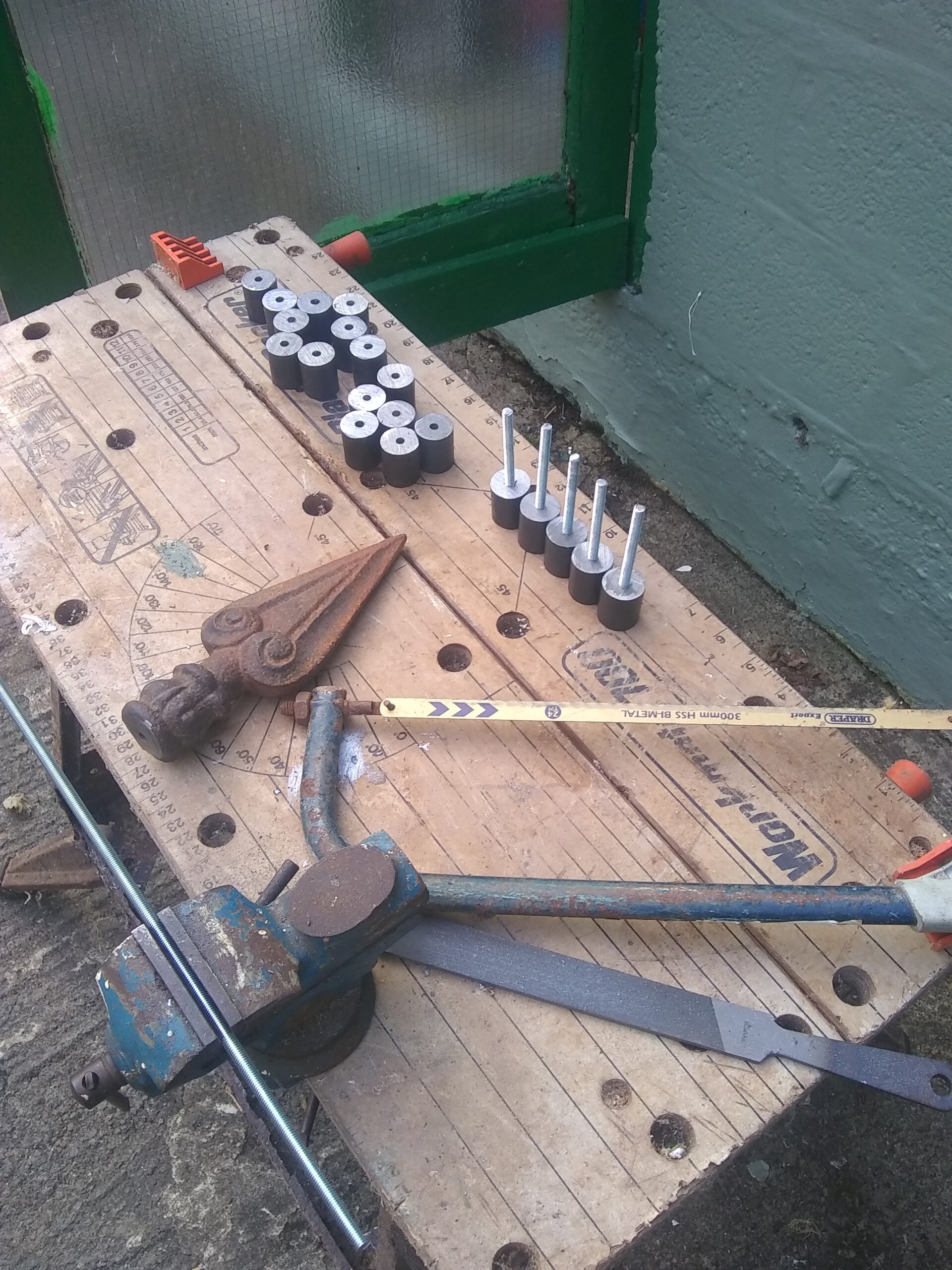
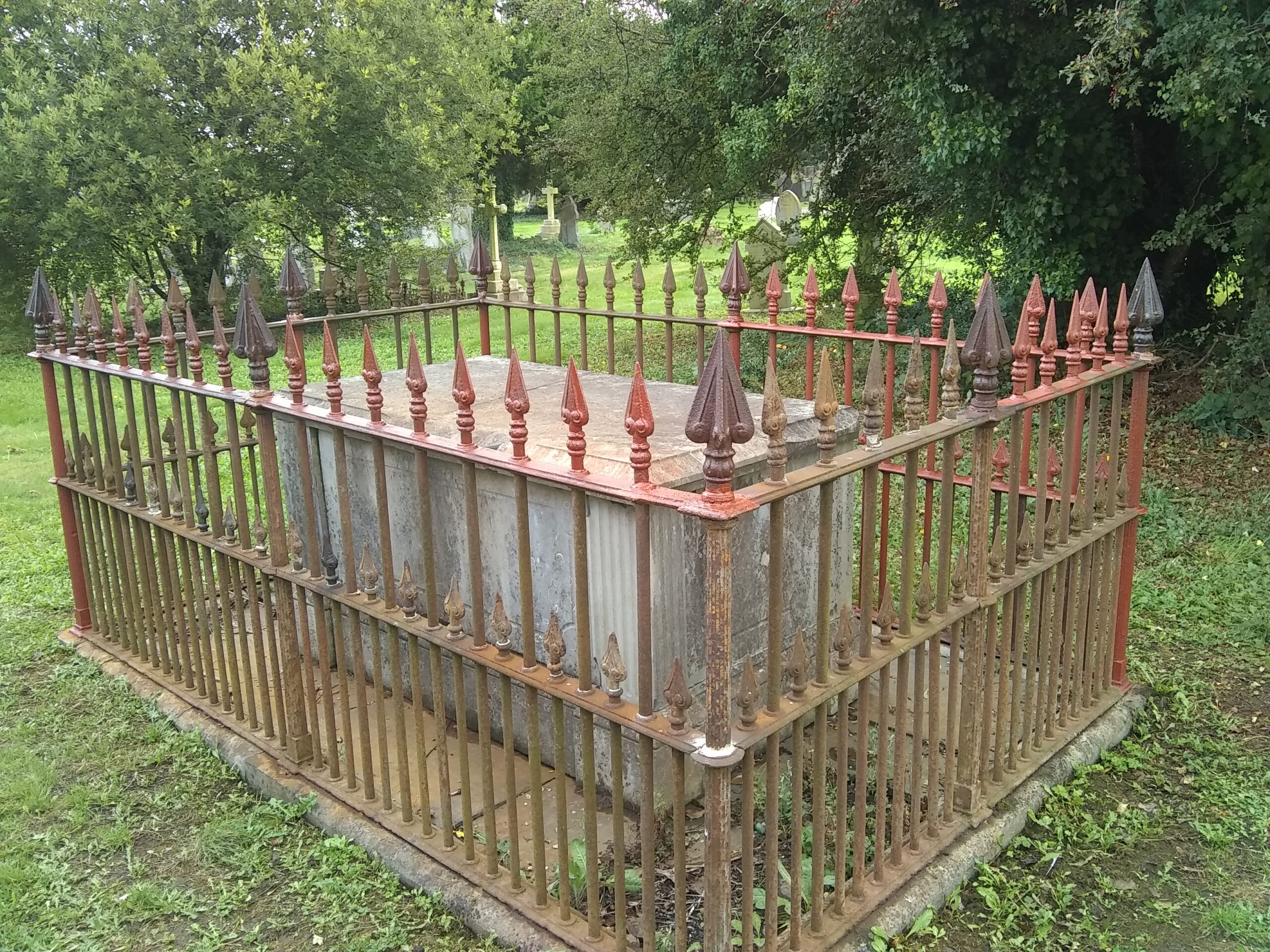
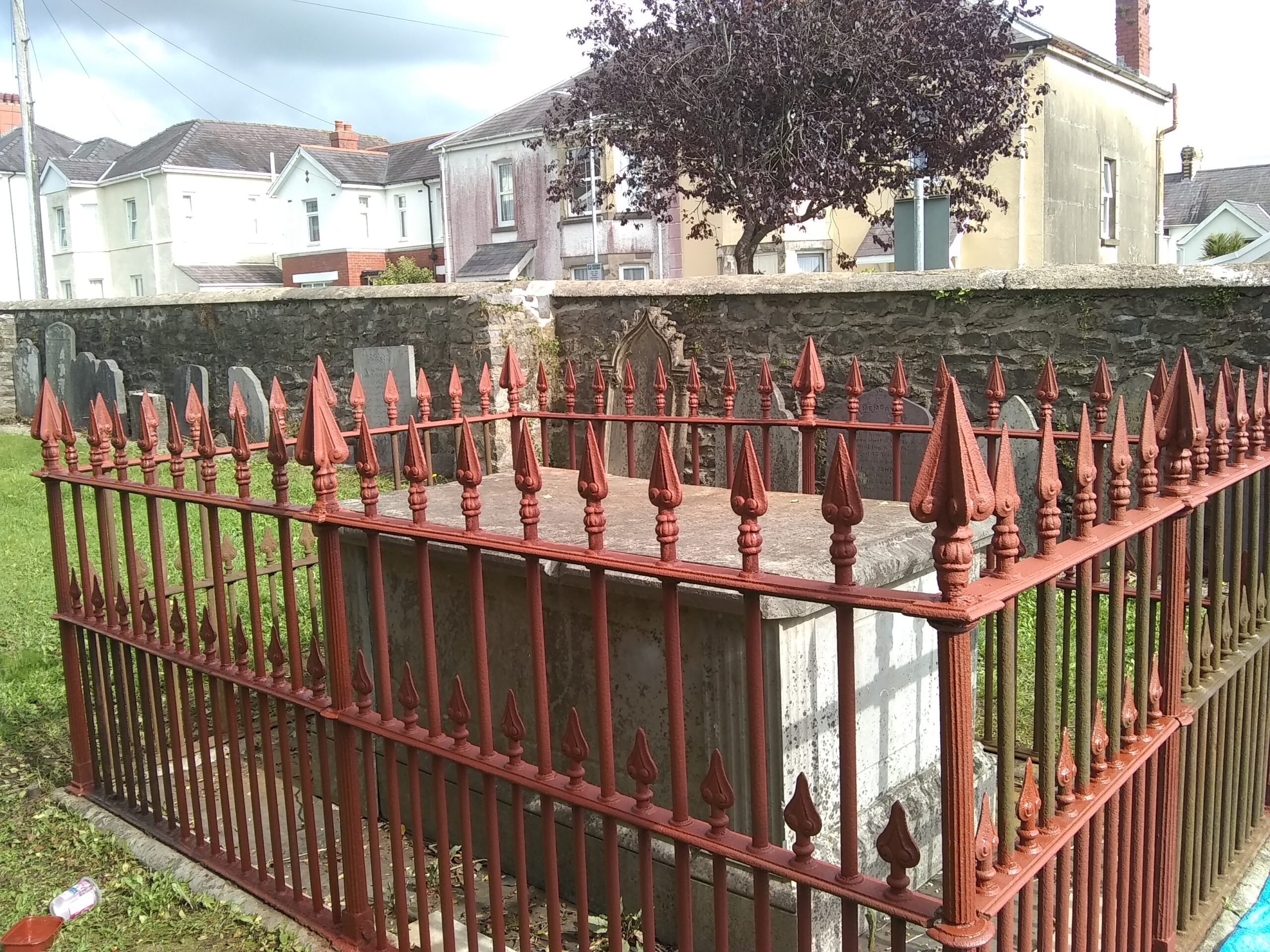
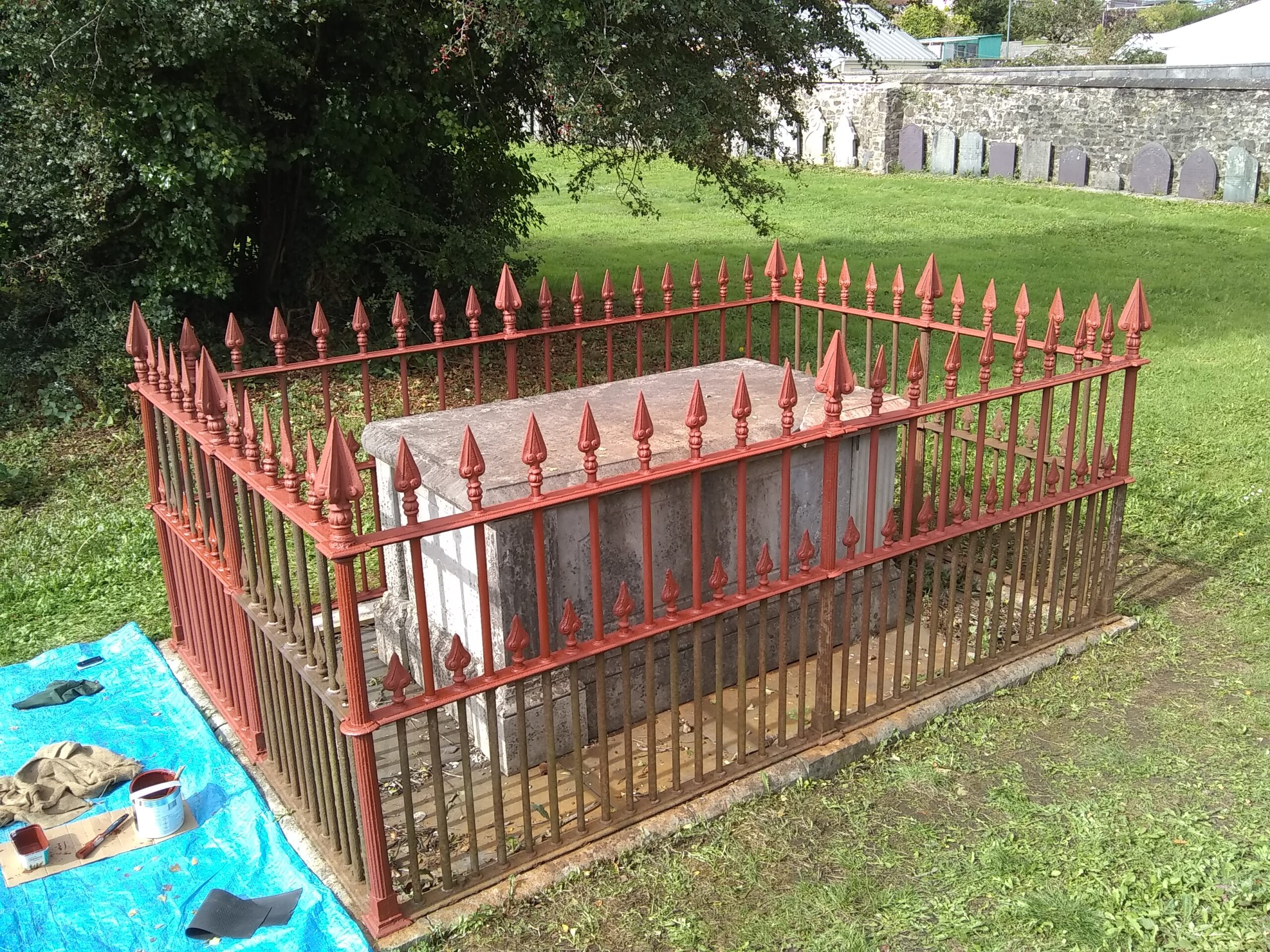
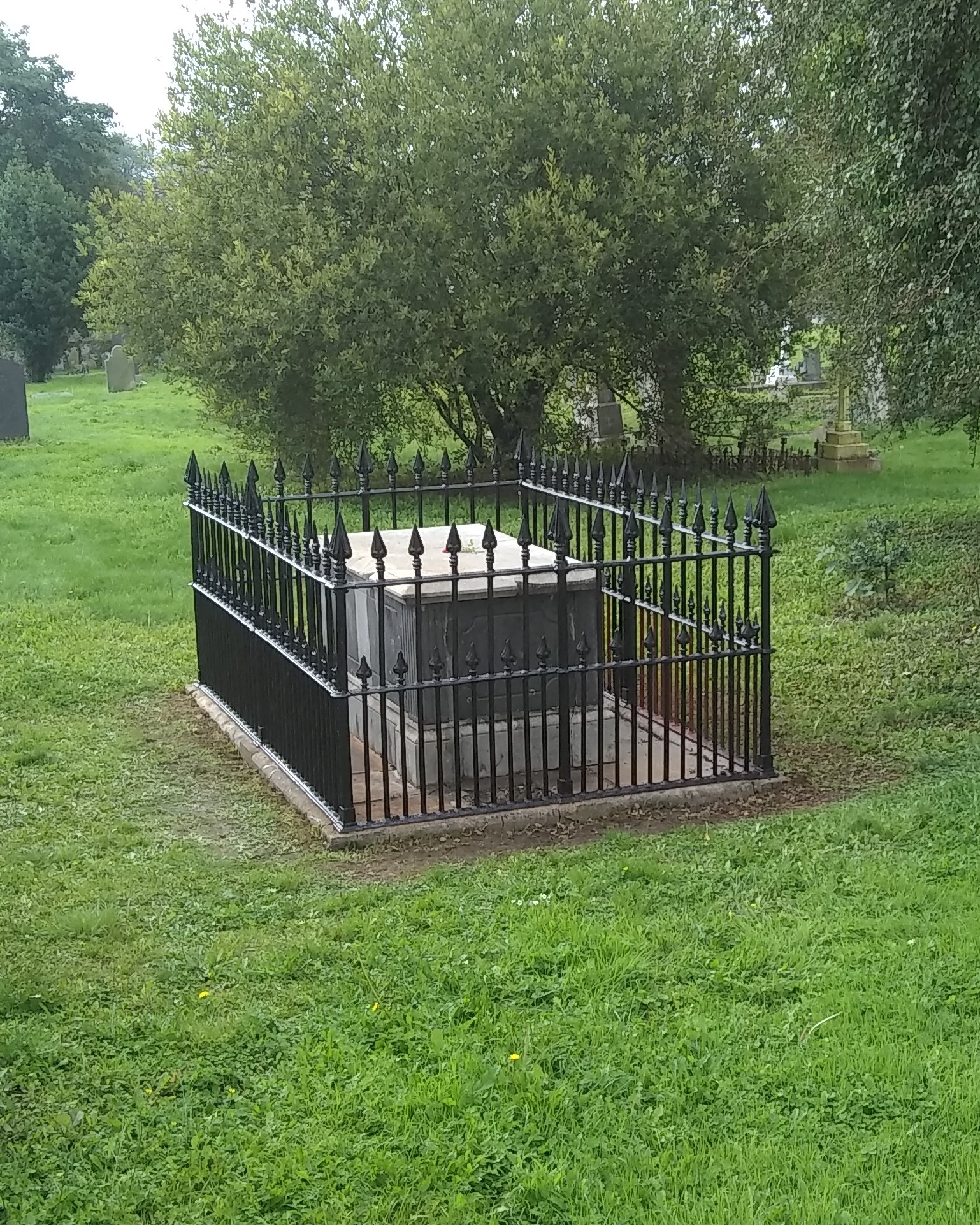
Out of all the restorations the Thomas & Elizabeth Mayhook Charity have carried out over the last six years on a variety of memorials, the restoration of the box tomb and railings of the Prytherch family has been the most costly. Not only financially but in time, effort, attention to detail and sheer manpower. Being located in the furthest corner of the cemetery behind a very large blackthorn bush, it is impossible to see despite its size. Only a brisk walk down to the far corner reveals it’s true beauty. However, its importance cannot be underestimated both in terms of historical significance and also of architectural importance. Of particular significance are the restored railings of the memorial which give a unique example of mid Victorian architecture in cemeteries, and of the construction of such railings around memorials and box tombs signifying the “wealth and importance” of those local families such as Daniel Prytherch who himself was Mayor of Carmarthen in 1831 and local Magistrate and wealthy land owner. Caroline his wife being reputed to be King George III youngest granddaughter from his liaison with Hannah Lightfoot whilst Prince of Wales. Whilst the railings themselves are not marked with the stamp of Coalbrookdale, the pattern books of the company still exist which give strong indications that they are, as much of the design is identical to both. However, the 25 missing finials were re-cast using original techniques by a local company and sections of steel bar, drilled and pinned with threaded steel rods completed the restoration process after five years of very hard work. Indeed, records show at the same time of the construction of this grave in 1854, Coalbrookdale railings and gates were installed at the entrance to the Church but were sadly removed in 1967.
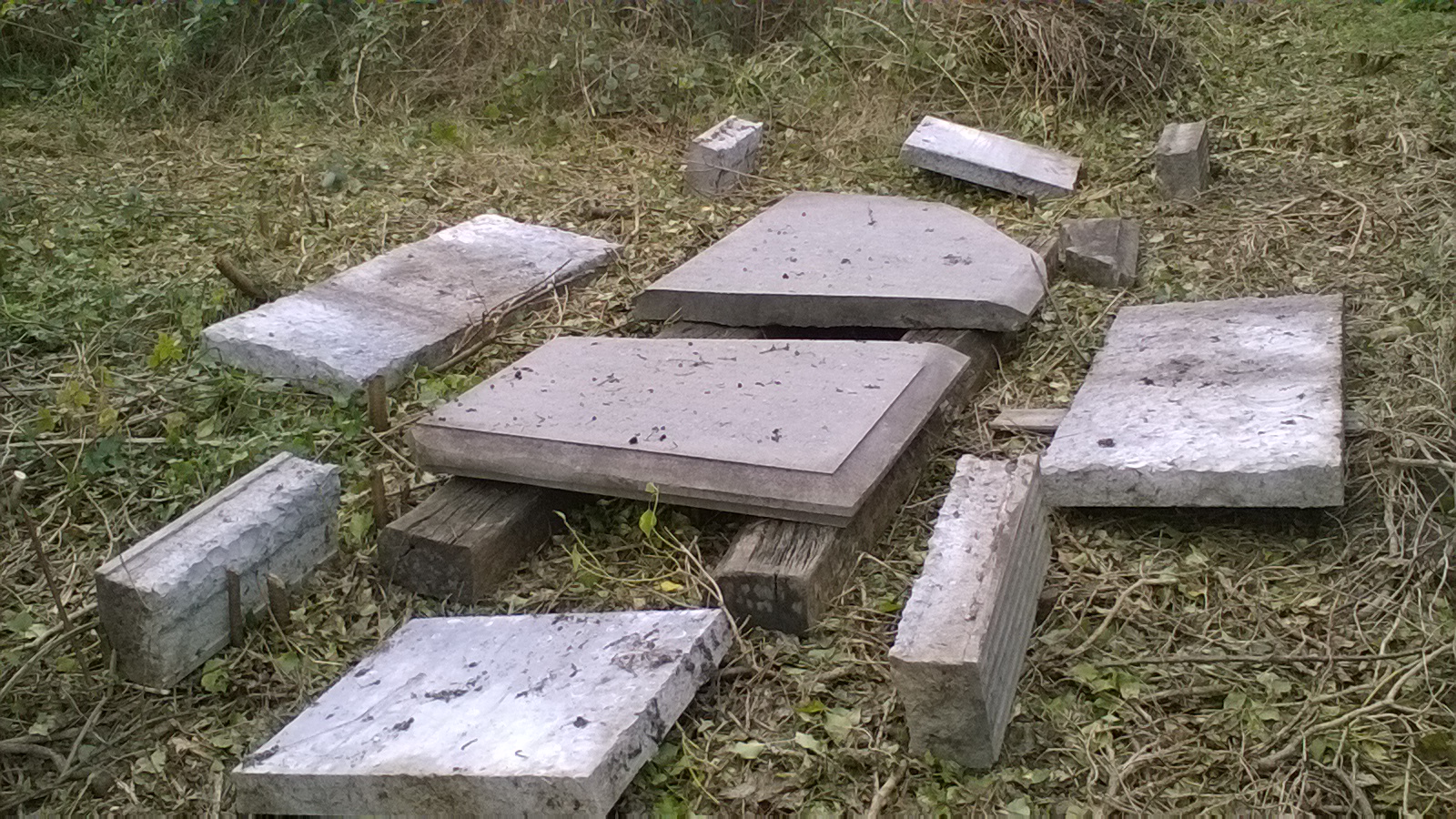
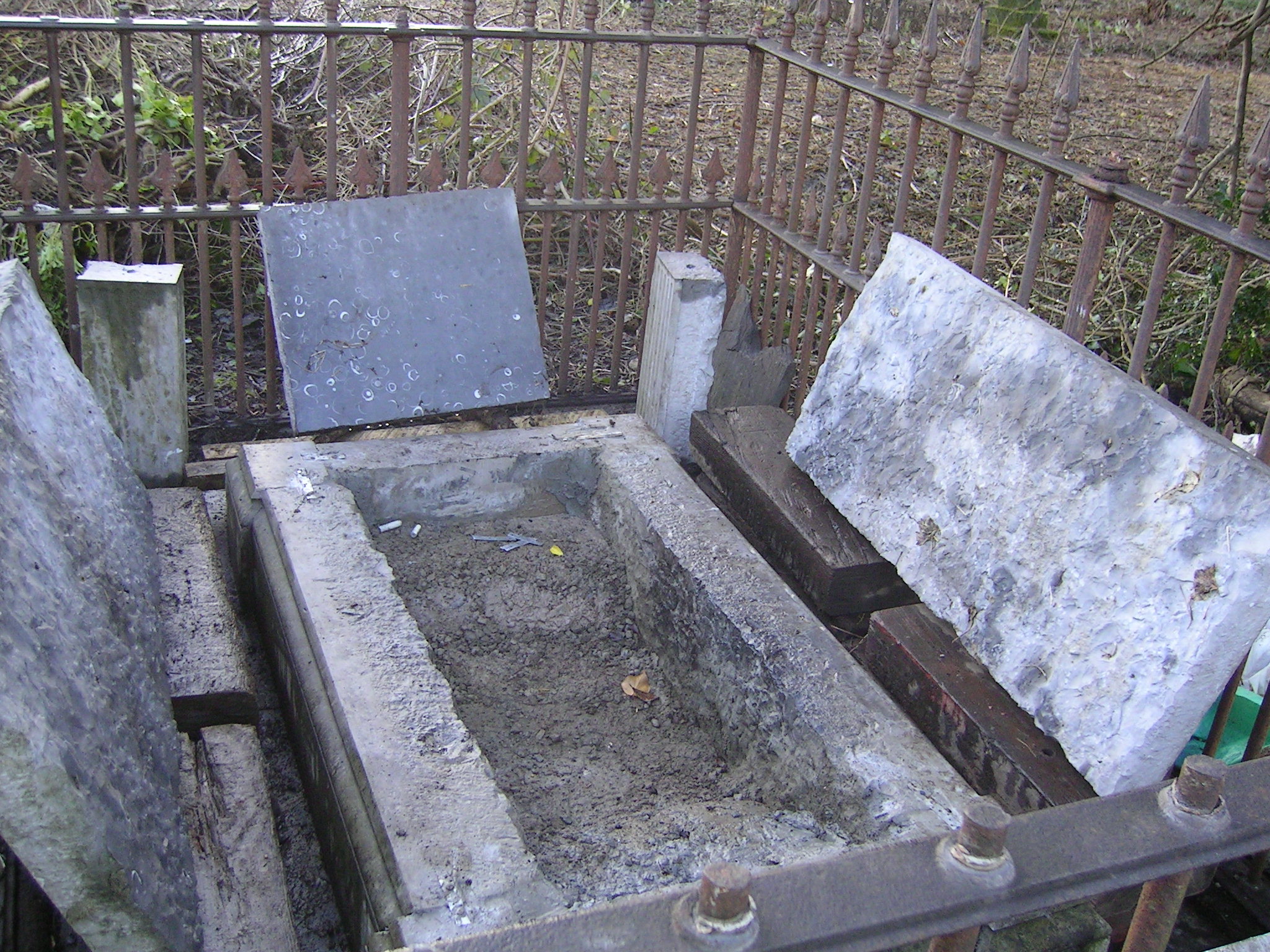
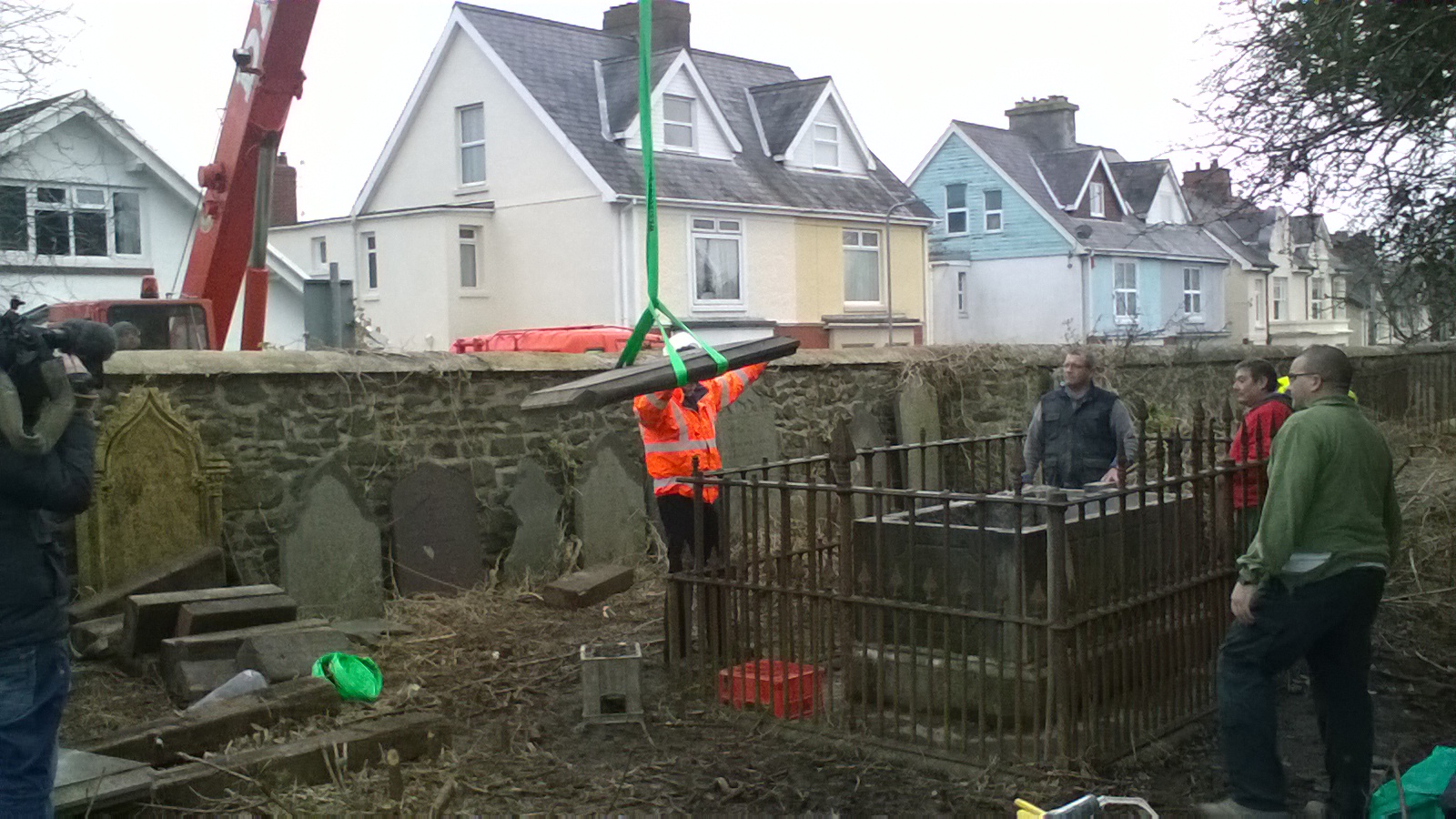
I think it is fair to say that there has never been a restoration of this type attempted before anywhere in the UK. The result of the restoration of the memorial is quite outstanding and an important historical feature on the brink of destruction has been saved for the nation. Indeed its location, nestling alongside the perimeter wall allowed an industrial crane to be parked close by and to lift all the pieces of stone box tomb outside of the railings like a jigsaw puzzle and to be rebuilt accordingly. The work of restoring the railings has been undertaken by me and my brother Robert having taken expert advice. I think you will be satisfied with the result.
What follows then is a gallery of photographs showing the phases of the restoration of the box tomb and railings from the beginning to the end. Finally if you look at the separate sub heading of “What’s in a Name” elsewhere on this website and scroll down the list of names you will see the story of the alleged “Royal Connection” under the name Caroline Georgiana Catherine Dalton/Prytherch. Please take time to read it and in particular to watch the video at the end.
Thank you…..Richard Goodridge (Chairman of Trustees)
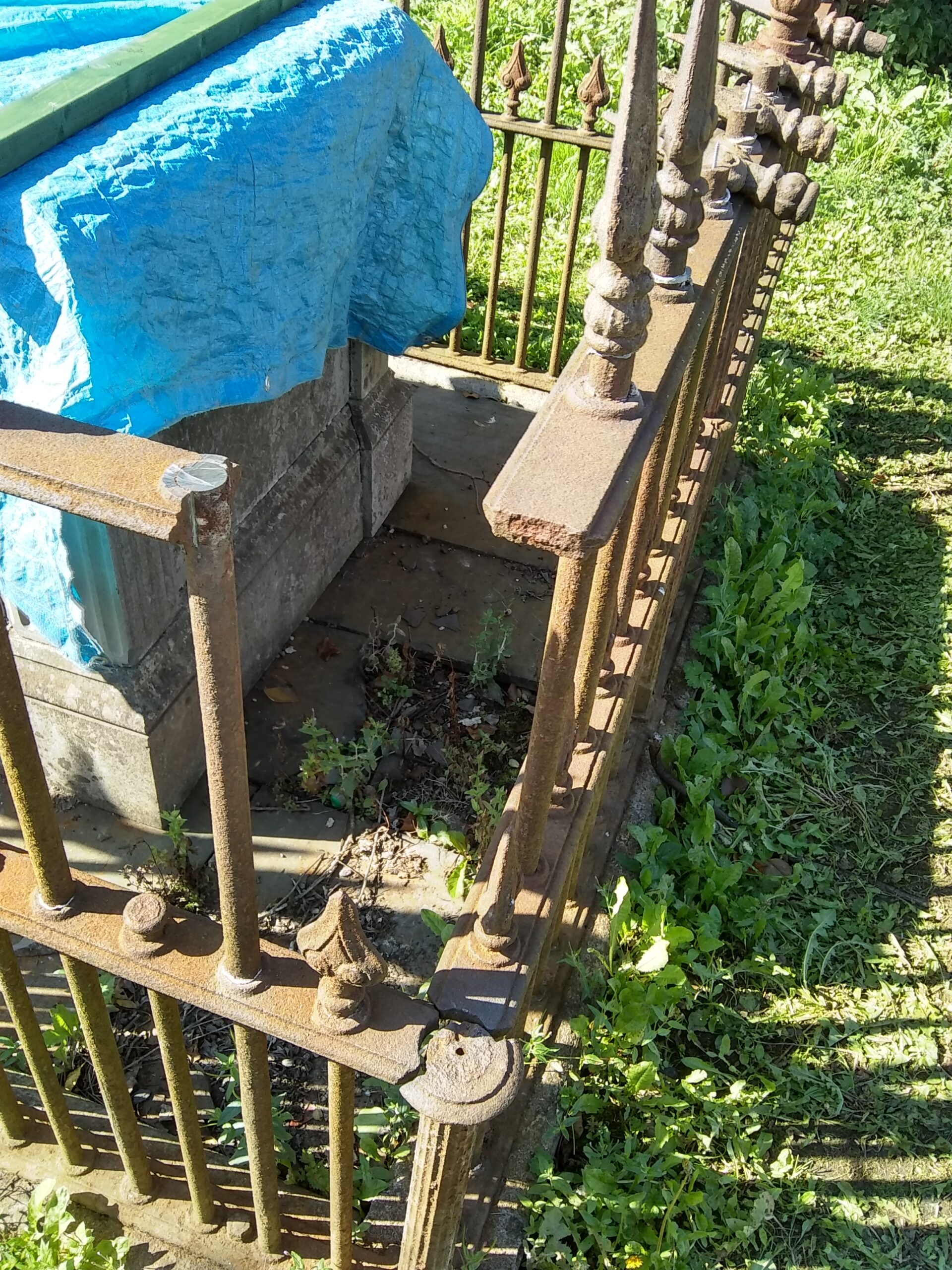
Corner of the tomb and railings before restoration began.Side of the box tomb and railings before restoration began.The tomb nearing collapse after ivy and overgrowth removal.The box tomb dismantled and removed by crane leaving the internal rubble visible. Note all the missing finials.The dismantled box tomb lays in pieces outside the railings ready to be re-assembled inside the railings by crane.Restoration of the box tomb begins. The crane doing its job of lifting the panels back inside the railings and the base being reinforced with concrete and steel pins.The panels were secured using steel pinsThe stone infilling begins – returning all the material that was found originally.Almost finished.Using a crane, the top of the box tomb is carefully returned.
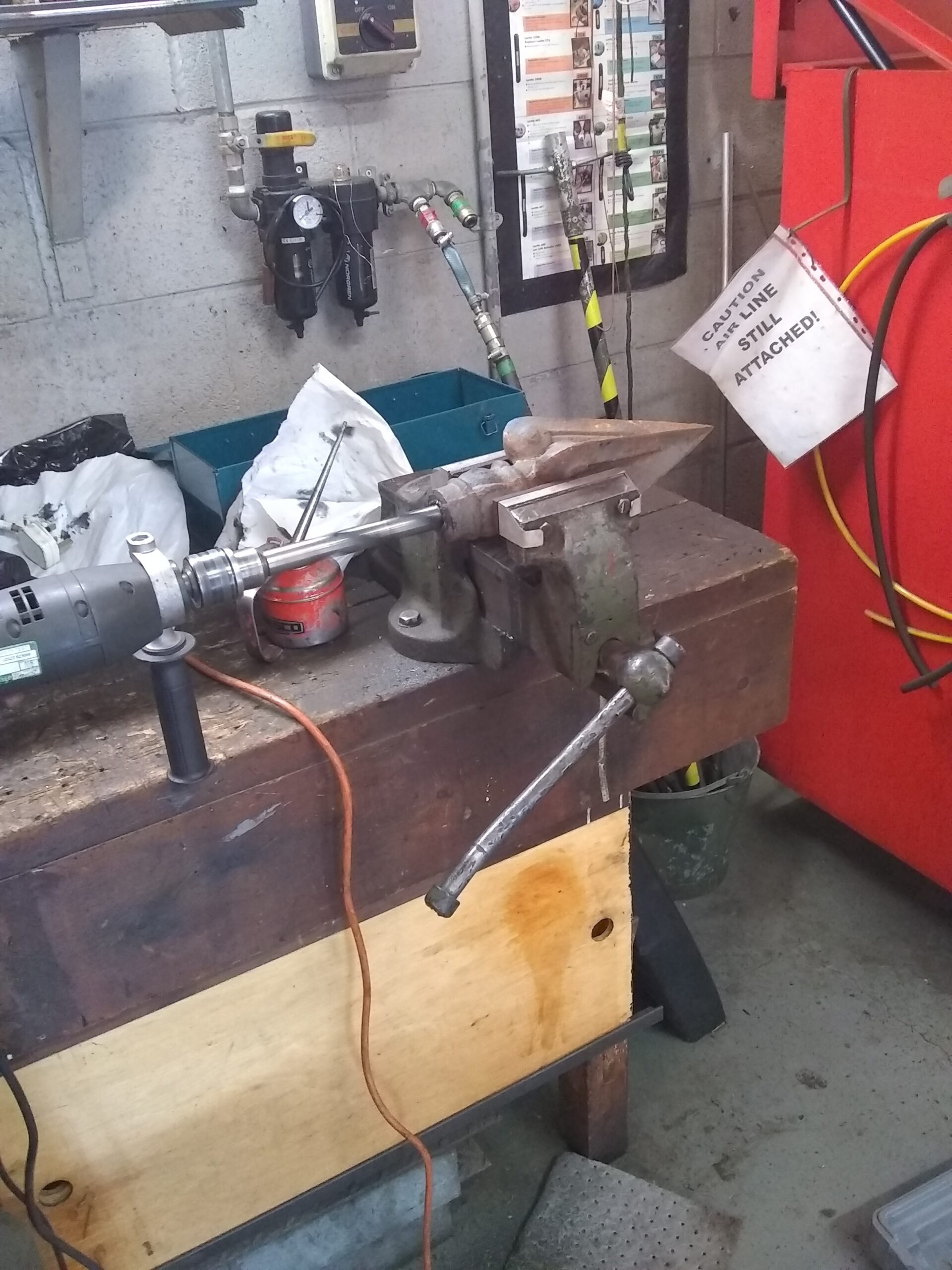
Some of the original finials and railings found lying in the ground. Many finials were missing and needed to be recast in cast iron using traditional techniques.Finials with a section of steel bar and pins insertedWorkbench ready.A new cast iron corner finial being drilled ready for fixingCorner section missingThe corner section back in positionThe cast iron railings with the missing finials.The final stages of restoration including the painting of the railings with red oxide.
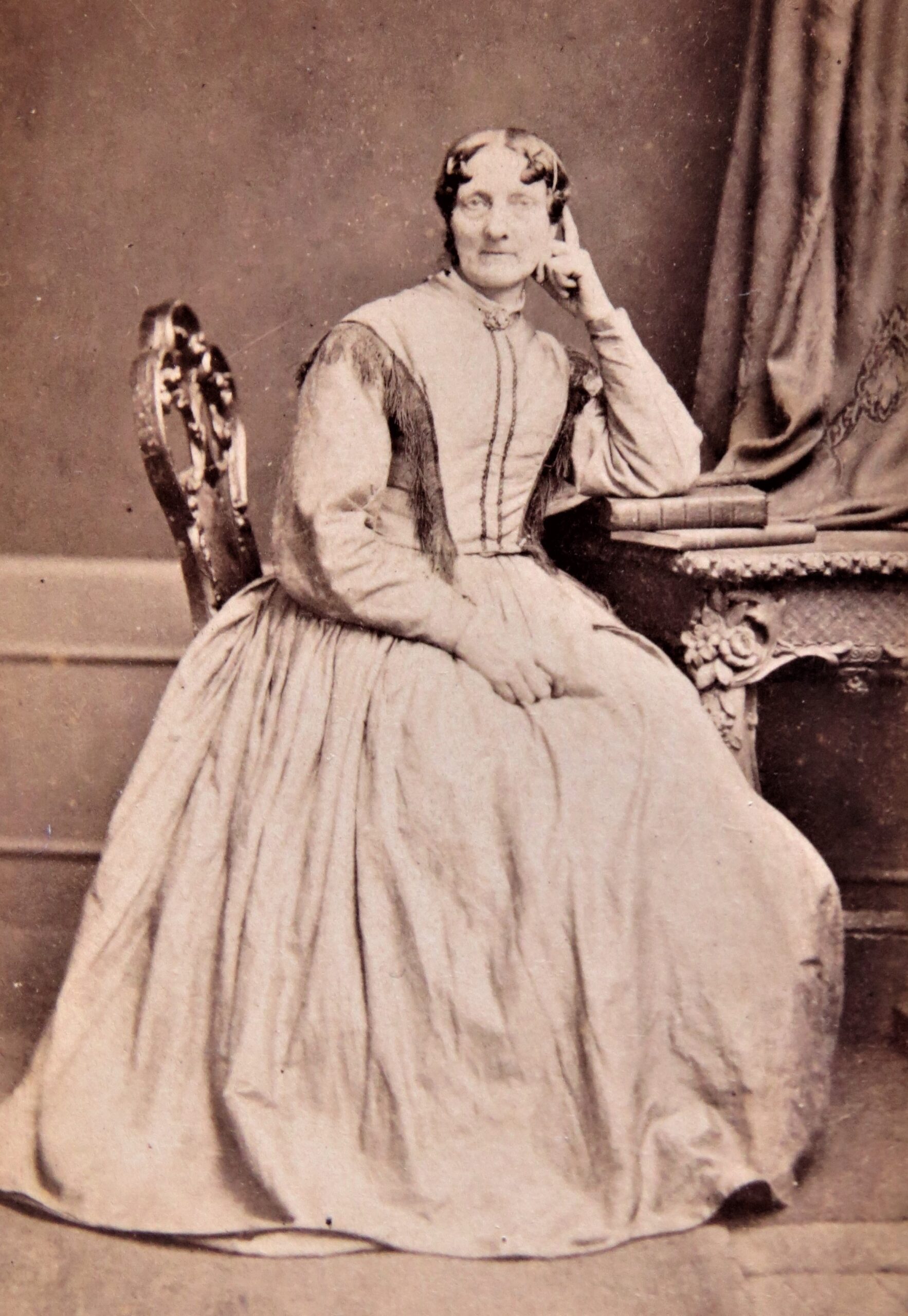
Photograph of Caroline Georgiana Catherine Prytherch taken in 1871. The last member of the family to be buried here.
Caroline Georgiana Catherine Prytherch (nee Dalton) was born on December 24th 1808 at a place called ARNEE in India in a fortified bomb proof barracks. She was the youngest daughter of four children born to Dr James Dalton and his wife Catherine. Caroline’s sister –Charlotte Augusta Catherine, also born in ARNEE, and her two brothers – Hawkins Catherine Augustus and Henry Catherine Augustus, born in MADRAS died at a young age and never married or had children.
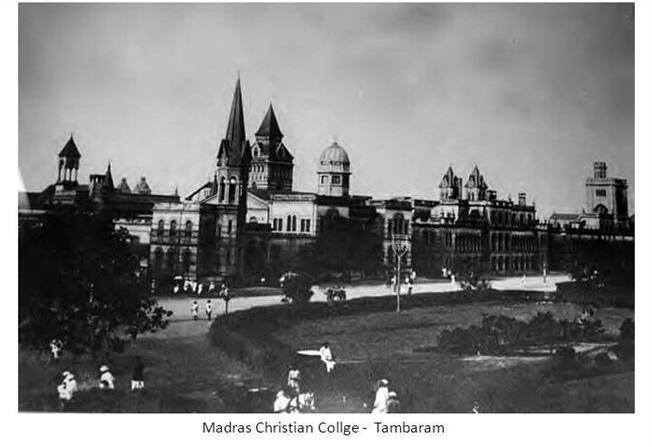
The “palatial” Hospital built by James Dalton which he owned, renting it out to the Indian government. The family continued to receive a substantial rental income until 1879 when a new hospital was built. The building is now used as the Madras Christian College.
Only Caroline married, at a church called Llanllwch on the outskirts of Carmarthen Town – to a wealthy Carmarthenshire landowner & Magistrate Daniel Prytherch who became the Mayor of Carmarthen in 1831. They had fourteen children. In 1875, whilst lodging at a house in Llanstephan with two of her children she died aged 67 and was buried in St David’s Cemetery Carmarthen with her husband and 3 children – Frances Sarah Dalton Prytherch, Blanch Dalton Prytherch, and Daniel Dalton Prytherch in what is undoubtedly the most elaborate and ornate grave in the cemetery.
The burial register entry for Caroline in 1875
For the last two hundred and sixty years the family has been mired in controversy in as much that it is still believed by some that Caroline’s mother Catherine was the daughter of a secret liaison between the then Frederick Prince of Wales (later king George III) and Hannah Lightfoot, known as the “Fair Quaker” Why such a story has persisted for such a long time is in itself a mystery and one that can never be answered. Even as far back as October 1821 a deluge of correspondence ensued in the London press on the subject. During all this time and even until her death Caroline herself kept a low profile bringing up her large family here in Carmarthen, many of whom died in infancy.
Apart from the historical interest we must not forget that architecturally, the Dalton/Prytherch memorial is significant in that it remains one of the few cemetery structures in existence with a now complete set of magnificent and ornate Coalbrookdale cast iron railings giving a prime example of Victorian architecture at its very best. What follows are extracts taken from a variety of sources on the families past published a number of years ago. History cannot be re-written and it is for each individual to make their own minds up as to what they really believe happened. Finally, once you have finished reading this story you will see a few photographs of the restoration process of the box tomb itself and the railings at the end. I wish therefore to direct you to the sub heading of MEMORIAL RESTORATIONwhich can be found elsewhere on this website and scroll down the list to find the story of the restoration of this grave. It has taken five years to complete, but worth every moment.
Photograph of Caroline Georgiana Catherine Prytherch taken in 1871 – Four years before she died in 1875. She was the last family member to be buried in St Davids. (By kind permission of Robin Prytherch)
…………………………………………”The eleventh century church of St. Peter’s is currently being given a much needed ‘face-lift’. Part of the million pound restoration programme is removing the existing chancel floor and constructing a new concrete replacement. However, what was found underneath the chancel was a surprise to everyone and an extremely important find historically”
The chancel floor was subsiding and had to be replaced. After the original floor was removed, the archaeologists moved in and excavated to a depth of a little over a meter. They uncovered several memorial slabs from the 1870’s but it is a large brick vault in the centre that caused the greatest jubilation. It has a domed roof and the memorial slab reads as follows:
In this vault are deposited the remains of
Charlotte Augusta Catherine Dalton,
eldest daughter of James Dalton Esquire,
formerly of this town and of
Bangalore in the East Indies,
she died on the 2nd Day of August, 1832
aged 27 years.
Also the remains of Margaret Augusta Dalton
second daughter of Daniel Prytherch, Esquire
of this town and Abergele, in this county,
by Caroline his wife,
youngest daughter of the above
James Dalton,
she died on the 24th day of January 1839
in the Ninth Year of her age
Who was Charlotte Augusta Catherine Dalton? Who was her young niece? To find out, we must now move back in time two and a half centuries.
We’ve all heard of the’ Madness of King George’ but it doesn’t end there! Poor George III was supposed to have married at least three wives!
One ‘wife’ was a Maria Fitzherbert. Another that he had been in love with was a Sarah Lennox. He married his Queen Charlotte Sophia of Mecklenburg-Strelitz in 1761 when he was 22 years. But was she the real Queen? Had he married before?
Prince George, Prince of Wales, had in fact, fallen in love with and married a Quaker girl, Hannah Lightfoot, three years previously in 1759. It is understood that she was the daughter of a linen-draper. The marriage and the existence of their children were kept secret to allow him to re-marry. They married at Kew (on the outskirts of London) on 17 April 1759 and the marriage documents can be seen at the Public Record Office there. Therefore, his later marriage to Queen Charlotte in 1761 was in fact a bigamous one. This second marriage lasted for 57 years and they had fifteen children.
What happened to Hannah after this is lost in the mists of time. Doubtless to say, her existence and that of their children was one of the greatest secrets of the 18th Century. It is understood that King George’s two ‘marriages’ co-existed and that his children from Hannah did not ‘arrive’ until long after his ‘marriage’ to the Queen.
It is understood that King George and his secret wife, Hannah had three children – two sons and one daughter. The eldest is reputed to be George Rex. He is reputed to have sailed to Cape Town, South Africa, in 1797 to save the monarchy from scandal. It is also understood that he never married- on the strict instructions of his father – so that there would be no legitimate heirs. It is said, however, that he did have children – two boys. It is though, the daughter, of Hannah – Catherine Augusta that married James Dalton, a doctor of medicine, in India on 20 October 1801.
James Dalton, who originated from Carmarthen, was a medical officer in the Bengal Army and spent some years in Bangalore in the East Indies. He was probably a descendent of the Dalton family who, in the 18th Century, lived at Clog y Fran House, near St. Clears (a town some ten miles from Carmarthen). It is understood that Catherine died in 1813 in Madras but not before she had borne him four children – two sons and two daughters. It is understood that all four children were baptised in Madras on the 20 October, 1813.
It is said that Dr. James Dalton returned to Britain on the 16th September 1823. His two sons and Charlotte did not live very long after this. Charlotte died on 2 August 1832 aged 26 years and was buried in St. Peter’s Church, Carmarthen. It is not known whether the burial was a secret affair, but certainly no record was kept and knowledge of the burial was not handed down through the generations. It is also known from the Dalton family that they had no knowledge of the burial place. For her tomb to be within the chancel and directly in front of the altar surely suggests that she was considered to be someone extremely important.
Charlotte’s sister, Caroline, had also settled in Carmarthen and married Daniel Prytherch. Prytherch was distantly related to her, there having been a marriage between the Daltons and Prytherchs prior to this. They had 13 children*. Two of the children were David and Margaret who died as a child of eight years and was buried with her aunt in the tomb. Daniel Prytherch, Caroline’s husband, was a prominent person in the town and was sometime, its Mayor. His family home was Abergole (or Abergolau) House at nearby Brechfa and this remained in the family until 1859 when David Dalton Prytherch died unmarried.
Does the royal connection with St. Peter’s Parish end there? Well, no it doesn’t! There is another interesting link. The church’s magnificent eighteenth century organ was originally meant for the Chapel at Windsor. The best organ builder of the time, George Pike England, had been ordered by the king to build a great organ for his beloved home at Windsor (one of the official homes of the reigning monarch). However the organ never reached its intended destination. It found its way to Carmarthen. Was it the King’s wish that it should go to St. Peter’s? It is unlikely that we shall ever know the answer.
Ironically, it was the organ that helped us to make the other connection between the King and the church. It was the great weight of the organ that caused the subsidence and the need for a new floor and the bringing to light of the Dalton tombs.
The following text is from an article by Byron Rogers, which appeared in the Saga Magazine:
Scandal Unearthed!
The poetry of history lies in the quasi-miraculous fact that once, on this earth, once, on this familiar spot of ground, walked other men and women, as actual as we are today, thinking their own thoughts, swayed by their own passions, but now all gone, one generation vanishing after another, gone as utterly as we ourselves shall shortly be gone, like ghosts at cock-crow. So writes G. M. Trevelyan in his “Autobiography of an Historian”
And among them there were mysteries, writes Byron Rogers.
They have put two foot of concrete over it, just as they did at Chernobyl, but already it is too late. Though the concrete has set, rumour is out, and a story already 250 years old is moving irresistibly into what may be its last act. If you have prayers to spare, say them now for the vicar of St Peter’s church, Carmarthen, in the West of Wales.
“When I was appointed seven years ago I was told I was being given the plum of the diocese. All I can say is that this plum has a stone in it. It has now got to the point where, during a clerical conference in Dublin, my mobile rang and there was this American voice on the phone. The Discovery TV Channel in the States wanted to come over to do DNA tests on someone buried in my church two centuries ago”.
The Rev was having some building work done to his church and St Peter’s, being Grade One listed, had, as required, sent in the archaeologists first, for this is a church so old it has a pagan Roman altar in its porch. The archaeologists assured him they would not be long, that they did not anticipate finding anything very interesting. And then they found something, the implication of which, to quote the Journal of British Archaeology, casts doubt on the legitimacy of the Queen.
Oh dear, said the vicar, Gordon Bennett, said I, for I was brought up in the town of Carmarthen.
But really it starts with the organ. The organ at St Peter’s was always a bit of a mystery, being so very big and grand, far too big and grand for a Welsh parish church. Originally intended for Windsor Castle, this was delivered to Carmarthen in 1796, and the tradition is that it was a personal gift from George III. The result, if you excuse the pun, is that the King’s organ points to what follows. For the organ was sinking. It had sunk eight inches into the chancel floor, said the organist, Paul Watkins. This, we were told, was because there were so many tombs beneath it. But it was when a lady put her foot through the floor during a midnight mass that we knew we were going to have to do something about it.
It was decided that a concrete raft was needed to halt the subsidence, which was when the archaeologists came in. A week after they started work, a team from Cambria Archaeology found a brick barrel vault in the centre of the chancel, in front of the altar, the most prestigious place in a church. And that was the first incredible thing, said the Rev Thomas. There was no historical account of such a vault in any of the church records, and there was no gravestone. If there had been a gravestone that disappeared when in Victorian times a new floor was laid, just as though someone wanted to hide it. You can see how we come to believe in a conspiracy theory.
When a vault is built a gravestone is usually part of the upper floor. Below are laid the earthly remains of one’s body. Here there was none. But as the archaeologists dug on they found a gravestone laid next to the brick vault, where the living would not see it.
The inscription read: In this vault are deposited the remains of Charlotte Augusta Catherine Dalton, eldest daughter of James Dalton Esquire, formerly of this town and of Bangalore in the East Indies. She died on the 2nd day of August, 1832, aged 27 years. Also the remains of Margaret Augusta Dalton, second daughter of Daniel Prytherch, Esq. of this town and of Abergole in this county, by Caroline his wife, youngest daughter of the above James Dalton. She died on the 24th day of January 1839 in the Ninth Year of her age. But when they peered into the vault there were four coffins. And then those names, too strange and grand for a Welsh family, and yet oddly familiar to anyone with a sense of history. That these were family names was clear for they occurred in two generations.
The burial records were checked, which confirmed only that persons of that name had been buried there. They then checked the records of the Carmarthenshire Antiquarian Society and found references in a 1911 essay to the Dalton family. It was then that the bells of rumour and conjecture began to toll, which in one context or another have been tolling for more than 200 years.
In the reference section of your local library, ask to see the Dictionary of National Biography. Now look up Lightfoot, Hannah, and you will read the following entry, the briefest in the DNB: Lightfoot, Hannah (fl. 1768), the beautiful Quakeress. (See under George III). Oh dear.
The relevant section refers to his teenage years, when he was still Prince of Wales. To this period belongs the scandal about the Prince’s attachment to Hannah Lightfoot, the fair Quaker, daughter or niece of a linen draper, whose shop was in St James’s Market. This is that part of London, which later disappeared under Regent Street.
The entry resumes. It is said that through the intervention of Elizabeth Chudleigh, who became Duchess of Kingston, he persuaded her to leave her home, and go through the form of marriage with one Axford, and that he frequently met her afterwards, and it is even pretended that he secretly married her, and had a daughter by her, who became the wife of a man called Dalton!
A man called Dalton; James Dalton, a doctor from Carmarthen, later in the employ of the East India Company, who called one of his own daughters Charlotte Augusta, and the other Margaret Augusta. George III’s mother and a daughter were called Augusta; another daughter was called Charlotte. Both names recur in generation after generation of the 18th-century Royal Family.
The official entry of James Dalton in the Indian Medical Services names of Surgeons held by the British Library
All of which left a very shaken clergyman in Carmarthen. The next thing I knew was that members of the Axford family had written to me, said Reverend Thomas. They said they had a copy of the marriage certificate between the King and Hannah Lightfoot, on which one of the witnesses was William Pitt the Elder. They also had a copy of Hannah’s will in which she signs herself Hannah Regina.
And then the Dalton Society of America wrote, saying they intended to come over and hold tours of the church.
A man who only wanted to have his chancel made safe for the future was caught in a tide of bizarre controversy. The DNB, while admitting that George III as a teenage Prince of Wales probably knew Hannah Lightfoot, dismisses the rest of the story on the grounds that it rests merely on anonymous letters of a late date. But this is not so.
George III became King in 1760 at the age of 22. But 10 years later, when his brother the Duke of Cumberland was cited by a wronged husband, the Public Advertiser newspaper of 1770 was already referring archly to the Letters of an Elder Brother to a Fair Quaker. In 1776 The Citizen, with heavy irony, mentioned The History and Adventures of Miss Lightfoot, the Fair Quaker, wherein will be faithfully portrayed some striking picture of female constancy and princely gratitude which terminated in the untimely death of that lady and the sudden death of her disconsolate mother. In other words, the story was common knowledge very early on.
These are the only known facts. Hannah was born into a Quaker family in 1730 in Wapping. Her father, a shoemaker, died when she was small, when she was adopted by her mother’s brother, and the linen draper of St James’s Market. But then in 1756 something amazing happened. She was thrown out of the Quakers on a charge of having been married by a priest to Some Person Unknown. After this, perhaps even more amazing, she could not be found, even though the Society made strenuous efforts to find her.
The well-known 18th-century writer, William Combe, later the author of the best-selling Dr Syntax verses, pointed to the significance of this expulsion. With such suitable precautions was the intrigue conducted, that if the body of people called Quakers, of which this young lady was a member, had not divulged the fact by the public proceedings of their meting concerning, it would in all probability have remained a matter of doubt to this day.
The only thing was, Hannah had been married in 1753 to a man called Isaac Axford, a grocer of Ludgate Hill, and thus not Some Person Unknown. But the sequel was the same, when Mary Pendered in 1910 wrote the only book on Hannah Lightfoot; she claimed to have made contact with the great-great-granddaughter of Isaac Axford by his second marriage in 1759. From her she heard the account handed down in the family that had Hannah being taken away from her groom at the church door, driven off in a travelling coach and never being seen again.
The Monthly Magazine of 1825 has a slightly different story. Its correspondent had contacted the Axford family, then still grocers on Ludgate Hill, who told him that Hannah had lived with her husband for six weeks until the night the coach and four called. The family had advertised widely for her whereabouts, but after some time obtained information that she was well provided for.
The 19th century, and its republican sympathizers, had a field day with the story. It was now that the story of an actual marriage with George III surfaced, something not mentioned before. Charles Bradlaugh, later an MP, stated that Queen Charlotte, after Hannah’s death, insisted on her own second and secret marriage with George III and that Prinny, the notorious Prince of Wales and their first-born, later George IV, used the story to blackmail his parents.
It gets even more complicated. The Historical Fragment, an anonymous publication, stated in 1824 that Caroline, the estranged wife of George IV, who had died three years earlier, had said openly that she was neither wife nor Queen. The first was because George IV was a bigamist, which was true, for he was already married to Mrs Fitzherbert. But the second claim was much more startling. Caroline was not a Queen because George III, when he married Queen Charlotte, was already married to Hannah Lightfoot, which would have made George IV illegitimate.
George I imprisoned his wife for life for adultery, and plotted to have his son, the Prince of Wales, kidnapped and transported to America. He, in turn, simply wished his son dead and said so in public. George III leaped at his son’s throat and tried to throttle him.
But it is the generation we are concerned with, George III and his brothers, who introduced a new twist of their own, secret marriages. The Duke of Cumberland, already paying out £10,000 to a wronged husband, was secretly married to a widow called Horton in 1770. His brother, the Duke of Gloucester, admitted in 1772 that he had been married for six years. Their nephew, later George IV, secretly married Mrs Fitzherbert. But their sister, being already married and the Queen of Denmark had no such recourse. She was locked away for life for adultery, and her lover, the Prime Minister of Denmark, was hacked into pieces by the public executioner.
Such would have been the diet available to readers of an 18th-century Hello magazine.
The point is, no contemporary would have thought it that bizarre that George III had married Hannah Lightfoot, and the story never went away. Cassell’s History of England, written in Victorian times and the most popular history ever (it still turns up in country house sales), presented it as historical fact, saying it had taken place in 1759 at Kew, and that documentary evidence survived.
The Irish politician Daniel O’Connell said he had once thought of writing a novel about a son of this marriage, making him a revolutionary soldier of fortune. Mrs Piozzi, Dr Johnson’s friend, wrote in 1781 that there was such a son in real life. Speculation turns on a man said to have been called George Rex, an 18th-century immigrant to South Africa, who was mysteriously set up there in great style, and whose black descendants survive. They were interviewed by the documentary film maker, Kenneth Griffiths, who said, “I started by not believing the story, and ended up convinced it was true”
The DNB does not mention George Rex whose name alone seems too good to be true.
So did George III marry Hannah Lightfoot? Did this odd, impulsive, not too bright, and lonely young man, who had been kept in virtual seclusion, rebel once before destiny closed in on him? As a young king he seemed to have brooded a lot on this destiny, confiding in the Duke of Chandos that, unlike him, the Duke was a happy man, in that he would never have to take into his arms a woman he had never even seen before. Of course he then did and had 15 children by a woman said to have been the plainest in Europe. But does that worry, and those early doubts suggest that he had known some kind of happiness which sent these into even higher relief?
But where the mystery really deepens is around Hannah. She marries Axford, but it is a very dodgy marriage, conducted for cash without license or banns in the 18th century by very dodgy clergymen. And it took place in the chapel of one Alexander Keith, a clergyman so dodgy he was excommunicated by the Archbishop of Canterbury, whom the Rev Keith himself excommunicated in turn. Why should a respectable grocer and a linen drapers niece have themselves married in such a place?
And there is more. A portrait survives by Sir Joshua Reynolds. The 1817 catalogue of pictures in the great house Knole, near Sevenoaks, says it is of Miss (sic) Axford. This is the Fair Quaker noticed by His Majesty when Prince of Wales. George III was then still alive. The portrait shows a serious young woman in white, and it is a face more interesting than pretty. But why should the most fashionable portraitist of his day have painted a grocer’s wife?
Nobody knows how the picture got to Knole. But then nobody knows what became of Hannah, who in the late 1750s just disappears from the face of the earth. There is no record of any attempt by her, or any member of her family, to profit from what may have happened. Everything is so quiet, so discreet, just as the vault in St Peter’s church is quiet and discreet, even more so under tons of concrete. But the gravestone, lost until now, will be laid in the new floor. There is no mention of a mother and no grand claims. Just those strange names. But it is enough to have the Discovery Channel tracing a Welsh vicar to an Irish conference, for the story has never gone away, which now moves into its Carmarthen Connection.
Side of the box tomb and railings of the Prytherch family before restoration began. Almost invisible due to the Ivy growth.Corner of the tomb and railings before restoration began.The box tomb dismantled and removed by crane leaving the internal rubble visible. Note all the missing finials.Five years later – the completed memorial and railings in all its glory.
John Howells was born in Carmarthen in 1823 and was a stonemason by trade. In September of 1844 aged just 21 whilst out drinking with a friend he was accosted by a notorious trouble maker John Evans whose reputation as a rather nasty individual was well known. At that time John Howells had a young wife and daughter and was just beginning to enjoy family life in Cambrian Place when his life was about to change forever. A quiet individual by nature, and always courteous, but provocation can sometimes change a person’s personality in an instant as was the case with John Howells on that fateful September evening when John Evans lay dead on the ground with a gaping head wound caused by the altercation with John Howells.
Even today those of us who have been brought up in Carmarthen will testify to its unfortunate reputation over the centuries of crimes committed through drunkenness and disorderly behaviour. Much has been written on the subject of Carmarthen’s rather inebriated murky past and this one story shows just how dangerous it could be walking the streets of Carmarthen in the 1840’s. It is amazing to think that in 1844 when this unfortunate incident occurred there were 171 Public Houses in Carmarthen (one hundred and seventy one) – an unbelievable number for such a small town, which had swollen in size to accommodate a substantial number of soldiers stationed here due to the Rebecca Riots. What follows are extracts from the “Welshman” newspaper of the case against John Howells, originally on a charge of murder but later changed to “Excusable Homicide” The newspaper reported the story as you will see, in a manner that today could appear to be offensive to many who read it. Part of the report on the Post Mortem of John Evans has been removed as even by today’s standards it is too graphic to publish.
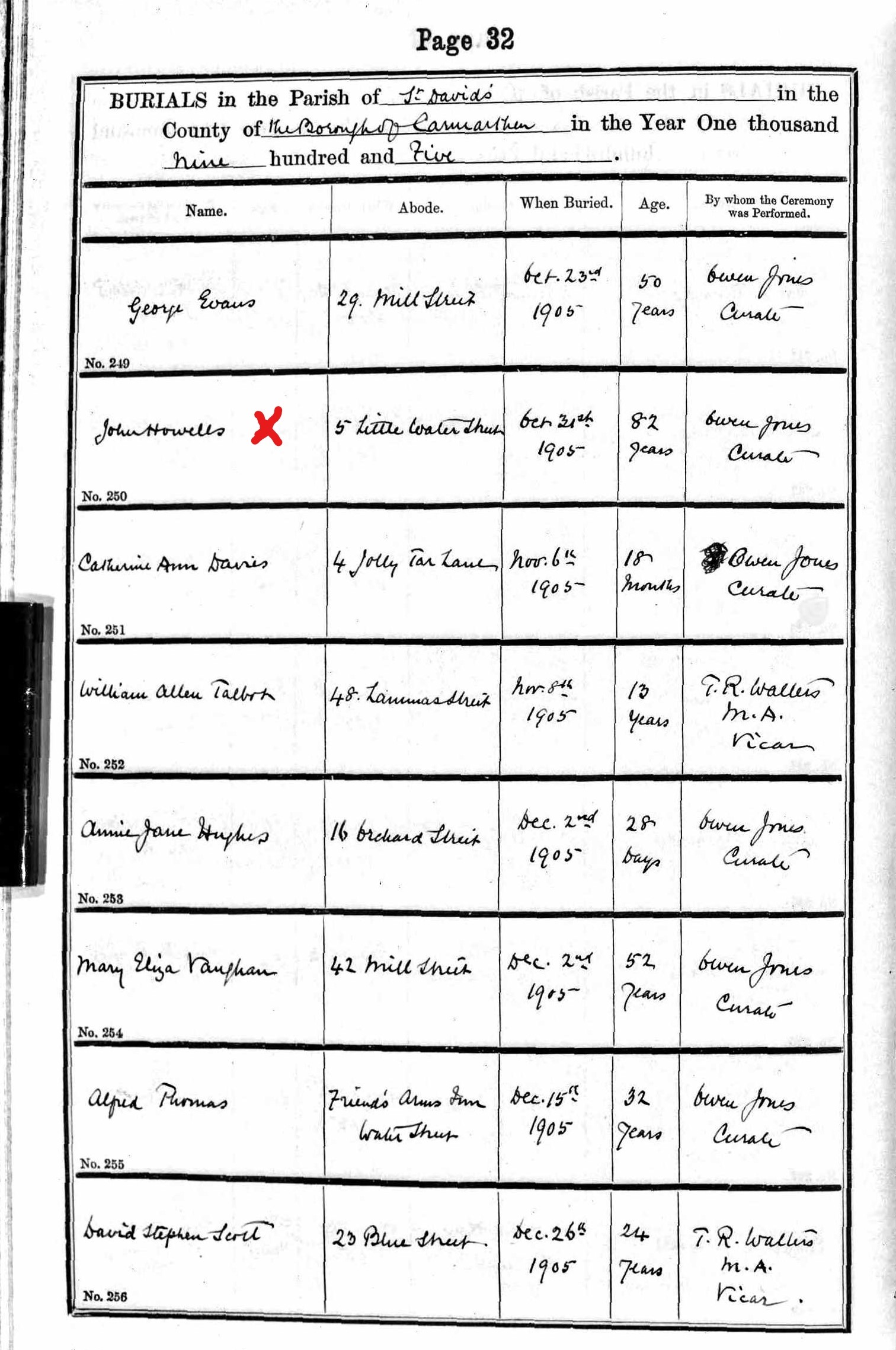
The entry of John Howells in the burial register
However, history cannot be re-written and John Howells was to live another 61 years after this terrible incident until his death in 1905 at the age of 82, when he was buried here in St David’s cemetery with his wife and daughter. He lived a quiet existence to the end of his life, may he rest in peace. As for John Evans the unfortunate victim in this story, he is not recorded as being buried in St David’s Cemetery. Also to continue the “theme” of the effects of alcohol, the short story at the end of this article recounts the sad tale of ANN JESSOP who died from asphyxiation as a result of becoming drunk – just a year earlier than the fateful fight between Evans and Howells. A sad ending to a life still to live.
“DEATH FROM DRUNKENNESS”
Great excitement was caused in Carmarthen on Wednesday evening, by a widely circulated report that a man had been killed. Large crowds of people thronged to the spot where the supposed murder had taken place, and where it was found that the deceased individual was John Evans, alias John Wilkes, who had been fighting with a mason named John Howells. Evans was a shoemaker of some notoriety in Carmarthen both for his propensity to inebriation, and his quarrelsome disposition when intoxicated. Howells, on the other hand, was a mason of a quiet disposition. From the particulars we were enabled to gather, it appears that Howells, in company with John Davies, a mason, came out from the back door of the Black Lion, into Conduit lane when there they were met by Evans, very much intoxicated, who commenced a series of annoyances against Howells, swearing at him, and threatening to fight him. Howells seems to have exercised forbearance rather surprising for a person of his class of life, telling Evans to go home, that he d not want to fight him, and that if he continued to annoy him, he would give him in charge to the police. Evans followed Howells to Spilman Street, and then, stripping off his coat, he rushed at and struck Howells several times about the head. Howells then adopted a mode of fighting but too commonly pursued in Carmarthen among the lower orders – an unmanly and cowardly mode. He bent down his head, and butting at Evans’s stomach, seized him by the thigh, as to throw him down in such a manner that his head struck the ground first. Evans got up, and again struck Howells, declaring that he was man enough for him, and would “send him to hell.” Howells again rushed at him, and this time with fatal effect, for Evans fell without a groan, and never moved afterwards. It is said that after the deceased fell, Howells kicked him two or three times on the head; but this seems doubtful. After remaining a few minutes looking on (during which time no one attempted to assist Evans up, or to see whether any life was remaining), Howells and his companion walked away, and Howells was apprehended the police on the bulwarks by the side of the river walking quite unconcernedly. The body of John Evans was conveyed to his own house and it was then found that he was quite dead. An extensive bruise appeared on the back of the head, and very slight cut was visible, but no other mark of violence was seen. Surgeons Rowlands and Hughes attended immediately, the former of whom attempted to bleed him, but all assistance was of no avail.
THE INQUEST.
The Inquest on the body was held yesterday evening a. six o clock, at the Black Lion, before J. P. Watkins. Coroner and a jury consisting of the following persons Messrs. John Williams, currier, (Foreman) J Philipps, J. L. Collard, T. Richards, J. Davies, T. Lamb, W. Morris, John Morgan, John Thomas, Thomas W. Jones, Evan Thomas, Samuel Evans, and John Thomas. The Jury proceeded to view the body, which was lying nearly naked on a kind of bier in the deceased’s house, or rather hovel, for there was scarcely an article of furniture in it. It was fast approaching decomposition (although it had only been lying dead a day,) and the effluvia emitted from it were quite intolerable. On their return, the prisoner and his attorney were allowed to be present, and a quantity of evidence was then taken, some of which was perfectly unimportant, while other parts were extremely contradictory. The first witness examined was Mr. Thomas Stanhope Gardnor, whose evidence was not material, as he only saw the commencement of the fight, and did not appear to know anything about the matter. Next came David Davies, auctioneer, who said :— about 5 o’clock yesterday evening I saw the deceased and Howells and another man standing in Conduit Lane. Evans was making attempts to strike Howells. I stopped there to look on. There was no crowd about them then. Evans held his fist up, but Howells did not. Evans came into Spilman-street, and took off his coat. He then turned to Howells, and said, “I’ll knock you to hell.” He went up to Howells several times, and thrust his fist in his face. Howells said, “I don’t want to fight you go home.” Howells also added that he would give Evans in charge, if he would not go home. Evans called him a coward, and struck several times. Howells then gave Evans a blow and pushed him down, falling upon him. Some persons standing by lifted them both up, and Evans attempted to strike Howells again, but as he was in the act of striking, Howells stooped, caught hold of Evans’s legs, and threw him down on his back, falling down himself also. Howells was lifted up by the person that came with him, but Evans remained lying there. Howells went away shortly after. Howells attempted to kick the deceased when he lay on the ground, but was prevented from doing so. Evans did not move after the second fall. I believe Howells only fought in self defence, because he told Evans to go home a great many times, as he did not want to fight. Howells lifted the deceased fairly up and threw him down. Evans was as drunk as he could be, but I should think Howells was sober, or he would not suffer so much abusive language as he did. Mr Thomas Jones, Saracen’s Head, corroborated the witnesses’ testimony.
John Davies, mason :-“ Howells and myself came out of the back door of the Black Lion about 5 o’clock yesterday in the Conduit Lane. John Evans came there and said Howells must fight with him, at the same time taking hold of him by the chin. Howells asked what he had done to Evans. Evans replied by cursing and swearing and declaring that Howells was bound to fight him. We then went away towards Spilman street, and Evans followed us, after having prevented us from going into King Street.
The very narrow alleyway Conduit Lane still in existence leading from King Street to Spilman Street
Evans then put his fists in Howells face, and Howells said that if he did not leave him alone he would give him in charge of the police. Evans took off his coat, handkerchief, and apron, and struck Howells several times. Howells caught hold of Evans by the hip and putting his head against his stomach threw him down on his back and fell on him. Evans rose and came up to Howells again. Howells seized him in the same way, and Evans again fell on his back. Howells fell on him again. I then seized Howells and took him away. The deceased was very quarrelsome when drunk.
Thomas Somersgill, Lance Corporal of the 13th Light Dragoons- “I was in the Saracen’s Head about five o’clock yesterday, and saw two men in the street fighting. I did not go out, but looked at them through the window. The deceased fell, but immediately got up and took his coat off. He made a rush at the prisoner, and struck him 2 or 3 times. The prisoner then made a step towards him, stooping down, and butted him with his head, and catching him by his legs threw him down on his back. When he was down, I saw the prisoner kick at him several times, but as there was a great crowd I could not see whether the kicks took effect or not. I called out from the window, “Take that coward away” and ran out to the passage. I saw the deceased on the ground and thought he was drunk or stunned. I saw that throughout the affair the prisoner was anxious to evade Evans. Howells did not appear drunk, or he would have returned the insults much sooner than he did. Evans was very drunk. In consequence of a wish on the part of the Jury that a post mortem examination should take place, the Coroner here adjourned the inquest until six o’clock this day. The post mortem examination is to be made by Messrs. Rowlands and Hughes. The Jury were then bound over in their own recognisances to appear today, and the prisoner was removed back to the station house.
6TH SEPTEMBER 1844 PAGE 3 THE WELSHMAN
DEATH FROM DRUNKENNESS.—ADJOURNED INQUEST.
At six o’clock on Friday evening the jury again met. The first witness examined was Mr. James Rowlands, surgeon, who deposed as follows:-“I made a post mortem examination of the body John Evans, at 10 o’clock this morning. Externally it presented nothing of importance, except on the left side and back of the head, where I found a contused wound from which blood oozed. There was a small scar on the left shoulder, but that was not a recent one. The proximate cause of death was pressure of blood on the brain, which pressure of blood was caused by outward violence. I don’t think it was apoplexy, because there was such a quantity of black venous blood. The walls of the heart were rather thin. The liver and kidneys were perfectly healthy. There was no previous disease to account for the appearances in the head except the violence. Drunkenness and a consequently distended stomach certainly have a tendency to produce apoplexy, but it did not produce it in this instance. Mr. John Hughes, surgeon, was next examined, and he fully corroborated Mr. Rowland’s testimony.-The Coroner then read the evidence to the jury and proceeded to observe upon the distinction between murder, manslaughter and homicide. He said that in this case there was no evidence of malice, and might proceed from sudden transport, or the involuntary commission of an unlawful act in the absence of malice. The right of a man to natural defence does not imply a right of attack. To justify the plea of self defence, it must be proved that the slayer had no other possible or probable means of escape from his assailant, and if the jury were convinced that Howells had no other possible – or probable means of escaping, and that he had retreated as far as he could, then the homicide might be excused. But if the evidence did not satisfy them that he had used due diligence and had other means of escape, then it cannot be excused. It did not matter who struck the first blow – that was unimportant; but before the homicide could be excused or justified, the jury must be perfectly convinced that Howells used all possible means of escaping from Evans.-The jury then consulted together for about an hour, and returned a verdict of “Excusable Homicide.” Howells, who had been all the while in custody, was discharged after having been admonished by the coroner.
13TH SEPTEMBER 1844 PAGE 3 THE WELSHMAN
…DEATH FROM DRUNKENNESS.— Editorial
We have to add another death this week at Carmarthen, to the many that are almost daily occurring in some place, from indulgence in “drink”. As the details in evidence of this case, a case of “death from drunkenness” will be seen our report of the inquest held yesterday evening on the body of John Evans, we allude to the melancholy event here, in order to direct public attention to the consequences of a vice which, notwithstanding all the efforts of teetotalers, is not, we fear, on the decrease. Temperance has yet to be taught in this town as well as in other towns. But it is not to be taught perhaps so effectually by teetotal lectures as by the affluent and influential classes, who, instead of offering inducement to drunkenness, either directly in the shape of gratuities, or indirectly, by countenancing a career of dissipation, should not only themselves practically inculcate temperance, but provide the humbler classes with the means of enjoying wholesome recreation. Where are the common lands of Carmarthen?-where the village greens of South Wales? Never was any population in the world so utterly destitute of the means of rational recreation. If the object had been to encourage drunkenness no surer method could be adopted than that which we see here. It seems—there is some difficulty in ascertaining it for certain, but it seems that John Evans, the unfortunate subject of the Coroners inquest, with other men, who are ever ready to welcome equally the arrival or the funeral at Carmarthen of any man, woman, or child, for a pot of ale, saw in the return of Mr. Morris, the borough’s member, an opportunity of indulging in drink. He and they accordingly having earned their gratuity, in the usual way, got drunk – the consequences of that drunkenness are detailed in our account of the inquest that viewed the body of the deceased. What a moral does not a drunken death teach! How eloquent is the fate of John Evans! No lecture so convincing, no sermon so impressive all that wretched mans end and that scarcely less wretched remainder of the survivor’s, John Howells. Nor are any of us perhaps wholly free from blame – the more influential the more reprehensible – who sanction by silence, or stimulate in any other way, a vice which has been the ruin of so many men—of so many even in the limits of the town where John Evans fell down dead —under what circumstances the evidence before the coroner’s jury shows.
ANN JESSOP
An inquest was held yesterday evening, at the Lion Royal Hotel, before J. P. Watkins, Esq., coroner, to enquire touching the death of Ann Jessop. The deceased had for some time past cohabited with an old pensioner named Johnson, who accompanies the troop of 4th Light Dragoons now in Carmarthen, as an assistant farrier. They resided on the Castle Hill. On Wednesday, Johnson received his pension, and after purchasing a gown, a pair of stays, some stockings, shoes, &c., for deceased, he gave her a sovereign. With this it appeared she purchased a bottle of rum, and drank until she became quite stupid. While in that condition she wanted more spirits, but Johnson, who was also intoxicated, refused to allow her to have it. The woman of the house went into their room some time afterwards, and discovered the deceased lying on the bed, on her face. She asked Johnson what was the matter, and he replied that she was drunk. It was found, however, that she was dead. A report was instantly raised that Johnson had killed her, but on enquiry it turned out perfectly unfounded. She had been “beastly drunk” as one of the witnesses described it, and falling on her face on the bed, had been suffocated. She was about 48 years old. The jury returned a verdict that the deceased died by excessive drinking. A vote of censure was afterwards unanimously passed by the jury, (many of whom were publicans,) on the shameful practice which prevails in this town of giving liquor to persons already intoxicated.
Ann Jones a young 27 year old lady died by swallowing cleaning fluid, and John Parcell hanged himself – both within the space of twelve months. They have no known grave. They are both also recorded in St David’s burial register as having received full burial rites, their names recorded for posterity. Had the Coroner found them to have committed “suicide”, they would have received no such accolade under church and canon law as it existed at the time and would not have been recorded in the register and not been given any burial rites, which did occur on a number of occasions. Being judged to be “temporary insane” by the Coroners jury was in many instances an outcome that was the better of two evils. Those who sat in deliberation of such occurrences knew full well that a decision of suicide would bring shame on those families concerned and would not entitle them to have a proper burial and so by being judged as “temporary insane” was in some way a more satisfactory outcome for all concerned. People took their own lives in desperation then as now, but we remember them all with compassion. What follows then are their stories, briefly reported on in the “Welshman” newspaper of the day. May they rest in peace.
ANN JONES 1842 -1869 – A SAD CASE OF POISONING.
On Tuesday last, an inquest was held at the Carmarthenshire Infirmary, before John Hughes, Esq., coroner, on the body of Ann Jones, who died on the previous day. The following evidence was given. William Jones said I live in the parish of Newchurch. I am a schoolmaster. The deceased is my sister. She is 27 years of age, and a single woman. She was employed as a servant with Miss Evans, Picton terrace. She had been there for some months. She was generally in good health. As far as I know she was quite comfortable in her service. She seemed to be of a cheerful disposition. The last time I saw her was about the middle of May, in the street, and she was in her usual health and spirits then. I do not know whether she had any trouble. I heard that she was taken ill on the 26th of June. I saw her at the Infirmary. I did not speak to her at all as to her illness, and of my own knowledge I know nothing about it. The Coroner remarked that the next witness ought to be Miss Evans, but as she was away from home she could not be present. If the jurors were not satisfied with the evidence they could adjourn the hearing. Dr. Lewis said: I am a physician, practicing in this town. I was called to see Ann Jones, the subject of this enquiry, on the 22nd of June last. I saw her about twelve o’clock at noon, at Miss Evans’s, house in Picton terrace. When I saw her she was on the bed partially undressed. She had frequent vomit. I saw a surgeon there and he gave her oil, eggs, and water. When I came to the house I took charge of the patient. The surgeon told me that he gave these as antidotes to something the deceased had taken. I gave her chalk and water, and after she had vomited several times I had her put in bed. Her mistress showed me a bottle containing Sir William Burnett’s disinfecting fluid, which I believe contained chloride of zinc, and I smelt the ejected contents of her stomach, which smelt of chlorine. Her mistress told me that she had taken some of the contents of the bottle. About an ounce of it was missing. The quantity that she had taken could produce the effects I saw. In a few days after, as she continued very ill, I had her removed to the Infirmary, and attended her until her death, yesterday morning at eleven o’clock. I have subsequently made an examination of the body, and found that the cause of death was the ulceration of the lower end of the stomach, and the contraction of the lower opening of the stomach. I have no doubt death was the result of her having taken some corrosive poison. I cannot say what, but I believe it to be a solution of chloride of zinc. I did not notice any particular feeling about her. I never saw her but once before. She was living alone in the house, her mistress being away from home. Catherine Bevan said I am the matron of the Carmarthenshire Infirmary. I knew Ann Jones a patient; here, and formerly a servant with Miss Evans, of Picton terrace. She was admitted in June last, and continued until her death yesterday. I had a conversation as to the cause of her illness about five weeks ago. She said that she had a great wish to take the sacrament of the Lord’s Supper, and then said she had taken the disinfecting fluid, knowing it to be a poison. I asked how she knew it was a poison, and she replied that it was a given by a gentleman, by mistake, to his wife in Swansea, and produced death. She said she had no reason for taking it, but that she had been ill for about six weeks before that. She said she had felt very queer, and could not account for her feelings. During her illness in the house I noticed she was depressed, and used to cry. I did not notice any wildness in her whilst in the house. Mary Davies, a nurse at the Infirmary, said I knew Ann Jones as an in-door patient. About a month after admission into the house she asked me to sit down, and said she had taken some disinfecting fluid purposely, and it was because she was miserable. She was very cheerful when free from pain but I saw her cry one day after coming from religious service in the house. William Jones said I am a confectioner. Ann Jones was a servant of mine about nine or ten years back. She remained with us about a twelvemonth, and during that time she was very gloomy and used to cry very often without any reason. The jury, after a short deliberation, returned a verdict, “That deceased died having taken Burnett’s disinfecting fluid** whilst in a state of temporary insanity.”
** In 1848, Sir William Burnett (1779-1861), Surgeon and Director-General of the Royal Navy’s Medical Department, developed, patented, and marketed zinc chloride (zincane or ZnCl2) as a disinfecting agent. Burnett was granted a patent for its manufacture on the ground that the compound had routinely demonstrated its worth as a preservative of timber, canvas, cordage, cotton, wool and other articles, all of which were subject to rot, mildew, and insect damage (“Sir William Burnett’s Disinfecting Fluid”). The chloride solution was, foremost, a deodorizer of sick-rooms, clothing, linen, drains, cesspools, bilge-water, stables, ship’s-holds, kennels, sewers, and other locations; and, because it preserved, anatomical specimens, it was widely employed in natural history museums and for anatomical instruction.
Sir William Burnett (1779-1861)
DISTRESSING CASE OF SUICIDE. JOHN PARCELL 1804 -1868. SHOEMAKER
An inquest was held at the Council Chamber on Tuesday evening last, before J. Hughes, Esq., coroner, touching the death of John Parcell, shoemaker. Elizabeth Parcell said I was the wife of John Parcell, who lived at Tabernacle Row. He was 64 years of age. He was charged about three weeks ago with stealing a coat, and the magistrates committed him to take his trial at the ensuing Quarter Sessions. Since then he has not eaten much food. He used to earn his livelihood by working at his trade. The charge of stealing was made at Llanelly. He was drunk on Saturday but was sober on Sunday, and on Monday until about 7 o’clock. On Monday evening he came home about 11 o’clock, and was then very drunk. I was in the house when he came in. The children told him to go to bed. He did so; but did not sleep, and got up in about two hours afterwards. When he got up about 1 o’clock, he tried to catch me, to beat me. I do not know what for. I ran out to Ann Evans’s house, and she went into my house and spoke to my husband, and he threatened me. He went to bed again after Ann Evans went in. In a little time afterwards I returned to my house, and I went to bed with one of the children. He afterwards got out of bed about 3 o’clock, and beat me with his fist, and called me shocking names I ran out again, and he came after me with the poker, and struck me in Ann Evans’s house. Ann Evans seized the poker. I ran away to Pentrepoeth, and he came after me; but did not find me. I returned home about a quarter to 5 o’clock, and sent Elizabeth Evans into the house to see if my husband was sleeping. I then heard the children scream, and I ran away thinking that my husband was after me, until I heard one of my children cry out mother. I stopped and the child said that her father was dead on the floor. I went to the house and saw my husband lying dead on the floor. He never attempted to commit suicide before. Since this charge of stealing was brought against him, he said that he would not see the Quarter Sessions. He used to get drunk very frequently, and has beaten me many times. I was quite sober last night; but I had been drinking some beer during the day. My husband never threatened to commit suicide.—Howell Evans, an under ostler at the Ivy Bush, said he got up about quarter to 4 o’clock that morning as he was disturbed by deceased and his wife quarrelling. Elizabeth Evans was sent to see if deceased was asleep, and he went after her. He saw her open the door and she cried out. He went up to her and asked what was the matter, and she said that deceased was hanging. Witness went in, found that deceased’s body was hanging to the ceiling, and cut him down immediately. Deceased was quite warm at this time. He knew that deceased’s wife got drunk sometimes. Ann Evans gave evidence as to what were the habits of deceased and his wife. She thought deceased was quite mad for the last three weeks, and he complained of a thumping in his head. He did not appear the same as a drunken man. The Coroner having summed up the evidence, the jury retired for a short time, and afterwards recorded a verdict that deceased “hanged himself under the influence of temporary insanity.”
James Ribbon married Jemima Robbins in 1803. James was born in Kent whilst Jemima was born in Henley on Thames. In all they had eleven children all of whom had a great musical talent, whether it was by singing or playing one of many musical instruments. James Ribbon senior was a particularly good friend of the internationally famous Carmarthen born pianist/musician Brinley Richards, who was himself an acquaintance of Chopin. Long before the Von Trapp family ever came to the big screen the Ribbons’ were already performing as a musical family a hundred years previously as the various newspapers reported their achievements. Wherever they went they attracted huge crowds eager to hear and see them perform. No memorial exists of the Ribbon family in St David’s cemetery and their graves are unmarked, but I am sure that their musical past will live on.
Burial entry of James Ribbon – his surname being spelt incorrectly as Ribbons
Below are newspaper articles relating to three concerts given by the Ribbon family in 1852 and 1853 which gives just a glimpse of their tremendous ability. What it must have looked like all those years ago to see them in their fine Victorian costumes and to hear their musical talent we can only imagine.
PROMENADE CONCERT.—On Tuesday last, a grand Promenade Concert was given in the New Market Place, Carmarthen, for the benefit of the widow of the late Mr. Henry Mason, the performers being the members of the Carmarthen Musical Society and the Choral Glee and Madrigal Society, to both of which Mr. Mason had contributed his aid until death removed him from his active sphere. This being the first Promenade Concert ever given in Carmarthen, extraordinary preparations were made to give it due effect, and a programme of unusual length and varied attraction was issued by Dr. Wastfield, who took up the matter with his usual alacrity and zeal. The orchestra was erected in a shed to the west of the Market Clock Tower, and although the construction of the roof prevented much of the sound being heard beyond the immediate vicinage of the performers, on the whole the arrangements were as perfect as circumstances would allow. The Carmarthen Musical Society performed six pieces, and the Choristers gave nine specimens of very excellent vocalization, in three instances being accompanied by the full band with” very decided and most gratifying effect”. The Bronwydd Band, which, by the kind permission of Mr. Lloyd, was in attendance, enlivened the promenade during the intervals of the performance by executing some fashionable music with much skill. They performed under the conductorship of Mr James Ribbon, to whose ability as a teacher they mainly owe their proficiency, and we cannot but add that it is rather a reflection that this town, so boastful of its musical skill, cannot display a Brass Band of equal pretensions. But this defect will, we hear, be soon remedied. The Concert was throughout most markedly successful, Dr. Wastfield s mode of conducting it rendering failure almost impossible, while his own vocal efforts in the popular song of Oh! Charming May!” drew down a hearty encore. Mr. Shackell joined Dr. Wastfield in a duet, and gave as a solo Mr. Brinley Richards’s “Englishman’s Song.” Mr. Trevor Alcock’s solo on the piccolo Sax-horn from Lucrezia Borgia, was much admired. The beauty of the evening added much to the gaiety of the affair, and the spacious Market was crowded by fashionable and well-dressed persons of both sexes, imparting to it a parterre like appearance. There has seldom been a more successful event in this town and it is gratifying to be enabled to add that the number of tickets sold at one shilling each was 663.
Brinley Richards -friend of Chopin, born in Carmarthen
CONCERT AT NEWCASTLE EMLYN. (The Welshman June 1853)
Mr. F. Ribbon, the band master of the Pembroke Royal Dockyard Battalion, gave a grand concert on Thursday evening, the 9th inst., in the ball room of the Salutation Hotel, Newcastle Emlyn, under the distinguished patronage of Mrs Fitzwilliam’s. Numerous and fashionable auditory assembled to acknowledge the abilities of Mr. Ribbon, whose mastery of the violin merited the applause it received. His eldest daughter’s performance of that beautiful air “Ah! Perdona”, on the harp with Mazzinighi’s variations was admirable. “La Mandolina Valse,” in which Mr. Ribbon, Miss Ellen Ribbon, Miss Jessie Ribbon, Miss Rowena Ribbon, and Master Ribbon, took part, was quite inspiriting with its liveliness and the “pretty blue star” was sweetly sung by Miss Ellen Ribbon. The various overtures and other pieces during the evening were admirably played, and elicited great applause. The musical skill and science exhibited by this talented family have long been known to and appreciated by the public. The various members of it never distinguished themselves more than on the present occasion.
MILFORD HAVEN.—On Wednesday evening a concert was given in the British Schoolroom by Mr. F. Ribbon and family (son and grandchildren of Carmarthen’s famous and well known musician Professor James Ribbon), under the distinguished patronage of Major Leach and the officers of the Yeomanry Cavalry who attended with nearly all the elite of Milford. Throughout, the performance was well sustained. The Solos by Mr. Ribbon on the violin were excellent, and also the execution by Miss Ribbon on the Harp. Piano forte and Concertina most complete and the performance of Master Ribbon, on the French Flagiolet quite astonishing. The music was of a very superior order and well calculated to gratify the most refined taste for the fine art. Perhaps the most attractive part of the performance was the song by Miss Ellen Ribbon who made her debut, and although only about eleven years old sung with great taste and good time, promising to become an excellent vocalist. She was unanimously encored after singing “Pretty Blue star”; by Blackly, accompanied by her father and sister. Great praise is due to Mr James Ribbon for his care and attention in training his family to perform their parts so admirably and with such artistical skill.
We use cookies on our website to give you the most relevant experience by remembering your preferences and repeat visits. By clicking “Accept All”, you consent to the use of ALL the cookies. However, you may visit "Cookie Settings" to provide a controlled consent.
This website uses cookies to improve your experience while you navigate through the website. Out of these, the cookies that are categorized as necessary are stored on your browser as they are essential for the working of basic functionalities of the website. We also use third-party cookies that help us analyze and understand how you use this website. These cookies will be stored in your browser only with your consent. You also have the option to opt-out of these cookies. But opting out of some of these cookies may affect your browsing experience.
Necessary cookies are absolutely essential for the website to function properly. These cookies ensure basic functionalities and security features of the website, anonymously.
Cookie
Duration
Description
cookielawinfo-checkbox-analytics
11 months
This cookie is set by GDPR Cookie Consent plugin. The cookie is used to store the user consent for the cookies in the category "Analytics".
cookielawinfo-checkbox-functional
11 months
The cookie is set by GDPR cookie consent to record the user consent for the cookies in the category "Functional".
cookielawinfo-checkbox-necessary
11 months
This cookie is set by GDPR Cookie Consent plugin. The cookies is used to store the user consent for the cookies in the category "Necessary".
cookielawinfo-checkbox-others
11 months
This cookie is set by GDPR Cookie Consent plugin. The cookie is used to store the user consent for the cookies in the category "Other.
cookielawinfo-checkbox-performance
11 months
This cookie is set by GDPR Cookie Consent plugin. The cookie is used to store the user consent for the cookies in the category "Performance".
viewed_cookie_policy
11 months
The cookie is set by the GDPR Cookie Consent plugin and is used to store whether or not user has consented to the use of cookies. It does not store any personal data.
Functional cookies help to perform certain functionalities like sharing the content of the website on social media platforms, collect feedbacks, and other third-party features.
Performance cookies are used to understand and analyze the key performance indexes of the website which helps in delivering a better user experience for the visitors.
Analytical cookies are used to understand how visitors interact with the website. These cookies help provide information on metrics the number of visitors, bounce rate, traffic source, etc.
Advertisement cookies are used to provide visitors with relevant ads and marketing campaigns. These cookies track visitors across websites and collect information to provide customized ads.