Welcome to the Thomas & Elizabeth Mayhook Charity website, dedicated to the Preservation, Upkeep & Maintenance of the historic St David’s Cemetery Carmarthen
The now world renowned Trinity St David’s University began life as the South Wales & Monmouthshire Training College in 1848 here in Carmarthen thanks to the then Bishop of St David’s Connop Thirlwall and the Reverend David Archard Williams (whose story can be found elsewhere in “What’s in a name”) founder of St David’s Church and Christchurch and also of the Model School, formerly in St Catherine Street.
The Training College circa 1900 by J F Lloyd
The Model School was built in 1847-8 to designs probably by Henry Clutton. The purpose of the model or practicing schools was to give practical experience to the trainee teachers at the training college (Trinity College) then being built to Clutton’s design. When the school was opened W. P. James, contractor for Trinity College was named as the architect and contractor. The Model school was opened in 1849.
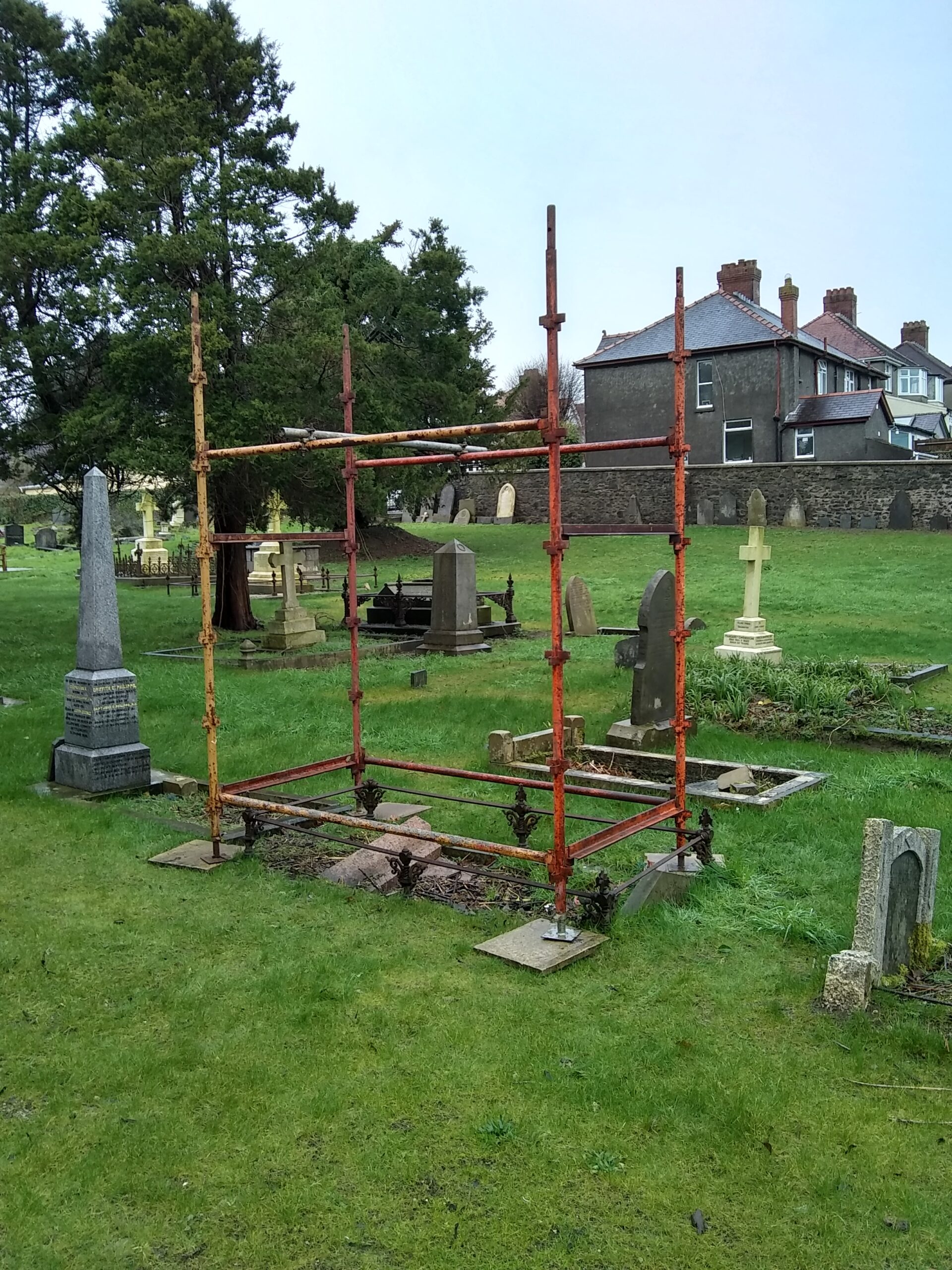
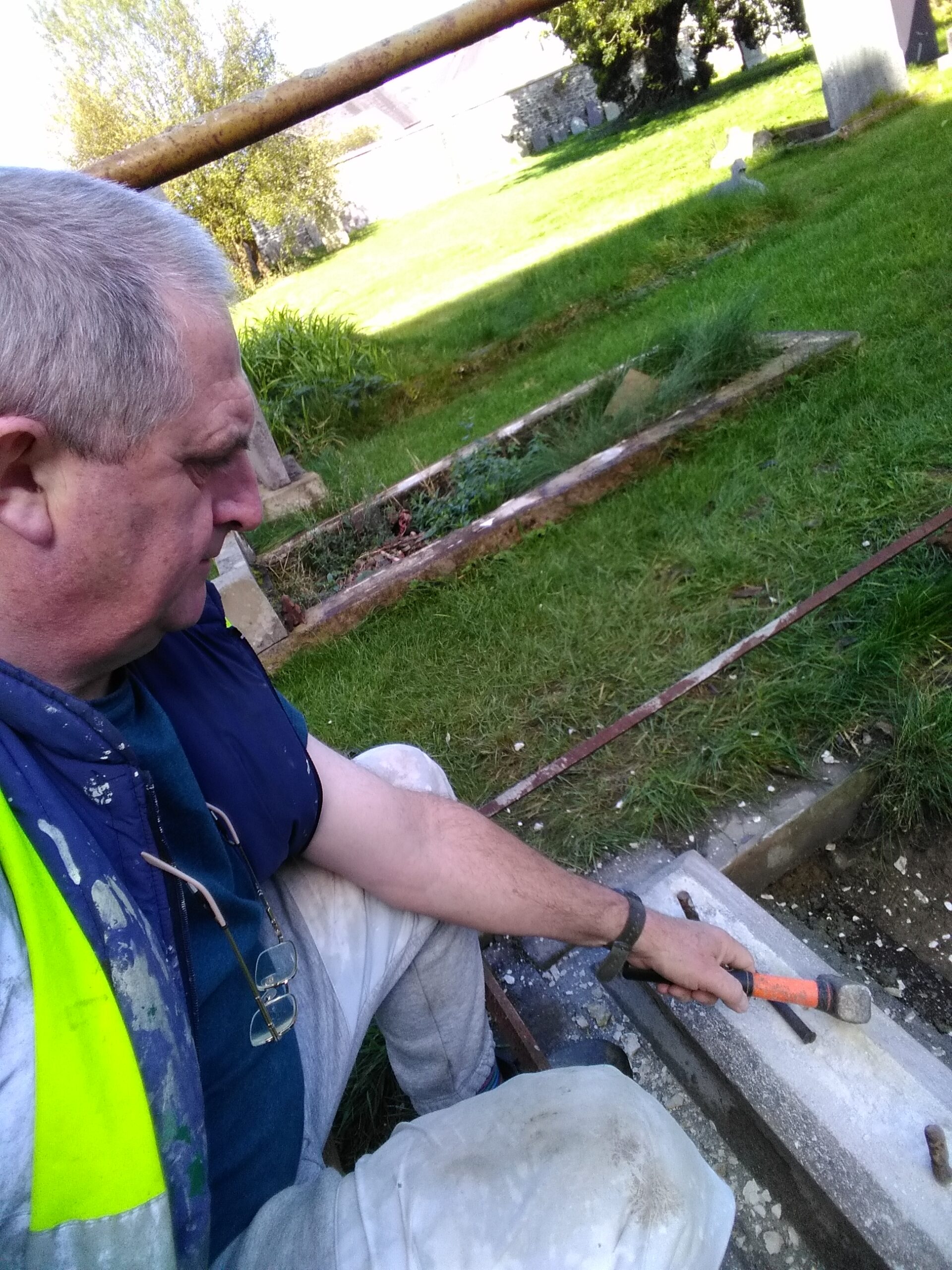
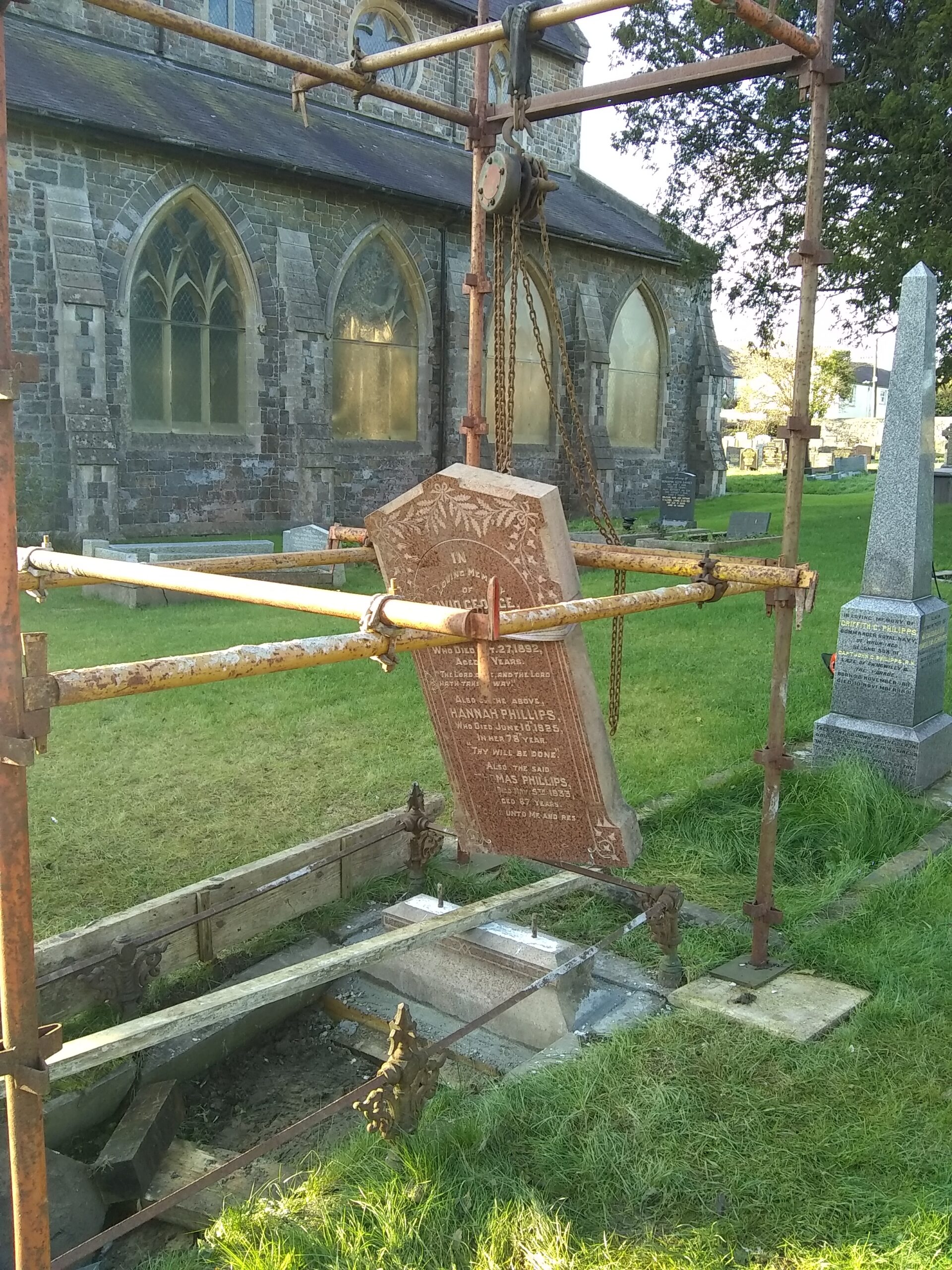
We know from the records that exist that David attended the Model school at the beginning of March 1892 as part of his training and in April was taken ill and unable to attend any lectures, suffering from a series of severe nosebleeds. Fellow students then helped by getting his medication for him from town and he was able to resume studies and private lectures. In June he became ill again and on the 2nd September he left the college and returned home – sick. He died in his fathers arms on the 27th October. Today the University is one of the best known educational establishments in the country. It was the first training college to be established in Wales. The number of Anglican residential students remained at a maximum of 60 until 1903 when a further 20 day students were added. In 1957 women were admitted for the first time. St David’s Cemetery and the University are inexorably linked through its name and history, with its founder and many of its former teachers and two former Principals and their families being buried here. As readers of these stories will know the Trustees continually strive to restore the cemetery and to repair where possible many of the memorials under it’s care and none more so than the very decorative pink granite memorial to the PHILLIPS family that had laid buried in the ground for over 50 years, no one knowing who was buried there, a family forgotten – until now.
The headstone buried for over 50 years.
The following very short obituary notice that appeared in the Western Mail is the only notice to have appeared in the press and no obituary exists. However one can only assume that the funeral must have been an extremely large one attended by all 60 students and their tutors. The College in the 1890’s was one of camaraderie, and friendship, with a desire to obtain respectability in life by becoming a teacher and also to be able to offer those young children whom they taught an education and a better chance in the world.
The headstone being lifted into position
By restoring this memorial the Trustees have re-forged the link between the University and St David’s Cemetery. The Trustees are also very grateful for the support shown by the Vice Chancellor of Trinity St David’s University, Professor Medwin Hughes DL who has been most complimentary of the work of the Charity in restoring the cemetery, so much so that he paid a visit to the cemetery last week to pay his respects to David George Phillips and lay some flowers at the graveside. After 128 years young David is now, once again remembered by the University, may he rest in peace. The Trustees are very grateful to the Special Collections Department of Trinity St David’s University Lampeter for assistance in the research of this article and for allowing a number images to be reproduced.
Death of a Student …….much regret has been caused among young men in Carmarthen by the death, which took place on Thursday morning, of Mr. David George Phillips, one of the most promising of the first year students at the South Wales Training College, Carmarthen. The deceased, who was the son of Mr. T. Phillips, foreman at the Welshman, was only 19 years of age.
WESTERN MAIL FRIDAY OCTOBER 28TH 1892
Professor Medwin Hughes DL, Vice Chancellor of Trinity St David’s University at the graveside of David George Phillips
After 128 years, flowers are laid once again
Teacher Training School “Nicknames”
The splendid group photograph of the 60 Carmarthen Teaching Training College students in 1898 – six years after the sudden death of David George Phillips, epitomises what life was like, nearing the end of the Victorian Era in an establishment that whilst strict in it’s methods of teaching, was every much a place of humour where students were at ease with the world. Clearly the photograph was taken with “PIPE SMOKING” being the main object of the “lesson” but what cannot be seen in the photograph are their handwritten surnames in ink in the margin together with their respective humorous “nicknames”. I have included some of them for your information, surnames followed by nickname. The very sad side to this photograph is that several were killed in the Boer War that followed two years later and many were killed in action fourteen years later during the first phase of the Great War in 1914.
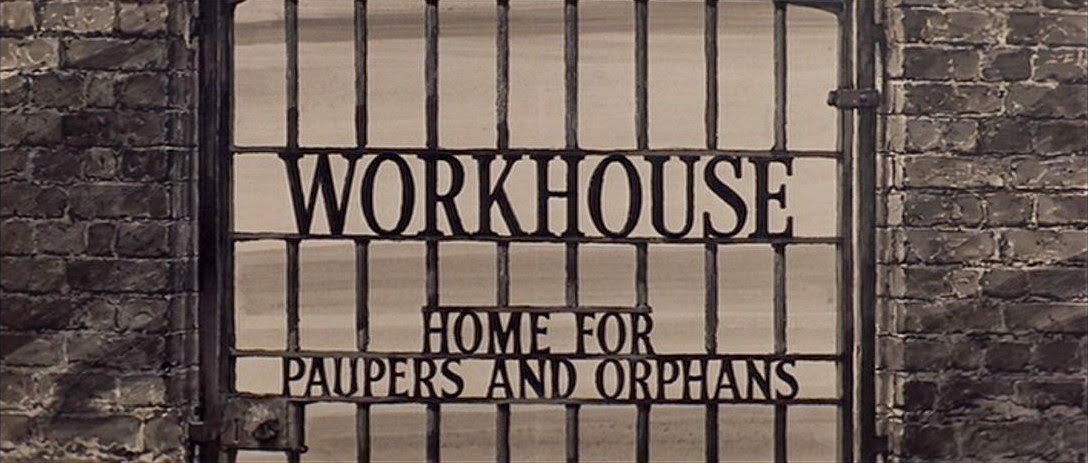
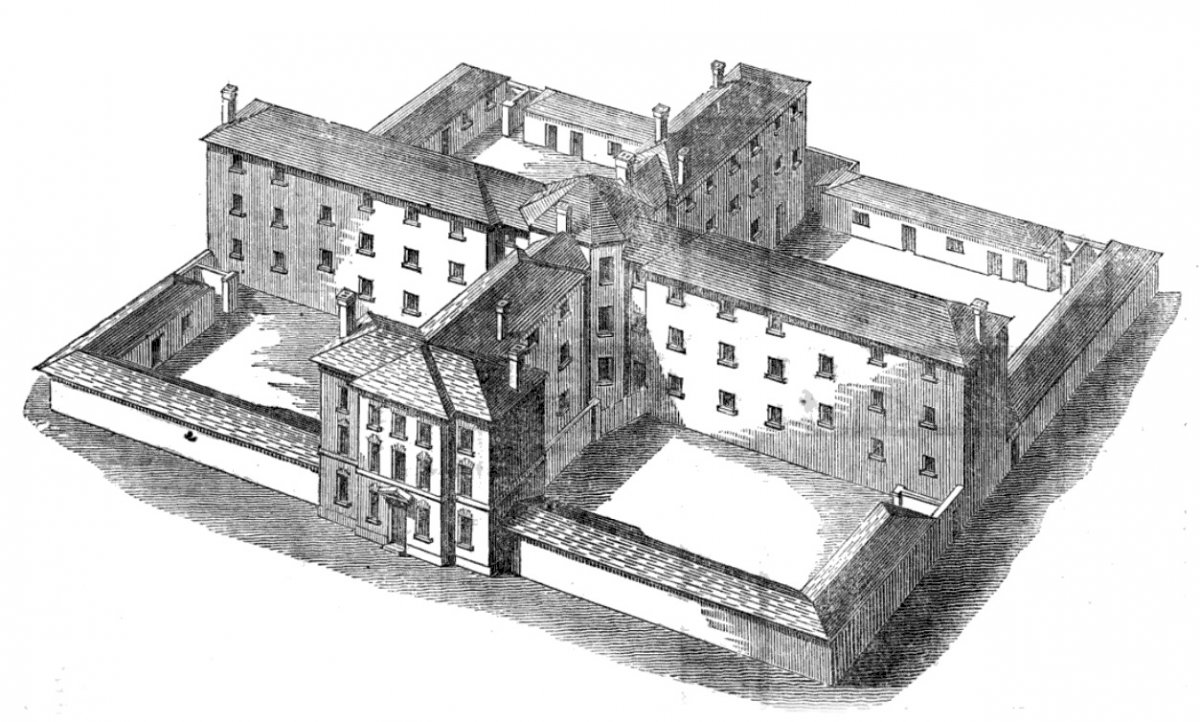
The present Carmarthen Workhouse building and the one occupied by George Adams and master David John Rees was originally built in 1837, and was meant to serve twenty eight parishes within the County Borough of Carmarthen. The two stories that follow are excruciatingly sad as they show how intolerable the conditions were regarding those who fell ill in the early years of the Workhouse in 1846, through neglect and starvation, when up until then no inquests were ever held regarding the death of an inmate, and also fifty years later in 1896 when thirteen year old David John Rees died suddenly but could have been saved if more attention had been paid to his deteriorating health condition. The two newspaper reports give an amazing true and detailed insight into the conditions in the Workhouse and how it was run.
As I have mentioned in previous articles and reports, St David’s Cemetery was the burial place of most of those who resided at the Workhouse and by their very nature were simple burial services with little or no ceremony in unmarked multiple graves. Researching the following two stories only served to strengthen my resolve and determination to see the CROSS OF SOULS /Y GROES ENEIDIAU project come to fruition in February next year, if only to give due recognition to all of them, who through no fault of their own ended their days in an establishment that was meant to look after their health and educational needs and failed. As we approach Christmas this year, please spare a thought for all of them who had the misfortune to live there and to end their lives there and in particular George Adams and David Rees whose lives, though 50 years apart, were cut short by illness and neglect but will now be remembered once again. May they rest in peace.
Workhouse similar in design to that of Carmarthen
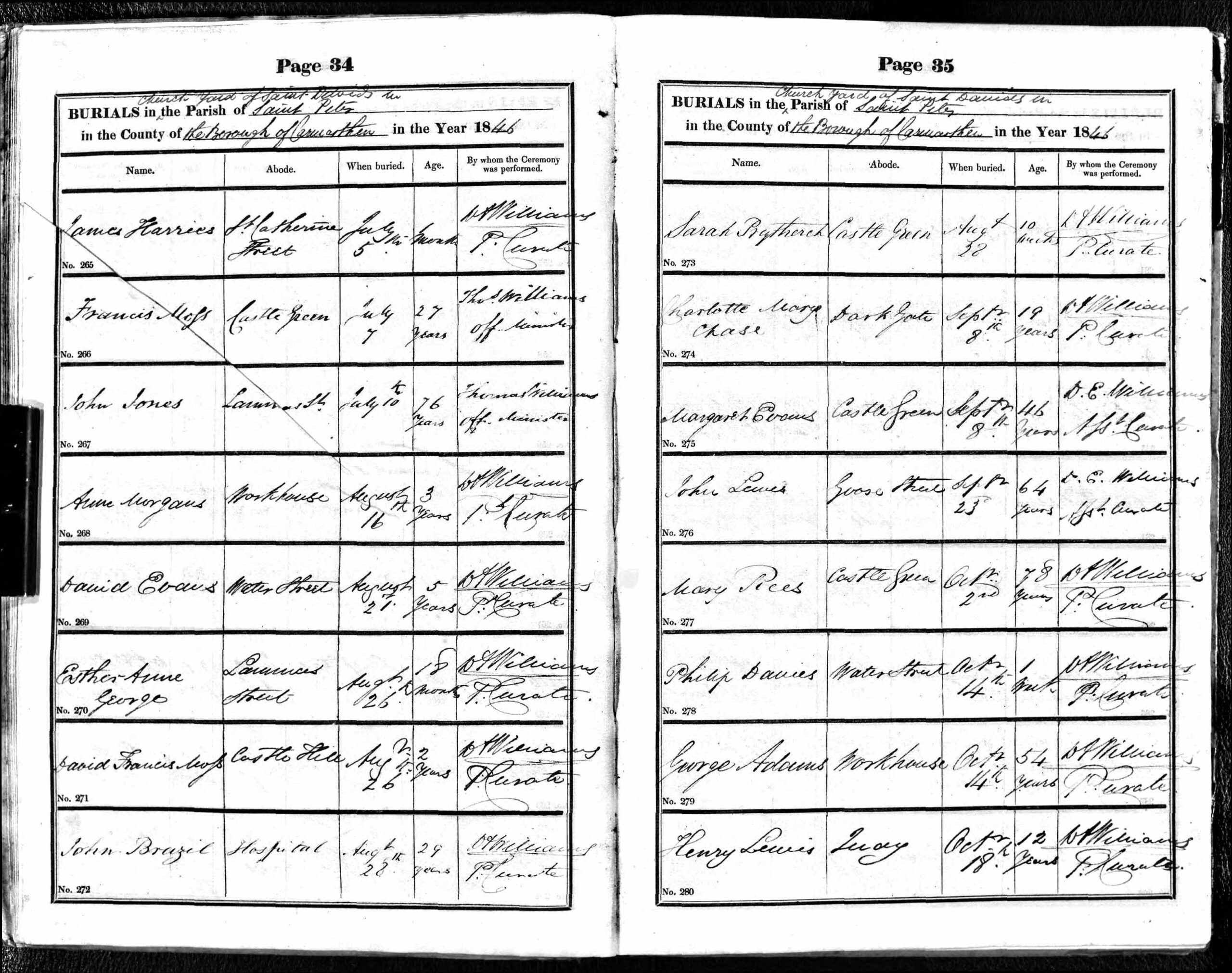
As for George Adams, how could a successful silversmith and accountant/book-keeper end up a “Pauper Lunatic” in such terrible conditions all within the space of four years? It is impossible to comprehend and understand. In the 1841 Carmarthen Census he is listed as living in Priory Street as an accountant, presumably looking after the financial records of the Ivy Bush Hotel as stated in the Coroners report. Prior to that, as a successful silversmith, this was also mentioned by the Coroner. No records or documents exist to shed any further light on his sudden fall from grace. George Adams & David John Rees are but two entries in a burial register fifty years apart, but in reality they are far more than that. They represent a hugely important part of our social history in Victorian Carmarthen. Whatever the circumstances, the following Coroner’s Inquest Reports have been faithfully reproduced unedited and I have to admit in shedding one or two tears in the preparation of their stories. Finally, you will come across the name of a young man by the name of EVAN AYE, also an inmate of the Workhouse towards the end of the coroners report on George Adams who died a “short time previously” and to quote what was reported at the time of the inquest in connection with this young man…. “The Coroner said that it appeared to him that the workhouse authorities were anxious to withhold something from the public which they were afraid to have known” No official record exists of Evan Eye’s death in any available records and neither does his burial appear in any burial register, which makes the coroners remarks even more intriguing. What then happened to Evan Aye and his body? And what were the authorities hiding from the public, and why does no record exist of his death or burial? Also, what did the coroner know for him to make such a sweeping statement? Poor fellow, we shall never know the answer, or will we?
CARMARTHEN UNION WORKHOUSE – CORONER’S INQUEST.
The Welshman, page 2, 16th October 1846
On Monday evening last, an inquest was held in the Board Room of the Carmarthen Union Workhouse, before George Thomas, Esq., Coroner, and a respectable jury, upon view of the body of George Adams, a pauper lunatic, aged 52, whose death had taken place on the morning of that day. Deceased was formerly in a respectable station of life, having been a silversmith in an extensive way of business in this town, and at one period of his life he was book-keeper at the Ivy Bush Hotel. When residing in the town he was generally considered a quiet, inoffensive man. After the jury had been sworn, the Coroner addressed them briefly, and said that perhaps they would think there was some novelty in their being required to assemble in the Union Workhouse to inquire into the death of an inmate, and he wished therefore to state that although he had been in office two years yet he had never had intimation given him of the death of any individual in that workhouse. There had been cases in which he had heard of deaths after the bodies had been buried, and on which he certainly should have deemed it necessary to hold inquests had he received intimation of the decease of the parties. He however, happened to be accidentally at the Workhouse that morning, and was informed of the death of George Adams, which had just at that time taken place, and he immediately summoned a jury to enquire into the cause of death. His principal reason for enquiring into the cause of the death of a pauper inmate of the Workhouse, was this:—Under an old statute of the reign of Edward the First, whenever a death took place in prison, it was made imperative to hold an inquest on the body, because the law said that when a person was under restraint and not able to follow the inclination of his own will, it was but right and proper that the cause of death should be ascertained, in order that the public should be satisfied that death was not caused by reason of the hardships put upon the parties so confined. At the time this statute was enacted, there was no Poor Law, (the first Poor Law having been enacted in the reign of Elizabeth) so that there could, therefore, have been no Workhouse, and paupers could not have been under the same restraint as they are now. The old statute was undoubtedly confined to prison duress, but the jury would at once see that the reason for holding an inquest was as cogent where the party was confined though not in a prison. In either case the parties were not free agents, and were placed under the surveillance of others. It was therefore necessary to inquire whether the individual died naturally, and whether he was or was not treated properly. In this case no one assumed that the deceased was not properly treated, but he wished it to go forth to the public that it was necessary to hold inquests in Workhouses as well as elsewhere and perhaps more so, because of the restraint placed upon the inmates. He had that day taken the precaution to desire the Registrar not to register any death occurring in that Workhouse without first communicating with him on the subject. The jury then proceeded to view the body, which lay in the dead house of the Workhouse. The deceased appeared to be in rather an emaciated condition, but there was no mark to show that his death was the result of violence. On the return of the jury to the Board room, the Coroner called Henry Winchcombe, who in answer to the questions of the Coroner deposed as follows: – “I have discharged the duties of master of this Workhouse for more than 12 months. When I entered upon the duties Adams was an inmate of the House and has continued so until the present time. He was about 52 years of age when he died. When first I came to the Workhouse his health was very bad and he has been sickly ever since. He was a complete lunatic and unable to help himself. He was not at all violent and I never put him under any restraint. He would occasionally upset a ladder we have in the house and try to carry it on his shoulders, when both he and the ladder would fall to the ground. He once tried to make his escape through the front door, but was brought back again. He would often pile up the tubs that are in the male paupers’ yard, and endeavor to get to the top of the roof, in order as he said to make his escape. On different occasions he tried to get on the roof of the place where he is now lying, and if a person was to get up there, and was sensible enough, he might go along the roof to the outer wall and jump down into Mr. Norton’s field. He never attempted to injure himself or anyone else. I concluded he was a lunatic from the filthy state in which he kept himself, and the various tricks he played, which no sensible person would think of attempting. The men who attended the sick ward washed and dressed him because he was unable to do anything for himself. His clothes were always changed once a day and sometimes twice, and he was well washed every day. I never found vermin about him. His diet was what is usually given to sick paupers. For breakfast half a pound of wheaten bread with butter on it, and a pint of tea with sugar in it, but no milk. I don’t know whether he took all his meals or not. This breakfast was given at 8 o’clock, and at quarter past 12 he had for dinner half a pound of the best wheaten bread and three and a half ounces of beef. His tea, at six o’clock, was the same as his breakfast. If sick people wish it, they can have gruel for their meals instead of the usual food. Deceased generally chose the usual allowance. There were no other meals in each day and we generally shut the paupers up about 9 at night. He had a bed to himself in the sick pauper’s ward. Five men slept in the same room with him, four of them being sick paupers and the other was a pauper who slept in the room to take care of them. About a week or nine days ago deceased became confined to his bed. He complained of his stomach and his head. His appetite was not so good then. Sometimes during the last week he wished for gruel instead of tea. He never expressed a wish for anything that he did not get. During the last week 2 men and sometimes 3 attended him. There was always some one within hearing of him. I saw him once or twice a day and sometimes oftener. He has been under medical treatment ever since I have been here. The medical officer attends the sick ward almost every day. Our boy brought some medicine from Mr. William’s more than once a week. My wife looks at the directions on the label of the medicine, and tells the boy who brings it to inform the men who attend the sick paupers who it is for and when they are to give it. I never saw it administered myself, but I do not thing it likely that the medicine can ever go down the wrong throat. The attendants cannot read or write. Deceased has not taken medicine all the time I have been here, but has been in the sick ward. The medical officer has seen him almost every day. There is no book in the house stating when and what medicine was given. Deceased had gruel and wine in it several times this last week. He had 2 ounces of wine twice a day in gruel. This was sent up to the attendants, who were told to give it to him. They are not paid attendants but merely paupers. I do not know anything of the tastes of paupers, although I have been master of the Workhouse. I do not know whether they would prefer gruel with wine in it to tea without milk. We have no security that the sick man received the gruel or that the other paupers did not drink it. W. Owens had charge of the sick ward last week. I have not seen deceased at his meals this last week. I sometimes prepared the gruel and wine and sometimes my wife did so. My wife has the care of the wine and before she gives it she has an order from Mr. Williams, the medical officer. Mr. Williams makes an entry in his visiting book and on the day that wine was ordered for the deceased I forwarded the book to Mr. Phillips, Clerk to the Guardians, who sent me up a bottle of port wine. I did not taste it. It is kept in the pantry and is locked up by my wife. It was not labelled port wine.”
Mr. Phillips here remarked that as the wine was obtained from Mr. Webb, a respectable wine merchant that ought to be a guarantee of its genuineness. The Coroner said that he did not doubt its genuineness, but thought there ought to be some distinctive mark upon it, because there might happen to be a bottle of catchup by the side of the bottle of wine the contents of which might by accident be put in the gruel while the wine might by accident be used by the master.
Mr. Winchcombe re-examined:—
“I know the parishes of the two attendants but have no means of ascertaining their character. It is not my business. Owens has been in the workhouse more than 12 months, and Wm. Davies, the other attendant, about 2 months. A juror asked if a pauper named Wm. Thomas, a very honest and intelligent man, attended the sick. Mr. Winchcombe:—No, he does not, I find him useful in other parts of the House. The men are paid nothing whatever for attending the sick paupers. I select the men to attend upon the sick. The sick ward is open to 10 or 12 male paupers. There is nothing to prevent any of those from taking the sick man’s medicine or gruel, but I am of opinion that the two men who attend the sick would not allow any one to take it. Whether the sick man got his wine, his medicine, or his food depended upon the conduct of the attendants, but I went sometimes to see whether Adams had taken all his food and found that frequently he had not. It was then left there to be given him from time to time as he could eat it. I have seen Adams every day during the last week and several times in each day. The meals are sent up when the meals are sent into the Hall to the other paupers and I cannot attend to both at once. The two men who attended him and also the medical officer I believe were with him when he died. I have not seen him alive today. He died about 9 o’clock. The Board sat at 10. He died before the Board had assembled. I believe he did but really cannot say when he died. I heard in the House that he died before the Board met. I am not the master now, but merely fill the office temporarily until another person is appointed. I ceased to be master about 4 months ago. I was removed from my office by a letter from the Poor Law Commissioners. I was requested by the Guardians to remain until a certain time had expired and that request was renewed at the expiration of that time. I am now left from hour to hour and minute to minute to suit the pleasure of the Guardians. The joint salary of myself and my wife is £60 a year. There has been no fresh agreement as to salary since my dismissal.”
In answer to a juror – “We allowed fire and candles all night in the sick ward.” The last money I received on account of salary was about 10 months ago. I have made applications for payment of my salary. I still continue here because I cannot get my salary paid up so as to allow me to go away. My books have been examined for the last 3 quarters, but I have only been paid up to Christmas last. A juror wished to know how it was that in the printed quarterly abstracts the salary of master and matron appeared as if paid, when Mr. Winchcombe swore positively he was not paid. Mr. Winchcombe – “I cannot get a shilling. I would leave here directly if I could get payment. I have written to the Commissioners to that effect. I asked for a settlement of my accounts and payment of what was due when I opened the Commissioner’s letter containing my dismissal, but Mr. Stacey, (Vice Chairman of the Board) told me he did not read the letter as an immediate dismissal. I am not desirous of continuing here as master”. The Coroner here said that his motive for questioning Mr. Winchcombe respecting his salary was to show that the guardians were wrong in detaining him and continuing him as master against his will, and also in withholding his salary, and thus withdrawing all stimulus for him to act rightly. Mr. Winchcombe: “I consider that all my responsibility as master of this workhouse ceased when I received the Commissioner’s letter of dismissal, and I do not hold myself responsible for anything that occurs in the workhouse. I have stated this to the Board, but Mr. Stacey told me he did not view the letter in that light. The Coroner said this appeared to be a species of imprisonment of Mr. Winchcombe, and if by any possibility he were to die it would raise a doubt in his (the Coroner’s) mind as to whether an inquest ought not to be held upon him, since he was clearly under restraint. A juror observed that in the medical officer’s visiting book there was a remark that deceased had ulcers on his back; he wanted to know how the deceased’s back could become ulcerated when he had only been in bed nine days. Mr. Winchcombe said that deceased had ulcers about him for some time past, but they were not of any consequence. He was quite helpless and sometimes fell out of the bed. The skin was off his back. The doctor was aware of it. There was no discharge from the ulcers. I only attended to his cleanliness, and left the rest to the medical officer. Deceased’s back was washed with warm water and black soap, and properly dried. He had a clean bed and clean bedding. We changed the bed clothes when requisite. At the request of Mr. Phillips, Clerk to the Guardians, the Coroner asked Mr. Winchcombe if he was offered his salary up to the time his accounts were audited. After a rather rambling statement, Mr. Winchcombe positively denied that he was ever offered his salary up to the time to which his accounts had been audited, and declared he had not been paid since Christmas last. Mr. John Williams, surgeon, was next examined: – he said:—“I am the medical officer for, this Workhouse, and have been so for 1 year and 8 months. Deceased has occasionally been under my treatment since he has been in the house. His last illness commenced on Saturday week, but I visited him every day previously. He had vomiting and purging with a little fever, being the symptoms of English cholera. I gave him medicine on that day. I saw one pill administered. One was to be taken every four hours, I had brought them up in my pocket, having heard that he was vomiting and purging. My orders are to take any medicine that I may have occasion to give to paupers to Mr. Winchcombe, and tell him to take it to the sick ward. I gave them on this occasion to an intelligent man named White, and desired him to give them every four hours. I had written on the box “One of these pills to be taken every four hours, George Adams.” White can read and write. I saw the deceased on Sunday, the next day. I have seen him every day since except Friday when I was from home, and Mr. Rowlands, surgeon, saw him for me. Deceased was considerably better on Sunday. I stopped the pills because relaxation of the bowels had ceased that morning. I saw him on Monday and he was rather worse. He had no purging, but his back was very much excoriated, more so than on Saturday when I last saw it. I ordered it to be well washed and wiped, and kept perfectly dry. It has been excoriated for some time; in fact great decomposition had taken place in his back. He had no symptoms of English cholera after Monday. On that day I ordered him 4 ounces of wine daily when I found that the skin was losing its vitality and sloughing, knowing that he required more generous treatment. He was gradually sinking on Tuesday, and his back got gradually worse. The wound is as large as both the palms of my hands, at the lower part of the spine or back. I did not give him any medicine after Sunday night as it would only have disordered his stomach. I relied on the wine. I ordered a bread and water poultice to be applied to his back on Tuesday, which was done. His back is now partially ulcerated. The cause of death was a broken down constitution and a loss of vitality in the skin. His constitution had been broken up for some time. He had had incontinence of urine for some years, and as he lay so much in bed decomposition had taken place in his back in consequence of the pressure. I communicated with Mrs. Winchcombe daily. I could never find Mr. Winchcombe. I do not know where he keeps himself. I have a book at home in which I keep a register of the treatment of sick paupers, which the auditor inspects. There is no book kept in the Workhouse in which the treatment of the medical officer is entered, nor is any account taken of the medicine given. There is a book in which I make entries of visits to patients. I am sorry to say that I do not every day enter my visits, because I cannot always find the book, it being with the master. I generally entered a number of days together. Deceased was a harmless lunatic. The porter’s book shows when I visit the house, and forms a check upon my book. My book ought to be in the Hall in order that I may enter each visit, but it never is. I depended more upon Mrs. Winchcombe to attend to the sick paupers than any body else. I could not depend upon the master. I always gave instructions to the matron, and asked her to be kind enough to explain to the attendants how and when the medicine was to be administered. I saw the deceased take the wine and gruel yesterday, and the matron told me he had it every day. There are at present one lunatic, and three idiots in the house. A juror:—“do you include Mr. Winchcombe among the idiots”. Mr. Williams “No, but he is partially idiotic”. In answer to the same juror, Mr. Williams said that he considered the two men who were in the habit of attending the sick ward to be decidedly unfit to attend such a man as George Adams. A juror here remarked that if the sick paupers could thus attend upon each other, surely the healthy paupers could do so, and thus the salaries of officials would be saved altogether. The Coroner said that there ought to be paid nurses to attend to the sick. Mr. Williams re-examined:—“Adams died at half past 11; I was feeling his pulse at the time. There were maggots in his back when I saw him on Monday. The Coroner asked if Mrs. Winchcombe ever attended to the sick men’s’ ward. Mr. Winchcombe said she did not, as she was not allowed in the male paupers ward. Mr. Williams said he was sorry to contradict Mr. Winchcombe, but he had met Mrs. Winchcombe in the sick men’s’ ward. Mrs. Winchcombe afterwards protested she had never been in the sick men’s’ ward since her sojourn in the workhouse.
Burial register entry for George Adams
The Coroner said that he had heard that in the case of a poor idiot named Evan Aye, who died a short time ago, an inquest ought to have been held. Inspector Young stated that on one occasion when he entered the room where Evan Aye was sleeping, the stench was so intolerable that he was compelled to make a precipitate retreat. The Coroner said that it appeared to him that the workhouse authorities were anxious to withhold something from the public which they were afraid to have known. However he really hoped that in all cases in future, intimation would be given to him in order that he might exercise his discretion as to whether an inquest was requisite or not. The room was then cleared, and after a short time the jury returned as their verdict that the deceased died a” Natural Death.” The following observations were appended to their verdict, “and the jury express their regret at the inefficient attendance upon the deceased during his last illness, and at the want of care bestowed upon sick paupers in general in the Union Workhouse” The inquest then terminated.
DAVID JOHN REES 1833-1846
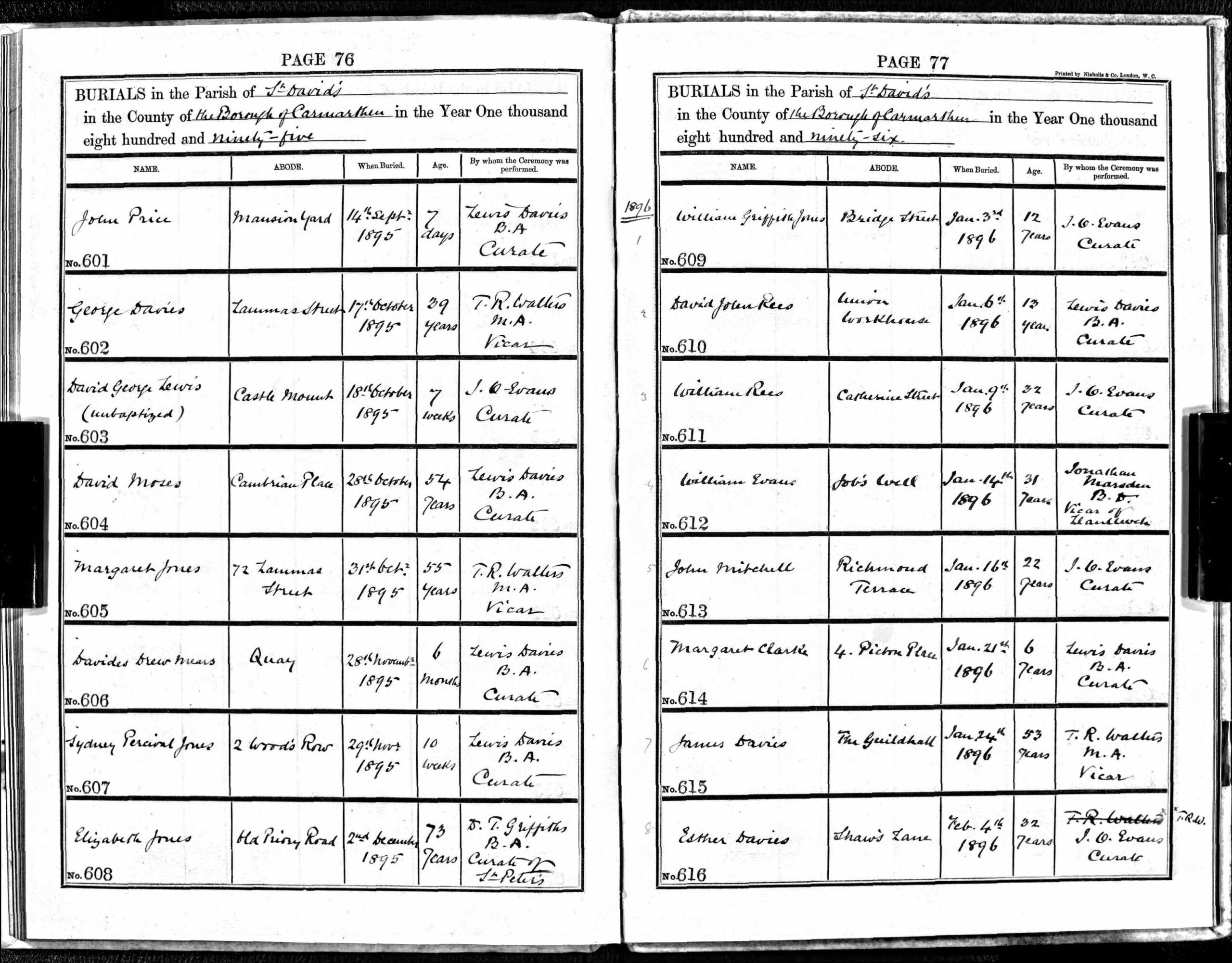
Sudden Death at the Carmarthen Workhouse. Inquest and Verdict.
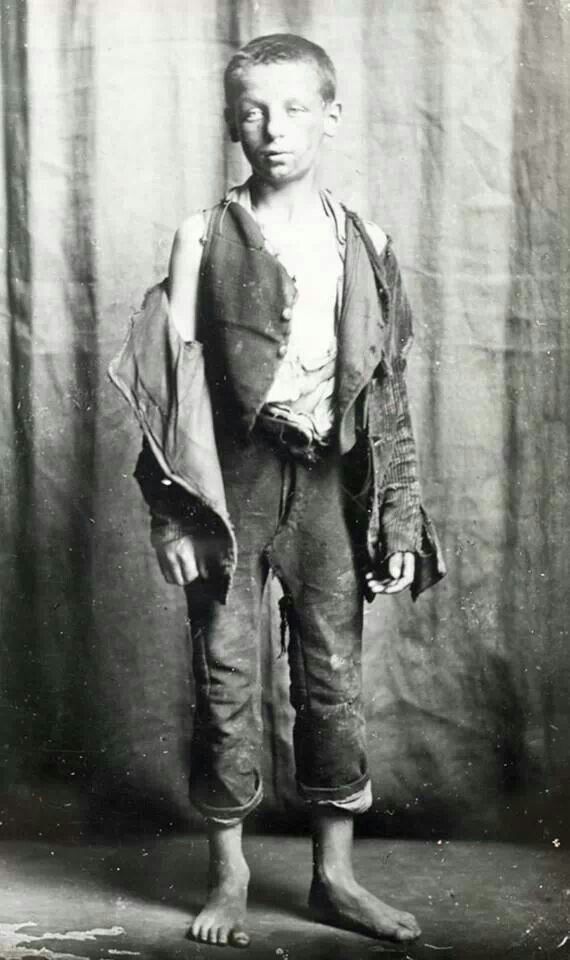
An inquest was held by Mr Thomas Walters, the borough coroner, at the Union Workhouse, Carmarthen, on one of the inmates, David John Rees, a boy 13 years of age, son of Cornelius Rees, a labourer. Thomas Williams said I am 14 years of age in August next. I am an inmate of the Union Workhouse. I have been in here six years. I knew the deceased since he came in here some four years ago. He and I attended school together. We slept in the same room and in the company of seven other boys. We had a bed each. I was the eldest boy there. My bed was about two yards away from the deceased. Deceased used to be ill at times and complained of his head.
A photograph of a 13 year old Pauper taken in 1898
He was then in the day-room with the other boys. He went to bed about 7 p.m. The other boys went to bed at 8 p.m. I went to bed about 10 p.m. I was with the trainer until that time. The deceased complained to the trainer and me about five o’clock as to being unwell. The nurse gave him an aperient dose about six o’clock. Her name is Miss Burnhill. He sat down until he went to bed. I did not tell the master about his illness or anybody else. I am sure the deceased was asleep when I went to bed. He was groaning about half past ten and continued doing so until 4-45 a.m. I did not sleep the whole night. I told the other boys that I could not sleep with the row he made all night. I am a very bad sleeper and have been awake other nights. I got up about five o’clock to look at David John. He was frothing. I asked him if he would stop making that row. He was making the same row then that he had made all night. I went to call Miss Rees, the trainer. I did this because William Bentland told me that he was frothing at the mouth. There was no light in the room, but Bentland rose up the blinds. The trainer slept in an adjoining room about 10 yards away. Deceased had not been taken like this before. He drank his milk at supper, but left his bread. When the trainer came she sent us for the nurse— Miss Burnhill. She came at once; the trainer was there with the light. I was told by the nurse when she came that David John Rees was dead. I am not requested to do anything when something goes wrong at night. Hannah Burnhill said I am the nurse at this institution. I have been such for 18 years. Deceased had been in pretty good health during the whole time he has been there. The last witness asked me last night for a dose of aperient medicine for the deceased. He told me that the latter was complaining of headache. I gave him about a tablespoonful of Epsom salts. I think he was not very bad, otherwise the trainer would have told me. It is her duty to attend to the children. I did not hear anything more until 5 o’clock this morning. I was then called and found David John Rees dead. Mary Ann Rees said I am the industrial trainer at this institution. The children are under my care day and night whilst inside the establishment. The boys’ dormitory adjoins my bedroom. There is a passage and two doors between them. I can hear from my bedroom if there is any noise in the dormitory. I did not hear any noise last night. Deceased went to bed at my request at 7.10 p.m. I saw him again at 8 p.m. He was then no better. I looked in at 10 o’clock. He was then asleep. I then went to bed, and heard no more of it until Thomas Williams called me about 5 o’clock in the morning. The reason I concluded him to be asleep was that he did not reply to the boy Williams when the latter spoke to him. I did not go into the room at 10 o’clock. It is a mistake if I said so. Dr Lewis Hughes spoke to being sent for that morning. The boy was dead when he arrived. There was nothing to show the cause of death. A post-mortem examination might reveal the cause of death. Deceased had been fairly well during the whole of his time in the workhouse. The Coroner adjourned the enquiry in order that a post-mortem examination might be made. The adjourned enquiry was held at the Guildhall on Monday. William Bentland said I am 12 years of age, and have been two years and a half in the Union. I was 12 years of age in March last. I knew David John Rees. I saw him on Thursday afternoon in the yard. He was playing with me and the other boys. There are eight of us. This was about 5 o’clock. We afterwards went into the day-room. We sat down there and read a book. David John Rees was playing with a little boy. The little boy had a doll, and David John Rees was putting a handkerchief round it to make it dance. I went out for a bit. When I came again David John Rees was sitting on the fender by the fire. Afterwards I was called in to my supper. We have supper about 6 o’clock. Nurse sent for some medicine for David John Rees because he was bad. After we had been jumping, I asked him if he was cold. I asked him that because he was white, and his hands were blue. He said he was bad. I had never seen him like that. He took his supper. He took the medicine after supper. He was then white. The trainer asked him if he would like to go to bed. I next saw him at 8 o’clock. The trainer asked him if he was better, and he said no. We had a light. The gas was half-turned on. The trainer then put the gas out, and we went to sleep. I awoke about a quarter to five. I know that, because soon after the market clock struck five. I thought that David John Rees was choking because of the noise he was making. His brother, Henry Rees, went up to him and shook his head. He did not answer, and Tom Edwards, Tom Williams, and I went to call the trainer. There was no light at the time. Sometimes the trainer comes to see us after we go to bed. The trainer came when we called. Thomas Edwards (13) gave similar evidence. Dr R. G. Price said I made a post- mortem examination of the deceased. The cause of death was an abscess on the brain, in connection with middle-ear disease. He had chronic inflammation of the ear. There are usually outward symptoms of that disease, but there are cases of sudden death resulting from it. The cause of death is quite consistent with the symptoms described by the witness. I should consider them dangerous symptoms in a child. They were not of such a character as to impress an ordinary mind with the necessity of obtaining medical assistance. The” medical mind” is different from the ordinary mind.” Something might have been done years ago when the disease started, but nothing latterly”. There was probably then a running from the ear and nothing was thought of it. Such things develop into brain disease. He could not have been in good health for some time previously. He would not necessarily be in bad health. Mr Edwin Price, master of the house, was then called to define the duties of Miss Rees, the trainer. He did not consider it her duty to go round the dormitories at night except if there was something wrong. The Coroner, in his summing up, said that no blame could possibly be attached to anyone for the death.
Burial Register entry for David John Rees. Note the entry of DAVID GEORGE LEWIS aged 7 weeks who is noted as having been UNBAPTIZED.
Under the circumstances it could never have been foreseen nor prevented. It might be well, however, for the trainer to take a look round before going to bed. The Jury returned a verdict in accordance with the medical evidence. They added no rider.
Supplement to the Carmarthen Weekly Reporter January 10th 1896
This story, whilst being one of the shortest in the series of “What’s in a Name” is important because it sheds light on “what lies beneath” and indeed “behind” the sad demise of many whose names appear in the St David’s burial register. At first glance of the many names inscribed, especially those of an advanced age, one perhaps automatically assumes that their passing was of “natural causes”
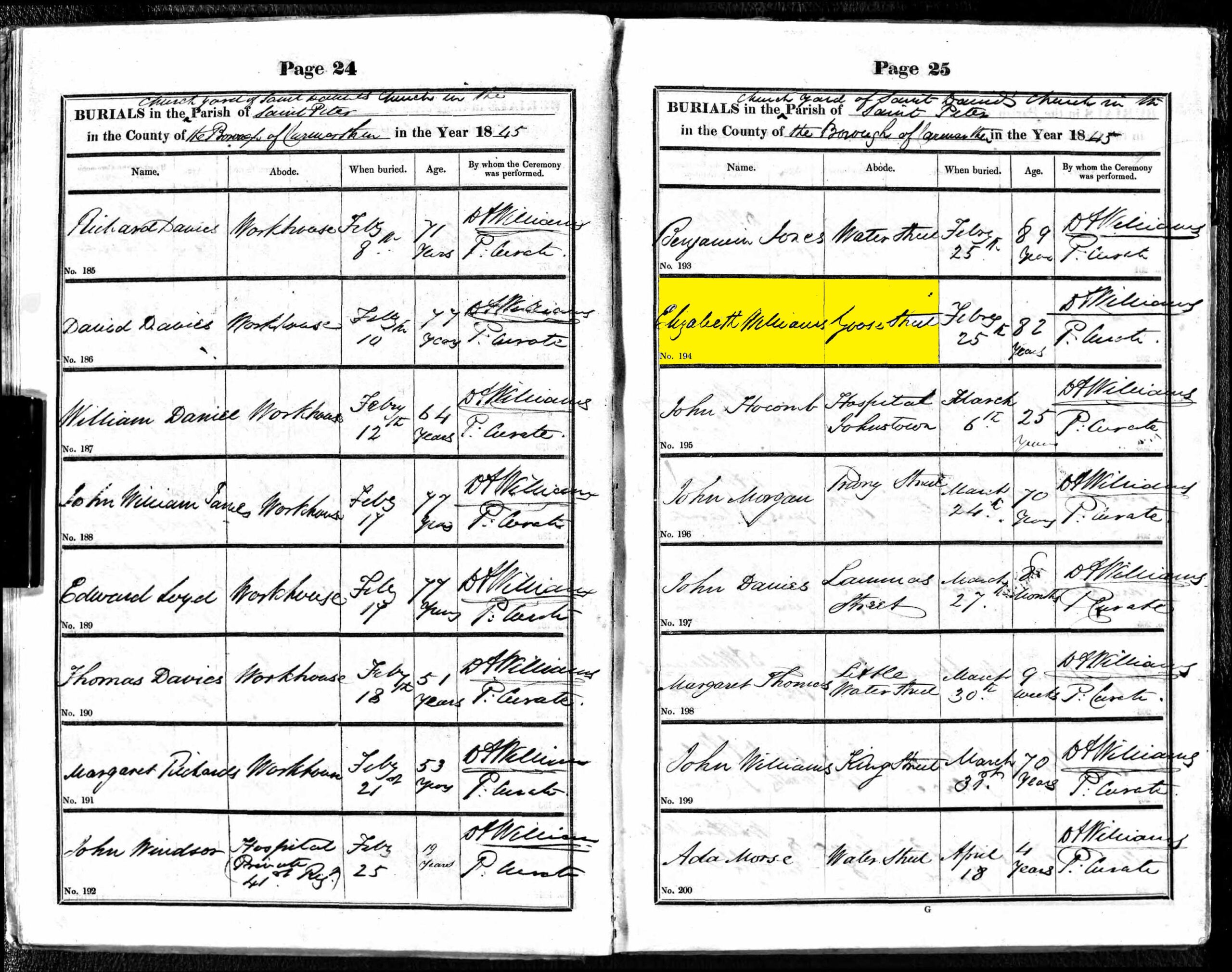
The burial register details of Elizabeth Williams
However as this short story reveals – not all is what it seems when reading the register and it is only when further research is carried out that the truth and full extent of the story is revealed. Elizabeth Williams lived in what was then a large street called Goose Street.
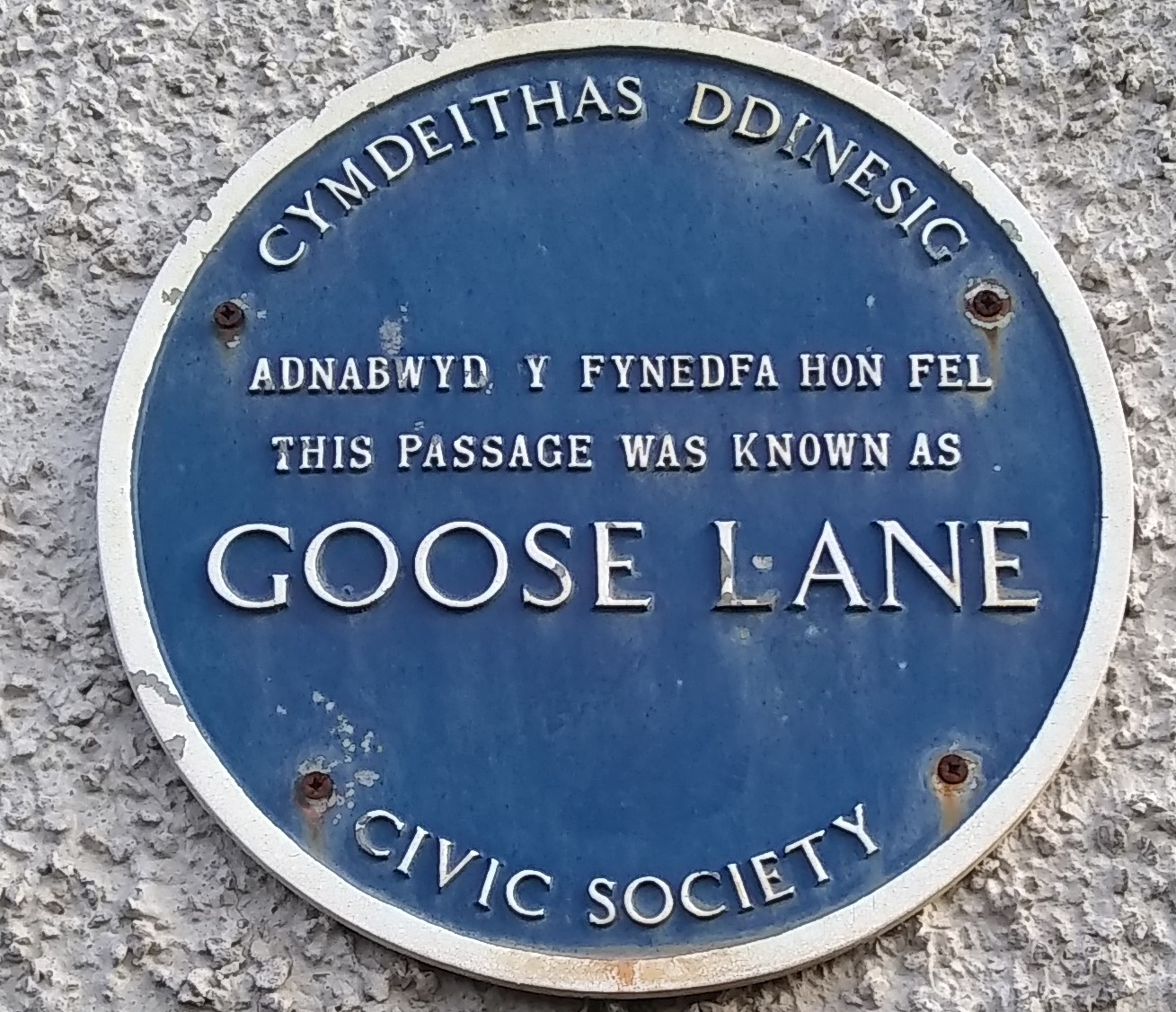
Civic Society Plaque commemorating Goose Lane
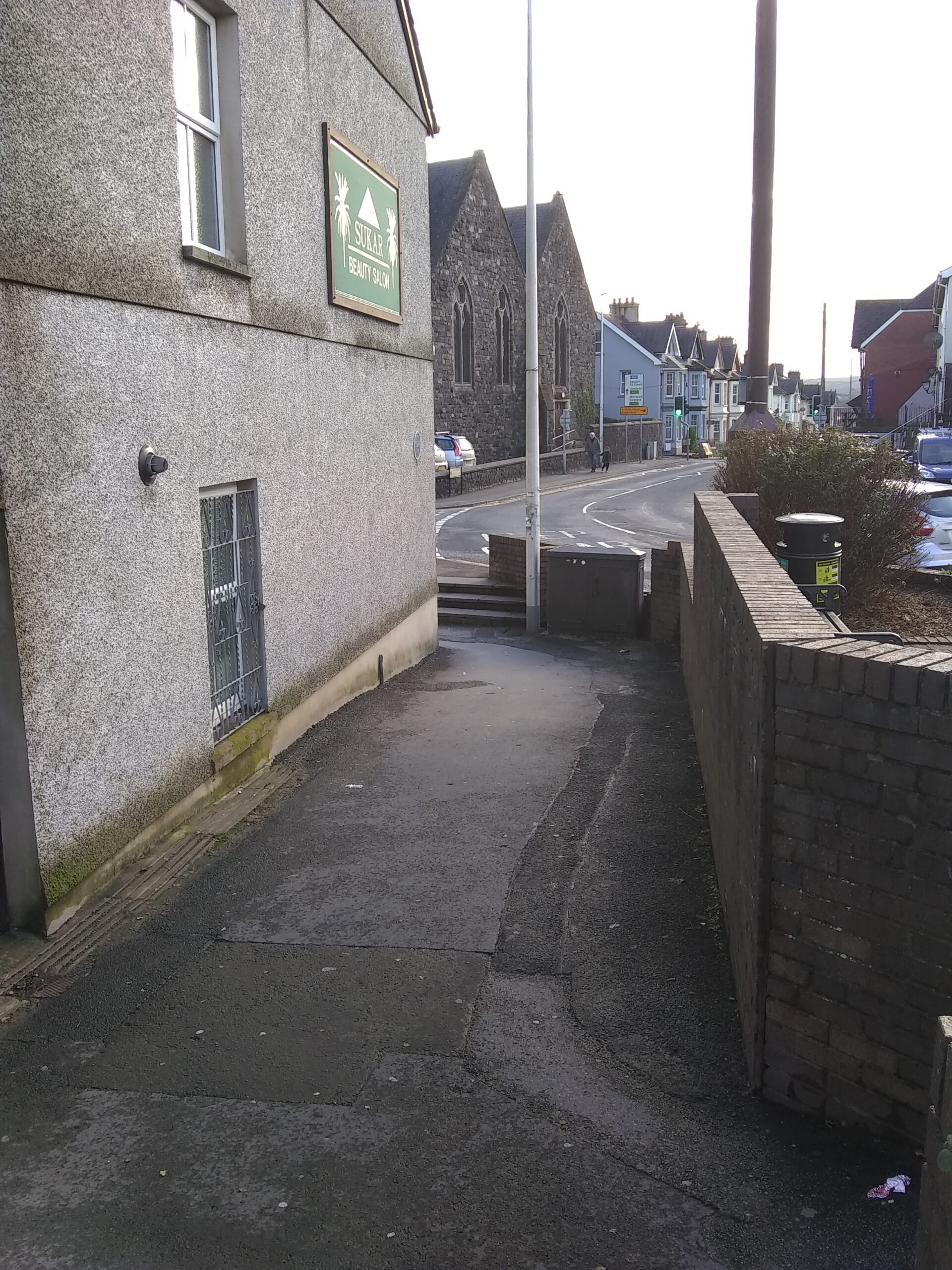
Whilst it is not in existence today, Goose Street stretched from the junction of St Davids Avenue to the Water Street Junction and during the 1850’s it disappeared from view and became an extension of what is now St Catherine Street. In 1841 it is recorded as having 56 properties with 236 occupants. A blue plaque now records GOOSE LANE for posterity which I unveiled when I was Chairman of the Carmarthen Civic Society many years ago. It was named as such because of the geese that were walked to market through this lane and street by local Drovers near and far. The feet of the geese were tarred to enable them to walk long distances to market without injury. February 1845 was a particularly cold month, one of the coldest on record. Whilst the inquest report is unclear on how it came about that Elizabeth’s clothes caught fire, we can only assume that it was nothing more than a dreadful accident as the report concludes, either resulting from a spark from the fireplace or a lit candle. Elizabeth has no memorial headstone in St David’s Cemetery, and her last resting place remains unknown within the cemetery, but like so many others, she will not be forgotten.
Goose lane as it is today
The Welshman February 28th 1845 page 2
INQUEST.—an inquest was held on Monday at the Mermaid Inn, Lammas Street, before George Thomas, Esq., Coroner for the Borough of Carmarthen, on view of the body of Elizabeth Williams, an aged woman residing in Goose Street. It appeared that on the preceding Friday, the deceased, who had been left all alone, set her clothes on fire, and after suffering the most excruciating agony, expired on Monday morning. A verdict of “accidental death” was returned.
** The Mermaid Inn was located between the Golden Lion and Christ Church in Lammas Street.
Long before the discovery of using fingerprinting as a method of detecting serious crime, Prison Governor George Stephens was one of the first men in the world to realise that the new technology of photography could create a useful official record of suspect’s faces. Many criminals would go on to reoffend and give false names when caught, but the mug shots would enable the authorities to identify people who had been convicted previously under a different name. George Stephens was a keen photographer. He served with the Metropolitan Police in London before being drafted in to Carmarthen to help deal with the Rebecca Riots, which started in 1839 with the destruction of a tollgate at Efailwen. George and his family arrived in Carmarthen from London in 1844. In 1851 the Census records Mary as being the Matron of the Gaol and George the “Turnkey”
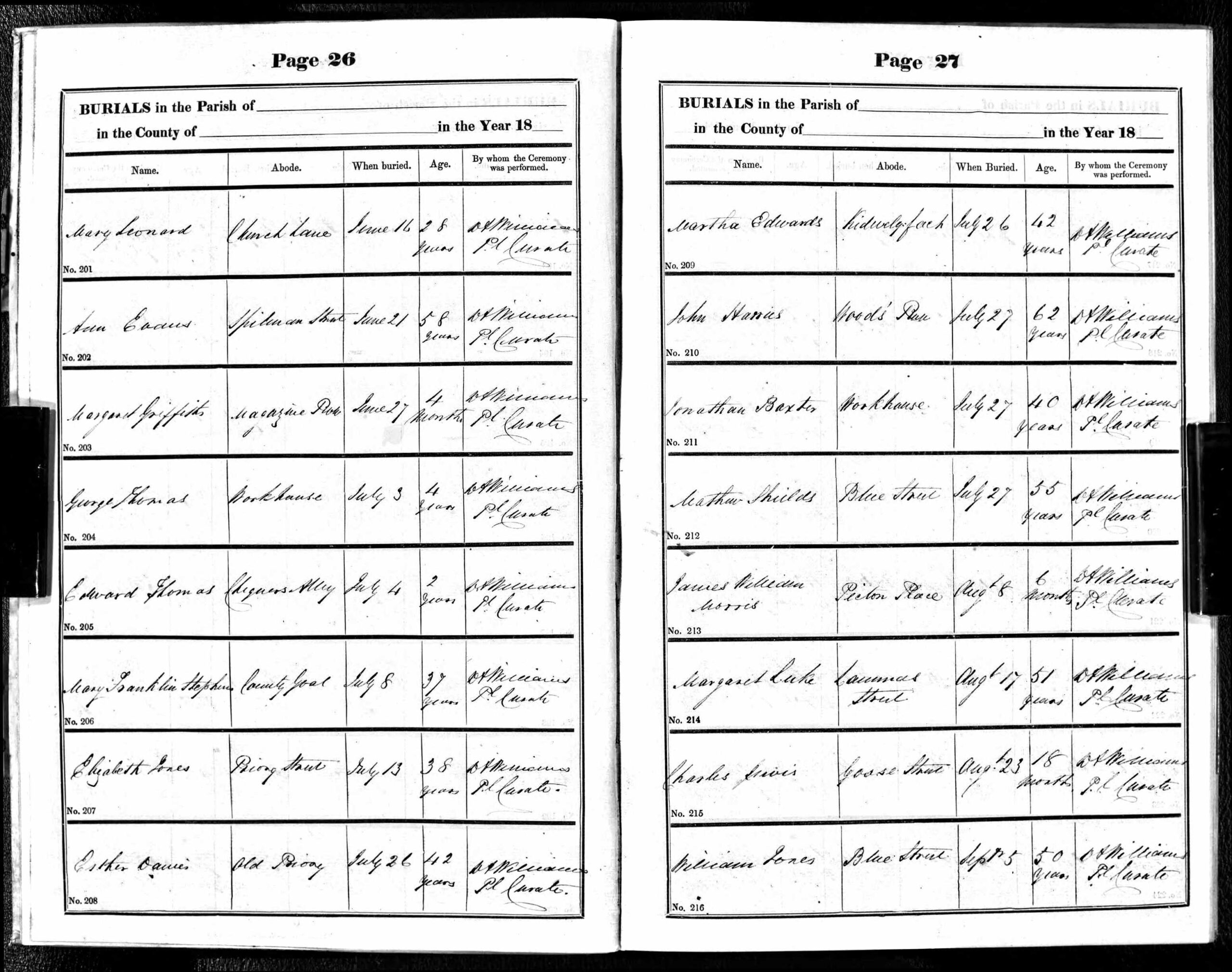
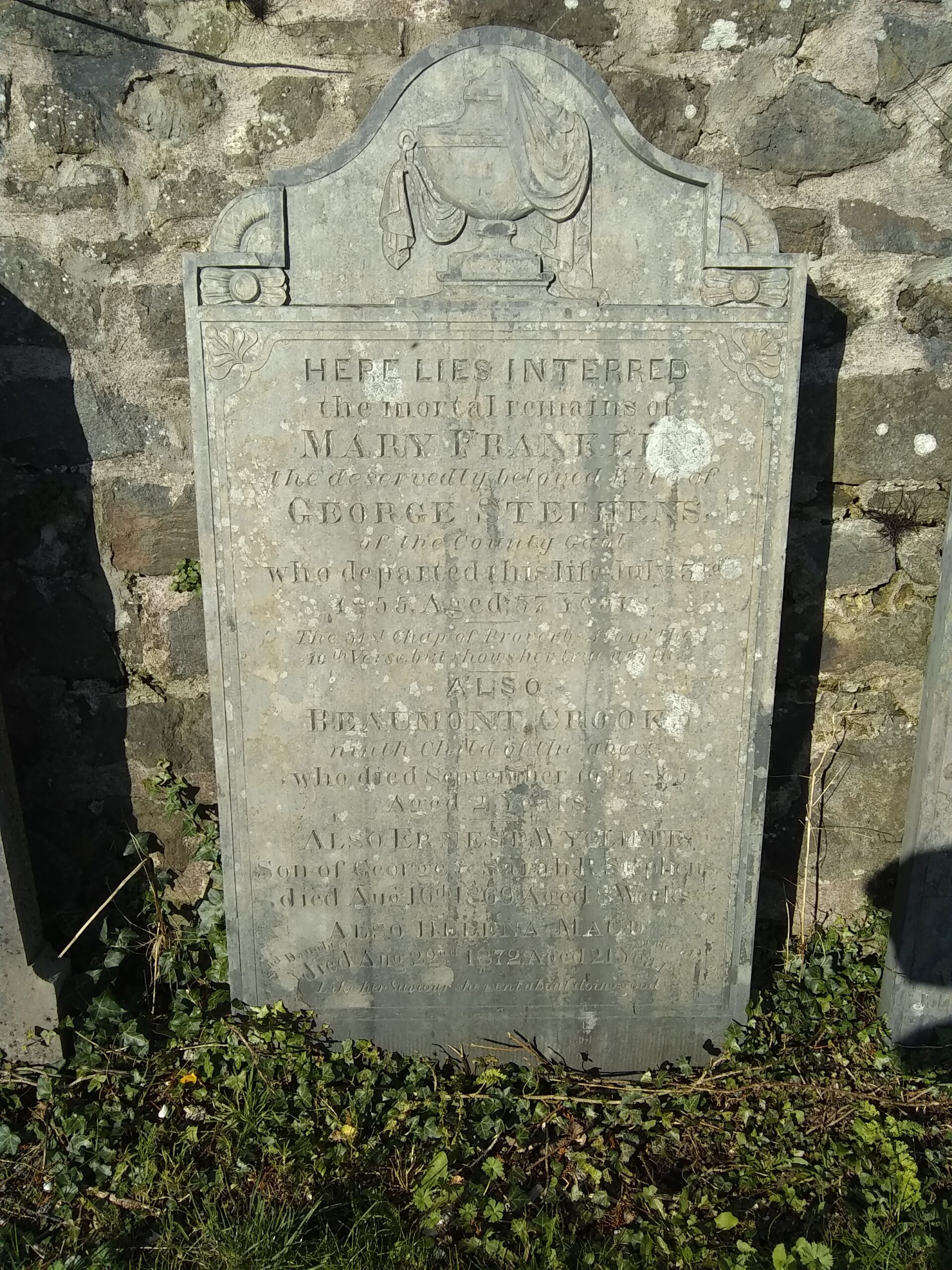
George Stephens managed the town’s prison for 33 years from 1845 to 1878 and retired with a pension of £166.9s.8d and died aged 81, in 1897. His first successful photograph of a felon was of James Jones, a weaver who was sentenced to be hanged in January 1858 for attempted murder, the sentence later commuted to penal servitude for life. Prior to this, his first wife Mary, as matron of the gaol for ten years, assisted him in experimenting with his passion of photography using what was called the Collodian process which was in its infancy but sadly Mary was never to see the fruits of their labour as she died three years before her husband’s first photograph appeared in what is called the FELONS REGISTER. George Stephens was born in Devizes Wiltshire in 1816 and his first wife Mary came from Middlesex. Mary Franklin (Arnold) married George Stephens in St Pancras London in September 1839 aged 18, the same year the Bow Street Runners, the Foot and Horse Patrol and the Thames River Police were amalgamated to form the Metropolitan Police. He had nine children with his first wife who died in July 1855 aged just 37.
The burial Register giving details of Mary Franklin Stephens
Mary is buried here in St David’s Cemetery together with their youngest child Beaumont Crook who died two months later in September 1855 aged two, and also their daughter Helena Maud who died in 1872 aged 21. Very interestingly, also buried in the same grave is eight week old Ernest Wycliffe Stephens who died in 1869, a child of George’s second marriage to Sarah Ridgeway Stephens.
The headstone of Mary Franklin Stephens, two children and one stepson
Both George himself and his second wife Sarah retired to a property near Fountain Hall Terrace, and George died in 1897 aged 81 and Sarah the following year aged 77. Both are buried in Carmarthen Town Cemetery in Trevaughan Road. Why George decided to be buried there other than in St David’s cemetery close to his first wife and children is a mystery which we will never know but his foresight in the use of photography as a means of crime detection was at the time unparalleled in the world. He was also one of the first in the world to photograph prisoners, in 1858 when photography itself had hardly been invented.
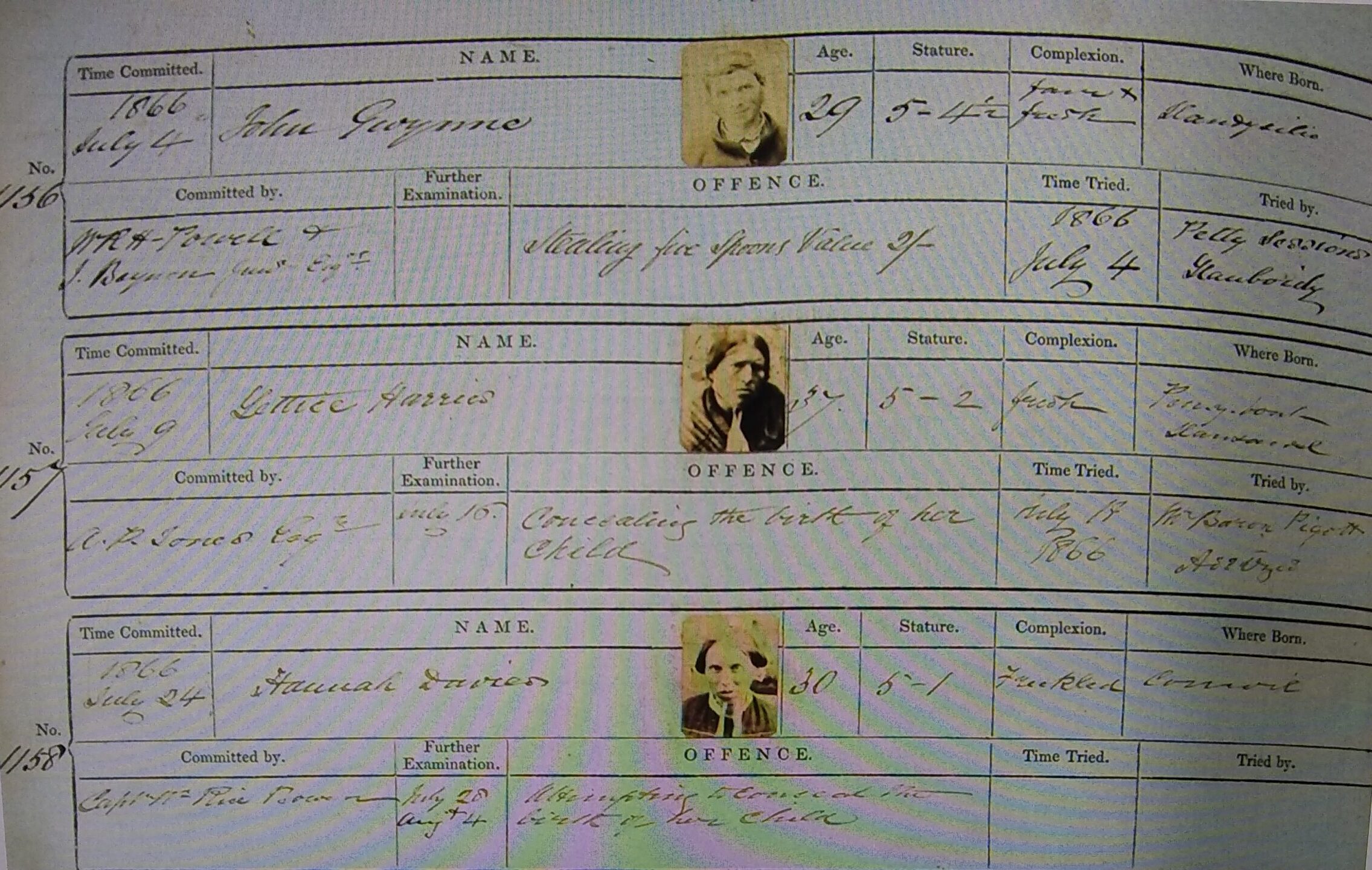
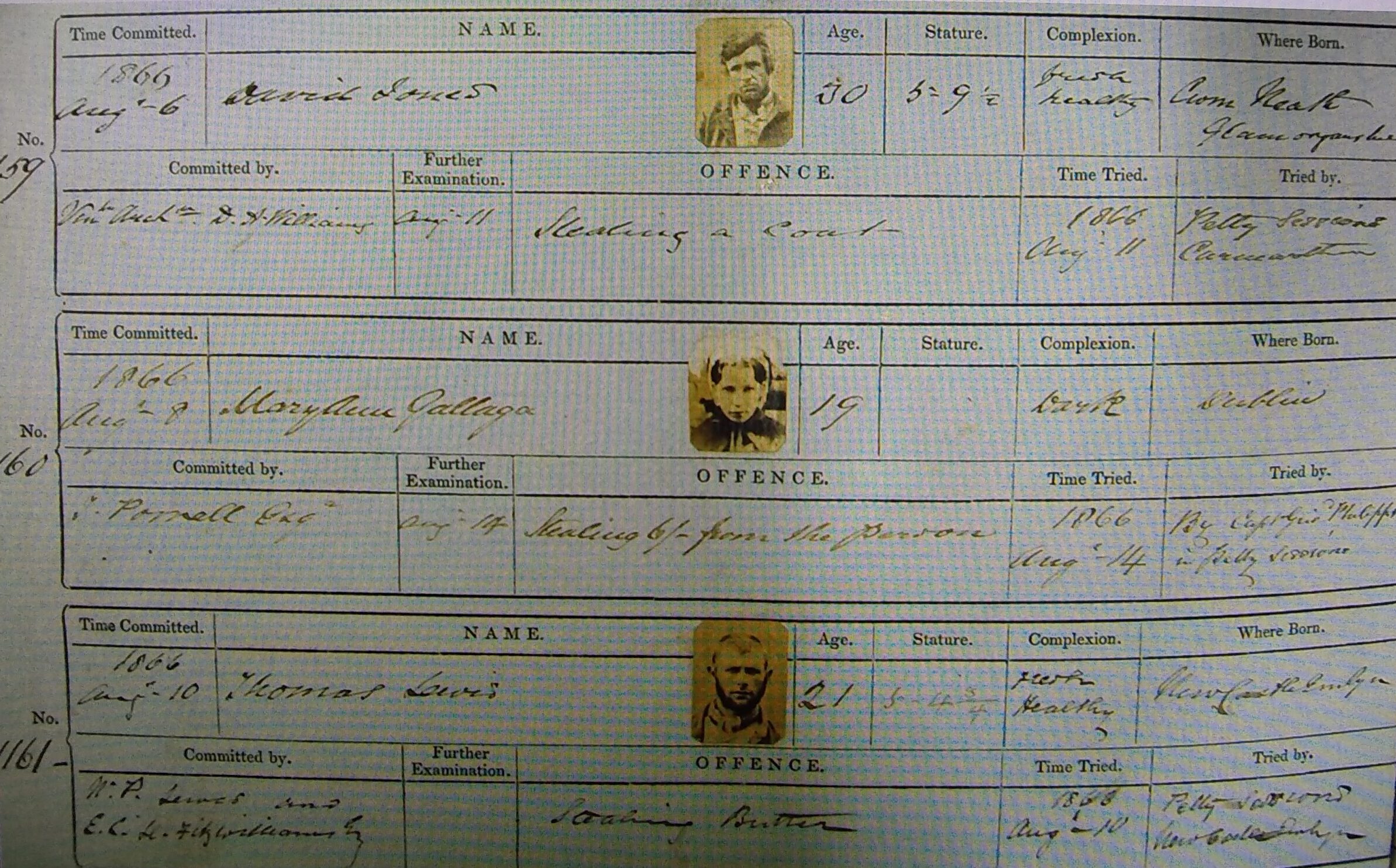
The top half of a page in the Felons RegisterThe bottom half of the same page
A true genius who has really never been given the credit he deserves, thanks to his late wife Mary and the encouragement, and support she provided. His legacy will live on in the Felons Register – a remarkable historical record of a bygone era.
The Felons Register entries –July/August 1866
John Gwynne aged 29. Convicted of stealing five spoons valued at two shillings
Lettice Harries aged 37. Convicted of concealing the birth of her child.
Hannah Davies aged 30. Convicted of attempting to conceal the birth of her child.
David Jones aged 30.Convicted of stealing a coat.
Mary Ann Gallaga aged 19. Convicted of stealing 6 shillings from the Parson.
Thomas Lewis aged 21. Convicted of stealing butter.
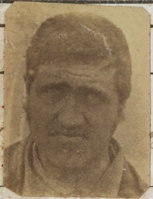
James Jones from Llanllwni. One of the world’s first successful photographic images taken of a convicted prisoner.
The image of the Felons Register and James Jones are reproduced by kind permission of the Carmarthenshire Archive Service.
James Jones aged 28 from Danyrallt, Llanllwni Carmarthenshire, originally convicted of attempted murder in January 1858. This is the first image of a prisoner successfully developed by George Stephens.
The following brief story is of a family long since forgotten in Carmarthen, but a family that played its part to the full in so many ways during what was a difficult period in mid Victorian Britain and Carmarthen in particular. Anne’s 6ft 4” axe wielding father David Woozley must have been quite a formidable character to have come up against yet was better known for his musical abilities than keeping law and order!! There is so much more to tell of this intriguing family but for now I hope this “snapshot of history” will be sufficient to acknowledge the part they played in the life of Carmarthen all those years ago.
Death and Funeral of Mrs Anne Daniel, Carmarthen. 1819-1904 Carmarthen Weekly Reporter 29th July 1904 (supplement)
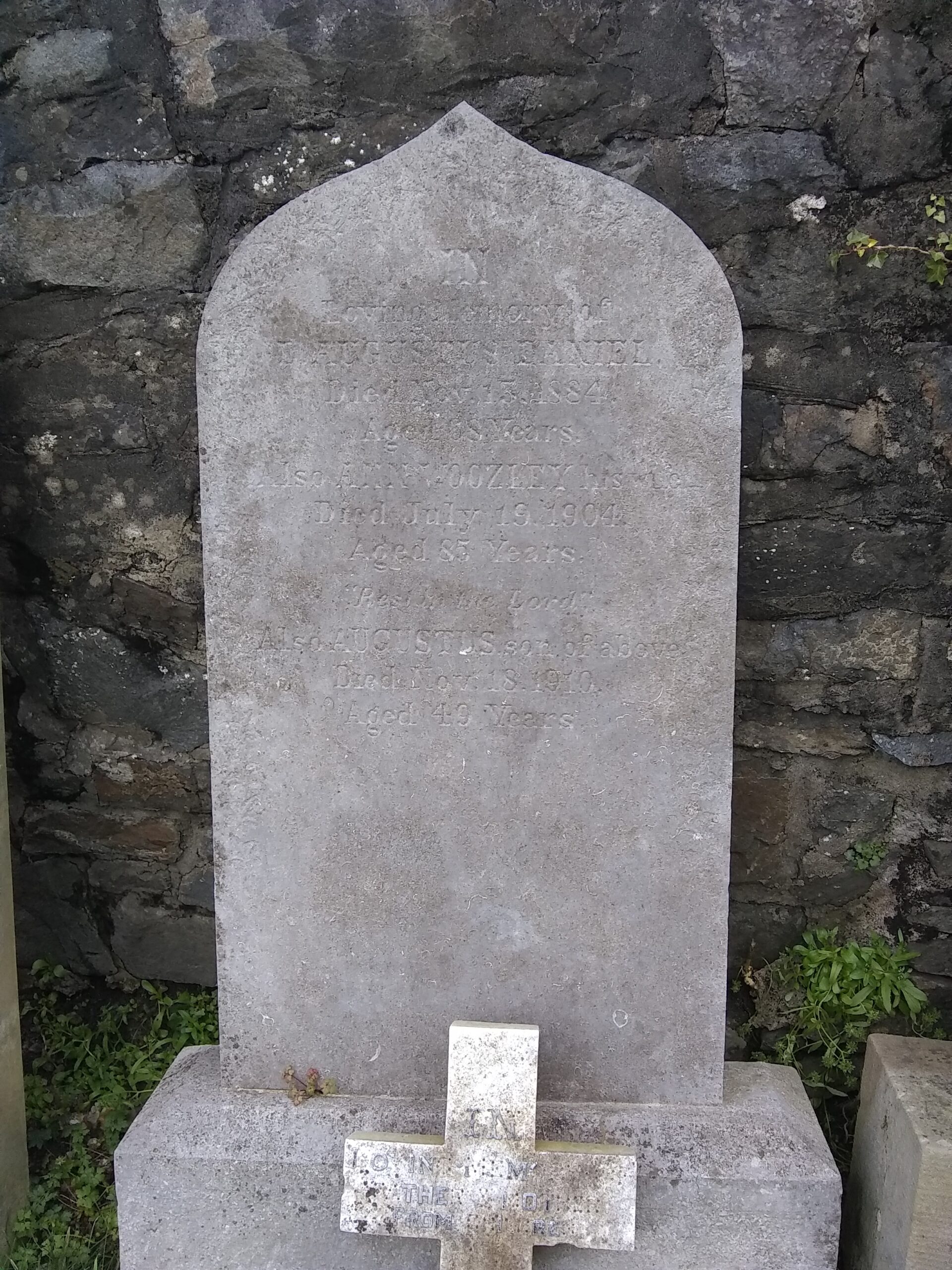
We have to record with sorrow the death and funeral of Mrs Anne Daniel, who died on the 20th inst. her remains were laid to rest on Monday, the 25th inst., at St. David’s burial ground in the same grave as her husband, Mr David Augustus Daniel, boot maker, of this town who died 20 years ago. The deceased was in her 85th year.
The headstone of Ann Daniel, her husband and son. Interestingly Anne’s surname appears as WOOZLEY – her maiden name before marriage. This headstone was found under the soil last year and saved for posterity
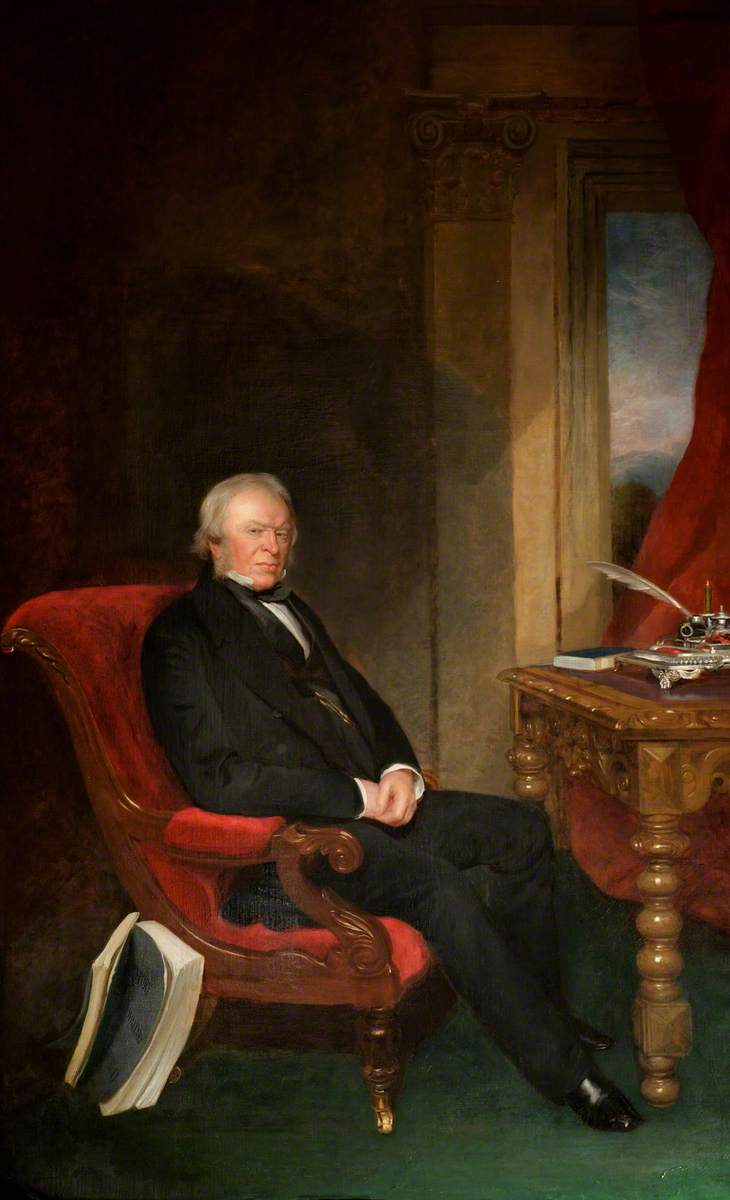
A special request has been made to mention the fact that Mrs Daniel in her young days was one of the ladies who carried a basket of flowers as was then the custom on the occasion of the great procession when the late Mr David Morris, of Carmarthen, was returned in the Liberal cause to Parliament.
Portrait of David Morris MP, by Thomas Brigstocke which hangs in the Crown Court Room of the Guildhall Carmarthen. Reproduced by kind permission of Carmarthenshire Museum Services.
Mrs Daniel was the daughter of the late Mr David Woozley, who for 36 years kept the Borough Police Station, It is noteworthy to chronicle here that the latter was a promoter and member of the old Town Band, and he brilliantly defended himself and the old Police Station against the onslaught of the Rebecca rioters on their way to the workhouse. On that occasion when the attack was attempted, Mr D. Woozley rushed to the door to meet the mob. He was of great strength, standing over 6ft. 4in. with a hatchet in his hand, and he dared one or any of them to touch the building under penalty of losing his life. The rioters then departed. Mrs Daniel was also the only sister of the late Mr Wm. Woozley, who for 21 years served in the Borough Police, and later 21 years a warder in H.M. Prison, Carmarthen. The funeral was attended by a detachment of the Borough Police, under Sergt. Davies, and a host of sympathising friends; Miss Amelia J. Kirton, of Grange Town, Yorkshire, a grand-daughter, also attended the funeral, as well as her two sons David and Augustus Daniel. Mr Wm. Woozley (nephew) who attended upon the old lady, together with his sister Mrs George Thomas until the last.
On the 31st August 1866 the Carmarthen Journal recorded the death of Anne Daniel’s father – David Woozley – the last survivor of the old “Watch” – the last of those who, muffled and cloaked, carrying their flickering lanterns, like glow worms in the dark, had broken the silence of the night with the comforting cry “”Starlight fair, and all’s well” (a quote from Pat Molloy -Shilling for Carmarthen)
“Death of an Old Inhabitant”
“Our obituary this week records the death of an aged and somewhat remarkable inhabitant of this Town. Mr David Woozley. The deceased was, in his youth a member of the old County Militia and accompanied his Corps to Ireland (The Irish Rebellion of 1801 &1802) Before the days of Policemen he was enrolled I the ranks of those Guardians of the Public Peace scarcely less ancient than night itself –“The Watchmen” Most of our readers have had the satisfaction of listening to the strains of what was known as the Carmarthen old band, the members of which never failed to turn out and do their best towards enlivening the town on all notable public occasions. Those who have not heard them will never have that pleasure in this world, for old David Woozley was the last of the company who have, let us hope, been made members of another and better band.
Late in his life Mr Woozley was appointed as keeper of the Station House (Police Station) a position which he held for 33 years, and up to the day of his death in 1866 giving entire satisfaction to the public. He was of great height, and was eighty two years old when he died. Many members of the police force attended as pall- bearers at the funeral, which was perhaps the largest and most respectable of its kind ever witnessed in Carmarthen”
As a committed Baptist like most of his family before him, he was buried in Penuel Baptist Cemetery in Priory Street Carmarthen alongside his parents. Other members of the Woozley family are also buried here in St Davids. Harriet Woozley, David’s sister in law is one, together with other members of her family. James Woozley, like his brother David was buried in Penuel Chapel Cemetery. One can only imagine how terrified the prospective husbands to be must have been to ask 6ft 4” David Woozley for his daughters hand in marriage! Being brought up as children in the White Horse Inn in Priory Street would in itself have been quite hard in the early 19th century but it served them all well and they all in turn served their community above and beyond the call of duty. God bless them all.
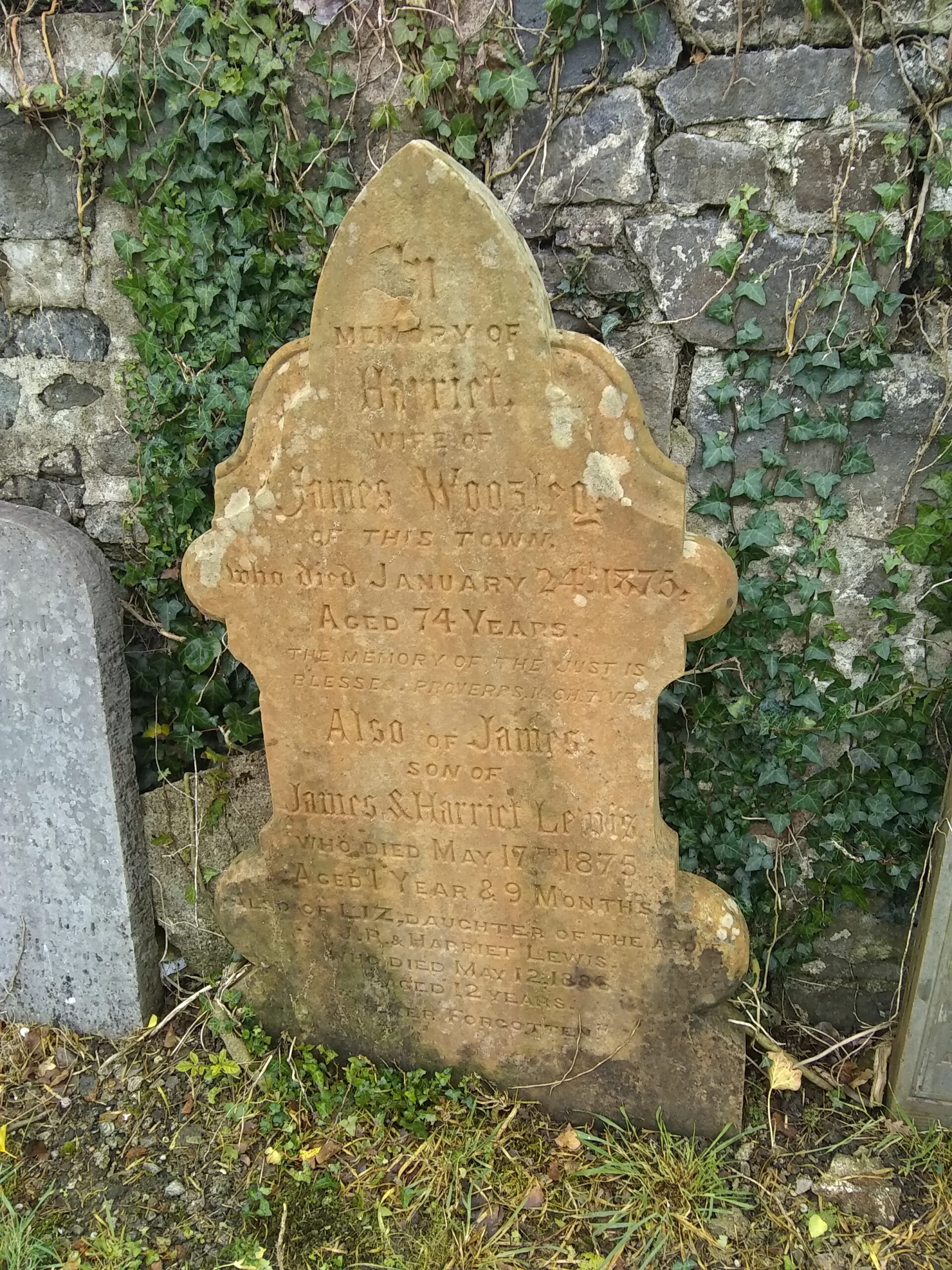
The headstone of Harriet Woozley -Aunt to Anne Daniel
The Reverend Thomas Rees Walters was Vicar of St David’s Church Carmarthen, prison chaplain, and Proctor in Convocation (The main purpose of the Convocations (meetings) was to take counsel for the well-being of the church and to approve canonical legislation, the meaning of the word Proctor was to “represent” – it was a very important role within the church which was carried out with great effect by the Rev Walters. He was one of three brothers, the Reverend W Walters who was the Rector of Rudbaxton in Pembrokeshire, and Doctor St Gynlais Walters, a world class physician on Tropical diseases who worked for the United States Government in Honolulu being the other two.
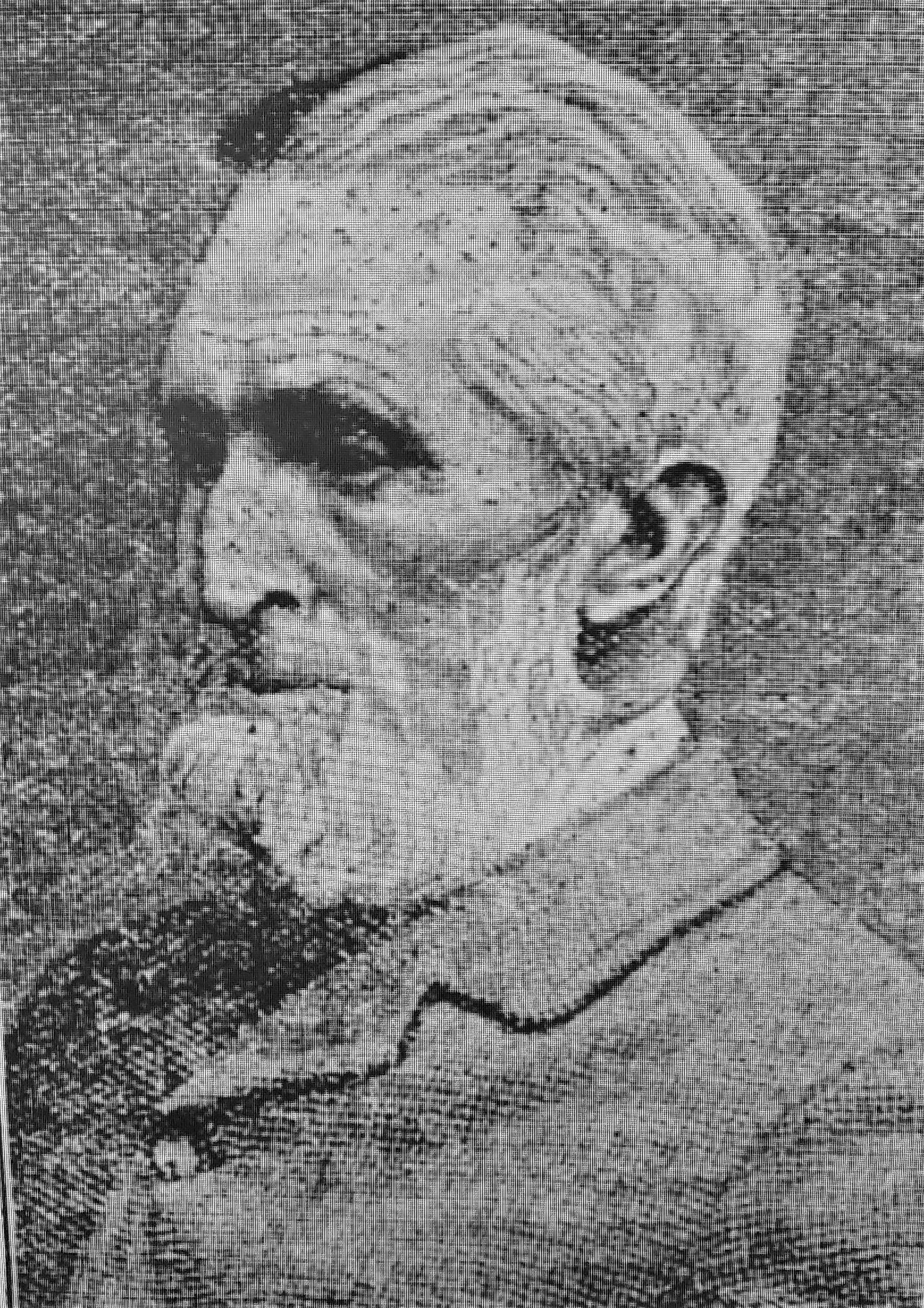
Reverend Canon Thomas Walters DD. Father of Thomas Walters of Carmarthen
Their father, the celebrated Reverend Canon Dr T Walters (Doctor of Divinity from Dublin) lived in Llansamlet and is buried in Ystradgynlais. Unfortunately, being a prison chaplain at the time when Capitol punishment existed inevitably meant that at some point in your career you would be called upon to preside over an execution and such was the case of the Reverend Thomas Walters here in Carmarthen whilst serving as the Prison Chaplain.
The crime of murder was exceedingly rare and always involved people, with a close, often family relationship. There were no executions in Carmarthen for almost 60 years between the hangings of David Evans in 1829 which was a public execution, and David Rees, “the Llanelli Murderer” in March 1888 –the subject of this story. David Rees was convicted for the gruesome murder a messenger carrying money for the payment of wages at the Dafen steel works, though his confession remains suspect even to this day as no money was ever found.
By this time executions were no longer public, but the crowds would still gather outside the gaol to share the thrill of the grim proceedings. Tickets were issued to the press however for them to witness the occasion.
The hangman or executioner as he was most commonly known was on this occasion a man called James Berry who arrived in Carmarthen on the 12th March 1888 to execute David Rees for his crime, having carried out another execution the previous day. During his “career” as executioner between 1884 and 1891 James Berry carried out 131 hangings including those of five women. This would be the only time he ever visited Carmarthen.
James Berry – The Executioner.
The following is an extract from the Carmarthen Journal..
“Berry arrived in Carmarthen by the 3 o‘clock train. On the journey down he was not recognised until he reached Carmarthen Junction, where as he waited for a train to carry him to Carmarthen Town, a great crowd collected and gazed upon the public executioner with mingled feelings of wonderment and awe. The news quickly spread from the junction to the town station, and on arriving there he found that his fame had preceded him. As he walked to the gaol, he was followed by a motley mob who hung around the portals of the prison for some time after the executioner had disappeared from view. The gallows were fixed up as a permanent structure. It is paced on the west side of the prison yard, next to Nott Square. The trap doors are on the same level as the ground so that the necessity of climbing up to the drop is dispensed with. The pit is excavated to a depth of ten feet and the sides are bricked. At the side is a manhole for the use of an attendant in case of any hold up. From the platform to the cross bar is a distance of seven feet. James Berry commented that this scaffold was one of the best he had used. The convict weighed nearly eleven stone and the drop would be about six feet, and this as a result of the experience of the executioner would exercise a strain of nearly 27 hundredweight”
All was now ready, and executioner Berry drank his nightcap with the Governor in his warm and cosy living quarters, whilst a few yards away in the bleak and bare sick ward David Rees awaited his fate. During his time in the gaol, the Reverend Walters visited David Rees twice a day.
The following day, Tuesday 13th March 1888 dawned and David Rees arose from his bed and for the last time on this earth had bread and butter with a glass of milk before being joined by the Gaol Chaplain, The Reverend Thomas Rees Walters who remained with him until the end, preparing the crying and shaking man for his imminent meeting with his maker – for the dread traditional hour of 8 o’clock was but an hour and a half away. Outside the gaol gates the mutton-chop whiskered Chief Constable Brown-Edwardes mustered his men as the crowd began to swell as the hour approached….The Carmarthen Journal continues the story…….
”At about a quarter to eight the Chapel bell began to toll and the press and officials were placed in the long corridor of the prison opposite the cell. At ten to eight the executioner, Berry, appeared dressed in a plain suit of dark clothes and wearing a red Turkish fez, bringing his pinioning straps with him. The executioner is a light complexioned quiet looking man about thirty years old with a light moustache, small short beard and whiskers, and bright brown eyes presenting altogether an appearance entirely unlike what generally might be expected of a public executioner.
At three minutes to eight Berry went into the condemned mans cell to pinion the arms of the convict, during which the unhappy man was crying bitterly and had to be supported by two warders .At a minute to eight the sad procession started from the cell and proceeded to the scaffold, Reverend Walters reading the burial service.The prisoner, who appeared to walk rather weakly, supported by three warders, appeared to be terribly distressed and seemed to be listening very attentively to the service which was read most impressively by the Reverend T R Walters.
As the mournful cortege reached the top of the steps leading to the prison yard David Rees seeing for the first time the scaffold before him cried “ Oh Arglwydd Anwyl”(Oh Dear Lord) The procession on reaching the gallows halted while the convicted murderer, executioner, and Reverend Walters prepared for the final act. David Rees was placed on the centre of the trap while the rope was adjusted around his neck by Berry, and the brass ring forming the noose was placed under the left ear, the white cap then being pulled over his head. The prison chaplain – Reverend Walters all this time had continued reading the burial service in Welsh, in which the unhappy man joined repeating the responses and occasionally shaking his head. At about one minute past eight at the words “Duw a drugarah wrthyf” the leaver was pulled. The drop fell and Rees was launched into eternity. As the drop fell the black flag was hoisted above the female wards facing Spilman Street”
Jack Berry stayed in Carmarthen for a further two hours before taking his leave and on departing remarked “Good morning gentlemen. I hope you will never want me here again” – It was his one and only visit……. for the Reverend Thomas Walters however it must have been a harrowing experience in having to cope with such an event, which I doubt he ever thought he would be involved with but as we can see from the reporting of the press at the time, he seemed to have prepared himself well for the ordeal which was nevertheless to have an everlasting effect on him.
The grave of Reverend Thomas Walters and his wife.
Reverend Walters’ went on to have a very successful ministry and was very much part of Carmarthen’s fabric and way of life, bringing up four children and being involved in many organisations. Being a clergyman in Carmarthen was not an easy task in those days, but to his credit he was top of is class in all that he did. His last resting place together with his wife is thankfully in very good order owing to the fact that it is very low lying and made of substantial polished grey granite resting alongside the east wall of the church.
Somewhere here in St David’s cemetery lie buried the mortal remains of Vitori Pedelina and his wife Sarah, no burial marker or headstone exists. When researching the names of many of those buried in this cemetery, it is always a fascination coming across a most unusual name and surname that appears in the burial registers. One then begins to wonder who were they, what they did, and where did they come from ?
The burial register entry for Vitori Pedelina
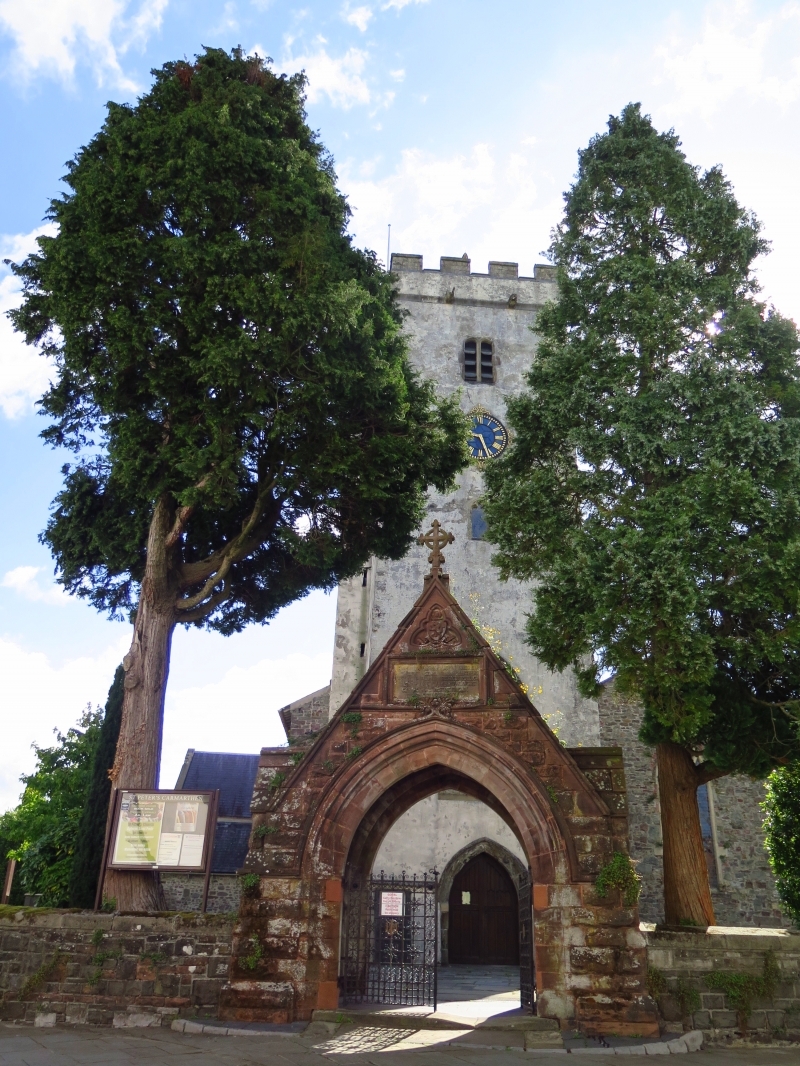
Such was the case with VITORI PEDELINA who was buried here on January 12th 1876 aged 79 in the same grave as his (second) wife Sarah who had died in December 1862. Sarah was born in Carmarthen in 1806 and her maiden name was TOMSON. The officiating minister at St David’s for Sarah’s burial was the Reverend Latimer Maurice Jones who the following year in 1863 was to become Vicar of St Peters Church and in 1874 the Deputy Provincial Grand Master of Freemasons.
Vitori and Sarah were married at Llanllwch Church on April 17th 1843, his profession being a Clockmaker and hers a Seamstress. We can also deduce from the Census records that Vitori was born in Switzerland in 1798. There has never been a central registry for civil affairs in Switzerland and there is still none today. In the early nineteenth century the parents would have registered the birth of their children at the local church registry (if they wanted to have them baptised). Nowadays civil matters are registered with the local authority and because the town/village is not known of where Vitori was born we can never know the full story.
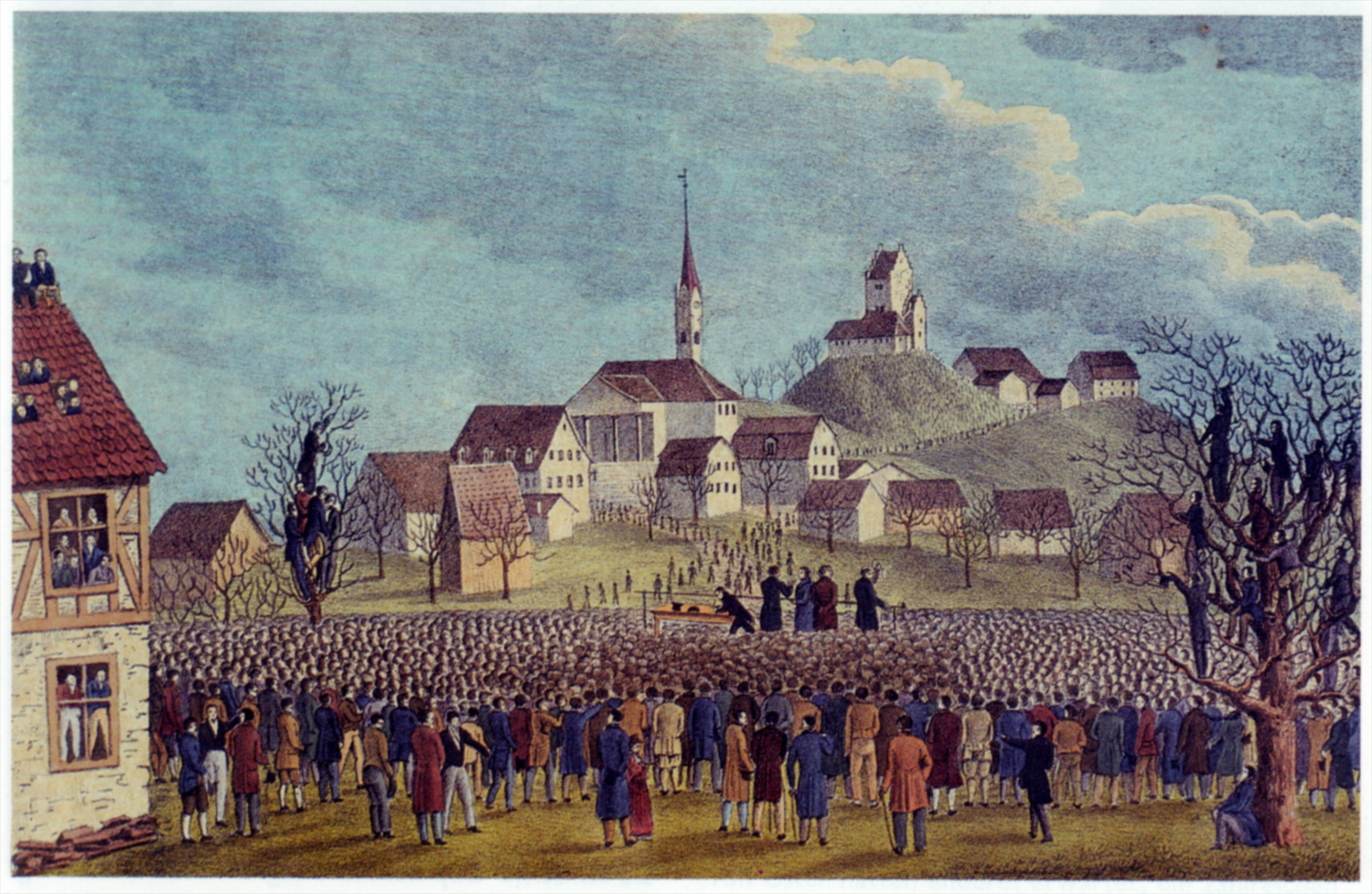
Having carried out some detailed research it is my belief that Vitori and his (first) wife left Switzerland around 1830 during the Swiss Revolution. The Ustertag revolution occurred on 22 November 1830, when 10,000 men of the Canton of Zürich gathered on Zimiker hill and demanded a new constitution. Their primary concern was parity between the urban and rural areas. The Ustertag is described as a “revolution” due to its impact, its focus, and its speed of events, which caused great change in the Canton of Zurich.
A painting depicting the Revolution in Ustertag, Zurich in 1830
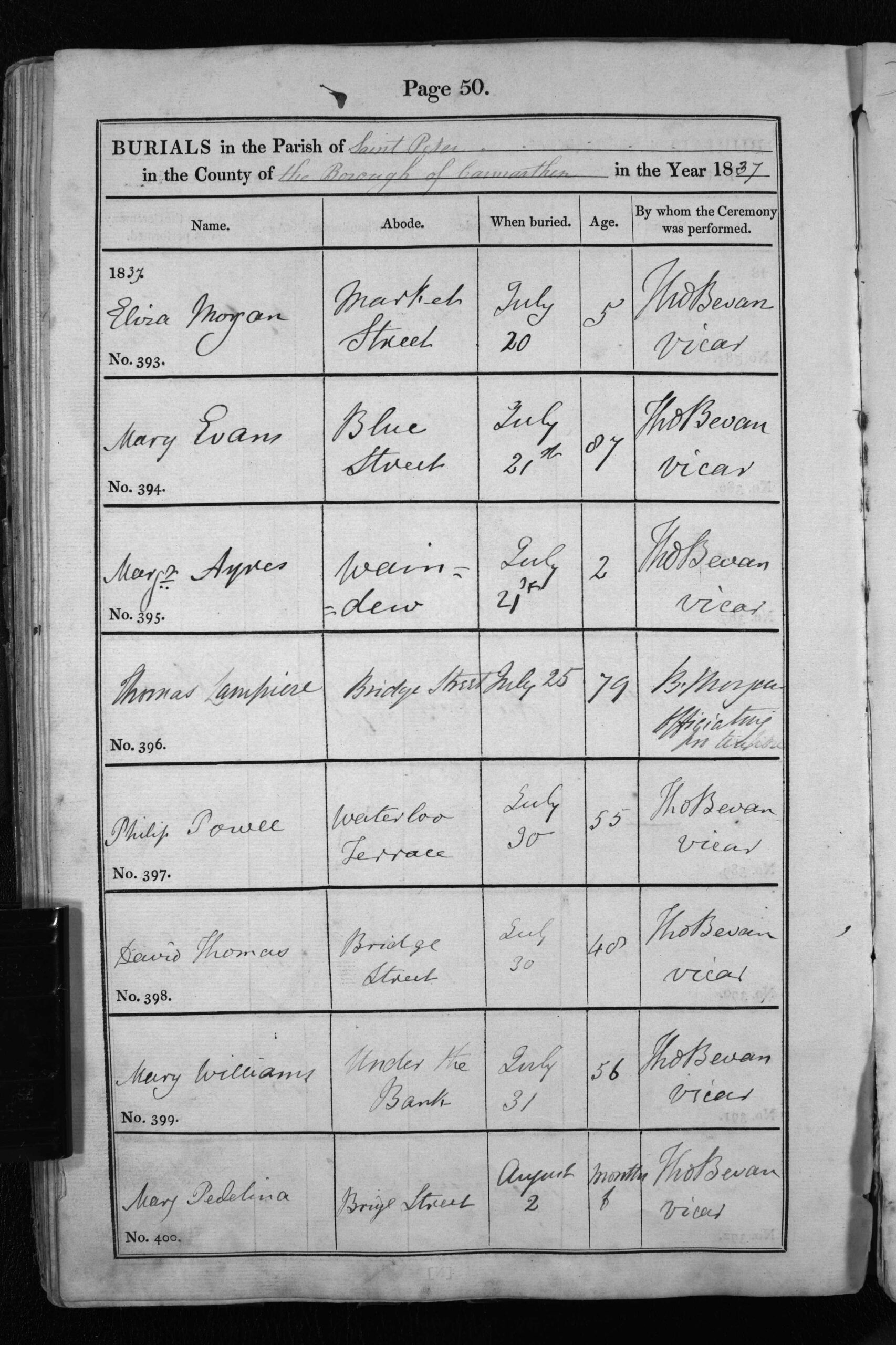
Quite how he ended up here in Carmarthen is a mystery that will never be solved. What we do know is that a six month old infant called Mary Pedelina was buried in St Peters Cemetery on August 2nd 1837. It seems obvious to me therefore that this must be Vitori’s daughter as the address is also given as Bridge Street –the same address as his in the later Census records of 1871. Unusually however, no burial records can be found of his first wife, as she must have passed away prior to 1843 in order for Vitori to re-marry.
Six month old Mary Pedelina’s entry in St Peters Burial Register
It is interesting to note that a small notice appears in the Carmarthen Journal of 1876 stating that Vitori died at the residence of his Stepdaughter, in Bridge Street, whose name we know to be Anne Davies as she is also listed in the Census documents of 1851 as “Daughter” aged 23, clearly indicating that Anne was a daughter from a previous marriage of his late wife Sarah.
It is also interesting to note the difference in the spelling of Vitori Pedelina throughout this time. Firstly on his marriage certificate his Christian name is spelt Vitory, in the 1851 Census he appears as Vittoria Patalina, and in the deaths column of the Carmarthen Journal he appears as Vitori Pedelina Brown. To have travelled from Switzerland to Carmarthen almost two hundred years ago is a feat in itself, but the fortitude of the human spirit and determination to survive is something that has endured since the birth of Christendom itself, and Vitori was just one of those survivors.
The Lych Gate to St Peters Church Carmarthen commemorating the Reverend Latimer Maurice Jones, officiating minister at the burial of Sarah Pedelina in 1862
From being a specialist clockmaker in Switzerland, escaping the horrors of revolution to becoming a hawker (a person who travels about selling goods, typically advertising them by shouting) and general dealer in Carmarthen shows just how hard and difficult life was all those years ago. Nevertheless Vitori Pedelina lived to a good age for the time (79 years old) and will be remembered once again in February next year together with his wife Sarah when the Cross of Souls is unveiled and consecrated which will finally become a lasting tribute to all those buried here without a grave marker or memorial.
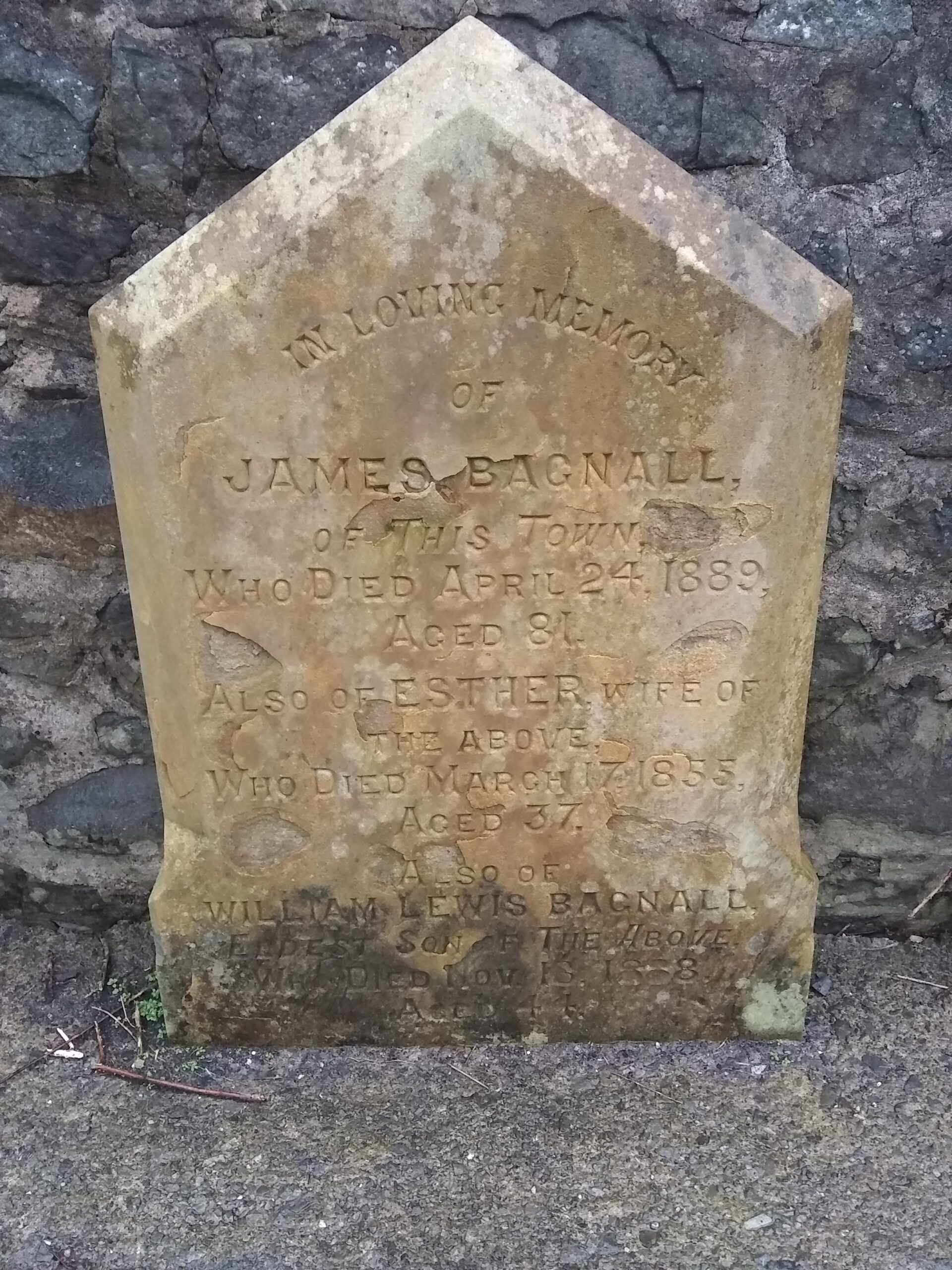
James Bagnall was one of three children, his brother George passing away in 1900 aged 95. Their father was the celebrated Wesleyan Methodist Minister the Reverend James Bagnall who was a close friend and compatriot of John Wesley who very often preached in Carmarthen. The Bagnall’s were one of the oldest and most respected families in Carmarthen and James himself had notoriety of his own in fathering sixteen children from two separate marriages. His elder brother George on the other hand had no children.
It was also his refusal as a staunch Methodist to pay church rates – a legal requirement at the time, and the seizure of his corn by the police which raised considerable agitation in the community eventually leading to the abolition of church rates in Carmarthen.
His brother George also gained notoriety by running after the carriage occupied by His Majesty King George IV on its way through Carmarthen in 1821 when it failed to stop at the Guildhall to acknowledge the local dignitaries assembled there, finally giving up his chase in Priory Street, almost a mile away. It finally stopped to change horses at the Lion Royal in Tanerdy. George, it is said was also the last surviving person to have witnessed a man being pilloried outside the Gaol in Carmarthen.
George Bagnall – Brother of James who famously ran after the carriage of King George IV when visiting Carmarthen in 1821
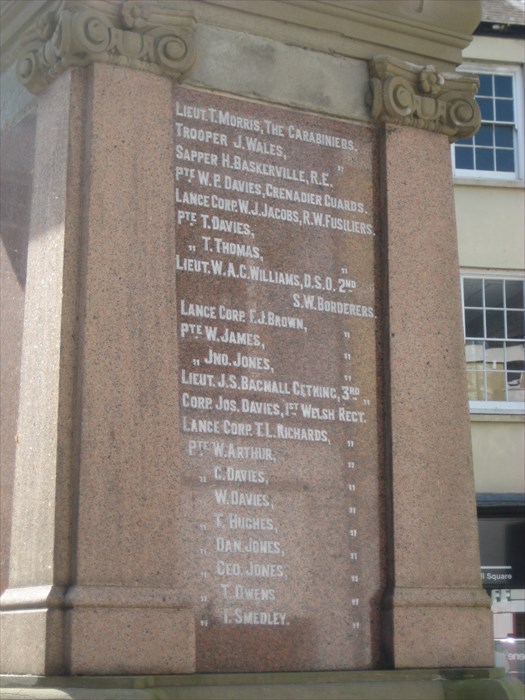
Two Grandsons’ of James Bagnall died on active service. One James Stanley Bagnall Gething died in the Boer War in South Africa in 1901 after falling off his horse, and his younger brother Hugh, a 2nd Lieutenant in the Royal Gloucestershire Hussars was killed in action at Gallipoli on the 21st August 1915. Both have no known grave. Hugh is commemorated on the Llanddarog War Memorial (the village where he was born) and in Gallipoli and James on the Boer War memorial in Guildhall Square Carmarthen.
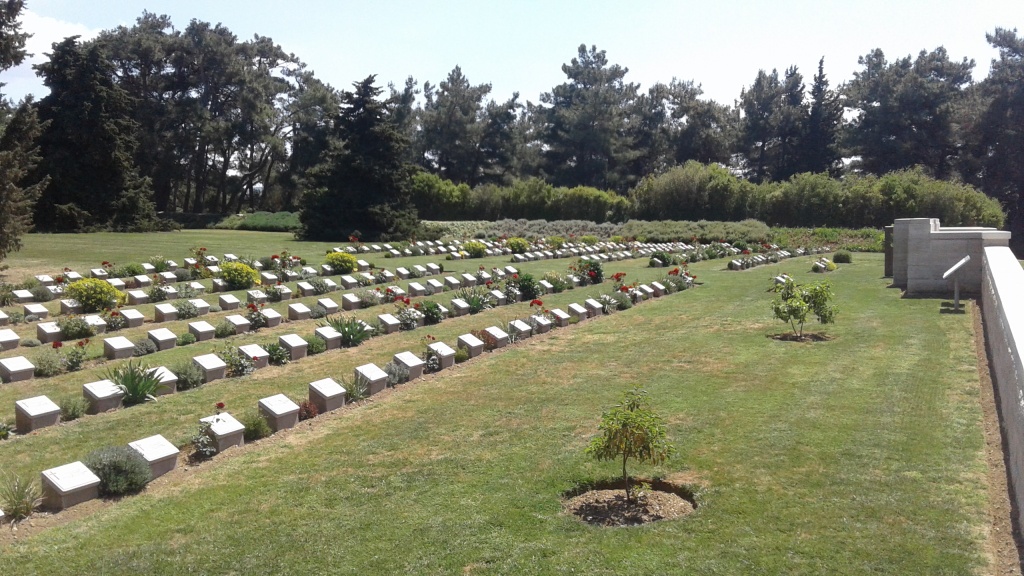
The side panel of the Boer War Memorial in Carmarthen with Lt James Bagnall Gething’s name clearly visibleGreen Hill Cemetery Gallipoli, where 2nd Lieutenant Hugh Bagnall lies buried. The inscription on his memorial saying “Believed to be buried in this cemetery”
The following is an obituary of James Senior that appeared in the Carmarthen Journal…..
DEATH OF MR J. BAGNALL, J P. CARMARTHEN.
With very great regret we have to record that another of the old inhabitants of Carmarthen has joined the great majority. On Wednesday Mr James Bagnall, of Castle-hill, died at the age of 82 years. Mr Bagnall was the son of the Rev. John Bagnall, one of the earlier of the Wesleyan Methodist ministers stationed in South Wales. Mr Bagnall, senior, was stationed here at the time that Swansea and Haverfordwest were in the same circuit, and Carmarthen was one of the preaching stations. He married a Carmarthen lady, and settled in business here, having three children, one being Mr George Bagnall and another, the subject of our sketch – James Bagnall. Mr James Bagnall was born in September, 1808. He was apprenticed to a bookseller at Birmingham in 1822, and afterwards went to Bristol, where he entered into partnership with Mr Wright, of railway time-table fame. Subsequently Mr Bagnall returned to Carmarthen, and joined his elder brother George in the drapery business of G. and J. Bagnall in Guildhall square. In 1841 he married a Miss Lewis, a sister of Mr J. Lewis- Philipps, of Bolahaul, by whom he had eight children, five of whom survive. Subsequently he returned to Bristol, and resumed partnership with Mr Wright, returning to Carmarthen in 1852 and setting up business as a merchant, which he continued till a few years ago. In 1867 Mr Bagnall married a second time, and raised another family of eight children, all of whom survive him. In 1865 he was placed on the commission of the peace for the borough, and made a most efficient magistrate. At that time Lord Westbury was Lord Chancellor, and in the list of names sent up were Mr George Bagnall, and his brother James. The Lord Chancellor declined to appoint two brothers at the same time, and Mr George Bagnall, waived his prior claim on the ground of seniority in favour of his brother. Mr James Bagnall was instrumental in getting the borough bench to arrange a rota of attendances. For a short period, about 25 years ago, Mr James Bagnall occupied a seat on the Carmarthen Town Council. He took much interest in the Carmarthenshire Infirmary and the Carmarthenshire Literary and Scientific Institution. In 1860 he was actively associated with the late Mr Edward Joseph in establishing the Carmarthen Weekly Reporter, and acted as its first editor.
James was buried with his first wife and eldest son
He was a staunch Liberal in politics, but of strong intellect and independent in thought and action. It is said that he nearly got into trouble in youth on account of his real or supposed sympathy with the Chartist movement. Apart from politics he was a genial and kindly man who made numerous friends. In earlier life he was a Wesleyan Methodist, and held office as a steward up to the time of the second settlement at Bristol. The death of Mr James Bagnall makes the fourth gap made by death in the Carmarthen borough bench during the last 13 months, his colleagues who have preceded him being Messrs. R. M. Davies, G. W. White, and W. Spurrell.
As I have mentioned previously, when researching an individual who is buried in St David’s Cemetery you never know what information comes to light during the course of that research. Such was the case with David James, a very respectable and popular Police Sergeant in Carmarthen. Little did I know that shortly after starting my research I was to find out quite by accident that he and two of his friends, one of which was also a Police Constable died together in a triple drowning tragedy on the River Towy on July 24th 1865. Even sadder was the fact that exactly two months later on 24th September, David’s only son Alphred died aged 4 years and five months, his mother Elizabeth, being unable to cope with the sudden loss of her husband, suffering a mental breakdown. It was to be another 35 years before Elizabeth herself, passed away in the Carmarthen Infirmary and was buried with them at the age of 60 in February 1900. My story however, would not have been complete without first visiting the “scene” of the tragedy on the River Towy 155 years ago and this Thursday evening I was privileged to be taken up river by Steve, a safety officer from the Gwendraeth Valley Paddlers, in a ribbed inflatable boat accompanied by Mr Malcolm Rees direct descendant of Owen Elias (who pulled out the body of Sergeant James from the river) and his wife Julie who had been kind enough to make all the arrangements. It was in fact memorable in more ways than one, in that it was 27 years ago in 1993 that I had last left the Quayside in a boat –as Admiral of the Port of Carmarthen.
The still and calm waters of the Towy with it’s deep pools
The sunlit evening and calm waters made the journey a very pleasant one if not a poignant one, passing many local landmarks along the way and seeing a great deal of wildlife, swans herons, squirrels, bats and much more besides. The clarity of the water was amazing in some stretches which belied its depth and after twenty minutes or so we reached our destination. From the detailed description of evidence given from the Coroners Inquest, we came to the spot close to the property known as Danyrallt where in 1865 four men entered the water and only one returned. The farmhouse – still occupied can be seen clearly from the river bank.
Whilst much of the course of the river has changed in the last hundred years this area will have changed little, largely due to the remains of the old Carmarthen Lead Mines carved out of the rock face protecting the river bank from any erosion. Visiting the scene, and seeing with my own eyes, the depth of the deep pools and strength of the current, it was not surprising that such tragedies occurred especially in the midst of a hot summer in July 1865 where “bathing” and not swimming was commonplace. Sadly, as we all know too well the Towy has claimed many lives over the centuries. The Towy Coraclemen – a celebrated group of experienced anglers and fishermen are as part of the fabric of Carmarthen as the river itself, and credit has to be given to them for the centuries of service they have given in the saving of many lives from the river and also for the retrieving of many of those who had sadly succumbed to it’s dangers.
Towy Coraclemen in 1908 assisted in locating the body of 3 year old Cromwell Davies who had fallen into a river near Merthyr. Note the “grappling Iron” being held by the man with the coracle on his back.
As will be seen from the Coroners report of this fatal tragedy, they had a large part to play in rescuing the three bodies before they disappeared for ever. At least the wives and family of those who drowned could now mourn the loss of a loved one at the graveside of their beloved son and husband. I am very grateful to Mrs. Julie Rees for taking some of the photographs & for organising the boat trip to the scene of the tragedy, which in some way brought closure on a story that is not well known but had very tragic consequences for 3 families whose lives were changed for ever 155 years ago.
My research first began when I started looking into David’s Police career and in particular involving one famous incident of his arrest of “POOR NANNY” (Anne Awberry) in February 1863. What follows is an extract from the late Pat Molloy’s “A Shilling for Carmarthen– The town they nearly tamed” followed by a further extract from the newspaper “The Welshman” published in July 1865 reporting on the Coroners Inquest into the deaths by drowning. Together they tell the tale of David James, whose bright and colourful career in the local Police Force was brought to a cruel and tragic end…..here then, is his story, one page out of many chapters.
“Anne Awberry, the doyen of the town’s drunks and nymphs of the pave, was still doing her stuff” PC William Jones said that about half past nine o’clock on Thursday night Anne Awberry was drunk in Guildhall Square. She had a crowd of children about her and was singing and dancing and very riotous. She is a prostitute. She was committed to the House of Correction for two months” (March 1863)
Police Sergeant David James charged Anne Awberry with being drunk and riotous. He said in his statement to the Magistrates “last night about 11o’clock I was on duty in Lammas Street when I saw the defendant there near the Boar’s Head Hotel. She was singing and making a great noise. She was very drunk and creating a disturbance. She has been very bad since she came out of gaol last. She is a prostitute and this is her one hundred and thirtieth appearance here in Court.” The magistrates committed her to the house of correction for three calendar months. So celebrated was “Poor Nanny” that she earned a distinction unique for one of the poorest of the community – an obituary in the Carmarthen Journal.
“Death of poor nanny”
This notorious person known as Anne Awberry is no more. She was only lately discharged from gaol where “Poor Nanny” as she called herself had spent most part of her time for the last thirty years, as an incorrigible drunkard. She was taken ill suddenly on Thursday and conveyed in a cart to the Workhouse, where medical assistance was given to her, but to no avail and she died on Sunday last (23rd August 1863) and was buried in the Town Cemetery in Trevaughan Road a few days later.
Sad that only this kind of notoriety could merit even a mention of the passing of those below the rank of “gentleman”, professional man or tradesman; only an entry in a court record or police occurrence book would mark their brief transit across Carmarthen’s crowded little stage. Others of the “lower orders” entered and left that stage without even leaving a footprint on its boards.
DISTRESSING AND FATAL ACCIDENT. THREE MEN DROWNED.
On Monday evening last, a melancholy accident occurred just at the time when thousands of people were assembled on the banks of the river Towy, to witness the ceremony in launching the steam-boat” Lily.” A few minutes before the launch it was rumored that, two Policemen and another man were drowned while bathing in the river, near Danyrallt. At first the statement was discredited, but when the ceremony was over it was known that the sad tidings were too true. It appears that Sergeant David James, Evan Jones, and D Williams all of the Carmarthen Borough Police Force and William Powell, formerly in the force but now an eating house keeper in Water street, went out for a bathe. They walked across the Carmarthen Bridge and along the footpath at the back of Tygwyn, and when they got to the south bank of the river, they looked for a suitable place to bathe, and fixed upon a spot about 300 yards above the Tin Works.
The scene of the tragedy in July 1865
They decided upon the place, because it appeared less dangerous than any other, while in reality no one beside an expert swimmer should venture there. Williams tried the depth, but he did not go far enough for near the bank there is a deep pool with a strong current. James and Powell could swim a little; the other two could not swim at all. They waited a few minutes for the tide, and then went in. James plunged into the river and appeared to be swimming but he was cautioned not to venture too far. He made no reply, being probably at that moment in imminent peril. Powell was also out in the stream, and found the current carrying him away, he cried for help Jones and Williams then joined hands to assist Powell who directly afterwards sank, and the others got beyond their depth. Jones let go his hold of Williams and floated out into the stream. Williams was then altogether under water, and very much confused. He, however, fortunately turned and made a desperate effort to reach the bank, which he just managed to do in an exhausted state. He then saw Jones struggling far out in the river crying that a rope might be thrown to him. Neither James nor Powell were anywhere to be seen. Williams gave an alarm and some fishermen in coracles came to his assistance, but too late, the three unfortunate men were then drowned. A search was at once made for the bodies. Powell was found at about 8 o’clock, and James at 11 o’clock that night. Jones was not found until Wednesday. On Wednesday evening an inquest was held in the Shire Hall, before John Hughes, Esq., coroner, when the following evidence was given. P.C. David Williams
…… “About half-past five o’clock on Monday last, the 24th inst, I went to bathe in the Towy, in company with P.S. David James, P.C. Evan Jones, and William Powell, eating-house keeper in Water Street. We went over the bridge, and near Tygwyn. The tide was not in when we arrived at the river side. I stripped first and went into the river to see how deep it was before the tide came. I came back and sat on the bank to wait for the tide which came in about ten minutes, when we all went in. Sergeant James was the highest up the river, near a pool. He plunged himself, and he was very long before he came up, and we said he must have been drowned. When he came up about three or four yards off, Evan Jones told him not to venture so much for fear something would happen. He did not answer but turned to the right about and went up with the tide to a deeper place. I believe he was carried up by the tide about twenty yards. Powell then called out for assistance, as he was drowning. He was only three or four yards from Evan Jones and myself. Evan Jones said “give me your hand” and I did so. Before we got to him hand in hand he was out of sight – he had sunk. I did not see him again. When we were hand in hand, directly after Powell sank, Evan Jones lost his footing and sank, and in sinking pulled me down with him till we were out of sight .He left my hand loose, and I turned back, I struggled and came out of the river. I looked back and saw Evan Jones in the middle of the river, struggling and on his back. He called out to me to throw him a rope. I said, my dear fellow, I had no rope, but ran to some coracles for help. I ran back in two or three minutes, and he was not in sight. I did not see David James after he was carried up by the tide, which was running very strong. I could not swim, but Sergeant James and Evan Jones could swim a little. Powell could not. By the Jury the water was about two and a half feet deep where we first went in. We waited for the tide to have a salt bath.”
David Evans, fisherman, Priory Row, said last Monday evening….. “About a quarter to six o’clock I was coming out of my house, which is near the river. I saw the last witness running across the Tygwyn marsh naked; he was calling out for help to some men who were drowning. I took my coracle and went as quickly as possible to the place which he pointed out, but I could see nothing there. Three others and myself went home to fetch nets and hooks. When I returned some men who were there said they could feel something in their net. I got hold of William Powell by the ankle, with a hook, and brought him out about 8 o’clock. It was in a very deep place”
Owen Elias, labourer and fisherman, the Parade, said last Monday… “I went from my work, and when I was drinking my tea I heard someone say there were three men drowning. About half-past eight I went on the river in a coracle, with a grappling iron with which I found the body of Sergeant James. I found it about ten yards higher than where the last man found the body of Powell. I found it about quarter past eleven o’clock.”
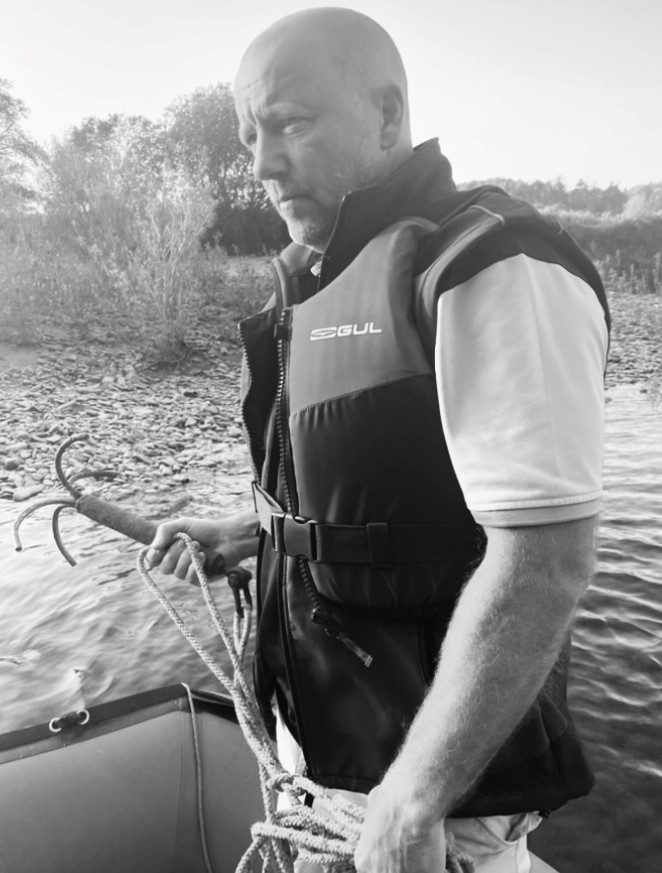
Mr Malcolm Rees with a “grappling Iron” at the scene of the tragedy. Malcolm is a direct descendant of Owen Elias, who found the body of Sergeant James.
Abraham Harris, fisherman, Priory-street, said…. “This morning about eleven o’clock I went out in a coracle, with a hook, to search for the body of Evan Jones. I put the hook down near where the others were found, and soon brought up the body. There were, perhaps, five or six yards between the three bodies. I was looking for the body yesterday with the grappling iron, but could not find it.”
This being all the evidence, the Coroner remarked that any comment from himself would be unnecessary, as the cause of death was apparent. The Jury immediately brought in a verdict of “Accidentally drowned while bathing.”
THE WELSHMAN, FRIDAY JULY 28TH 1865.
Sergeant James’s headstone & that of his infant son and wife in St David’s Cemetery Carmarthen.
Sacred
To
The Memory of
DAVID JAMES
Sergeant in the Carmarthen Borough
Police Force, who was Accidentally
drowned by bathing on the 24th July 1865
Aged 32 years.
Boast not thyself of tomorrow for thou knowest
not what a day may bring forth.
ALSO of ALPHRED J JAMES, son of the
above named who died 24th of Sept 1865
Aged 4 years and 5 months.
In loving memory of ELIZABETH, wife of
DANIEL JAMES, who died at Carmarthen
Infirmary, Feb 12. 1900 aged 60 years
And finally, the photograph below shows the intrepid quartet setting off from the Quay just after 19.00 hrs on Thursday 17th September, returning safe and sound later in the evening. Left (front) Mr Malcolm Rees (Back) Richard Goodridge – Chairman of the Trustees of the Thomas & Elizabeth Mayhook Charity and author of this story. (Back right) Mr Stephen Bright, Safety Officer of the Gwendraeth Valley Paddlers, and Mrs Julie Rees
During the course of our restoration of the cemetery during the last five years it is always in our minds that the cemetery has probably more burials of infants and children than any other age group, such was the disease and deprivation during the Victorian era in Carmarthenshire. The headstone below is testament to that in recording the deaths of four children of one family, two of which died a day after each other aged 4 and 3 years old. Not a lot of detail is known of the family itself, which is sometimes the case but one thing is certain, that their names will not be forgotten.
IN
Loving Memory of
WILLIAM LAPHAM
Son of Edward Alfred & Alicia Owen,
Ship-Inn, of this Town,
who died April 18, 1880, aged 4 years.
Also of Eliza Jane, their daughter,
who died April 19, 1880 aged 3years.
Also of William Edgar, their son,
who died Feb 15 1886 aged 1 year.
Also of Beatrice Alicia, their daughter,
who died April 12, 1890 aged 4 years.
“HE SHALL GATHER THE LAMBS WITH HIS
ARM, AND CARRY THEM IN HIS BOSOM”
The LAPHAM children’s headstoneThe children’s headstone with inscription visible after rubbing flour into the inscription
What’s in a name” EXTRA” The following comprises of a list of unusual surnames that appear on many of the memorials, together with a list of professions reflecting the huge and important mixture of people that made Carmarthen what it is today – many long since disappeared from the English Dictionary and only now found in history books, and finally Public Houses which are also recorded on many of the memorials as places of residence. Here then are the Three P’s …….
People, Professions & Public Houses.
PROFESSIONS
DRAPER
CATTLE DEALER
SEA CAPTAIN
COAL MERCHANT
TAILOR
SOLICITOR
ASSYLUM ATTENDANT
BUTCHER
WEAVER
OSTLER
GLOVER
HATTER
CURRIER
MARBLE MASON
SERGEANT (ARMY)
SERGEANT (POLICE)
SERGEANT MAJOR
PLUMBER
COACH BUILDER
TIMBER MERCHANT
SCULPTOR
WATCHMAKER
GUN MAKER
PAINTER
CABINET MAKER
SADDLER
TEACHER
IRONFOUNDER
MERCHANT
SLAUGHTERHOUSE KEEPER
PRINCIPAL/TRAINING COLLEGE
BOOT CLEANER
SURGEON
BOOTMAKER
CHURCH WARDEN
CONSTABLE
SHOEMAKER
TINPLATE WORKER
FISHMONGER
POST OFFICER
PRINTER
DRIVER
COOPER
GROCER
JOURNAL PROPRIETOR
VICAR
ARCHDEACON
PARISH WARDEN
GWR GUARD
GWR FIREMAN
MASTER MARINER
ALDERMAN
MAYOR OF CARMARTHEN
COMPOSITOR
ORGANIST
SHOEMAKER
GARDNER
GROOM
BUILDER
COUNTER CLERK (PO)
MIDWIFE
WATER INSPECTOR
CHAPLAIN (PRISON)
COUNCILLOR
BAKER
CHIEF CONSTABLE
BOOKBINDER
MAGISTRATE
BOROUGH SURVEYOR
CARMAN
HOUSEKEEPER
POTTER
SCHOOLMASTER
SPIRIT MERCHANT
SAILMAKER
HARBOURMASTER
COMMANDER- R.N.
MALTSTER
FOREMAN
MILLWRIGHT
PROCTOR IN CONVOCATION
MASTER OF THE INTERNATIONAL SCHOOL, LLANDEILO- FAWR.
DEPUTY LIEUTENANT
PEOPLE/SURNAMES
WOOZELEY
OLIVE
BASS
MEYRICK
NOTT
DUCKFIELD
BRODRIBB
WEATHERHEAD
BRIGHT
CASSIN
TRIVETT
WHITNEY
BURNELL
TALBOT
POOLEY
BARFIELD
BUCKLAND
WHARFINGER
DUFF
GOBLE
WOOLASTON
NEEDLE
SHELL
LAPHAM
AUBERY
COMPTON
KINDER
SPURRY
VALENTINE
POSTHUMOUS PRYSE
GILLELAND
BAGNALL
CADWALLADER
SHARKLAND
BLAND
SOPPITT
COTTRELL
VIGOR
GOWER
CLEVERLEY
NESBITT
DELL
PUBLIC HOUSES
BOAT & ANCHOR
ROYAL OAK INN
NAGGS HEAD
SQUARE & COMPASS
MORGAN ARMS
OLD WHITE LION
OLD PLOUGH INN
STAG & PHEASANT
SHIPP INN
RAILWAY TAVERN
GOLDEN LION
STAGS HEAD
SWANSEA CASTLE
We use cookies on our website to give you the most relevant experience by remembering your preferences and repeat visits. By clicking “Accept All”, you consent to the use of ALL the cookies. However, you may visit "Cookie Settings" to provide a controlled consent.
This website uses cookies to improve your experience while you navigate through the website. Out of these, the cookies that are categorized as necessary are stored on your browser as they are essential for the working of basic functionalities of the website. We also use third-party cookies that help us analyze and understand how you use this website. These cookies will be stored in your browser only with your consent. You also have the option to opt-out of these cookies. But opting out of some of these cookies may affect your browsing experience.
Necessary cookies are absolutely essential for the website to function properly. These cookies ensure basic functionalities and security features of the website, anonymously.
Cookie
Duration
Description
cookielawinfo-checkbox-analytics
11 months
This cookie is set by GDPR Cookie Consent plugin. The cookie is used to store the user consent for the cookies in the category "Analytics".
cookielawinfo-checkbox-functional
11 months
The cookie is set by GDPR cookie consent to record the user consent for the cookies in the category "Functional".
cookielawinfo-checkbox-necessary
11 months
This cookie is set by GDPR Cookie Consent plugin. The cookies is used to store the user consent for the cookies in the category "Necessary".
cookielawinfo-checkbox-others
11 months
This cookie is set by GDPR Cookie Consent plugin. The cookie is used to store the user consent for the cookies in the category "Other.
cookielawinfo-checkbox-performance
11 months
This cookie is set by GDPR Cookie Consent plugin. The cookie is used to store the user consent for the cookies in the category "Performance".
viewed_cookie_policy
11 months
The cookie is set by the GDPR Cookie Consent plugin and is used to store whether or not user has consented to the use of cookies. It does not store any personal data.
Functional cookies help to perform certain functionalities like sharing the content of the website on social media platforms, collect feedbacks, and other third-party features.
Performance cookies are used to understand and analyze the key performance indexes of the website which helps in delivering a better user experience for the visitors.
Analytical cookies are used to understand how visitors interact with the website. These cookies help provide information on metrics the number of visitors, bounce rate, traffic source, etc.
Advertisement cookies are used to provide visitors with relevant ads and marketing campaigns. These cookies track visitors across websites and collect information to provide customized ads.