Welcome to the Thomas & Elizabeth Mayhook Charity website, dedicated to the Preservation, Upkeep & Maintenance of the historic St David’s Cemetery Carmarthen
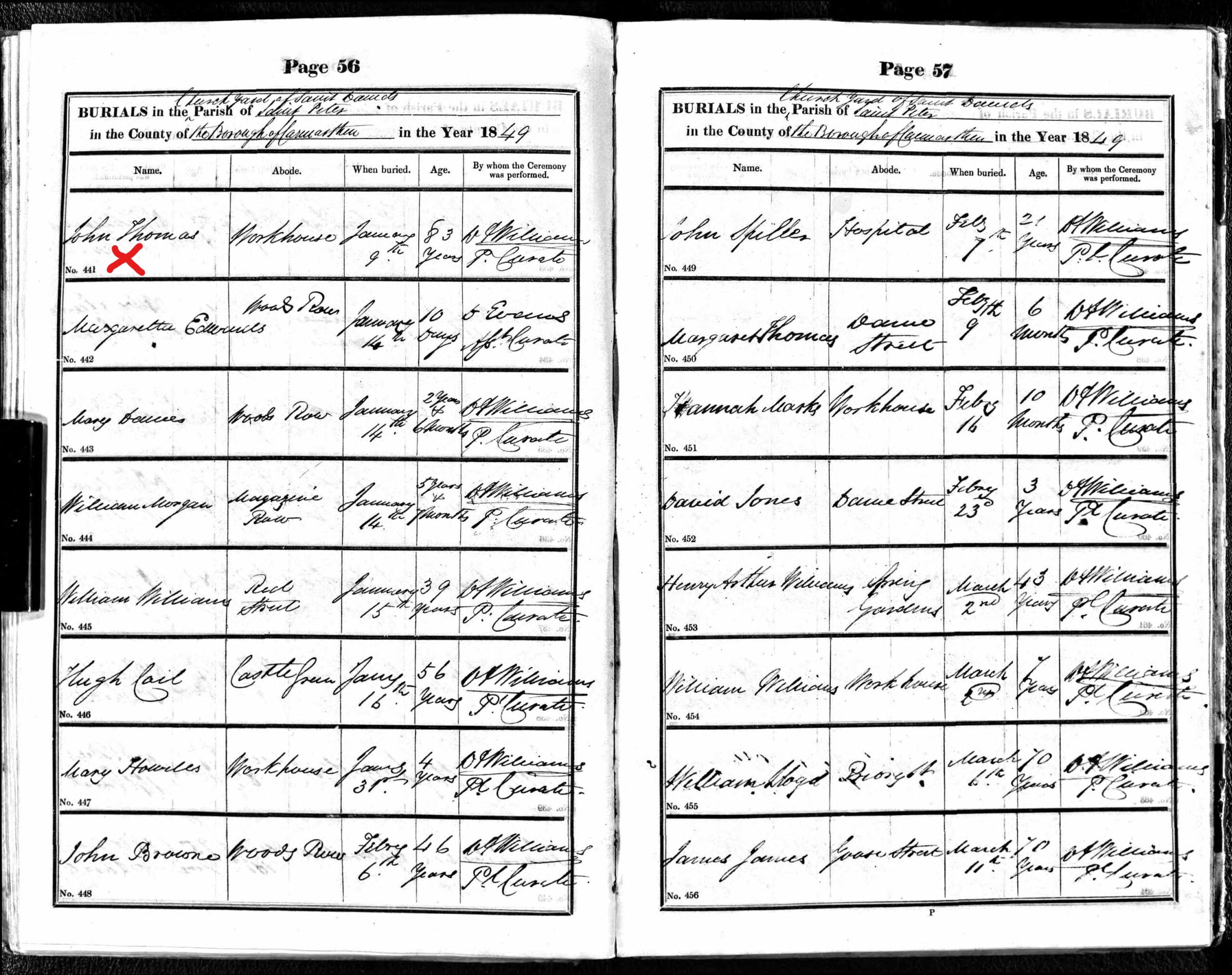
The following, and sad story tells of the utter neglect of a frail octogenarian resulting in his painful and traumatic end that could so easily have been avoided had his family and local community taken more interest in his wellbeing. Taking over four hours to be transported in an open cart to the Carmarthen Workhouse ( at his own request) a distance of seven miles in the freezing month of January with hardly any protection from the weather, ultimately aided his early demise. As is also the case with so many of his generation, he died in the Workhouse amidst the most terrible conditions and is buried in a paupers grave. May he rest in peace.
An INQUEST was held on Saturday last, at the Board Room of the Carmarthen Union Workhouse, before John Hughes, Esq., Coroner, upon view of the body of John Thomas, who met his death in the mode detailed in the following evidence. The first witness examined was Thomas Jones, who said about nine o’clock on the morning of Wednesday last, I saw deceased in the hayloft belonging to Plas, near Llanstephan.
PLAS, LLANSTEPHAN. AN IMPOSING RESIDENCE OVERLOOKING THE TOWY ESTUARY
I asked him why he was lying there, and he said because they had not put up a bed for him, speaking incoherently. He raised himself in a sitting posture, and said his back was painful, and that he had had a bad fall in coming through the hayloft door the preceding night. There was sufficient light for me to see that he had a bruise over one of his eyes. I then sent my wife down to the village of Llanstephan, who brought deceased’s son and police constable Thomas Phillips, by whom the prisoner was assisted home. He was accustomed to sleep in the loft and obtained a living by begging about the country, and received no parochial relief. Deceased was about 83 years of age. Thomas Phillips was sworn and said:- That he is a constable of the parish of Llanstephan, and was sent for by last witness to see deceased whom he assisted in company with his son, to his son’s house, where he (witness) gave him some beer, bread, sugar, and sevenpence in money. He stayed in his son’s house that night and seemed better in the evening, but complained of pain in his abdomen. On Thursday morning witness and deceased’s son put him in a cart to take him to Llanybri, two miles off, in order to see the relieving officer. About three bundles of straw were put in the cart for him to rest upon, and a piece of carpet was wrapped about his legs. He was very badly clothed it was a bitter cold day and freezing hard. He expressed a wish to be in the sick ward in the Workhouse. Having obtained an admission ticket for the Workhouse, witness put more straw over him, and brought him to Carmarthen, where they arrived about half-past three. The journey, being about ten miles, lasted four hours. John John, Master of the Workhouse, deposed that when deceased was brought into the sick ward, he was very low, and could hardly speak distinctly. He was extremely cold and had but a little straw over him. Witness immediately sent for Mr Williams, the surgeon to the union, who was from home. Mr. Rowlands, surgeon was then sent for and on his arrival at 8 o’clock he ordered some gin for him, but before it could be obtained the man was dead. Witness believed he died of exposure to the cold. He was in a very filthy state when brought to the Workhouse, and covered with vermin. When he arrived witness believed him to be dying. He was about 83 years of age. David Thomas, deceased’s son, deposed that after his father’s removal to his house he smoked a pipe and seemed much better. He admitted that he gave his father in charge to Thos. Phillips under the Vagrancy Act. The inquest was adjourned until Monday when the evidence of James Rowlands, Esq., surgeon, was taken. He deposed as follows: – “On Thursday last about 8 o’clock in the evening I went up to the Workhouse, and saw deceased in the sick ward. He was in bed by the fire and in convulsions. He was quite cold in his thighs, arms and forehead. His legs and arms were quite stiff, and the pupils of the eyes dilated. No pulse could be felt at his wrist. I believe he died from the effects of some injury done to his head, but he may have died from exposure to cold. I ordered heat to be applied to him, and some gin to be given him in gruel. From the external bruise around the left eye, I believe some injury was done to the brain. That was also indicated by a weakness of the right side and convulsions in the left side”. The Coroner then ably summed up the evidence, and the jury returned as their verdict, that deceased died in the Union Workhouse, but how or by what means he came to his death, there was no evidence to determine. Both deceased’s son and the constable Thomas Phillips were severely reprimanded for their inattention and neglect of the deceased.
One of the earliest schools in Carmarthen was established by Mr. John White who also founded a well-known family printing business together with his wife Hannah. Born in 1762 at Knowstone, Devon, John White was appointed Headmaster of The Great House School, Chard in Somerset in 1787. He came to Carmarthen at the close of 1803 and on March 31st 1804 he went to live in 44 Priory Street. A cultured and educated man, he became a noted schoolmaster in the town. Mr. John White’s School, Priory Street gave instruction in English Grammar; useful and ornamental penmanship; arithmetic; fractions; decimals; extraction of roots; logarithms; geometry; trigonometry; land surveying; navigation; the use of globes and other sciences. The strictest attention was also paid to the ‘morals and improvement of the pupils committed to his care. Subsequently he moved to King Street where he kept a school called “The Writing, Commercial and Mathematical School”, which gave instruction in the same subjects as previously mentioned. Strict rules on behaviour, dress, cleanliness, tidiness and discipline were laid down and had to be observed. In 1796, even before his arrival in Carmarthen, John White produced a new Ciphering Book called “The Teacher’s Ease and The Scholar’s Help”, containing a great variety of instructive and amusing sums and questions, together with a complete set of Arithmetical Tables. It was for use in Ladies’ and Gentlemen’s Schools and private families. In 1809 he produced the second edition which was printed at Carmarthen. Advertisements for his school showing the subjects taught, together with the financial terms were printed by J. White and Sons at the Commercial printing Office, Carmarthen. According to one advertisement, the rapid progress pupils make under his care is a convincing proof of the attention paid to their learning, many of whom have far exceeded the expectations of their parents.”
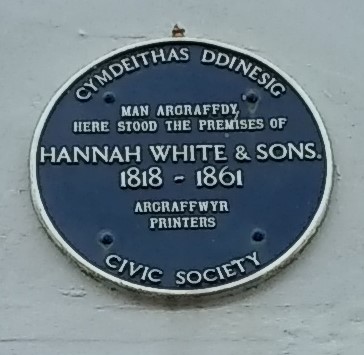
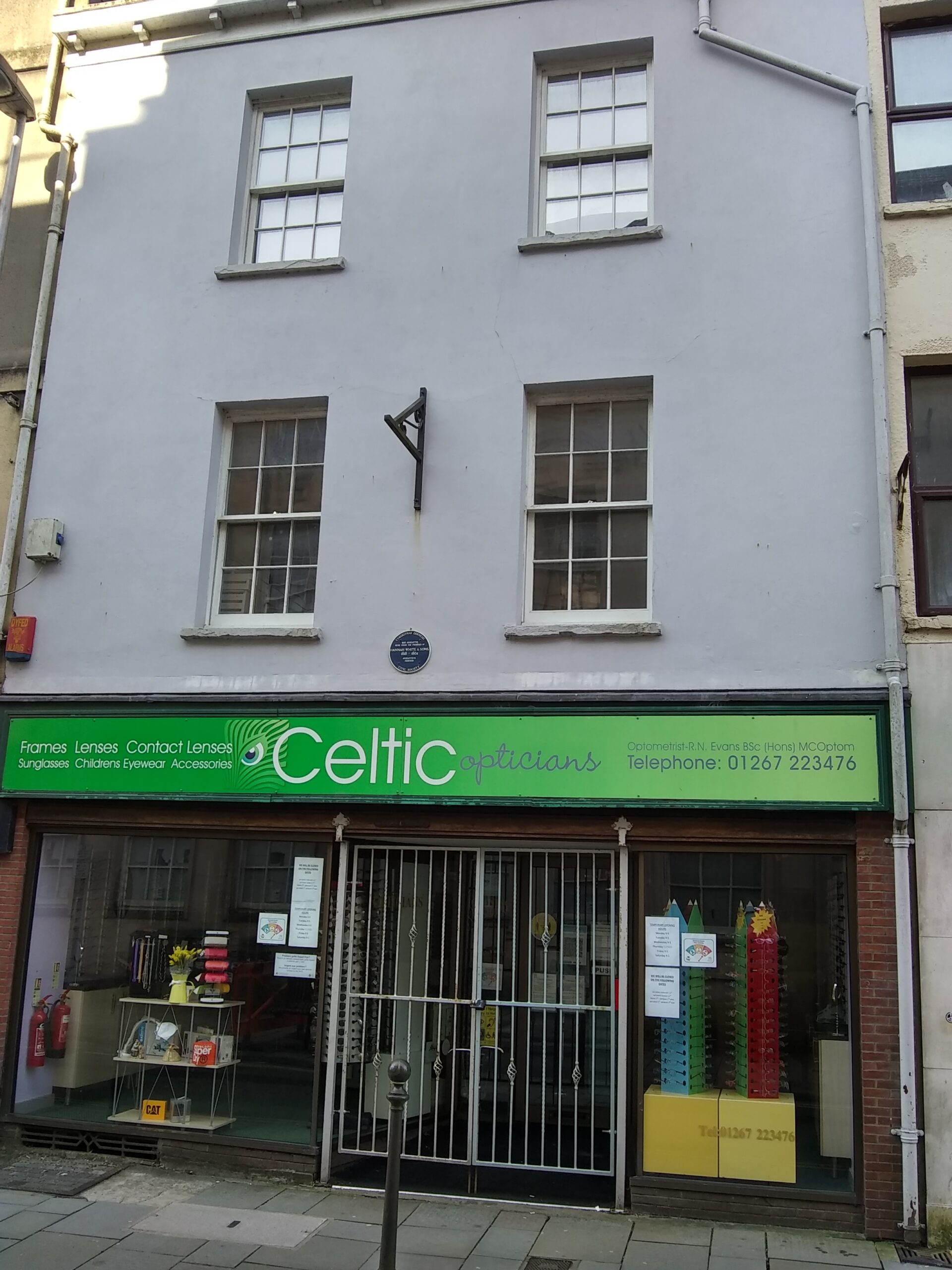
The blue plaqueThe premises in King Street where Hannah lived and worked
Until her husband’s death in 1818, Hannah White traded on her own, employing a number of individuals. From 1818-1860 she traded as ‘H. White and Sons’ printers; booksellers, stationers etc. Two of their sons, George (Henry Brunel’s father) and Isaac were later partners in the printing business with their mother at Carmarthen. Another son Henry was a master printer in Merthyr and in 1850 was High Constable of Merthyr. John White, Hannah’s Husband was buried in St. Peter’s churchyard Carmarthen, and Hannah rather mysteriously was buried in St. David’s cemetery in June 1861 together with two of her sons. The business was sold at auction in 1861 following the death of Hannah, and the retirement of her sons George and Isaac.
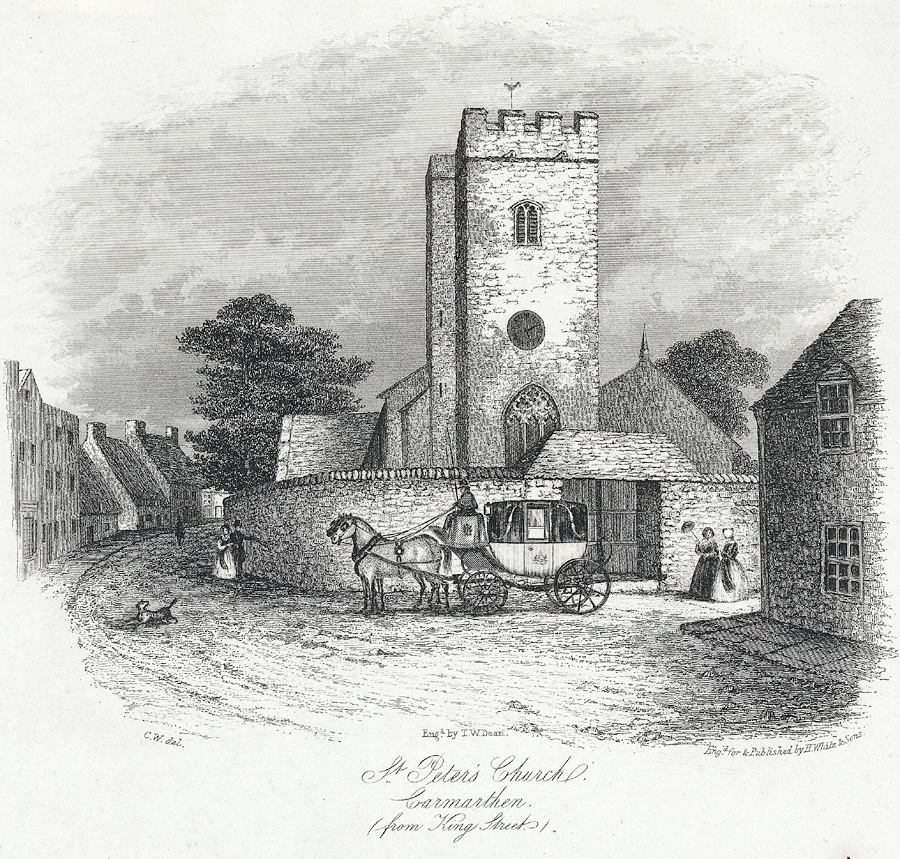
An engraving by Hannah White from copperplate of St Peters Church Carmarthen 1859
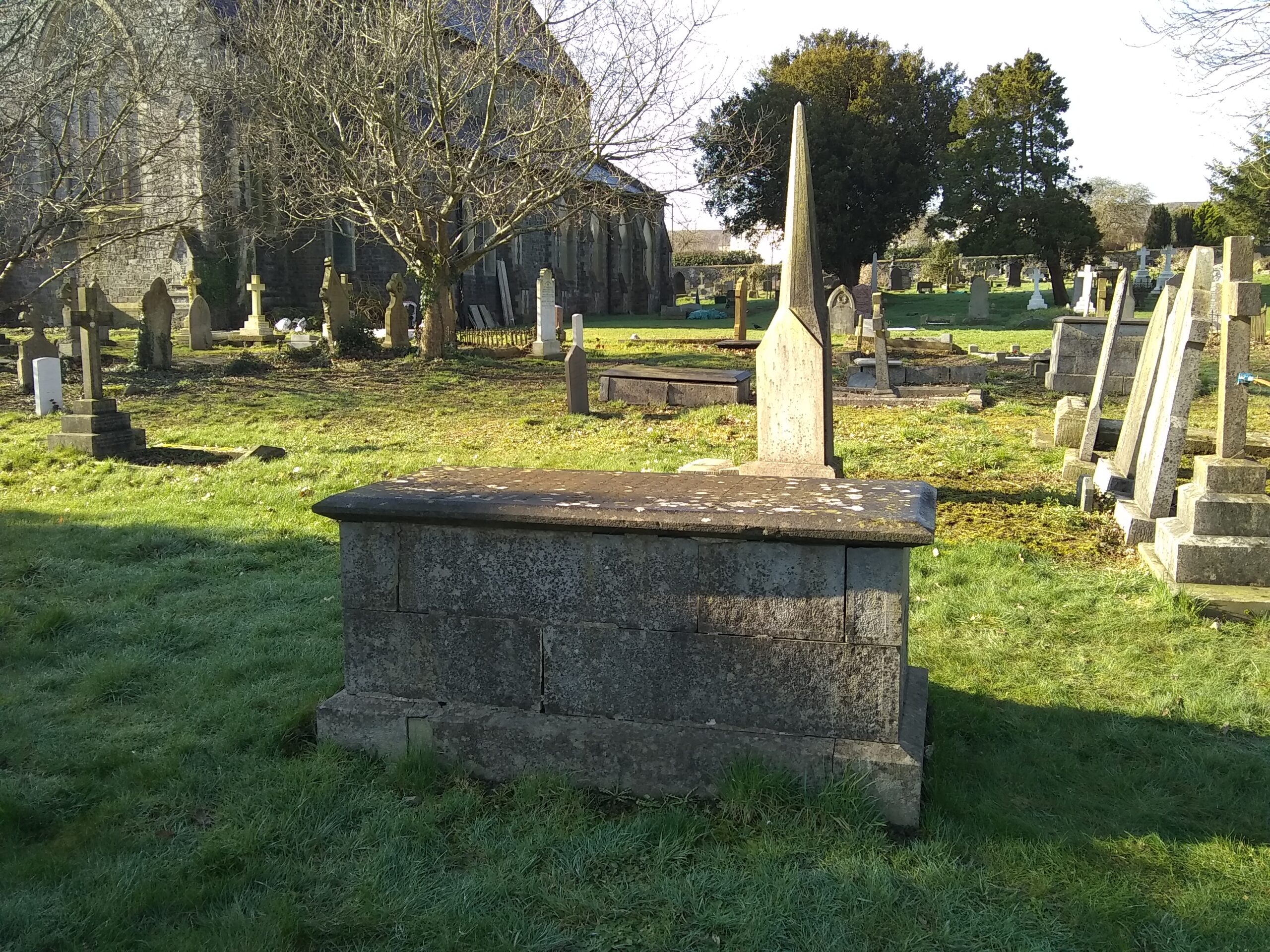
It was one of the most successful publishing dynasties ever produced anywhere in the country, and many of the publications are still in existence today, of exceptional quality. Any Carmarthenshire Antiquarian will know of the name of Hannah White, who for half a century, and indeed uniquely as a businesswoman in Georgian and Victorian Britain ran a hugely successful business and rather appropriately she is buried next to another great antiquary and indeed neighbour – William Spurrell.
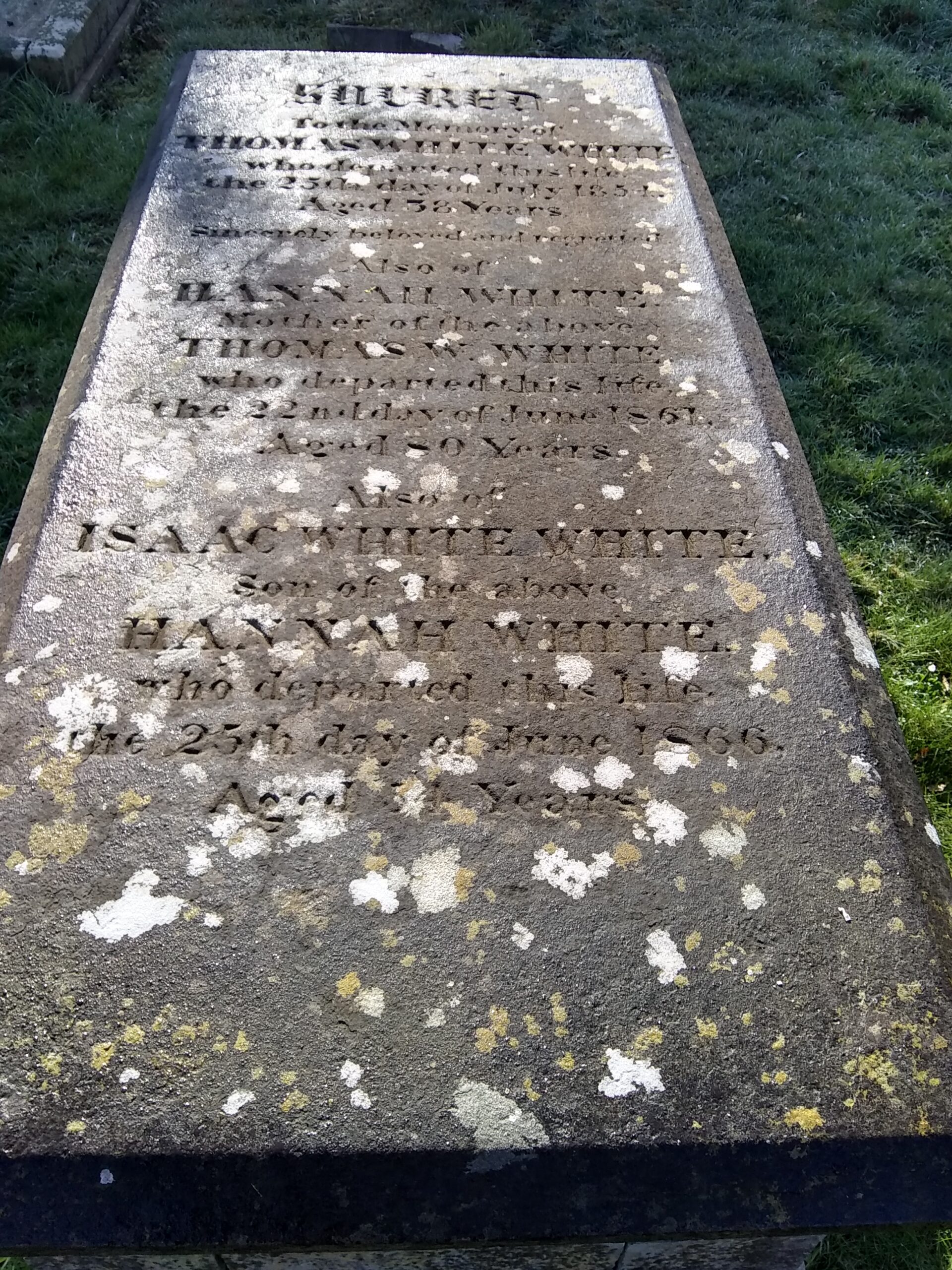
SACRED
To the Memory of
THOMAS WHITE WHITE
who departed this life
the 25th day of July 1854
aged 38 years
Sincerely beloved and regretted
Also of
HANNAH WHITE
Mother of the above
THOMAS W WHITE
who departed this life
The 22nd day of June 1861
Aged 80 years
Also of
ISAAC WHITE WHITE
Son of the above
HANNAH WHITE
Who departed this life
The 25th day of June 1866
Aged 54 years
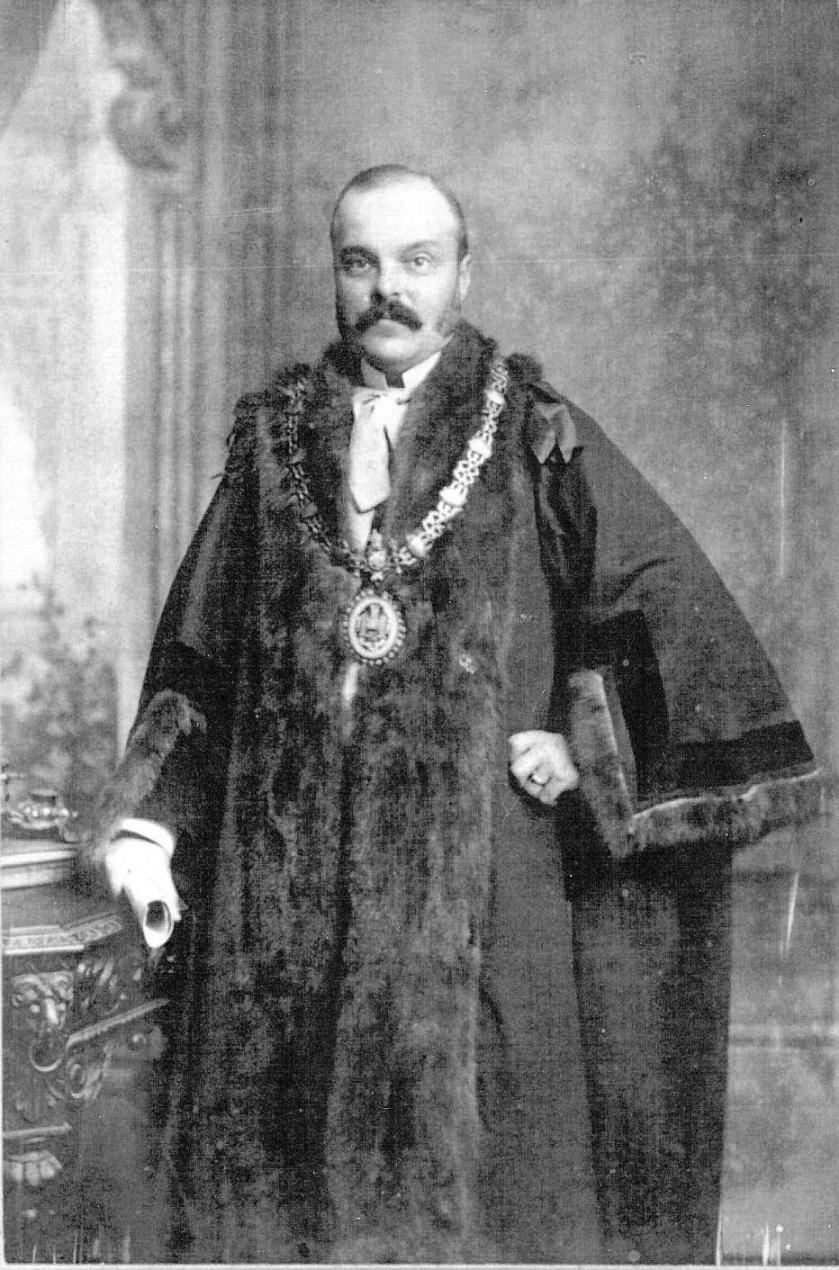
Alderman Henry Brunel White – Hannah’s grandson in the Robes of Mayor of Carmarthen (1894-1898)The box tomb of Hannah White and her two sons. In the background is William Spurrell’s memorialThe inscription on the box tomb
Whilst carrying out research on this story it became evident that there were indeed many such fatalities of a similar nature that befell many an inhabitant of Carmarthen. Whether a servant or master, the type of clothing worn in the 1800’s was certainly not fire proof and standing too close to an open fire was hazardous to say the least. Hot embers and coals falling off the fire onto the carpets and flooring together with clothing catching fire was all too commonplace, to the extent that adverts were placed in the local papers warning people of the dangers of open fires. Sadly as you will see in the following story, Mary Anne Walters aged 16 was one of many that succumbed to the flames and she lies buried somewhere in St Davids Cemetery, her last resting place unknown.
FATAL ACCIDENT BY FIRE. ( THE WELSHMAN 18TH APRIL 1851 )
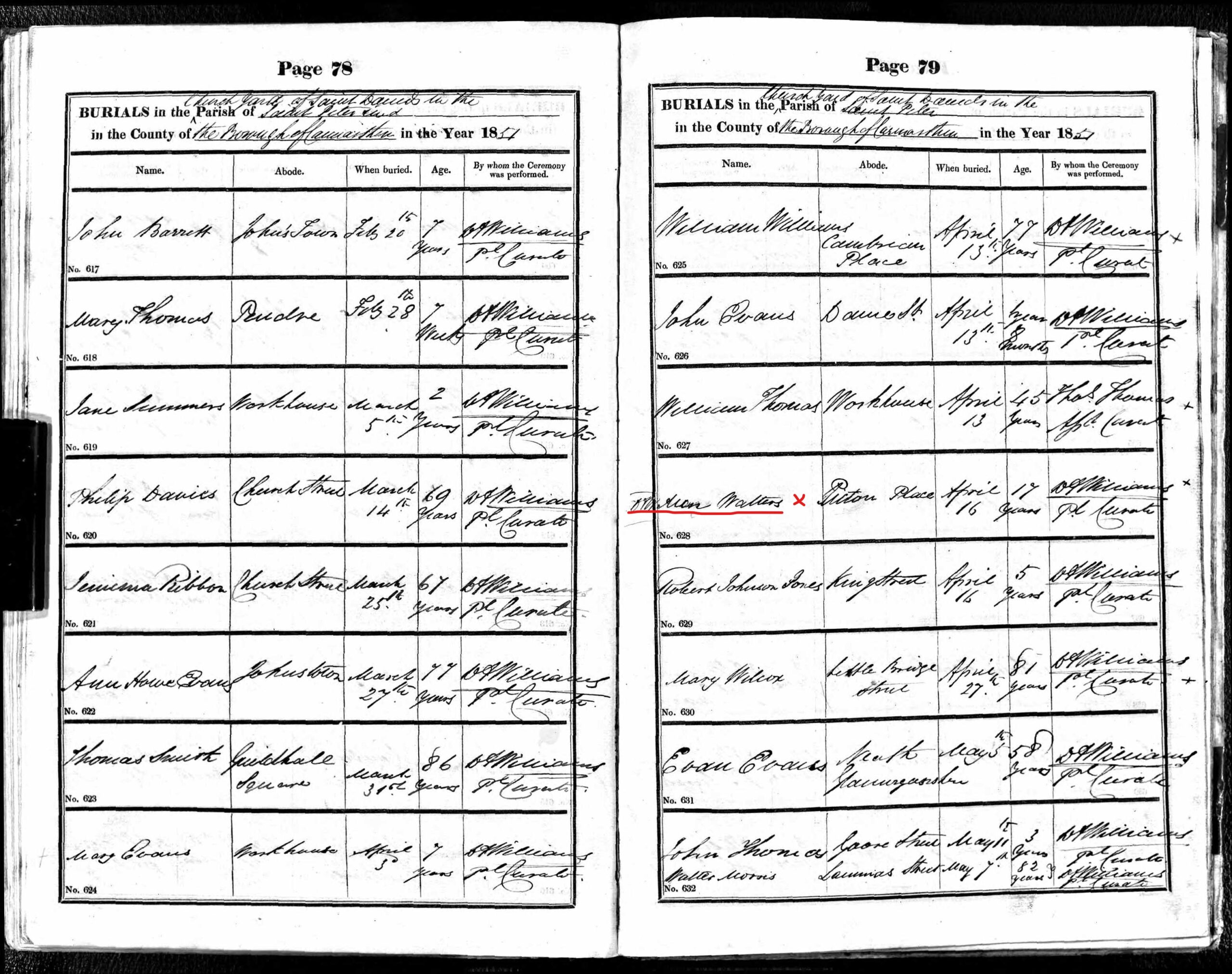
A melancholy accident occurred on Sunday morning last, which resulted in the death of Mary Walters, aged about 16, (daughter of a hatter in Water Street, named John Walters) that was in service with Mr. David Rees, retired Tallow Chandler, residing in Picton Place, Picton Terrace, in this town. It appears that at half past eleven o’clock, deceased was preparing dinner for the household, and in the course of her avocations had occasion to remove a kettle of water from the fire. In doing so her apron, which was of cotton fabric, accidentally caught fire, and she became speedily enveloped in flames. Mr. David Rees, who is very infirm and decrepid, was sitting by the kitchen fire at the time of the occurrence, but was unable to render her any assistance whatever, otherwise than to tell her to go into the pantry, and make use of some water which was placed there. The poor girl, however, ran about the house shaking her apron, which naturally had the effect, of increasing the flames. She then ran out to the yard, and returned to the pantry, but again went upstairs, being still on fire, and her screams during the whole of this period being of the most agonising description, while she was calling out, “HELP, HELP, WHAT SHALL I DO, I SHALL BE BURNT TO DEATH.” Eventually, however, Edward Sexton, mess-waiter to the officers of the 77th regiment, heard the girl’s cries for aid, and went with all expedition to Mr. Rees’s house. He found the street and garden doors wide open, and the unfortunate girl standing in the garden with her clothes, all but a pair of stockings, literally burnt off her body, and holding a piece of drugget about her in the best manner she was able. She was screaming violently, and said that the Misses Evans, next door neighbours, had seen her, but would not come to her assistance. The stair carpet was burning when Sexton went in. He immediately fetched Mr. Hughes, surgeon, who applied proper remedies, and the poor creature was removed to the Infirmary on a bier or stretcher, which was carried by four “navvies” who chanced to be passing. It was almost self-evident, however, that she could not recover, and notwithstanding every attention was paid to her, about 12 o’clock on Monday she expired. An inquest was held on Monday evening, at the Infirmary, before John Hughes, Esq., Coroner, when a verdict of “Accidental death” was returned.
A horse drawn fire engine similar to the one used in Carmarthen in 1851The Merryweather fire engine design from the Great Exhibition of 1851
To the Editor of the Welshman. (25th April 1851 page 3)
SIR
In the report of the Inquest held on the girl who was burnt at Mr. Rees’s, in Picton Place, inserted in your last week’s paper, it was stated that the sufferer called upon her neighbour Miss Evans, to come to her aid, but that she called in vain. I beg to give that statement the most unqualified and unhesitating contradiction. Miss Evans was the person who first heard the girl’s screams: she was the first who entered the house, tore off the burning clothes from her person, and summoned the people at the Mess House to come to her aid; having wrapped the poor girl in a shawl and a drugget she had taken with her for the purpose. Had Miss Evans been summoned on the inquest, she would have stated all this, and would have stated also the reply made to her when she enquired at Mr. Rees’s door to know what had occurred, and where she could find the girl. The distress of mind felt by Miss Evans on reading the report has been very great, and it has compelled me to trouble you with this letter. As a neighbour, I am enabled to bear a strong testimony to the general kindness and humanity of Miss Evans, and that, in this instance especially, the promptitude and decision she displayed in rendering assistance was beyond all praise.
I am, Sir, yours truly,
AN INHABITANT OF PICTON TERRACE.
April 24th 1851 – Editorial comment of the anonymous letter. “The statement above alluded to was not an emanation from the editorial pen, but merely a portion of the evidence given by Edward Sexton, the mess waiter, at the inquest; as he most positively stated to the Coroner, that the unfortunate sufferer had told him that Miss Evans had heard her, and had refused to come to her aid. We have now no doubt that he must have been mistaken.—ED. W”
The burial register with details of Miss Walters. Note the Christian name is illegibleThe census entry of 1851 showing details of the household of David Rees
** Note the Christian Name of Miss Walters is impossible to read which is why it does not appear in the Digitised Register of Burials research tool on all the research websites.
Readers of these stories will recall that some time ago I wrote about George Adams, and in that story I referred to the fact that no record could be found of the burial of Evan Aye who was referred to in the Coroners inquest (see below)It now transpires that the reason for this was that the name AYE was indeed a nickname and not his real name which was in fact EVANS. As in all these most sad and harrowing stories one can only imagine the terrible tragedies and sufferings they endured not least the lack of basic medical attention which seems to be a common theme in many. Following on from this short and sad story of Evan Evans I have once again published another poem, this time referring to the burial of paupers from Workhouses which was written by the famous Victorian poet Gerald Massey in 1856. He had personal knowledge of the conditions of these poor individuals, having himself experienced poverty in his early years. It is highly likely therefore that this poem was written from personal experience of his friendship with a childhood friend just like poor Evan Evans from the Carmarthen Workhouse…The poem, if I may say so, exemplifies everything wrong with Victorian society at the time and is a remarkable heart rendering piece of story telling, even after 150 years.
The Welshman 4th July 1845 page 2.
The poor idiot named Evan Evans, and nicknamed Evan Aye, from his peculiar mode of expressing himself, died on Monday last, in the Carmarthen Union Workhouse. He was well known to almost every inhabitant of South Wales as a cattle driver or general assistant of drovers at fairs. His life was an eventful one, and those who knew his history pitied his misfortunes. It is said that the poor fellow was not an idiot from his birth, but that the cruel treatment of his father bereft him of his senses. As is usual in persons afflicted with idiosyncrasy, he was faithfully attached to those who behaved with kindness to him, amongst whom may be reckoned the late lamented John Jones MP. Evan attached himself to Mr. Jones’s party, and at elections always wore his colours (Red); at one election in particular, when party feeling ran high in Carmarthen, he was suspended over the bridge, and threatened that unless he cried out, “Blue for ever” he should be thrown into the river below. Faithful to the last, the poor fellow stuck to his colours, & refused to desert the cause of his kind patron. He was eventually released from his perilous position. The cause of poor Evan’s death may be attributed to an accidental burning of his right arm and side at Abergwili fair, and the wound not having been dressed so soon as it ought to have been, is supposed to have accelerated his departure from this busy world, in which during the long space of forty dreary years, he had not enjoyed a single portion of this world’s happiness. “After life’s fitful fever, he sleeps well”
The poet Gerald Massey 1860John Jones MP. By Thomas Brigstocke. By kind permission of Carmarthenshire County Council.The burial register with details of EVAN EVANS
The comments mentioned below from the Coroner referred to the inquest into the death of George Adams of the Workhouse, who is featured in a separate story in “What’s in a Name”. George Adams died in October 1846 over a year after Evan (Aye) Evans. It is strange therefore for the Coroner to refer to his death as having been “a short time ago” but nevertheless the descriptions of the living conditions of these poor defenceless individuals is plain to see.
“The Coroner said that he had heard that in the case of a poor idiot named Evan Aye, who died a short time ago, an inquest ought to have been held. Inspector Young stated that on one occasion when he entered the room where Evan Aye was sleeping, the stench was so intolerable that he was compelled to make a precipitate retreat. The Coroner said that it appeared to him that the workhouse authorities were anxious to withhold something from the public which they were afraid to have known. However he really hoped that in all cases in future, intimation would be given to him in order that he might exercise his discretion as to whether an inquest was requisite or not”
There can be no greater way to commemorate something than by the writing of a poem, which brings all the power of the human language into focus in an instant. At some time or other in our lives we have all rehearsed a rhyme or two and been taught poetry in our school days. In St Davids Cemetery there are many memorials to those who lie elsewhere, in particular to mariners and soldiers whose families have felt it necessary to commemorate them in some way so that they will not be forgotten despite the fact that they are not buried here. Three examples come to mind such as Sapper Thomas Lewis Bennett who lies buried in a field in France “somewhere” with a very rare memorial to his name being specially erected.
The description of the cemetery where Tom lies buried “somewhere”The Commonwealth War Graves Commission document confirming a “special memorial” being made for himThe memorial to Tom Lewis Bennett in St Davids cemetery with the most touching epitaph
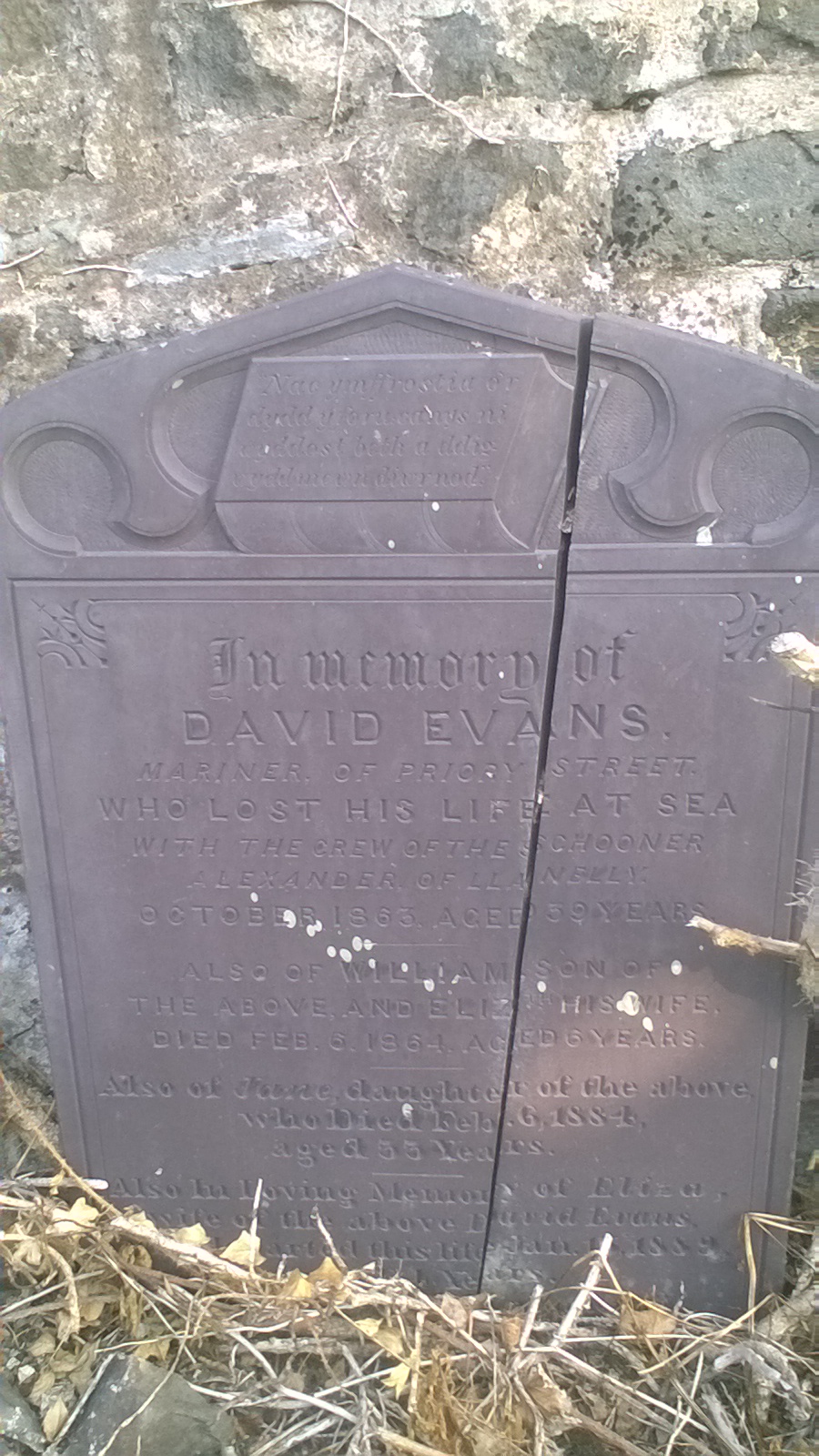
Also the headstone to David Evans who died whilst on a voyage through the Bristol Channel is also commemorated. His story will also one day be told as will George Johns, who having travelled the world, succumbed to a short illness and died on board ship off the coast of Egypt. The Cross of Souls Memorial therefore, soon to be erected will be a hugely important milestone in the charities short history in commemorating nearly 4,000 with no known grave or memorial within the cemetery. The following very powerful poem therefore I think resonates perfectly in what it really means. I hope you enjoy reading it.
David Evans from Priory Street was lost at sea.George Johns who died from fever whilst on a voyage in the Red Sea and was buried at Sea two days later.
THE HOMES OF THE DEAD
We must not make a home for the dead,
Nor raise and osiered mound,
Till the eloquent prayer and priestly tread
Have sanctified the ground.
But there are those who fall and die
Upon the desert land,
With no pall above but the lurid sky,
No bier but the scorching sand.
No turf is laid – no sexton’s spade
Chimes in with the mourner’s groans;
But the prowling jackal finds a feast,
And the red sun crumbles the bones.
There are those who go down in the dark wild sea,
Where storms have wrecked proud ships,
With none to heed what the words may be
That break from their gurgling lips.
No anthem peal flows sweet and loud –
No tablet marks their graves;
But they soundly sleep in a coral shroud
To the dirge of the rolling waves.
There are those who sink on the mountain’s path,
With cold and curdling blood –
With the frozen sleet for a funeral sheet,
And no mates but the vulture brood.
No tolling bell proclaims their knell –
No memory stone is found;
But the snowdrift rests on their skeleton breasts,
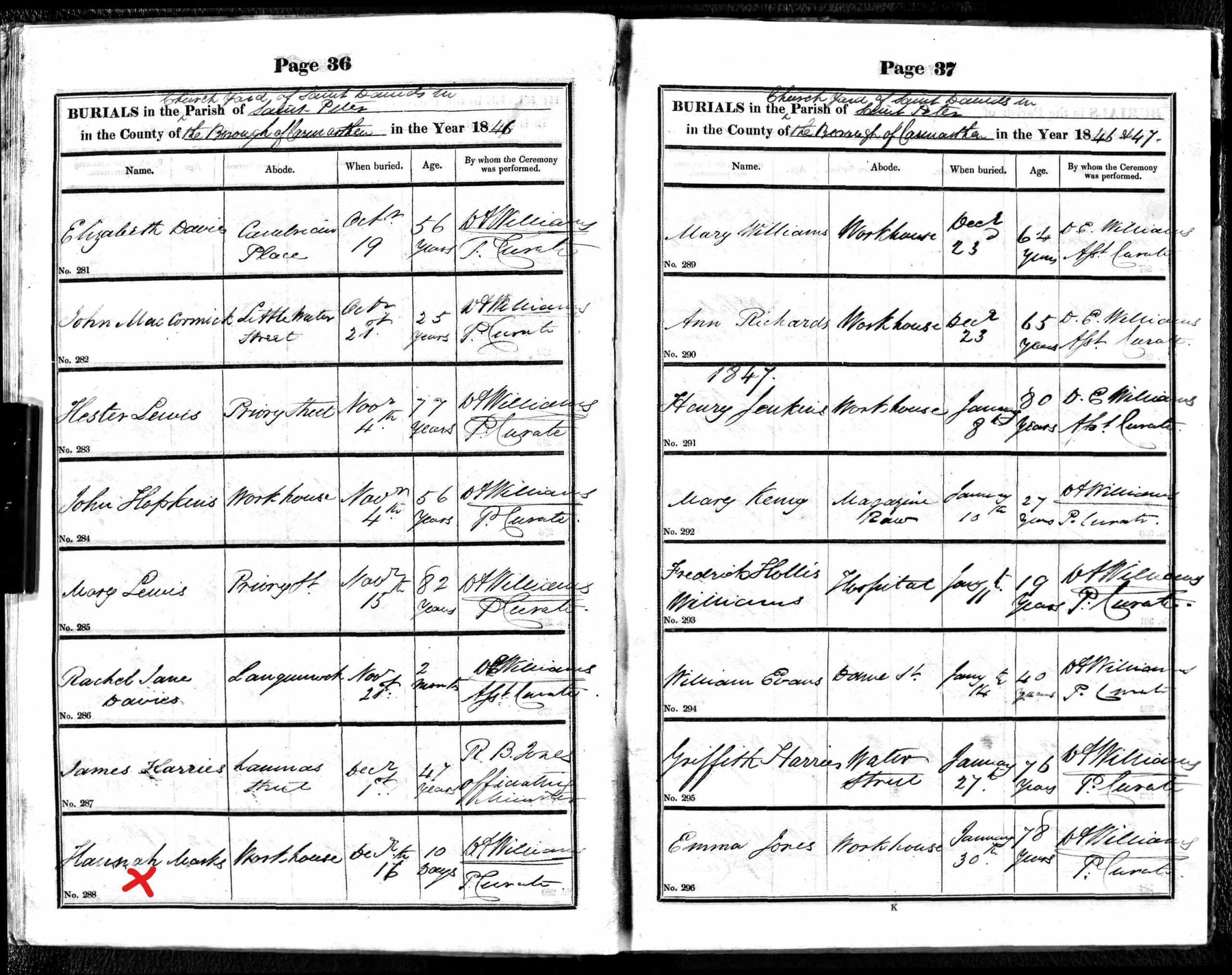
What follows is the story of a disturbing, sad and untimely death of a ten day old baby at the Carmarthen Workhouse in 1846. Over two years later Hannah’s sister also died in her infancy – aged 10 months old, again in the Carmarthen Workhouse. The conditions alluded to of the sick ward during this time, at the end of this report are also of great concern though unsurprising. Readers will know by now that the Workhouse itself fell under the Parish of St David’s Carmarthen at this time and therefore most burials took place here at St David’s Cemetery, often at an alarming rate. In some ways I consider myself not only as Chairman of this charity but also as Curator of an “outdoor museum”, the exhibits being the memorials to those who are interred here. There are many memorials of course that no longer exist, but that does not mean that their stories cannot also be told, even those like Hannah whose life was ended all too soon after just ten days…..their stories also need to be told however harrowing the facts may be. May she rest in peace.
ALLEGED INFANTICIDE. – On Tuesday morning, considerable excitement prevailed in this town in consequence of a rumour which was extensively circulated, that a child had been murdered in the Union Workhouse, and that suspicion was attached to the mother as being the unnatural perpetrator of the horrid deed. E. H. Stacey, Esq., the Vice Chairman of the Board of Guardians, deeming it proper to arrest these idle rumours, requested Geo. Thomas, Esq., coroner, to hold an inquest upon the body of the deceased infant, whose name was Hannah Marks, aged 10 days, an illegitimate daughter of Phoebe Marks, a pauper confined in the Workhouse. Accordingly the coroner and a respectable jury (Mr. Job Jones, Foreman), met at the Workhouse at half past 2 o’clock, and having viewed the child’s body, which appeared very much emaciated and was marked with considerable lividity or echymosis, proceeded to hear evidence touching the cause of death. From the evidence of Hester Joseph, nurse to the sick ward, it appeared that the child was born on Saturday week and that it was from the first extremely sickly, but improved considerably up to Monday night. The mother received every attention during her confinement, although she frequently complained that she had not half enough to eat. She never showed much attention to her child and several times said that it would be a good thing if it was dead, and she should be glad if it was so. In consequence of what she said, Mrs. Johns, the matron, was fearful that the infant was deprived of its proper nourishment, and on Monday night the nurse fed the child, as on previous occasions she had detected the mother eating the food which was provided for her child. About 5 o’clock on Tuesday morning the nurse was awoke by Phoebe Marks calling her, and telling her she was afraid the child was dead, as it was quite cold. Upon taking it from her arms the nurse found the child quite dead, and blood oozing from its mouth and nose. She accused the mother of having done something to injure the child, or of having lain upon it, but this was strenuously denied. There were black marks behind the child’s ears. There was no blood on the bed clothes. Mr. Williams, surgeon to the Union Workhouse, deposed that he was present at the child’s birth. It was a small child, but had much improved on Monday evening. The mother did not suckle the child as she ought to have done and upon his reproaching her for her cruelty, she told him he might take the child himself if he liked. The umbilical cord was twisted round the child’s neck when it was born and he severed it. No injury, however, resulted to the child, nor was any mark left on its neck.
Burial Register with details of Hannah Marks aged ten days
He had examined the body that day and found some livid marks about the ears and the posterior part of the head. He thought the marks were caused by pressure which had stopped the respiration. He was decidedly of opinion the mother had overlain the child, and it had thus been suffocated. After some further evidence, the Coroner addressed the jury, and begged them not to jump to a hasty conclusion, but to weigh well the evidence in their minds. He then explained the law of the case to the jury and having commented at great length upon the evidence adduced, left three verdicts for their choice. If they thought the mother had designedly been accessory to the death of the child, their verdict must be “willful murder,” but there was no evidence to support that verdict. If they thought with Mr Williams, the surgeon, that the mother had over-laid the child, their verdict must be “accidental death,” but if otherwise their verdict would be “natural death.” Having consulted together for about five minutes, the jury returned a verdict of “Natural death.” The Coroner very properly remarked upon the unwholesome stench prevailing in the sick ward, and said that no person ought properly to be allowed to remain in a room where the atmosphere was in such a polluted state. He could not remain in such a room for any length of time. “We can bear testimony to the dreadful smell emitted from the room, which every one of the jury also observed, as well as the Vice Chairman of the Board. It is to be hoped the Guardians will lose no time in securing ventilation for the sick ward”
(THE WELSHMAN, DECEMBER 1846)
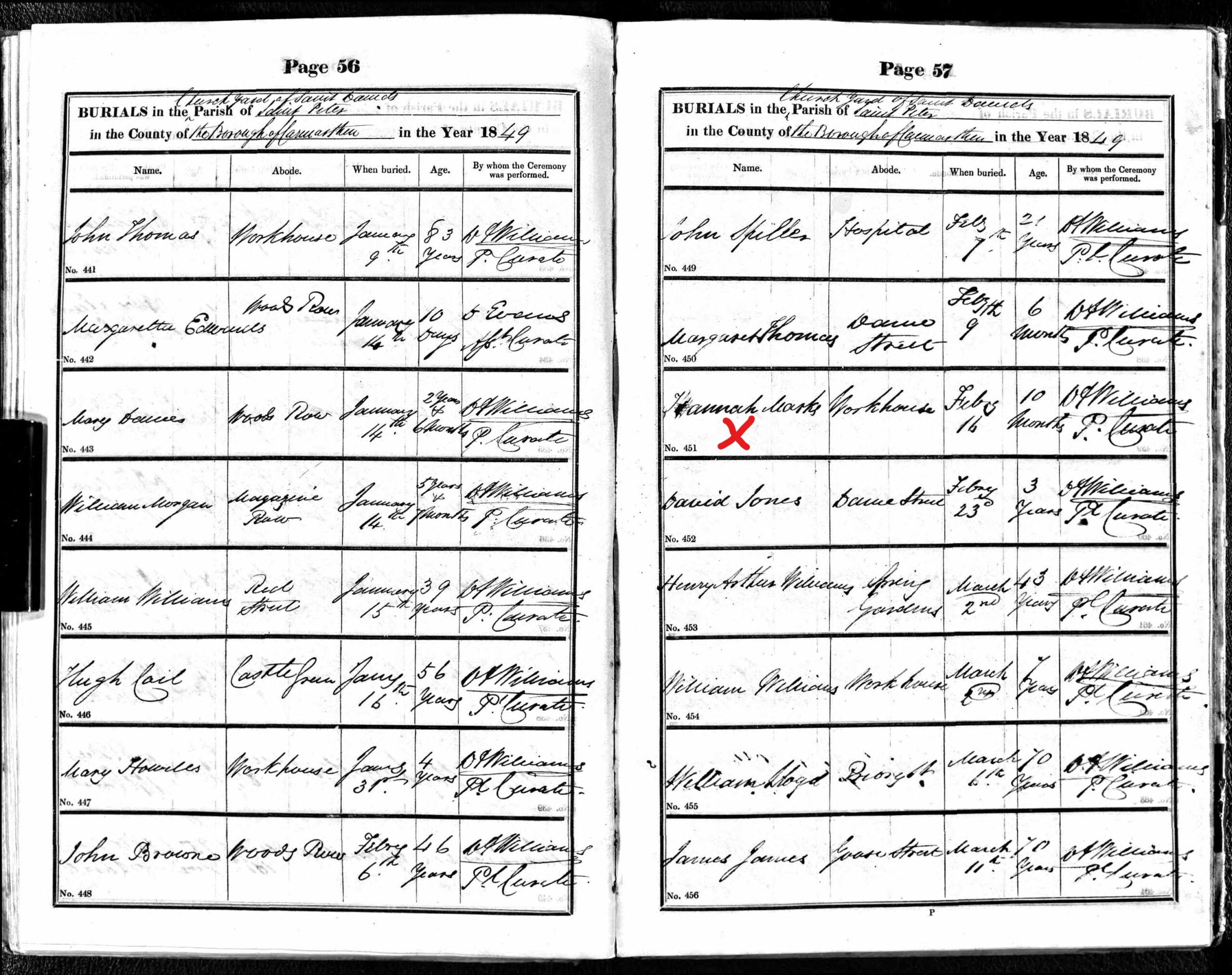
There is one “twist however to this story which doesn’t end there……over TWO YEARS LATER after the mysterious death of her baby daughter in 1846, another illegitimate baby girl by the name of Hannah Marks was also buried in St David’s Cemetery on February 16th 1849 aged ten months.
Burial register of Hannah Marks aged 10 months 1849.
The mother being the same Phoebe Marks and the same place of death – the Workhouse. No record exists of any inquest on the death of this infant unlike her sister two years earlier. Clearly, even being “confined” to the Workhouse in the female wing of the building and suffering the deprivations therein, was not enough to stop this lady from becoming pregnant again which in itself throws up even more questions on how the Workhouse was managed during this period.
What Happened to Phoebe Marks herself we will never know. There is only one entry that matches her name and date of birth in all available records and it relates to the death of a Phoebe Marks in the Parish of Beddington in the County of Surrey in January 1904 aged 77. I would like to think that this is her and her end was a peaceful one.
This story is one that originally appeared in these columns previously, but at that time the details of the incident and name of the deceased was unknown, as was his fate. However, quite by chance, the detail of Thomas Jones’s unfortunate death can now be revealed after it was discovered quite by chance whilst carrying out further research. The original story therefore has now been replaced with this “updated” one. It is a very sad story like all suicides but nevertheless a story that forms an important part of the history of St Davids cemetery……
Suicide was a crime and regarded as the height of profanity in Victorian Britain. A newspaper report of September 1848 shows how the rougher element of Carmarthen took full advantage on the Church of England’s revenge on the suicide, and how the Carmarthen Journal reported the incident – It makes uncomfortable reading even after 172 years. It is an event however that actually took place and therefore an historically important link to St David’s Cemetery itself.
MORAL OUTRAGE
“One of the most disgusting scenes witnessed in this Town for a long time took place. We allude to the burial without Funeral Rites of the body of a respectable old man named Jones who committed suicide.
It having become known that the body was to be interred, a vast concourse of people amounting to several hundred, assembled to witness the sad sight, and when the coffin was brought out about nine o’clock, (at night) borne on the shoulders of four men, who galloped away with it almost at the top of their speed, the scene was truly disgraceful to a civilised and Christian nation, as the conduct of the populace, who occupied the time in coarse and indecent jesting, laughing and jeering and other more depraved acts far more befitted a heathen than a civilised nation.
The body, having been brought into the churchyard, was almost literally thrown into the grave and covered over with the greatest rapidity. If such scenes as these must be enacted, we think they may very easily be conducted in a more orderly manner and at a time when they are not likely to be attended by such truly demoralising accompaniments as characterised on Thursday night.”
The following inquest report was featured in the local newspapers prior to Thomas Jones’ burial giving details of his suicide.
A melancholy case of self-destruction occurred on Wednesday last in this town. In the evening of the same day an inquest was held on the body, at the Town hall, before John Hughes, Esq… Coroner, and a respectable jury, of which Mr. William Morgan was foreman. The deceased, Thomas Jones, was a carpenter, advanced in life, and much respected by those who knew him. The following depositions were made at the inquest: – Margaret Jones deposed,—“I am niece to deceased and lived with him. Soon after 9 o’clock deceased went to Jacksons Lane to put a room in one of his houses in order. About 11 o’clock I went to look for him, but could not find him, and returned home. I went again about 1 o’clock, and was informed by Mrs. George that deceased had been in her house, and had the keys of an adjoining house, now empty. Mrs. George accompanied me to the house, when I saw deceased with his feet on the ground, half lying. I perceived he had a cord round his neck, which was fastened to a hook in the ceiling he was dead and cold. He has been very unhappy this last twelve months about money matters. He had an impression that he should be ruined, and had threatened to do himself an injury in fact, I was always watching him. On Sunday week he was quite distracted, and struck his head against the wall several times. His memory has recently failed him. Was much as usual this morning, but he had been giddy for several years. John Morgan, a mason, stated that he was called to go to an unoccupied house in Jackson’s lane, and found decease suspended by a cord round his neck to a hook in the cellar his feet reached to the floor, and his head leaned forward. Witness cut him down, but he was dead and quite cold. He had conversed with him on that morning, and did not observe anything unusual in his manner” Mrs. George confirmed the witness’s evidence. The jury, after a consultation, returned a verdict of Felo de se.**
** Felo de se, Latin for “felon of him-or herself”, was a concept applied against the personal estates (assets) of adults who ended their own lives. Early English common law, among others, by this concept considered suicide a crime – a person found guilty of it, though dead, would ordinarily see penalties including forfeiture of property to the monarch and a shameful burial. Beginning in the seventeenth century precedent and coroners’ custom gradually deemed suicide temporary insanity – court-pronounced conviction and penalty to heirs were gradually phased out. Such judgment and penalties had taken in any deceased, lawfully killed for self defence or defence of another, committing a felony.
As regular readers of the this website will know, the “What’s in a Name” series tries to impart some information on the persons buried here in St David’s Cemetery and to give some meaning to their lives through historical research, and those lucky enough to have a surviving memorial will have a photograph of it included in the story. These stories themselves are never meant to be exhaustive but hopefully provide the reader with some interesting facts on those who lived here all those years ago whether they be young or old.
Most recently whilst walking amongst the memorials in the cemetery my brother Robert found a small and what appeared to be an insignificant fragment of a long lost headstone on the surface, covered in soil with nothing more than a partial name and date. The photograph as you will see shows exactly what little is left of it. But who were they and how many of the family were buried there and what happened to them? Indeed was there any possibility of finding any information at all?
the small fragment of headstonethe partial inscription on the fragment of headstone
Well, I am pleased to say that after much delving and diving into the unknown and much midnight oil being burned, I am finally able to (almost) complete the picture and solve the riddle of the headstone fragment. Far from being “insignificant”, it brings to life a truly momentous story of a family long since forgotten but one that had a pivotal role in one of the most important periods of Carmarthenshire’s and indeed Wales’ social and industrial history known as the Rebecca Riots. During this period an Englishman named CHARLES WATLING WISBEY who lived in Picton Terrace was the owner and proprietor as well as editor of the very successful and well respected local newspaper “The Welshman” which prided itself on publishing local and regional news as well as news of a world wide interest. It was not without great personal risk to himself and his family that he published a number of articles in support of those attempting to gain justice for what was perceived to be an unfair and immoral tax –known as the TURNPIKE TAX and other social injustices as can be seen from the following extract from his own newspaper and it makes fascinating reading. This meeting on MYNYDD SELEN – at which Charles Wisbey himself attended and reported on was to be the catalyst that eventually brought an end to the Turnpike taxes and changed the course of history, but not before the death and bloodshed of many local inhabitants.
Sadly his two first born children died within five days of each other from Typhoid and were both buried in the first week of January 1845, and this small fragment of headstone is the only thing left to commemorate their short lives. Charles and his wife Charlotte arrived in Carmarthen about 1842 and returned to London a number of years later where he ran a successful publishing business & they had a number of children.
The St David’s burial register for January 1845 containing the names of Charles and Charlotte’s two infant children
Charles himself died in November 1876 aged 81 and Charlotte, his wife died twenty years later in 1896 also aged 81. A remarkable achievement considering that almost 40 years previous they were both seriously ill with typhoid whilst living in Carmarthen and almost died. What is even more amazing is the fact they lived in what was one of the most valuable, exclusive and palatial properties in London at the time – PALL MALL – at no 5 Suffolk Street (now demolished), which was a very fine four storey Georgian town house designed by no less a person than Sir John Nash. One of Charles Wisbey’s neighbours was the GARRARD family – world renowned jewellers and goldsmiths, and a stones throw from Queen Victoria at St James’s Palace.
Number 5 Suffolk Street, Pall Mall. One of London’s most desirable residences.
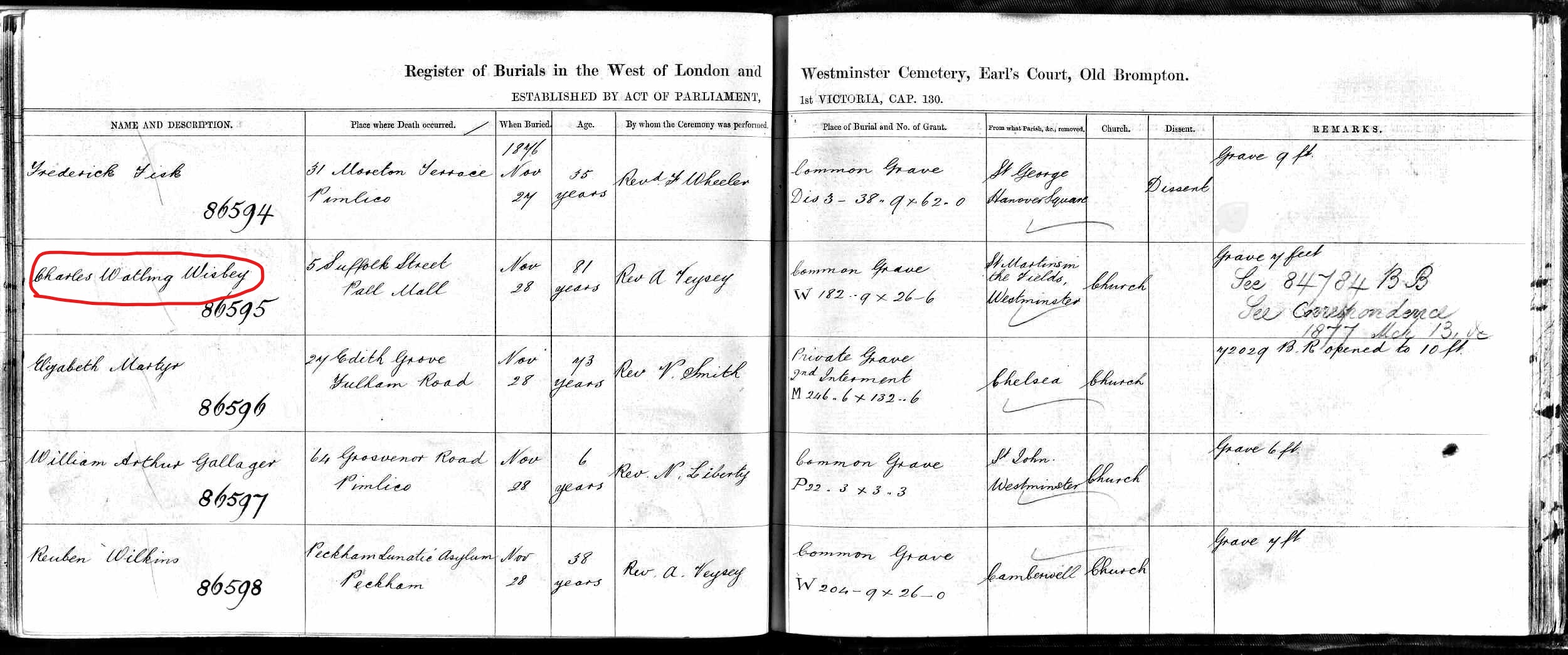
The world renowned Oxford and Cambridge University Club now occupies what was number 1 to 4 Suffolk Street. Quite how they could have afforded to live here in such luxurious surroundings is a mystery as the freehold of the property was owned by the Crown and leasing would have been extremely expensive. It is also interesting to note that both Charles and Charlotte were buried in Brompton Road Cemetery London in what was described as “a common grave” rather than a “private” one. One thing is for sure however, that when they left Carmarthen nearly three decades earlier, and left forever their two young babies behind, who would have thought that 176 years later their stories would be told once again, thanks to a fragment of stone with a partial inscription found buried in the mud. May they all rest in peace.
The burial register containing the details of Charles Watling Wisbey
The following newspaper extracts therefore shed some light on this family and provide a fascinating glimpse into their life as it was in Carmarthenshire in the 1840’s.
Carmarthen: Malignant fever, in some cases assuming a typhoid character, has laid up several of the inhabitants of this town. Amongst other families that have suffered under this afflicting visitation is Mr. Charles Wisbey’s every member of which, excepting one, has been extremely ill. His youngest child expired last Sunday morning; another child of his died on Wednesday, and a third appears past recovery while he himself and Mrs Wisbey have also suffered severely from fever. (3rd January 1845 page 3 The Welshman)
FEVER AT CARMARTHEN. – “We believe it will be found that, in the way of febrile induction, the disagreeable defective state of the sewerage and drainage of the town will be found to have always had great and deadly influence. At any rate, it is a well known fact that even the best houses in the best and highest parts of the town, have either insufficient sewerage and drainage, or (in most cases) none at all. With a cloaca only a yard or two from the sitting room—a cloaca so constructed as constantly to emit the moist noisome vapour and foulest stench, rendering the surrounding air fetid and quite unfit for the purposes of health – and no drains to carry off the accumulating mass of impurities and unwholesome liquid of which it is a necessity of man to momentarily create, there is but little doubt in our mind that death arises, in MANY cases, from the defective construction of the houses at Carmarthen. The tainted atmosphere too, the close rooms, with the sulphuric smell of the Welsh coal, and the other pestiferous influences peculiar to most of the houses in Wales – all this that may not be felt by those robust persons, born & bred here, may not only be unfavourable to the lives of English families but may cause disease and death. If most of the best houses be in the condition referred to, what must be the state of the hovels into which the poor are forced? And what a mass of misery must they not exhibit? (The Welshman editorial 3rd January 1845)
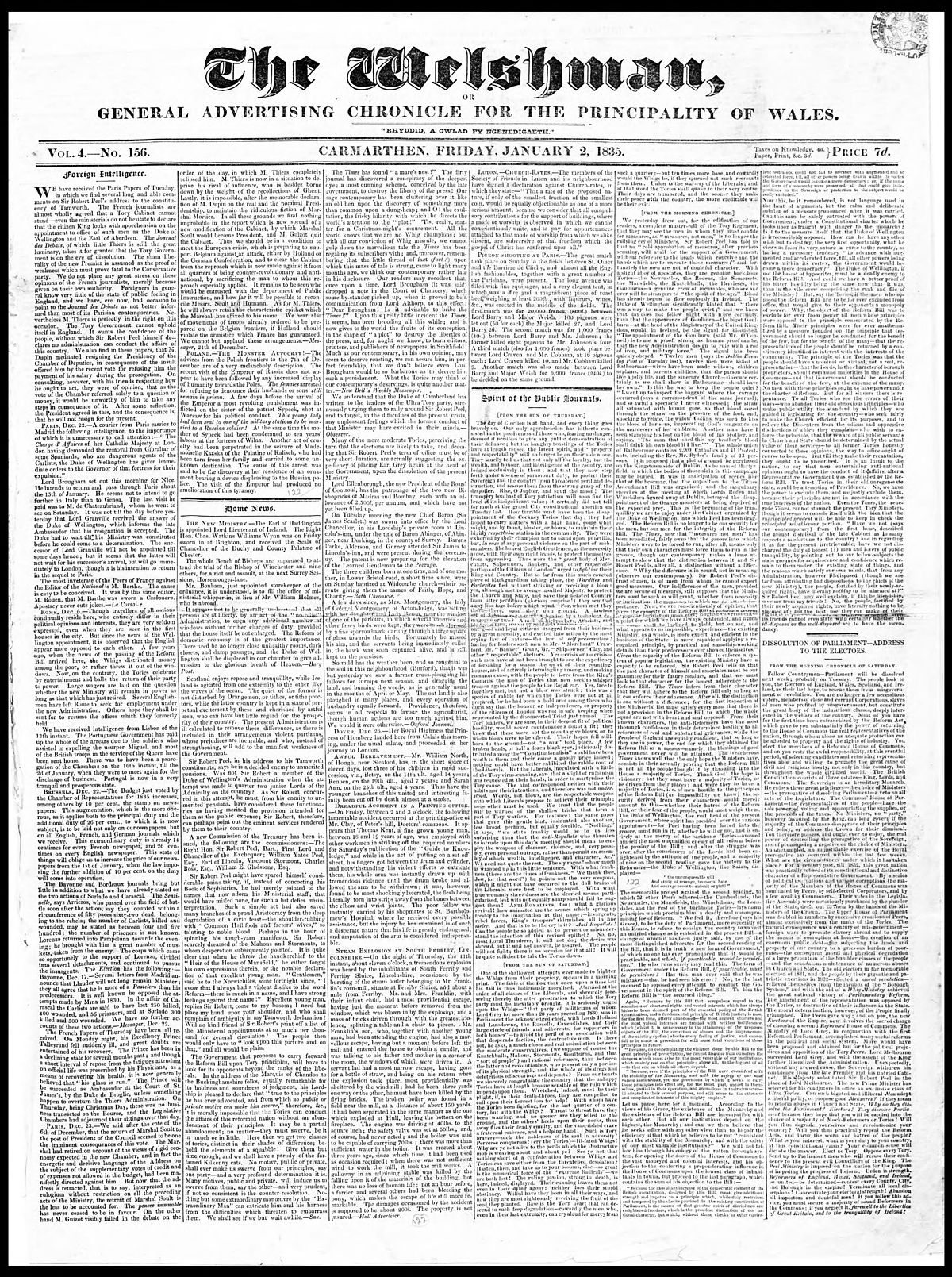
An early edition of the WELSHMAN -1835
The following extract was printed in Charles’ newspaper following on from the many letters of condolence he received in the loss of his two infant children….
“We are requested by MR. CHARLES WISBEY to convey to his numerous friends in the neighbourhood an expression of the great regret he felt at having been compelled to forego the pleasure of acknowledging to them individually their kind courtesy and good neighbourhood. He begs his friends to believe that he never ceases to bear them in remembrance” (THE WELSHMAN JANUARY 17TH 1845)
GREAT MEETING ON MYNYDD SELEN
Some further discussion of a not very relevant kind ensuing, Mr. Charles Wisbey begged to disclaim any design to dictate to the meeting, or indeed to take any part whatever in its proceedings. He abstained from expressing any opinion on them-but would venture to suggest that the only question before the meeting was the adoption or the rejection of the petition proposed by Mr. Hugh Williams. If the petition before them embodied the sense of the meeting, they should adopt it, but on the other hand, if they dissented from the objects sought to be attained by it, they ought unhesitatingly to reject it. Was the meeting to be a nullity, or a reality? That was the question for them to decide. Eventually the petition was unanimously adopted amidst general cheering (The Welshman- 1st September 1843)
The Editor of The Welshman (Charles Wisbey) would not trespass upon the meeting by making any lengthened observations but would beg them to believe that he was by no means insensible to the honour which had been so flattering conferred upon him by the greatest meeting he had ever yet seen in South Wales. He heartily thanked them, he was most grateful for the vote of thanks adopted by them; and he assured them that it would supply an additional stimulus for exertion, and another inducement to the fearless and efficient discharge charge of his duty as a member of the public press. Thanks must also be extended to The Welshman newspaper, which had most ably portrayed the state and feelings of the country. Had it not been for the very able reports which had appeared in The Times and The Welshman the Rebeccaites would have been supposed to be a set of persons wantonly committing outrages without there being the slightest reason for them. Mr. Rees, of Kilymaenllwyd (County Magistrate), seconded the motion, and willingly bore testimony to the great accuracy of those reports. The motion was carried unanimously with three cheers. (The Welshman 1st September 1843)
The following is an extract from the report of the Welshman of this historic meeting that was attended by Charles Wisbey.
“Mr. Williams then read the petition, which embraced the subjects set out in our last number, and of which the following is a summary. It begins by saying That the local and public transit of the county of Carmarthen has been long impeded by the erection of a multiplicity of turnpike gates through the county, whereby heavy tolls have been long imposed and exacted in a most oppressive and illegal manner; that, according to the powers invested in the several turnpike acts now in force, a certain number of individuals, including in several instances the magistrates of the county, are vested with an irresponsible power, as trustees, of imposing at PRIVATE meetings any number of turnpike gates they think fit without reference to, or consulting, the public interest and that, although the amount of toll or tax is defined, such trustees have an unrestrained power of multiplying gates as they may be interested or influenced; that the public and their interest under the present system are not consulted. Your petitioners have endured oppression until they can no longer bear it without appealing and making their complaints known to your Most Gracious Majesty”
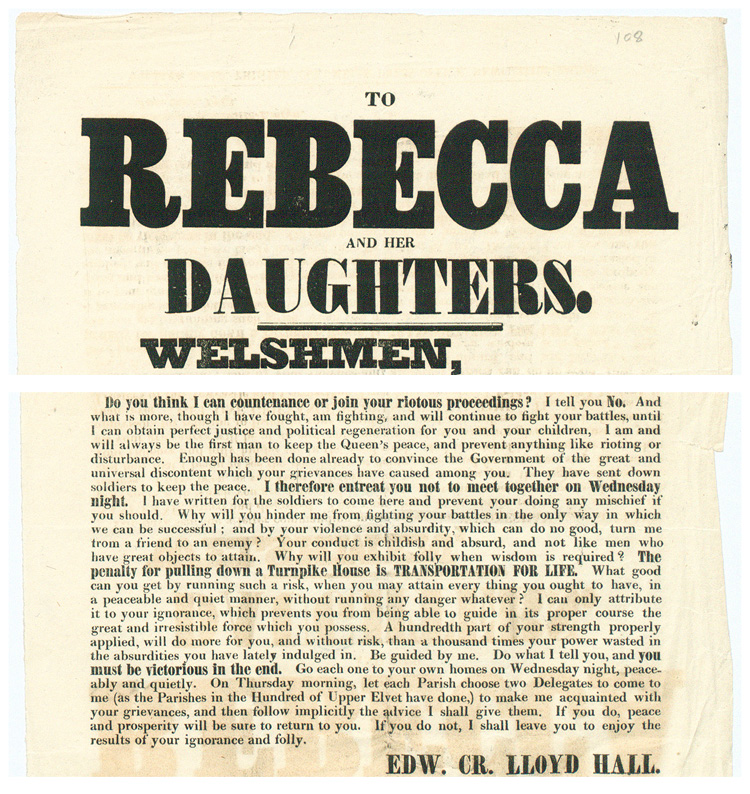
The meeting was attended by upwards of 4000 men and women and started at one o’clock in the morning, despite the fact that nightly meetings were judged to be illegal. This mountainous region is near Pontyates, about 12 miles from Carmarthen and at the time largely consisted of coal pits and the mining industry. It was one of the most tumultuous periods of Welsh social unrest which was to have an everlasting effect on society. Mr Charles Wisbey was a crucial key player as owner and indeed editor of the “Welshman” newspaper at the time in publicising the hardships felt by the local inhabitants, evidenced by the support he received at the above meeting. He played his part well and through his newspapers fight for the injustices of the Turnpike Tolls and Taxes contributed to the eventual success of the campaign to have them removed. The photograph below is of a printed poster of 1843 printed by the then High Sheriff of Cardigan – Edward Crompton Lloyd Hall, which is in stark contrast to the support shown by Charles Wisbey’s newspaper, the WELSHMAN.
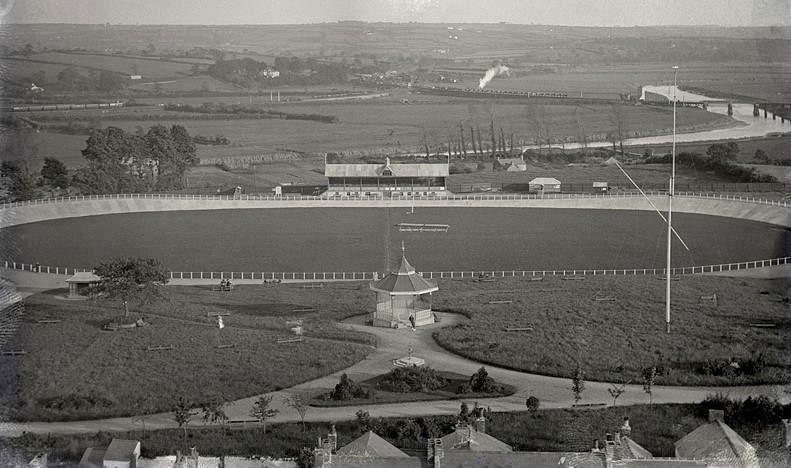
The following story, whilst not by any means a definitive one, is one that finally gives recognition to a man long since forgotten in Carmarthen – until now. A man it can be said without doubt has brought joy and happiness to countless individuals young and old for 120 years. Never has such a facility been more appreciated by the people of Carmarthen than “the park”. Carmarthen Park and cycle track was officially opened on Easter Monday 1900 (April 16th) and was acknowledged as being the finest cement cycle track in the United Kingdom. Designed and constructed in the supervision of the Borough Surveyor Mr Fred J Finglah.
Carmarthen Park & Cycle Track opened in 1900
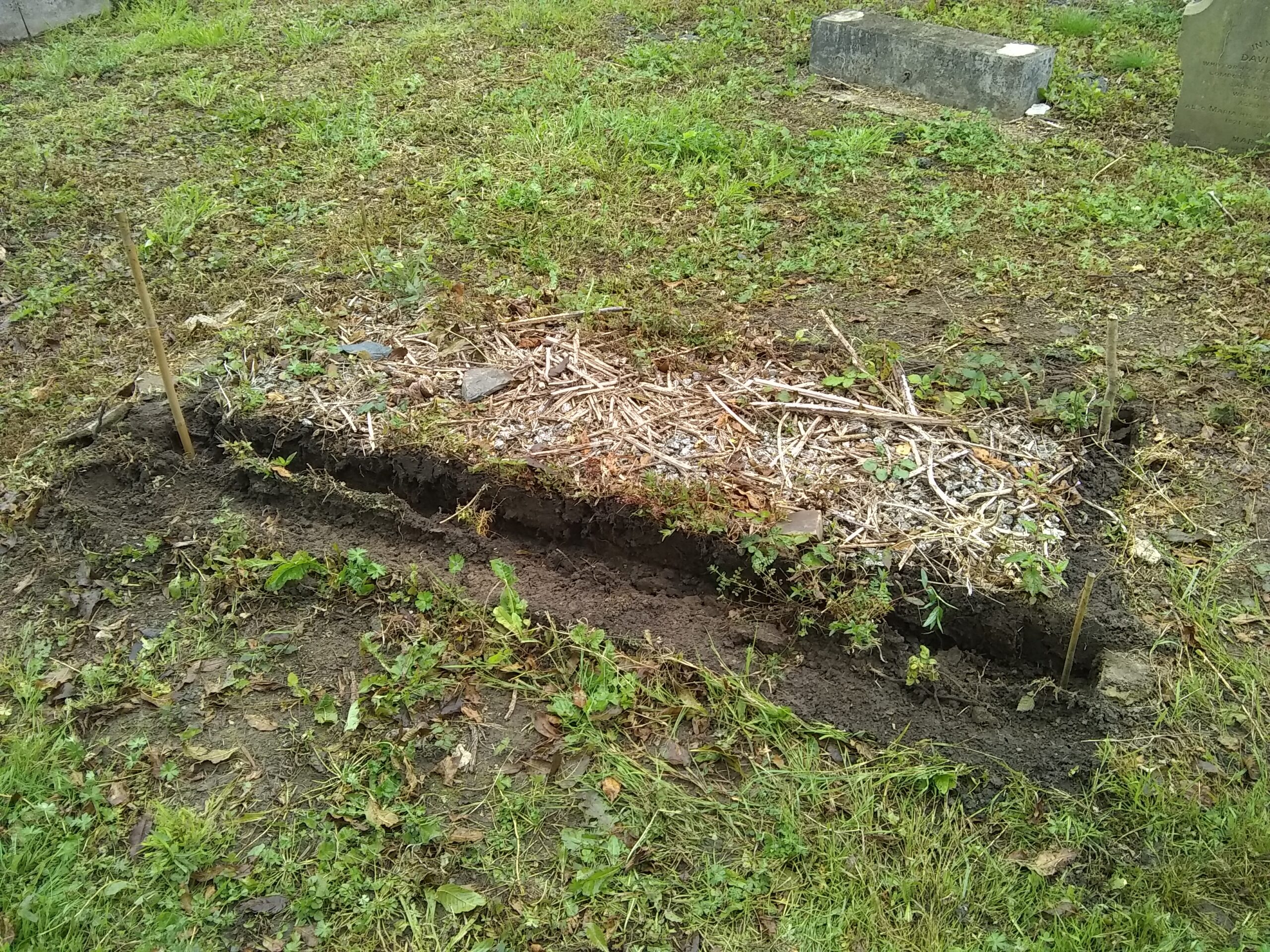
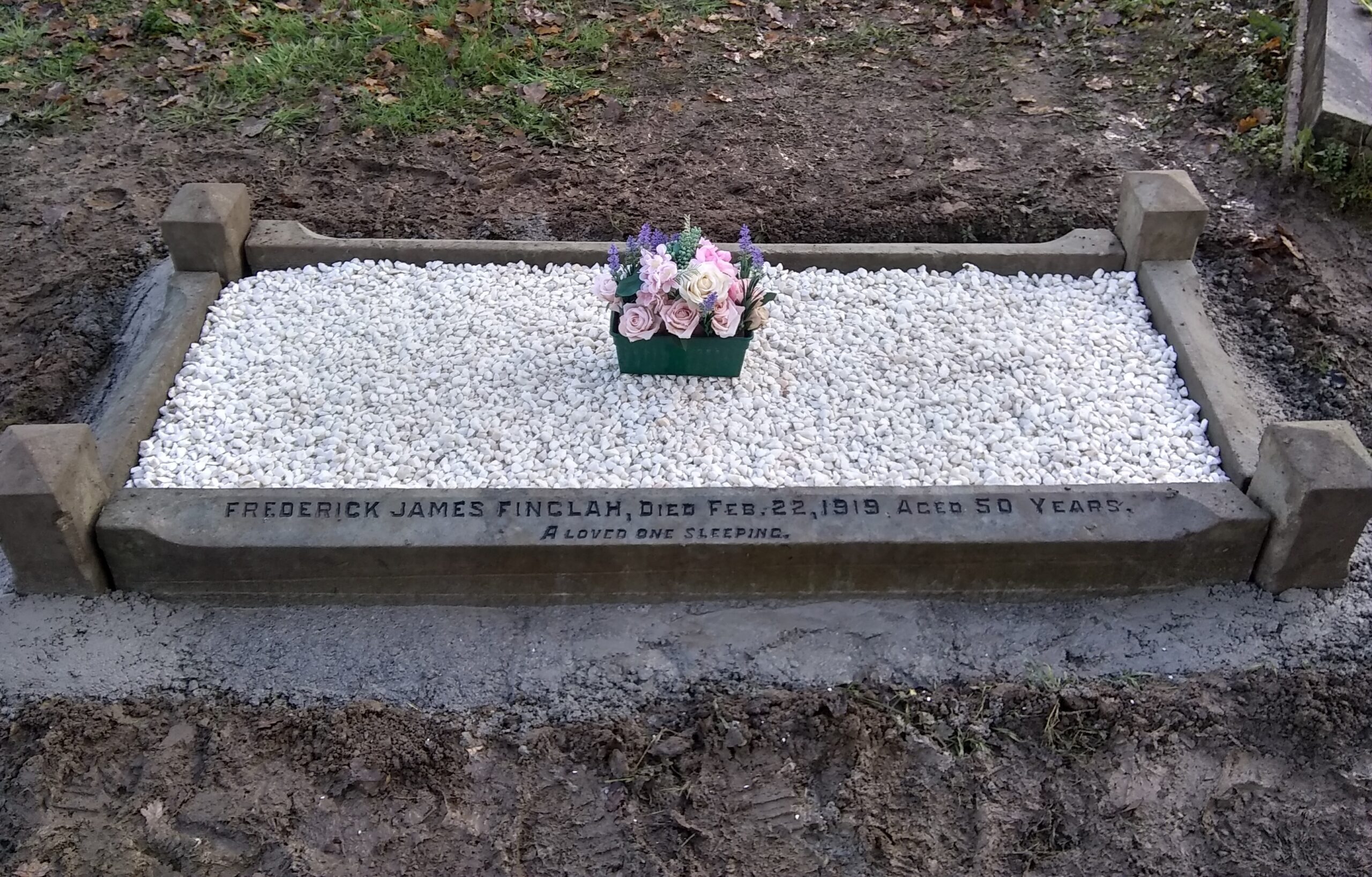
The Thomas & Elizabeth Mayhook Charity is therefore delighted to have been able to completely rebuild and restore the last resting place of Frederick James Finglah from a forgotten, dilapidated, overgrown grave in St David’s cemetery to what is now a fitting tribute to one of Carmarthen’s true heroes of history. Fourteen Carmarthen Freemasons – members of the Mackworth Club came to the cemetery on what was one of the wettest day’s ever in November to restore the grave of one of their forebears and the end result was a remarkable transformation – now visible for the first time for all to see.
This story starts off with a brief outline of his birth, followed by his marriage, and then newspaper reports of the opening of the cycle track and park in 1900, and him becoming Master of the St Peter’s Lodge of Freemasons in 1907, an amusing and interesting account of a legal case regarding a portrait photograph followed by his obituary in 1919. Most of the information has been extracted from newspaper reports at the time together with other reference material. I hope you enjoy reading it.
Frederick James Finglah was one of seven children,-three brothers and four sisters. His father was a shoemaker from Barnsley. During the time of his employment as Borough Surveyor he lived at number 7 Church Street, just opposite St Peters Church with his wife, one year old daughter Dorothy Letitia, and his widowed mother in law and sister in law. His daughter Dorothy died unmarried in Shrewsbury in 1987 aged 88.
Fashionable Marriage at Carmarthen. 28th October 1898 Carmarthen. Report by the Weekly Reporter.
The marriage was celebrated at St David’s Church, Carmarthen, on Tuesday, at 10.30 a.m., between Mr Fred J. Finglah, C.E., borough surveyor, Carmarthen, and Miss Letitia Jane Mary Grey Hughes, elder daughter of the late Rev W. Hughes, vicar of Newchurch, Carmarthenshire, and Mrs L. Hughes, Carmarthen. The bride, who looked charming, was attired in a dress of cream silk, trimmed with Swiss lace, orange blossoms, and pearls, and also wore a large tulle veil, wreathed with orange blossoms. She carried in her hands a beautiful bouquet, the gift of the bridegroom. The bridesmaids were Miss Katie Hughes, sister of the bride, and Miss Gladys Thomas, Guildhall-square, Carmarthen. The former was attired in a dress of pink silk, trimmed with white chiffon sash, and a hat of cream velvet, trimmed with cream tips and ribbon. The latter wore a white-figured muslin dress, trimmed with white sash, and a white fancy straw hat, trimmed with white tips and ribbon. Both carried large handsome bouquets, the gifts of the bridegroom. The bridegroom was accompanied by Mr C. E. E. Fisher, civil engineer, of Aston, Birmingham, as best man. The marriage ceremony was performed by the Vicar of St David’s (Rev T. R. Walters), assisted by the Rev H. Hughes, Vicar of Myddfai, Carmarthenshire (uncle of the bride), who was given away by Dr Bowen-Jones, The Friary, Carmarthen. Miss B. M. Cooke, L.A.R.M., presided at the organ, and played the “Wedding March “(Mendelssohn), Handel’s Grand March in Scipio,” and the War March of the Priests,” from” Athalic.” The choir sang the hymn “The voice that breathed o’er Eden,” and chanted the 128th Psalm. The church was crowded, and a considerable display of bunting was made by friends and neighbours of the bride, three garlands of flags stretching across the main street near the church. On one of these was expressed a wish for “long life and prosperity,” and on the others “health and happiness.” The Corporation steam-roller was decked with flags and evergreens by the workmen, and was instrumental in the discharge of numerous detonators. The peal of bells in St Peter’s Church tower was also rung. After the ceremony the bridal party, upon whom confetti, rice, and flowers were plentifully showered, returned to The Cedars,” Union-street, where a large company of friends, among whom was Mr C. Burton, Birmingham, uncle of the bridegroom, sat down to the wedding breakfast, and where, at a later period of the day, Mrs Hughes, the bride’s mother, held a reception. The happy couple left by the 1.20 p.m. train for London, where the honeymoon is to be spent. The travelling dress of the bride was of royal blue cloth, “faced with white, and she wore a large picture hat to match. The bridal couple were the recipients of presents to the number of 160.
Opening remarks by Her Majesty’s Lord Lieutenant of Carmarthenshire Sir James William Drummond CB, regarding the official opening of the Carmarthen Park & Cycle Track on Monday 16th April 1900 and his praise of James Finglah.
The Lord Lieutenant Sir James Williams-Drummond (1857-1913), of Edwinsford, Llandeilo.
“For the laying out of the ground Carmarthen was indebted to their Borough Surveyor Mr Frederick James Finglah (applause). He has been responsible for the planning and the carrying out of the whole work, including the construction of the cycle track, which was unsurpassed by anything in the Kingdom (applause). The ground represented a considerable expenditure of money, which was money well spent by the Carmarthen Sports and Recreation Committee. It is a gratifying circumstance that there is an increasing demand for land suitable for building purposes in Carmarthen. I am not at all surprised that people should be desirous of coming to live in this beautiful neighbourhood. Land suitable for the purpose of a recreation ground has been getting scarcer every year and the price inevitably increasing. I am satisfied that the verdict of the public would be unquestionably that the Corporation of Carmarthen had done the correct thing, and that the present and future generations of Carmarthen would be justly proud, thanks to the ingenuity, foresight, dedication and ability of Mr Finglah” (loud applause)
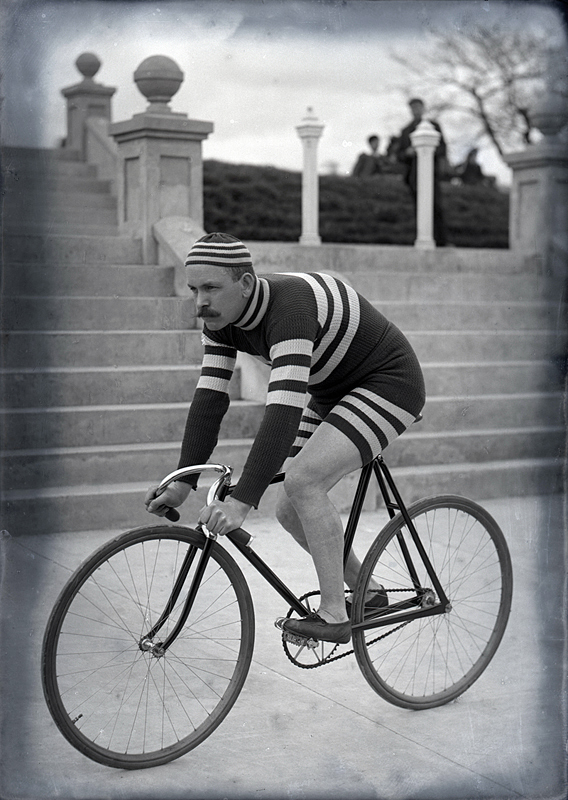
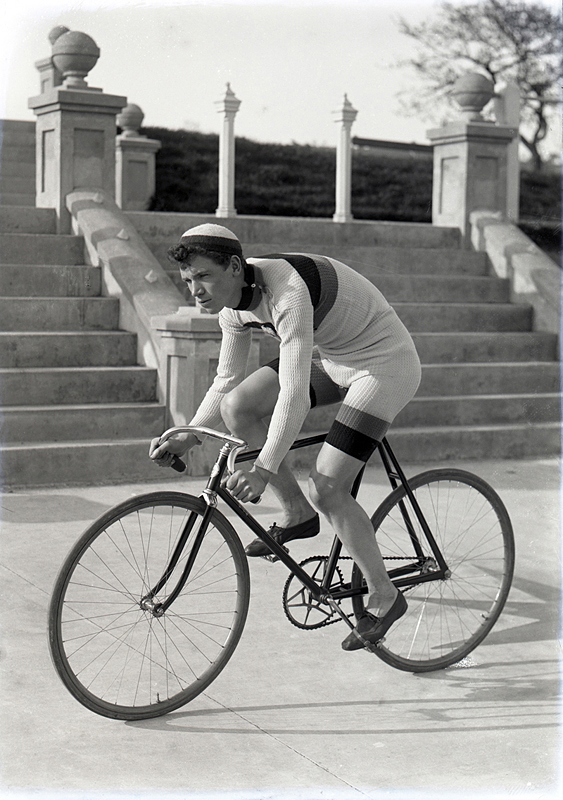
Two cyclists that took part in the opening ceremony in 1900.
Carmarthen Weekly Reporter 20th April 1900. The opening cycle race… Oh dear!! .. this could only happen in Carmarthen !
The unfortunate fiasco which happened in the mile professional scratch race has been the means of creating a lot of ill-feeling as regards the winner of the final heat. One of the official judges -Mr Mitson of London, unfortunately, had the bell rung for the last lap when it proved to be only the third and not fourth lap and Tom James going strong for the finish after the bell rung thought he had won but there being another lap to go W Rees got home first in the fourth lap. Tom James has laid an objection to the result.
The opening race. The Cycle Judge Mr Mitson who lost count after three laps can be seen in the bowler hat on the right of the photograph.
Mr Britten, treasurer of the National Cyclists Union in proposing success to the Cycle Track, said he understood that their surveyor, Mr Finglah, had had a free hand in the construction and design of the track. He congratulated Mr Finglah upon his success, and the only thing which he could suggest for its improvement would be to slightly rough it. He was glad to hear of a track in a town of the size of Carmarthen, and stated that he knew of no other in the whole kingdom like it. It was a track of which Carmarthen could be proud. As treasure of the N.C.U., he was pleased to find the South Wales Centre creeping up and up, and he hoped the results of Carmarthen Sports Committee would creep up and up. He coupled with the toast the name of Mr Finglah. Mr Finglah, in responding, said he had not, expected to be asked to make a speech. He said it was very satisfactory to hear such a good opinion of the Carmarthen track and sports management. With regard to the track he said that were it “roughed” it would only be at the expense of speed.
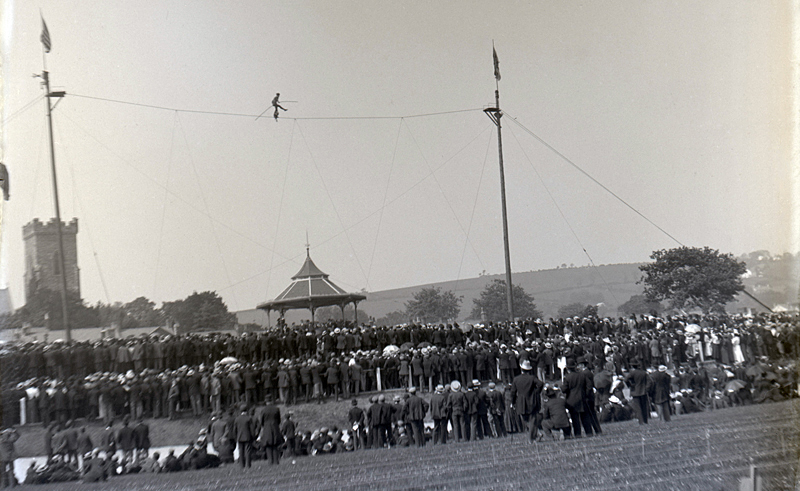
The amazing hire wire act without safety nets on the day of the official opening. Note St David’s Church in the background.
On the 20th December 1907 the Carmarthen Weekly Reporter reported on the local Freemasons installation ceremony.
“On Tuesday night the installing ceremony in connection with the St. Peter’s Lodge of Freemasons No. 476, was held at the Masonic Lodge, Spilman street, Carmarthen. Bro. F. J. Finglah was installed Worshipful Master for the ensuing year, and the following officers were invested:—I.P.M., W.Bro. B. A. Lewis; S.W., Bro. Thomas Davies; J.W., Bro. Chas. E. Davies; chaplain, W.Bro Rev J. Marsden, P.M., P.P.S.G.W. treasurer, W.Bro. James John, P.M., P.P.S.G.W secretary, Bro. Harry Reeves; director of ceremonies, W.Bro. Thomas Walters, P.M., P.S.W. S.D., Bro. Lewis Giles; J.D., Bro. C. H. Mounsey; T.G., Bro. E. G. Tuck; organist, Bro. J. Howard Morgan; steward, Bro. D. Roberts; steward, Bro. W. O. Minister; and tyler, Bro. John Thomas. After the installation a banquet was held at the Ivy Bush Royal Hotel”
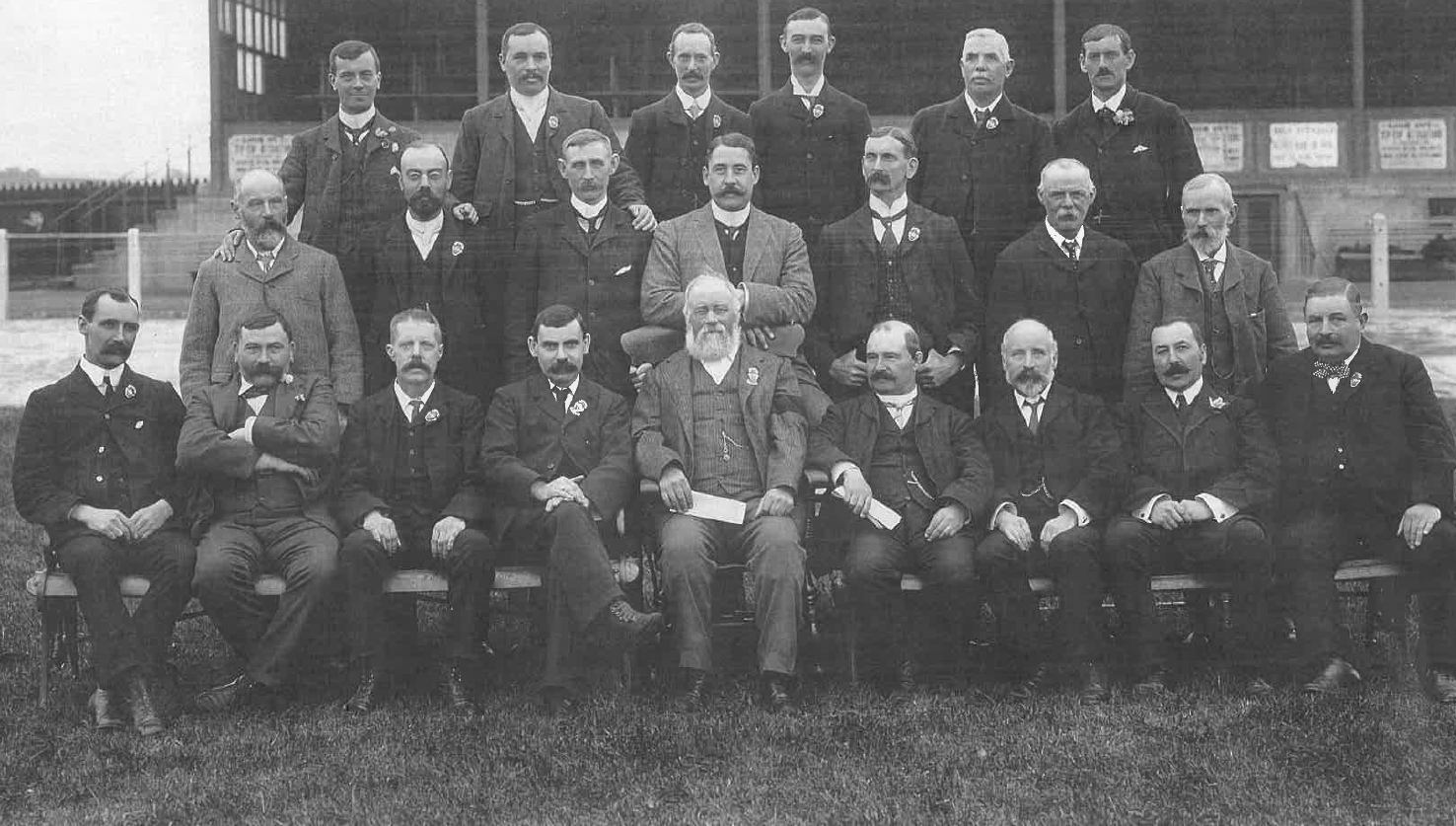
The Sports and Recreation Committee responsible for employing James Finglah and financing the project of constructing the cycle track.
The story of the unwanted Portrait. Carmarthen Weekly Reporter June 1914
The Crown Court case and His Honour Judge Lloyd Morgan’s verdict.
A Swansea photographer brought a claim against Mr F. J. Finglah, Borough Surveyor, Carmarthen. Mr J. F. Morris appeared for the defendant. Plaintiff stated that he had a, studio at Walters Road, Swansea. He had lived formerly at Pontypridd. He had carried on business in South Wales for six or seven years. He called on Mrs Finglah and she agreed to have a water colour enlargement of her husband’s photo, the price to be two guineas. He had only had 15s. Mr J. F. Morris asked if the plaintiff had not promised Mrs Finglah that the portrait would be a special new process of which he was the sole patentee. Plaintiff said that he never said anything of the kind. He was not the patentee of any process. Mrs Finglah gave him particulars of the colour of her husband’s eyes, hair and complexion to enable him to colour the enlargement. Mr S. Collin also gave evidence. He said that Mrs Finglah said that she would prefer the water colour enlargement. The price agreed was two guineas. Mrs Finglah said that the plaintiff told her that he was canvassing for portraits done by an entirely new process of which he was the inventor. He said that it was neither oil nor water colour nor a photo.
His Honour Judge Lloyd Morgan KC – A Carmarthen man, buried in the next street up from St David’s in Union Street Chapel cemetery.
He said that the portrait would be washable and could be spring cleaned like a chair. She agreed to take a portrait at 15s 6d. She paid 10s, and the balance of 5s was to be paid on delivery. When the plaintiff brought the portrait and asked for three guineas, she told him to clear out of the house and to take the portrait with him. Plaintiff asked the witness whether Mr Finglah had not sent him a letter stating that he was playing a, “dangerous game.” Witness said that was so. Plaintiff: What is the dangerous game? The Judge: It is a, dangerous game to say there is a contract if there is no contract. Plaintiff (to witness): The Judge can see very well that you are committing nothing but a lot of perjury. The Judge: You must not say that. Mr Finglah said that he knew nothing of the matter until the portrait was delivered. He knew something of photography and had done a little sketching. He thought that the enlargement was worth 5s if uncoloured. Coloured as it was it was worth nothing. The Judge: The wife is not the husband’s agent to buy things like that. The husband is not responsible. Mr Finglah said he had no desire to fight the case on a technicality, but on its merits. Plaintiff: If the case goes on like this it is no good me bringing on cases. Can I summon the wife? The Judge: I don’t think it would be any use. If I had to decide the case on the facts, I would give the same decision.
The Judge** found in favour of Mr Finglah and dismissed the case.
**Judge Lloyd Morgan himself was born in Carmarthen in 1861, becoming a Liberal MP for Carmarthen West from 1889 to 1910. He became a KC (Kings Counsel) in 1906 and was much respected in the town. He died in 1944 and is buried in Union Street Chapel Cemetery Carmarthen, a few minutes walk from St David’s.
Obituary. Carmarthen Weekly Reporter 28th February 1919.
MR F. J. FINGLAH. Mr F. J. Finglah, Borough Surveyor, died at his residence in Johnstown on Saturday. The deceased, who was 50 years of age, had been appointed Borough Surveyor of Carmarthen in the year 1898. He was a native of Walsall, and previous to his appointment at Carmarthen was assistant surveyor to the Heston and Isleworth District Council. When he came to Carmarthen the Nantcwmtawel water scheme had just been adopted, and he carried out the work under the late Mr Barnes, of London, who had drawn up the scheme. Mr Finglah laid out the Park and the Cycle Track at Carmarthen. He was of a very quiet retiring disposition, and his voice was seldom heard at Council meetings. He was held in high esteem by all who knew him, and was a capable and upright official. He was well-known for his courteous and gentlemanly demeanor, and was held in high esteem by the Corporation and townspeople generally. He is survived by a widow (a daughter of the late Rev T. Hughes, vicar of Newchurch) and two daughters. The following photographs show the state of James Finglah’s grave before restoration began and the progress made in it’s complete restoration.
The Mackworth Club after completing the restoration. Well done to all of them.
POSTSCRIPT. 100 years on
One hundred years after the opening of Carmarthen Park in 1900, the newly restored Coalbrookdale cast iron gates that stand proudly at its entrance once again became the subject of a lesser known “campaign” by my friend the late Earl of Snowdon GCVO. It was a subject close to his heart involving the removal of a fine set of Coalbrookdale gates originally erected as the gateway to the London Great Exhibition in 1851, only to have been re-erected some years later on the boundary of Kensington Gardens and Hyde Park, now acting as a backdrop to a major road junction propping up some road signs and totally out of place.
The late Earl of Snowdon GCVO. Copyright by kind permission of Andrew Hasson.
It was Lord Snowdon’s idea to have the gates removed and installed at the front of the Albert Memorial near Kensington Palace as part of a plan to erect a memorial to the late Princess of Wales. The “campaign” dragged on for ever with letters and phone calls from all over the UK and beyond but sadly to no avail. The Carmarthen Gates and that of the Great Exhibition- both being made by Coalbrookdale, were very similar in design and the fact that ours had been removed and restored and finally re-erected came to Lord Snowdon’s attention through a telephone conversation I had with him.
The restored Coalbrookdale gates at Carmarthen Park entrance
Indeed we had many a conversation over the telephone about them and how wonderful it would be if a similar project could be done in London, albeit with their relocation near the Albert Memorial. I was able to advise him quite a bit and we became good friends, but sadly all our efforts fell on deaf ears.
Lord Snowdon’s tribute to the fallen of Carmarthenshire in the Great War
Nevertheless Lord Snowdon maintained an interest in what was going on here in Carmarthen and in August 2014 he very kindly wrote for me the foreword to the 100th anniversary service of commemoration programme of the start of the Great War in 1914 – the event very appropriately being held, where else but at Carmarthen Park within the cycle track itself, and so after 114 years James Finglah’s everlasting legacy once again provided a backdrop to a significant historical occasion as it has done continuously since it’s inception all those years ago. James provided Carmarthen with a legacy beyond anyone’s imagination. If nothing else, we owe it to him and his memory to remember what he achieved.
And finally….the great man himself – Frederick James Finglah. A never before seen photograph.(Copy of photograph kindly provided by The National Archives, Kew) Please ask for permission from the Thomas & Elizabeth Mayhook Charity to reproduce this image.
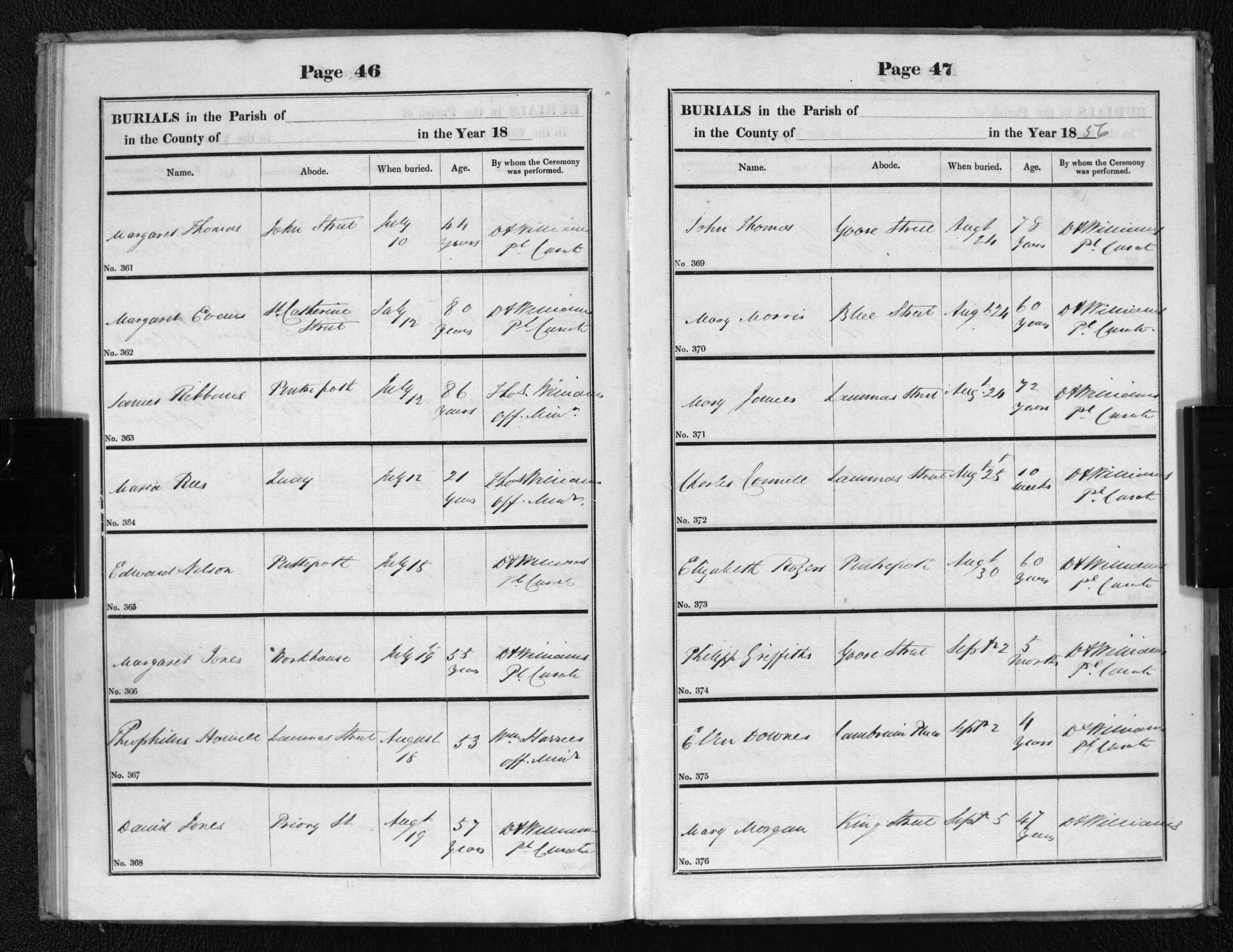
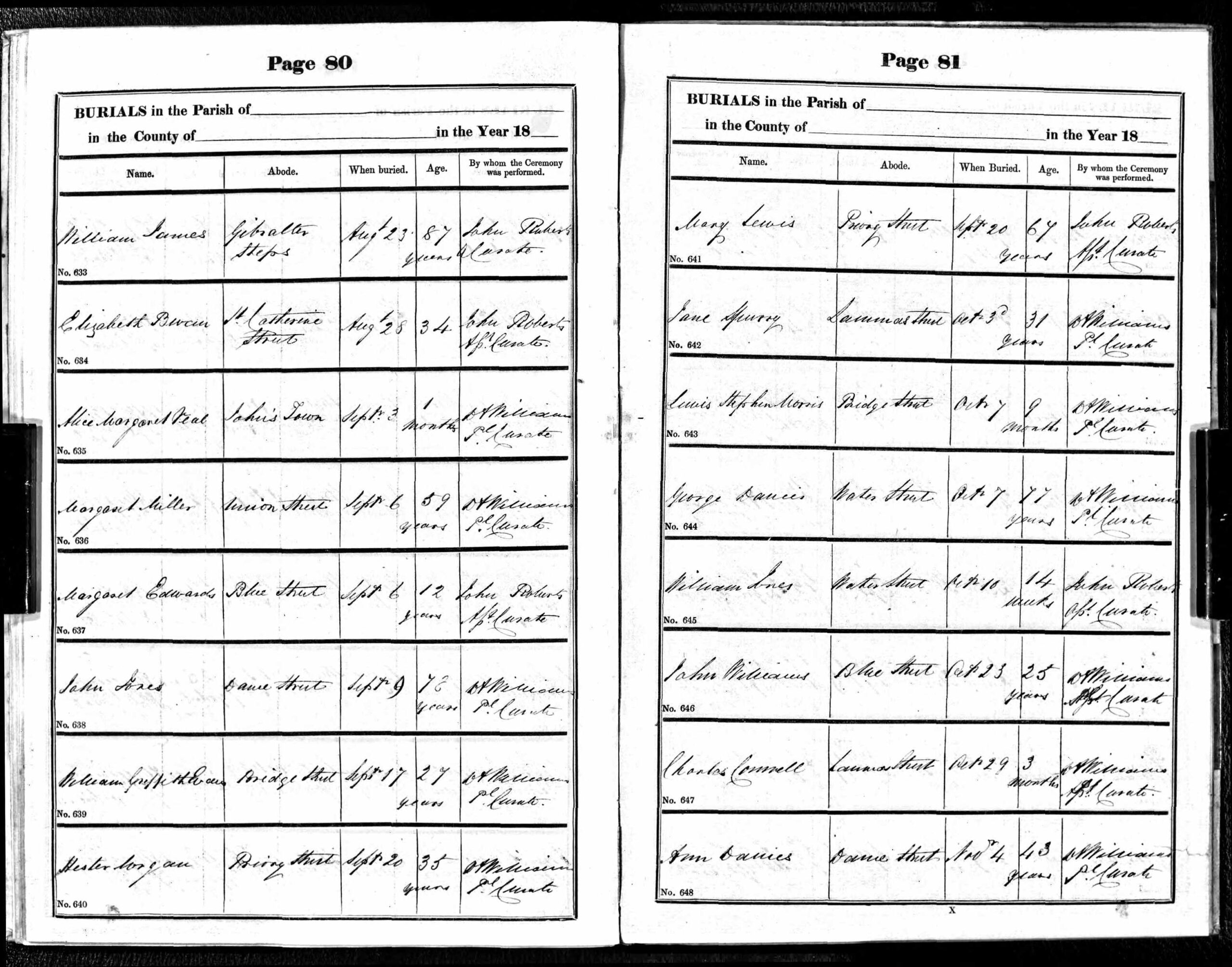
The two infant brothers, both named Charles Connell lie buried together somewhere in this cemetery. They have no headstone or known last resting place. Their lives taken away at such a young age, as were so many during this period through illness and disease. The purpose of this story therefore is to give readers a flavour of a history that would otherwise be forgotten and unknown to many of Carmarthen’s residents – the history of their forgotten father WILLIAM CONNELL who grieved his entire life in the loss of his beloved infant sons.
The burial register giving the details of ten week old Charles Connell
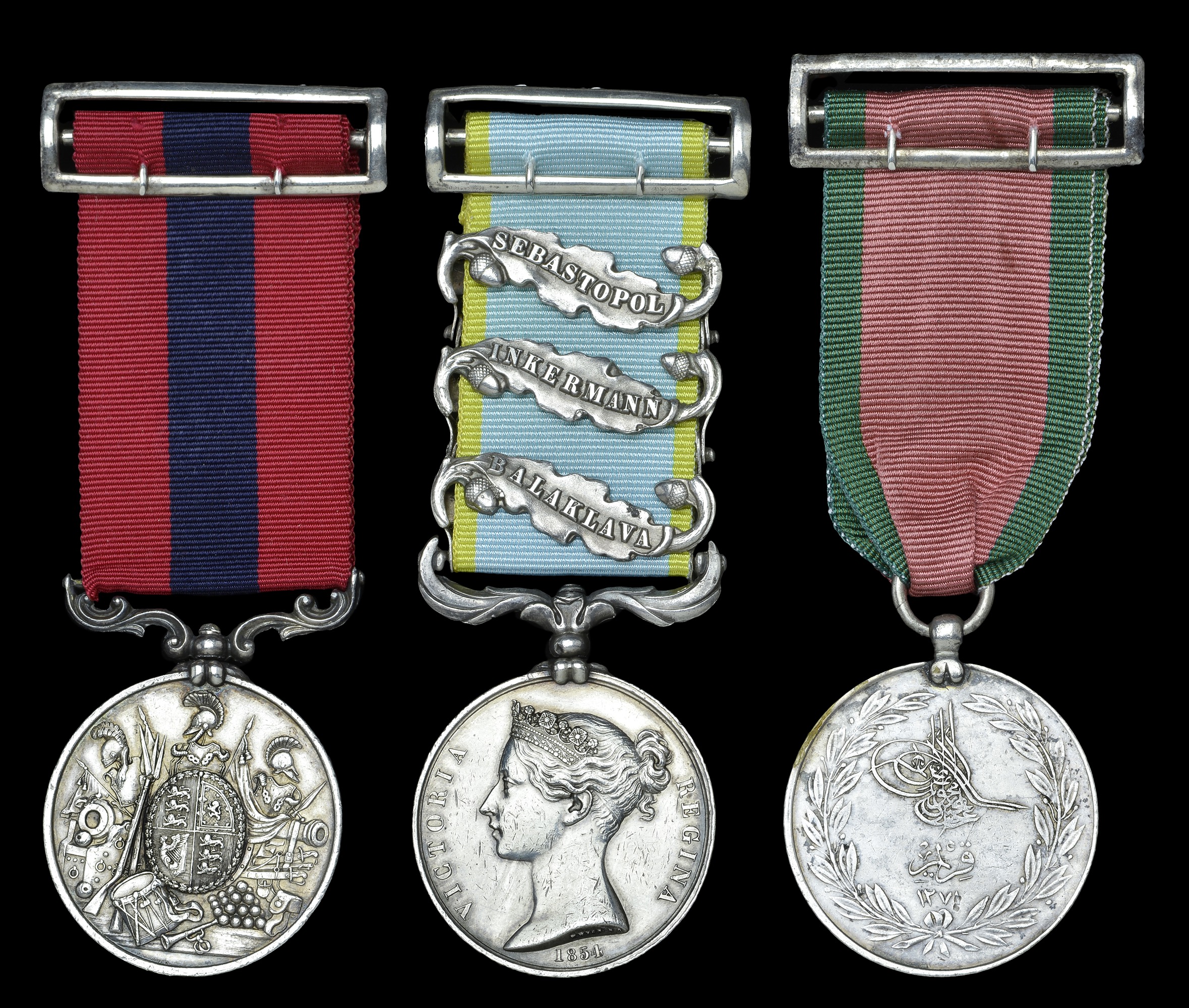
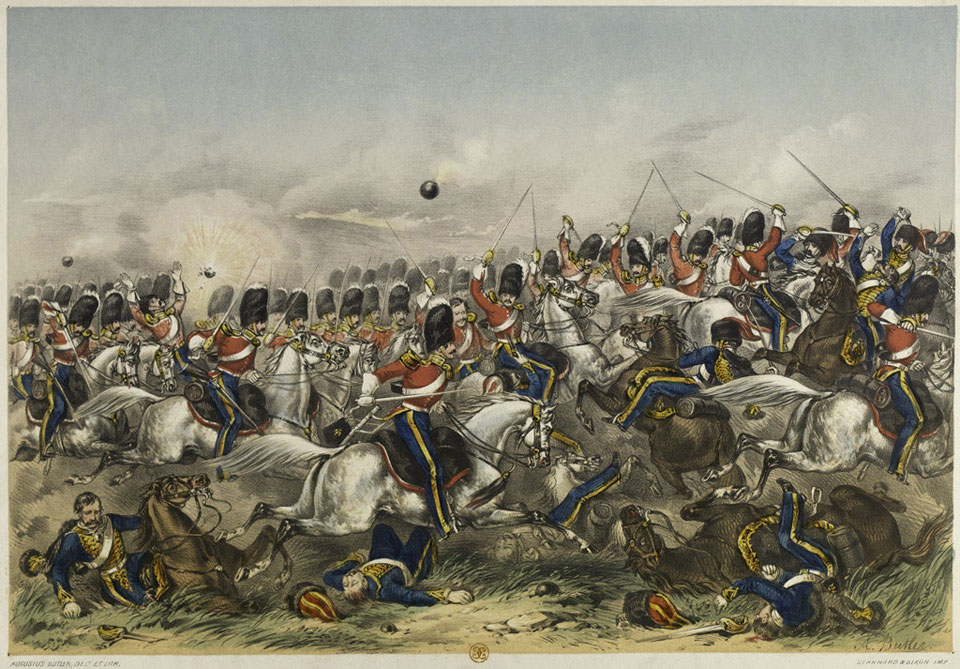
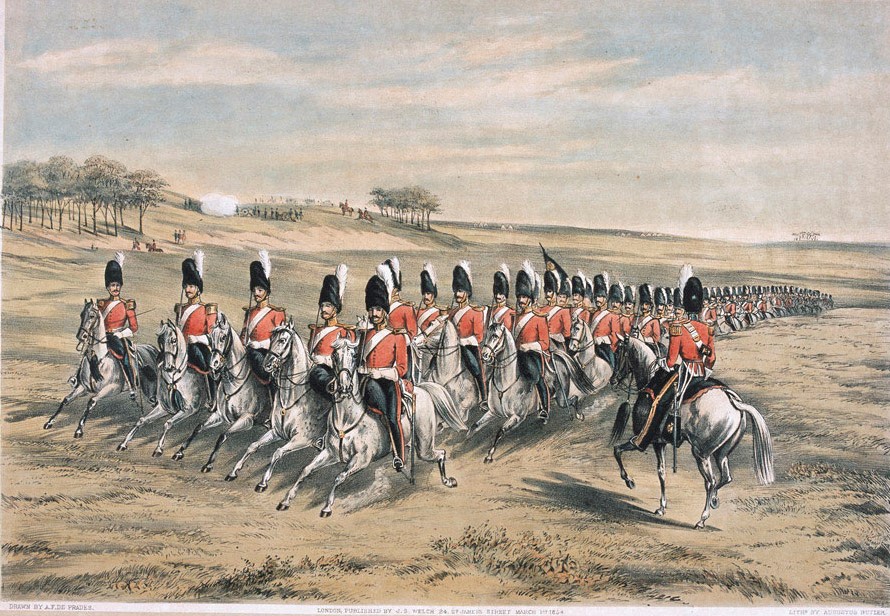
William was a hero in the true sense of the word, having fought with the Heavy Brigade at the famous battle of Balaklava in the Crimea on the 25th October 1854 winning the Distinguished Conduct Medal for extreme bravery and gallantry……what follows is but a brief glimpse of his life and that of the CONNELL family. I hope you find it of interest. After returning to the UK from the Crimea, William came back to Carmarthen to marry his sweetheart and joined the Great Western Railway as a Policeman, eventually becoming a signalman at Carmarthen Junction.
William Connell was born in Kilmarnock and enlisted in the 2nd Dragoon Guards (Scots Greys) on the 16th May 1846 in Glasgow at the age of 24 years and 6 months for the princely sum of five pounds fifteen shillings and sixpence, having previously served for over four years in the same Regiment. He was considered as medically unfit on the 25th April 1855, having served a total of 9 years and 28 days. He is described in his military records as being 5ft 9” with grey eyes and blonde hair.
His medical report when discharged from the army informs us that …. “He is rendered totally unfit as a consequence of severe gunshot wounds near the right shoulder and through the neck of the humorous received in the Cavalry Charge at Balaclava”
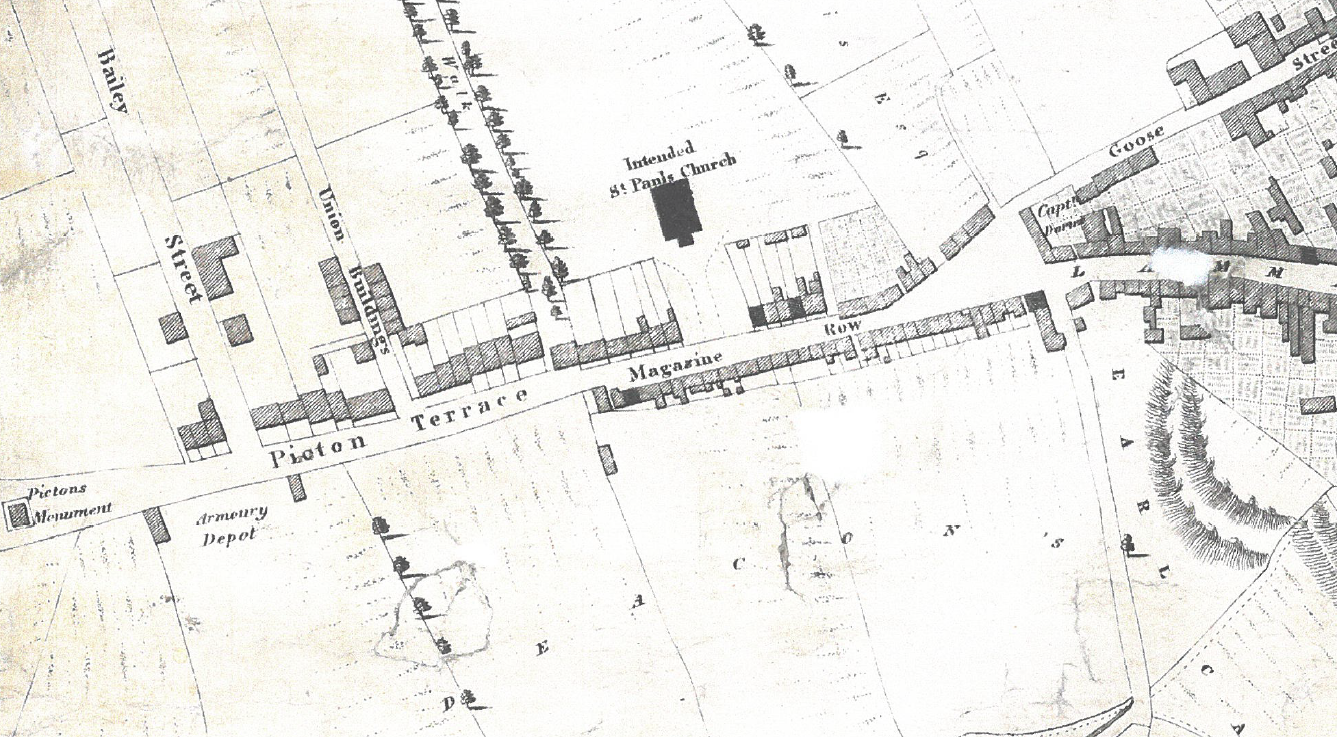
On being discharged from the Army, William returned to Carmarthen to continue his courtship of his beloved girlfriend Margaret Miller who lived in Magazine Row, close to the Barracks armoury in Picton Terrace. William had met Margaret during the time he was stationed here with the 2nd Dragoon Guards in 1848 during the civil unrest caused by the Rebecca Riots, their courtship only being interrupted when the Dragoons were deployed for service abroad. On July 13th 1855, Margaret and William were married at St David’s Church Carmarthen, both their parents being described as shoemakers and William’s profession as Carpet Weaver. So began a lifelong marriage which was to last 45 years .Very sadly William and Margaret’s first born son Charles died aged just ten weeks and was buried in St David’s cemetery on August 25th 1856. To say that they were heartbroken was an understatement; after all that William had gone through in his life to have his first child die so prematurely was a terrific blow to them both, to be followed by another tragic death of their third child aged just three months, also named Charles in July 1861.
Burial Register giving the details of 3 month old Charles Connell
It was said that William returned to St David’s cemetery every year without fail on the anniversary of their deaths to visit their last resting place. Neither of his sons now have any headstone and their burial place remains unknown, but his father’s love for his two deceased infant children and of Carmarthen, the place he loved so much during his 45 years will live on in the telling of this brief story.
Retirement of an Old Balaclava Hero (A report headline from the local newspaper in October 1899)
ENTHUSIASTIC FAREWELL MEETING AT CARMARTHEN RAILWAY STATION.
The retirement of Mr William Connell from the G.W.R. Company, after 44 years service, was the occasion of an interesting presentation at Carmarthen Station this week. Mr Connell, who has attained the advanced age of 79 years, was born in Kilmarnock, in Ayrshire, and enlisted on the 15th of May, 1846, at the age of 24, in the 2nd Dragoons. He was one of the heroes who won three medals for distinguished conduct in the field of Balaclava, the scene of that memorable charge of the Six Hundred. Mr. Connell has held the post of signalman for many years at the Bridge signal-box, and is now leaving Carmarthen with Mrs Connell and Miss Connell for Birmingham, where he will reside with his son, Mr Robert Connell. There were a large number of officials and friends present, and the meeting was a most enthusiastic one, the utmost good fellowship and sympathy prevailing. On the motion of Mr W. Hughes, seconded by Mr Lloyd, Mr Inspector T. Dalton was unanimously elected to the chair. Mr Dalton thanked them cordially for electing him to the chair on such an auspicious occasion. Nothing afforded him greater pleasure than to be associated, however remotely, with that presentation to their old friend, which was the object of their gathering there that afternoon (applause). All of them had known Mr Connell for many years, and he thought he would be voicing their sentiments when he said that a more agreeable and courteous old gentleman it would be difficult to meet with (hear, hear). There, before him, he saw the portrait of Mr Connell, wearing the medals which he had won for bravery and distinguished service in the Crimean war, and if it were in their way to do so, they would be happy to present him with another medal for his faithful and exemplary conduct, and his kind consideration and courtesy towards his fellow men (hear, hear).
A set of Crimean medals identical to those won by William Connell
He was retiring after 44 years’ service, at the age of 79, truly a wonderful age. He had held the important position of signalman, and, as they were all aware, the signalman’s and engine-driver’s posts were the most important on the railway. But Mr Connell, notwithstanding his great age, never showed any want of alertness or activity in the performance of his duties, and he was glad to see him retiring with his mental faculties as bright as ever (applause). Great importance and consideration were given to the signalmen and their duties at the present day by all railway companies in their own interests and the interests of the public and the greatest precautions were adopted by them in everything affecting the signalman’s box, insomuch that an age limit had been fixed in respect of signalmen but it was in virtue of his exceptional activity that Mr Connell had remained so long in that post. However, it was unnecessary to assure them that he was leaving the service with the highest respect and esteem of the men and officials, many of whom were unavoidably absent on that day (applause). He was sure that no man had ever left the service who carried with him the affection and regard of his fellow-men to a greater degree than Mr Connell did and the hearty response of subscribers also went far to testify that (hear, hear). He had been his Inspector for five years, and he would say that he felt the most profound regret at losing such a worthy man, in whose conduct there was much they could all endeavour to emulate.
A map of 1835 showing Magazine Row where William and Margaret lived for 44 years
He hoped sincerely, notwithstanding his great age, that he would live a still further span of life, and that his declining years would be marked with good health and happiness, and tender recollections of his pleasant associations with that large circle of friends he would leave behind at Carmarthen (loud applause). Mr Teale said I fully appreciate what has been said here to-day by our worthy Chairman with regard to our noble friend, Mr Connell. I have during the past eight years worked most successfully with him without any hitch or unpleasantness. I have always found him a solid colleague, ready and attentive at all times, and always up to a perfect standard of work. I have found in him a man of faith and good conduct, an upright and virtuous man, who endeavoured to do what, was just and right towards his fellow-man (hear, hear). This portrait before me will remind Mr Connell in the future of the great friendship which existed between him and his co-workers. I sincerely wish him every pleasure and happiness in the quiet society of his son (applause). Mr Griffiths (Loco, Department) fully endorsed the praiseworthy remarks which had been made by the Chairman and Mr Teale respecting Mr Connell. He had always been very fond of their friend, Mr Connell, inasmuch as he always treated his fellow-men and officials alike (applause). He was truly a man whom they all admired for his noble manliness (applause). He sincerely wished him the good health and enjoyment in the future which he richly deserved, and hoped they should see him visiting the old town again (hear, hear). Mr Phillips, Carmarthen Junction, said I am very pleased to have this opportunity of expressing my feelings towards Mr Connell. He is a gentleman whom I have always admired, and a chat with him about his adventure was a source of infinite pleasure to me. We have lost from the district a faithful and sympathetic friend, and an excellent railwayman and it is a loss which I and all very deeply regret. It pleased me infinitely to hear the expressions of good wishes for Mr Connell’s welfare and happiness in the future which accompanied every subscription to the list. The arranging of this little affair has been a labour of love to me, and I hope in conclusion that Mr Connell will enjoy good health and many years again in his new home (applause). Mr T. Phillips, district relief man, spoke in commendatory terms of Mr Connell. There had been a slight difficulty in deciding what to present to their old friend, but he thought nothing would be more appropriate than that beautiful portrait as a memento of his happy associations at Carmarthen. They all knew his capabilities, and also that the old adage was true, “Virtue has its own reward,” and in Mr Connell’s life they saw that adage exemplified (hear, hear). He had attained a great age, and he was glad to see him enjoying such good health and strength. He was leaving them with the good will and hearty good-wishes and regard of everyone who knew him, and he (Mr Phillips) did not know what could be more gratifying to a man than that assurance (hear, hear). He hoped he would further enjoy happiness and comfort in his new home (applause). Mr Hughes, guard, said he heartily agreed with all that has been said d their dear old friend who was about to leave them. His moral soundness, kind and courteous disposition, had made him admirable in the eyes and hearts of his colleagues. He had borne an exemplary character right through his life. He had won honour and glory for himself in the defence of his country, in the memorable engagement at Balaclava, and he had won the honour, respect, and admiration of his fellow-men in the Great Western Railway service (hear, hear). He hoped most sincerely that the evening of his day would be yet the most pleasant time of his life (loud applause). Mr David Lloyd, guard, heartily agreed with the previous speakers. He knew Mr Connell from experience, and he knew that he rightly merited the praiseworthy allusions that had been made there that afternoon respecting him. He had been an ideal railwayman, who did his work with a spirit of cheerfulness, and endeavoured at all times to make matters glide smoothly over the rugged path of life (applause). He wished every happiness to Mr Connell in his retirement. Mr Richard Webb (signalman) said I have been closely associated with Mr Connell for over four years, and when I think of the pleasant time we have spent together I feel the most profound regret that we are to lose from this district a gentleman whom I, and all others, have always regarded with the affection of a brother (hear, hear “). Everybody in the district respected and admired Mr Connell, whose sterling qualities and noble character have made him an example worthy of imitation by all (applause). I, and so do you all, I am quite sure, wish our dear old friend here to-day every happiness, every comfort, pleasure, and good health, and many more years again to enjoy it (loud cheers). Mr Charles Bowen, stationmaster, Carmarthen Junction, then rose to make the presentation. He was, indeed, very pleased to hear the kind things that had been said of Mr Connell. It was his (Mr Bowen’s) intention to have been away that day, but he would have felt very grieved upon his return to find that he had been absent from that auspicious event. He could fully endorse what had been said. He had always found Mr Connell very courteous and obliging, and always ready to put his hand to the plough to do a good turn for any- body. He assured them that he was very sorry to lose him from his staff. He looked forward with pleasure to a visit to the Bridge cabin, where he used to hear exciting and inspiring stories of the old times. Those medals he saw before him were reminiscent of the time when he (Mr Connell) was in the thick of the fight, where, by his undaunted courage and bravery, he had won honour and fame (hear, hear),
A painting depicting the Charge of the Heavy Brigade
A better servant the Company had never had. He did not think he could enlarge upon what have been said by previous speakers, and he was sure that they would all agree with him that what had been said was perfectly correct, which many of them present knew from experience.—Turning to Mr Connell, Mr Bowen said I now, on behalf of your friends and fellow-workmen at Carmarthen Junction and Carmarthen, present you with this portrait and purse of money, as a token of the respect and esteem in which you are held by them all, and I hope you will live many years again to look upon it. It will remind you of the pleasant associations and sterling friends yon have made, who are heartily sorry to see you leaving the town after such a long stay. I wish you good health, every comfort, and happiness in your new home (loud cheers). The old hero then rose to respond, but was suddenly overcome with emotion, and the scene was most pathetic and affecting. On recovering, Mr Connell said with difficulty “I sincerely thank you, my dear friends. I can assure you I deeply appreciate your kindness. I have always tried to live peacefully, and I think I have succeeded (cheers). My family will appreciate as much as I do your great kindness to me. I thank you again from the bottom of my heart (loud cheers)”. The pathos of the farewell scene was most touching. The portrait was beautifully executed by Mr Henry Howell, The Studio, and bore the following inscription on a brass plate “Presented to Mr. W. Connell by his fellow servants, as a mark of esteem, on the occasion of his leaving the service of the G.W.R. Company. October, 1899.
DEATH OF MR WILLIAM CONNELL
(CARMARTHEN WEEKLY REPORTER FRIDAY NOVEMBER 9TH 1900)
It is with sincere regret we hear of the death of Mr William Connell, late of Magazine row, in this town, which occurred at his residence, 41, Willis-road, Wiston Green, Birmingham, on Thursday, November 1st from senile decay, at the ripe old age of 78 years. In October 1899, Mr Connell retired on a pension from the position of signalman on the Great Western Railway at Carmarthen, after 44 years service, and his leaving was made the occasion of a presentation to him of a framed oil-painting of him- self and a purse of money by his fellow servants. Mr Connell was born in Kilmarnock Ayrshire, and enlisted on the 15th of May, 1846, at the age of 24 in the 2nd Dragoon Guards. He was one of those who won three medals for distinguished conduct on the field of Balaclava, the scene of the memorable charge of the Six Hundred. It was while the Dragoons were stationed at Carmarthen that he met his future wife. Mr Connell was of a quiet peaceful nature, and was highly respected in Carmarthen for his integrity and uprightness and his departure with Mrs and Miss Connell this time last year for Birmingham, to take up his residence with his son, was much regretted in the town. We are sure that Mrs Connell and the family-Miss Connell and her three brothers-receive the sincere sympathy of their Carmarthen friends in their sorrowful bereavement. (Margaret his beloved wife died in Birmingham on March 26th 1903 aged 75)
The recommendation for William Connell’s Distinguished Conduct Medal (DCM) is dated 13th January 1855, the medal was sent to the Crimea on 26th March 1855 but was returned and sent to Chatham on the 14th May as William had been invalided home. The DCM was created on December 4th 1854 for the Crimean War and was conferred on Non Commissioned Officers and soldiers who were recommended for “distinguished conduct in the field” It was the second highest award for gallantry in action after the Victoria Cross awarded to military ranks below commissioned officers. Out of 300 men of the 2nd Dragoon Guards that fought at the battle of Balaclava only 7 were to receive the DCM.
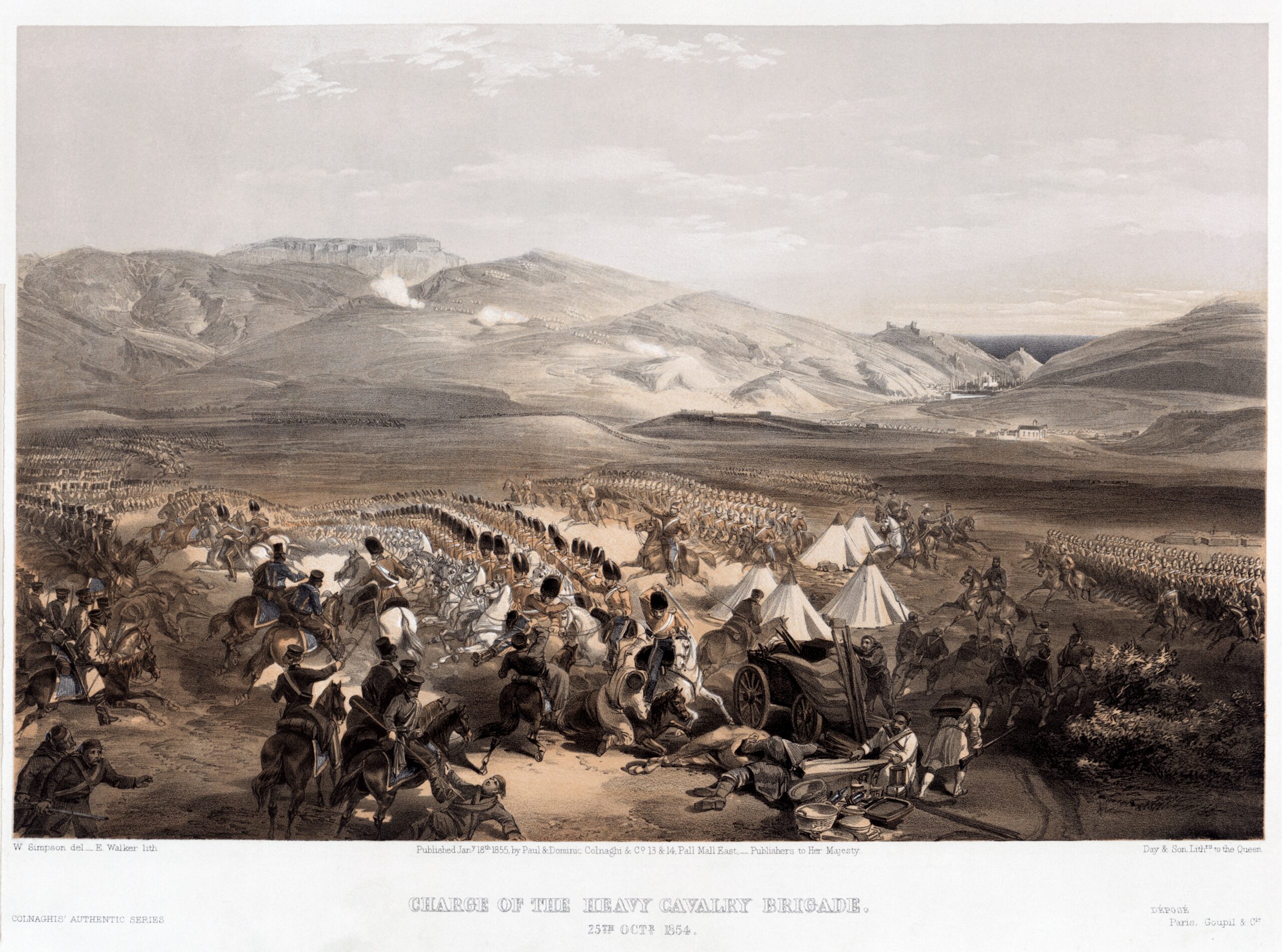
I cannot let this story end however without giving a brief insight into the historic battle and repeating the last section of Tennyson’s Poem of the Charge of the Heavy Brigade…..for William Connell to have survived at all was a miracle…………….
Another painting depicting the famous charge
The Charge of the Heavy Brigade at Balaclava on the 25th October 1854 was one of the most neglected events in the annals of British military history. On the day in question the Heavy Brigade were involved in TWO SEPARATE CHARGES. The first was the successful charge of the Brigade on the advancing Russian cavalry who were intent on capturing the overcrowded port of Balaclava, the main supply point of the British army. The second was in support of the LIGHT BRIGADE on their unsuccessful attack on the Russian Artillery. Lord Raglans real intention was to prevent the Russians from removing the British guns situated in the redoubts along the Causeway heights, but the orders were confused. As the Light brigade advanced down the valley, the Heavy Brigade followed in support. Lord Lucan had sufficient foresight to halt the advance of the Heavy Brigade which had come under heavy bombardment to prevent it from being annihilated in the same fashion as the Light Brigade.
The Heavy Brigade under the command of General Scarlett had assembled at the foot of the heights, organising his troopers into a near perfect formation. He instructed his trumpeter to sound the charge. Then against all the odds they attacked the Russian force which outnumbered them five to one. The charge was made uphill against an oncoming force, the Dragoons taking few casualties and the Russians were routed. Lord Cardigan in charge of the Light Brigade charged LATER as a direct result of a garbled and misunderstood message resulting in the destruction and loss of the Brigade with 118 men killed and 127 wounded or taken prisoner.
Following on from the Charge of the Light Brigade, a reporter by the name of William Russell wrote a poignant newspaper report for the Times and this in turn inspired Tennyson to write one of the most well known poems ever written. The poem was to be recited up and down the country and made Lord Cardigan a household name and immortalise the Light Brigade who charges into the “Jaws of Death” The heroism of ALL the men involved in BOTH of the charges along with their unwavering determination should have been equally recognised. However, 28 years after the event Lord Tennyson, realizing his error of judgement wrote another poem specifically in relation to the Charge of the Heavy Brigade, and the following is the last part of the poem which encapsulates the scene most vividly. How William Connell survived his horrific injuries in this battle is a miracle in itself, but survive he did for another 45 years.
THE SCOTS GREYS (2ND DRAGOON GUARDS)
Fell like a cannon-shot,
Burst like a thunderbolt,
Crash’d like a hurricane,
Broke thro’ the mass from below,
Drove thro’ the midst of the foe,
Plunged up and down, to and fro,
Rode flashing blow upon blow,
Brave Inniskillens and Greys
Whirling their sabres in circles of light!
And some of us, all in amaze,
Who were held for a while from the fight,
And were only standing at gaze,
When the dark-muffled Russian crowd
Folded its wings from the left and the right,
And roll’d them around like a cloud,–
O, mad for the charge and the battle were we,
When our own good redcoats sank from sight,
Like drops of blood in a dark-gray sea,
And we turn’d to each other, whispering, all dismay’d,
‘Lost are the gallant three hundred of Scarlett’s Brigade!’
‘Lost one and all’ were the words
Mutter’d in our dismay;
But they rode like victors and lords
Thro’ the forest of lances and swords
In the heart of the Russian hordes,
They rode, or they stood at bay-
Struck with the sword-hand and slew,
Down with the bridle-hand drew
The foe from the saddle and threw
Underfoot there in the fray-
Ranged like a storm or stood like a rock
In the wave of a stormy day;
Till suddenly shock upon shock
Stagger’d the mass from without,
Drove it in wild disarray,
For our men gallopt up with a cheer and a shout,
And the foeman surged, and waver’d, and reel’d
Up the hill, up the hill, up the hill, out of the field,
And over the brow and away.
Glory to each and to all and the charge that they made!
Glory to all the three hundred, and all the Brigade!
We use cookies on our website to give you the most relevant experience by remembering your preferences and repeat visits. By clicking “Accept All”, you consent to the use of ALL the cookies. However, you may visit "Cookie Settings" to provide a controlled consent.
This website uses cookies to improve your experience while you navigate through the website. Out of these, the cookies that are categorized as necessary are stored on your browser as they are essential for the working of basic functionalities of the website. We also use third-party cookies that help us analyze and understand how you use this website. These cookies will be stored in your browser only with your consent. You also have the option to opt-out of these cookies. But opting out of some of these cookies may affect your browsing experience.
Necessary cookies are absolutely essential for the website to function properly. These cookies ensure basic functionalities and security features of the website, anonymously.
Cookie
Duration
Description
cookielawinfo-checkbox-analytics
11 months
This cookie is set by GDPR Cookie Consent plugin. The cookie is used to store the user consent for the cookies in the category "Analytics".
cookielawinfo-checkbox-functional
11 months
The cookie is set by GDPR cookie consent to record the user consent for the cookies in the category "Functional".
cookielawinfo-checkbox-necessary
11 months
This cookie is set by GDPR Cookie Consent plugin. The cookies is used to store the user consent for the cookies in the category "Necessary".
cookielawinfo-checkbox-others
11 months
This cookie is set by GDPR Cookie Consent plugin. The cookie is used to store the user consent for the cookies in the category "Other.
cookielawinfo-checkbox-performance
11 months
This cookie is set by GDPR Cookie Consent plugin. The cookie is used to store the user consent for the cookies in the category "Performance".
viewed_cookie_policy
11 months
The cookie is set by the GDPR Cookie Consent plugin and is used to store whether or not user has consented to the use of cookies. It does not store any personal data.
Functional cookies help to perform certain functionalities like sharing the content of the website on social media platforms, collect feedbacks, and other third-party features.
Performance cookies are used to understand and analyze the key performance indexes of the website which helps in delivering a better user experience for the visitors.
Analytical cookies are used to understand how visitors interact with the website. These cookies help provide information on metrics the number of visitors, bounce rate, traffic source, etc.
Advertisement cookies are used to provide visitors with relevant ads and marketing campaigns. These cookies track visitors across websites and collect information to provide customized ads.