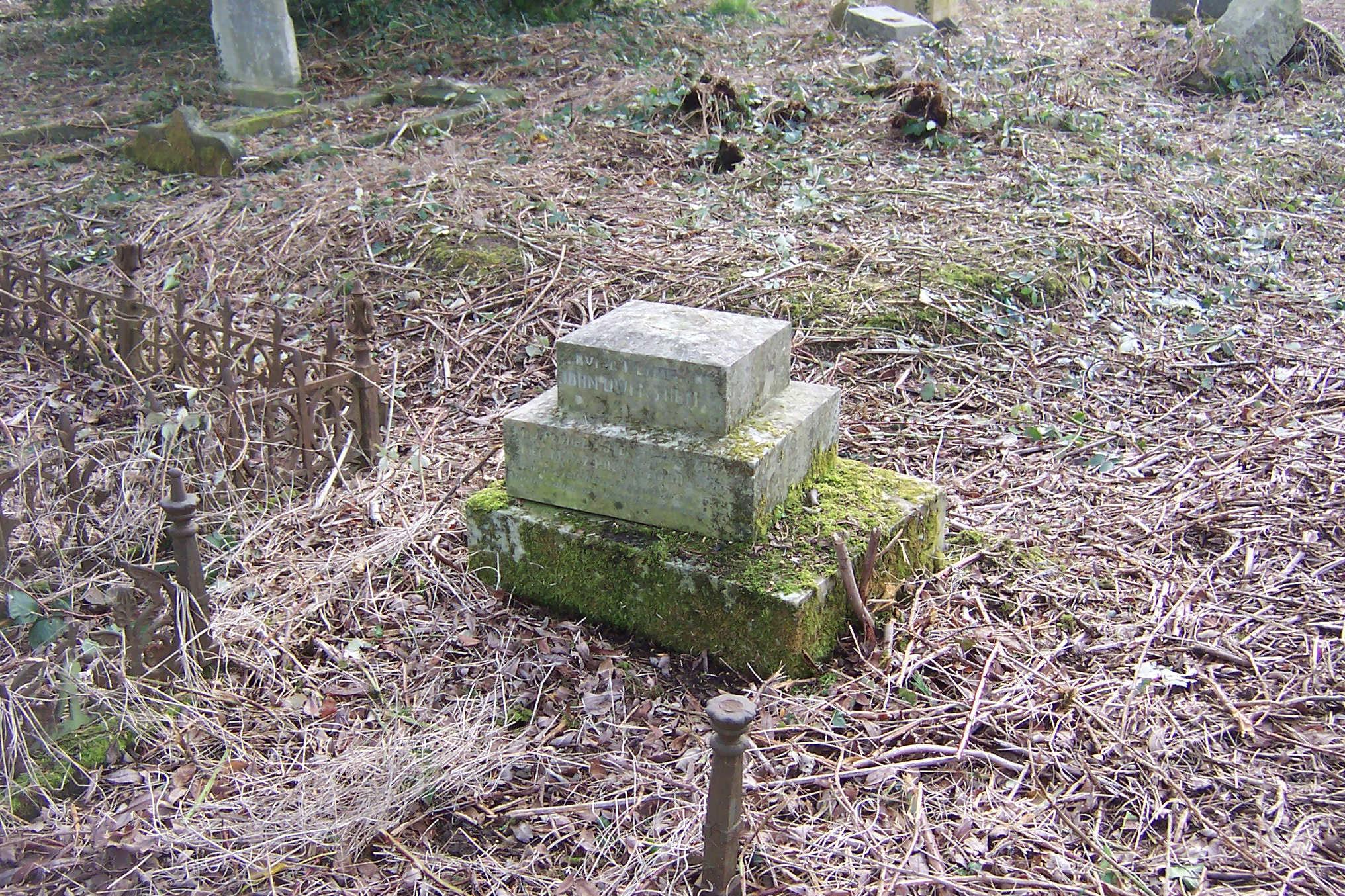
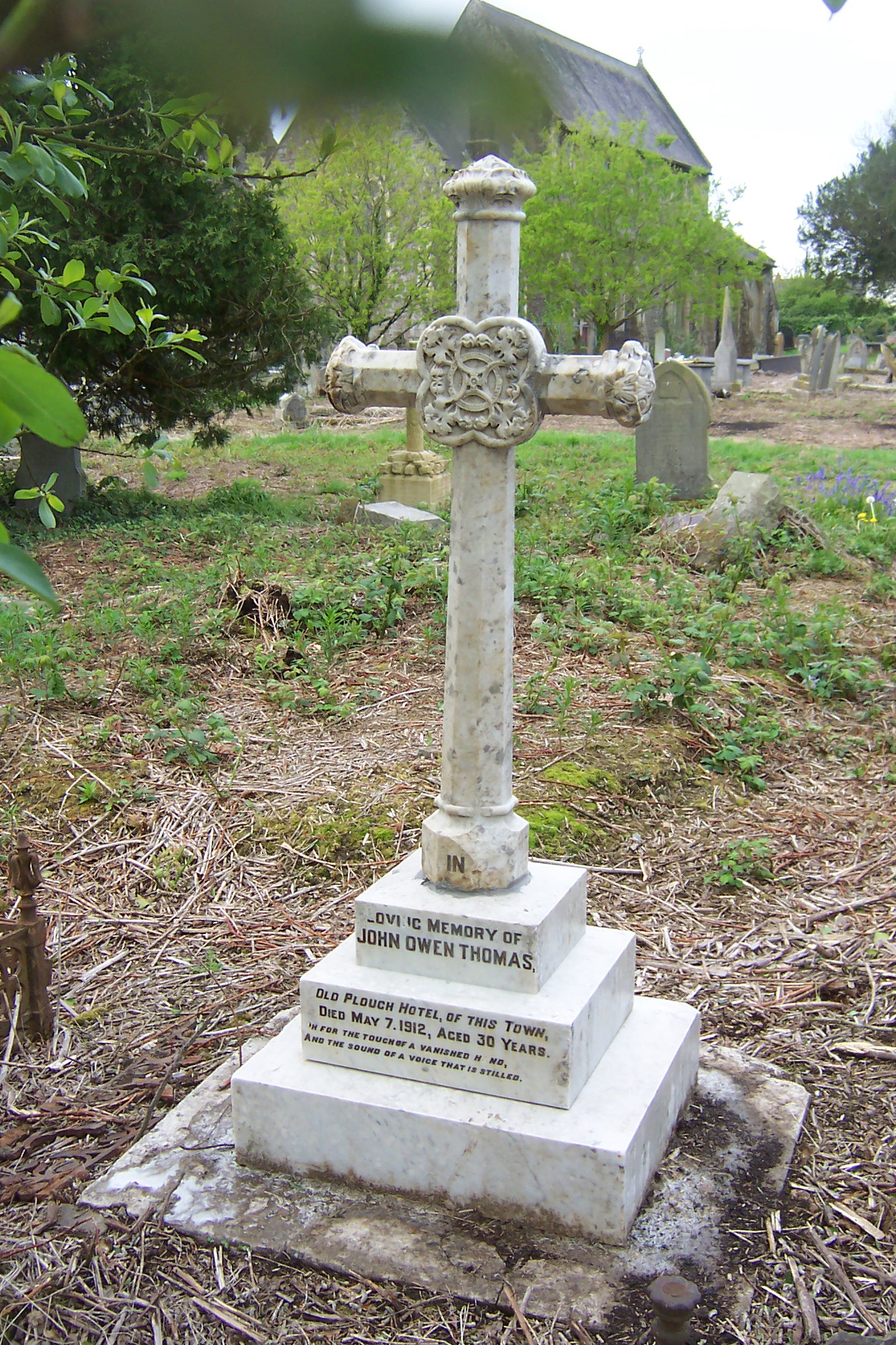
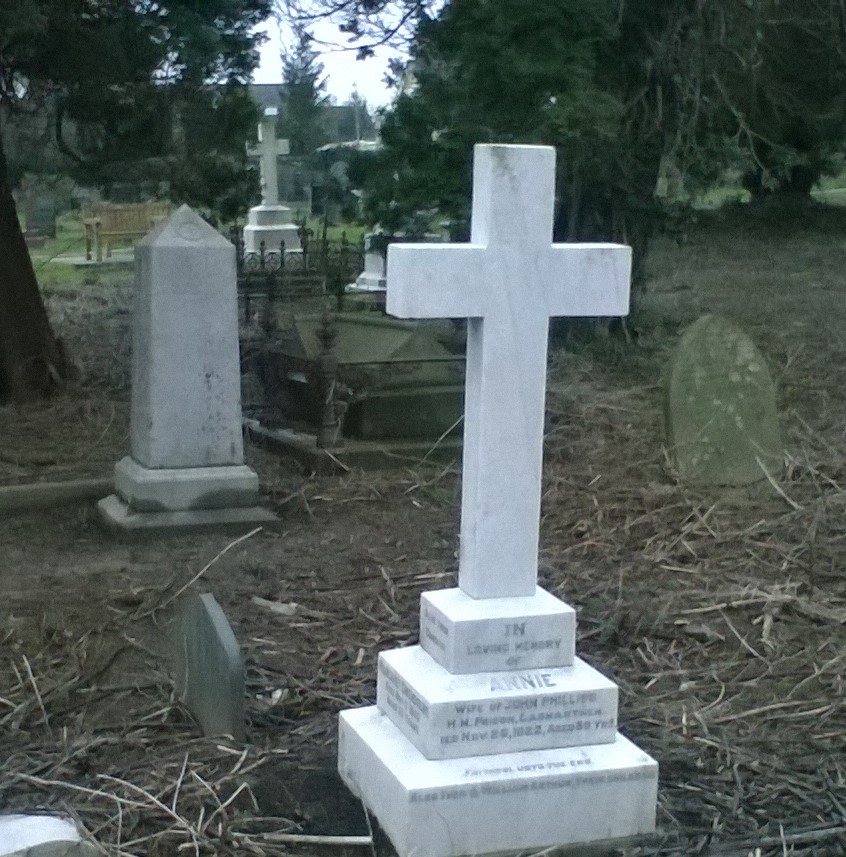
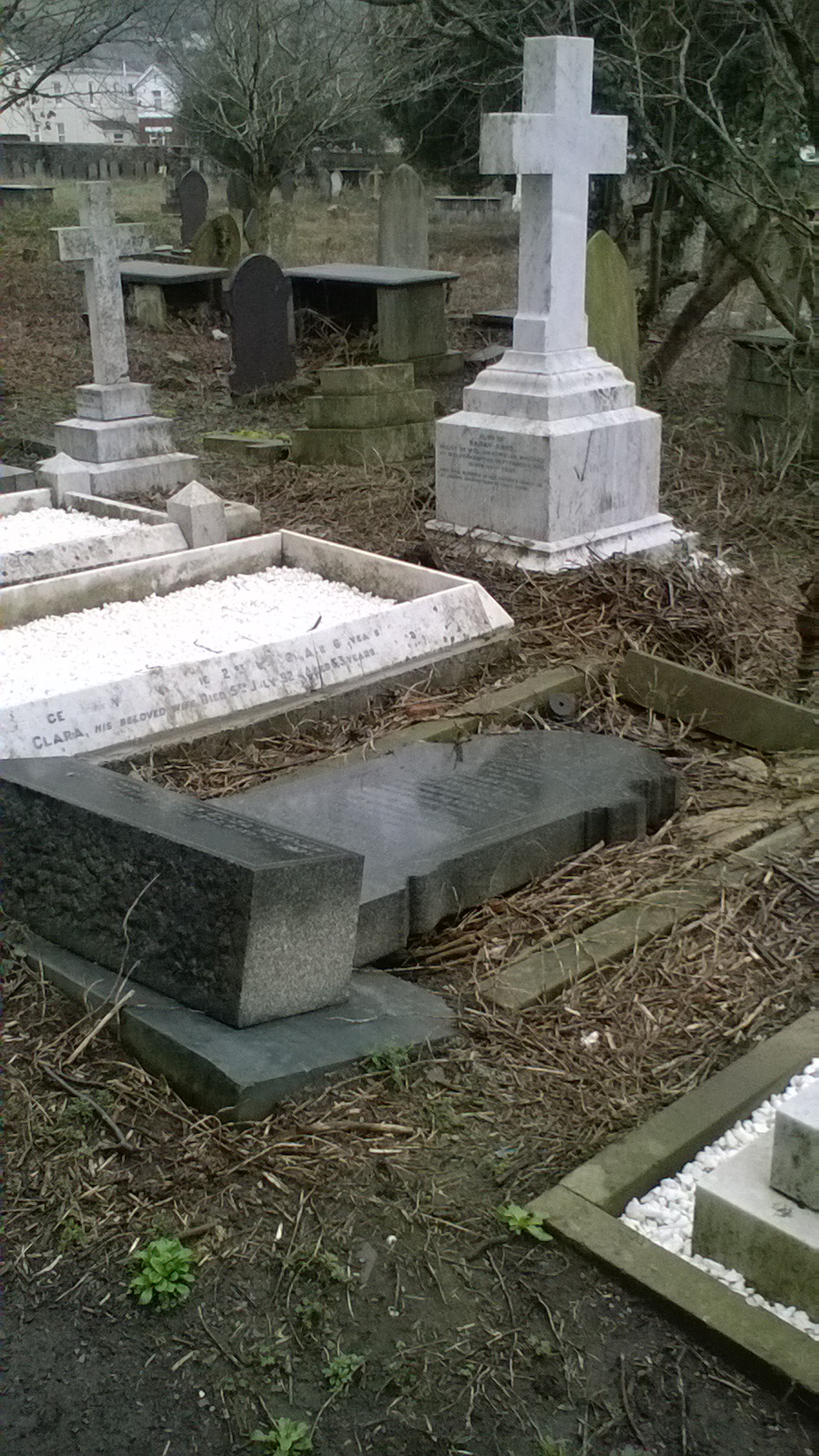
Welcome to the Thomas & Elizabeth Mayhook Charity website, dedicated to the Preservation, Upkeep & Maintenance of the historic St David’s Cemetery Carmarthen
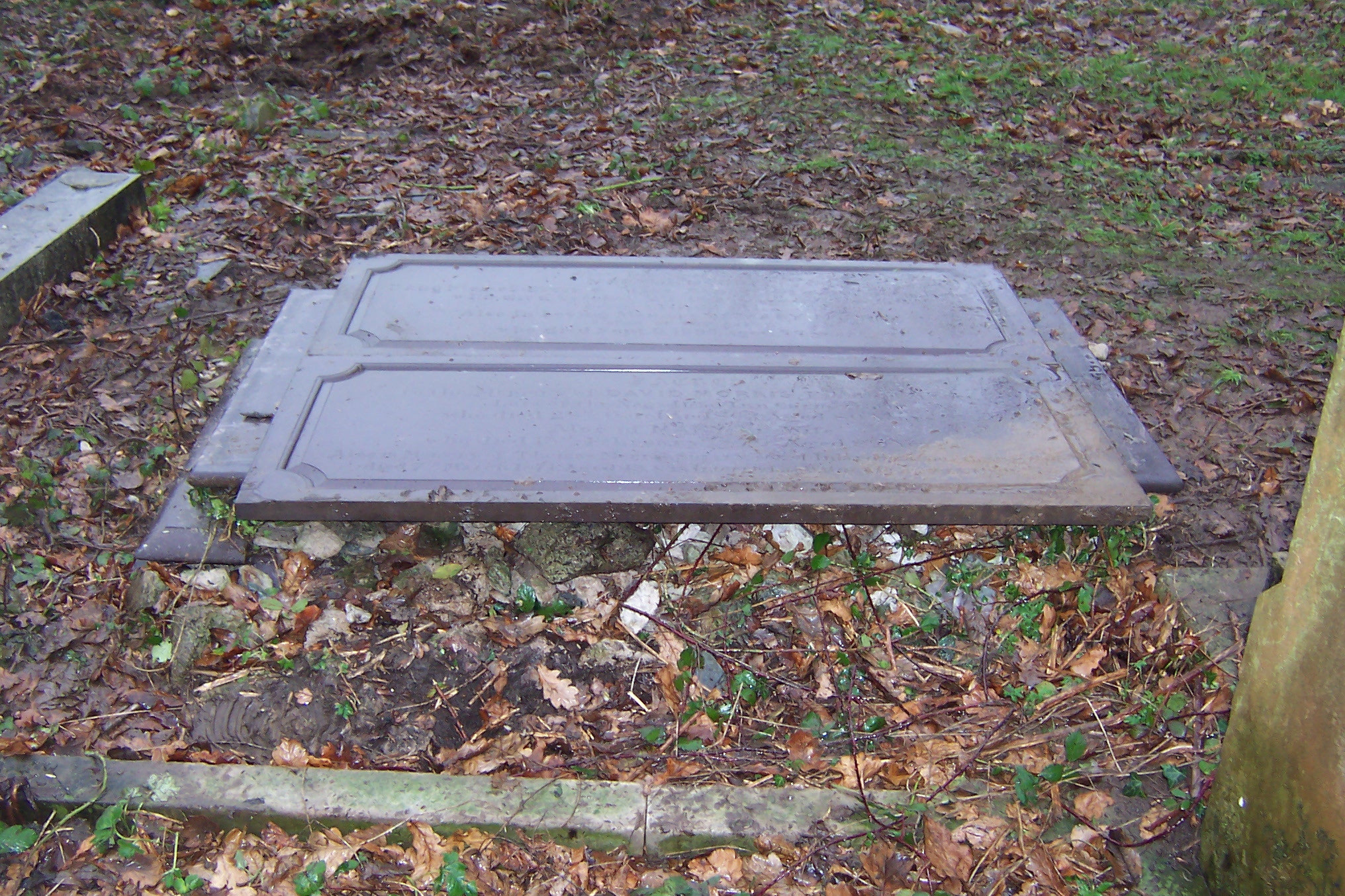
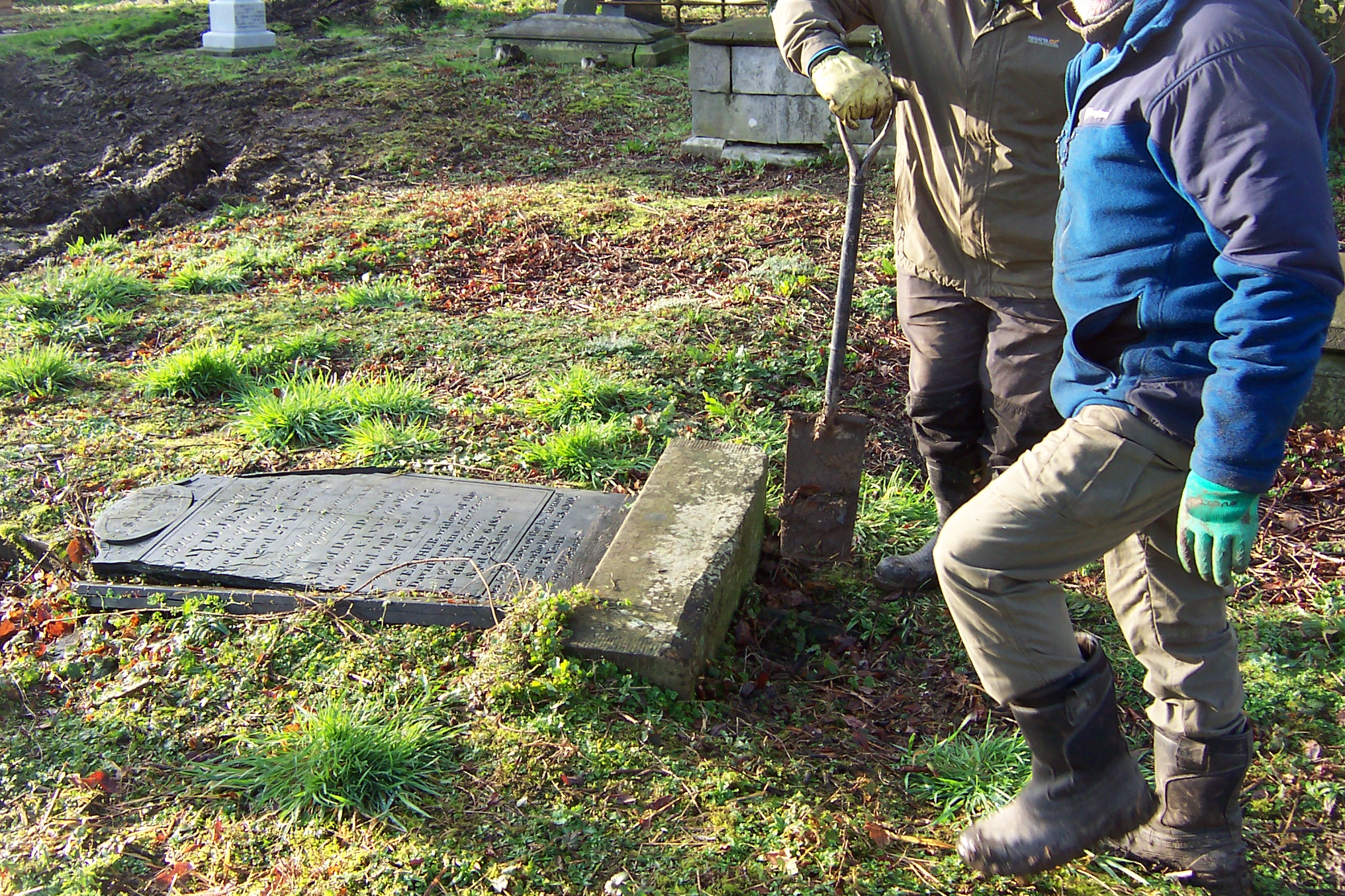
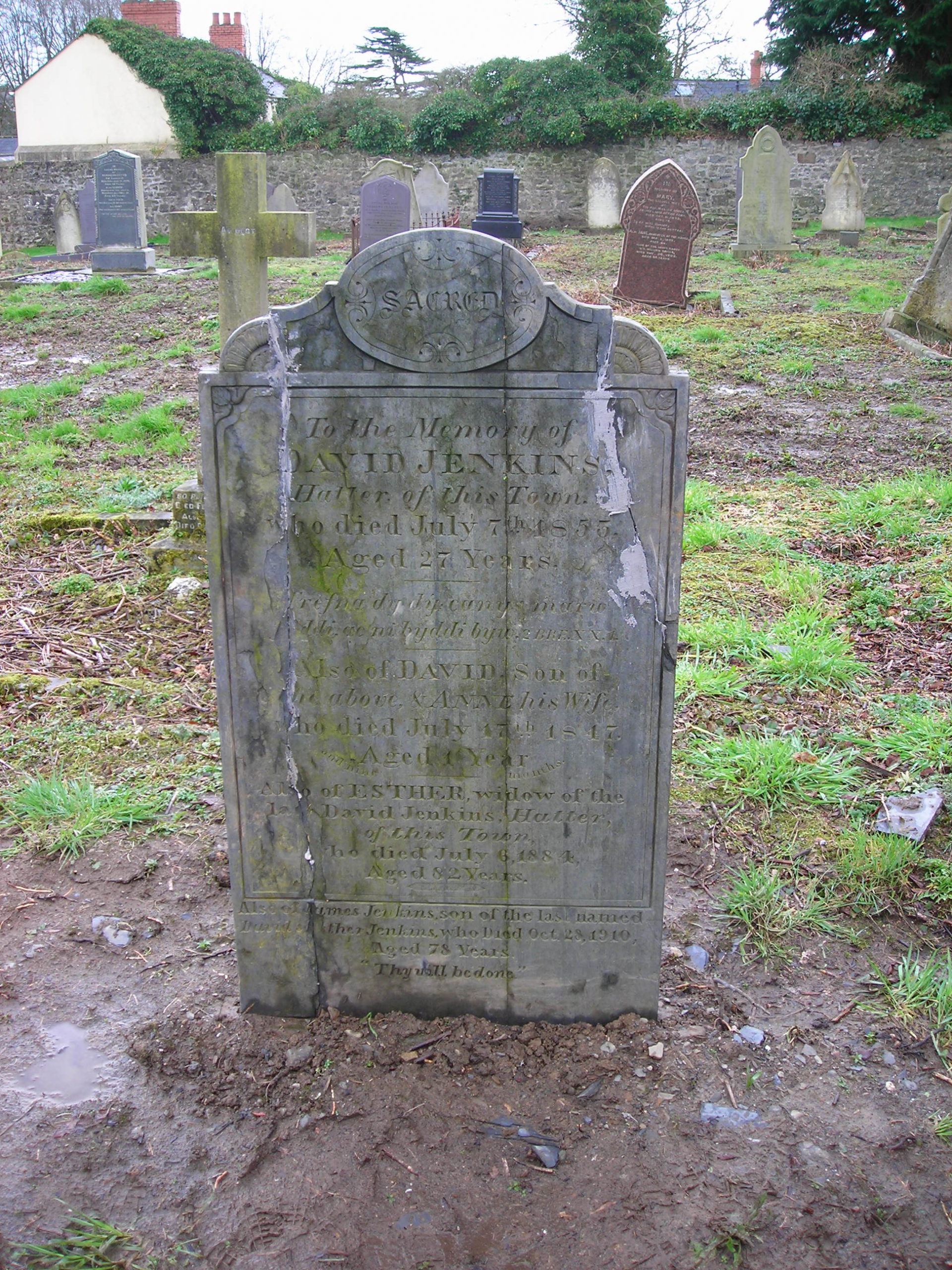
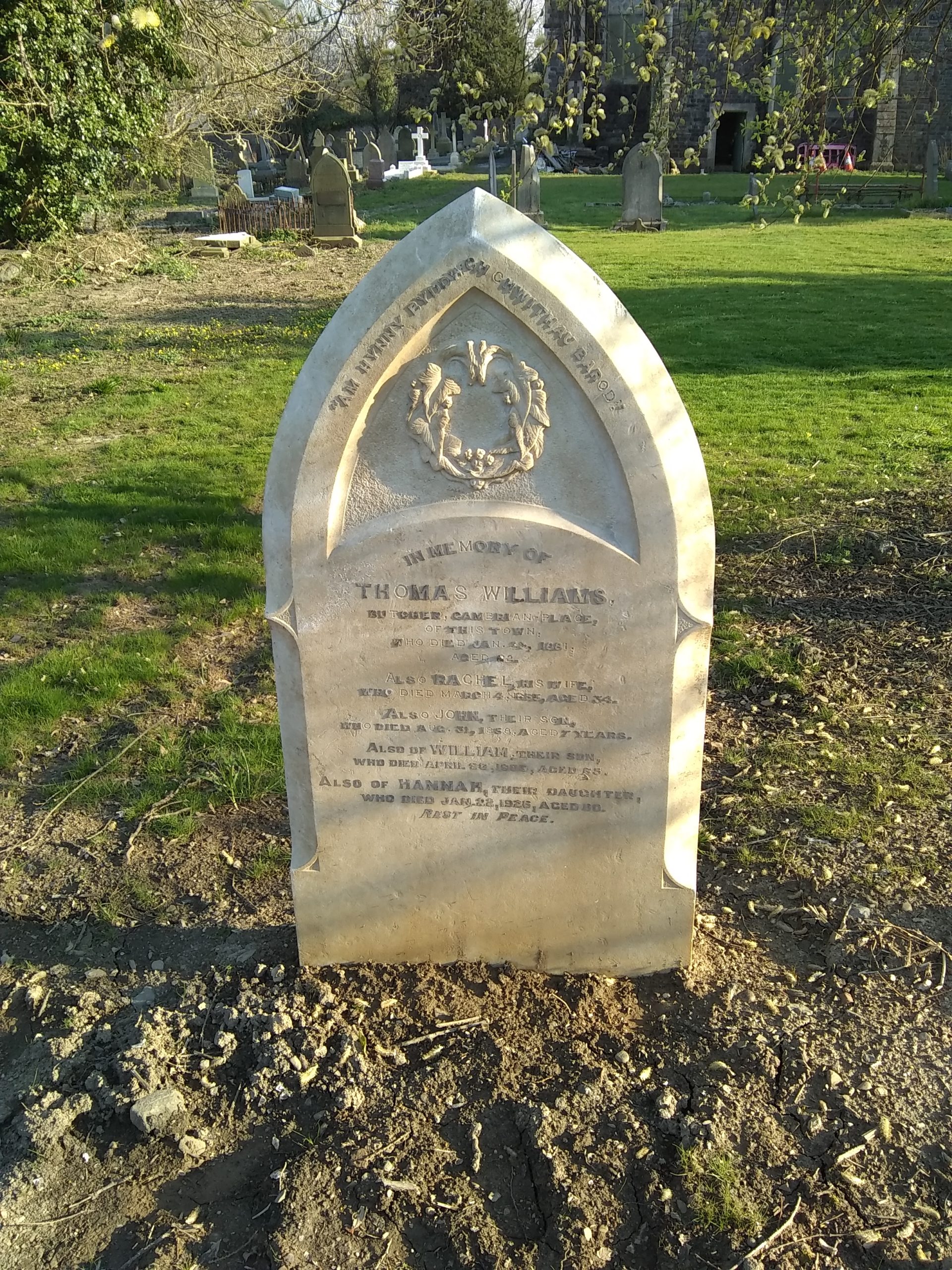
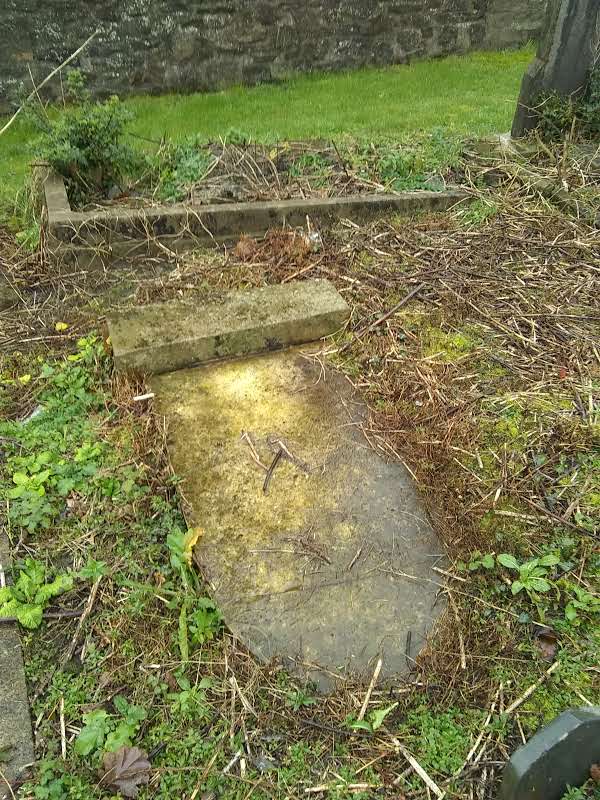
The photographs below, again show the before ( sometimes during) and after, that the work the Thomas and Elizabeth Mayhook Charity have been doing during the last twelve months in restoring the dignity, pride and honour of those families whose memorials had the misfortune to have been damaged by the ravages of time, decay and neglect and in many cases ending up face down in the soil and mud, not seeing the light of day for over 50 years….here then are a few more photographs of the “before” and “after” and whilst the detail of the families themselves have not been included, they show how, with great sensitivity these grave markers are finally being restored thanks to the support of the “Friends” of the charity through their donations and also to the volunteers who have been helping the charity in it’s never ending determination to restore them. In particular, members of the “Mackworth Club” – a group of young Freemasons from Carmarthenshire have been particularly helpful in bringing machinery and manpower to our aid and without their support much of the work recently undertaken (in January) would not have been possible, so a BIG thank you to all of them. Hopefully when the world returns to some form of normality they will return once again.
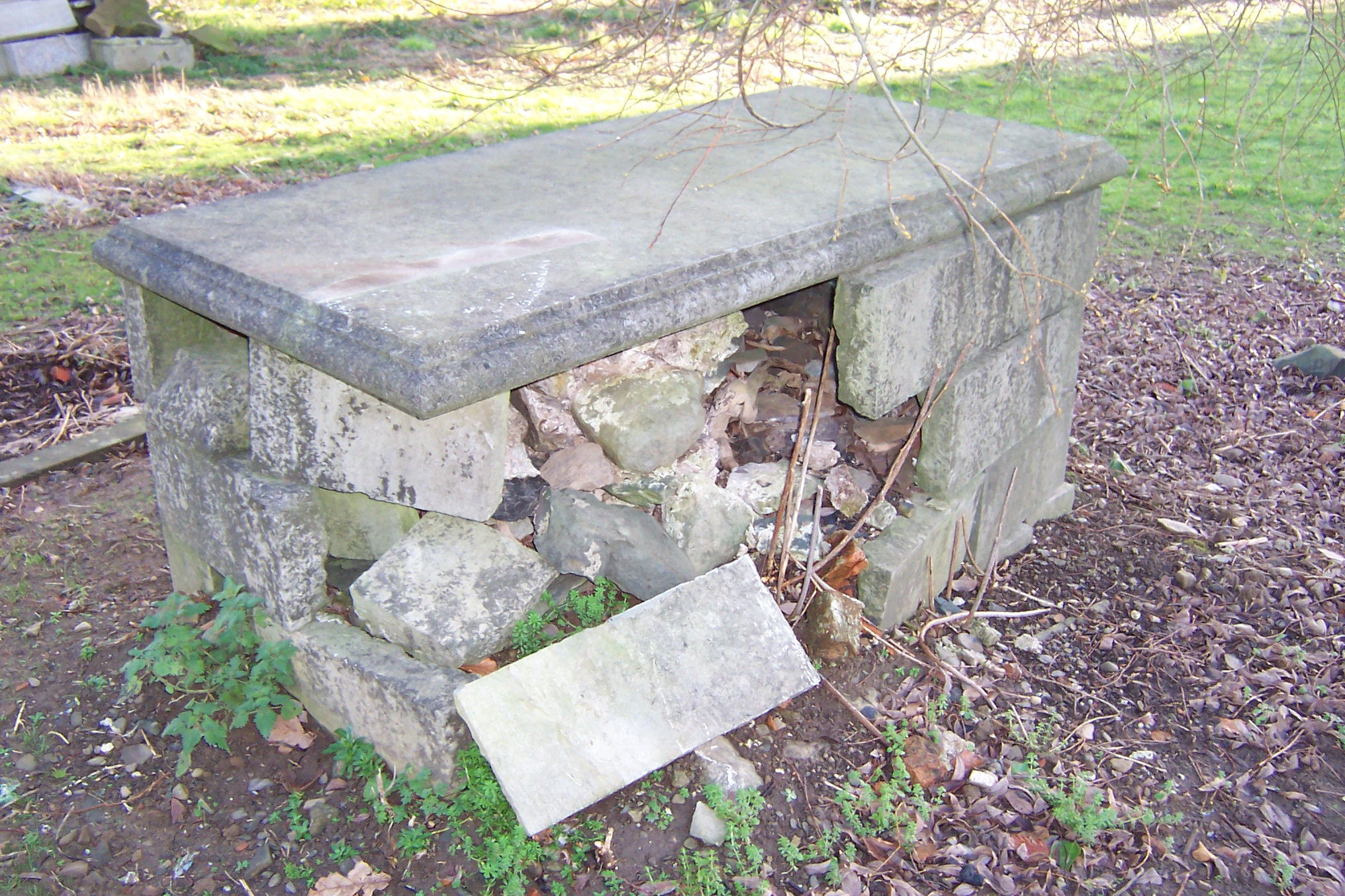
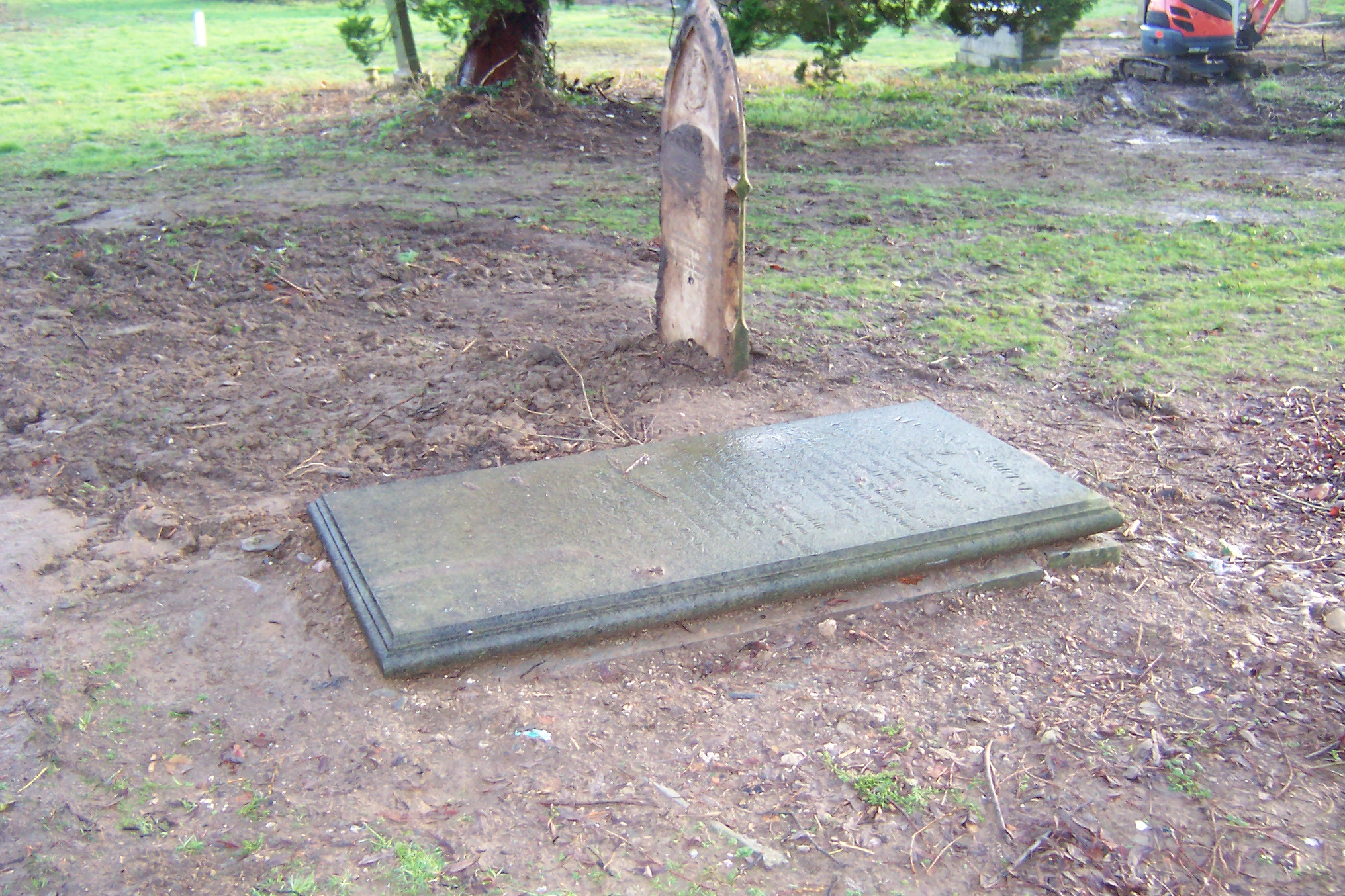
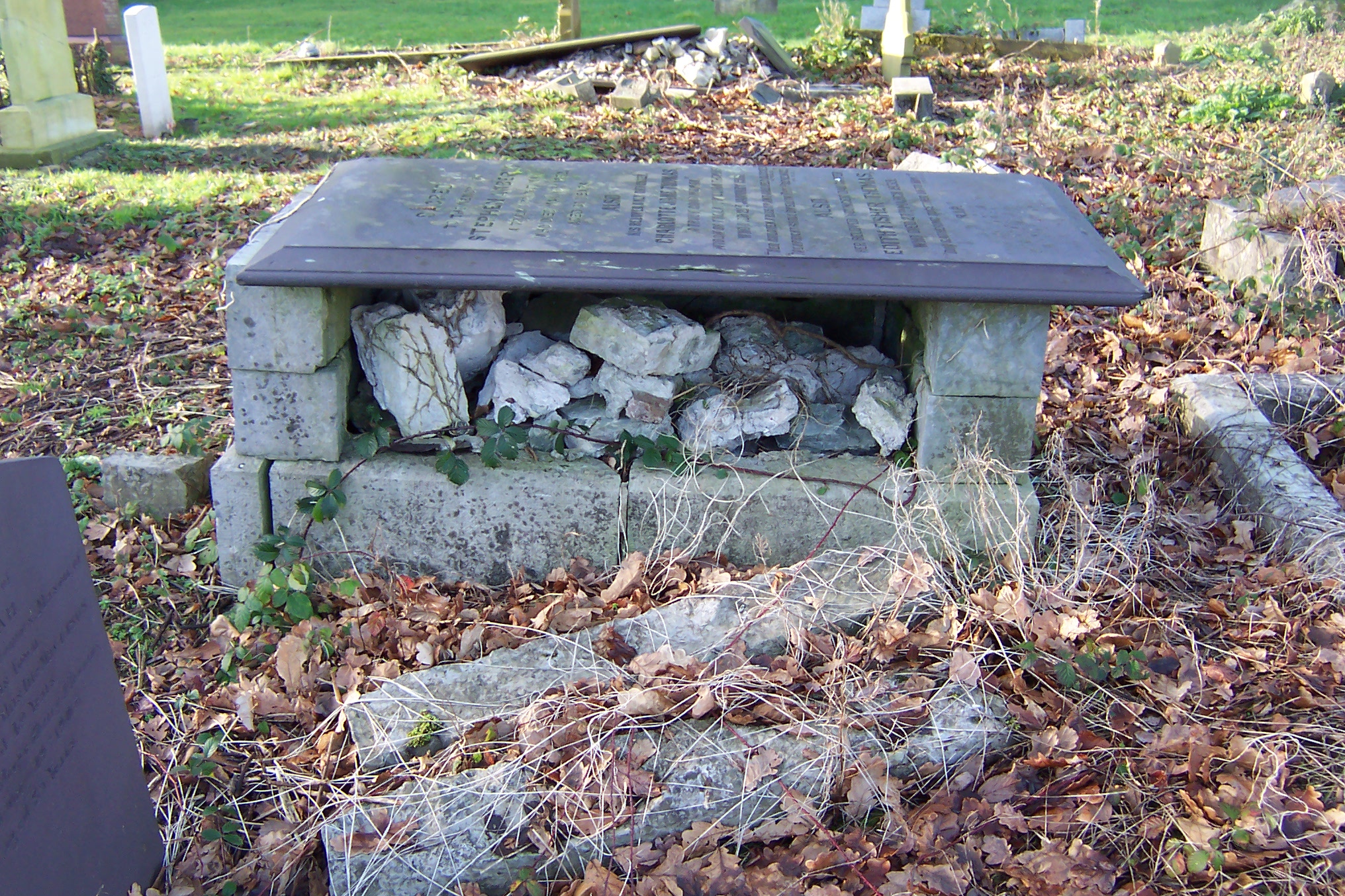
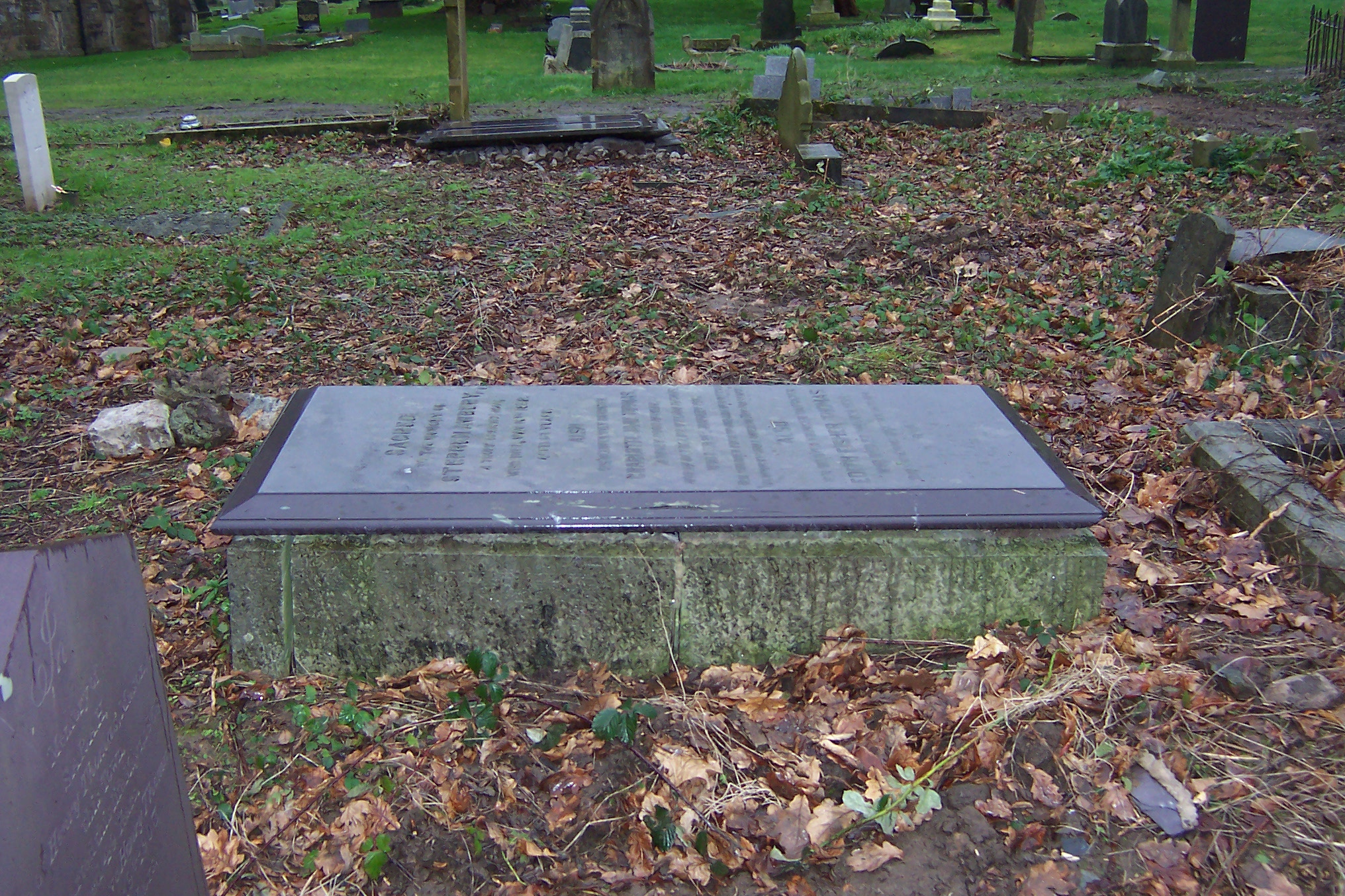
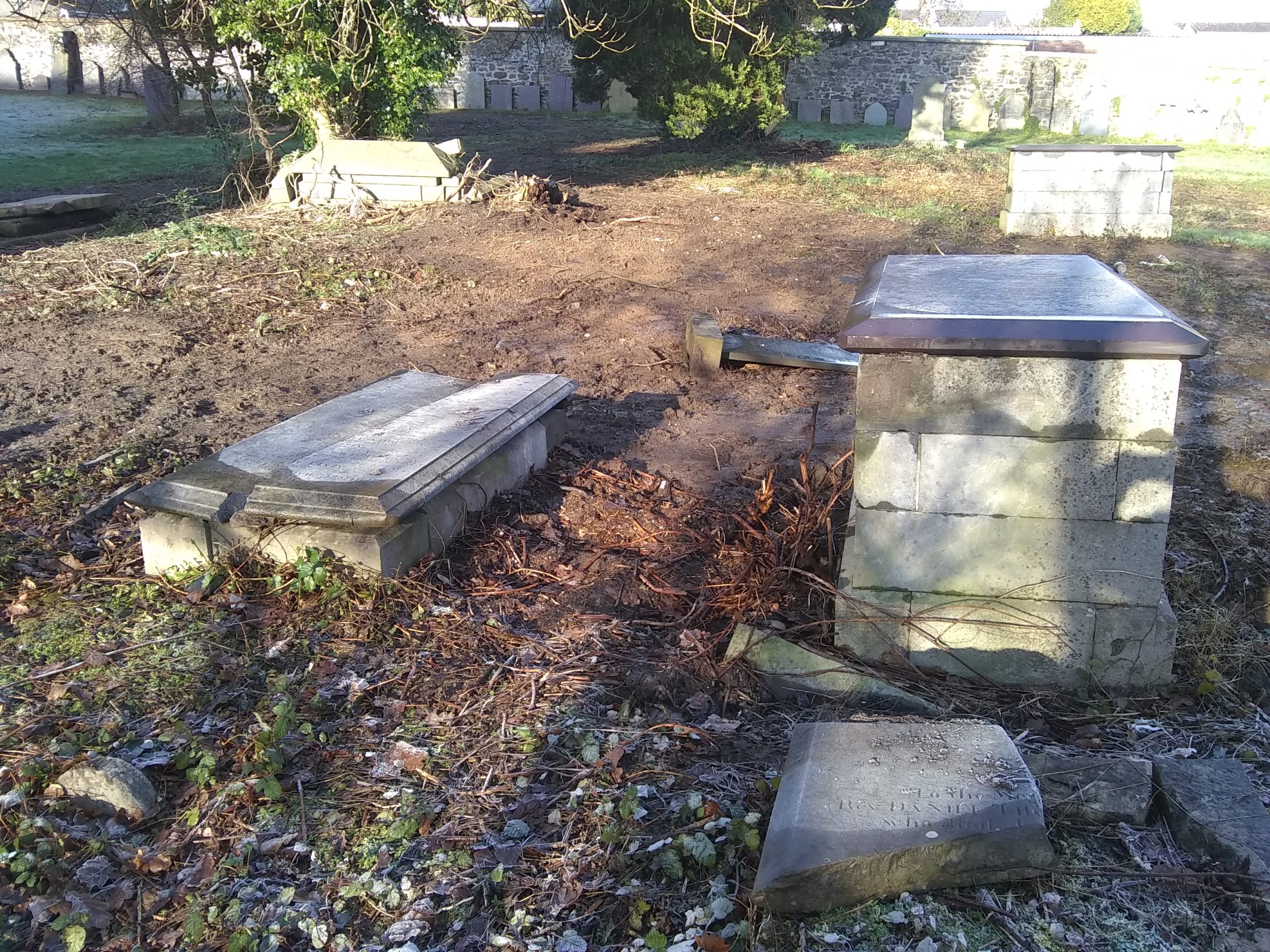
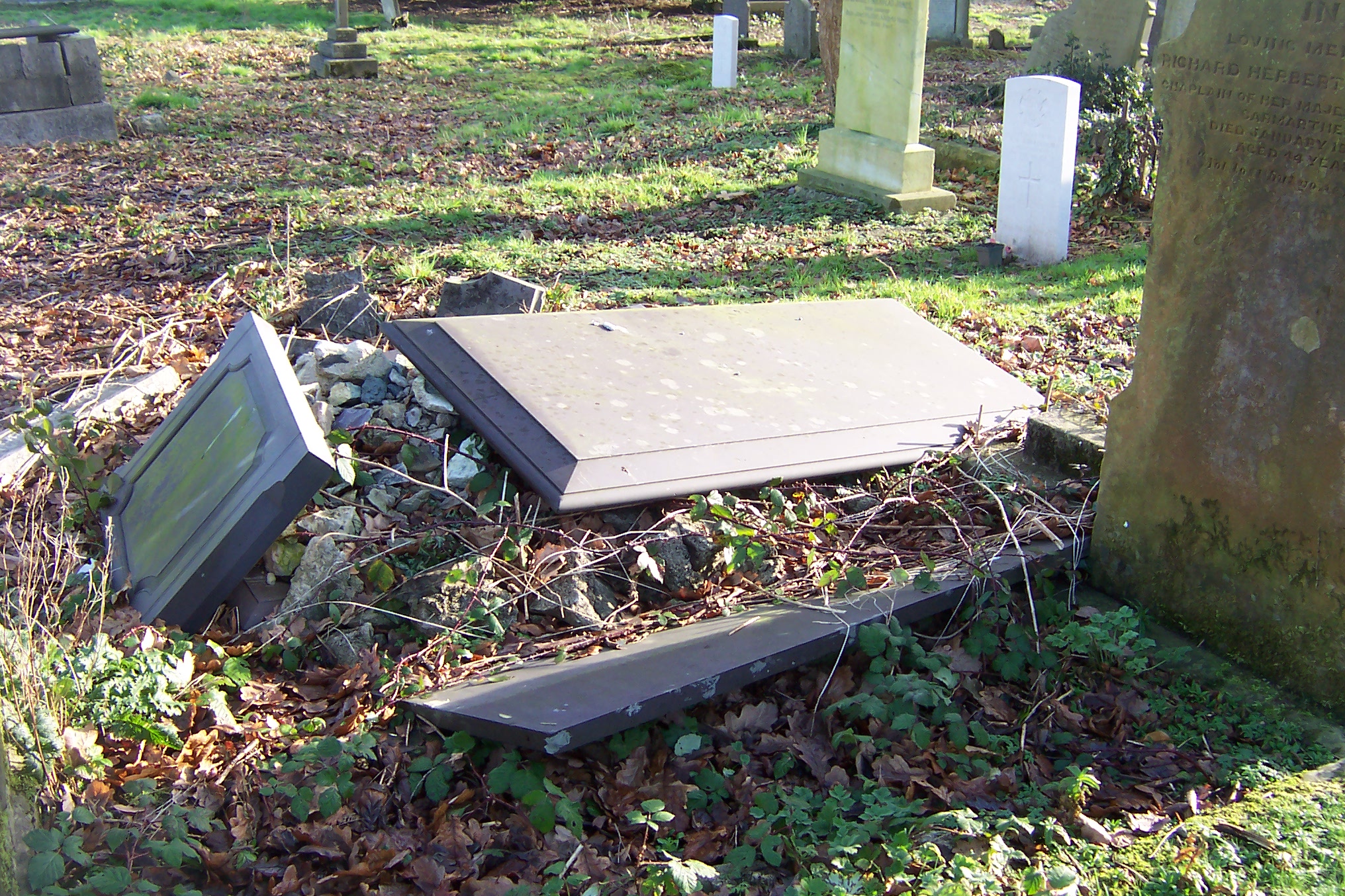
It is also a fact of life however that some memorials were in a perilous state of decay and becoming a danger to the public and visitors to the cemetery. Indeed one box tomb that was in a partial state of collapse, totally collapsed and could have caused serious injury to anyone nearby. It was precisely because of these unsafe memorials that a “Faculty” was applied for previously in order to make safe several of the box tombs and other memorials and once permission had been received from the Church in Wales we then began the process of reducing the height of these unsafe memorials whilst keeping in situ any inscriptions so as to identify those whose are buried there, in keeping with the guidance offered by the Church in Wales….Here then are some of those photographs.
Collapsed box tomb before tidying up
Collapsed tomb after clearance
Box tomb in a state of decay before making safe
The box tomb after making safe and keeping the inscription in situ
Structural damage before making safe
After making safe
An untidy area of rubble and damaged memorial beforehand
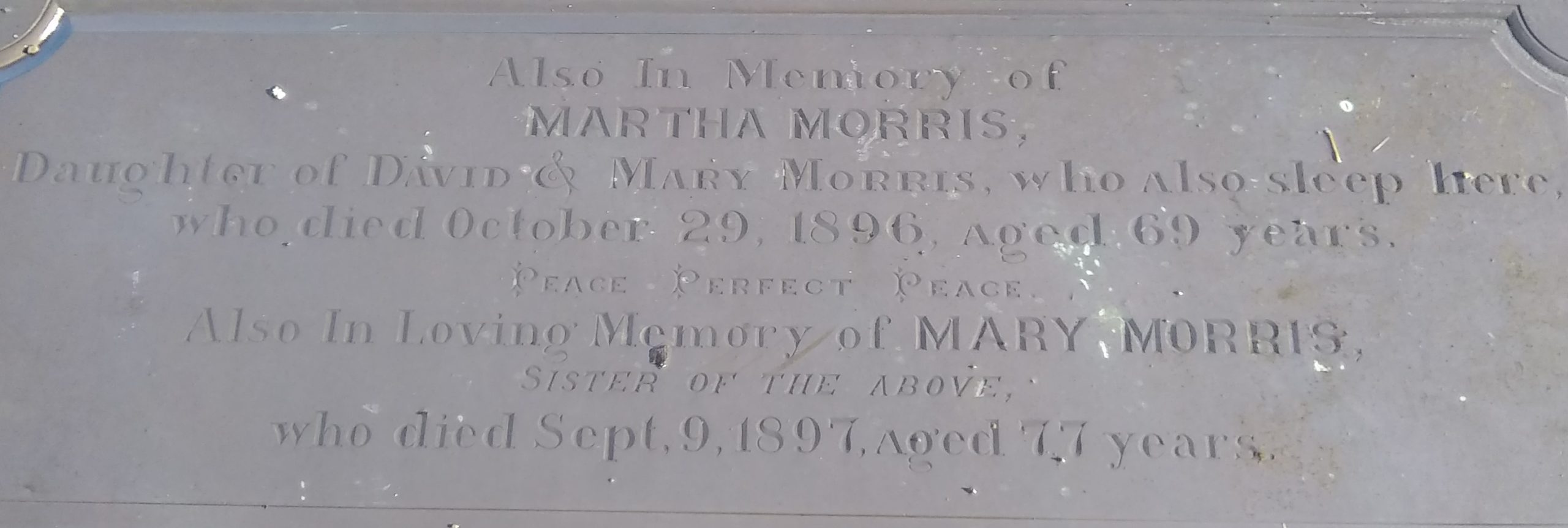
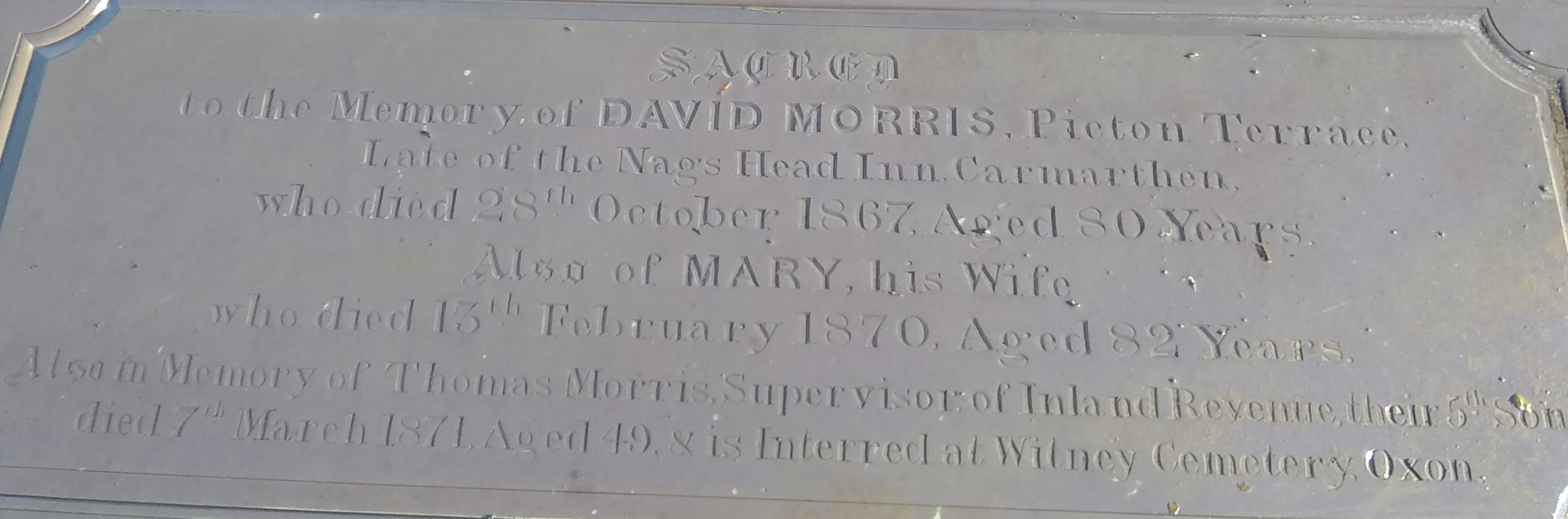
The five photographs below show the damage to the collapsed box tomb of the MORRIS family of the NAGGS HEAD PUB, the oldest recorded public house in Carmarthen and the work in making the area safe once again for visitors and in tidying it up as best as possible whilst still retaining the named inscriptions on the side panels that have been placed together for visitors to read.
the side panels of the MORRIS family box tomb placed alongside each other for visitors to read
The following photographs are of a seriously damaged slate headstone which has been partially restored. Removing the residue of the resin compound will return this memorial to some dignified appearance.
The headstone after initial repair
The following photographs show the restoration of a massive white marble headstone buried in the ground for decades.
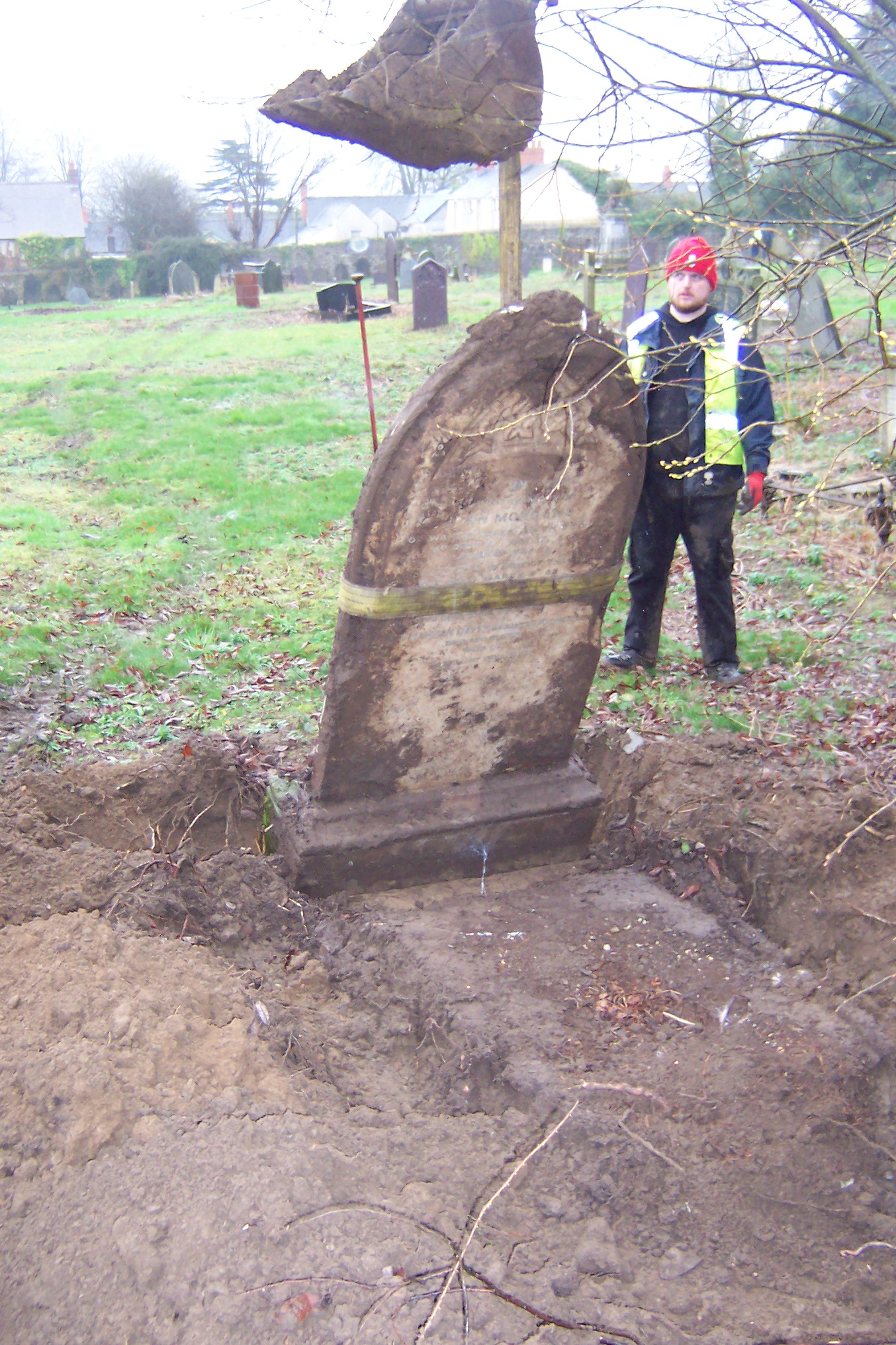
Being lifted out of the ground
Lying face down
After cleaning, but with lead lettering missing….but still able to read inscription clearly
The following photographs of the MORGANS family memorial completely buried in the soil, but now it’s white marble glinting in the sunlight once again.
The memorial being uncovered
Gradually being lifted off the ground before being inspected
The MORGANS family memorial, glinting in the sunlight once again
A rather dirty memorial …to begin with.
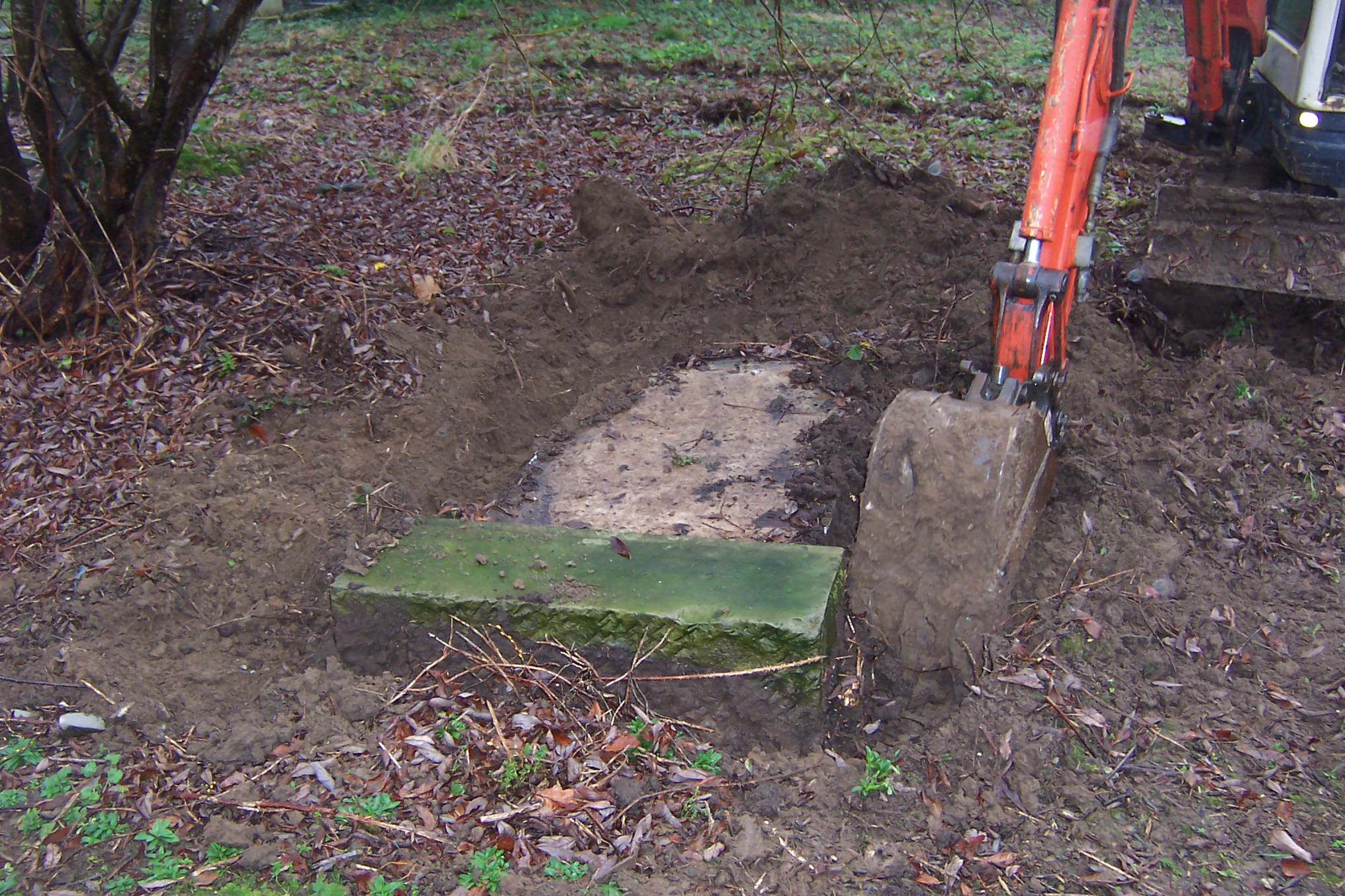
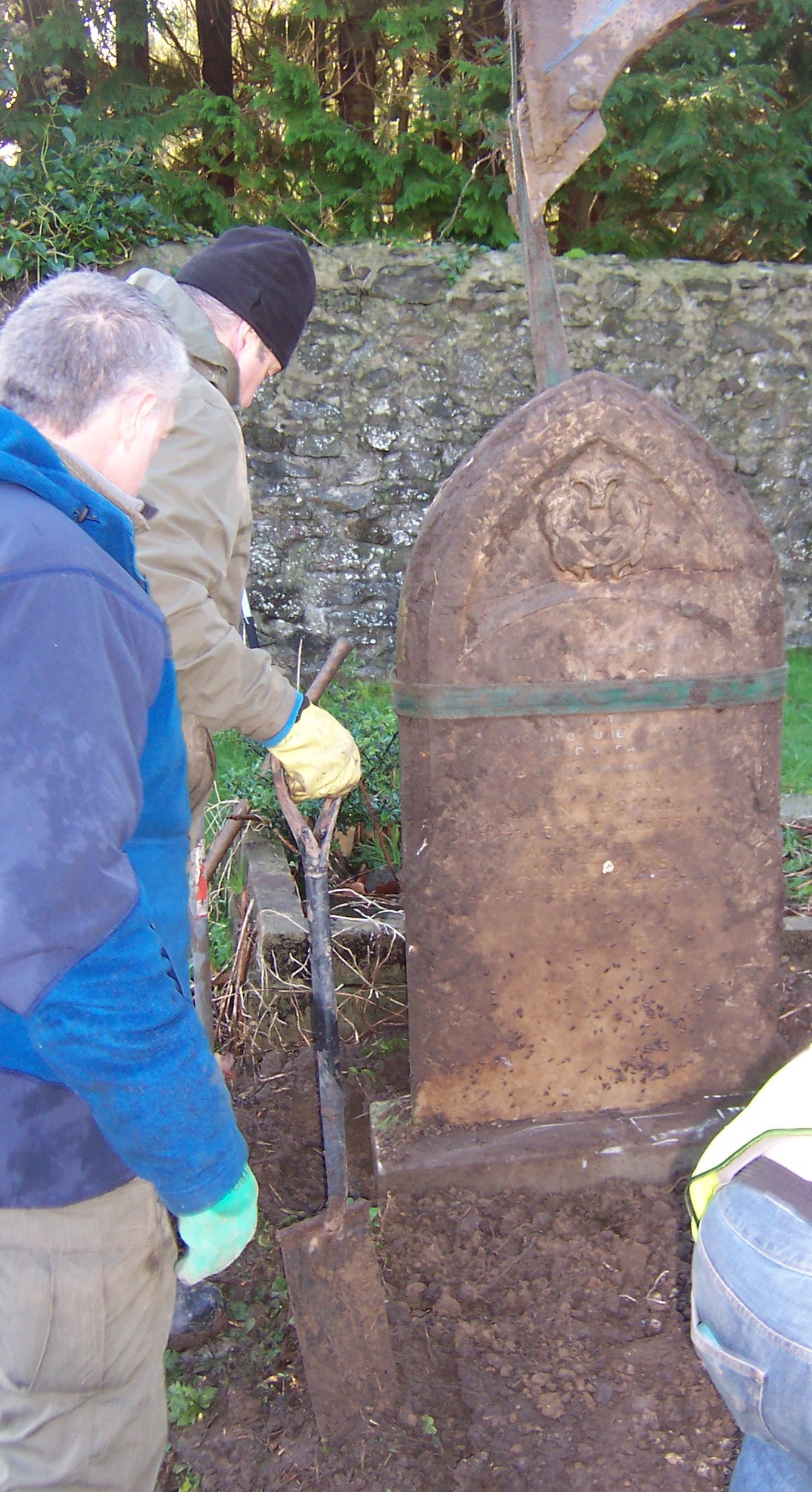
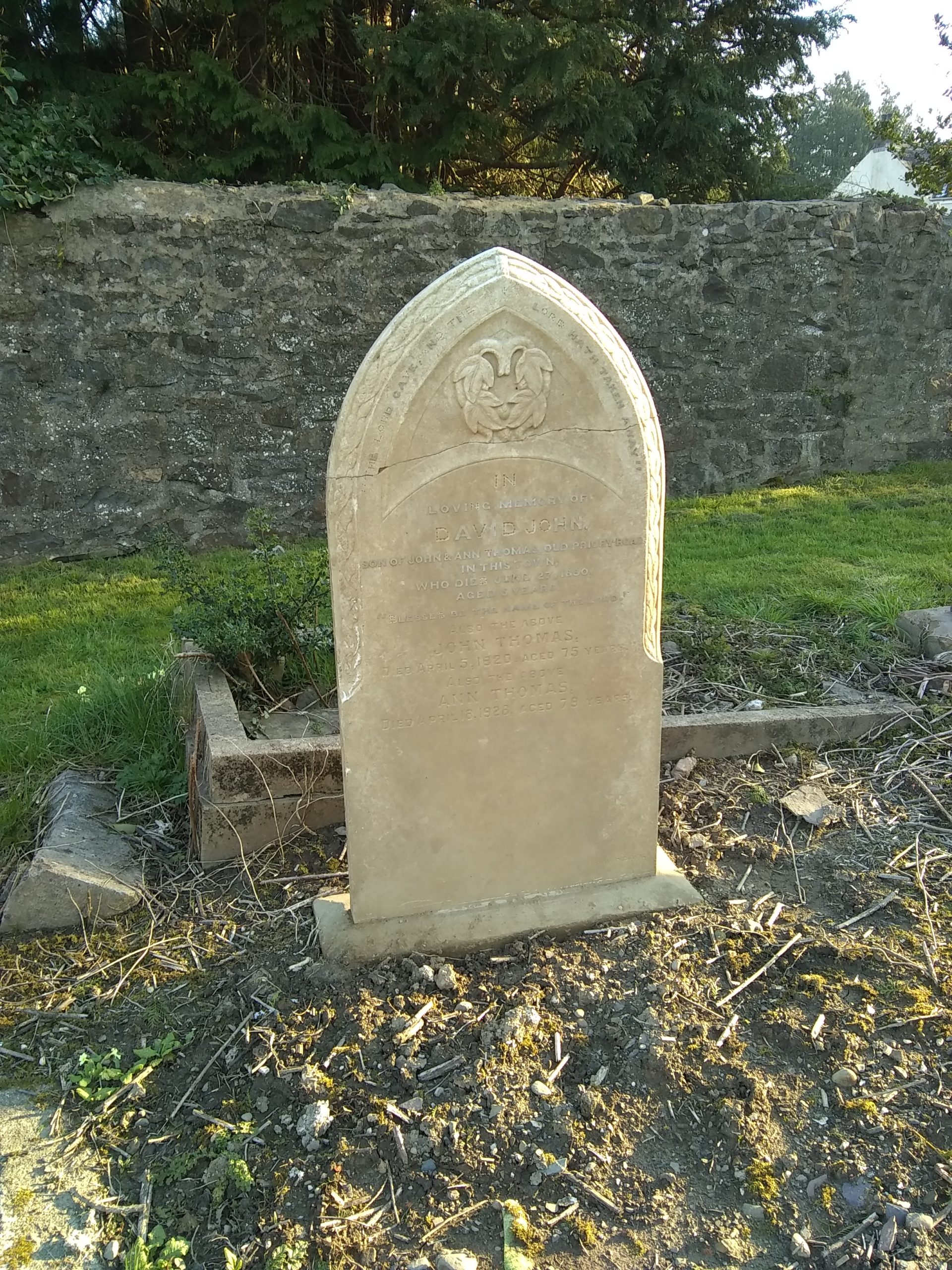
The white marble headstone below of the JOHN family, before, during and after restoration in January of this year
Fallen marble Headstone face down for over 50 years
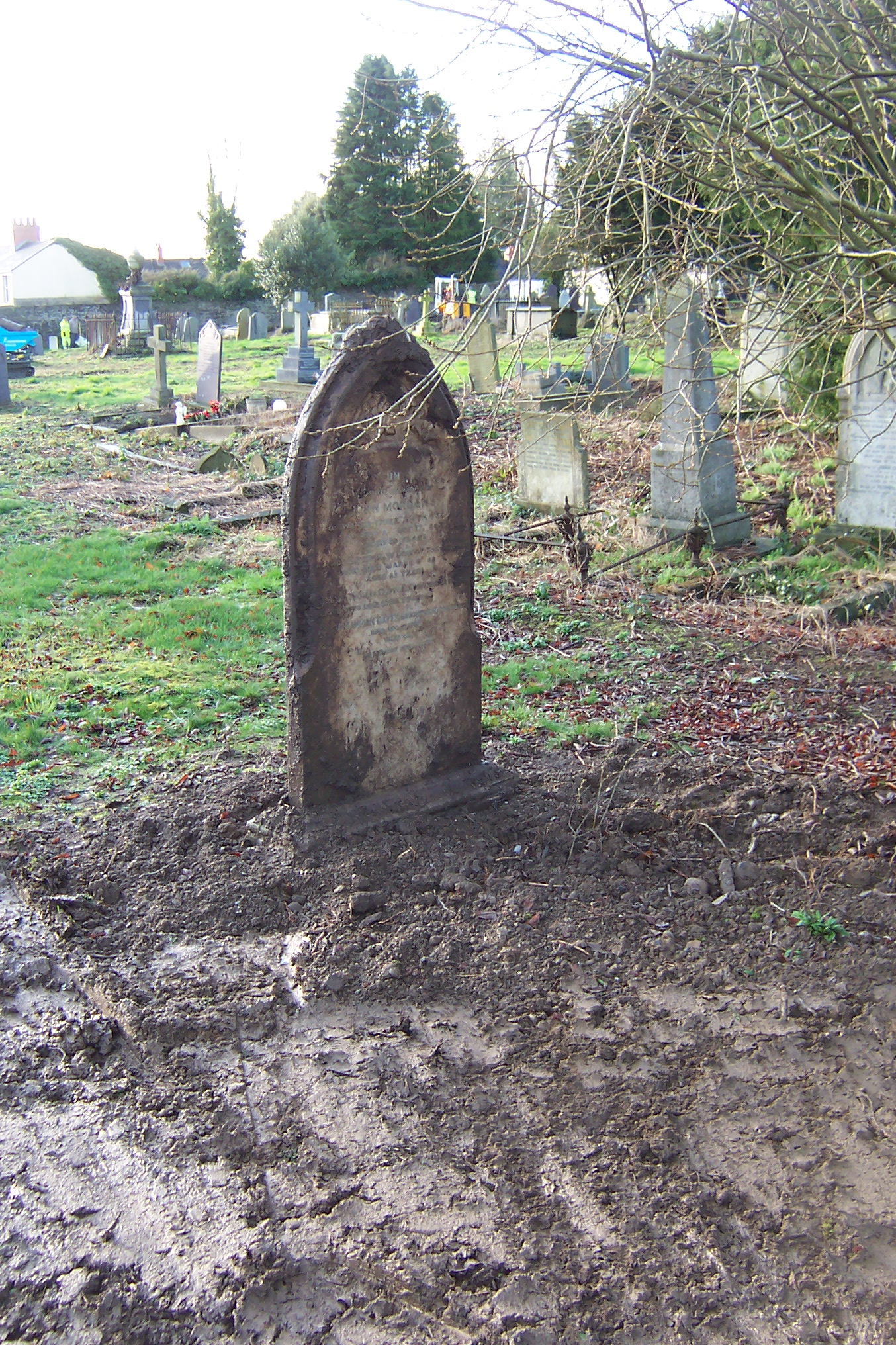
The re-erected memorial, when after being carefully cleaned will look perfect but first will need to be sprayed with water
After being secured into position
After cleaning. Though lead lettering is missing, the inscription can clearly be seen
Many memorials continue to be cleaned, prepared and restored and the programme of restoration continues unabated. The photographs below show a before and after of the grave of Albert Mervyn Parry who was buried in August 1915 aged just two months, who was the son of the then Principal of the Carmarthen Teacher Training College Albert William Parry, and his wife Catherine.
The damaged grave of little Albert Parry, just two months old.The completed restoration of Albert’s memorial.
Albert senior was a unique individual who was first appointed Principal in 1909 and served in that capacity until 1949 – a remarkable 40 years.
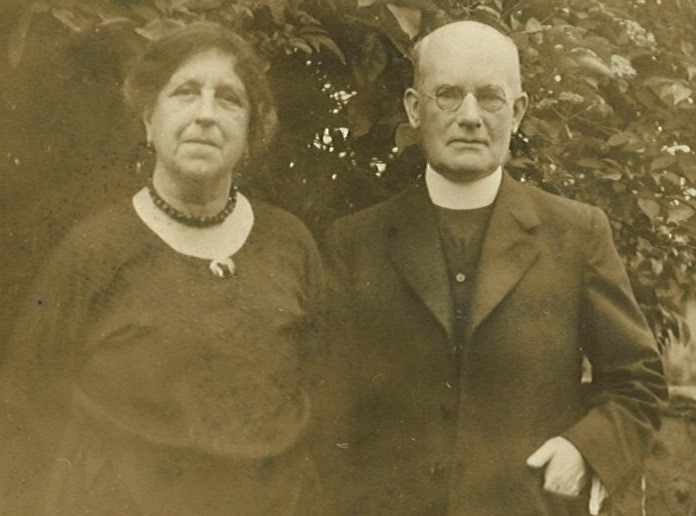
Below is a photograph of Albert and Catherine taken in the garden of their home at Trinity University in 1934.
Canon Parry and his wife Catherine in their garden at Trinity College Carmarthen
Both Albert and Catherine, together with their daughter Eirene are buried in the newer section of the cemetery, the wording is as follows.
Love is Eternal, Life Immortal Irene Parry 21st October 1928 Catherine Esther Parry 22nd October 1948 Albert William Parry Priest Principal Trinity College 1909 -1949 Dean of St David’s 1946 – 1950
The last resting place of the Reverend Albert Parry and his wife Catherine
St Davids Cemetery and Trinity St Davids University are inexorably linked through history, not least because of the large numbers of former teachers and members of the clergy buried there. Principal Parry had the misfortune to be in charge of the college during the outbreak of two world wars, he himself serving as Chaplain to the 4th Battalion Welch Regiment in the Great War. In an interesting insight to the role the University played during the Great War the following is an extract of a letter that Albert Parry wrote to the Carmarthen Journal in June 1915
Referring to the statement made in the Carmarthen Journal that none of the members of the Carmarthen Training College had enlisted, Principal A. W. Parry writes: (Carmarthen Journal 4th June 1915, page 3)
“SIR, I am sorry that it is possible for anyone at the present time to make a statement of so unfounded a character, and that under the veil of anonymity a letter should appear in the public press without the writer having first endeavoured to ascertain the truth of his assertions. May I, therefore, state that of the students who were in residence at the Carmarthen Training College during the session 1913-14 no less than 90 per cent are now members of his Majesty’s forces. In addition, every member of the teaching staff of the college, who is of military age, is also serving in the army. The writer of the letter refers to the extremely well-conducted “soldiers’ club.” apparently run by a committee of young men. He may be interested to learn that the chairman of the committee is the Principal of the Carmarthen Training College, who is also serving as the chaplain to the 4th Battalion Welsh Regiment. The other members of the committee are the Mayor of Carmarthen, the registrar of the Diocese of St. David’s, and Sir Owen Philipps (president of the club). I may be allowed to point out that a list of the ex-students of the Carmarthen Training College who are now serving with the colours is now in course of compilation, and that though this list is incomplete there are already nearly 200 names on it. The writer of the letter is also probably ignorant of the fact that at the present time Carmarthen Training College is housing students of St. Mark’s College, Chelsea. These students were at one time members of the 10th Middlesex Battalion. When that regiment- was sent abroad these young men were discharged from the army on medical grounds, and were sent by the Board of Education to complete their course of training at the Carmarthen Training College.”
…………………………………………………….
It would be remiss of me at this juncture not to complete the picture of a great intellectual of his time without the following news article printed in 1919. Alfred Parry’s life was certainly an interesting one but tinged with great sadness through the deaths of his two children but as his epitaph reads…….. Love Is Eternal Life Immortal.
REVEREND A. W. PARRY MA, BSc, DSc
New Science Doctor -DISTINCTION FOR PRINCIPAL PARRY, CARMARTHEN. As already briefly announced in the Carmarthen Journal, the Rev. A. W. Parry, M.A., B.Sc., principal of the South Wales Training College, Carmarthen, has obtained the D.Sc. degree at the University of London. As evidence of the hard and diligent study which the winning of the distinction entails, he is the only clergyman in Wales to have brought off this signal achievement. The subjects of his thesis were “Nature, Origin, and Development of the Social Consciousness.” and “Education in England in the Middle Ages.” Principal Parry, who is a brilliant scholar, was educated at the University College, Aberystwyth, and is M.A. and B.Sc. of the Universities of London and Wales, his thesis for the M.A. degree being on “English Writers on Education from the Sixteenth to the Nineteenth Century.” He is honoursman in English language and literature, economics, and political science, and holds the Diploma in Pedagogy (University of London), and is examiner in the practice of teaching for the University of Cambridge Teachers’ Diploma. The new Doctor of Science, who is a native of Atherstone, Warwickshire, has been principal of the South Wales Training College, Carmarthen, for eleven years, being before that head of the Day Training College and professor of education at the University College, Exeter. He is a powerful preacher in popular demand in the Church, and is a member of the Representative Body and the Governing Body of the Church in Wales and a member of the St. David’s Diocesan Conference, being secretary of the social service committee, and is closely associated with other Church organisations. During the recent war the college was closed, as all the eligible students were on military service, and Principal Parry served as chaplain to the 4th Welsh Regiment. With only two exceptions, all members of the staff also served. The college re-opened on September 29th last, and there are 103 students, over 80 per cent of whom are ex- service men.
Carmarthen Journal & South Wales Weekly Advertiser 5th December 1919 page 1.
The above story was originally printed in the Thomas & Elizabeth Mayhook charity newsletter in January 2019. For the benefit of those who were not recipients of the newsletters, all previous stories will be published here in due course.
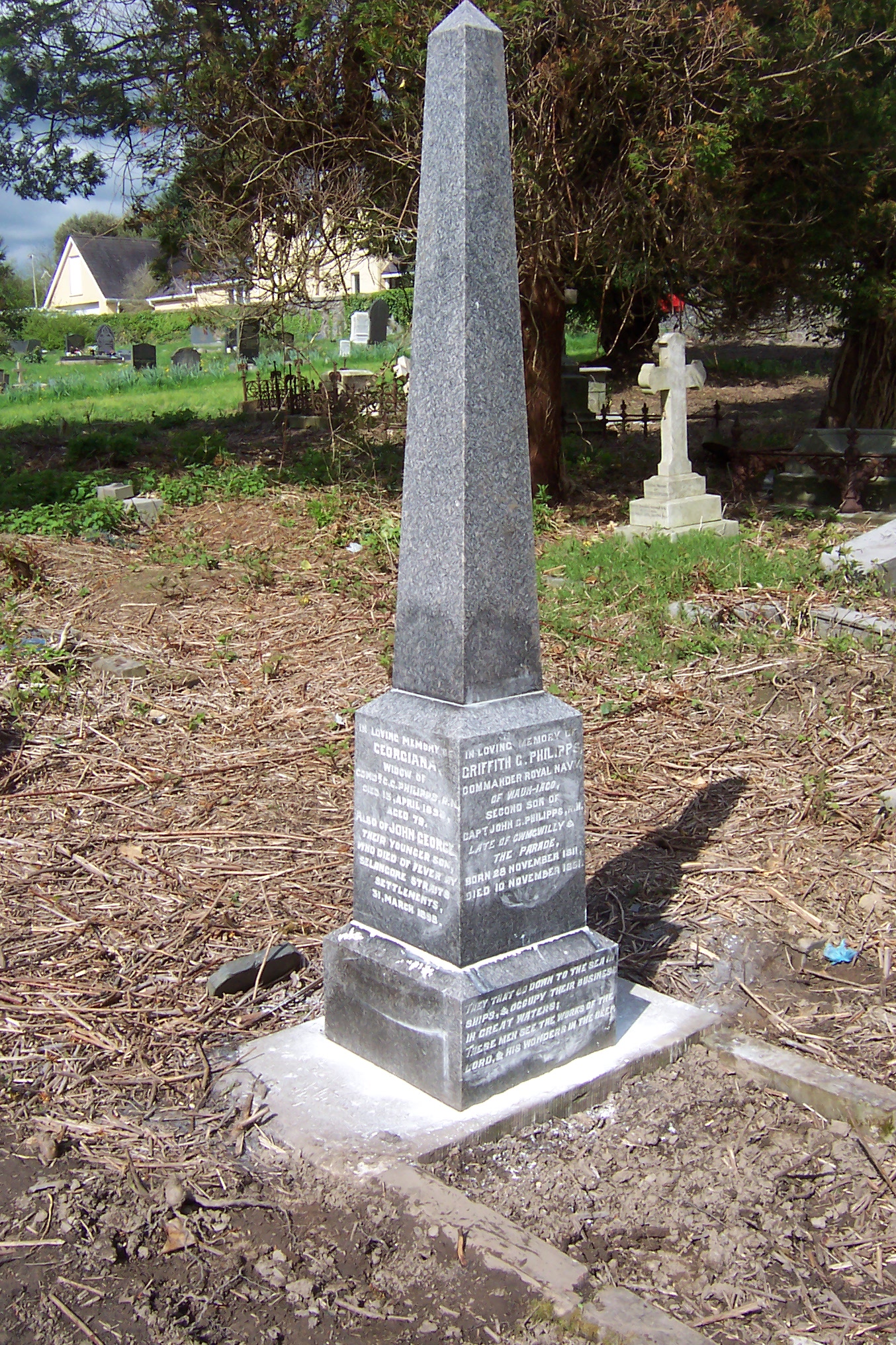
THEY THAT GO DOWN TO THE SEA IN SHIPS, & OCCUPY THEIR BUSINESS IN GREAT WATERS; THESE MEN SEE THE WORKS OF THE LORD, & HIS WONDERS IN THE DEEP
Griffith Grismond Philipps 1811 -1891 was a most remarkable Naval Hero, on a par with that of the fictional Horatio Hornblower. His family pedigree in the true naval tradition is unparalleled and this very small article about his life is but one chapter in what was a truly remarkable life.
The restored memorial to the Philipps family
It would take many volumes to tell you his full story here but at least his memorial, from being destroyed and dilapidated to being restored and becoming a place of dignity and honour is now a fitting tribute to his name thanks to the Thomas & Elizabeth Mayhook Charity. His elder brother Grismond Philipps fought in the Peninsular Wars in Spain and the great battle of Waterloo in 1815 as a Captain in the Royal Welch Fusiliers.
Commander Philipps’ brother – Captain Grismond Philipps in the uniform of a Captain in the Royal Welch Fusiliers, wearing his Waterloo Medal. This picture is taken from a miniature in the families collection.
Commander Philipps’ father John George Philipps of Cwmgwili, Bronwydd Arms, was also an accomplished seaman and Captain in the Royal Navy, having served with great distinction at the battle of the Nile in 1798 as a Midshipman on HMS MINATOUR which fought alongside Nelsons Flagship HMS VANGUARD. As a fellow officer he was also a great friend and confidante of Horatio Nelson.
Vice Admiral Horatio Nelson. Friend of the Philipps family
FUNERAL OF COMMANDER GRISMOND PHILIPPS, WAUNIAGO.
The funeral of Commander Griffith Grismond Philipps, who was said to be the sole survivor of the Battle of Navarino, took place in St. David’s Churchyard, Carmarthen, on Friday morning. His death removes a familiar and interesting figure from Carmarthen. He was the second son of Captain John George Philipps, R.N., J.P., D.L., of the Parade, Carmarthen, and was born on the 28th November, 1811; so that had he lived until the end of the present month he would have attained his 80th birthday. He received his early education at Shrewsbury. Commander Philipps showed an unmistakable liking for the sea, and in 1825, when he was only 14 years of age he entered the Naval Service as a first class volunteer, on board the “Dartmouth”** then under the command of Captain Thomas Fellowes, C.B. While serving under that officer, young Philipps exhibited excellent seamanship and no small amount of intrepidity. On the 20th October 1827, two years after he entered the service, he experienced what most young officers so much desire- a brush with the enemy. He took part in the battle of Navarino, and received the medal and clasp for the engagement.
The battle of Navarino
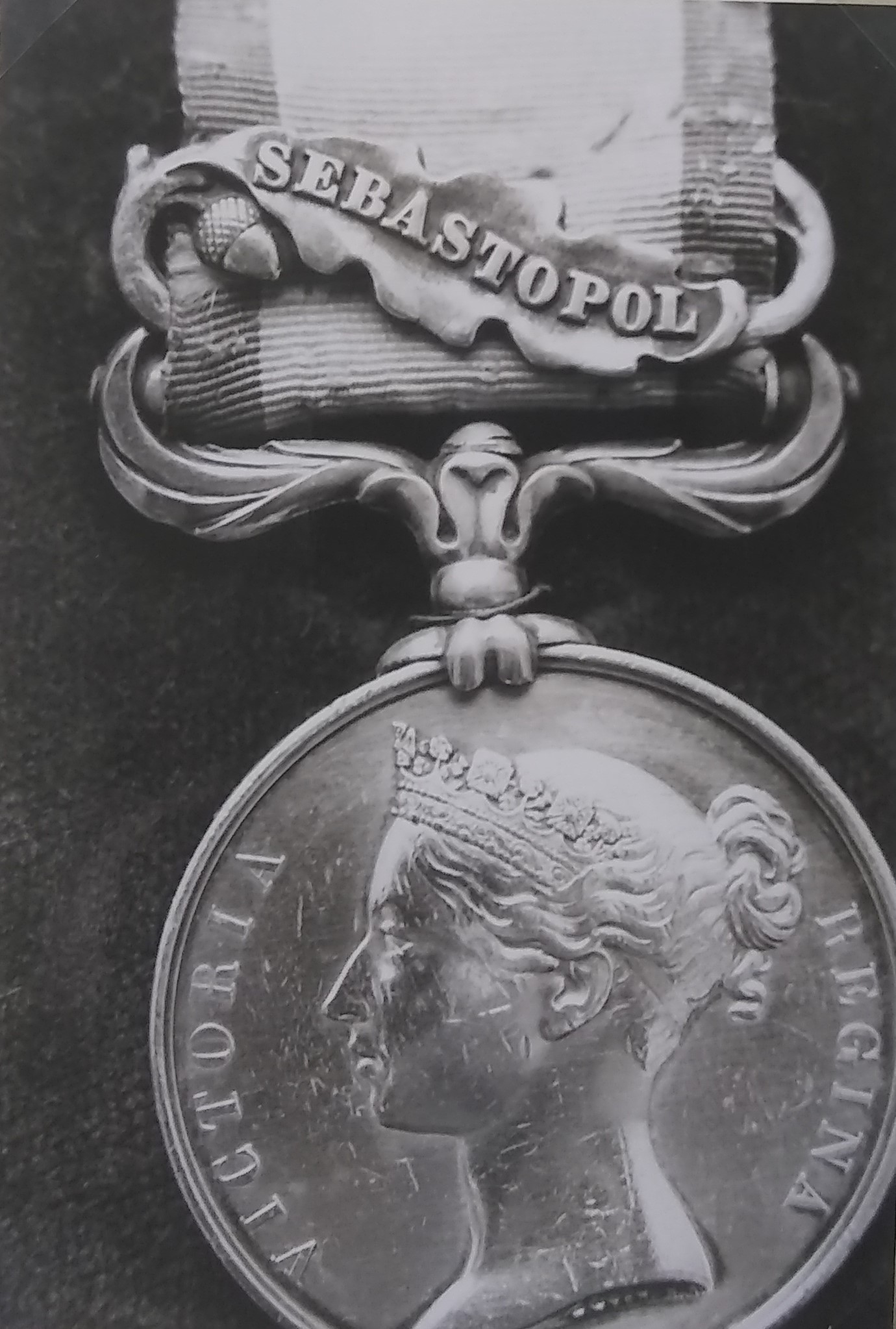
After this, Commander Philipps rapidly rose in favour, and, a few years after, was promoted to the rank of lieutenant. He was afterwards appointed to the “Hecate,” a steam sloop, and in that vessel proceeded to the west coast of Africa, where he was engaged for some time in the suppression of the slave trade. Here he took part in many exciting adventures with Arab dhows and was specially mentioned for his zeal and sagacity. On his return from Africa, Commander Philipps was commissioned to the “Acheron,” commanded by Captain John Lord Stokes, a native of Pembrokeshire. Commander Philipps afterwards saw service in the Crimea, and was present at the landing of the British troops at Kalimite. He took part in the siege of Sebastopol, and received the Crimean medal with the Sebastopol clasp.
The actual medals still held in the families possession.Commander Philipps’ Crimea Medal with clasp Sebastopol
In 1856 he retired from the service, being granted the rank of Commander. Commander “Captain” Philipps, as he was most familiarly known among his friends, then returned to his native town, and there spent the remainder of his days. He was placed on the Commission of the Peace for the county nearly thirty years ago, and, until some four or five years back, was a pretty regular attendant at the Carmarthen county petty sessions. It should be added that in 1852 Commander Philipps married, at Barbados, Miss Wilkinson, and there have been five children of the marriage. The eldest son, Griffith Grismond Philipps, is a lieutenant in the Royal Navy, and thus the family has been represented in the service for three successive generations. Deceased was a great favorite in his native town, and his death is deeply deplored. (Carmarthen Journal Page 8 – 20th November 1891)
**On the 20th October 1827, at the entrance to the bay, Capt. Thomas Fellowes on the frigate Dartmouth had been detailed, with six smaller vessels (2 brigs and 4 schooners) to keep watch on the group of Ottoman corvettes and fire ships on the left flank of the Ottoman line.
Captain Thomas Fellowes who commanded the “Dartmouth”
As the Allied ships continued moving into the bay, Fellowes noticed that an Ottoman crew was preparing a fire ship and sent a boat to instruct them to desist. The Ottomans fired on the boat and lighted the fire ship. Fellowes sent a cutter to tow the fire ship to a safe distance, but the Ottomans fired on the cutter, inflicting casualties. The young Grismond Philipps was on board the cutter but was not injured himself, though six of his shipmates were killed and 8 wounded.Fellowes opened musket fire on the fire ship crew to cover his men. At this point the French flagship Sirène, which was just then entering the bay on the tail of the British-French line, opened fire with muskets to support Dartmouth. An Ottoman corvette then attacked Sirène with its guns. This chain reaction spread along the line, so that within a short time, there was general engagement. This small but significant event caused the battle of Navarino, but led to the ultimate independence of Greece from the Ottoman Empire and in a quiet and unassuming cemetery in Carmarthen lays a naval hero long since forgotten….until now. May he rest in peace.
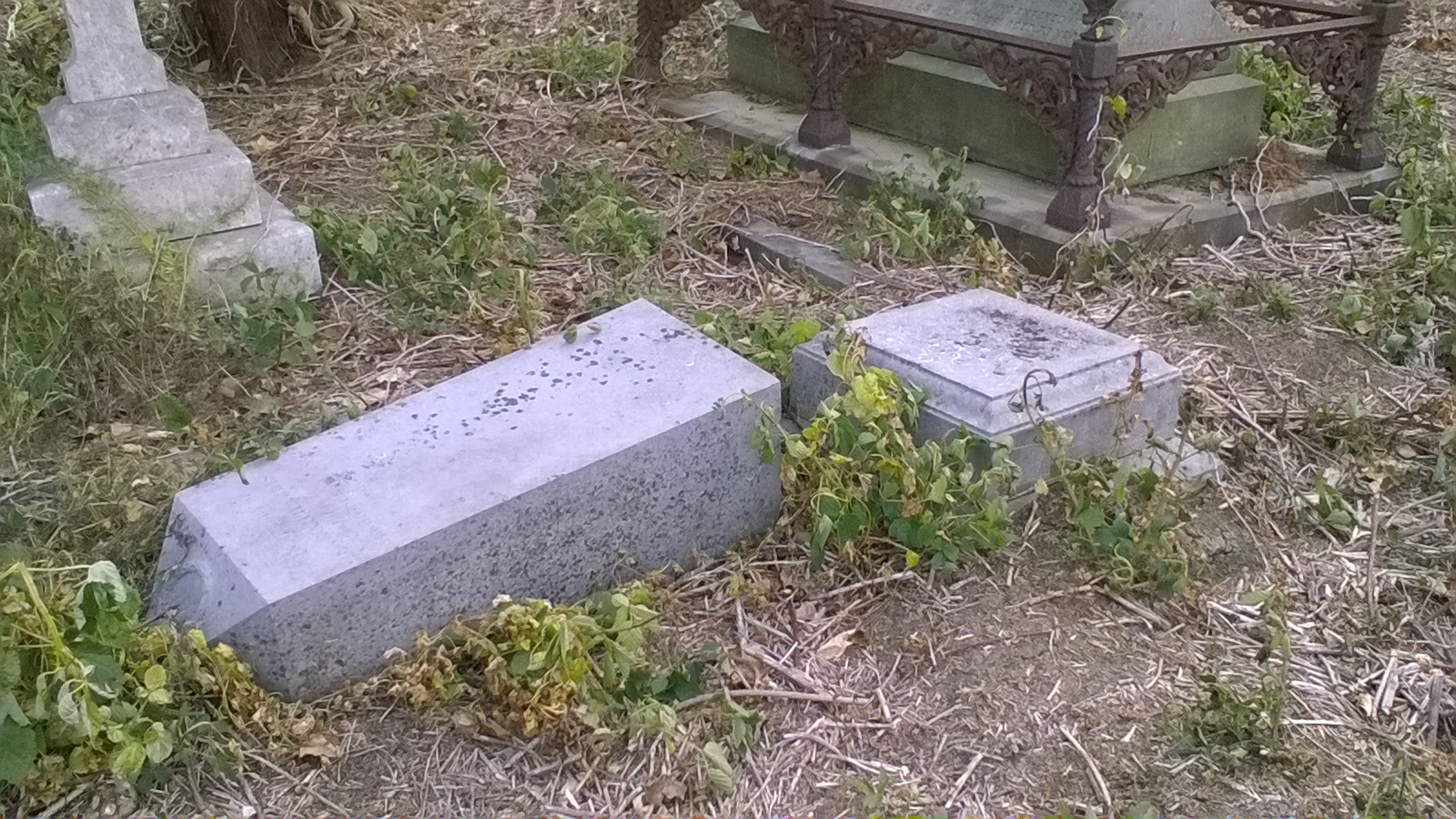
The Philipps’ memorial and grounds before restoration began.The memorial during restoration, before it was re engraved and gilded
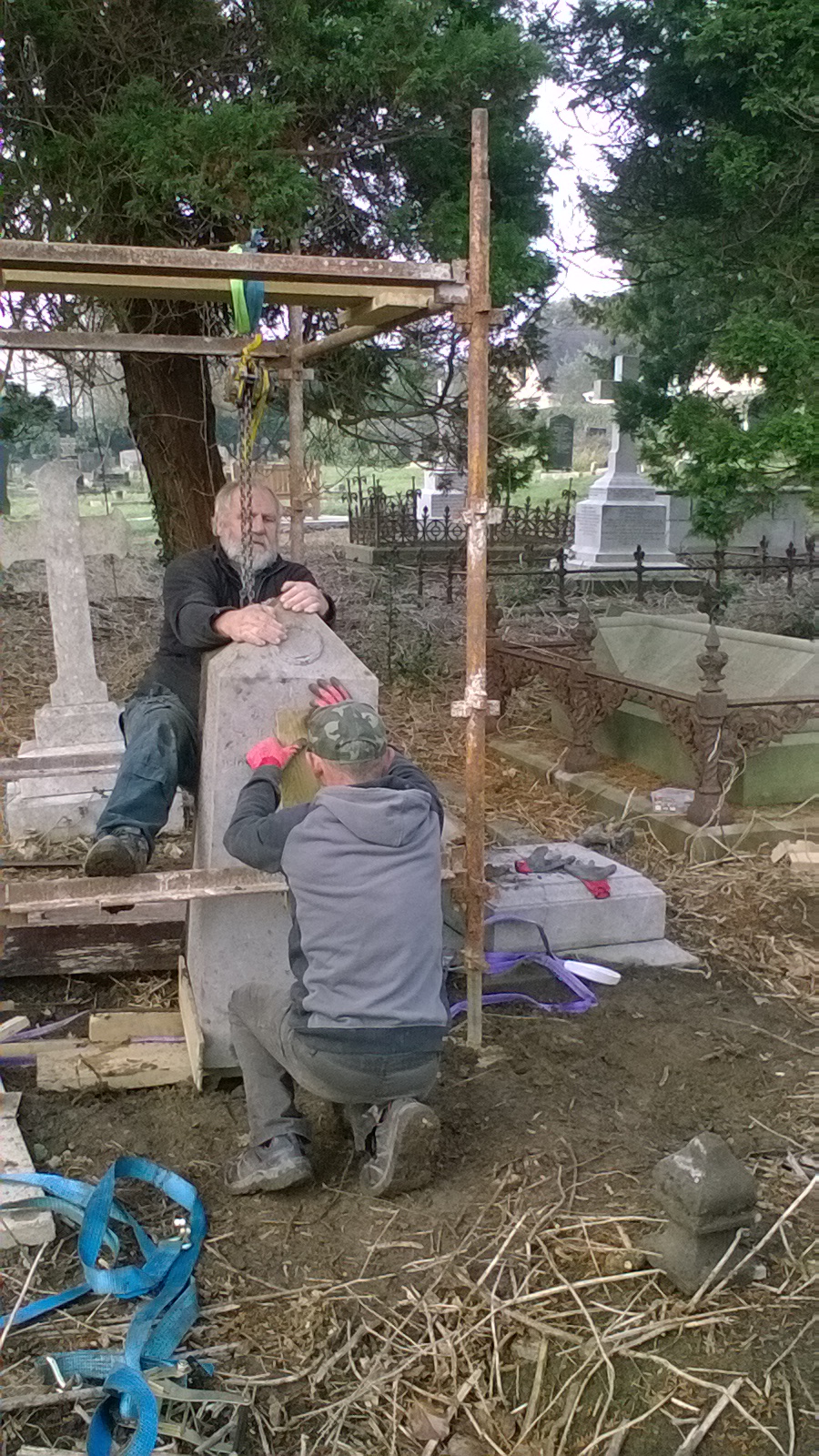
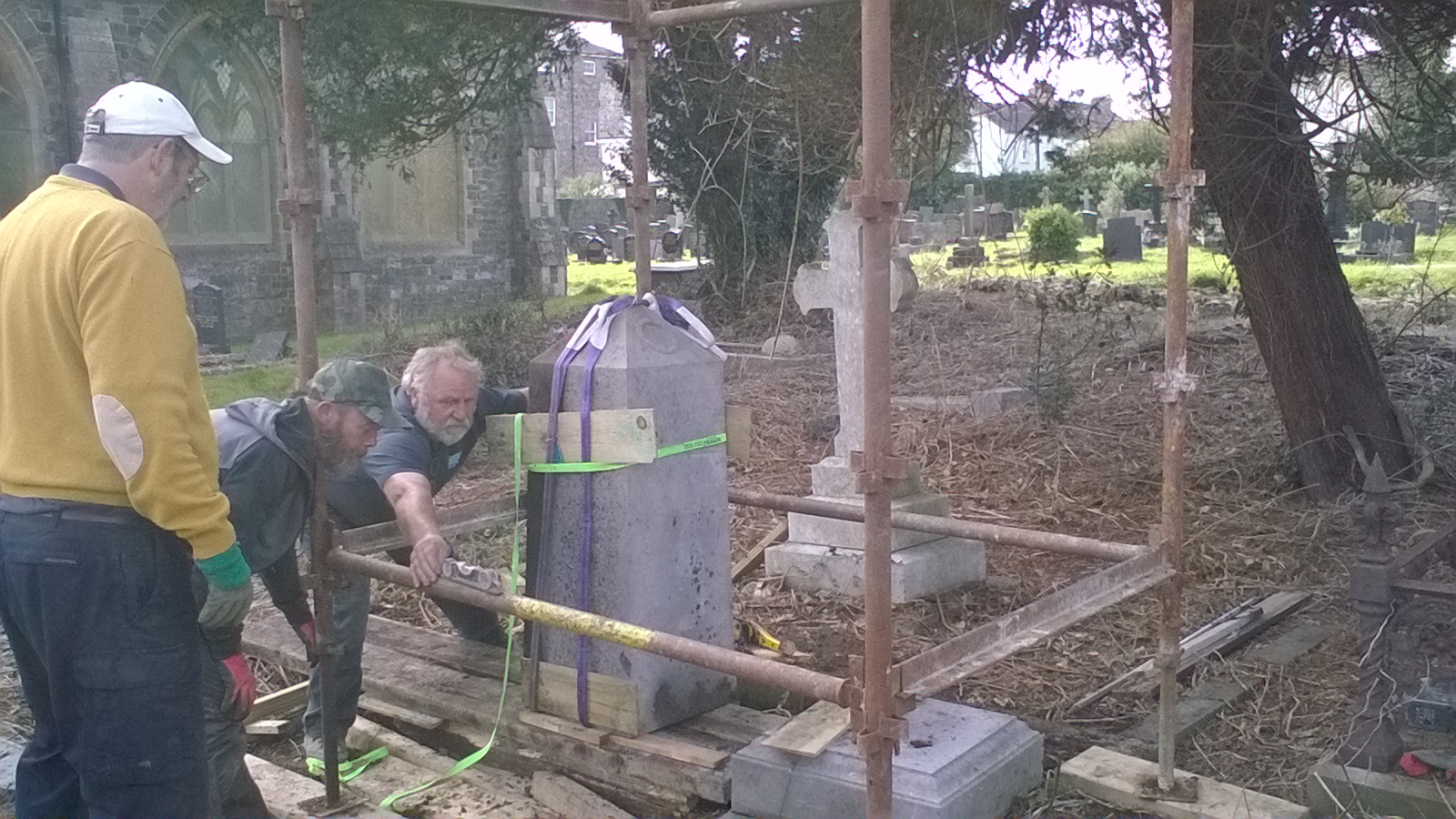
In this feature, I have started to publish some photographs of some of the work we have done previously in restoring, cleaning and repairing the headstones, and memorials in St David’s Cemetery. They all feature a “before” (sometimes during) and an “after” photograph so that everyone can see the magnitude of the work involved. Sometimes the effort is quite easy and often the effort is gigantic, requiring hydraulic lifting equipment and also scaffolding and pulley systems. Sometimes the insertion of steel rods and pins, and also the use of a special resin to hold it all together is also needed. Details of the individual families have not been included but sometimes, some can be found in the “What’s in a Name” menu of the website giving much more details about their past etc. Many photographs have been taken over the last five years and over the coming months, many will be added to this section of the website. If you have any queries or questions please use the contact page and a response will follow asap.
Thank you for looking……..Richard Goodridge
The Sarah Harris obelisk lying on it’s side before lifting it into place
The completed restoration by Mr Mick Butler and John Mc Dermott
Marble dislodged bases litter the cemetery with fallen crosses and moss covering the lead lettering.
The completed restoration (including restoring the arm) and cleaning
An example of the memorial cross having fallen off the pedestal base.
The completed repair and cleaning of the white marble cross.
The massive headstone, lying face down and separated from it’s base
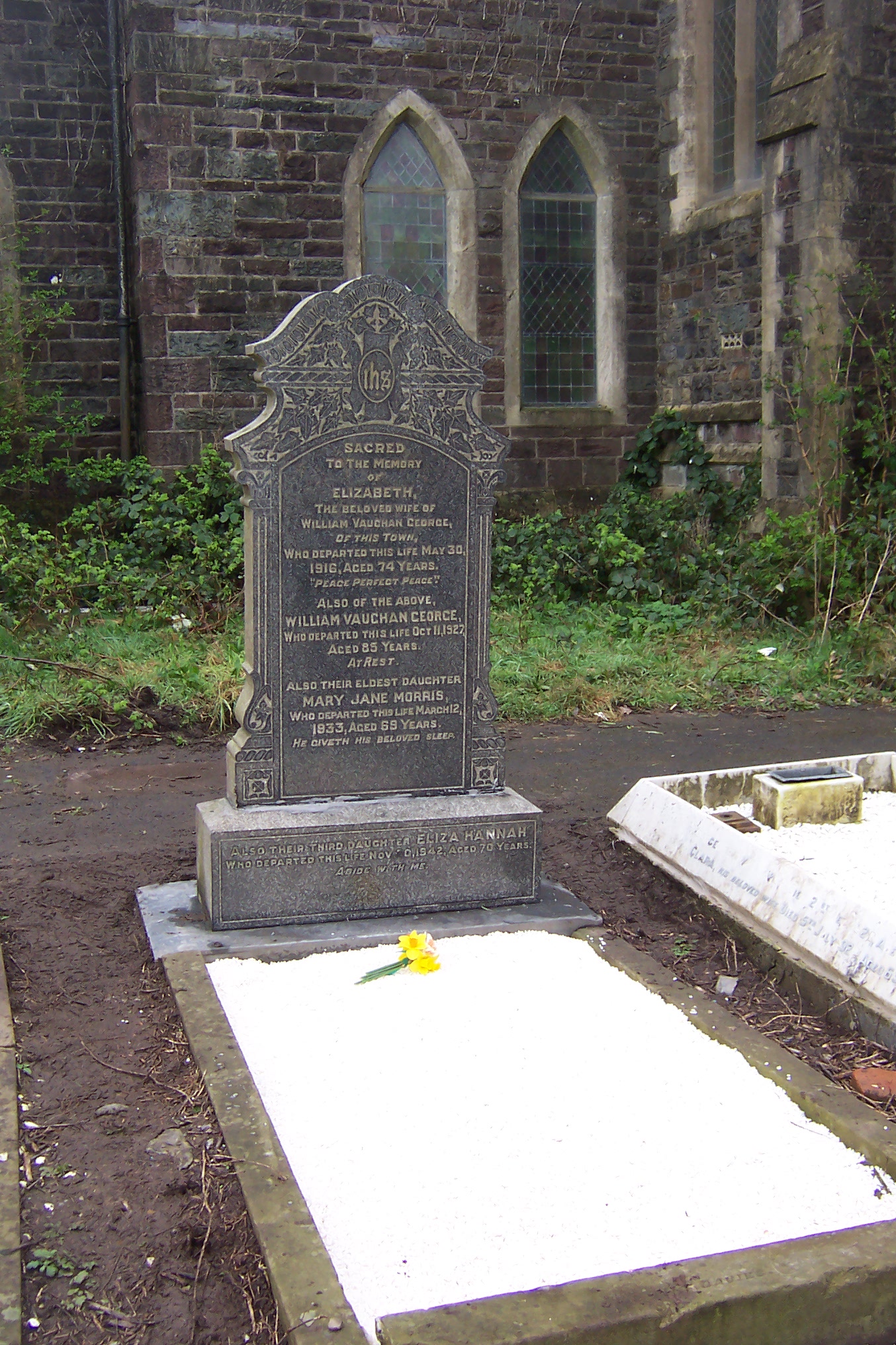
The completed restoration of the GEORGE family grave requiring hydraulic lifting equipment, steel pins and specialist resin compound to hold it all together
In 1915, during the ravages of the Great War and the unfolding tragedies taking place in Europe and elsewhere at that time, the centenary of the battle of Waterloo one hundred years earlier was far from the minds of most people in the country. However, possibly to underline the importance of “fighting for ones country and recruitment of much needed young men” a new slate memorial headstone was erected on the grave of John Samuel on June 18th 1915 and unveiled by local hero Lieutenant General Sir James Hills Johnes VC, GCB. Sir James winning his Victoria Cross in the Indian Mutiny of 1857, some 58 years previously. In 1977 this headstone together with many others was removed to the perimeter wall where it now rests. However, because a detailed map of memorials was made before their removal we do know in this instance the actual burial spot of Mr Samuel should anyone visitor be interested. John Samuel served initially with the Carmarthenshire Fusiliers which he joined in 1807 before enlisting in the Scottish 1st Regiment of Foot in Northumberland in 1811 aged 19. He served as a Private from 1811 to 1825 –almost fourteen years, before being promoted to Corporal, a rank he held for 4 years and 242 days before finally being promoted to Sergeant in 1829, a post he held until his retirement in 1833. John ended his army service in St Lucia having served a total of 25 years and 115 days. Having been wounded on many occasions during his career, being shot in the chest with two musket balls in 1813, having his right knee nearly blown off with another musket ball in 1815 and to continue his military career for a further 18 years until forced to retire in 1833 whist stationed at St Lucia is an unbelievable feat of human endeavour. In 2015, a further bicentenary commemoration took place at his graveside and memorial to re-enact that of 100 years before. The following story then is but a small part of his long life. In his latter years he served as a sidesman at St David’s church wearing his medals with pride on special occasions. May he rest in peace.
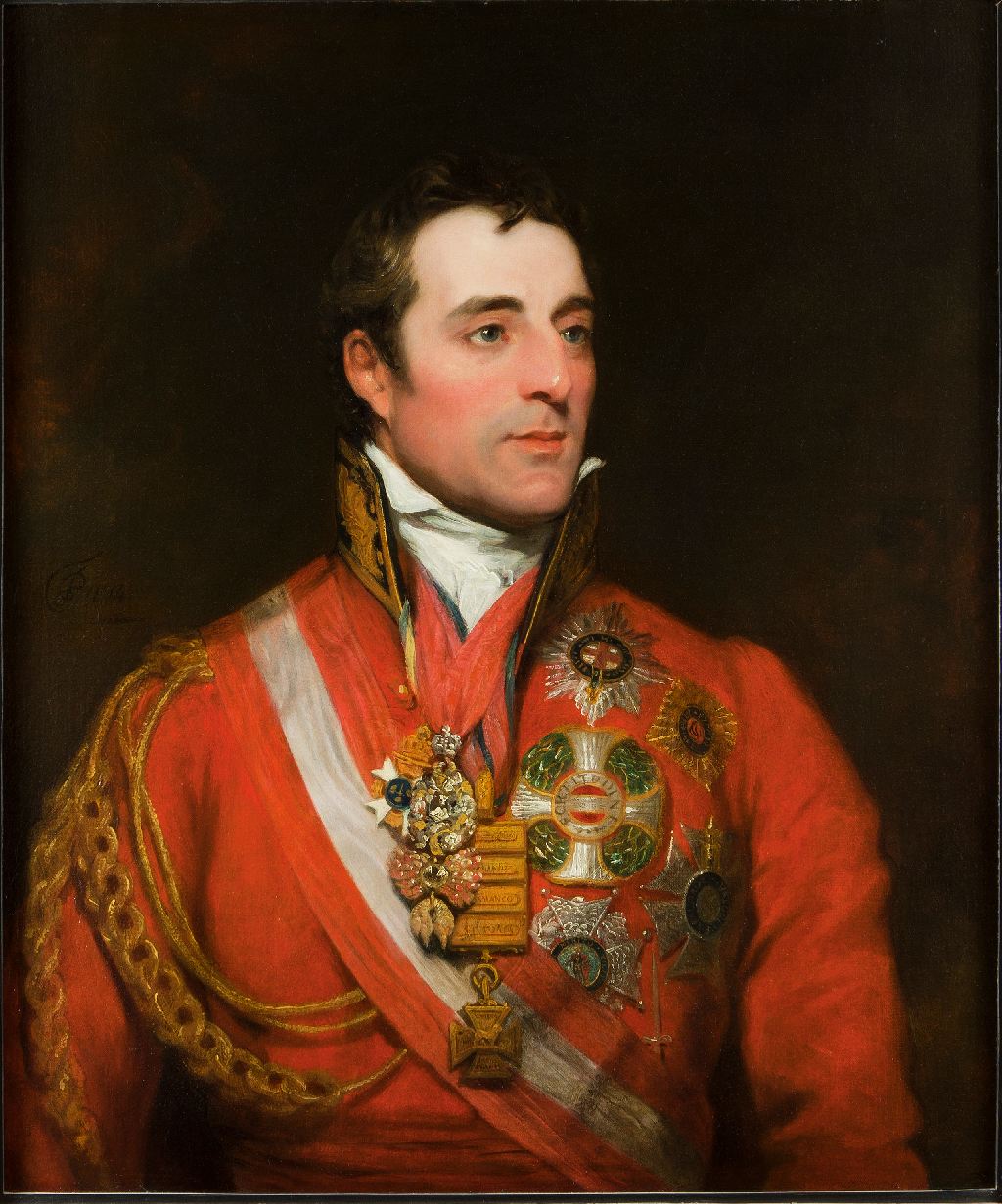
The Duke of Wellington, who spoke to John Samuel three days before the battle of Waterloo.
In piecing together this story, which has taken many months to prepare I felt that there was one piece of the jigsaw still remaining……an image of John Samuel himself and what he would have looked like in old age, and so I set about producing an oil sketch of how I think he would have looked like. I have no qualifications as an artist but I hope I have done justice to his name and memory by producing such an image – with all it’s faults!
(Richard Goodridge)
95th Anniversary of the battle of Waterloo and a local man’s reminiscences of the battle.
Wednesday last, being the 95th anniversary of the “glorious Battle of Waterloo, our readers may be interested in the following recollections of the battle of Waterloo and Quatre Bras, taken from the notes of a Carmarthen man, who was present at the battle. Many of the older inhabitants will recall a sturdy, broad shouldered old veteran, of middle height, who, when four score years of age, might often have been seen trundling a barrow of manure to his cottage garden on Waundew.
Oil sketch of John Samuel by Richard Goodridge.
John Samuel by name, he and his wife (who had been with him through the wars) lived happily for many years, the latter being known locally as “Mrs. Samuel, the nurse,” being one who assisted in many local families when interesting events came about. John Samuel died some 36 years ago. The account is somewhat meagre, but was taken down verbatim by a local gentleman (of little experience as an interviewer) from the old man’s statement on a visit to him on the 5th of July, 1870. The interviewer was about going off on a trip to Belgium, and thought he would like to hear some news at first hand of the great Waterloo fight; as some of the Edwardes of Rhydygorse and Philipps of Cwmgwili fought at Waterloo, apart from the great General Picton, it is a matter of regret that Samuel was not asked about these other Carmarthen heroes who shared in the glories of the campaign. The following is the extract from the diary of the 5th July 1870.
Sergeant John Samuel’s medals (replicas)
“I went this day to see an old pensioner named John Samuel, living at Waundew, and who is, although 84 years of age, with all his mental powers and very vigorous. He was present at Badajoz and was wounded, and what he called Waterloo, but which, I fancy must have been Quatre Bras. From his statement it appears he belonged to the 1st Royals under Col. Campbell, and was orderly to the Quartermaster of his division at Brussels. He said that they were all very well treated at Brussels, and he “himself was billeted at a butchers’ shop. This shop, the old man said, was kept by a stout, good man, and was not far from a square built church, and that a baker’s shop was near. “We were not permitted to cook our own food by the Belgians,” and yet in the Spanish campaign, and at Badajoz he said they were for five or six days together without rations. On Thursday night, the 15th June, 1815, there was, he continued a ball at Brussels but when the letters came to the Quartermaster the bugle sounded and about three in the morning they reached Waterloo. There was some fighting, the Royals being kept in a wood, on what he called the second day, but by which I think he means the second day of fighting. He was wounded in the afternoon about three o’clock and lay all night a very wet part of the churchyard of Waterloo, and had to get back to the village of Waterloo by the help of two firelocks as crutches. He staunched the wound with a quid of tobacco which, he said, got to stink when he got back to the butcher’s shop in Brussels. In later year’s he was attended at the County Infirmary for the same injury. “Boney,” as he always termed Napoleon was not expected so early, and that was the reason they hurried from Brussels. The old man further said that their Colonel, with other officers, together with Lord Wellington, passed them near Waterloo, addressed the men, and told them they were to be led to glory, and asked the officers to encourage the men. One officer, fainting about this time, was carried back by his servant, but on his recovery and return got shot two hours later. He said further that they were ordered to throw away all extra trappings. Samuel said he threw away his shaving- box, razor, and a pair of boots. Extra ammunition was served out and three days rations and the officers had to inspect the flints of the fire locks very carefully. He said the peasants whom they passed were full of joy at seeing them and offered them something to drink in small cups. This old man, John Samuel, died aged 89, and his funeral was attended by many respectable inhabitants of the town.” The above article was printed in 1910
The 1st Regiment of Foot (Royal Scots) at Waterloo
In the Waterloo campaign, the Royal Scots formed part of the 9th Infantry Brigade under Major-General Sir Dennis Pack, itself part of the 5th Division of Sir Thomas Picton. The division arrived at Quatre Bras on 16 June at about 3 o’clock, having covered 21 miles at a rapid pace, and practically without food. After a short rest the division took up an alignment along the Namur- Nivelle road, Pack’s brigade being on the right, and nearer to the cross roads.
It was immediately found necessary to send forward the light companies of the division, to resist the swarms of French skirmishers which were advanced as the prelude to an attack in force. Whilst this musketry fight was in progress, the division suffered terribly from the French artillery on the opposing heights against which the Allies had but few guns to oppose, and upon seeing the heads of the attacking columns emerge into the open, Wellington decided to attack in turn rather than await their advance. The division, with the exception of the 92nd, advanced, and though suffering severely from the fire of both artillery and infantry, pressed forward steadily till their opponents, overawed by their demeanour and the bristling line of levelled bayonets, broke and fled.
The division now formed a series of battalion squares which were fiercely assaulted by large bodies of French Cuirassiers and Lancers, which they repulsed with loss. To support the 42nd and 44th, which were occupying a more exposed position, and were surrounded by cavalry, Picton decided to unite The Royals and 28th, and led them boldly forward in quarter columns into the midst of the French troops. On reaching a favourable position a square was formed. A contemporary account by W. Siborne describes what followed:
“The repeated and furious charges which ensued were invariably repulsed by The Royals and the 28th, with the utmost steadiness and consummate bravery, and although the Lancers individually dashed forward and frequently wounded the men in the ranks, yet all endeavours to effect an opening of which the succeeding squadron of attack might take advantage, completely failed. The ground on which the square stood was such that the surrounding remarkably tall rye concealed it in a great measure in the first attacks, from the view of the French cavalry until the latter came quite close upon it, but to remedy this inconvenience, and to preserve the impetus of their charge, the Lancers had frequently to recourse to sending forward a daring individual to plant a lance in the earth at a very short distance from the bayonets, and then they charged upon the lance flag as a mark of direction.”
In this way, the battalion, in common with the others forming the division, sustained repeated charges from an overwhelming force of French cavalry, and notwithstanding heavy losses from artillery fire, presented an undaunted front to all opponents, even though towards the end of the day, shortness of ammunition rendered it impossible to sustain an adequate fire to keep down that of the ever present French tirailleurs.
Siborne concludes: “Along the whole front of the central position of the Anglo-Allied army, the French cavalry was expending its force in repeated but unavailing charge against the indomitable squares. The gallant, the brilliant, the heroic manner in which the remnants of Kempt’s and Pack’s brigades held their ground, of which they surrendered not an inch throughout the terrific struggle of that day, must ever stand prominent in the records of the triumphs and prowess of British infantry.”
The 3/1st Foot lost 6 Officers and 20 men killed, and 12 Officers and 180 men wounded in this engagement. Captain William Buckley of the 1st Foot was one of the officers killed and the most senior officer in the regiment to be killed either at Quatre Bras or at Waterloo, itself, on the 18th. On the recommendation of the Duke of Kent, and approved by King George, his wife was granted a Royal Bounty of Sixty pounds a year, in addition to her usual pension.
Sergeant Samuel and the Storming of St Sebastian (Known as the Peninsular Wars -fought in Spain between 1808 & 1814)
‘On 17 July [1813, at St Sebastian], the important post of the Ridge of St Bartholomew after having been bombarded, was carried with great dash by three companies of The Royals, and one of the 9th Foot, under Colonel Cameron.
A model of the storming of St Sebastian
A further redoubt was unsuccessfully stormed, but was taken a couple of nights later. On the 20th, the breaching batteries opened from the Chofres Hills, and directed their fire on the weakest part of the wall, namely the eastern face. On the 22nd, the wall was breached. A second breach, further to the right, was commenced on the 23rd, and the assault was fixed for the next day, even though the defences which covered the breach had not been mastered. This was, indeed, tempting providence, but owing to a fire which broke out in the town, the attack was postponed. This postponement is said to have affected the troops, and the conditions under which they had to work, unfavourably. In addition, it gave General Ray, a most indefatigable soldier, time to prepare a warm reception for the storming party.
The troops detailed for the assault of the great breach, were the battalion under Major Frazer, supported by the 9th Foot. The Forlorn Hope consisted of the light company of The Royals, and 20 men of the light company of the 9th, with a ladder party. Lieutenant Clarke was in command of The Royals, and Lieutenant Colin Campbell [afterwards Lord Clyde], of the 9th, in command of the whole. The 38th Foot were to assail the lesser breach.
The signal was given at 5 a.m. while it was still dark, and the troops filed out of the trenches and crossed the open ground which lay between them and the walls, as quickly as its slippery and broken condition would allow. All might have gone well, but the British batteries, not having heard the signal for the advance, continued to fire, so that the stormers were soon under fire from both friend and foe, which caused considerable confusion in the ranks.
Major Frazer, closely followed by some of his men, was the first to reach the breach, but the difficulties of the advance and the confusion caused by two-thirds of the storming party having lost their direction, and becoming engaged in a musketry contest with the defenders of the walls they had halted in the dark to fire on a gap in the wall which they mistook for the breach) denied to this party the immediate support which was essential to success.
Major Peter Frazer was killed whilst gallantly encouraging the few men that were with him. He leaped down the farther side of the breach, had reached the burning houses, and died almost in the ranks of the enemy. The command then fell upon Captain Mullen, which duty he performed with much credit. But the moment for success had passed, the stormers were dispirited by their awful losses, and the confusion which had been experienced; and the defenders, flushed with the success of their first endeavours, redoubled their efforts, and a frightful fire of grape, musketry, and hand grenades from every gun, musket, and hand, smote the confused and pent-up mass of the stormers. Success being hopeless, the troops were ordered to retire, burning with rage and shame at the want of success which they could not but recognise was largely due to circumstances outside their control.’ Casualties amongst the 1st Foot (Royals) on this occasion were substantial. In addition to Major Frazer, one Captain, four Lieutenants, six Sergeants, and 75 rank and file were killed; nine Officers, including Captain Buckley (severely), 7 Sergeants and 230 rank and file were wounded, and a further two Officers, 7 Sergeants and 126 men became prisoners of war. Pulverised by the rain of shot and shell the head of the column ceased to exist and over 600 men perished in a matter of minutes.
Speech by Lieutenant General Sir James Hills Johnes VC.GCB at the graveside of John Samuel on 18th June 1915.
Lieutenant General Sir James Hills Johnes VC.GCB, who laid a wreath at John Samuels grave in 1915
“In this churchyard lies buried a soldier who bravely fought for his country in the Waterloo campaign. He was Sergeant John Samuel. He fought in the battle & was wounded and lay out in Waterloo churchyard all night in the rain and so he played his part. He recovered and returned to Carmarthen where he lived for many years. He died on 16th Oct 1874 and was buried with every mark of respect short of a military funeral which it was found impossible to give as he was not a soldier at the time of his death he having left the army long before. I have been asked by the boys and girls of the Model school who I am very pleased, to see here today to deposit this wreath here to the memory of Sergeant John Samuel.
I am glad to have the great honour of placing this wreath on his grave. It is a proof that the good services of men serving in the ranks are as much appreciated by their countrymen as those of the officers. The placing of this wreath today on the centenary day of Waterloo shows the honour in which Sergeant John Samuels good services are still held by his countrymen. May the honour thus paid be an incentive to young men who are able to join the army to come forward to help their King and Country and their sorely tried countrymen fighting so gallantly against terrible odds in an awful battlefield”
The following is the inscription engraved on the headstone.
In Memory of Sergeant JOHN SAMUEL of the 1st, Batt, 1st Royal Regiment of Foot who was born at Llangunnor in 1788, and died at Carmarthen, on October 16th 1874 He served in the Army 25 years, was wounded at San Sebastian on July 25th 1813 and at Waterloo on June 15th 1815
On the centenary of Waterloo, a wreath was laid on this grave by General Sir James Hills Johnes VC And this stone was erected by the Vicar, Rev Griffith Thomas, and D Davies, Sculptor.
John Samuels slate headstoneBicentenary of Waterloo 18th June 2015. Flowers laid by Mr Griffith Philipps DL & Mrs Glenda Lloyd (Chairperson of Llangunnor Community Council)
St David’s Cemetery has over 900 gravestone’s and memorials recording the lives of nearly 6,500 who are buried here between 1841 and 2002. George Rees who lived in Priory Street opposite the infirmary, despite his early death at the age of 46 became an accomplished composer and expert fisherman in his spare time. He won many awards at a number of Eisteddfodau in Swansea, Carmarthen and at other venues in his short life, and it seems impossible to believe therefore that his last resting place would not be marked by a headstone or other form of memorial. However, having looked through the survey of 1977 which recorded all the memorials in the cemetery there is no mention of George Rees.
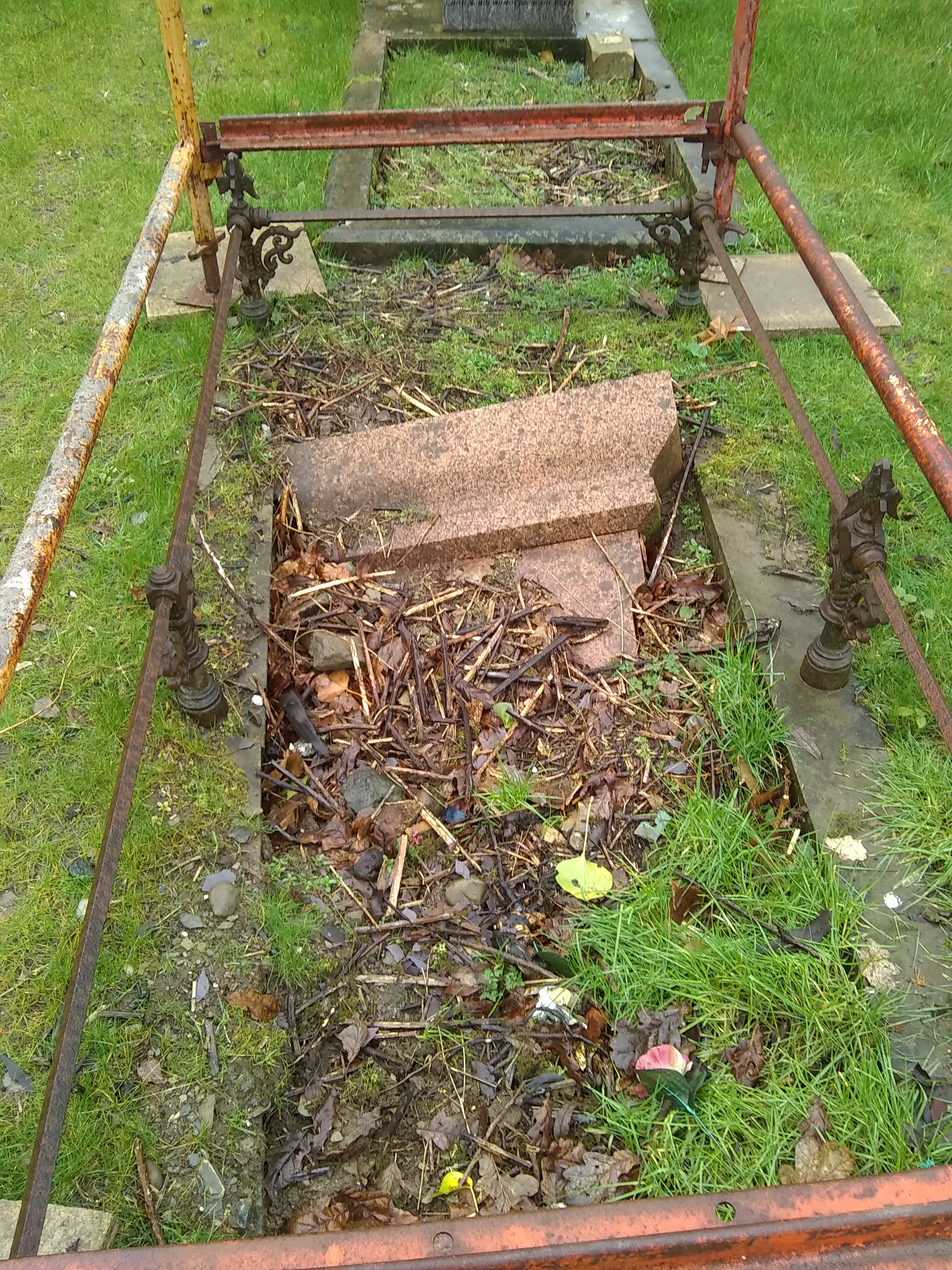
The pink granite headstone that will be restored in the next few weeks. Is it George Rees’…we shall see
There is however, one pink granite headstone that remains face down and will shortly be restored to it’s rightful position by the use of scaffolding and a pulley system. Could this be the stone that has his name engraved on it ? We shall know very soon. Pink Granite was a very expensive stone to use and is uncommon in the cemetery. Once uprighted it will at least bring dignity and respect back to that family and to those buried there. This memorial has laid flat on it’s face for nearly fifty years and it’s now time to put matters right……….GEORGE REES was a remarkable young man and the following report of his funeral, his missing medal, and the furore that sometimes happened at some of his performances gives an insight into his amazing life.
Death of Mr George Rees, Priory Street, Carmarthen. It is with regret that we have to chronicle the death of Mr George Rees (Caradog Bach) at his home 134, Priory Street, on Saturday morning the 23rd May, from that dreaded disease, phthisis. Of a quiet disposition, the deceased will be greatly missed at Penuel Baptist Chapel, where he was a faithful member for many years, and was held in the highest esteem by the members for his readiness shown in furthering the cause. In the musical world, he was widely known and for over 20 years acted as conductor of the juvenile choir of Penuel Chapel. While conductor of this choir, he won over 120 prizes at various Eisteddfodau, including those held at Swansea, Llanelly, Burry Port, Llandeilo, Carmarthen, etc. At the Albert hall Swansea, on April 22nd, 1889, his choir was awarded the first prize of £5 5s, a baton, and silver medal, the test piece being “Storm the Fort of Sin.” The large audience present at the Albert Hall were so delighted with the excellent rendering of the choir that they demanded a repetition. The deceased, who was an ardent angler when out fishing some four years ago, and whilst wading in the Gwili, near Cwmdwyfran, lost the highly- prized medal he won at Swansea. Somehow, it became detached from his watch-chain, and falling into the water could not afterwards be found. Deceased was much distressed at the loss of this much coveted trophy, of which he was so justly proud, not for its intrinsic value, but for the honour which it carried. It is a strange and sad coincidence that on the morning of his death the medal should have been found again. Mr John Hurley, angler, Lammas Street, was wading in the Gwili at the spot where -Mr Rees lost his medal, fishing with a worm. Believing he had a “bite,” he pulled up his line and to his great surprise found that he had a round piece of tin, as he thought, attached to the hook. Hurley, on examination, thought it was a silver coin, and on rubbing it was astonished to find the medal, With the following inscription thereon:- “Won at Swansea Eisteddfod, April 22nd, 1899,” and on the reverse side was “George Rees.” The medal was handed to Mr John Rees (Alaw Prior), deceased’s brother, by Hurley on the Tuesday.
Scaffolding around the headstone, ready to reveal the identity of those buried there.
The funeral, which was largely attended, took place on the 26th inst., at St. David’s, Churchyard, being public for men only. The Rev E. U. Thomas, Tabernacle, officiated at the house, and the Rev D. T. Alban at the church and graveside. The deacons of Penuel Chapel Mr David Hinds, Mr Geo. Thomas, 32, Priory Street, Mr John Lewis, Catherine Street, together with Mr William Evans, Dukes yard, acted as bearers. Among those present were: Mr David Williams, J.P., Mr T. Conwil Evans, Mr J. Patagonia Lewis, Mr Williams, Prudential Assurance; Mr George Howells, supt. Pearl Assurance; Mr William Davies, Regent Hons-; Mr Owen Jones, Dark Gate, and Mr D. Tank, Priory street. The mourners were: Mr John Rees (Alaw Prior) (brother) Mr W. E. Buckland, Swansea (nephew); Mr David Jones, Waterloo terrace (cousin): Mr Tom Rees, Island Cycle Works (cousin); Mr D. R. Thomas, Chapel street, Mr Thomas Jones, Chapel street; Mr M Davies, 65, Priory street (nephew); Mr Lloyd Davies, 38, Richmond terrace (cousin); Mr Tom Davies, 65, Priory street (nephew); Mr William. John Mason, Felinfoel, Llanelly. Wreaths were sent by the following: Mrs S. Parcel Rees, Mr D Marsden Harries, Priory Street; Mr and Mrs Henry Jones, The Avenue; Mr and Mrs Lloyd Davies, 38. Richmond terrace, Carmarthen; Miss Ann Thomas 12, Francis terrace . CARMARTHEN WEEKLY REPORTER. 5TH JUNE 1908 PAGE 1
Mr. George Rees’ Concert.
To the Editor of the Carmarthen Weekly Reporter.
DEAR SIR, I was not at all surprised to find a letter in your last week’s issue complaining about, and protesting against, the unseemly conduct of a very big batch of the audience at this concert. What did surprise me, however, was the fact that the writer placed the whole blame at the doors of a religious community of which he was a member. Nothing could very well be more unfair or more unjust. This concert was not held under the auspices, nor was it organized by the Penuel Baptist Church, and it could very easily be proved that the patronage bestowed upon it from the outside was far greater, relatively and absolutely, than that from the inside. As a matter of fact, it should be known that when any set of performers, local or touring, is unfortunate enough to be supported by the rowdy youths of Carmarthen, then the noise and clamour and disturbance rank as amongst the most unseemly, unkind, and undiscriminating that is anywhere made. But who would for a moment think that any one, or a particular denomination, was responsible for this? That one whose conduct and remarks generally show a legal acumen and correct discernment should have so erred is beyond my comprehension. Yours truly, ONE OF THE SAME RELIGIOUS COMMUNITY
CARMARTHEN WEEKLY REPORTER 2ND OCTOBER 1896 PAGE 5
The policy: This privacy policy notice is served by stdavidscemeterywales.org, under the website; stdavidscemeterywales.org. The purpose of this policy is to explain to you how we control, process, handle and protect your personal information through the business and while you browse or use this website. If you do not agree to the following policy you may wish to cease viewing / using this website, and or refrain from submitting your personal data to us.
Policy key definitions:
“I”, “our”, “us”, or “we” refer to the business; stdavidscemeterywales.org. “you”, “the user” refer to the person(s) using this website. GDPR means General Data Protection Act. PECR means Privacy & Electronic Communications Regulation. ICO means Information Commissioner’s Office. Cookies mean small files stored on a users computer or device. Key principles of GDPR:
Our privacy policy embodies the following key principles; (a) Lawfulness, fairness and transparency, (b) Purpose limitation, (c) Data minimisation, (d) Accuracy, (e) Storage limitation, (f) Integrity and confidence, (g) Accountability.
Processing of your personal data Under the GDPR (General Data Protection Regulation) we control and / or process any personal information about you electronically using the following lawful bases.
ICO Data Protection Register; We are exempt from registration in the ICO Data Protection Register because We only process personal data for ‘accounting, administrative and marketing purposes’.
Lawful basis: Consent Our purpose for processing, why it is necessary and how we process your information is: We process your information in order to reply to any messages you send via our Contact Form
Data retention period: We will continue to process your information under this basis until you withdraw consent or it is determined your consent no longer exists.
Sharing your information: We do not share your data with anyone.
If, as determined by us, the lawful basis upon which we process your personal information changes, we will notify you about the change and any new lawful basis to be used if required. We shall stop processing your personal information if the lawful basis used is no longer relevant.
Your individual rights Under the GDPR your rights are as follows;
the right to be informed; the right of access; the right to rectification; the right to erasure; the right to restrict processing; the right to data portability; the right to object; and the right not to be subject to automated decision-making including profiling. You also have the right to complain to the ICO [www.ico.org.uk] if you feel there is a problem with the way we are handling your data.
We handle subject access requests in accordance with the GDPR.
Internet cookies
We use cookies on this website including those that may be required by your own browser to enjoy the full functionality of this website. Some additional cookies may be required to enable monitoring of website traffic and to assist in the full functionality to this website.
Data security and protection We ensure the security of any personal information we hold by using secure data storage technologies and precise procedures in how we store, access and manage that information. Our methods meet the GDPR compliance requirement.
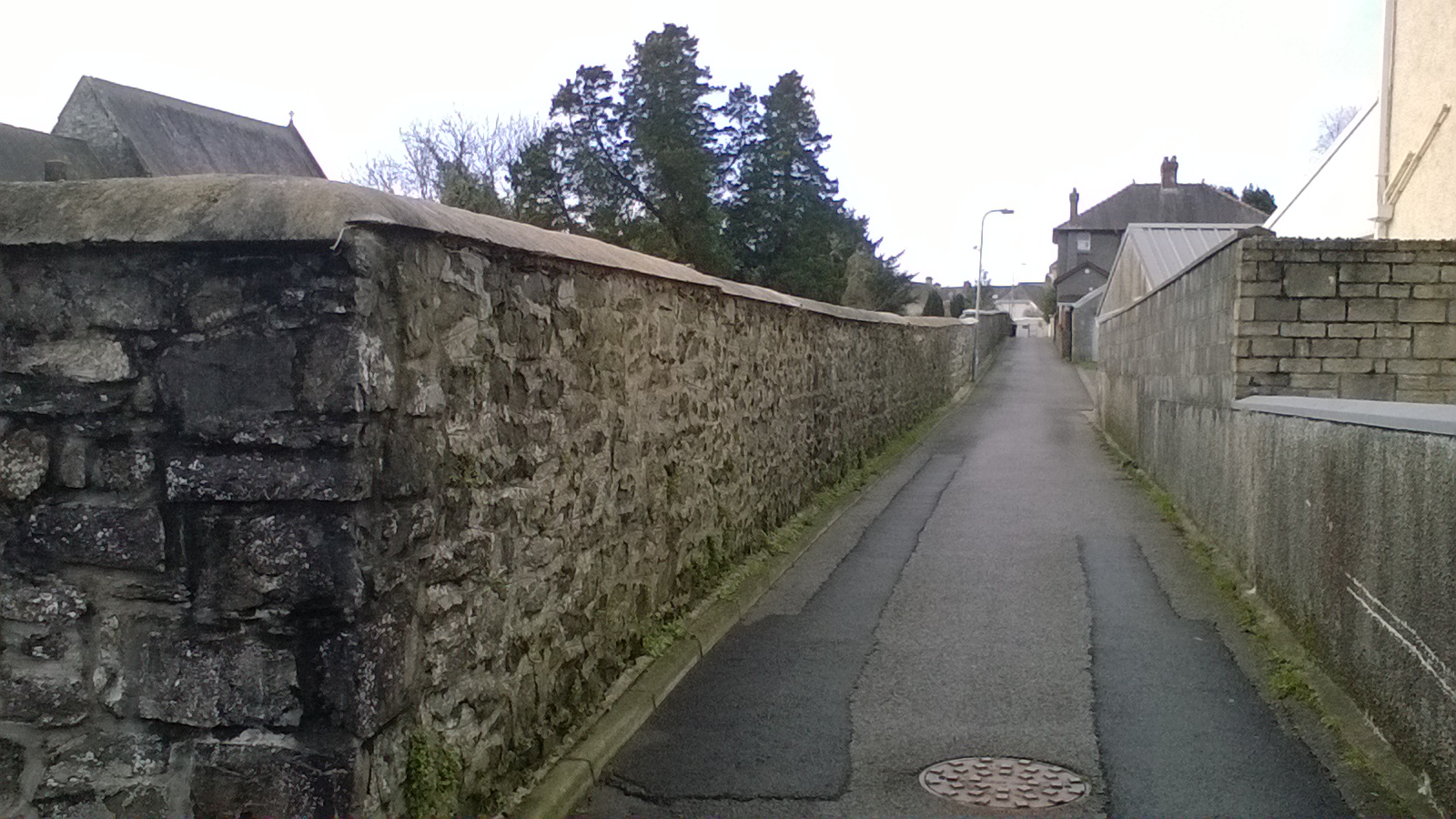
The historic grade 2 listed stone boundary walling to the north and east of the cemetery was originally built in the 1830’s.
The wall before ivy removal
It is a substantial structure (totaling over 200 metres in length) made of random rubble limestone two feet thick and upwards of eight feet high on the road side. The top is capped with a concrete coping of various cross section shapes. This boundary wall is for the charity to maintain.
Most of the wall was covered in very heavy ivy growth, some climbers as thick as your arm. It was unknown at the outset what sort of condition the wall was in therefore it was decided that removal of the ivy was one of the first tasks in order to inspect the wall.
the wall after removal of ivy and repair
Eventually most of the ivy was removed and a structural inspection revealed it to be in good condition generally. However a 30metre length of coping was missing from the top of the St Non’s Avenue wall along with missing and loose stones. The Trustees agreed to undertake work to replace the coping in order to protect the top of the wall from further weather damage and the subsequent major cost to repair.
missing section of the wall before restoration
Tenders were invited and local contractor SI Evans (Dean Richards) was appointed to undertake the repairs and re-forming the missing coping. Works commenced in September 2018 and the final cost to the charity was £5784.
after initial repair
Grant money was used to fund this work from the Pilgrim Trust and the Prince of Wales’s Charitable Foundation.
The two men working for SI Evans, Richard and Anthony who carried out the repairs should be commended for their workmanship and cleaning up afterwards. Further repair and restoration is needed on other sections of the wall where pointing is required and this will be carried out this year
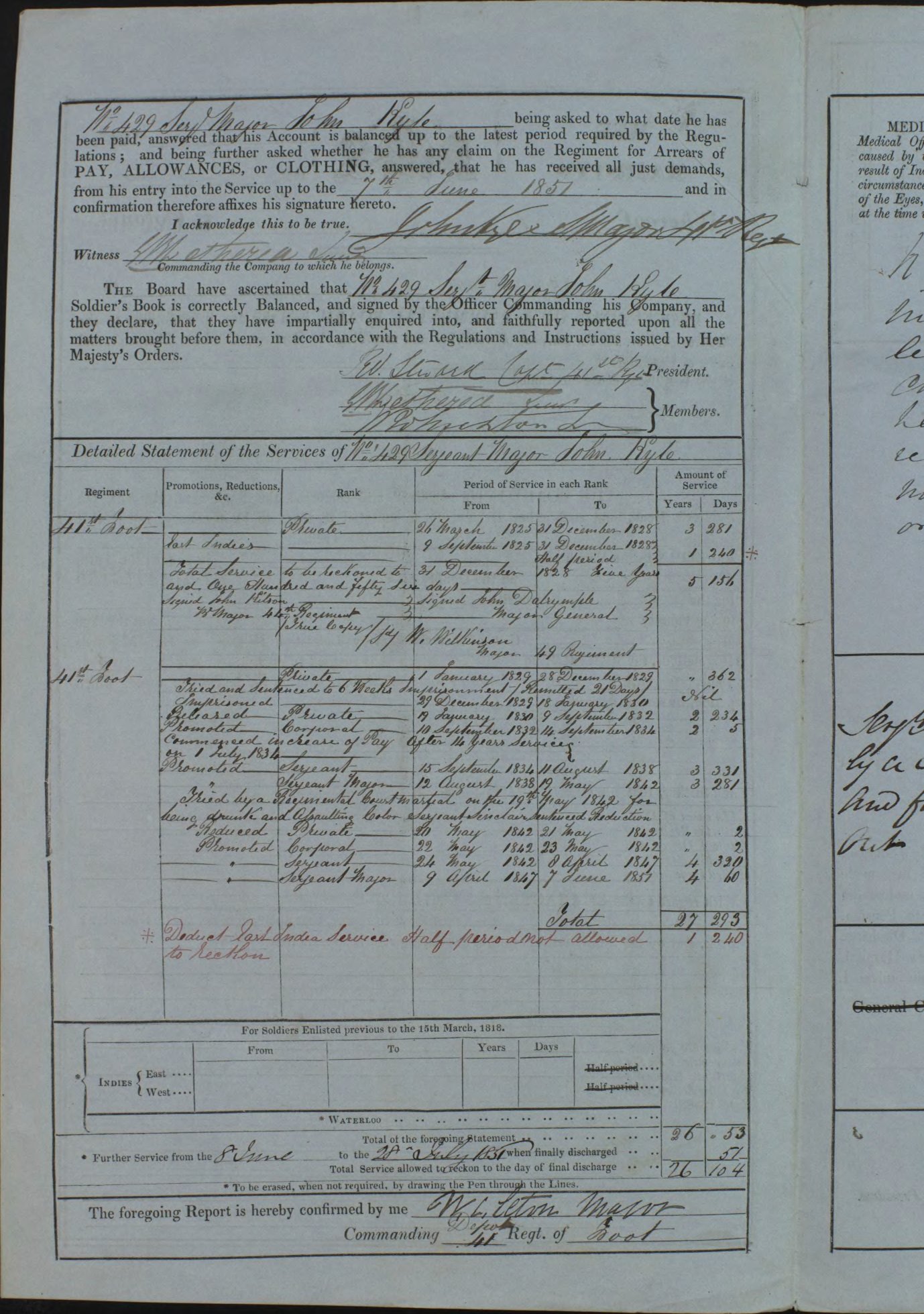
John Kyle, was born in the village of Tullow in the county of Carlow, Ireland in 1807 and joined the Welsh 41st Regiment of Foot on the 27th March 1825 aged 18 as the Regiment was stationed in Ireland at the time. He served a total of 26 years and 53 days in his beloved Welch Regiment, 17 of those years he served abroad, before his retirement on the 7th June 1851, ironically in Ireland again.
The medals of Sergeant Major John Kyle. Left to right. Army of India medal with bar AVA, Afghanistan medal for 1842, Meritorious Service Medal, & Royal Humane Society medal for saving life.
On looking at his service papers it is interesting to note that after serving for nearly four years as a Private he was tried by Court Martial and imprisoned for six weeks which was remitted to 21 days from 29th December 1829 to the 18th January 1830. Again in 1842 whilst at the zenith of his career and serving as the Regiment’s most senior non commissioned officer – Sergeant Major Kyle was tried by a Regimental Court Martial for being drunk and assaulting a Colour Sergeant, for which he was found guilty and sentenced to a reduction in rank to Private for two days, Corporal for a further two days, and then Sergeant for a further five years before finally resuming his rank as Sergeant Major on promotion in 1847. As his discharge papers reveal, he was a brave soldier in the field, which is a very rare comment to have been written.
John Kyle’s remarkable service record
Sergeant David Haslock who served with John Kyle throughout the First Afghan War wrote the following in his diary dated 13th February 1845 “The silver medals conferred on us by Her Gracious Majesty for victories gained in Afghanistan were presented to us by Lieutenant Colonel Gore Brown CB who made an appropriate speech on the occasion and we replied with three British cheers. This is an honour that the soldiers are delighted to win and wear on their left breast.” “All the armies of heaven and earth who brought me safe through and out of those wars, he ordained that I should escape the edge of the enemies’ sword in that campaign , many hundreds of which were never buried but still lie where they fell in the Mountain passes, but many hundreds of us were spared to march in honour under the triumphal arch and return to our native land, meet our dear friends and receive from the throne of our kingdom the very great badge of honour that money cannot purchase.”
Colonel Gore Brown CB who served as a Major in the 41st Foot during the Afghan Campaign and who presented the medals to the 41st Foot at Carmarthen in 1845
What most military historians fail to realise these days is that these very special medals were presented to the 41st Regiment of foot whilst stationed at Picton Barracks in Carmarthen as a mark of respect to Major General Sir William Nott GCB, their Commander in Chief in Afghanistan who had died the previous month and was buried in Carmarthen.
One remarkable piece of military history unknown to most historians of today is the connection that John Kyle had in the creation of a small but significant role his former Corporal played in the American Civil War by the name of Patrick Roynane Cleburne…..Patrick Ronayne Cleburne became the highest-ranking Irish-born officer in American military history, attaining the rank of Major General. He was born into a neighbouring County to John Kyle in Southern Ireland. He entered the Civil War as commander of the Yell Rifles, which became part of the First Arkansas Volunteer Infantry Regiment. He became a drugstore owner and lawyer in his new Arkansas hometown of Helena (Phillips County) and was a delegate to the Democratic Convention in 1858.
Pat Cleburne was born in Ovens, County Cork, Ireland, on March 16, 1828, at Bride Park Cottage to Joseph Cleburne, a doctor, and Mary Anne Ronayne Cleburne. He was the third child and second son of a Protestant, middle-class family that included children Anne, William, and Joseph. His mother died when Cleburne was eighteen months old, and his father married Isabella Stewart. There were three half-siblings born to this union: Isabella, Robert, and Christopher. When Cleburne was eight, the family moved to Grange Farm, near Ballincollig. Cleburne attended Church of Ireland Reverend William Spedding’s boarding school nearby. His father died suddenly of typhus in November 1843, having contracted it from a patient, and “Ronayne,” as his family called him, was expected to carry on the family profession of medicine. He apprenticed for two years, with plans to enrol in Apothecary Hall in Dublin. However, Cleburne failed the entrance exam in February 1843. Too humiliated to return home, he enlisted in the Forty-first Regiment of Foot of the British army, expecting to be sent to India. Instead, the regiment was posted to Mullingar for civil duties in Ireland stemming from the crisis of the Great Famine.
For three and a half years, Cleburne was posted at barracks around famine-stricken Ireland. He served during the turbulent months of the 1848 Young Ireland Rebellion and received a promotion to Corporal on July 1, 1849 on the recommendation of his Sergeant Major –JOHN KYLE. He returned home to find the family farm in arrears for six months rent. His stepmother suggested the oldest four children emigrate.
On November 5, 1849, Cleburne, his older sister Anne, and brothers William and Joseph boarded the Bridgetown for America and landed in New Orleans, Louisiana, on Christmas Day. Employment was a priority, and the siblings headed up the Mississippi River looking for work. Patrick found a job as a druggist at Nash and Grant’s Drugstore in Helena after arriving in April 1850. Immediately following his five-year wait for naturalization, he passed the Arkansas bar examination in 1856. He supported law partner Thomas Hindman in his bid for the Senate against Know – Nothing candidate W. D. Rice. Cleburne was wounded when Rice ambushed him and Hindman in a Helena street in 1856.
Cleburne adopted his new country thoroughly. He joined many social clubs and affiliations, which brought him close to the citizenry of Helena. Cleburne’s politics mirrored Arkansas’s Southern stance, and he joined the Democratic Party in 1855 during their fight against the Know-Nothing party in the 1856 elections. Cleburne never owned slaves and voiced his opposition to the institution, yet he valued the right and desire of a section of the country to govern itself. Much of his philosophy was based on witnessing the Irish fight for independence. This acceptance endeared him to the Arkansans whom he would command in battle.
Local plantation owners and well-respected citizens formed a militia company called the Yell Rifles, named for Arkansas governor Archibald Yell. They elected Cleburne captain, and the company was thoroughly drilled in the skills he learned in the British army under Sergeant Major Kyle of the 41st Foot. The Yell Rifles, along with similar groups from around the state, travelled to Little Rock (Pulaski County) hoping to seize the Federal Arsenal in February, 1861. Federal troops abandoned the arsenal without a fight on February 8. Arkansas seceded on May 6 and joined the Confederate States of America.
The Yell Rifles became part of the First Arkansas Volunteer Infantry Regiment. Cleburne was elected colonel. The First Arkansas was attached to the Army of Tennessee, the main Confederate army in the western theatre. Cleburne was promoted to brigadier general in March 1862, and his brigade participated in the Battle of Shiloh in April and the 1862 Kentucky Campaign that summer. At the Battle of Richmond, Kentucky, on August 30, Cleburne was struck in the face by shrapnel and forced to leave the field. He remained away from the army until his recovery six weeks later, when he returned to duty for the Battle of Perryville in October. On December 14, 1862, Cleburne was promoted to major general. He commanded a division at the Battle of Murfreesboro in east Tennessee. During 1863, Cleburne participated in battles at Chickamauga and Missionary Ridge. On November 27, 1863, his division made a stand at Ringgold Gap, Georgia, as the rearguard protecting the retreating Confederate army. His 4,000 men held back 15,000 of General Joseph Hooker’s Union troops.
Cleburne received a Congressional citation from the Confederate capital for his victory over Hooker’s army at Ringgold. He used this show of support from the Confederate government to discuss his proposal to enlist slaves before the Confederate commanders. Cleburne believed that if slaves in the South were offered military service in exchange for their freedom, the foreign support and manpower issues would be resolved, as well as the slavery dilemma. His superiors did not see his vision, and his idea was suppressed, despite a similar suggestion from General Robert E. Lee. Eventually Lee’s request was put into writing, and the Confederate Congress passed the act to enlist slaves in 1865. However, it came too late to avert losing the war.
In 1864, Cleburne became engaged to Susan Tarleton of Mobile, Alabama, and a fall wedding seems to have been planned. Cleburne returned to the front at Dalton, Georgia, and faced Union General William T. Sherman’s troops during the Atlanta Campaign from May through August. In September 1864, Cleburne, under the command of Confederate General John Bell Hood, proceeded north to Nashville to attack the Union army under General George H. Thomas.
Major General Patrick Cleburne, formerly a Corporal in the 41st Foot under John Kyle
Cleburne died while leading a charge on the Union breastworks on November 30, 1864, in Franklin, Tennessee. He was buried at St. John’s Church cemetery in Columbia, Tennessee. In 1870, his body was re-interred in Helena in the Helena Confederate Cemetery within Maple Hill Cemetery.
THE CARMARTHEN RIFLE CORPS AND SERGEANT-MAJOR KYLE.
When the 2nd Carmarthenshire Rifle Corps was established it was singularly fortunate in the appointment of its officers. Capt. Edwardes, who assumed the command at the unanimous request of the corps, was an efficient soldier, having spent several years in one of the regiments of the line, in which he was distinguished for all the best qualities of a well-disciplined soldier. The other officers, although new to the profession, were gentlemen of intelligence, in the prime of life, and with ample leisure speedily to acquire a practical knowledge of their duties. But much as the corps is indebted to the officers who have been most active and diligent, it owes in a very great measure the compliment which was specially paid to it at the Review at Gloucester to Sergeant Major Kyle, who with remarkable patience and ability went through the tedious labour of instructing the volunteers for many hours every day during the last summer. He spared no pains, grudged no amount of toil, never tired in explaining the true principles of the drill. It mattered not who the volunteer was that sought instruction, nor at what hour or personal inconvenience to himself, he was always ready and willing to help him. And, then, there is no drill sergeant in the service more competent than Sergeant Major Kyle-at Gloucester he was the first- and Captain Edwardes says “Of his qualities as a soldier I need not speak – the medals which cover his breast show of what stuff he is made.” This soldier-like compliment was confirmed by a hundred voices, cheering most lustily. It was no more, then, than the veteran sergeant deserved, to have presented to him some durable acknowledgment of his valuable services. A subscription list was some months since opened, and £30 was immediately obtained, the subscriptions being strictly confined to the 2nd Carmarthenshire. Many not connected with the corps, but who admire the sergeant’s devotion and energy, would have been glad to add their tokens. This was not permitted, and the testimonial is the more complimentary owing to it. The presentation was unavoidably delayed until last night. For two months the corps has not been able to drill regularly on account of the inclemency of the weather. The wool-room has now been fitted up for the purpose, and on Monday the drill was commenced in it. Last night was, therefore, the second time the corps has occupied their new premises, and it was properly chosen as a fitting occasion to present the testimonial. And at the conclusion of the drill, Capt. Edwardes said they were met there this evening, not only for the purpose of drill but to present their late drill-instructor, Sergeant Major Kyle, with a slight token of the respect they bear to him, for the very effective manner in which he had discharged his duties. (Cheers). He could safely say that they were at least as well up in their drill as their neighbours, but that would shortly be-proved. What they had accomplished was due in a great measure to Sergeant-major Kyle, who, from the moment of his appointment, was ever ready and willing to instruct them at any moment not merely in the ordinary hours of drill, but at any hour of the day – it mattered not when. (Cheers). Then, again, he was always punctually at his post. (Applause). They would remember that at first they drilled three times a-day at 7 o’clock in the morning, at half-past 2, and at 7 in the evening, and they would agree with him that no exertions were spared to make the corps really efficient. (Cheers.) He believed that if they had been inspected two months ago they would have mustered much better than they could now. The weather had been very much against them for the last two months, and having no suitable place for drill, they had not been as attentive as he deserved. But now he had obtained the use of this large room, which was suitably fitted up, the winter would present no obstruction to drill, and he hoped they would be able to perfect themselves before the spring. (Cheers). He thought it right to mention that some members of the corps had to his surprise said, “Catch me in the Wool Room,” and if he did catch them here he would tell them something they did not like. (Applause). He had his eye upon them, and should watch them closely. On Monday next he should commence the fines, and unless just cause was shown the fine should be enforced. What did they enroll for? Was it to wear a uniform – or to carry a rifle? Surely they aimed at becoming efficient soldiers. (Cheers). He could safely say that they were extremely fortunate in securing the services of Sergeant Major Kyle, on whose qualities as a soldier it was useless for him to dwell-the medals which covered his breast showed of what stuff he is made. (Loud cheers). The gallant Captain then formally presented to Sergeant Major Kyle a purse containing thirty gold sovereigns, amidst the vociferous cheers of the corps.The purse, specially knit for the occasion, is of silk, with steel beads and rings, and is very handsome. On a silver plate attached to it is the following inscription Presented by the Officers, Non-commissioned Officers, and Privates’ of the 2nd Carmarthenshire Rifle Volunteers to their late drill-instructor, Sergeant Major Kyle – October, 1860.” Sergeant Major Kyle, who was heartily cheered, said he begged to return them his most sincere and heartfelt thanks for the handsome and substantial testimonial which they had presented to him. He never dreamed that his poor services would have been so richly rewarded. When he commenced instructing them, seven or eight months ago, he knew well the good materials he had to work upon, and that the efficiency of the corps rested very much with himself. He had, therefore, given himself to his duties earnestly, and they had responded to his call nobly, and the result of their drill was seen at Gloucester, where all he had told them was fully borne out, for they were universally admitted to be second to no corps on the field, and in his heart and soul he believed they were not. He had now left them officially, but he was ready at their call at any moment when it did not interfere with his military duties elsewhere. He should be most happy to help them in any way. (Cheers.) But, they should attend drill – nothing call be done without it. He knew what they could do if they liked-they might become perfect in drill. If they were regular in drill during the winter they would soon be as efficient as any of the best disciplined regular soldiers of the line. (Applause) They had from the first given him the utmost satisfaction and pleasure. He bad received every support and assistance from the officers and particularly from Captain Edwardes, who from his practical knowledge on the parade ground where it was given in a most gentlemanly and handsome manner, and by his internal organization of the corps it has attained a proper footing. (Cheers.) If ho had on any occasion, in his anxiety to push them forward in their exercise, over- stepped the bounds of courtesy, he hoped they would forgive him. (Applause). He again thanked them from his soul for this (holding the purse in his hand) very beautiful and handsome testimonial, which he should ever retain as a lasting memorial of his gratifying connection with the 2nd Carmarthenshire Volunteer Rifle Corps. (Applause). He had unintentionally forgotten to thank Colonel Scott for the valuable advice and assistance which he had afforded him in the execution of his duty. (Cheers), Capt. Edwardes said that the formation of a second company was in progress, and those who wished to volunteer into it could obtain all the information they require at the office of Mr. George Thomas, solicitor. He had already twenty-five to draft off, and he under- stood others were prepared to enrol, and the sooner they did so the better. The proceedings terminated, and the corps was then dismissed. The above article appeared in the CARMARTHEN JOURNAL PAGE 5, 23RD NOVEMBER 1860
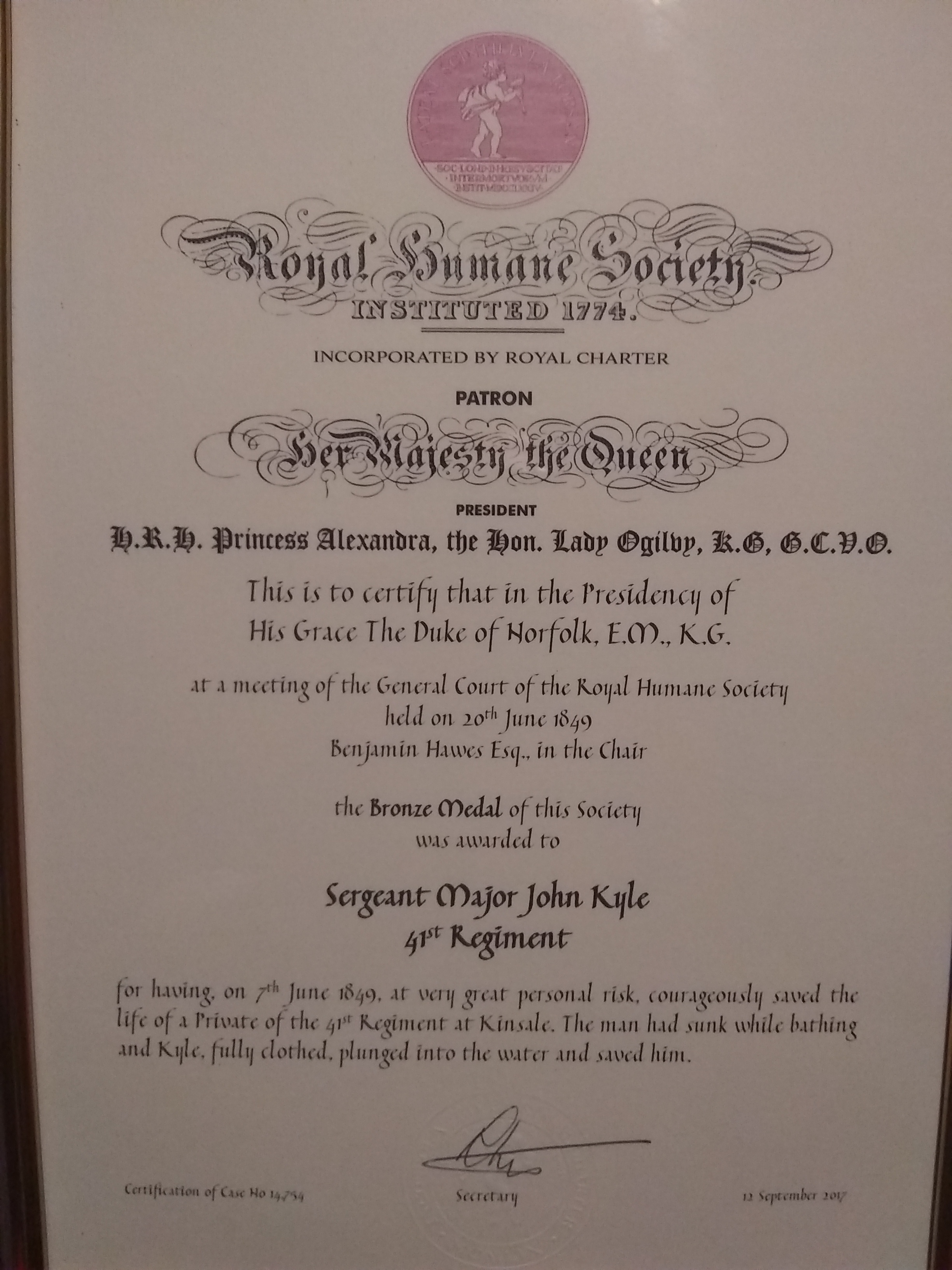
Finally, It would be inappropriate not to mention that shortly before his retirement from the army whilst the Regiment was stationed at King Charles Fort on the Southerly outcrops of Kinsale in Ireland, John Kyle rescued a Private soldier from drowning and saved his life by diving into the raging waters of the Irish Sea, regardless of his own personal safety and whilst in full uniform, brought him ashore between the jagged shoreline.
A copy of the Royal Humane Society certificate awarding John Kyle a bronze medal for successfully saving a man from drowning
Unfortunately we don’t have the name of that soldier but it goes to show that right up until the end of his career he thought nothing of his own safety but the safety of his men, now that’s what you call a real hero.
SUDDEN DEATH OF A VETERAN
We regret to record the death of Sergeant-Major Kyle, well known in the town and county from his being for many years on the staff of Carmarthenshire Militia as drill instructor to the volunteers of Carmarthen. In early life he saw a good deal of active service in India, and, on the regiment being ordered home, it was sent to Carmarthen about the time of the Rebecca riots, and soon afterwards the deceased retired, receiving a pension. He was then placed on the staff of the militia, but left a few years ago, much to the regret of the regiment. Sergeant-Major Kyle was warmly attached to the volunteer movement, and from the formation of the Carmarthen corps (with a slight interval) he acted as their drill instructor, and he will be remembered with affection by his comrades in arms. His conduct as a soldier, husband, father, and friend was that of an upright and worthy man, and his somewhat sudden decease will be lamented by many friends and acquaintances. He caught cold at drill on the 11th inst, inflammation of the liver supervened; and, after severe suffering, he expired on Thursday, He will be interred with military honours this afternoon.
WESTERN MAIL 21ST FEBRUARY 1870 PAGE 4
John Kyle’s grave at St David’s Cemetery Carmarthen.
Sergeant Major John Morgan 1775 – 1852. The United Kingdom’s longest serving member of the Armed Forces.
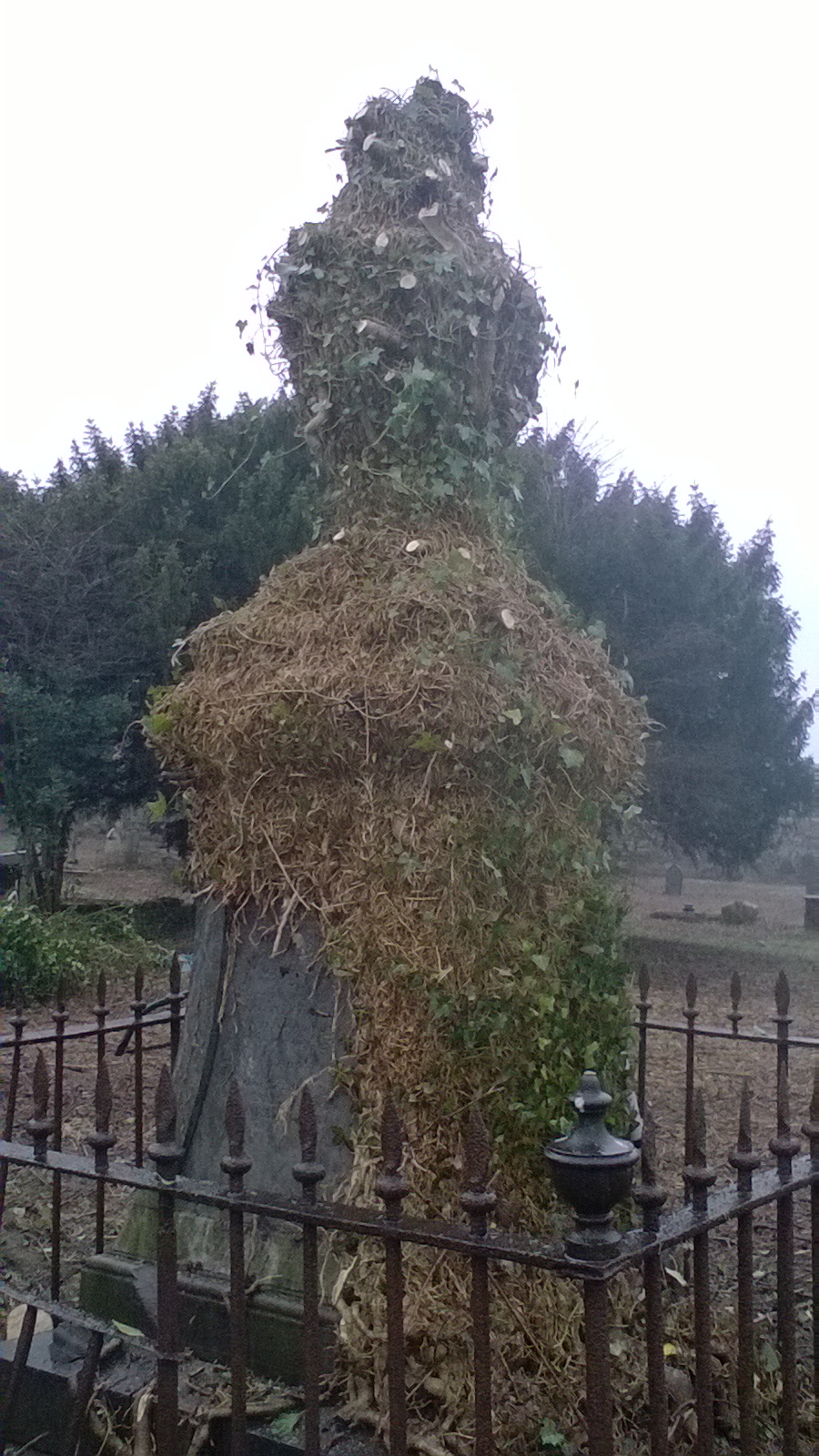
John Morgan’s memorial before restoration
John Morgan was born in Machynlleth in 1775. Little is known of his family at that time, though on setting up a small business in Carmarthen’s Priory Street, selling groceries and brewing beer in the 1780’s, his family became well known in the town and very wealthy as a result. When the Thomas & Elizabeth Mayhook Charity began the restoration of his family memorial we could never imagine what we were about to reveal and what condition the memorial would be in. Indeed at the outset, we did not even know to whom the memorial commemorated- if anyone.
For several months we began the painstaking removal of the Ivy that had wrapped itself around the limestone memorial to such an extent that it had formed itself into a kind of tree of it’s own as can be seen in the accompanying photographs.
The memorial during restoration.
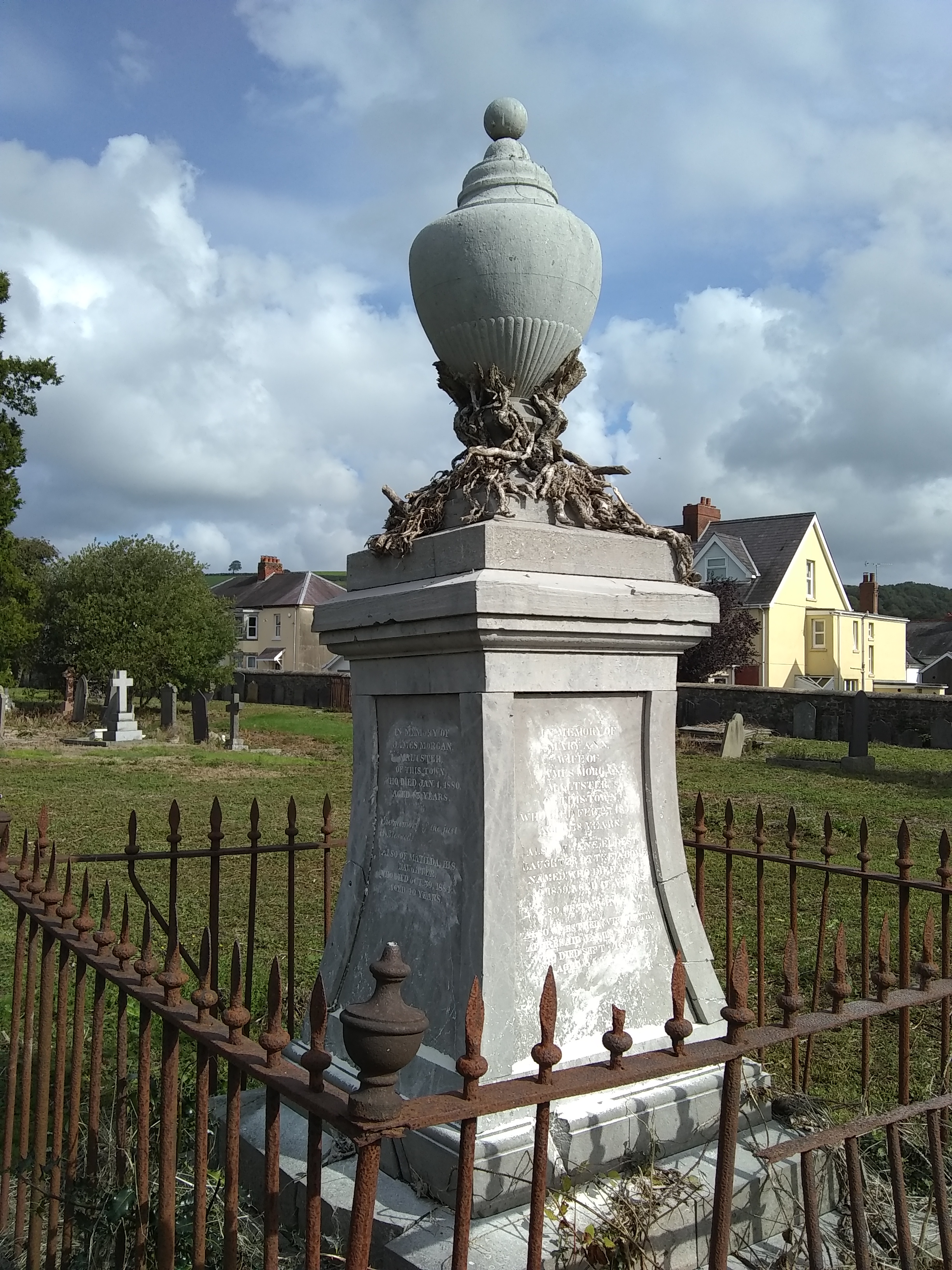
Gradually though, after sawing, cutting, pulling, and praying that nothing would fall off we gradually revealed the secret that lay beneath this enormous memorial – a huge and very impressive solid earn of limestone. Over 50 years of growth had finally been removed, and though there is some structural damage to some of the memorial, it is damage that can with care be repaired. It was decided however, to leave some of the old ivy growth around the base of the Urn at the top of the memorial to prevent the Urn from toppling over in the event of any weakness.
The solid limestone Urn atop the memorial is revealed.
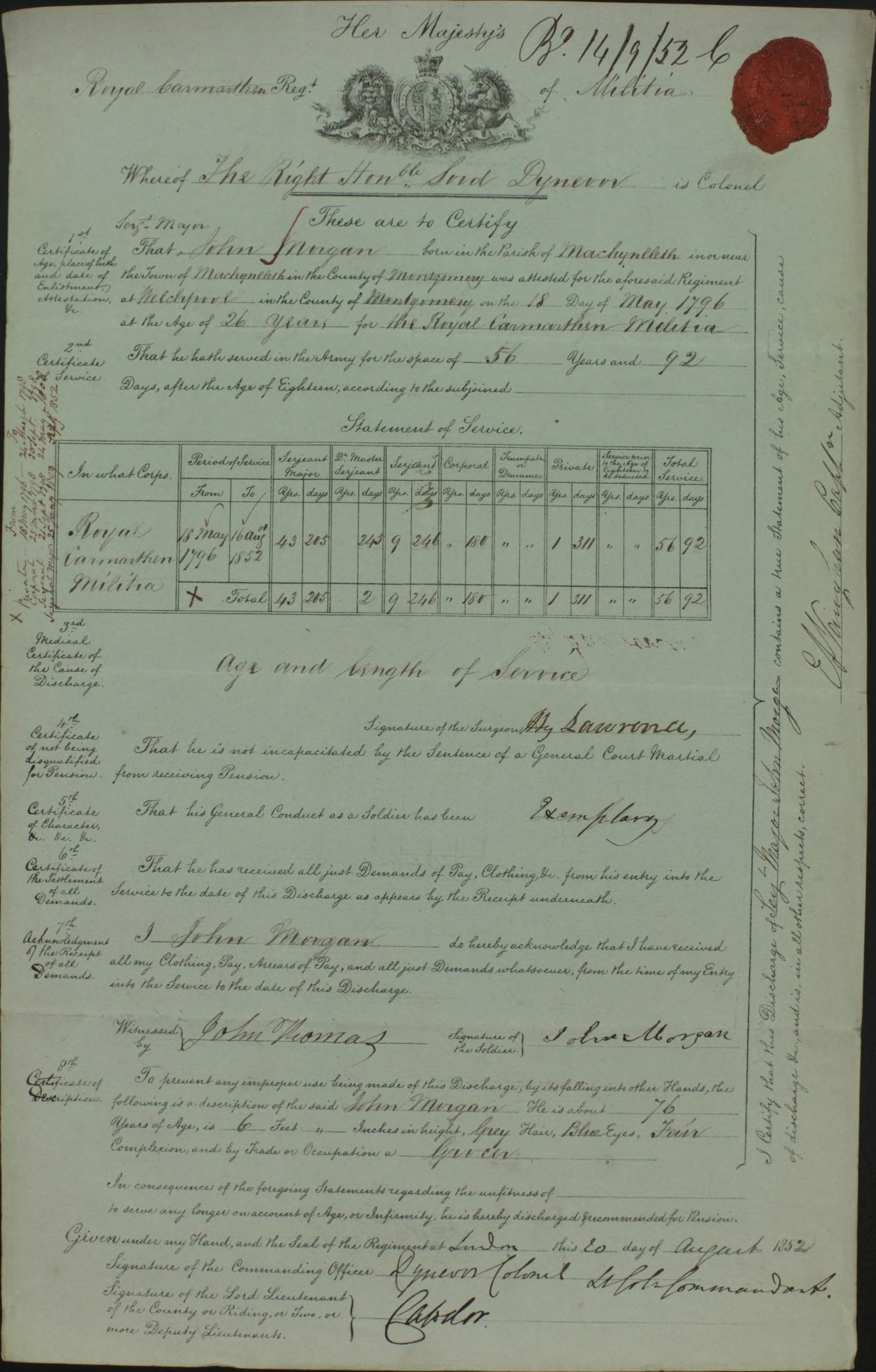
The memorial commemorates eight members of the Morgan family and in particular SERGEANT MAJOR JOHN MORGAN OF THE ROYAL CARMARTHENSHIRE FUSILEERS REGIMENT OF MILITIA, who died on June 6th 1857, aged 82. What is most remarkable about John Morgan is the fact that he served in the Carmarthenshire Militia for a total of 56 years and 92 days of unbroken service which as far as I know a record that is unsurpassed in British military history.
The memorial as it looks today including the ball on top of the urn which was found 100 metres away in the ground.
His record of service is as follows:-
Enlisted at Welshpool on the 15th May 1796 as Private aged 26
Promoted Corporal 25th March 1798
Promoted Sergeant 21st September 1798
Promoted Quarter Master Sergeant September 1808
Promoted Sergeant Major 25th May 1809 and continued in that post for 43 years until retirement in September 1852 aged 76 !!
Total length of service 56 years and 92 days
Now that’s what you call long service. From the French Invasion of Fishguard in 1797 to which John marched as a 26 year old Private with his 17 year old friend William Nott (later to become Major General Sir William Nott GCB) to the Napoleonic Wars and battle of Toulouse in April 1814, as part of the 23rd Regiment of Foot (Medal and clasp) John Morgan served his country well beyond that expected of him until his retirement in 1852.
One of the limestone panels with details of John Morgan and his wife. Three other panels are also inscribed with other members of the family
In 1857 he was laid to rest here in St David’s Cemetery with no ceremonial and only a small obituary notice in the local press. However, he does have the most impressive memorial which serves as a reminder of his past achievements. Being smothered in Ivy and bramble for over 50 years, his story can once again be told. May he rest in peace.
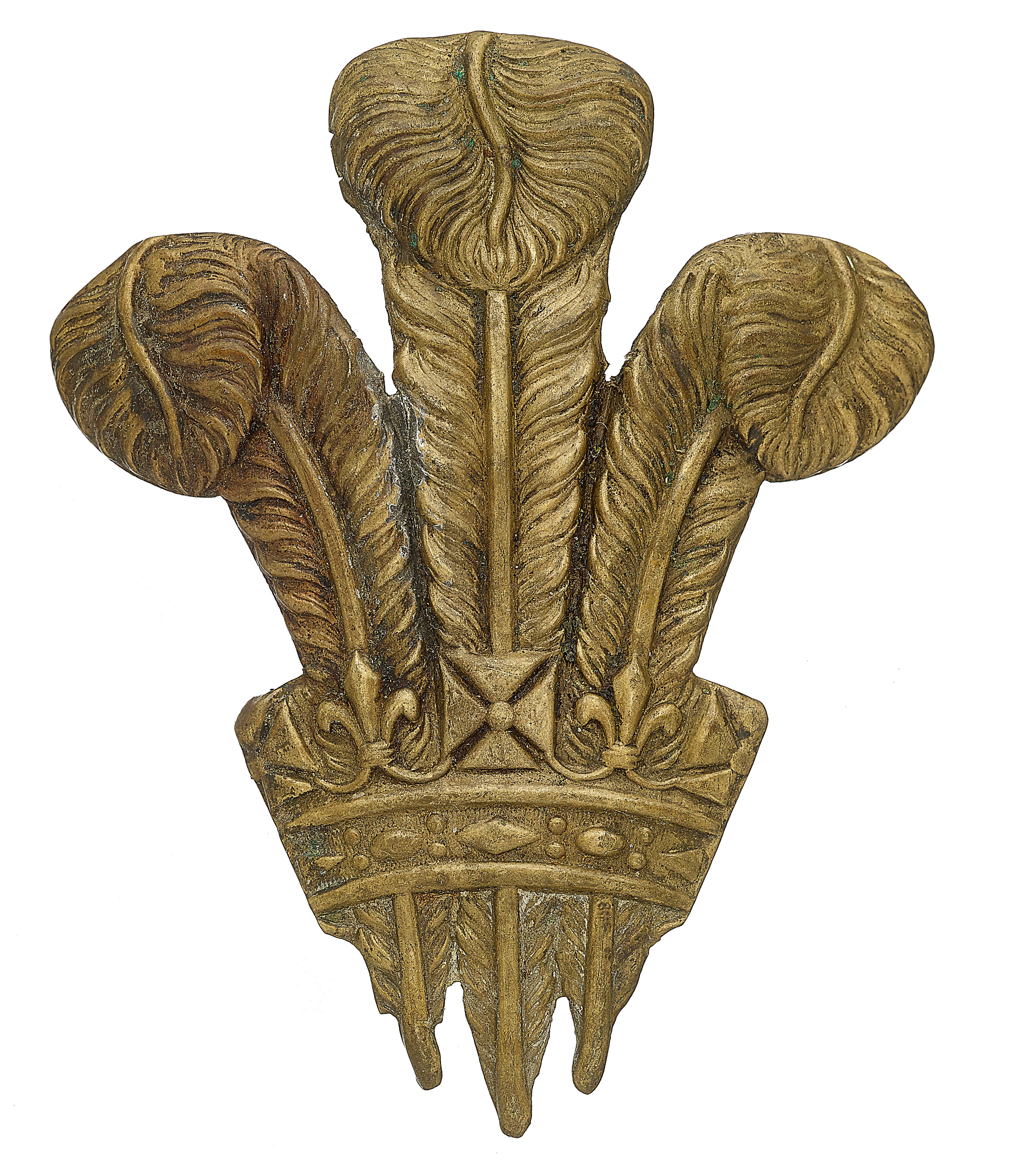
The discharge certificate of Sergeant Major John MorganOil painting on canvas, Colonel George Rice-Trevor. A full-length seated portrait of the 3rd Baron Dynevor, in uniform of Colonel of the Carmarthenshire Militia. Copyright by kind permission of the National Trust.Rare Brass Shako Plate, attached to the headdress of the Carmarthenshire Militia
We use cookies on our website to give you the most relevant experience by remembering your preferences and repeat visits. By clicking “Accept All”, you consent to the use of ALL the cookies. However, you may visit "Cookie Settings" to provide a controlled consent.
This website uses cookies to improve your experience while you navigate through the website. Out of these, the cookies that are categorized as necessary are stored on your browser as they are essential for the working of basic functionalities of the website. We also use third-party cookies that help us analyze and understand how you use this website. These cookies will be stored in your browser only with your consent. You also have the option to opt-out of these cookies. But opting out of some of these cookies may affect your browsing experience.
Necessary cookies are absolutely essential for the website to function properly. These cookies ensure basic functionalities and security features of the website, anonymously.
Cookie
Duration
Description
cookielawinfo-checkbox-analytics
11 months
This cookie is set by GDPR Cookie Consent plugin. The cookie is used to store the user consent for the cookies in the category "Analytics".
cookielawinfo-checkbox-functional
11 months
The cookie is set by GDPR cookie consent to record the user consent for the cookies in the category "Functional".
cookielawinfo-checkbox-necessary
11 months
This cookie is set by GDPR Cookie Consent plugin. The cookies is used to store the user consent for the cookies in the category "Necessary".
cookielawinfo-checkbox-others
11 months
This cookie is set by GDPR Cookie Consent plugin. The cookie is used to store the user consent for the cookies in the category "Other.
cookielawinfo-checkbox-performance
11 months
This cookie is set by GDPR Cookie Consent plugin. The cookie is used to store the user consent for the cookies in the category "Performance".
viewed_cookie_policy
11 months
The cookie is set by the GDPR Cookie Consent plugin and is used to store whether or not user has consented to the use of cookies. It does not store any personal data.
Functional cookies help to perform certain functionalities like sharing the content of the website on social media platforms, collect feedbacks, and other third-party features.
Performance cookies are used to understand and analyze the key performance indexes of the website which helps in delivering a better user experience for the visitors.
Analytical cookies are used to understand how visitors interact with the website. These cookies help provide information on metrics the number of visitors, bounce rate, traffic source, etc.
Advertisement cookies are used to provide visitors with relevant ads and marketing campaigns. These cookies track visitors across websites and collect information to provide customized ads.