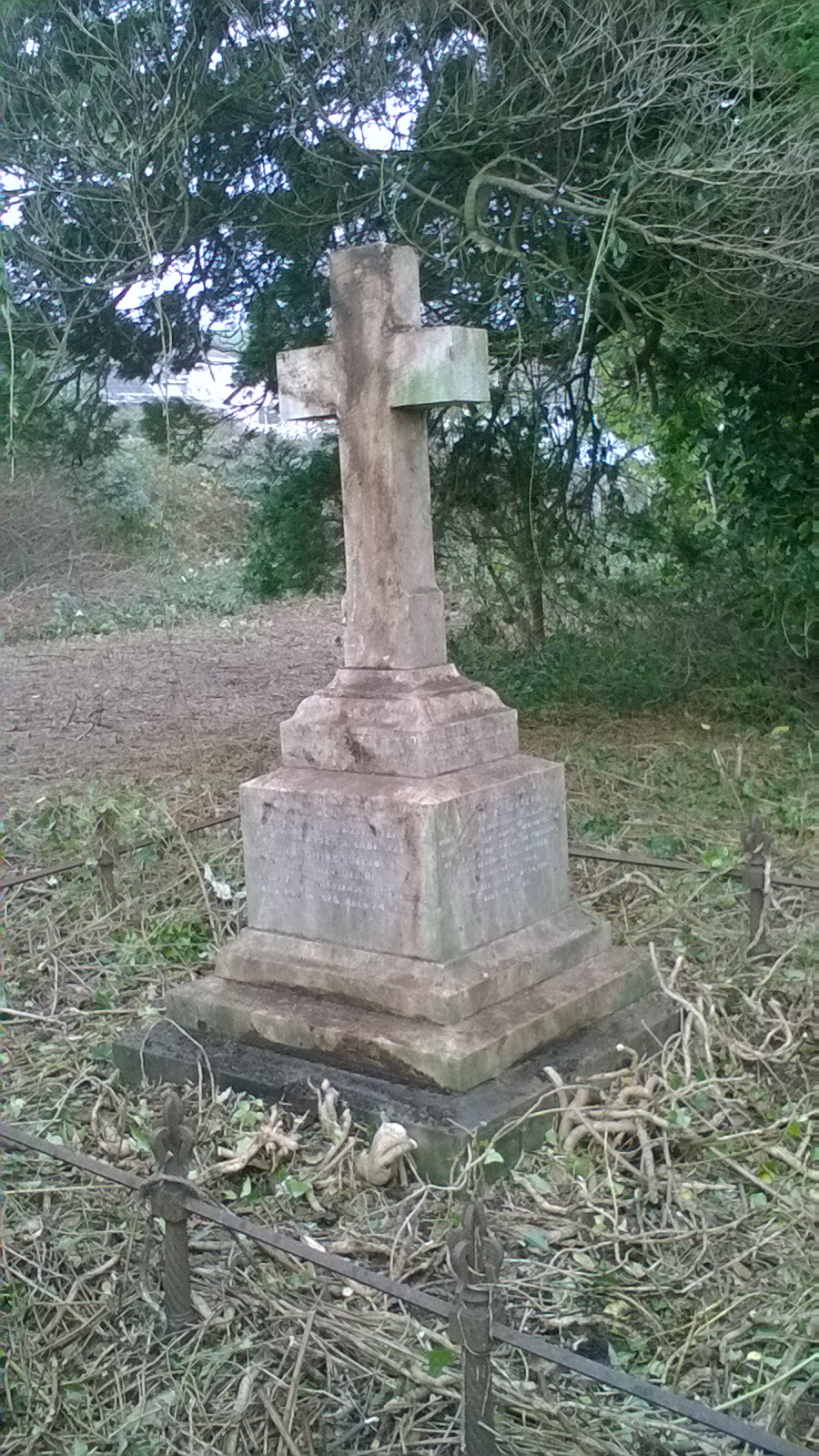
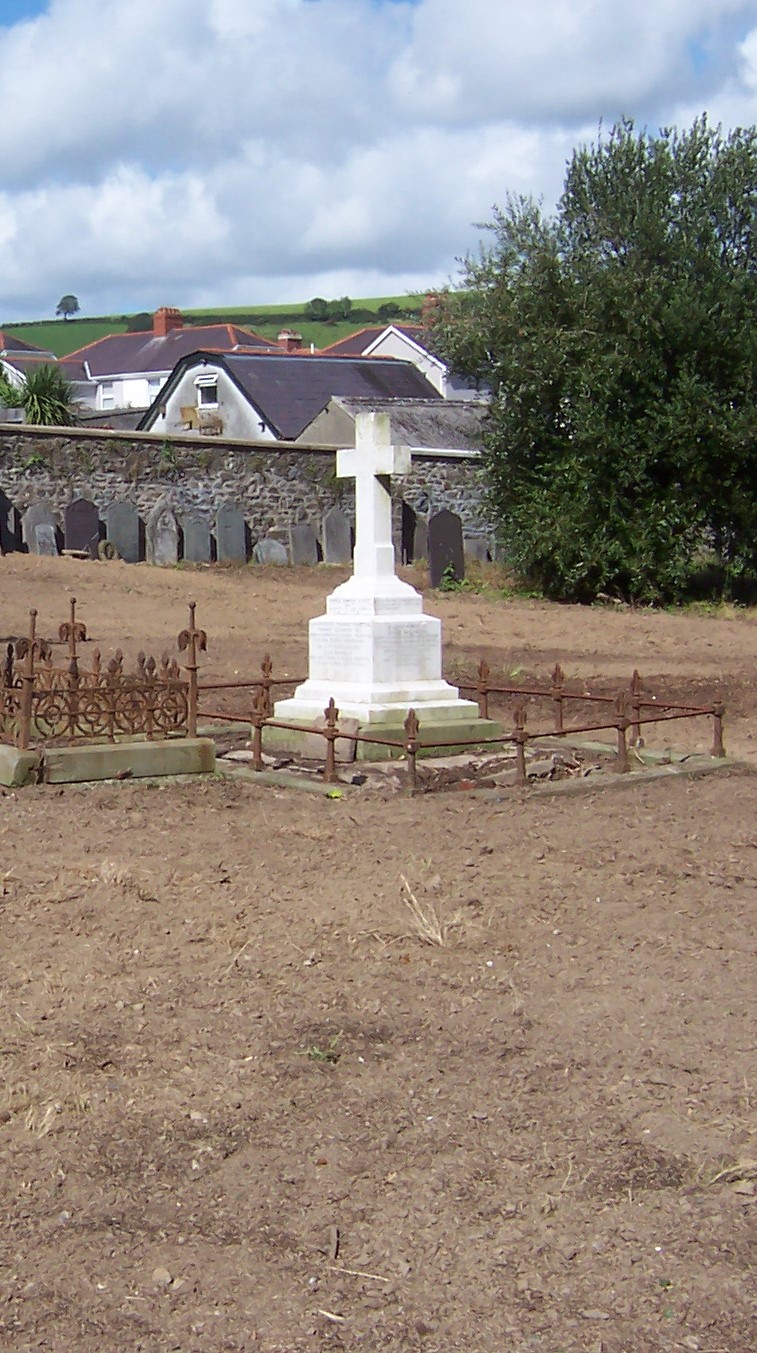
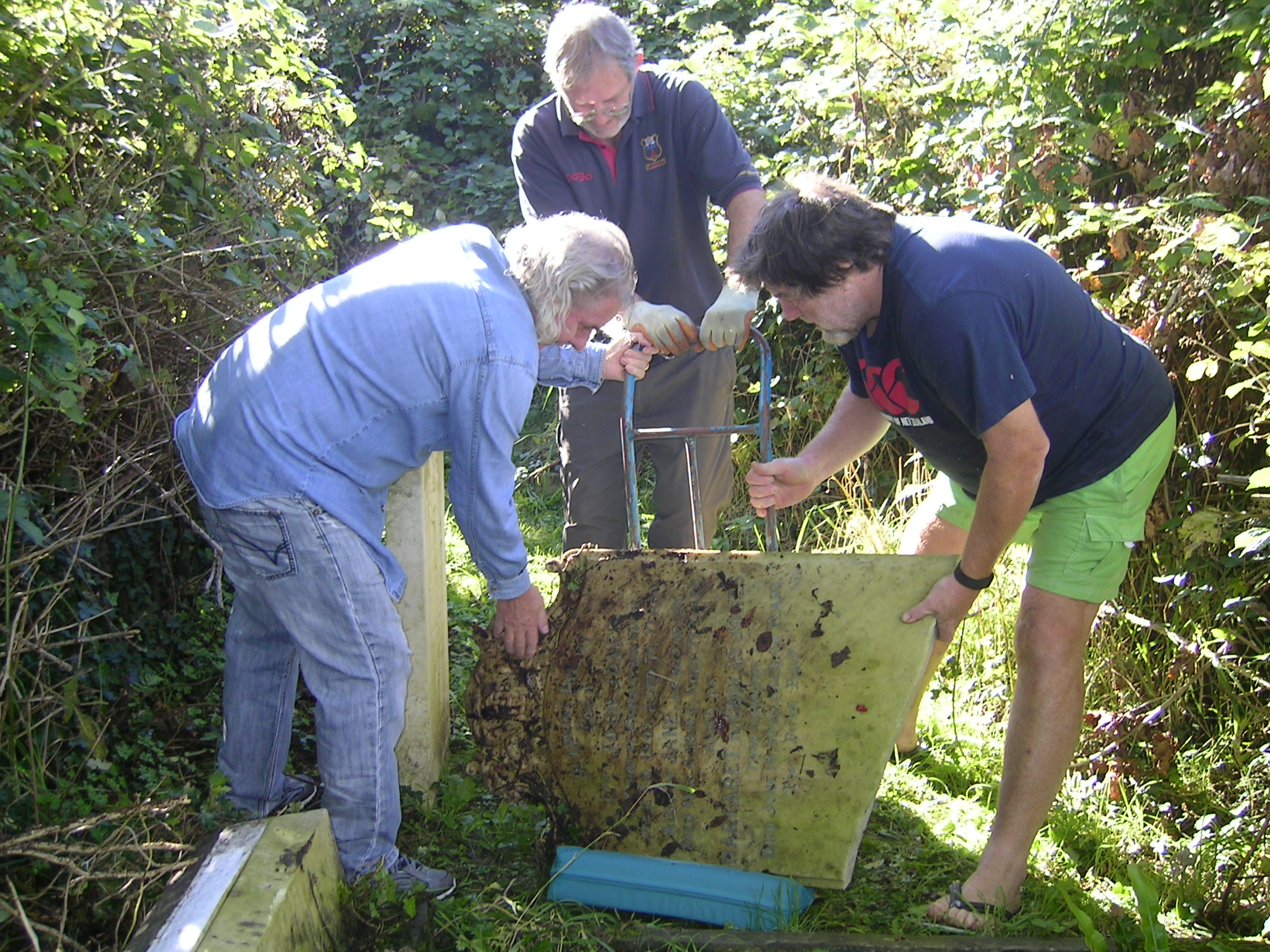
Welcome to the Thomas & Elizabeth Mayhook Charity website, dedicated to the Preservation, Upkeep & Maintenance of the historic St David’s Cemetery Carmarthen
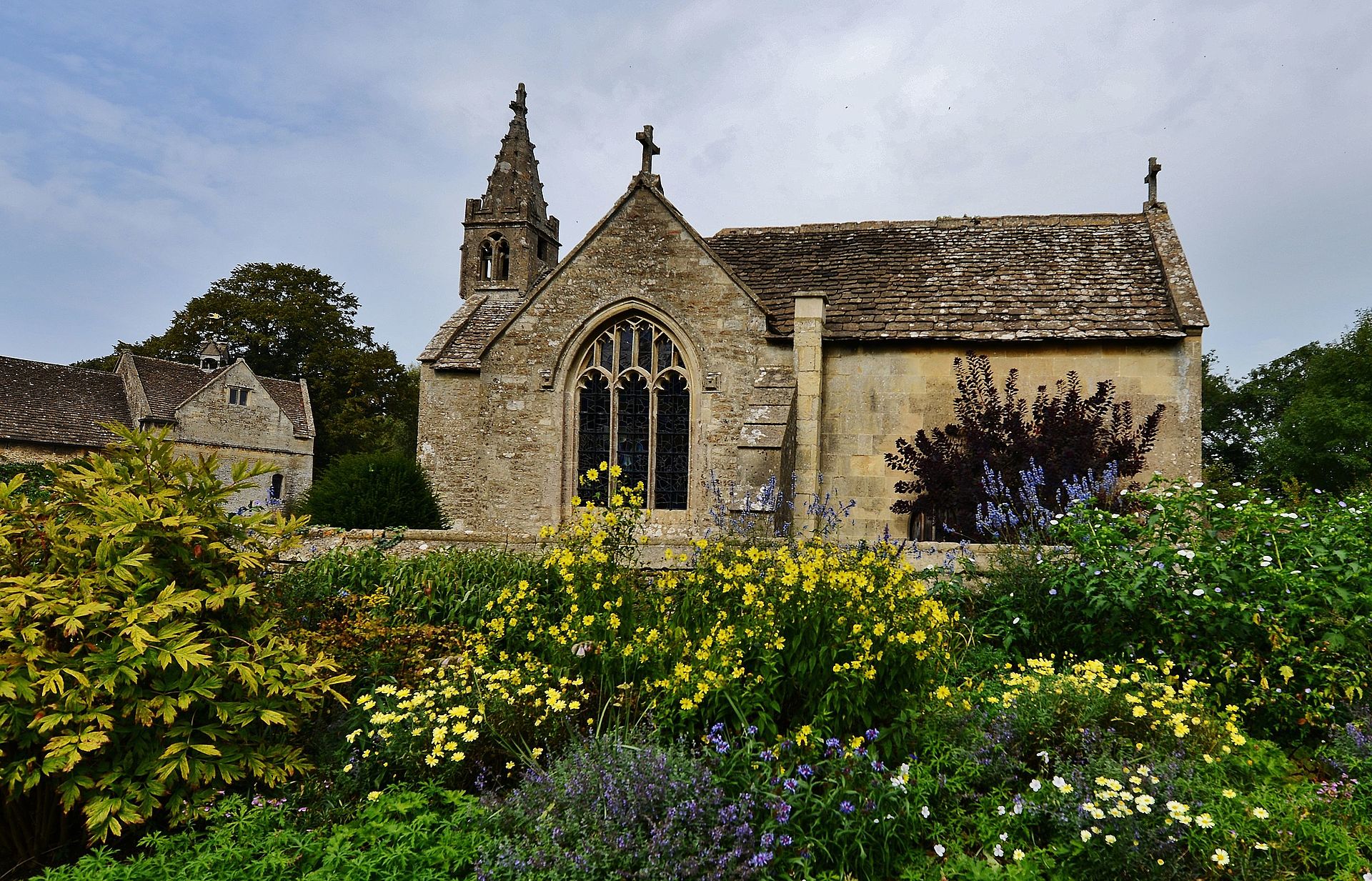
George Nott is described in the Carmarthen Census of 1851 as a “Landed Proprietor” He lived in Picton Place and had three servants one of whom was Ms Emma Daniel. George was the eldest of three brothers. George was born in 1780 his brother William* in 1782 and the youngest Henry in 1784. All were born in the small village of HOLTin Wiltshire and baptised in the neighbouring village church of Great Chalfield.
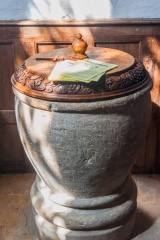
The Early Norman Font at Great Chalfield Church where George, William and Henry were all Baptised.Copy of the Baptismal entry in Great Chalfield Church for William Nott. This original copy is in the British Library and was required by the East India Company as proof of Baptism before entry could be accepted as an Officer Cadet in the Bengal Army
For some inexplicable reason, all published material on the birth of these children in particular William gives the birthplace as Neath which it was not as can be proven from a copy of the Baptism register in Great Chalfield Church. George’s father Charles was a native of Shobdan in Herefordshire and was a well respected agriculturist. In the early 1790’s the family found themselves in Neath where Charles was employed to run the rural estate of Sir Herbert Mackwith of Knoll Castle. It was during this time that the boys were educated albeit briefly at Cowbridge Grammar School. In 1794 the family were on the move again – this time and for the last, to Carmarthen where Charles rented two farms in Johnstown and also became the proprietor of the “Old Ivy Bush Inn” in King Street, later to become the Ivy Bush Royal Hotel in Spilman Street, whilst also entering at the same time into the business of mail contractor (Post Office)
All Saints Parish Church Great Chalfield where George, William and Henry were all Baptised. copyright M Garlick.
The youngest brother Henry died at a very young age whilst serving as a junior officer in the Royal Army in 1799 aged just 15, and William the second and middle of the three brothers became one of the most famous Generals and Army Commanders in British military history rising to the rank of Major General in the Honourable East India Company taking charge of the Army in the first Afghan War of 1839- 1842. William was knighted for his services to his country and received the Knight Grand Cross of the Military Division of the Most Honourable Order of the Bath on behalf of Queen Victoria from the hands of the Governor General of India Lord Ellenborough and also received a gold sword encrusted with diamonds, emeralds and rubies on behalf of a grateful British Government which has never been found to this day.
Major General Sir William Nott GCB by John Deffet Francis curtesy of the National Museum of Wales
Whilst serving in the mountainous terrains of India and Afghanistan William entrusted the education of his two eldest boys, Charles and William to his brother George in Carmarthen and correspondence dated 1818 refers to their being educated by a Mr Williams from the town. Later in life both boys went on to be educated at Eaton and subsequently had very successful careers in the legal profession and in the City of London. On the General’s triumphant entry into Carmarthen in 1844 after his retirement from the army the first person he called with was his brother George in Picton Place where it is recorded that upon reaching the house the General, helped from his carriage wept openly upon embracing his devoted brother, such was their bond despite not seeing each other for over twenty years. Sadly, in January 1845 Sir William passed away from heart failure and was buried alongside his parents in St Peters Church Cemetery in what was described as the largest funeral ever to have taken place in Carmarthen. George died unmarried In January 1855 aged 75 and rather interestingly the inscription on his memorial reads “GEORGE NOTT OF CARMARTHEN”
The damaged grave of George Nott before restoration
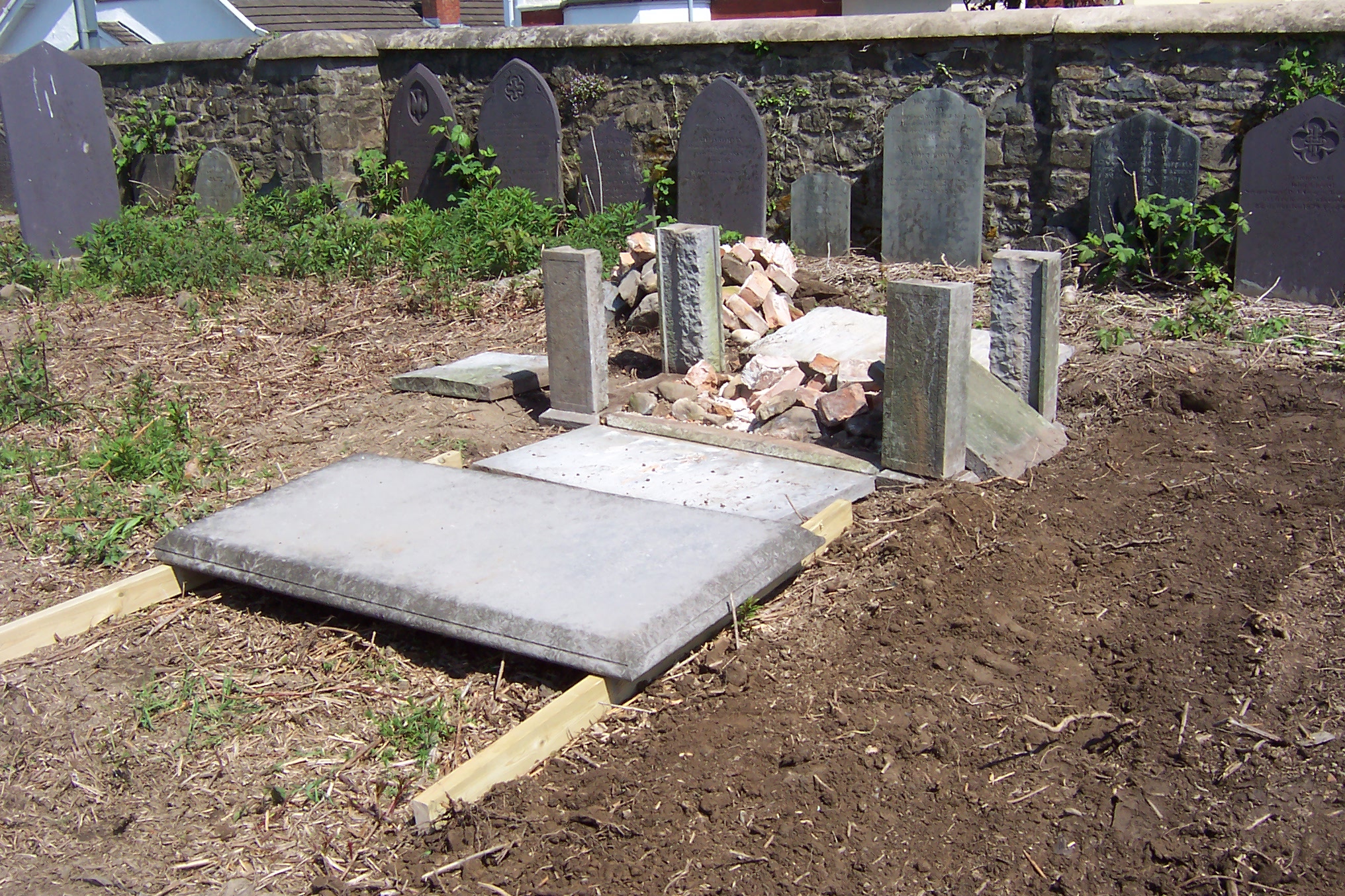
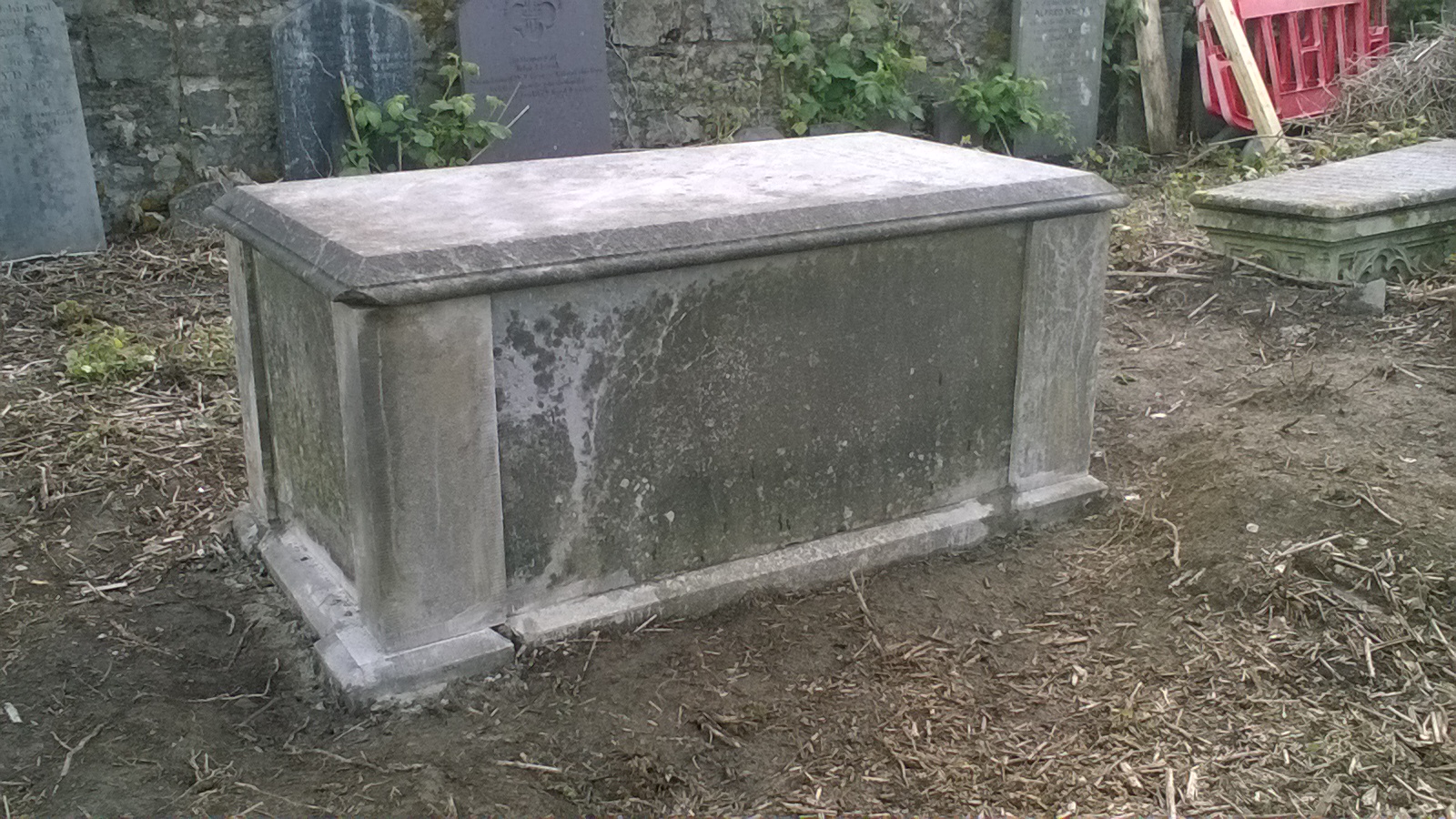
The restoration of George Nott’s grave in St David’s Cemetery was a complex one involving the complete dismantling of the structure due to its cast iron fixings becoming eroded and part of the structure having collapsed over time. The accompanying photographs give a good indication of the work involved from the beginning to end and this could not have been achieved without the help and assistance of Davies Cranes who gave their time and equipment freely, and also to Tumble Memorials and Philip Bowen the proprietor whose expertise was invaluable. Finally a mention must also be given The Right Honourable Sir John Nott KCB – direct descendant of the General and whose generous donation made everything possible.
The restoration in progress
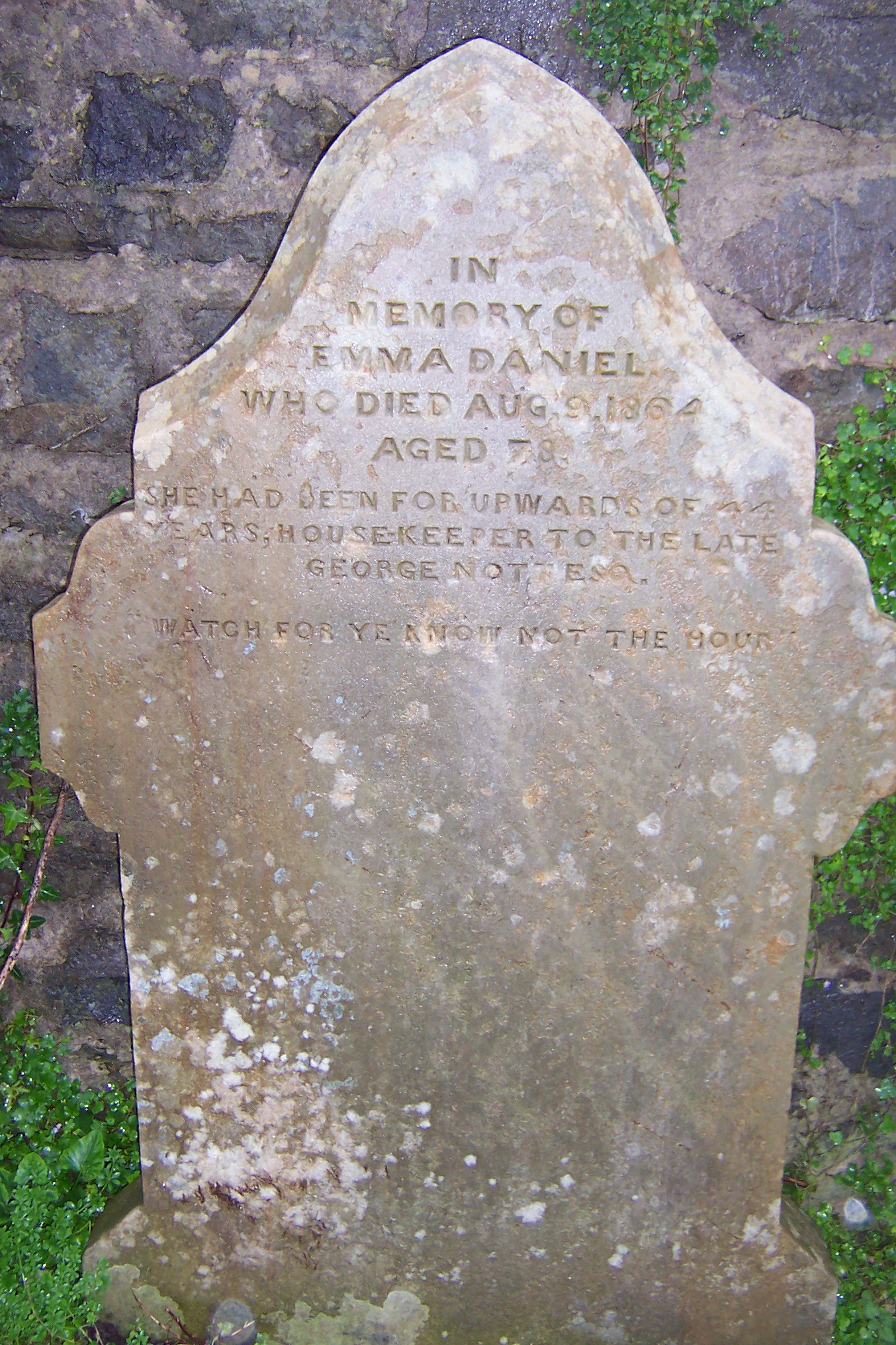
Elsewhere in the cemetery is also the headstone of Miss Emma Daniel, devoted servant of George. Very clearly she must have been well cared for, as she passed away nine years after George in 1864 and was provided with a very nice headstone and suitable inscription.
Almost complete
Completed restoration
The headstone of Miss Emma Daniel. Housekeeper to George Nott for 44 years
OBITUARY NOTICE OF SGT WILLIAM ARCHARD MORRIS, DCM. FREEMAN OF CARMARTHEN
10TH MAY 1918
A Freeman of Carmarthen SERGT “ARCHIE” MORRIS, D.C.M., DIES FROM WOUNDS There were expressions of regret on all hands at Carmarthen on Friday last when the news arrived that Sergeant W. Archard Morris, D.C.M., Welsh Regiment, son of Mr. Phil Morris, compositor at the JOURNAL Office, and Mrs. Morris, Island Wharf, Carmarthen, had died In hospital in Birmingham from wounds ‘received in the recent offensive in France. Sgt. Archie” Morris, who had a long and meritorious service in the army, was well-known and highly popular in Carmarthen, and in January last, whilst home on leave from the front, the freedom of the borough was conferred upon him at a public meeting at the. Guildhall in recognition of his winning the Distinguished Conduct Medal and the Order of St. George of Russia for bravery in France described in the “Gazette” of Sept 22nd, 1916, follows: “For conspicuous gallantry and devotion to duty in action. By his fine leadership a sap held against hostile attacks. Though wounded he remained throwing bombs for two hours. He has displayed great bravery on other occasions.” Although only thirty-eight years of age, the deceased was veteran in the service of his King ‘and Country. He served through the Boer War with the 1st Battalion the Welsh Regiment, and at the close of that campaign was awarded the Queen’s and King’s medals with six clasps. As a time-expired man, he enlisted at the outbreak of the present war, when he was working at Neath, and went out to France in November, 1914, and had served at the Western front for three and a half years. He had experienced very severe fighting, and at Pozieres was badly wounded. Of a kind and amiable disposition, he was very popular in his regiment, at Carmarthen, and at Neath, and the deepest sympathy is extended to his widow, a native of Stonely, Hunts. and to his parents and relatives. The four other sons of Mr. and Mrs. Phil Morris are, on active service. The high esteem in which Sergt. Morris was universally held in his native town was demonstrated in a marked degree at the funeral, ‘which took place at St.. David’s Churchyard; Carmarthen, on Tuesday. The body arrived from Birmingham the previous day. As was fitting in the case of such a brave and gallant gentleman the burial was carried out with military and civic honors. The funeral was largely attended by all sections of the community, while the streets were lined with crowds of sympathizers. The service at the house was conducted by the Rev. Gwynfe Jones (curate of St. David’s) and Mr. R. Bathe Davies (lay-reader), after which the cortege proceeded to Christ Church, where an impressive service was held. The cortege was headed by the Rev. Griffith Thomas (vicar of St. David’s), Rev. B. Parry Griffiths (vicar of St. Peter’s), Rev. Gwynfe Jones, and Mr. R. B. Davies, who were followed by a firing party of the local Volunteer Regiment, under the command of Lieut. Spurrell, who was in charge of the procession; the Town Band, led by Trumpeter John Jones, Magazine-row, which played the Dead March en route: the wounded soldiers at the Red Cross Hospital; the discharged sailors and soldiers of the town; the general body of the Volunteer Force; the St. David’s Church Lads’ Brigade, under Lieut. W. David Thomas; and a detachment of the Labour Battalion stationed at Carmarthen who formed the bearers. In front of the coffin marched the boys of the Model School (of which Sergt. Morris was an old pupil) with their headmaster, Mr. J. Howell Davies, each carrying a wreath, together with Mr. H. V. Burnhill, MM who was made freeman of the borough the same time as Sergt. Morris; and Mr. W.D. Jones, who assisted the Mayor and Mr. Lewis Giles in making the necessary arrangements.
The original headstone before being renewed in 1987. Note the different spelling for WELCH in comparison with the new one.
The coffin, wrapped in the Union Jack and surmounted by deceased’s cap, belt and bayonet, was borne on a bier, after which came his (widow); Mr. Phillip Morris (father); Staff-sergeant W. Cole, R.E., and Mrs. Cole, Cardiff (brother-in-law and sister) Miss A. May Morris, Cardiff (sister); Mr. Charles Davis, Graig, Treharris (brother- in-law); Mr. and- Mrs. J. Dent, Carmarthen (cousins); Mr: I Herbert Williams, Carmarthen (cousin); and Mr. Willie Jones, Pontypridd. Deceased’s four brothers were unable to be at the funeral as they arc on active service m Palestine.
Among the general public were the Mayor (Aid. Wm. Evans}; the deputy mayor Cllr, John Lewis, J.P.); Mr. H. Brunei White (town clerk); borough justices, and the Corporation. Sgt. Longden, D.C.M. Welsh Regiment (an old friend of the deceased), and Sergt. Jones, representing the Registration Staff, and other prominent gentlemen of the town. The cortege was met at Christ Church gate by the choir, the cross-bearer being Lance-corpl. Gwilym Lewis and the firing party lined up in the gateway. The Vicar conducted the service at Christ Church, the lesson being ‘read by the Rev. B. Parry Griffiths. The large congregation feelingly rendered the hymn, On the Resurrection Morning” and “Now the Laborer’s task is o’er.” As the procession left the sacred edifice, Griffith Thomas gave a beautiful -rendering of “0 rest in the Lord” on the organ. At the grave- side the committal prayers were delivered by the Revs. Griffith Thomas and Gwynfe Jones, after which “0 Fryniau Caersalem” was sung by the crowd of sympathizers who had gathered round.
Sunday 29th November 1987. All four headstones were renewed. Richard Goodridge – Chairman of the Thomas & Elizabeth Mayhook Charity is on the right. The poppies were laid by Captain Richard Withers (Adjutant 4th Volunteer Battalion)
The firing party then fired over the grave, and the “Last Post” was sounded by members of the C.L.B. Beautiful floral tributes were sent by the following:-His Wife, Mum and Sis, Stonely Hunts.; Father, Mother and Brothers; Sisters Minnie, Gertie and May; All at Millstream Cottage; Uncle, Auntie and Cousins, Friar’s Park; Mr and Mrs. Ernest Howell, of Handsworth. Birmingham; Journal Office Staff: Model Schools boys; Mr. and Mrs. Peters, Priory-street: Mrs. Alfred Olive and family, Jolly Tar; Mr. and Mrs. A. Crabb; Mrs. Jones end family; Mr. Bland Davies and family; Mrs. Hopkins and family; Mary and Lizzie, 16, Quay-street; Mrs. Jones, 19, Blue-street; Mattie and Jennie, Bridge-street; Fred and Alice: Mr. D. J. Harris, Buckingham- place; Mrs. Griffiths and family, Buckingham place; Mrs. Thomas and Maggie; Mr. and Mrs. W. Burnhill, Friar’s Park; Gunner Jim Jones; Mrs. M. Rees, MiII- street: and Mrs. D. Phillips, Mill-street.- Mr. Morris and family desire to thank all who sent them letters of sympathy and floral tributes in their bereavement.
RUSSIAN DECORATION FOR CARMARTHEN D.C.M.
Mr. & Mrs. Philip Morris; 24. Island Wharf, Carmarthen, have been informed that their son. Corporal W Archie Morris, Welsh Regiment, has been awarded the Russian Order of St. George in addition to the DCM. On Tuesday morning Mrs. Morris received the following letter from Corporal W H Farrell, Welsh Regiment, of 2, Woodland Terrace, Troedyrhiw, Glam…
“Dear Mrs. Morris, I expect you will be surprised to have a letter from a person, who is a stranger to you, but I have seen your son’s photo, in the Evening Express and the announcement that he has been awarded the D.C.M. No doubt you are proud of the fact, and so are all who know him. I had the pleasure of knowing Archie (as we called him) for eight months, and in fact it is he that I have to thank for my being alive to-day. I enlisted in the 3rd Welsh with a chum two years ago, and the following Feb- got drafted to the 2nd Battalion in France, where we met Archie, and we became great pals. We kept together until September of last year, when we went into the battle of Loos. Two days later, in the middle of the night. I became severely wounded in the back by a piece of shell and was clean out for a while. On coming round I shouted for assistance and Archie came to my aid, carried me back to safety, and bandaged me up. No doubt, but for his timely aid, I would have died through loss of blood. My pal has told me since he came home wounded a few weeks ago that Archie had been badly wounded, and we heard no more about him. I hope you will send him this letter, and I trust it will find him alive and well again. I have been discharged a good while now, as I am partially disabled, but would like, to meet Archie if possible to thank him. This is only one act of bravery out of many that your son has done and I send him my heartiest congratulations on him winning the D.C.M., and he has earned it right well. When you send him this he will remember me, also my chum, Lance Corporal Thos Jones, now in Cardiff. I will close now, trusting you are in the best of health.”Corporal Morris has four brothers presently serving in the Army, “Corporal Phil. Morris, Pembroke Yeomanry, Sapper, Arthur Morris, Royal Engineers; Trooper Denver Morris, Welsh Territorial’s – Sapper Ernest Morris, Royal Engineers: while his brother-in-law, Sergeant William Cole, is serving with the Royal Engineers. His father, Mr. Philip Morris, is a Volunteer of many years standing, and formerly belonged to the 12th Glamorgan (old Taff battalion, the 2nd Carmarthen, and the Isle of Wight Rifles)
The above article appeared in the Carmarthen Journal 24th November 1916, page 8
CARMARTHEN VETERAN SOLDIER OF KANDAHAR HERO PASSES AWAY.
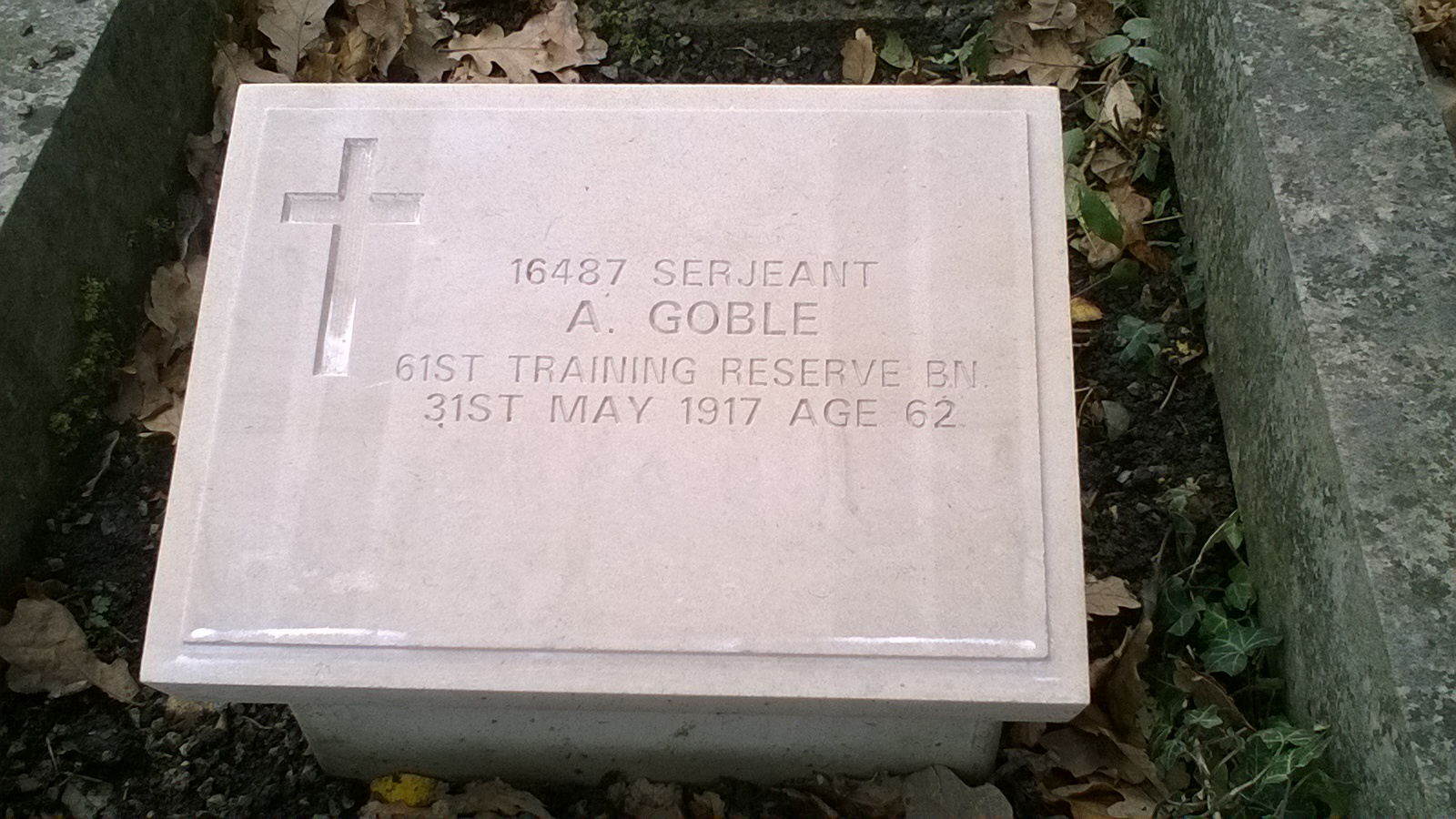
The news of the death of Sergeant Goble at a military hospital in North Wales on Thursday last week was received with much regret at Carmarthen. He had a splendid record of military service, having served in the Regular Army many years. He was one of the now dwindling band of hero’s of the Afghan campaign of 1878 and took part in the celebrated march to Kandahar under Lord Roberts. Sergt Goble could tell many thrilling stories of that campaign when he served in the Elephant Battery. He was a native of Worthing, Sussex. He came to Carmarthen a good many years ago as instructor for the Royal Garrison Artillery. As soon as the present war broke out Sergt Goble was anxious to do his bit once again, and after being employed for a period at the Army Remount Depot at Carmarthen, he joined on the 21st Feb1915, a service battalion of the Welsh Regiment stationed at a North Wales camp, and remained there until his death after a short illness. He was 64 years of age. He leaves a widow, four daughters and four sons-two of whom are serving with the Army. On Monday the body, accompanied by four sergeants from deceased’s camp arrived at Carmarthen, and they were met at the station by the local V.T.C., under the command of Mr. Walter Spurrell. The funeral, which was a military one, took place on Tuesday, interment being made at St. David’s graveyard. The cortege was headed by a number of the V.T.C., under the command of Mr. John Saer, and was followed by the hearse, the coffin being draped with the Union Jack, and surmounted by beautiful floral wreaths. There were a number of wounded soldiers from the Red Cross Hospital and soldiers from the Registration Staff present. The bearers were deceased’s fellow sergeants. The Rev. Griffith Thomas, vicar of St. David’s, officiated throughout. At the graveside the “Last Post” was sounded by a bugler from Kinmel Park. The chief mourners were: Mrs Goble (widow); Masters Albert and James Goble (sons); the Misses Nellie, May, Jenny and Nancy Goble (daughters); Mrs. F. Goble (daughter-in-law); and Mrs Kettley, Parcmaen street. Wreaths were sent by the Widow and Children; Stan Robinson; Mr. and Mrs Weaks; Sergeants’ Mess at Kinmel Park; Staff at the Land Valuation Offices; Mrs. Kettley; Mrs. Reeves; Members of his Company at Kinmel Park; Annie and May Morgan, Kidwelly The two elder sons of the late soldier, who are on active service in France, were unable to come home in time, for the funeral. Mrs. Goble and family wish to thank their friends for the sympathy extended to them in their bereavement.
CARMARTHEN JOURNAL 8TH JUNE 1917 SECOND EDITION PAGE 3.
MR HARRY EVANS.
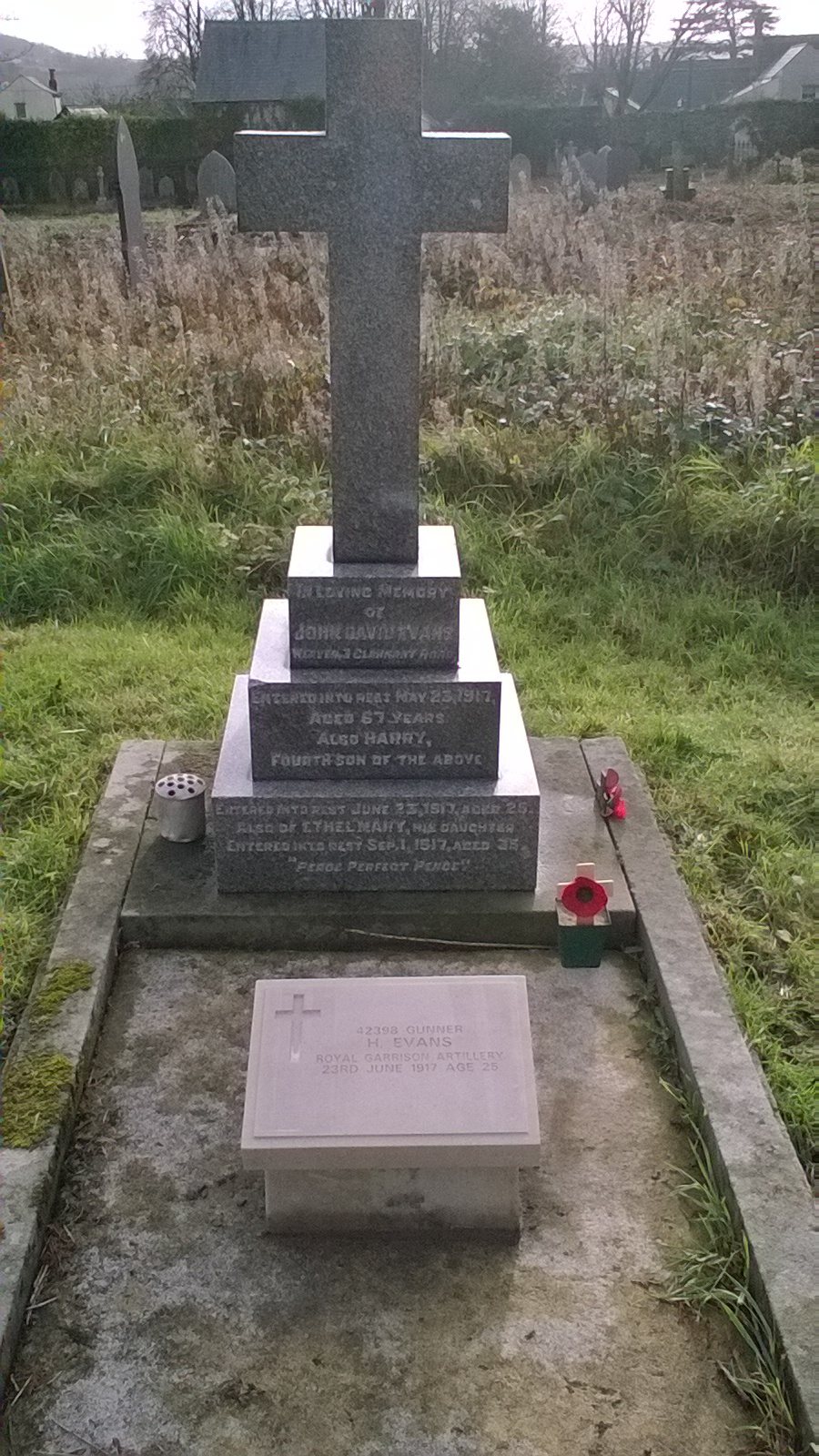
We regret to announce the death of Mr. Harry Evans, 3, Glannant Road, Carmarthen, which event took place on Saturday last at the residence of his sister and brother-in-law, Mr. and Mrs. D. J. Davies, 37, Queen-street, Llandovery, in his 25th year. Deceased joined the Royal Garrison Artillery the second week of the war, and served in France and Salonika for some time. Owing to ill-heath, he was discharged some time ago. He was only a few days at Llandovery, thinking that a change would do him good. Deceased was the fourth son of the late Mr. John Evans, weaver (whose death we recorded in these columns only a few weeks ago), and was a very highly respected young man. The body arrived in Carmarthen by motor-car on Monday evening. The funeral, which was for men only, took place on Wednesday afternoon last at St. David’s Churchyard, and was largely attended, notwithstanding the inclemency of the weather. The service at the house was conducted by the Vicar (Rev. Griffith Thomas) and at the church the Vicar and the Rev. J. Gwynfe Jones (curate) officiated, while the former further officiated at the graveside. The chief mourners were: John, Teddy and Victor (brothers); Mr. D. J. Davies (brother law); Mr. David Evans, St. David’s Street, Mr. John: Griffiths, St. David’s-street (uncle). Wreaths were sent by the following: Mother and sisters; David Jack, Ted and Victor; Misses Hancocke, Wimbledon; Mrs. Orman and family, 6, Glannant road; Agnes and Polly, 37: Water street; Mr. and Mrs. Harries Millstream Cottage; Sallie and Willie, 4, Glannant-road; Mr. and Mrs. Williams, Cardigan House; Mr. and Mrs. Williams, Green Hill, Trevaughan; Mrs. Williams, Cemetery Lodge; Ebenezer Thomas, Drover’ Arms; Gwladys and all at 38, Water-street; Mr. and Mrs. W. Bartlett, Castle House; Mrs. Phillips and family, Water-street; all at 2 Glannant- road; Miss Ellen Griffiths, 46, Lammas- street. The family wish to sincerely thank all those who sympathised with them in their sad bereavement.
Carmarthen Journal 29th June 1917 page 1
Private Brighty Thomas Lewis – Welsh Regiment
His many friends learned with regret of the death of Pte. Brighty Thomas Lewis, 1/4 Welsh Regiment, son of Mr. D. Lewis, 47, Mill-street, which occurred on Saturday at the age of 29 years. Deceased joined the Army in November, 1914, and landed in Egypt in August, 1915. He had served in the East for about three and a half years. He was wounded in March. 1916, and again on July 13th, 1918, when he had the misfortune to lose his right leg. Pte. Lewis arrived home from hospital on December 14th, and had been under several operations for his leg. Before joining the Army, he was a collier at Ponthenry. Sympathy is felt with the bereaved father, widow and two little children in their sorrow. The funeral took place on Tuesday at St. David’s Churchyard, Revs. E. Basil Herbert and J. Gwynfe Jones officiating. Deceased was accorded military honours, and the funeral was a very impressive one. Heading the cortege were the Deputy Mayor (Ald. John Lewis, J.P.), and Councillor Thos. Davies, who were followed by a large muster of soldiers on leave, among whom were several repatriated prisoners of war. Members of the Discharged Soldiers’ Federation were also present in good numbers, in charge of by Mr. Meredith Williams, chairman of the local branch. At the graveside the Last Post” was sounded by Mr. Dan Bowen. The chief mourners were Mr. D Lewis (father), Mr. D. Ray (father-in-law), Messrs D. Thomas, W. Evans, D. Evans and F Bye (brothers-in-law) and Mr. David Lewis (cousin). Floral tributes were received from the following: All his friends; Mrs. Richards 7 Mill- street; Mrs. Richards,1 Cotterill’s Lane; Mrs Mortimer, 2 Mill-street; Mrs. Richards, Cambrian Place; Mrs. Evans 34 King-street; Mrs. Williams, 32, Mill-street- and Mrs. Evans, Fountain Hall, Terrace.
Carmarthen Journal 28th February 1919 page 4
MR. G. H. WALTON.
Among those who halve succumbed to pneumonia following influenza is Mr. George Herbert Walton, elder son of Mrs. Walton, 73, Lammas-street, Carmarthen, who passed away on Tuesday, at the age of 25 years. He was a teacher by profession, and for the past nine months was on the staff at Pentrepoeth Boys’ School. He was an old student of the South Wales Training College, Carmarthen, and formerly belonged to the College Company, 4th Welsh Regiment, and mobilised at the outbreak of the war. Mr. Walton was a popular young man, and was greatly esteemed by a wide circle of friends. He was a faithful member of Christ Church. He is survived by his mother, one brother (Sapper William Walton, R.E., (who has been in Egypt for the past three years), and one sister, with whom deep sympathy is felt. The funeral will take place to-day (Friday) at St. David’s Churchyard.
Carmarthen Journal 8th November 1918 page 1
MR. R. A. EVANS. The death occurred on Wednesday morning of Mr. Richard Albert Evans, third son of Mr and Mrs T. Evans 29, St. Catherine street, Carmarthen, at the age of 27 years. Deceased was one of four brothers who had served in the recent war, and had been in the East for four years and four months. He belonged to the 4th Welsh Regiment and was at Gallipoli, Egypt and Palestine, being Sergeant (Regimental) Shoe Maker. He was taken ill on the way home from the East last March, and had been ailing since that time. Of an amiable disposition he was popular with officers and men of his regiment. Deceased was a member of St. David’s Church. His three brothers who survive him are: Mr. Johnny Evans (who served in France), Donald Evans (who was at Gallipoli, Egypt and Palestine, and was on the ship “Transylvania” when she was torpedoed on her journey from Egypt to England), and Mr. Evan David Evans (who did duty in this country, being past for home service only). Much sympathy is felt with the parents and family in their sad bereavement. The funeral will take place at St. David’s Churchyard at 3 p.m. on Saturday.
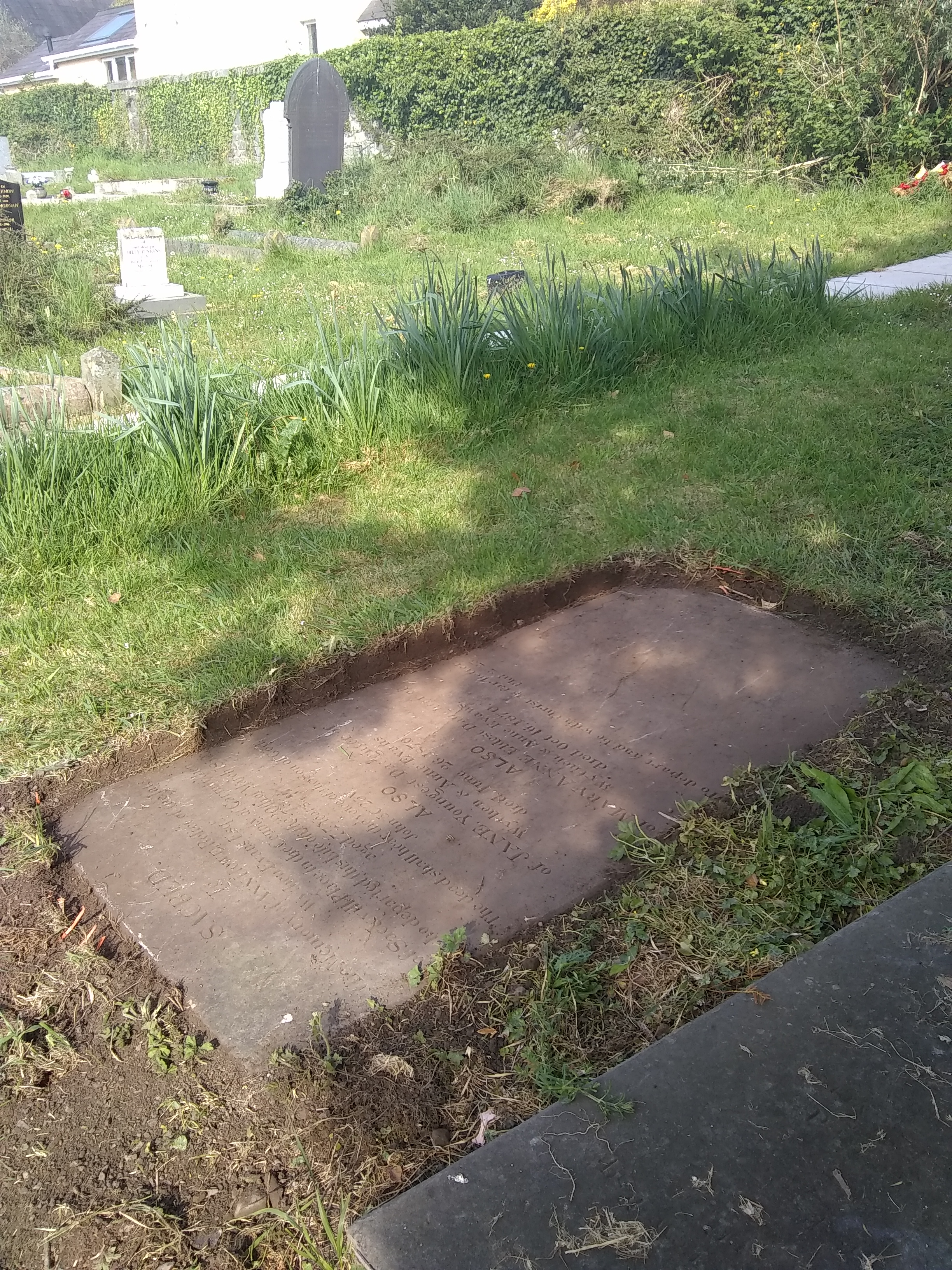
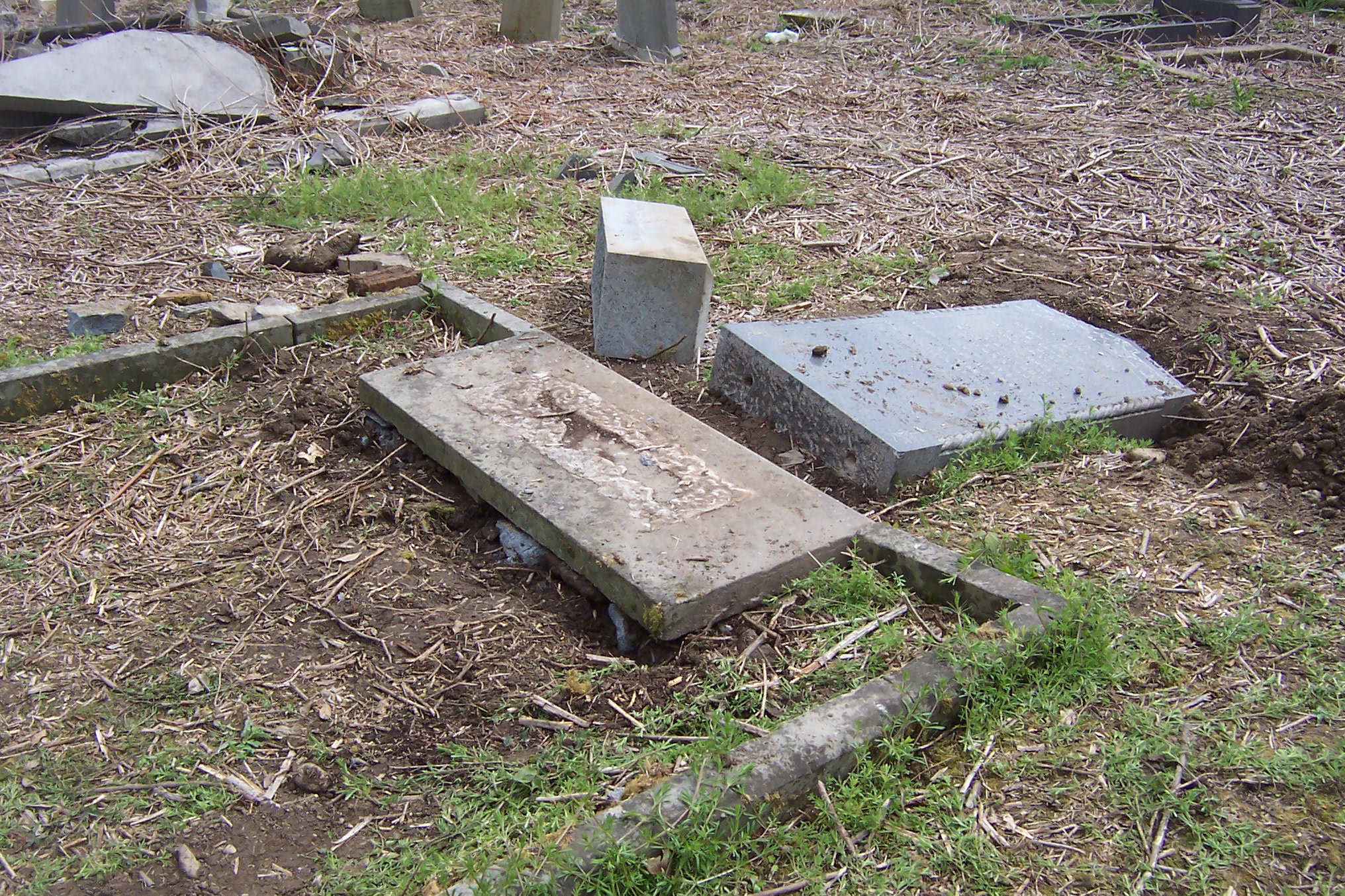
Early this summer whilst carrying out some grass cutting at the cemetery, a small piece of stone emerged from the earth, believed to be another “bit of old discarded stone” an attempt was made to remove it but it was soon apparent that this was no ordinary stone but the corner of what was to turn out to be an unknown grave of one of the most romantic families in Wales.
the corner of the grave revealed
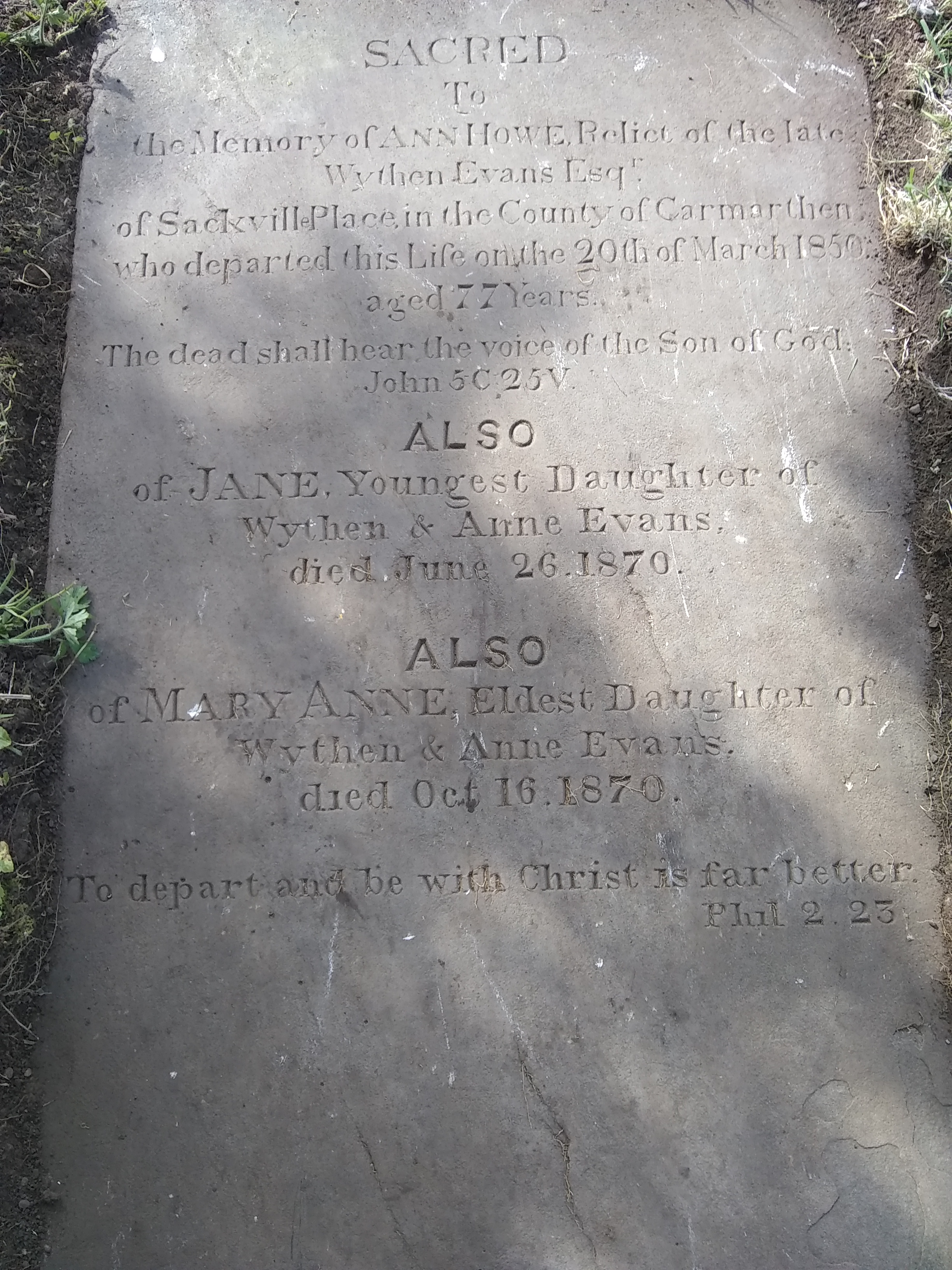
Further careful “digging” revealed the true extent of the grave and the wonderfully preserved inscription. The survey of graves taken in 1977 has no mention of it due to the fact that it lay buried under the soil until now. Here then is a brief story of a truly remarkable family. Wythen Evans was originally from Dolau, Machynlleth. On 9th June 1793 he married at Llandovery Anne Howe Gwynne, a daughter of Sackville Gwynne of Glanbran and settled with her at the Glanbran town house in Llandovery, Sackville Place, just below Llanfair ar y bryn church, where they were married.
the grave of Anne Howe Evans (nee Gwynne) and family
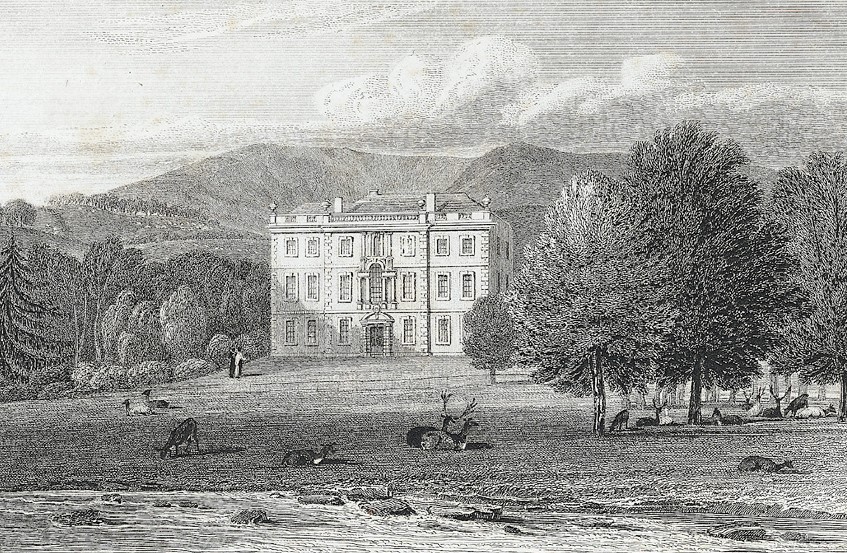
(This house was later called St Mary’s Cottage and then Llanfair Grange and became a hotel in the mid C20th and is now a nursing home, much altered and rebuilt of course). Wythen Evans died on 24th August 1819 aged 59 and was buried in Tirabad church, near Glanbran, but just over the border in Breconshire. This had been built by Anne’s great great uncle in 1716, because Glanbran was miles from Llandovery and Cynghordy church (which would have been much nearer) was not built until the late C19th. Many of the C18th Gwynne’s are buried there. Anne’s father was the famous gentleman harpist Sackville Gwynne. He was noted as a lover of the harp. Edward Jones (Bardd y Brenin) affirms that Sackville Gwynne was one of the finest players of his day upon the triple harp. He was also patron of harpists. JOHN WOOD JONES (1800 – 1844), said by some to have been born on the roadside near Barmouth; was christened at Llanfihangel-y-Traethau, on 6 April 1800. He was taught to play the harp by his father and by Richard Roberts of Caernarvon (1769 – 1855), and became one of the most celebrated harpists of his time and, indeed, of the country; he was generally known as ‘John Jones.’ He was at one time family harpist to the Gwynne’s of Glanbrân, near Llandovery and then kept a school for harpists under the patronage of Carnhuanawc ** at Carmarthen, and finally became harpist to the Llanover family; he died at Llanover, 12th December 1844; Anne’s father died 1794 and in fact he and Anne’s mother, who had died before him, are buried at Llanfair-ar-y-bryn. Glanbran was a famously beautiful mansion, abandoned in the early C20th and now entirely disappeared. When Wythen Evans died, he was given a big obituary in The Cambrian and the Carmarthen Journal, both on 27th August (so very fast work writing it and sending it in!). It emphasises what a lovely chap he was, a regular Churchgoer, with a wide circle of friends and “As a husband and parent, he was ever affectionate, tender and indulgent”.
So it was obviously a very happy marriage. The discovery of Anne’s grave and that of her children links in to one of the most romantic of Carmarthenshire’s old families.
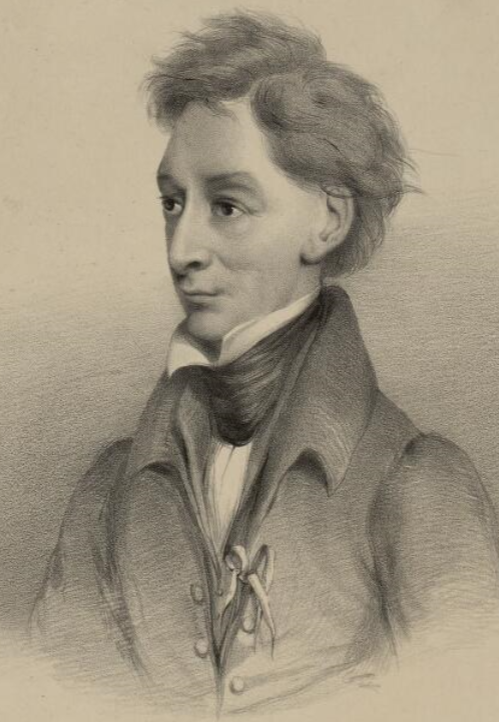
Wythen Evans oil portrait. Husband of Anne Howe Evansthe complete memorial inscription uncovered
** Thomas Price (Carnhuanawc) was an ardent advocate of the cause of the native language and culture of Wales. About 1820 he founded, at his own expense, a Welsh school at Gelli Felen, while in 1833 he was agitating in the press for the use of Welsh in Sunday and day schools. As rural dean he insisted that the clergy under his jurisdiction should instruct their Welsh parishioners in their native tongue. In 1844 he wrote a series of scathing but unsigned letters to the press condemning the way in which church services were conducted in English for the convenience of a few rich people, and bishoprics and livings conferred on men whose ignorance of Welsh should have disqualified them from holding benefices in Wales. Throughout his life he took an intense interest in everything concerning the triple harp.
The Reverend Thomas Price CARNHUANAWC
And finally what of the “Royal Connection” well Eleanor Gwynne, more commonly known as Nell Gwynne, was a prolific celebrity figure of the Restoration period. Praised by Samuel Pepys for her comic performances as one of the first actresses on the English stage, she became best known for being a long-time mistress of King Charles II. Called “pretty, witty Nell” by Pepys, she has been regarded as a living embodiment of the spirit of Restoration England and has come to be considered a folk heroine, with a story echoing the rags-to-royalty tale of Cinderella. Eleanor Gwynne is reputed to have descended from this Welsh branch of the family and had two sons by King Charles : Charles Beauclerk and James Beauclerk. Charles was created Earl of Burford and later Duke of St. Albans.
Glanbran Mansion. One of the most beautiful mansions ever built
What’s in a Name……Captain George Jones (1829-1904) Master Mariner and Quay Warden of Carmarthen.
“Out of the deep I cry unto thee O Lord”
George Jones, passed away on February 20th 1904 aged 73. To say he had a remarkable and eventful life is an understatement and even today, much is not known about his true exploits which would excite any Hollywood movie director. Apart from his own demise which is explained below, you cannot feel saddened by the early deaths of two of his young children, Margaret aged 4 years and George aged 6 years who both died three weeks apart in 1864, their mother Jane living until 1913 aged 84. During the continuing restoration of the cemetery the foundations of the family headstone has been strengthened and also uprighted as it was leaning badly.
the headstone before being repaired and levelled.
The inscription on the slate headstone gives little away about the true demise of George senior except the words as quoted above “Out of the deep I cry unto thee O Lord” ….this is his brief story…….
FATAL ACCIDENT TO MR. GEORGE JONES. Carmarthen Quay Warden Drowned. A feeling of general sorrow has been caused in Carmarthen by the sad fatal accident which happened to Mr George Jones, the quay warden, on Saturday evening. Mr Jones, who was formerly an experienced seaman, has lived here nearly all his life, except when aboard ship, and he was loved and respected as one of the kindest and most upright men in the town. He leaves a widow, two sons, and two daughters, with whom the most sincere sympathy is felt by people of all classes. The deceased, in his seafaring days, was shipwrecked several times, and once he was among only a few survivors who were rescued from the ice after the loss of the vessel. During the Crimean campaign he was taken prisoner of war by the Russians, and was kept in close confinement for over 15 months. The privations which he and his mates endured were terrible. He was a son of Captain Rees Jones, proprietor of the Old Bull Carmarthen, a public-house done away with now many years. Details of the unfortunate accident by which he lost his life will be found in the report of the inquest;
On Monday afternoon, at the Town Hall, Carmarthen an inquest was held before the coroner, Mr Thomas Walters, on the body of George Jones, 22 Quay Street, who had been found drowned in the river the previous afternoon. The deceased had been Quay warden for about two years. He was 74 years of age, and possessed a medal and clasp for service in the Crimean campaign. The first evidence was given by deceased’s wife at her house. Her name is Jane Jones, and she said that deceased was 74 years of age. At 7.30 p.m. on Saturday he left the house to see about some steamers coming in, which was part of his duty as quay warden. She never saw him again. Her husband suffered from giddiness. Griffith Lewis, Oak Villa, Mill-street, fisherman, said that on Saturday night at eight o’clock, he and William Rees were down on the Pothouse to move a schooner containing manure, and just by Spillers and Bakers’ Stores met Mr Jones, who asked them who was going to move the boat. In about five minutes they saw a hat floating past the boat on the side of the Quay. At the same time, a man named William Robinson called out, “There’s a man in the river,” and a witness said, “It is George Jones.” They searched the river and as they found nothing they went up to the house, and asked deceased’s wife where her husband was, and she said “In bed.” A woman from next door went to look and saw no one. John Owens, 6, Jones’ place, said that he and others went to search for the corpse on Sunday afternoon. About 30 or 40 yards below the place where deceased was supposed to have fallen in the river, witness and John Evans picked up the body. Mr John Morgan, Blue-street, foreman, said that the jury returned a verdict of “Accidental Death.” They desired the coroner to inform the Town Council of the desirability of having lamps fixed at the spot where deceased fell into the river as it was very dangerous. Griffith Lewis said this was the second fatal accident within twelve months. A lot more shipping was done there now than formerly. It was a most dangerous spot without light. Mr Walters said he would convey their statement to the Town Clerk. The funeral, which was public for men, took place on Tuesday afternoon last. It was very largely attended, and respectable. The principal mourners were: First carriage-Mr Rees Jones, Aberystwyth (son); Mrs. J. Jones, London, and Mrs. M. Richards, Narberth (daughters); Mr Willie Jones, Sheffield (son); and Mr T. W. Richards, Narberth (son-in-law). Second carriage- Miss Nanno Morris, Mr J. Jones, Quay-street; Mr J. Jones, Wood’s-row; and Mr William Lewis, Pensarn (cousins). Among the floral emblems were a wreath sent by “The Children,” and a cross from his son-in-law. The Rev. Owen Jones (curate) officiated.
The above was extracted from The Welshman 26th FEBRUARY 1904
George Jones sailed on at least 15 different vessels during his maritime career to places such as Nova Scotia, Quebec, and New Orleans to name but a few. One of the vessels he was on – The Prince Rupert was wrecked off the coast of New Zealand on September 4th 1841, having been driven onto the rocks at Mouille Point, a notoriously dangerous stretch of water in a storm suffering many casualties. He himself being a good swimmer survived and swam ashore. Another ship was sent to pick up the survivors but many on board were fearful for their lives due to a Maori Massacre that had recently taken place and refused to leave their cabins.
The restored slate headstone after being repositioned and uprighted.
George Jones was Quay Warden of Carmarthen from 1901 to his death in 1904 which was in effect a key position of supervising the incoming and outgoing vessels from the very busy Quayside ensuring that the Quay and waterways were kept free of any obstacles that may cause danger to shipping etc. It’s interesting to note the following article that appeared in the Carmarthen Journal prior to his appointment which gives a “flavour” of the types of candidates that were then being considered for the post….May he and his family rest in peace………….
There will probably be several applicants for the post of Quay Warden. One applicant, at any rate, I believe is Mr Edward Harries, “sand and clay,” who has already temporarily performed the duties of Quay Warden. Another candidate, I hear, is Mr Arthur James Davies, a person who has practically been brought up on the Quay, and has been associated with river matters all his life. He is about 36 years of age, and has saved numerous lives from drowning in the river. In 1892 he was publicly presented at a concert in the Market-place with the Royal Humane Society’s bronze medal for his gallantry in rescuing a little boy from drowning in the Towy. He had saved a large number previously and has saved several since. Only one other person in the town holds this highly-prized medal and his name is John Rees, of Mill Street, the one-armed swimmer.
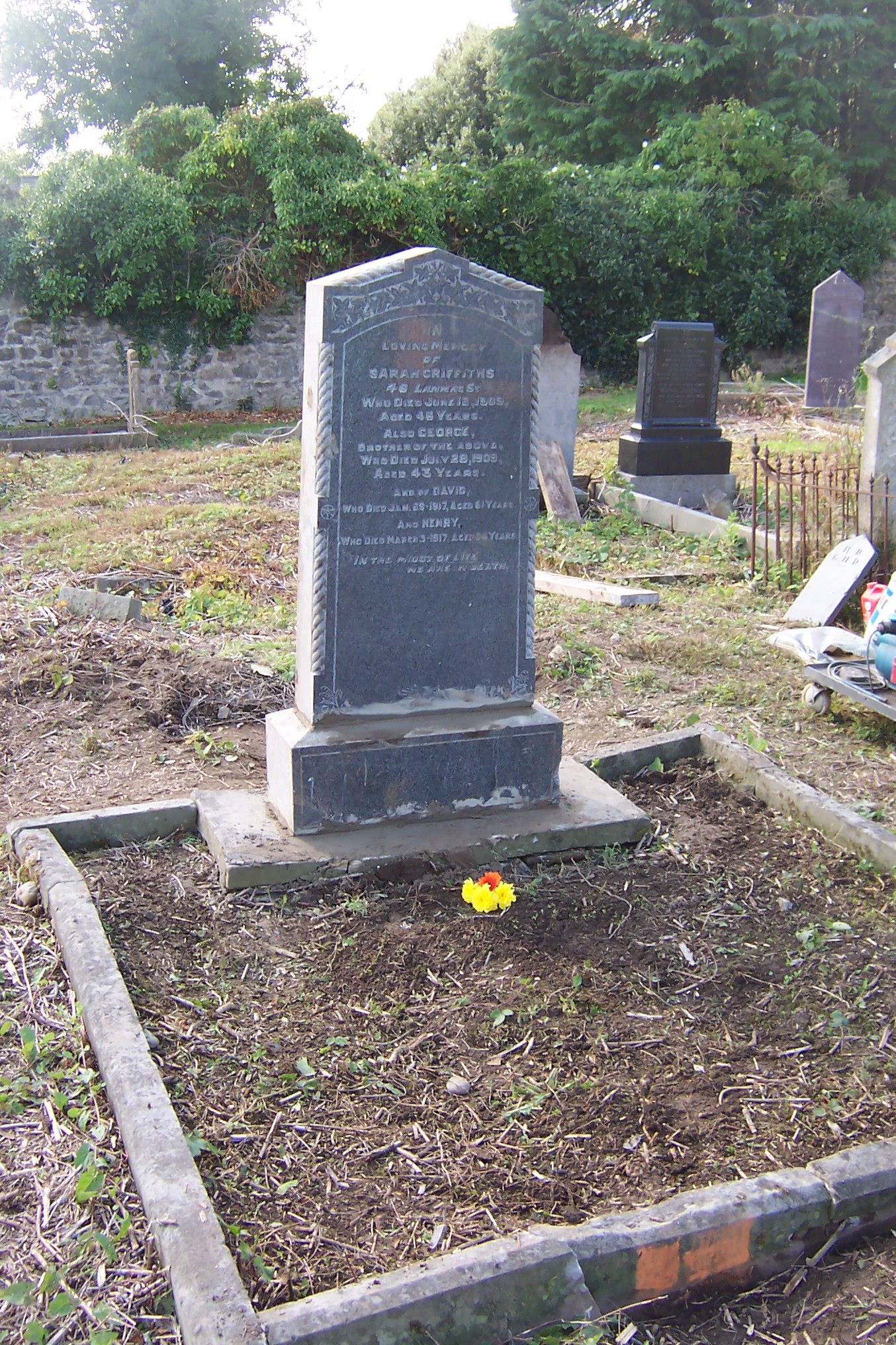
Memorial Restoration features very highly on the list of “things to do” and there is a considerable amount of restoration and repair to do given the fact the cemetery had been abandoned for decades. With the help and advice from qualified stonemasons many memorials have already been restored and hopefully a photographic archive of the work carried out will feature on the website in due course.
The Griffiths headstone before restoration
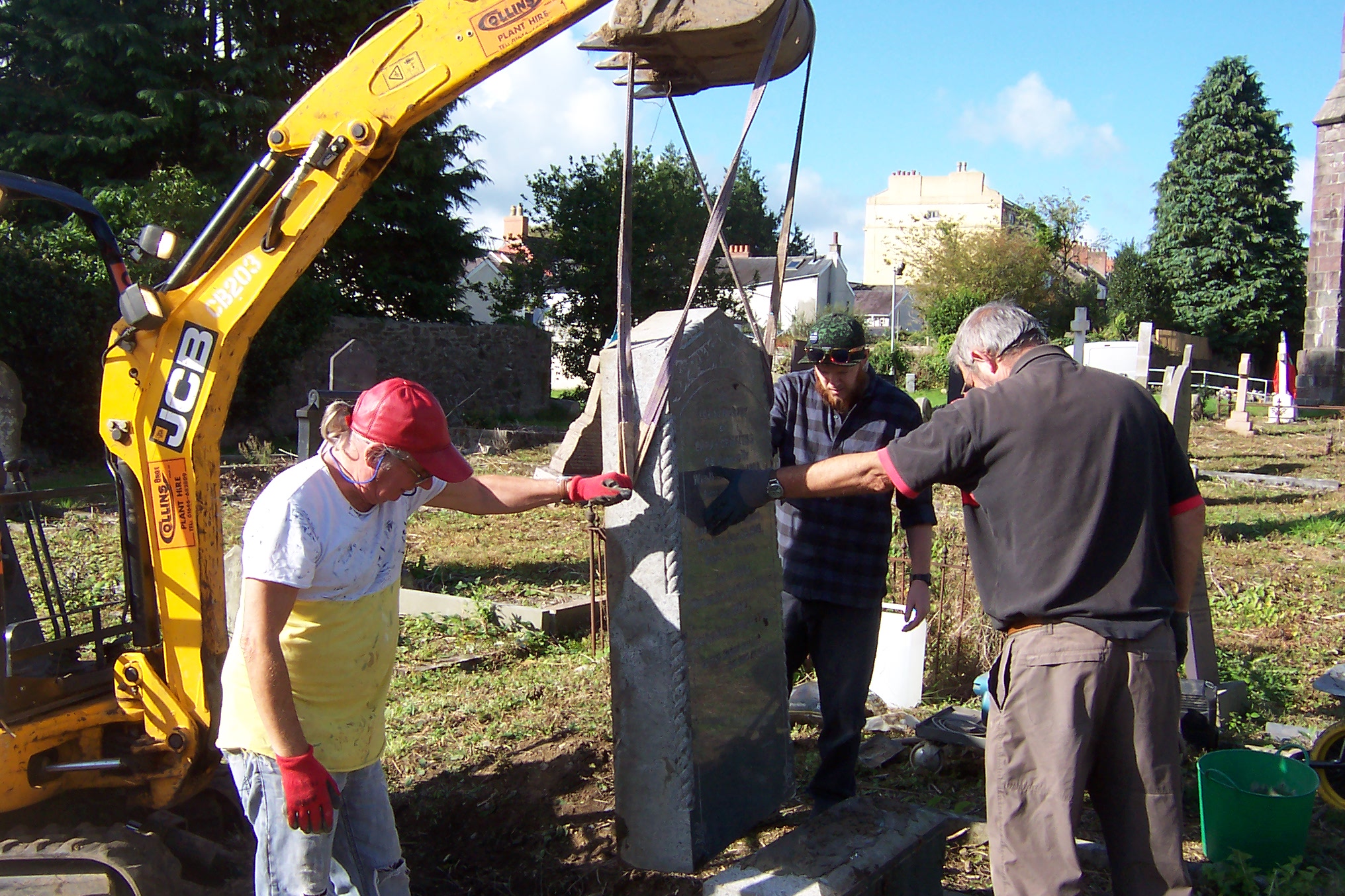
For now however the restoration and repair of the huge marble headstone of the GRIFFITHS family has recently been undertaken and the end result can be seen in the accompanying photographs. Without the continued financial support of the “Friends” of the Thomas & Elizabeth Mayhook Charity our work would not be possible and though our present income is limited the Trustees are always happy to receive any donation however small.
Hydraulic lifting gear re-positioning the headstone
The headstone to the Griffiths Family was an unusual one in that it’s width was the same from the base to the top. The polished marble weighed over a quarter of a ton and had to have two steel pins inserted into the side of the memorial in order to lift it into position. As you can see from the photograph below the final result was achieved with great effort and the Trustees are grateful to all those who helped on the day.
Over the last three years the trustees of the Thomas & Elizabeth Mayhook Charity have strived to restore and repair as many damaged memorials as possible, and on occasion revealing what can only be described as stirring and emotional stories, in particular the death of a child or in the case of many families more than one child.
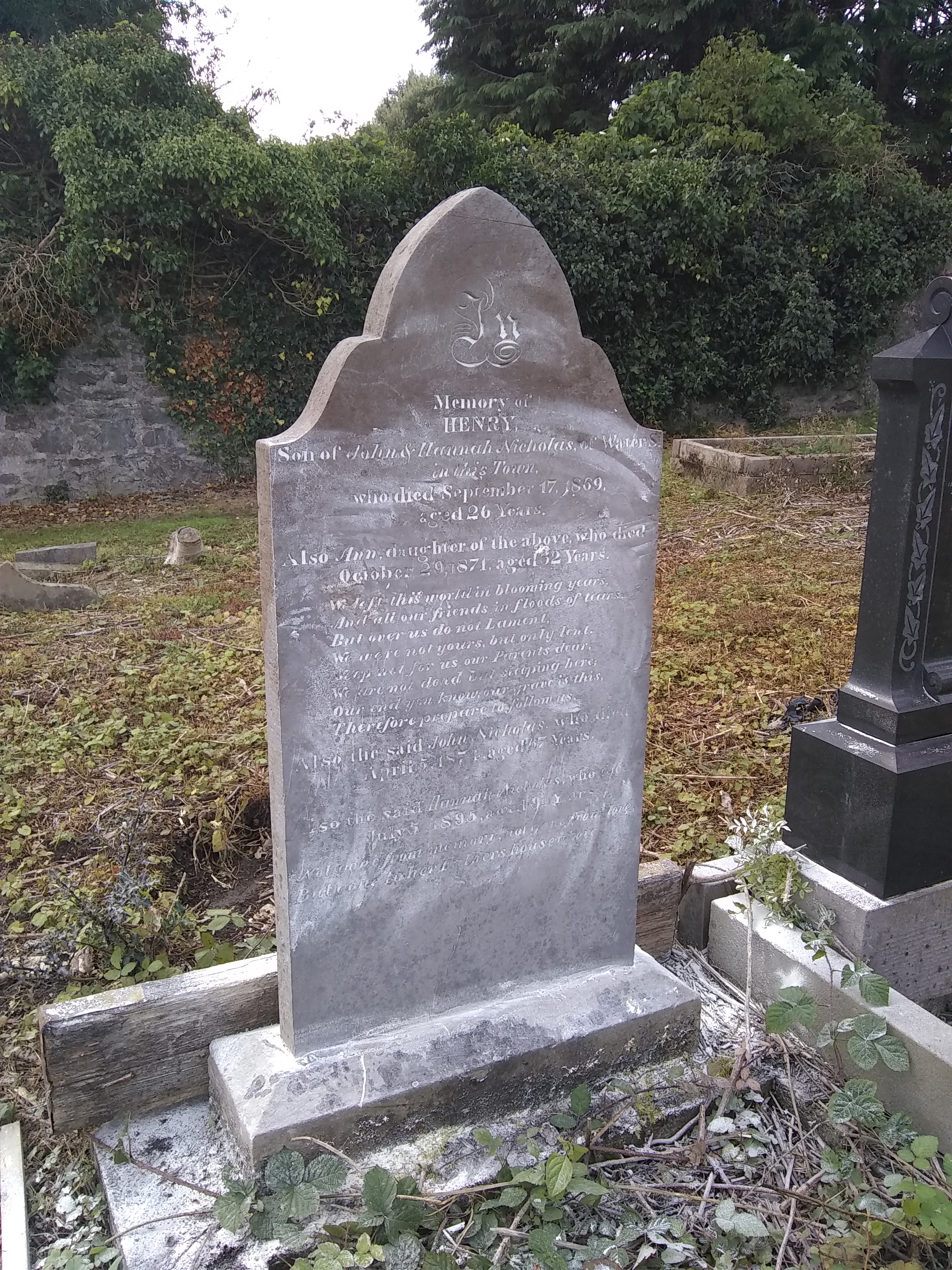
the engraved stone memorial finally reveals it’s past with the help of self raising flour
The charity recently undertook the repair and restoration of one such stone headstone that had fallen to the ground many years ago face down and it has only now been possible to reveal the inscription upon it. At present not much is known about the NICHOLAS family but I hope that in time a fuller picture may emerge about the tragic events that occurred. At least now, as in the case of many others they can rest in peace in the knowledge that they won’t be forgotten. The following is a transcript of the engraving.
In Memory of
HENRY
Son of John & Hannah Nicholas, of Water St
in this Town
who died September 17th 1869,
aged 26 years.
Also Ann, daughter of the above, who died October 29 1871 aged 32 years
We left this world in blooming years And all our friends in floods of tears But over us do not lament We were not yours but only lent Weep not for us our Parents dear We are not dead but sleeping here Our end you know, our grave is this Therefore prepare to follow us
Also the said John Nicholas who died
April 5 1874 aged 67 years
Also the said Hannah Nicholas who died
July 5 1895 aged 91 years
Not gone from memory, not gone from love
But gone to her fathers house
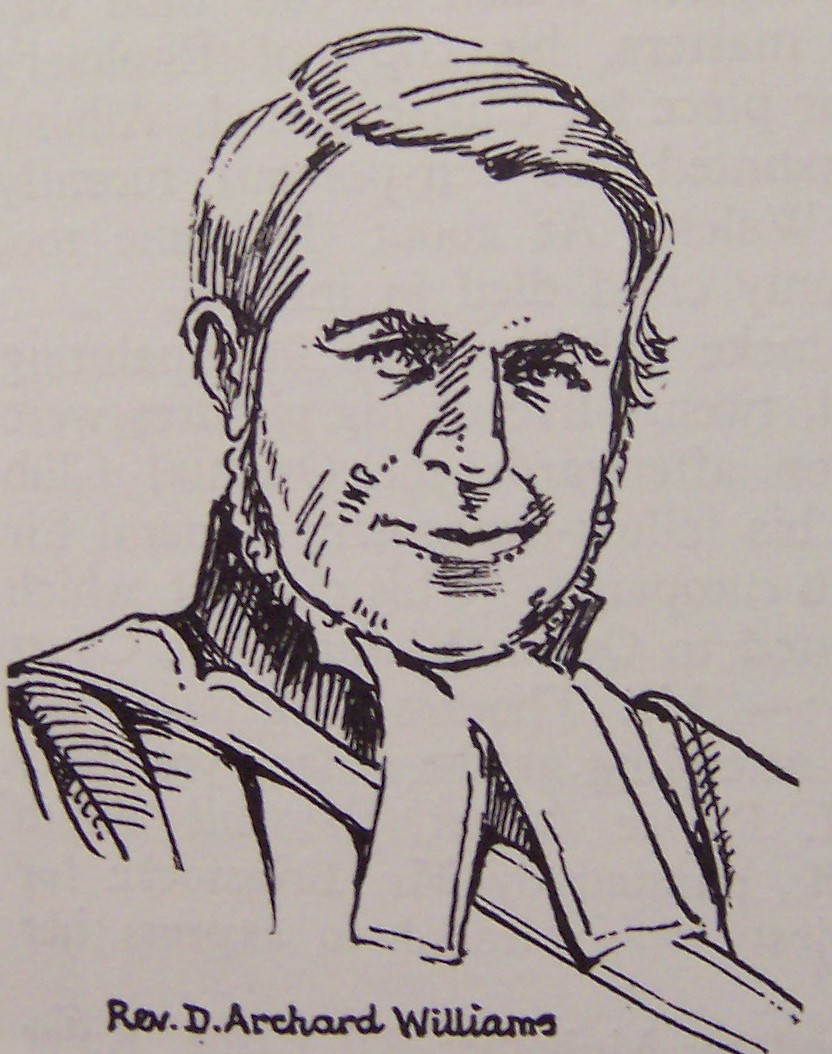
The Venerable David Archard Williams 1796-1879 A brief history of a great intellectual and benefactor of Carmarthen.
The history of the life of David Archard Williams may almost be said to be the history of Carmarthen during most of the 19th century in that as a holder of many prominent positions both civil and ecclesiastical he was inseparably connected with the events that took place.
He was born in 1796; the son of a curate of St Peter’s and was an orphan at four. He became a scholar at the Boys Grammar School and it was from here that he was ordained into the Church of England. He became an assistant master and later headmaster of the Boys Grammar School between 1824 and 1854, the second longest serving Headmaster in the history of the school.
It is important to remember in the light of subsequent events that he did not go up to university. In 1828 he was made rural dean and the list soon becomes impressive – perpetual curate of Llanfihangel-Uwch-Gwili, incumbent of St David’s Carmarthen, rector of Merthyr, principal surrogate of the diocese (matters of probate were dealt with by the Consistitory Court until 1857) thus the position was that of a judge. He was made Chancellor of the diocese in 1857 until 1865 when he became Archdeacon of Carmarthen. Other appointments at different times included chaplain at the workhouse and asylum, editor of the Carmarthen Journal, director of the gas works, county magistrate and vice chairman of the Board of Guardians. He was also responsible for the location and formation of the Training College in Carmarthen (now known as Trinity St David’s University) instead of Swansea, the building of the Model School in St Catherine Street and the building of Christ Church in Lammas Street. Probably he would most like to be remembered for his work with regard to his beloved St David’s Church which was built primarily for Welsh speaking church goers to worship in their own language, since this carried out the idea originated by his father. The following obituary taken from the Carmarthen Journal gives a fulsome report on the funeral, and it is worth noting that in the 161 year history of St Davids Cemetery this is the only occasion at which the serving Bishop of St Davids officiated at a burial – Basil St David’s
The ivy covered grave of the Archard Williams family before its restoration
FUNERAL OF THE VEN. ARCHDEACON WILLIAMS. From the Carmarthen Journal Wednesday 26th September 1879.
Since the funeral of the late lamented Vicar of St Peter’s, undoubtedly the largest witnessed for years back in this town, there has been no such demonstration at the grave of any inhabitant as that at the grave of the Ven. David Archard Williams on Wednesday. Although by no means so largely and well attended as was the funeral of the Rev Latimer M. Jones, still the number of persons present in Wednesday’s procession testified to the high esteem in which the late Archdeacon was held. The circumstances in which death found these two public men will probably account in some measure for the deeper grief in which the loss of their much beloved Vicar plunged the town. The Vicar was cut off untimely in the flower of his manhood, his work unfinished, while the Archdeacon died in the fullness of time, at a ripe old age, his earthly mission fully accomplished. It was rather, then, to testify their appreciation of the way in which this mission had been discharged than to express their sorrow over his grave, that the inhabitants of the town, and those from a distance, came together on Wednesday to attend the public funeral of one who had so ably filled the high position he had been called to. As arranged, those who intended to form part of the procession met in Priory-street, at 12.30, and formed four deep in the order given below. The children of the Sunday and Day Schools, under the direction of their superintendents and teachers met on the Parade at twelve o’clock, and forming four deep, passed by way of the North Parade into Priory-street. The procession marshaled, a move forward was made shortly after one o’clock, and the procession passing through King Street, Guildhall-square, and Lammas-street, proceeded around Picton’s Monument, keeping the left hand side, and on reaching St. David’s Church, halted at the south porch, and there remained until the arrival of the clergy and the body. About two o’clock, the body borne by members of St. David’s choir and congregation, left the Parsonage, preceded by the clergy in their robes, headed by the Right Rev the Lord Bishop of St. David’s, and followed by the mourning carriages containing the members of the late Archdeacon’s family and the servants of his household. On the way to the church, hymn 235 (Hymns Ancient and Modern) “O what the joy and the glory must be was sung by the members of the St. David’s and Christ Church Choirs. The body was met at the church door by the Rev N. Thomas, curate of St. David’s, and the Rev T. Jones, curate of Christ Church. After the body was taken into the church the place was quickly filled by the public, eager to catch a glimpse of the proceedings in-doors.
the grave after ivy clearance
The service was commenced by singing the 39th Psalm, after which the Ven Archdeacon Lewis read the Lesson. A Welsh hymn, “Ymado wnaf a’r babell,” was then impressively sung, and the wreaths having been placed on the coffin by the mourners, the body was carried out by members of the Christ Church Choir and congregation, the organist playing the “Dead March” in Saul. At the grave, which we may remark was very beautifully decorated by Miss Mary Kyle; the service was read by the Lord Bishop of St. David’s. Hymn 401 (Hymns Ancient and Modern), “Now the labourer’s task is o’er,” was sung at the grave, and at the close of the service flowers were thrown into the grave by many present, after which the crowd assembled to witness the ceremony quickly dispersed. The chief mourners were Mrs. Hancocke, Mrs. Soppit, Mr and Mrs. David Williams (Millbrook) and their children, Miss Hancocke, Miss B. F. Hancocke, Mr A. Soppit and Mr F. Soppit. The pall was borne by the Ven Archdeacon Lewis, the Ven Archdeacon North. Canon Williams (Llanelly), Rev J. H. Harrison (Laugharne), Rev L. Price (Llandeilo), and Rev W. E. James, Abergwili. Before giving the order of the pro- cession a few words should be said about the different contingents of which it was made up, and about the signs of mourning displayed in the town. In the first place the Sunday and Day Schools were well represented. The Volunteers, on the other hand, were not a large body, the rifle meeting at Haverfordwest having probably something to do with the poor attendance. The staff of the Royal Carmarthen Artillery Militia, and the Clubs and Benefit Societies was present in full force. The students of the Training College numbered about sixty, while the boys of the Grammar School numbered about twenty. The inhabitants and other friends of the deceased constituted a very large, if not the largest, part of the procession. The Corporation of Carmarthen attended in almost full strength, the Mayor, in his robes of office, being at their head. The choirs of St. David’s and Christ Church considerably swelled the ranks, while the clergy in surplices numbered over fifty. The churchwardens of St. David’s and Christ Church, and women, completed the number of those present. Everywhere in the streets through which the procession passed shutters were put up and blinds drawn down, while in some instances, more especially in St. David’s parish, the shops were entirely closed. The church bells of St. Peter’s and Christ Church tolled a muffled peal, and the church of St. David’s was draped in mourning.
the restored grave of David Archard Williams and eight members of his family.
It should be here mentioned that among those present at the funeral were many Nonconformist ministers, including Father Carrolan, Roman Catholic priest. The order of the procession was as follows: The Sunday and Day Schools Volunteers, four deep, with music Staff of the Royal Artillery Militia Clubs and Benefit Societies (Oddfellows, Ivorites and Foresters) Students of the Training College, Boys of the Grammar School; Inhabitants and other friends of the deceased including the Mayor and Corporation of Carmarthen; Choirs of St. David’s and Christ Church Clergy in surplices Churchwardens of St. David’s and Christ Church; On the return of the procession from Picton’s Monument, the Body, borne by Members of St. David’s Church Congregation, and the Mourners, followed the Clergy. The female friends halted near the Parsonage while the Body and Mourners joined the procession. The arrangements were very satisfactorily carried out under the direction of the Churchwardens of St. David’s and Christ Church, assisted by a committee consisting of the Churchwardens of St. Peter’s, Major De Kantzow, Mr William Morris, Mr T. Mostyn Davies, Mr W. I. Rickard, and Sergeant Major Palmer, R.C.A.M.
the brass plaque in the Chancel of St David’s Church Carmarthen
St David’s Cemetery has an abundance of memorials to those who were seafarers and their families as befits such an historic town with close links to the sea. Even today the Mayor of Carmarthen retains the title of “Admiral of the Port of Carmarthen” – a centuries old title. John Jones is but one example of those who went to sea. His memorial was the first one to be restored over two years ago amidst the bramble and bushes…here is his (brief) story together with photographs of the restoration of the memorial.
Obituary of Captain John Jones as reported in the Carmarthen Weekly Reporter 5th July 1901 page 3
Death of Captain John Jones, Carmarthen. We regret to have to announce this week the death of one of the oldest and most highly respected inhabitants of Carmarthen in the person of Captain John Jones, of Carmarthen House, which occurred on Saturday afternoon at his residence after a comparatively short illness. He had a paralytic seizure some months ago, which affected his side, and on Saturday morning he was attacked by another, to which he succumbed. Captain Jones, who had reached the age of 76 years, had seen many lands, having literally been all over the world several times. He was a member of the crew of the vessel which took out the first party of convicts to Van Diemen’s Land, and had suffered many shipwrecks. He spent some time in Australia many years ago, when the gold fever was on and when the crews of all the British ships were deserting their vessels. He was full of reminiscences of events in his travels, and though usually very reticent regarding his personal adventures, when led on to them he would entertain one for hours. Since his retirement from maritime affairs he had carried on business as a fruit and potato merchant and fancy dealer. He was a member of Christ Church, Carmarthen, and a Liberal in politics. He was one of the old members of the Loyal Wayne Lodge of Oddfellows. He leaves two sons, one of whom, Mr. W H Jones, is resident in London, and the other, Mr. A J Jones, is manager of the Carmarthen Weekly Reporter, and three daughters, Mrs. Davies and Miss Jones, Carmarthen House, and Mrs. Booth, of Ballarat, Victoria, Australia, with whom the greatest sympathy is expressed in their affliction. Mrs. Jones predeceased Capt. Jones some thirteen months ago. The funeral, which was private, took place on Tuesday afternoon, the interment taking place at St. David’s Churchyard, in the same grave as his late wife and other members of his family. The Vicar (the Rev T R Walters) officiated at the house, the church, and the graveside. The first coach contained the Rev T R Walters and Dr E R Williams (medical attendant). Then came the hearse, bearing the coffin, which was of polished oak with brass fittings, followed by the mourning coaches. In the first were Mr. A J Jones (son), Master David John Davies (grandson), Mr. John b Walbridge (Westbury-on-Trym, Bristol), Mr. W T Rogers (Nott-square), and Mr. Ben Thomas (Kirk Villa). The second coach contained Mr. William Jenkins, Water-street; Mr. Joseph Thomas, Picton Court; and Capt. Everett, of the SS. “Merthyr,” of Bristol. All along the route shutters were up and blinds drawn, as tokens of respect to the deceased gentleman. Mr. Henry James, Wood’s-row, was the undertaker.
broken and split in threeThe chairman examining the damage in 2016Removal of the headstone for safekeeping
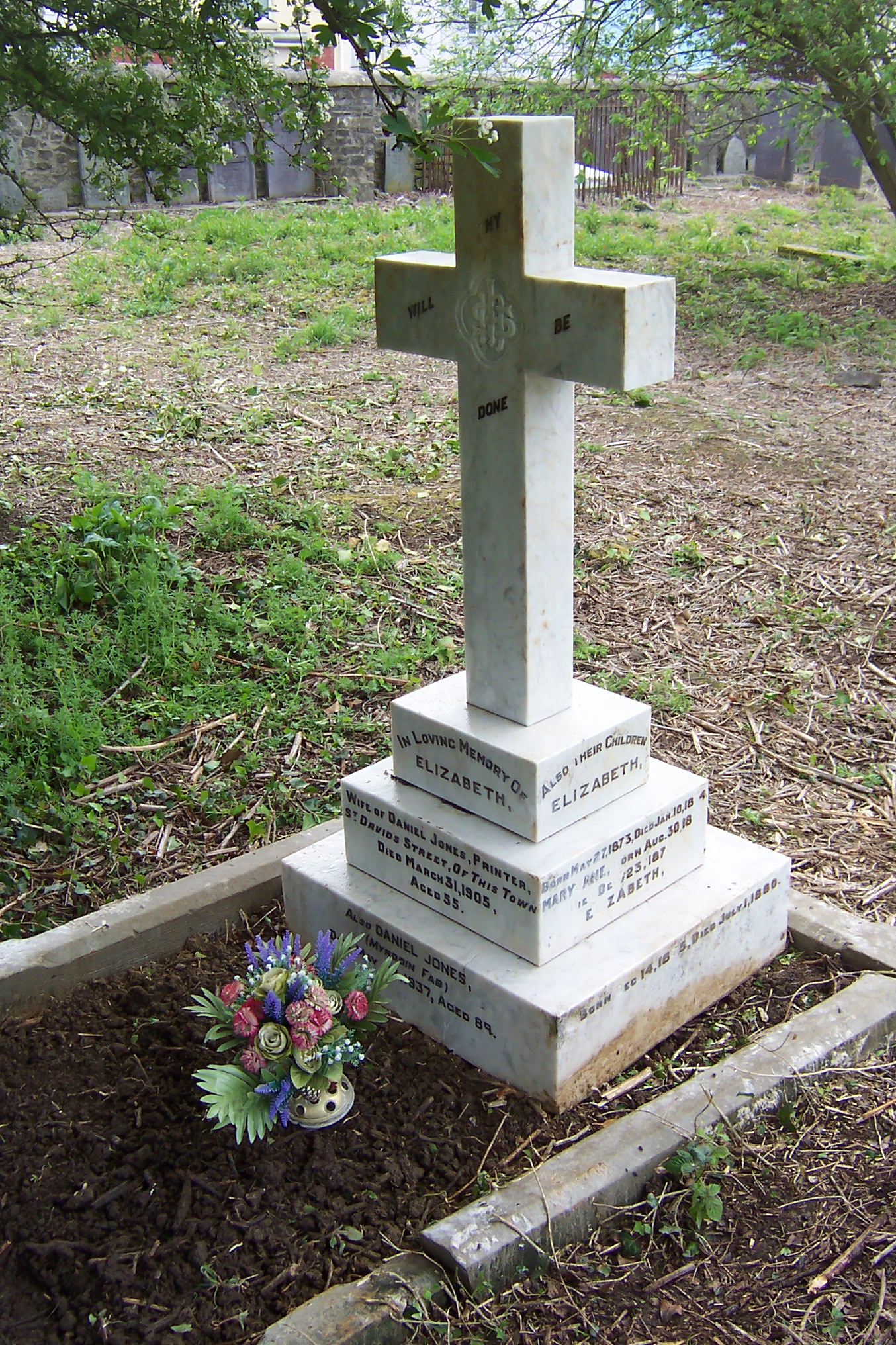
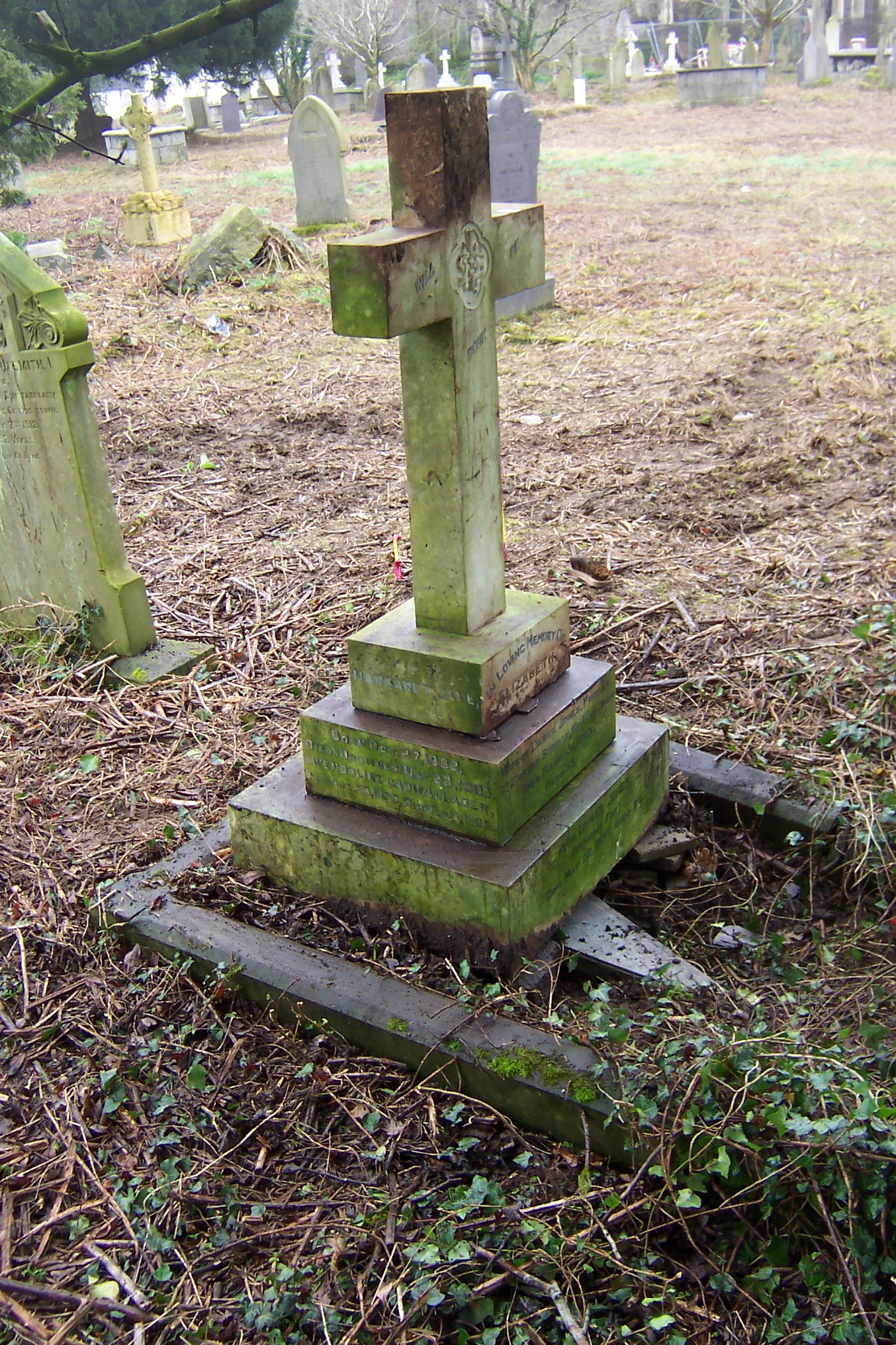
During the last three years the Charity has embarked upon a number of memorial restorations and none can be more poignant and moving than the one containing the remains of Maggie Jones, her parents and four sisters. When found, the memorial was broken in three pieces with the cross and base half buried upside down in the mud. With the aid of a mechanical hydraulic lift and some precise and loving care it is now fully restored. Here then is Maggie’s story as told from a report in the WELSHMAN newspaper, page 8 dated 30th May 1895. No Coroner’s investigations/reports exist in the Carmarthenshire Archives so we can be very grateful of this detailed account of the coroner’s inquest as it happened 124 years ago….The newspaper report begins with the headlines…
SENSATIONAL INCIDENT AT CARMARTHEN
ALLEGATIONS AGAINST DOCTOR
DISTRESSING FATALITY IN CARMARTHEN. A Child Drowned in the Towy. Mr Thomas Walters, coroner for the borough of Carmarthen, held an inquest on Wednesday evening last at the Town-hall, on the body of Margaret Jane Jones, aged twelve years, who was drowned in the Towy at about half past eight on the previous night. The inquiry was largely attended by the public. Daniel Jones, compositor, 5, Sawmill-terrace, said the deceased was his daughter, and she was twelve years of age on the 28th of October last. He last saw her alive between seven and half past on Tuesday evening. At half past nine, the same night, her dead body was brought home. Henry Luxon, master of the SS Alpha, said that about 8.30, on Tuesday evening, he was coming up the river. When about 160 yards below the Pothouse Quay he saw two children fall into the water and drift along with the tide. There were several people on each side of the river, and a witness raised an alarm. He next jumped into a boat with one of his crew, and rowed to the spot where be had seen one of the children disappear. He did not see the child reappear on the surface of the water until he lifted her out with his boat hook. From the time she fell in till he picked her up she was, in his opinion, under water for about a quarter of an hour. His steamer was aground during this interval. After recovering the body he took it ashore and did what he could to restore animation until the doctor arrived. Several gentlemen assisted. The Coroner: What means did you adopt? Witness: We got her boots off, rubbed the soles of her feet, tried to clear her throat, rubbed her arms, and put some white pepper to the nostrils. We turned her face downwards. Continuing witness said he did not notice the slightest signs of life in the child from the first. The doctor arrived in about fifteen or twenty minutes. Ann Barnett, widow, 3, Jones’s place, the Quay, said she received the child from Captain Luxon. There was then no sign of life. She did not witness the occurrence. John Olive, ironmonger’s apprentice, of the Boar’s Head, Lammas-street, said he was down by Pilloffi when he heard the alarm that two children had fallen into the water. He hurried to Pothouse Quay and saw Captain Luxon and men in coracles, searching for the body of the deceased. He arrived at the Pothouse four or five minutes before the body was found. As soon as he saw it picked up he ran up the town at once to find a doctor. He called on Dr Bowen Jones, in Lammas Street, and saw the doctor himself. Witness told him that some children had fallen into the river, and that they were nearly drowned. He asked the doctor then if he would go down, but he said something to the effect that he did not think he would get paid, or that he wanted to know who would pay him. The Coroner: What was the impression on your mind as to what the doctor said? Witness: That he would not go down because he did not think he would be paid. That is my impression. The Coroner: What did you say then? Witness: Nothing. I then went home. The Coroner: Did you go to the Quay again? Witness: No. The Coroner: Did the doctor ask you whose child this was, or anything about her? Witness: No. A Juryman: Did you tell the doctor the child was drowned, or that she had fallen into the river? Witness: I told him I thought she was drowned. I was very excited at the time from running. A Juryman Did you make him understand distinctly at the time that the child was drowned? Witness: No, perhaps not, but I gave him to understand that medical assistance was wanted. Another Juryman: Did you convey to the doctor that his presence was urgently needed? Witness: I did. George James Hodges, store keeper at the United Counties’ Asylum, of 46 Francis-terrace, said that as he was passing the Town Hall at half-past eight ‘on Tuesday evening, he heard that a child was in the river. He made at once for the Pothouse, and pushing his way through the crowd, found the child lying on the ground. He immediately commenced artificial respiration, and continued it until Dr Parry arrived, which was in about quarter of an hour. He then assisted Dr Parry in the work. From the very first, witness was of opinion that the child was dead, for, on trying in the usual places, he could not discover any pulse. The Coroner: Have you had lessons in restoring the drowned? Witness: Yes. Dr C P Parry deposed that he was called to the Pothouse at about a minute before quarter to nine by a man named Williams, in the employ of Mr Bland Davies. The Coroner: He gave you to understand that you were urgently wanted by Dr Parry?: Yes. On arriving at the Pothouse, he found the child lying on the bank, and Mr Hodges was performing artificial respiration. Witness and Mr Hodges then carried on the work in turns till about half-past nine. He did not stop to examine the child when he first arrived, but he thought she was dead when he arrived. The Coroner: Assuming a person was immersed, how long would it take to produce death? Dr Parry: Sometimes four or five minutes. There have been some cases which have been immersed for half-an-hour and recovered. But, as a rule, death occurs in four or five minutes. In the present case, he should have expected that the child would have come to the surface by her own struggles. The Coroner: The sooner medical aid is given the better? Dr Parry: Yes. The Coroner: Minutes are of great importance in a case like this, are they not? Dr Parry: Yes. Continuing, witness said Mr Hodges thoroughly understood artificial respiration, and he was as good in this case as a doctor. The Coroner: Do you go as far as that? Dr Parry: I don’t think he would be as good as a doctor in every kind of case, but in the way of performing Sylvester’s method of artificial respiration he would. The Coroner: Would he be as good as a doctor under the present circumstances? Dr Parry: Yes. The Coroner: Then, to put it another way, you back Mr Hodges against the profession (laughter). Dr Parry: Well, that is all we do-use Sylvester’s method of artificial respiration. There was nothing that could be done in the case except this. In his opinion, the absence of a medical man, when Mr Hodges was there, made no difference. In reply to further questions, Witness stated that no other medical man, besides himself, was there. Strong Remarks by the Coroner. The Coroner, in summing up, said he did not think there could be any difficulty in this case for the jury to arrive as to what was the cause of death. There were circumstances in the case, however, which they ought to consider, not that they would do any good to the little child who was dead, but in future it might be of advantage to them when similar cases occurred. The difficulty he found from the evidence was to gauge the time that elapsed between the actual falling into the river and the picking up. According to Captain Luxon, a quarter of an hour elapsed before the child was picked up, but when one was in a state of great excitement minutes went into five minutes, and seconds into minutes. If the other witnesses were correct, and especially if Dr Parry was correct, Captain Luxon must have been under some misapprehension as to the time the child was in the water. However, all the witnesses agreed that there was a man present who was as competent to deal with the case as any man on the medical register of England, and he did all that could be done, under the circumstances, to resuscitate the child. Whatever time the child was picked up it was evident that she was dead. The Coroner then proceeded as follows: One matter I am bound to refer to, and that is the evidence of the witness Olive. However unpleasant a task it may be, it is my duty to refer to it, and I shall not shrink from it. You have heard in evidence of two doctors being sent for. One was sent for before the other, and, as we have heard from Dr Parry—and as commonsense would tell anyone of us – time, in a case of this kind, is a matter of great importance. When the witness Olive heard the alarm that a child had fallen into the river he ran up to the Pothouse and saw the child picked up out of the water. He tells you he then immediately went away to fetch a doctor. He ran up Blue-street, and saw Dr Bowen-Jones in Lammas-street. I must be careful as to what I say now. I do not want to say anything unpleasant to anyone. It is most unpleasant to have to say anything like this, but so long as I occupy the position I do I shall do my duty. If I do anything wrong, men let those who have the right to do so remove me; but whether it be friend or foe, I must express my surprise that any person in the medical register of England and Wales, should have given such an answer to a person who came to ask for his assistance under these circumstances (applause). I do not know whether Dr Bowen Jones is present or not, but I can only account for his conduct in one way. It does not matter whether this child was in the water ten minutes or half-an-hour, -whether she was alive or dead, so far as Dr Bowen Jones’s conduct is concerned. He did not know, when the witness Olive went to him, whether there was a chance of restoring the child or not. He was told sufficient to have induced any man, be he peer or peasant, or pauper, to have done what the instincts of normality would have prompted any one to do (loud applause). I hope that then, there are conditions in life where pounds, shillings, and pence, do not come into question at all. No one is more willing to give credit to the medical profession than I am. They perform duties in many circles gratuitously, and it is in the nature of their peculiar calling to do a great deal gratuitously, but who would ever think of stopping to ask who would pay him for saving a drowning child or a drowning man (applause)? Would anyone who sees a person in danger hesitate and wonder who is going to pay him for saving that person? I can only imagine that Dr Bowen Jones was labouring under some misapprehension at the time, and I can only hope that he did not take the matter in the proper light. As I said before, it is most unpleasant for me to have to make these remarks, but I cannot help referring to this matter when it comes under our notice in the way it has. I believe thoroughly that in infringing the laws of humanity there follows a punishment equally as great as when we infringe the laws of the land. However, that we have nothing to do with here. If my feelings have led me to say things that I ought not to have said, I am extremely sorry, but it is difficult to express one’s condemnation in mild terms of such conduct as has been brought before us in regard to this matter. It may be said of what use are these coroner s inquests? If coroner’s inquests are of no use let the coroner and his court be abolished at once. If they are of no use why are we required to make a solemn enquiry? Let us make it an enquiry and not a farce. Another matter the Coroner referred to was with respect to the police in relation to inquests. He did not think it was the duty of the coroner to find out evidence or to ascertain what witnesses might be called. He made these remarks because there was some little disagreement between himself and Sergeant Jones. The officer was perfectly sincere in what he thought to be his duty, but he (the Coroner) thought that the police were the proper persons to produce evidence before the coroner and the jury, and if there was any difficulty in the case, of course the coroner would give what advice and instructions he thought fit. If it was a case of murder, the police would, make all the enquiries they could, and he thought in all cases they should conduct enquiries and collect evidence. The jury then retired, and in about half an hour returned into Court with a verdict of “Accidentally drowned.” They also added the following rider: The jury express their displeasure at the conduct of Dr Bowen Jones in not attending when called upon. They think that grappling irons and instruction boards should be placed freely on the Pothouse, and a policeman placed there during spring tides. The Foreman: The majority of the jury are in favour of the rider, but not all. The Coroner- But this is your verdict! The Foreman: Yes. The enquiry then closed. The funeral takes place today (Friday) at 4.30 p.m. at St. David’s Church, for men only.
Once again hydraulic lifting equipment was needed to lift the cross from the ground into position after the base was re-aligned and strengthened. The grave contains the remains of Maggie, her four sisters (all of whom died before their 6th birthday) and her parents. Daniel, the father was the oldest who passed away in 1937 aged 89. Now 82 years later, dignity and respect has finally returned to this tragic family.
In an unassuming part of the cemetery underneath the large yew tree close to the gate and bench seating area lie the remains of brother and sister – George Stonhouse Vigor – aged 16 and Charlotte Eliza aged 19. George died from Tuberculosis of the lymph nodes whilst living in Johnstown and Charlotte from heart disease whilst staying at a friend’s house in Ferryside.
George’s mother Louisa was present when her son sadly passed away in 1847, but was not present when her daughter passed away in 1853. Their family heritage is most interesting and quite why they were living in Carmarthen at that time remains a mystery. The inscription on the grave reads as follows
UNDERNEATH
ARE INTERRED THE REMAINS
OF GEORGE, ELDEST SON OF THE LATE
REV’d HENRY STONHOUSE VIGOR, AM
AND OF LOUISA BURT, HIS WIFE, DIED JUNE 9TH 1847,
AGED 16 YEARS AND 4 MONTHS.
ALSO OF CHARLOTTE ELIZA, THEIR ELDEST DAUGHTER
WHO DIED AUGUST 1ST 1853 AGED 19 YEARS AND 9 MONTHS
WHOM THE MARBLE TABLET IN THIS CHURCH REFERS
Louisa Burt Gordon married the Reverend Henry Stonehouse Vigor on the 24th March 1829. They had three children, two of whom are referred to above and a third son named Alfred Henry Say Stonhouse Vigor who died aged 57 in 1889.
George and Charlotte were great nephew and niece to the Right Reverend George Isaac Huntingford MA.DD.FRS.FSA. Bishop of Hereford (and former Bishop of Gloucester) and Warden of Winchester College. Their Great Grandfather was The Reverend Sir James Stonhouse Vigor (1716 -1795) who was a celebrated physician, cleric, religious writer, and founder of the County Infirmary at Northampton in 1743. Sir James’s first wife was Maid of Honour to Her Majesty Queen Caroline of Ansbach ( wife of George II )
The Reverend Sir James Stonhouse BA. MA. MB. MD (1716-1795)
Here rests awhile, in happier climes to shine,
The Orator, Physician, and Divine:
‘Twas his, like Luke, the double task to fill,
To heal the nat’ral, and the moral ill.
You, whose awaken’d hearts his labours blest,
Where ev’ry truth by ev’ry grace was drest;
Oh! let your lives evince that still you feel
The effective influence of his fervent zeal.
One spirit rescued from eternal woe
Where nobler fame than marble can bestow;
That lasting monument will mock decay
And stand, triumphant, at the final day.
The above poem was written by Hannah More (2nd February 1745 – 7th September 1833) who was an English religious writer, Romantic and philanthropist. She can be said to have made three reputations in the course of her long life: as a poet and playwright in the circle of Johnson, Reynolds and Garrick, as a writer on moral and religious subjects, and as a practical philanthropist.
Queen Caroline of Ansbach. Supplied by The Public Catalogue Foundation
unknown artist; George Isaac Huntingford, Bishop of Gloucester; New College, University of Oxford
We use cookies on our website to give you the most relevant experience by remembering your preferences and repeat visits. By clicking “Accept All”, you consent to the use of ALL the cookies. However, you may visit "Cookie Settings" to provide a controlled consent.
This website uses cookies to improve your experience while you navigate through the website. Out of these, the cookies that are categorized as necessary are stored on your browser as they are essential for the working of basic functionalities of the website. We also use third-party cookies that help us analyze and understand how you use this website. These cookies will be stored in your browser only with your consent. You also have the option to opt-out of these cookies. But opting out of some of these cookies may affect your browsing experience.
Necessary cookies are absolutely essential for the website to function properly. These cookies ensure basic functionalities and security features of the website, anonymously.
Cookie
Duration
Description
cookielawinfo-checkbox-analytics
11 months
This cookie is set by GDPR Cookie Consent plugin. The cookie is used to store the user consent for the cookies in the category "Analytics".
cookielawinfo-checkbox-functional
11 months
The cookie is set by GDPR cookie consent to record the user consent for the cookies in the category "Functional".
cookielawinfo-checkbox-necessary
11 months
This cookie is set by GDPR Cookie Consent plugin. The cookies is used to store the user consent for the cookies in the category "Necessary".
cookielawinfo-checkbox-others
11 months
This cookie is set by GDPR Cookie Consent plugin. The cookie is used to store the user consent for the cookies in the category "Other.
cookielawinfo-checkbox-performance
11 months
This cookie is set by GDPR Cookie Consent plugin. The cookie is used to store the user consent for the cookies in the category "Performance".
viewed_cookie_policy
11 months
The cookie is set by the GDPR Cookie Consent plugin and is used to store whether or not user has consented to the use of cookies. It does not store any personal data.
Functional cookies help to perform certain functionalities like sharing the content of the website on social media platforms, collect feedbacks, and other third-party features.
Performance cookies are used to understand and analyze the key performance indexes of the website which helps in delivering a better user experience for the visitors.
Analytical cookies are used to understand how visitors interact with the website. These cookies help provide information on metrics the number of visitors, bounce rate, traffic source, etc.
Advertisement cookies are used to provide visitors with relevant ads and marketing campaigns. These cookies track visitors across websites and collect information to provide customized ads.