LIEUTENANT COLONEL RICHARD ANDREW SCOTT 1800 -1875, CARMARTHENSHIRE’S FIRST RURAL CHIEF CONSTABLE.

Richard Andrew Scott was born in Woolwich in 1800. He served with distinction in the army with the Royal Staff Corps and was appointed Chief Constable of the newly formed Rural Police Force of Carmarthenshire on the 10th August 1843, an appointment that was brought about because of the Rebecca Riots that had fueled great unrest in the County over the previous three years spreading from the townships into the rural idylls of the countryside.  It is interesting to note that on appointment to the post of Chief Constable his army rank was Captain, but he appears to have been “promoted” twice to Lieutenant Colonel whilst serving as Chief Constable suggesting that he also retained his army commission. Furthermore Richard Scott’s appointment was meant to be a temporary appointment, but one, as it turned out that lasted for 32 years until his death in 1875.
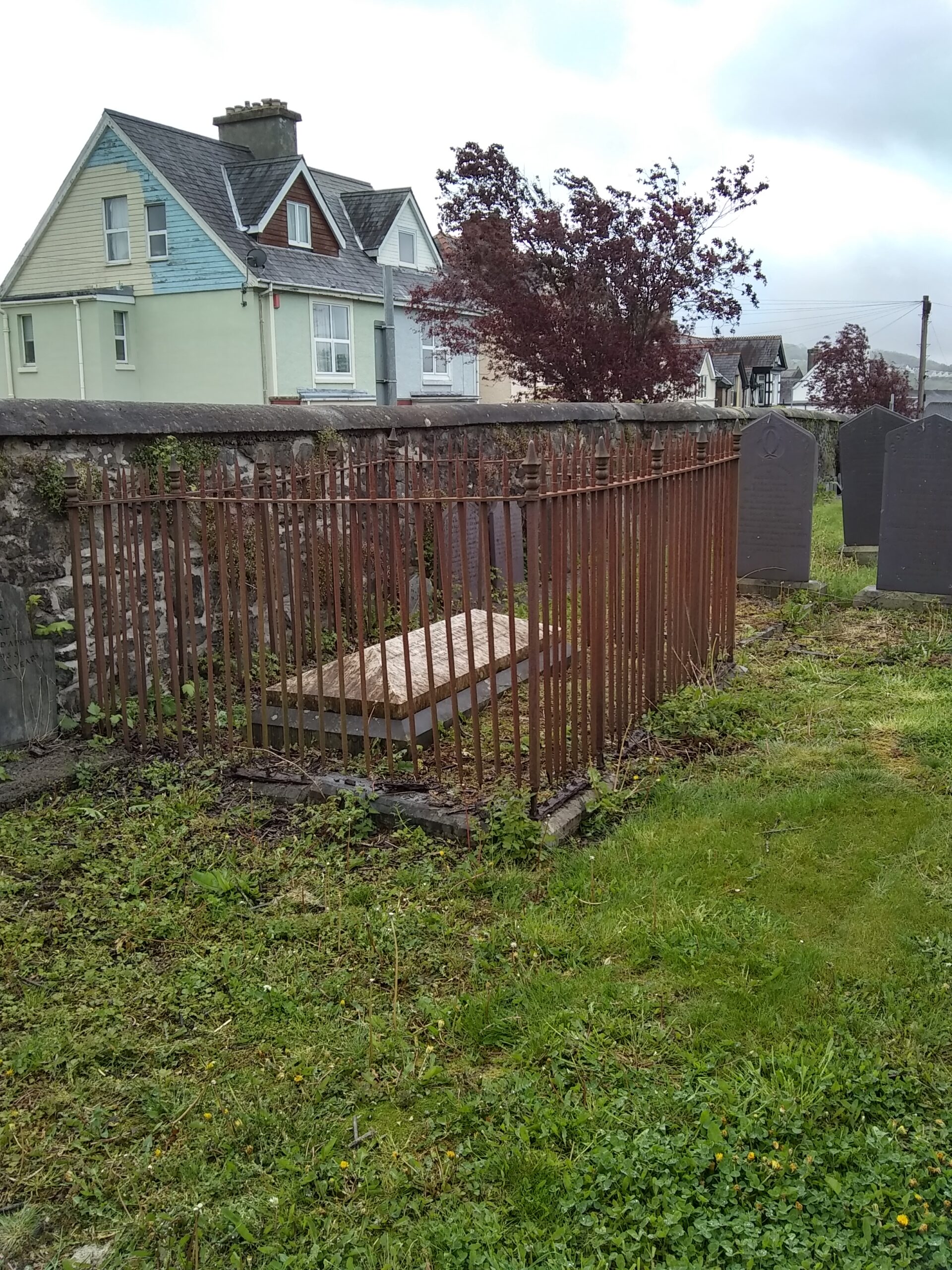
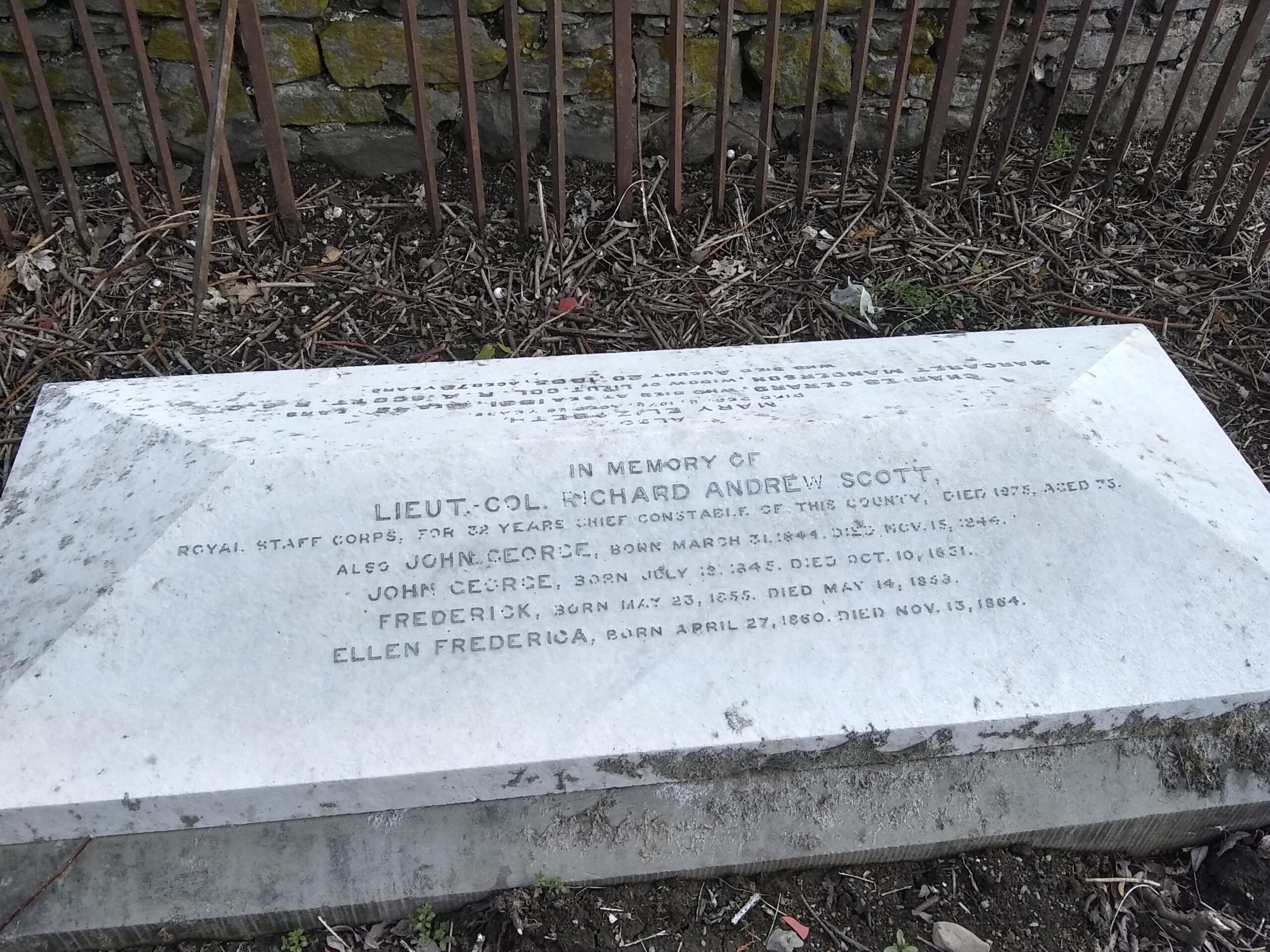
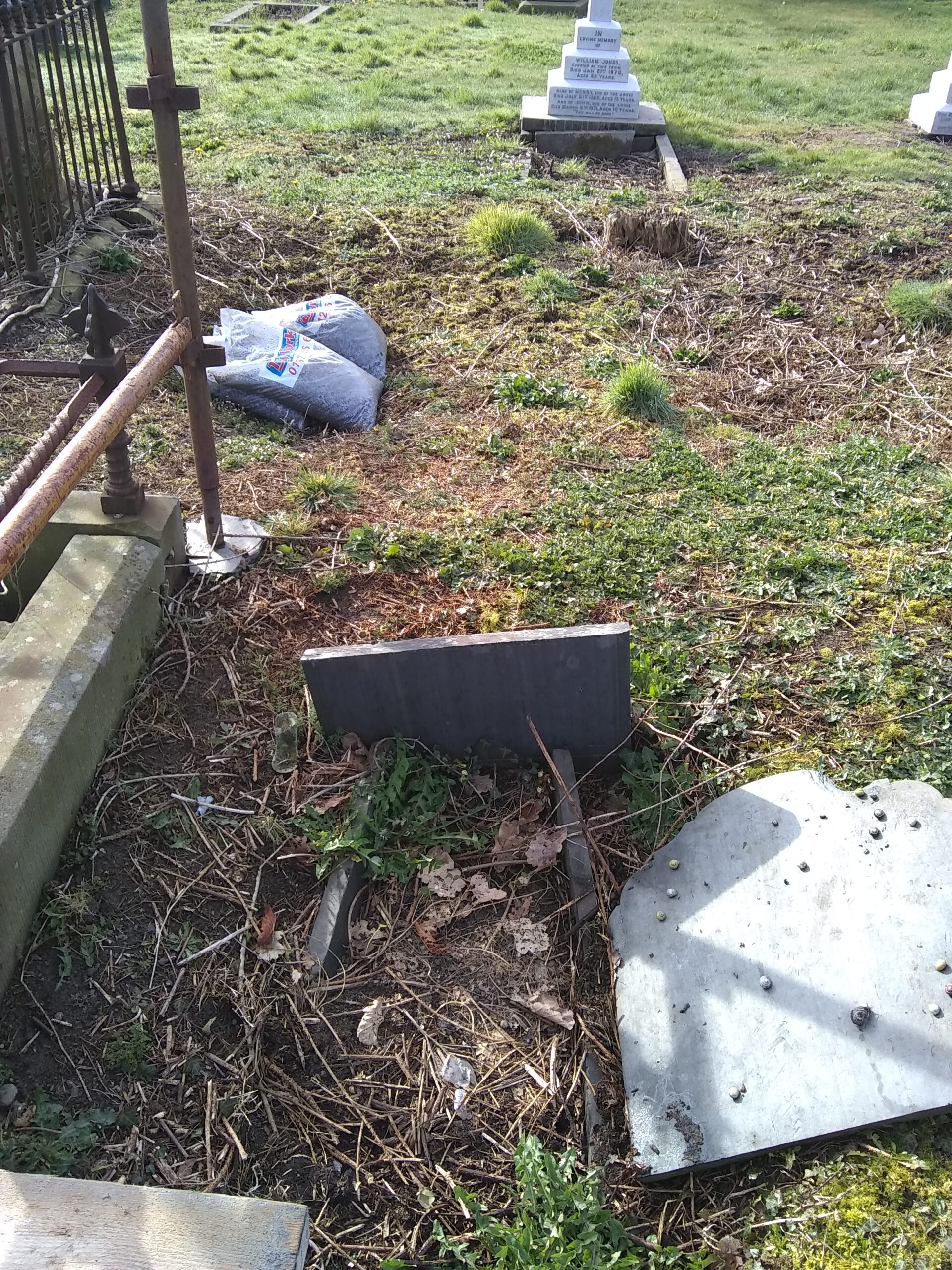
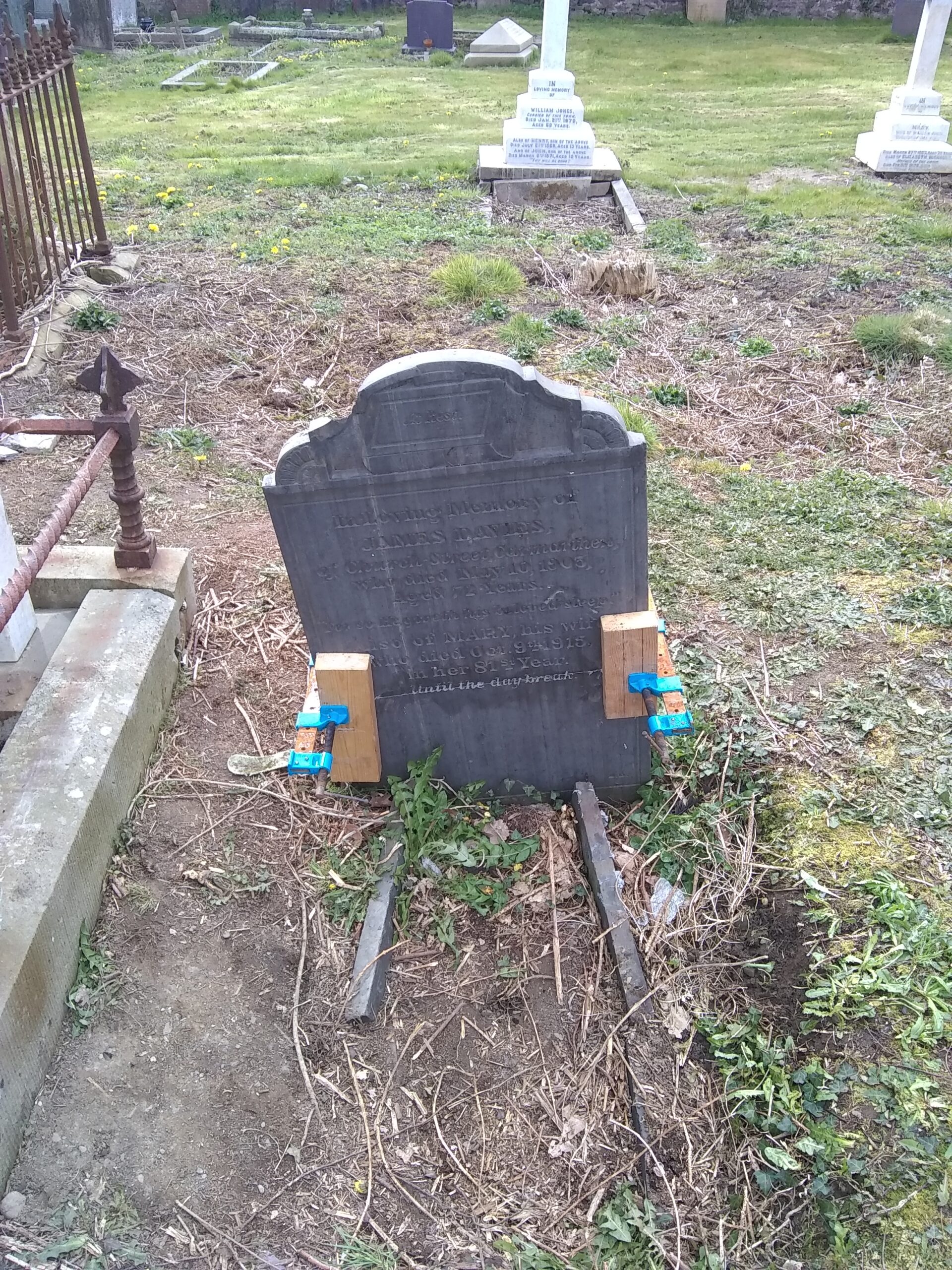
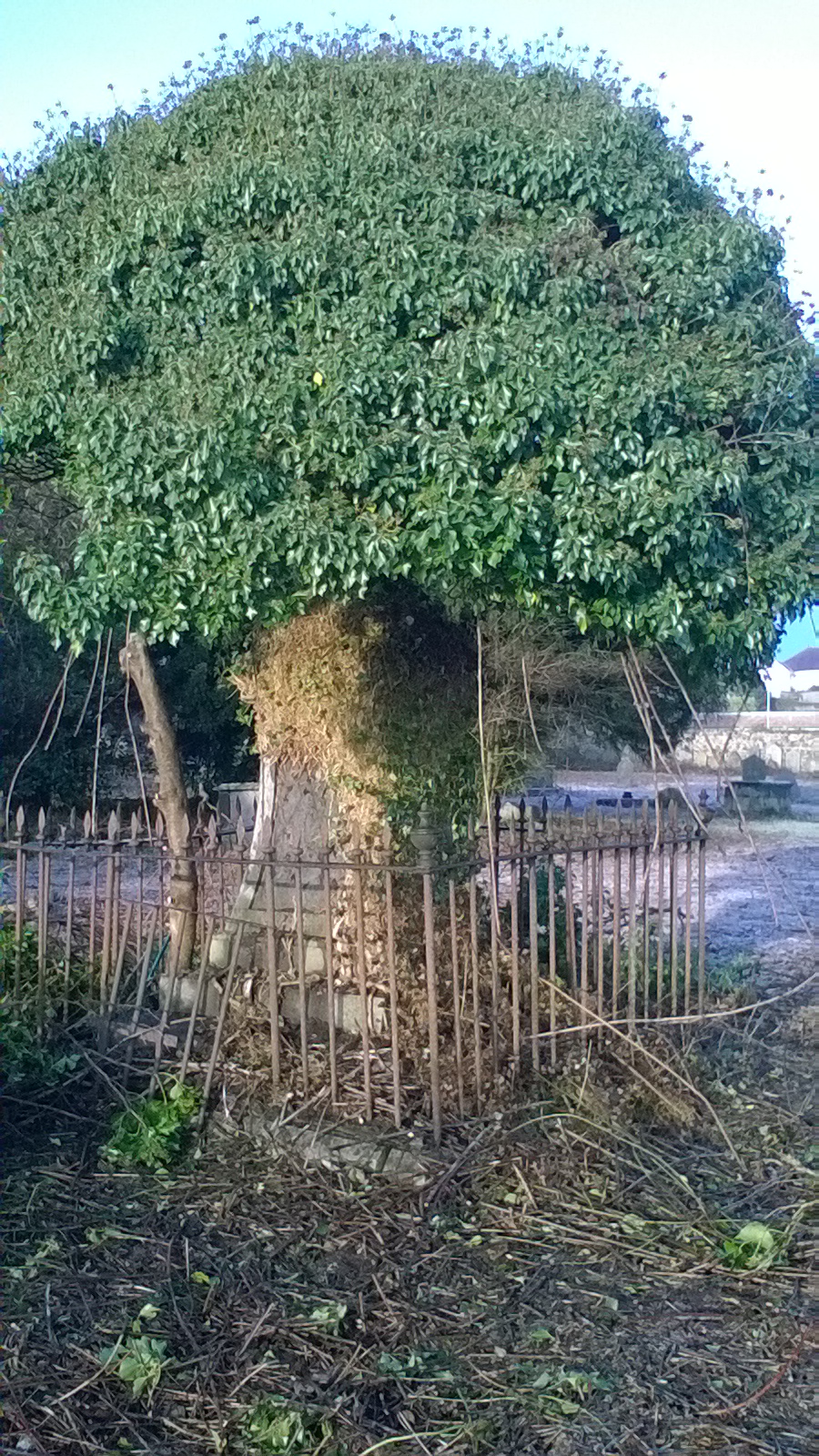
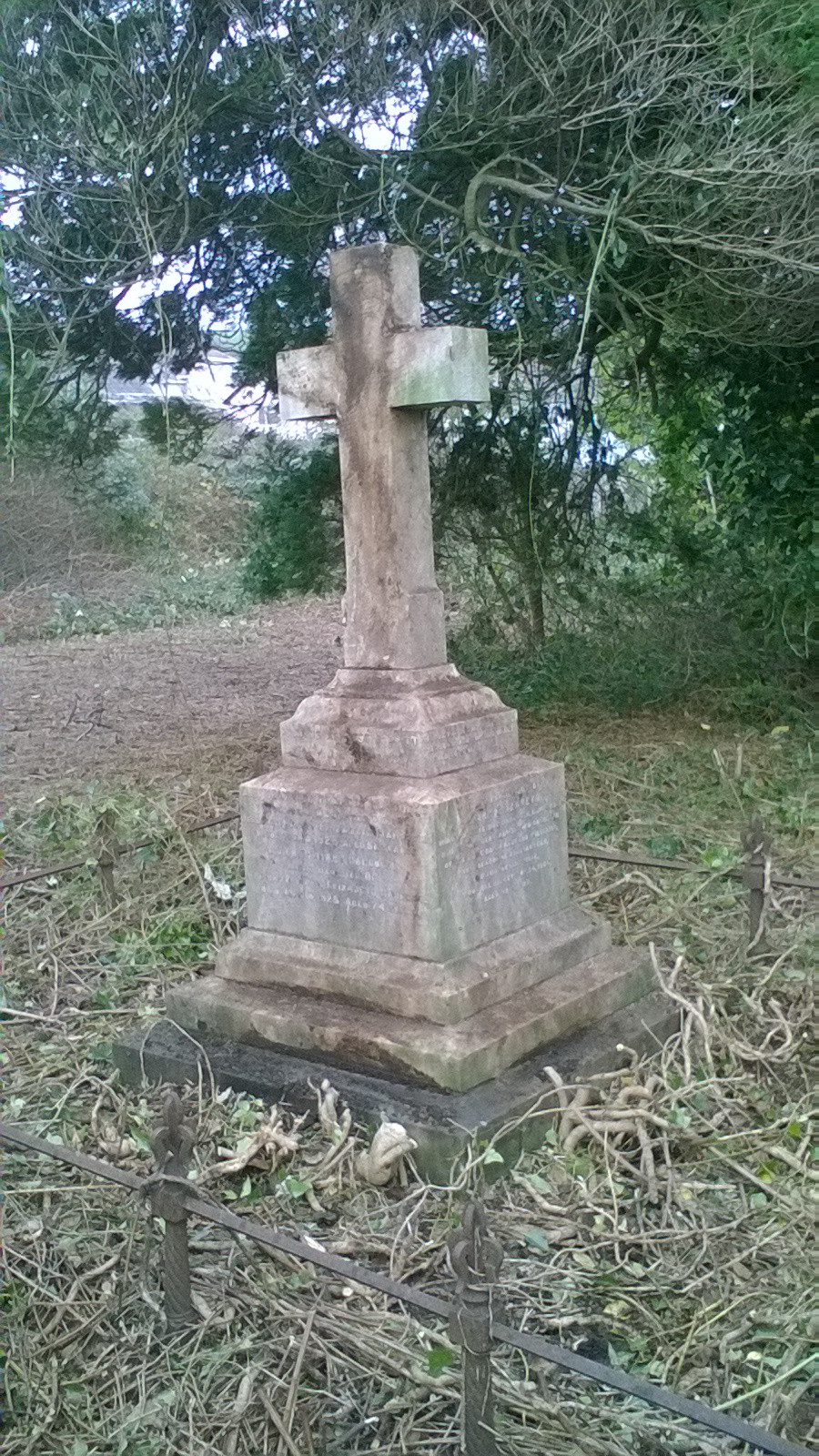
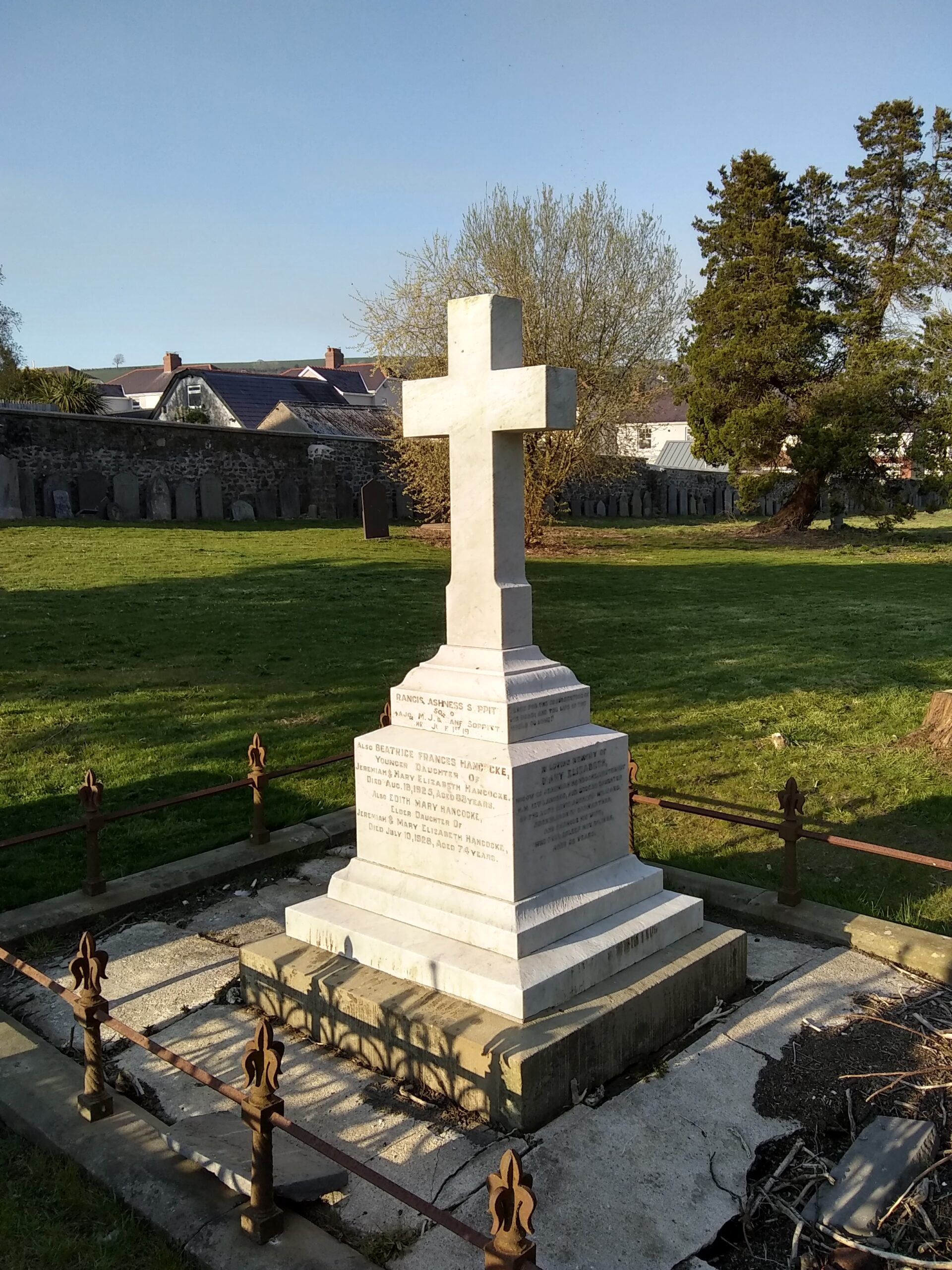
The family grave of the Scott family
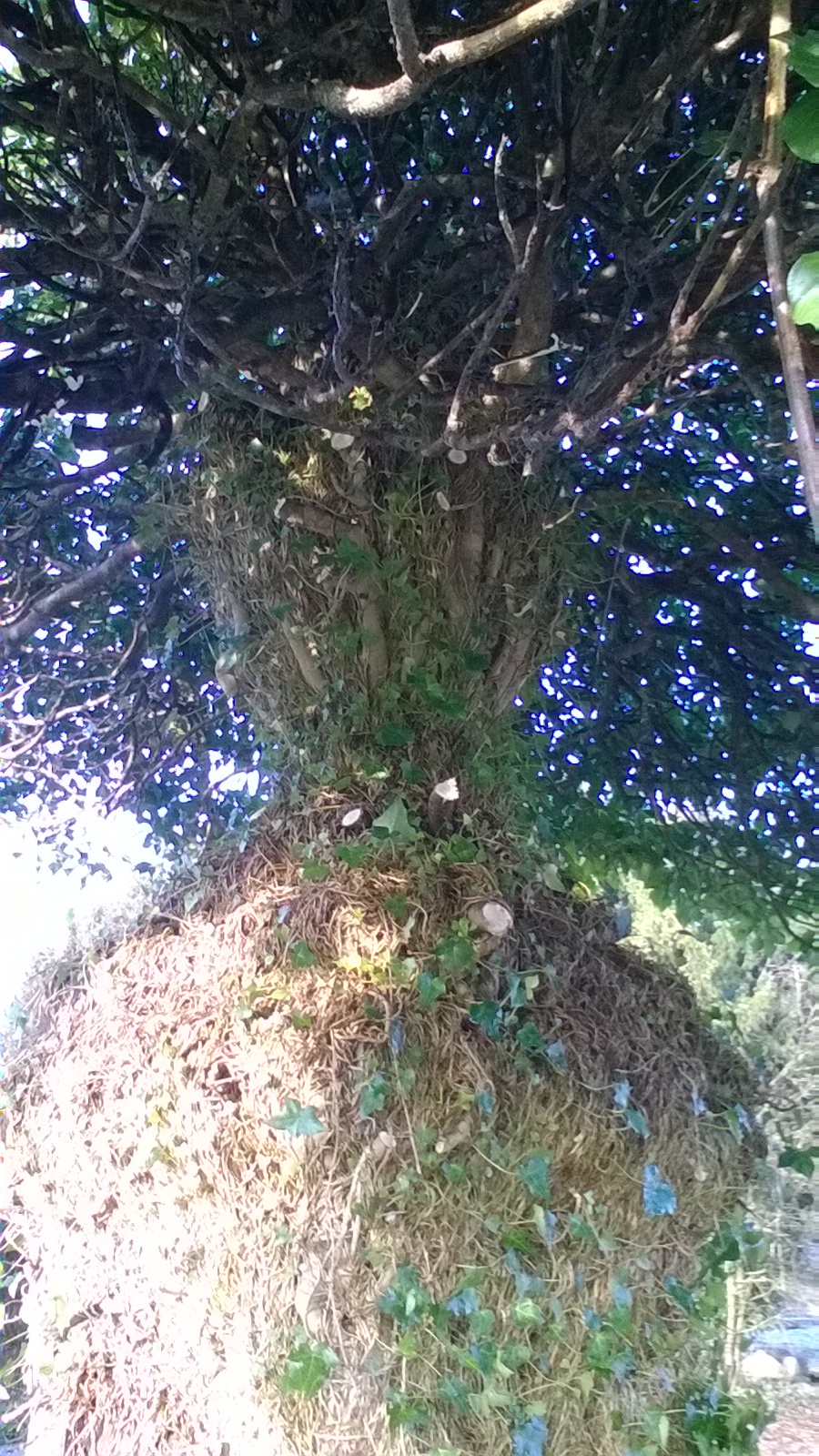
A close up of one side of the cleaned and refurbished memorial

The following two obituaries of Richard and his wife Margaret give a very short “resume” of their lives in Carmarthen, but they were lives that were spent to their fullest and with great “gusto” fully embracing the welsh culture and bringing up their large family in the community they loved, though not without tragedy along the way. The Carmarthen Borough Police Force, (Town) was formed in 1836 and the formation of the Rural Police Force in 1843 did not go down well in some quarters, though it became an unrivalled force for good with many notable successes especially in the detection of rural crime and in one particular case of apprehending the suspect in the brutal murder of a young lady called Esther Davies in Cwmduad who was shot through the chest at point blank range in November 1869. Five years ago the Scott’s family grave was completely covered with very dense growth and brambles – impossible to see, but today it has, like many others undergone some major restoration work to bring it back to some respectability. Now their story can be told and of the enormous impact and contribution that Richard himself played in the birth of a fledgling police force, now known as Dyfed Powys, which is now recognised as one of the best in the United Kingdom.

In 1835 local government was reformed with the passing of a new act of parliament called the Municipal Corporation Act, which meant that for the first time, all Boroughs were required to form their own police force. However, as the towns and cities became ever more populated, and more people began to live in the countryside due to overcrowding there became the necessity to form a rural police force and thus in 1856 it became compulsory for all Boroughs to create such a force. Carmarthenshire however was way ahead of the game and had already formed its own rural police force and appointed it’s first Chief Constable in 1843 –some thirteen years earlier.
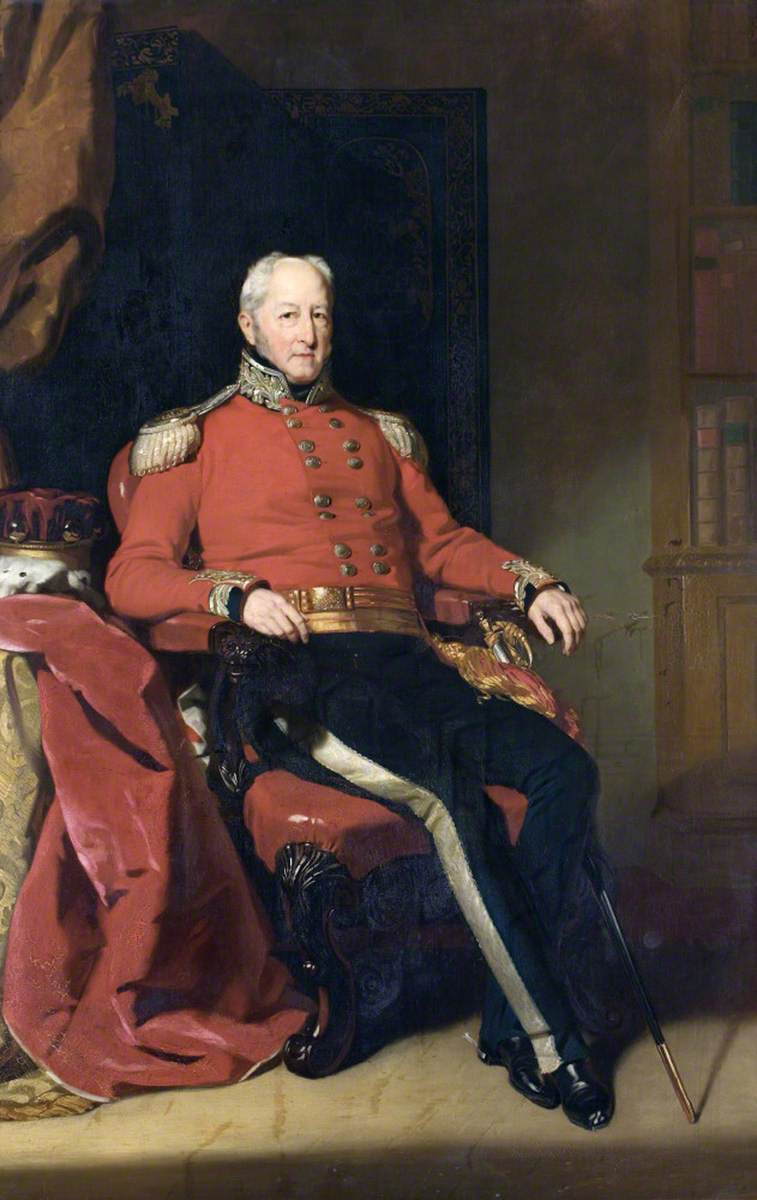
Colonel George Rice-Trevor (1795-1869), 4th Baron Dynevor. The man who appointed Richard Scott as first Chief Constable of Carmarthenshire. (By kind permission of the National Trust)


This was done as a direct result of the civil unrest in the county as a direct result of the Rebecca Riots. In August of that year the following anonymous letter was published in the “Welshman” newspaper which gives one person’s rather singular insight into the situation at the time.

CARMARTHENSHIRE RURAL POLICE.  (The Welshman – August 1843)                                                                                                                                   

“We are quite sure that no practicable and effective remedy can follow the establishment of a rural police force- the measure resolved upon by the Carmarthen Magistrates, and on the efficacy of which they appear so fully to rely. A really efficient rural police may do much, but it must be fully adequate to the emergency, which it manifestly is not. The present is a crisis involving results of great moment and difficulty. Such an establishment may be effective to the restoration of order in ordinary cases. It may disperse a disorderly crowd or lodge a body of drunken rioters quietly in the station- house, but looking to the number and description of that guerrilla band, to whose outrages it is meant to be applied, we do not think that, in the way of experiment, a more perilous measure could have been adopted. Rebecca, though not perhaps of the noble race of Shenkin, has, nevertheless, no obstinate daughters in her family. They give ample proof of the rigorous obedience to which they are trained. Their celerity of movement, and the skillfulness of their tactics, shows them to be disciplined by no common hand. Far from being awed by the military, the troops are hardly out of sight before the obnoxious gate is levelled with the ground, a shout of triumph is given, and in an instant the assailants disappear. They vanish, as it were, into the bowels of the earth, and no trace of them is visible but in the work of demolition which they have achieved, the vigilance of the soldiery is everywhere baffled and their activity defied. It is in this critical disposition of affairs that at a meeting of the local Magistrates and gentlemen of Carmarthen, Colonel Trevor, the county Member, says that, he having great responsibility cast upon him, fairly stated to the county that he did not believe any other method could now be followed than the establishment of a rural police force for the whole county, and not as had been at first suggested, for the disturbed districts only. What ground, we would fain ask, can the gallant Colonel have for supposing that where the soldiery had failed, a rural levy of police would succeed? There was an instructive voice in what had passed before him, to which he should have listened. There is a toughness of heart and muscle, and a firmness of purpose, in our regular troops, which might have justified him in concluding that where they had done nothing, nothing could not be done; we mean nothing in the way of actual conflict, and then, the amount of force with which he proposes to grapple more closely than hitherto with this astounding evil-what is it? – 50 constables, with one chief constable and the superintendents. Is Colonel Trevor, or any other of the Carmarthen Magistrates, aware of the collective number, strength, and equipment’s of the Rebeccaites, to whom this constabulary force is to be opposed? Have they ascertained how many out of the fifty policemen dispersed over the whole county, can be summoned in an instant to the spot at which the work of toll-gate destruction is going on, and whether they can be mustered, on the spur of the occasion, in sufficient force to capture the assailants ? To interfere to any useful purpose, they must, when any desperate outrage calls them into action be in a condition to cope with the audacious and daring enemy they have to deal with. Has their means of doing this been computed? If all these emergencies have not been foreseen and provided for – if care has not been taken to make the issue of each sudden encounter successful – the result will be in every way deplorable. Now, how all this, or anything like it, is to be effected by 50 men scattered over the whole county, we are at a loss to imagine. The Rebeccaites can concentrate their forces, at any moment, to any spot. Their watch is continual, and their movements simultaneous. They have a systematic plan of operations, with spies and outposts on the heights in every direction. With the police it is just the reverse. They cannot group themselves. They are scattered at wide distances, without the means of mutual support and co-operation in any case either of attack or defence. If out on active duty during they day, which they of course must be, it will inevitably happen that during the nightly expeditions of the toll-gate breakers they will be in their beds, from which they will rise only to witness the acts of devastation which have been going on while they slept. The sure consequence will be that, instead of repressing the disturbance, the confederates will become more active and hardened than ever. They will be excited to fresh outrages by the demonstrated inefficiency of the force employed to subdue them. Many thoughtful moments ought to have been bestowed upon the rural police plan before any resolution was passed to introduce it. As a piece of military machinery, it is, under the circumstances, the worst that could be devised. It is a fresh torch of discord, the effect of which will be to embitter the spirit of violence and  revenge will break forth with redoubled wrath, and will be directed not only against the rural police as a body, but, stealthily, against every straggling individual of the corps. The Magistrates of Carmarthen seem to set but little value on the mediation of Government when compared with the contrivances of their own wisdom. The language of the Earl of Cawdor at the above meeting we hold to be somewhat exceptionable on this score. The Government Commission might, he is pleased to admit, produce a good result he hoped it would, but it must not, it seems, be considered as at all superseding the wisdom and good judgment of the Magistrates, whose duty it still was to do what was necessary for the peace and safety of the county. This language, we think, savours somewhat more of presumption than the noble speaker, either on his own part, or on the part of his brethren, is entitled to hold.”

DEATH OF LIEUTENANT COLONEL SCOTT.  The Welshman – page 6, 19th March 1875.

Lieutenant Colonel Scott, Chief Constable of the Carmarthenshire Police Force, died yesterday morning at his residence, in Picton Terrace, Carmarthen. About two years since he fell over some steps and received injuries of a serious nature, from which he did not recover. He was able however, to discharge the duties of his office until the other day, when he was obliged to yield by the gradual loss of health, and for a month only was unable to attend to business. Up to that time he managed to move about, complaining only that his feet were tender and weak. But it was evident that his once vigorous strength had given way, and when confined to the house this became more apparent, and he grew worse day after day until the end came yesterday morning. His loss will be greatly felt in the police force, and we believe will be also deeply mourned for although his discipline was most severe, he was good at heart. A hard and seemingly unbending demeanor to those under his command concealed a very warm and generous heart. All that he looked for was strict attention to duty, and he would in all circumstances see that it was done by every man. In this way the Carmarthenshire Police Force has won the reputation of being one of the best in the Kingdom. Only a few days before his death, the officers of the Force presented him with a massive silver teakettle, bearing the following inscription: “Presented to Lieutenant Colonel Scott, by the Officers of the Carmarthenshire Constabulary, as a testimonial of the respect and esteem in which he has been held by them during the 31 years he has been their Chief” Colonel Scott was in the seventy-fifth year of his age. He entered the Army early in life, and was attached for many years to the Staff Corps of the Quarter Master General. In 1843, during the Rebecca Riots, he was sent into this county to “organise the police force,” of which he has since been Chief Constable. His efficiency had frequently obtained the commendation of the Justices in Quarter Sessions and of the Government Inspectors. As a citizen he was much esteemed. He took very little part in public affairs, although feeling a real interest in them, because as Chief Constable he thought it was scarcely becoming in him to do so. But the volunteer movement was an exception. In this he took a warm interest, attending drill more regularly than any other volunteer, and laying himself out ungrudgingly for its success. He will be buried on Monday next, at 11 o’clock, in St. David’s churchyard.
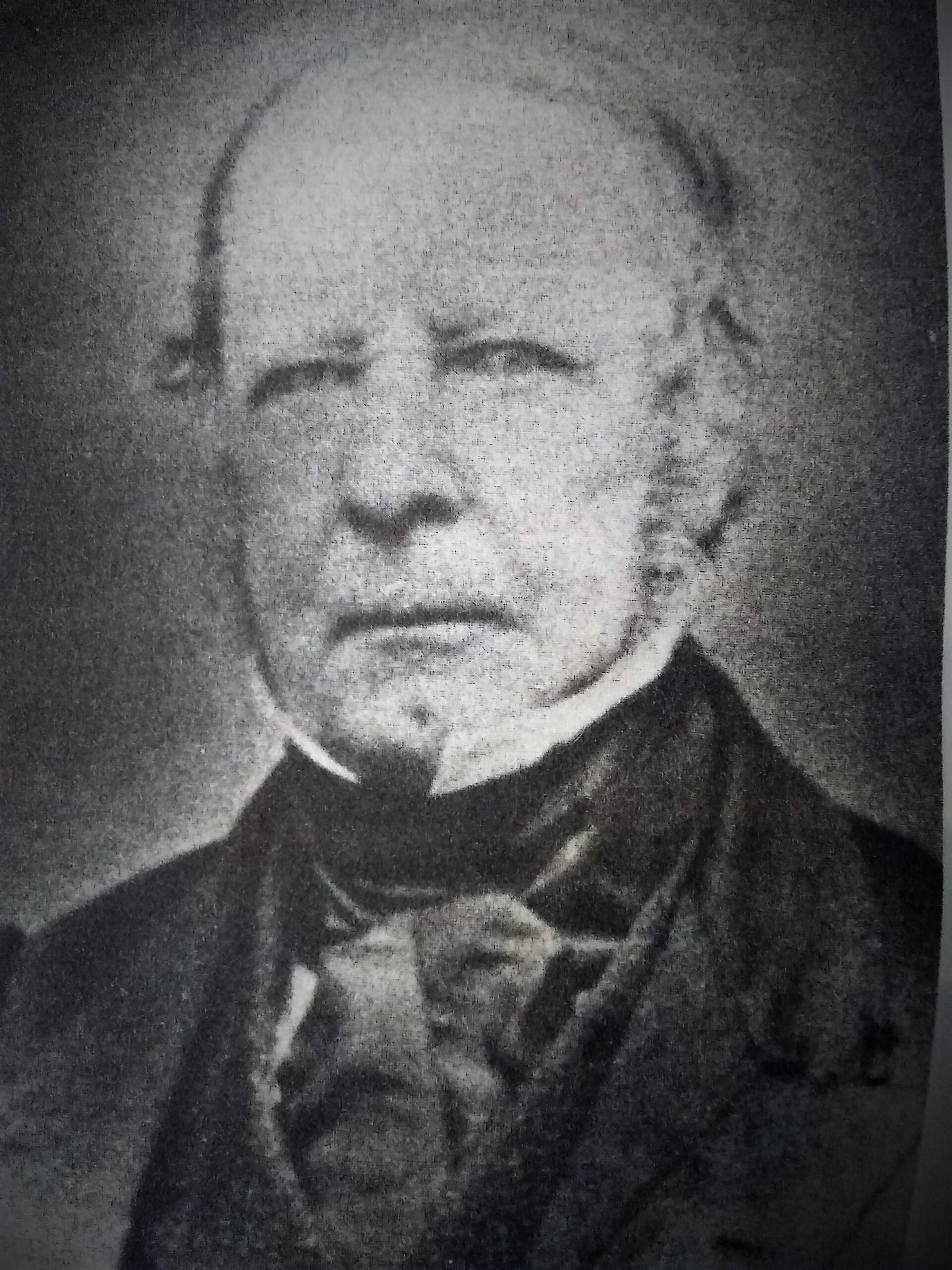
Richard Andrew Scott. By kind permission of Dyfed Powys Police archives.


DEATH OF MRS. SCOTT,  PICTON TERRACE, CARMARTHEN. (The Welshman 30TH August 1895 Page 5.)

The news of the death of Mrs Margaret Manderson Scott, of Picton-Terrace, Carmarthen, was received on Tuesday morning with much regret in Carmarthen, where the deceased lady was well known and greatly respected. Mrs Scott was the widow of the late Lieut Col Scott, formerly of the Royal Staff Corps, from which regiment he came to Carmarthen to take up the position of Chief Constable for the county at the time of the outbreak of the Rebecca riots. The deceased lady, who was 81 years of age, had latterly showed signs of general breakdown, and her death was, therefore, not quite unexpected by her relations. She was born at Falmouth, Cornwall, and was one of eight children of Dr Vigurs. Mrs Scott accompanied her husband to Carmarthen, and has resided here ever since. She was one of the oldest communicants in the parish of St. David’s, and attended divine worship at St. David’s Church twenty five years before Christ Church was built. By reason of her generous disposition, lovable nature, and her constant and earnest desire to assist in every movement which had for its aim the benefit of the parish, she wad held in universal esteem and affection. Mrs Scott leaves two children to mourn her loss, viz. Major Scott – St. Lucia, West Indies, and Mrs Garwood, wife of Colonel Garwood, Royal Engineers, India, and also a sister, Mrs Pooley, Picton Place, Carmarthen. The funeral, which was of a private character, took place today (Friday) at St. David’s churchyard.
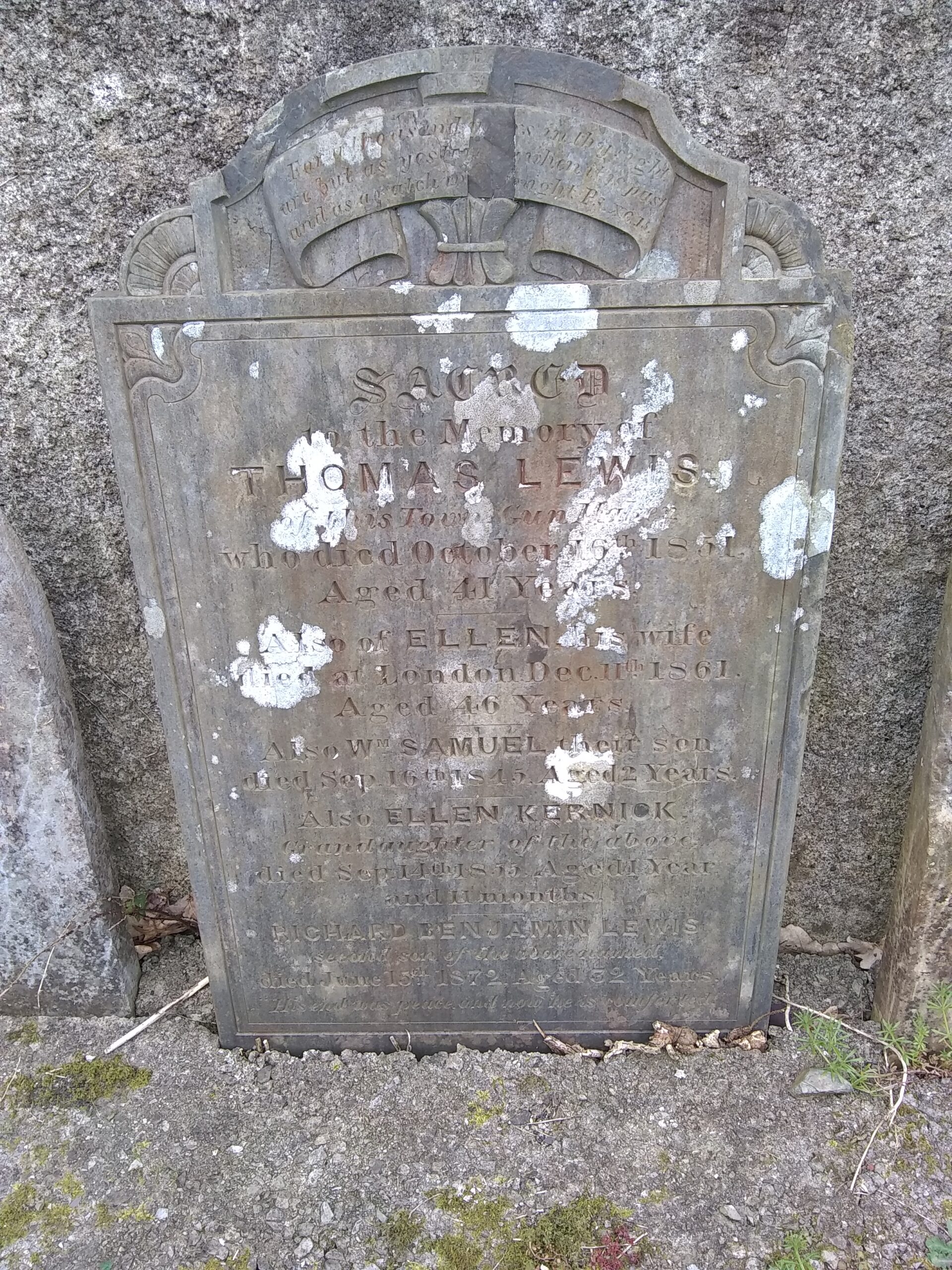
THOMAS LEWIS – MASTER GUNSMITH 1810 – 1851. & HIS SON – ORDINARY SEAMAN RICHARD BENJAMIN LEWIS 1840 -1872.

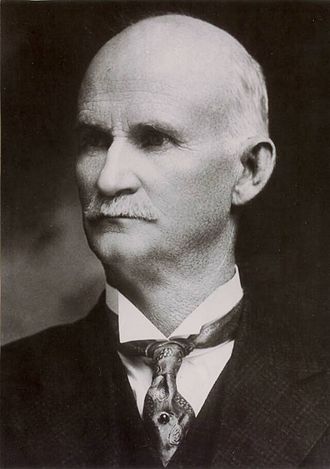
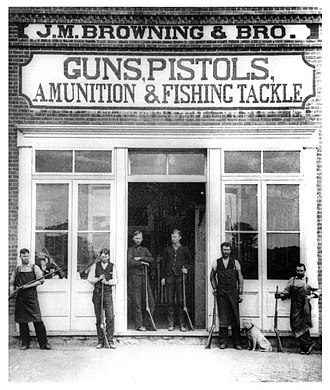
On October 26, 1881, shots rang out at the O.K. Corral. Within the first 30 seconds of the shootout, three members of the Clanton gang were killed. Men on both sides, including Wyatt Earp, Doc Holliday, and Billy Clanton, would become legends in part because of what happened in Tombstone, Arizona. They were firing a legendary weapon, too. The Colt Single Action Army, held many names over the years. First came its clunky official title, “the New Model Army Metallic Cartridge Revolving Pistol” but soon it became known as the Frontier, the Equalizer, the Model P, and most famously, the Peacemaker. There was no peace that October day in Tombstone. But the shootout was one of many that cemented the reputation of this six-chamber gun that saw more than 20 years service with the United States Army and became the iconic revolver of the West thanks to John Moses Browning. John Moses Browning was the most prolific gun inventor the world has ever known, working in his father’s shop from the age of seven, where he was taught basic engineering and manufacturing principles, and encouraged to experiment with new concepts. There he developed his first rifle. He made his first firearm at the age 13 in his father’s gun shop and was awarded the first of his 128 firearm patents on October 7, 1879, at the age of 24.

Gunsmiths too were also evident in Carmarthen even as far back as the early 18th century, often passing down the secrets of their trade from father to son. William Thomas for example had a business in Priory Street in 1732, & Thomas Rees is recorded as being a gunsmith in 1771. Thomas Lewis however was unique and a man way ahead of his time, born in Bristol in 1810, his parents came to live in Carmarthen soon after and lived near the Carmarthen Gas Works when his father became the manager (as were generations of the family thereafter) Seeing for himself at a young age all the component parts of the various gas turbines his father showed him as he took him around the gas works he was mesmerised by all the moving parts and developed a keen interest in mechanics and in particular handguns, so much so that at the age of 15 in 1825 he was mentioned in the  “Mechanics’ magazine and journal of science, arts, and manufactures” having designed a unique gunlock mechanism that was to change the concept and design of handguns (The gunlock (lock) of a firearm is the firing mechanism used to ignite the propellant. Lock, stock and barrel is an old figure of speech defining the totality of a firearm as the barrel through which the bullet is directed toward a target, the stock which provides a means of gripping the firearm, and the lock as all other essential parts)

Over 30 years later John Browning developed a similar method in the United States and the rest is history. What vast fame and fortune could have been won by Thomas Lewis had he patented his design and gone on to develop his ideas like John Browning and not died at the early age of 41 from illness. We will never know, except that here in St David’s cemetery lies buried a man that could have changed the course of world history had he lived.

The article first published in the Mechanics Magazine in 1825, click to enlarge
Thomas Lewis headstone with his son Richard inscribed at the bottom, click to enlarge

In 1848 the local newspaper carried the following story … “On Wednesday last, as Richard Lewis, a little boy aged 8 years, son of Mr. Thomas Lewis, gun maker, in Lammas street, was firing off a pistol loaded with powder only, the recoil of the piece was so great that it struck him in the face, laying his cheek open from the mouth nearly to the ear, and exposing the jaw-bone. Instant assistance was rendered, and although the boy was seriously injured, and in great agony, yet it is apprehended no danger will supervene”

Needless to say Richard never succeeded his father in the gun making business, deciding to join the Royal Navy aged 18 in 1858 as an Ordinary Seaman on board the Flagship of the Mediterranean Fleet –HMS MARLBOROUGH. He is described as being 5ft 6 inches tall with brown hair and hazel eyes and not surprisingly “with a large scar on his left cheek and eye”, resulting from that terrible gunshot injury ten years earlier. He left the Royal Navy 1868 after a period of 10 years and died at his brother in laws house in Kidwelly in 1872. His body was returned to Carmarthen and he now lies buried with his father and other members of the family.

Morgan, Henry J.; HMS ‘Marlborough’ off Gibraltar; Government Art Collection;


As for Thomas Lewis himself, the following obituary appeared on 17th October 1851…DIED. “On Saturday last, with perfect resignation to the Divine will, Mr Thomas Lewis, Gun maker of this town, eldest son of Mr. Lewis, Manager of the Carmarthen Gas Works, leaving a disconsolate widow and eight children to lament the loss of a good husband and father”


Burial entry of Richard Benjamin Lewis


May they all rest in peace.

EMMA TRYPHENA CLINT 1846 – 1857. CHILDHOOD FRIEND OF THE MAHARAJA OF THE PRINCELY STATE OF KOCH BIHAR -BENGAL

In October 1857 the Welshman Newspaper reported the death of an 11 year old girl living in Carmarthen – Emma Tryphena Clint. Her story is all the more remarkable when you consider the fact that she was also a childhood friend of an Indian Maharaja. Emma was born on the 1st October 1846 at a large palatial mansion, then called CONSTANTIA in Lucknow which became known as Le Martiniere College for boys.

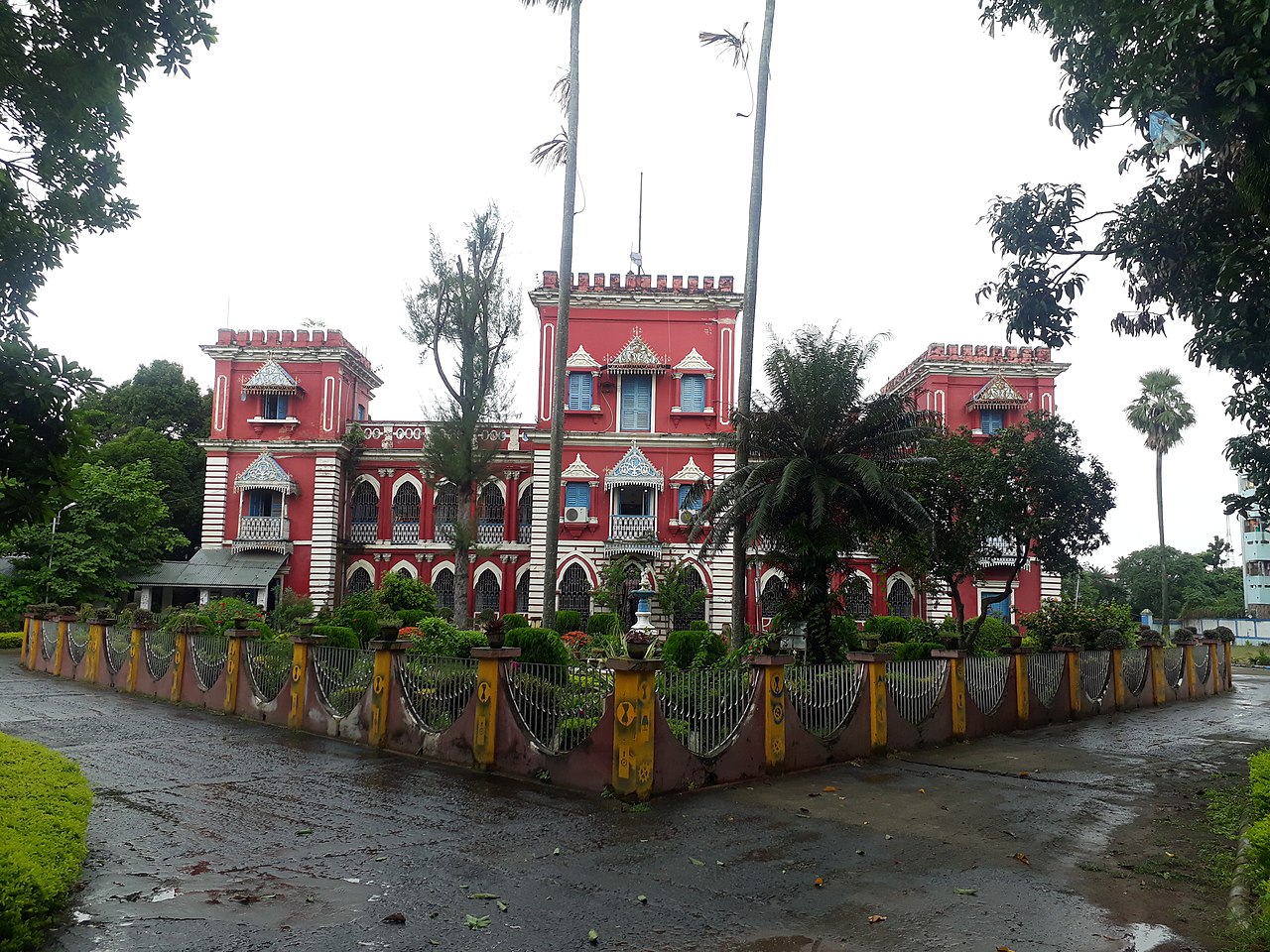
The magnificent Le Martiniere building in Lucknow. Birthplace of Emma Tryphena Clint in 1846

In 1857 – the boys at the college under the leadership of George Schilling (who took over from Leonidas Clint 3 years previously) were to take part in the defence of Lucknow following an uprising. These events of 1857 saw the making of a military legend. For the first time in history, Britain called on schoolboys to assist in the military conflict – namely the defence of the Lucknow Residency, and to put up the fight of their lives against the terrible suffering, torture and death that befell anyone caught. However it was not until 1932, following a request by the College, that the British Government finally recognised Martinière’s role in 1857. The school was granted the right, on ceremonial occasions, to carry a British Army regimental-style ‘colour’ or flag bearing its own coat of arms with a picture of the Residency and the words “Defence of Lucknow, 1857”. It thus became the only school in the world to be awarded a British battle honour.

George Schilling, Principal of Le Martiniere, whom Leonidas Clint appointed as his successor and whose bravery in 1857 earned him a place in history.

Eighteen days after Emma’s birth on the appointment to another teaching post in Calcutta they travelled over 500 miles , she was baptised in Chinsurah, not far from Calcutta.  Emma’s father, being a highly qualified academic was first appointed as head (Principal) of Le Martiniere College in 1845 and served there for nine years before his promotion to Principal of Krishnanagar College in Bengal and so began a remarkable journey that was to end in tragedy.

Krishnanagar College in Calcutta where Emma met the young Maharaja when her father was Principal

Her father Leonidas had served in India for over twenty years as a brilliant academic  and just prior to the Indian Mutiny in 1857 returned to Britain and to Carmarthen  where they lived in Lammas Street to begin his final chapter of entering the priesthood and holy orders.

Emma’s father – Leonidas Clint, also became a founding member of the University of Calcutta in January 1857 with responsibility for English & the Arts and whilst Principal at Krishnanagar College in West Bengal prior to his appointment in Calcutta he was attracted by one his pupils –Srila Sachchidananda Bhaktivinoda Thakur, and his mastery of the English language and literature. The future nineteenth century pioneer of Krishna consciousness was born in 1838 in Bengal. He worked tirelessly to preserve the spiritual tradition and literature of India; he composed, edited, and published more than 100 books in Sanskrit, Bengali, and English. Towards the end of 1856, he published an English poem, “The Poriade”, which was a poem in classical English about the wanderings of Porus (Puru), who fought Alexander the Great in the pre-Christian era, which was well-received in educated circles in Calcutta. All Thakur’s English poems were published in the paper, Library (Literary) Gazette & he delivered a lecture to the British Indian Society in 1856 on the evolution of matter which was much applauded.

Emma’s father Leonidas can therefore claim some credit for what his young pupil was to achieve in later life, but sadly not for his own daughter who died at the age of 11 years old on the 25th September 1857 in Carmarthen Wales, from consumption most likely contracted by her stay in the hot climate of India. She lies buried in an unmarked grave in St David’s Cemetery Carmarthen.

In 1845 aged 4 years old, Narendra Narayan was adopted by his uncle (the Maharaja of Koch Bihar, Shivenra Narayan) when his own son died at an early age. Later, upon death of his uncle on 23 August 1847, Narendra was installed to the throne of Koch Bihar at the tender age of six but was only granted full ruling powers in 1860. He was the first ruler of Koch Bihar to have English education under the pupilage of Leonidas Clint and also founded Jenkins School in Koch Bihar in 1861, which today remains one of the oldest boys’ schools in India.

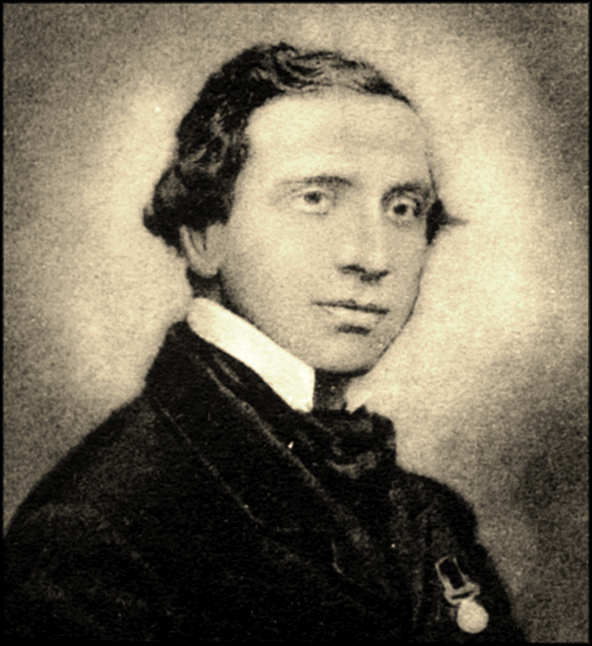
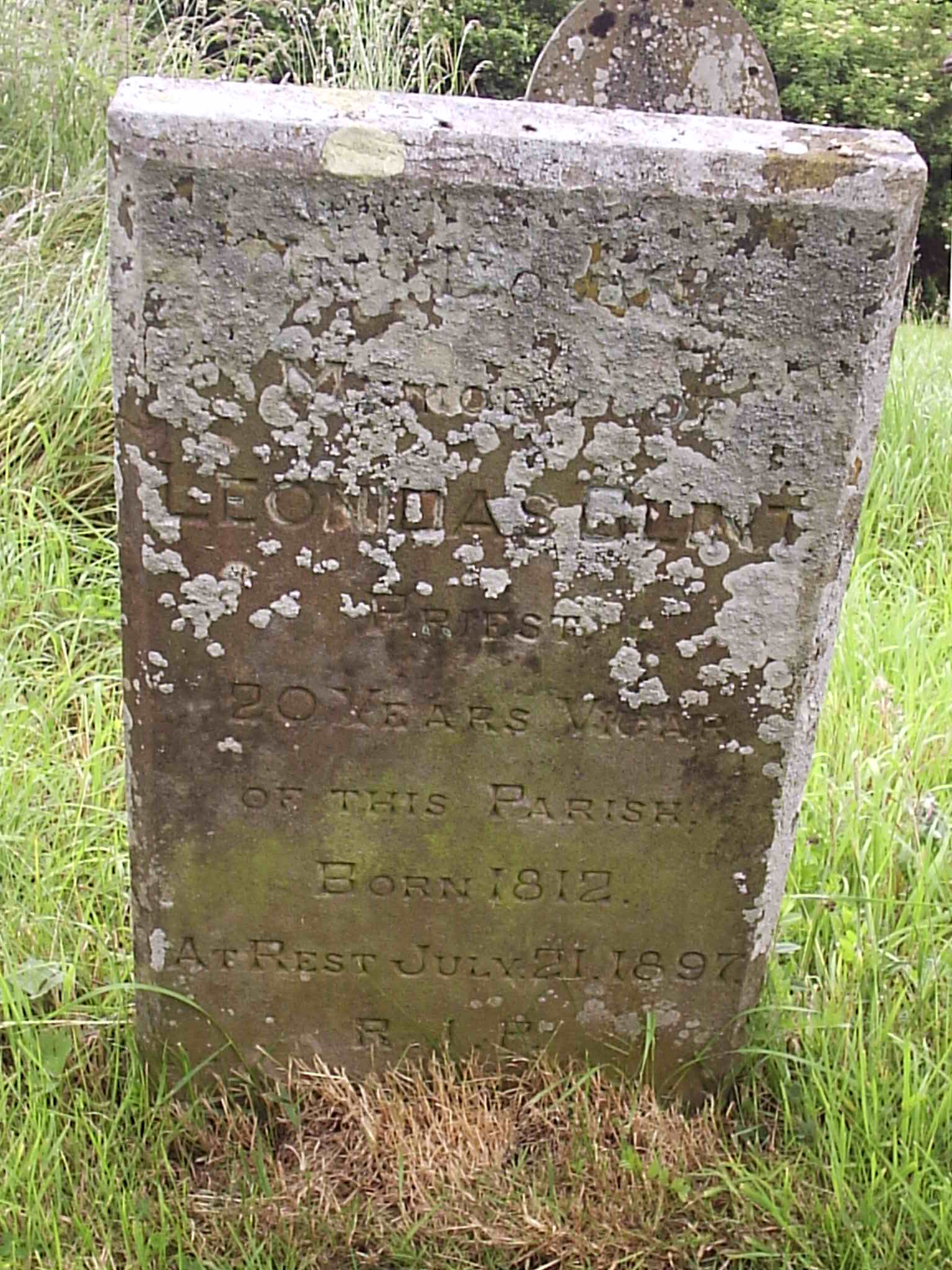
The Maharaja also became a great childhood friend of Emma Tryphena Clint at the College where he was being taught in Bengal. The Maharaja was 13 years old and Emma was nine when they first met in 1855.  The Maharaja had two sons, one of which – Nripendra Narayan succeeded his father in 1863 and whose photograph is reproduced by kind permission of the National Portrait Gallery. Who knows what might have happened if the childhood friendship had lasted longer, but sadly that was not to be. The Indian climate was certainly not one for young European children, and inevitably illness and disease became prevalent. For Emma, her life had ended all too soon, but for her childhood friend, untold riches beckoned and a place in Indian folklore. Shortly after Emma’s’ death in 1857 her father Leonidas became a vicar in St David’s Pembrokeshire and served in other dioceses across the UK until his death in Dewsbury Yorkshire in 1897 aged 85, a life well lived. However, he was to be buried in a  Herefordshire, in a parish that he had served for twenty years – Linden, where his mortal remains now lie, together with that of his devoted wife Mary.

Nripendra Narayan, MAHARAJA OF Kuch Behar wearing the diamond ruby and emerald headdress as was the custom (Courtesy of the National Portrait Gallery)
The gravestone of the Reverend Leonidas Clint at St Michael and All Angels Church in Linden Herefordshire. By kind permission of Christine Moore

Y Groes Eneidiau – The Cross of Souls – Unveiled & Consecrated on 21st June 2021

In the 180 years since St David’s first burial in 1841 nearly six and a half thousand burials have taken place until the cemetery was closed for any further burials in 2002. As we stand today, only approximately one thousand of those buried either have a memorial or inscription to their name. Most families could not afford the “luxury” of a memorial especially when you consider that Carmarthen Workhouse was situated in the parish and therefore responsible for all burials of those unfortunate inmates, all of whom received a pauper’s burial. These burials are by far the largest number accounted for in this cemetery. Others of course, fell on hard times, having once been prosperous businessmen and women such as the Swiss clock maker Mr Pedelina whose story, like many others can be found in the sub heading “What’s in a Name” & Mrs Elinor Children, sent to a convent in France in her teens, whose father was one of the worlds best mathematicians of his day. The burial of any family member is of course a sad occasion for us all, especially when it comes to children and infants, of which there are hundreds here, all with no burial place to visit or memorial – until now.

This Cross of Souls memorial will now serve to remember ALL those five thousand plus who lie buried here who previously never had a memorial of their own. This construction finally brings to an end the disparity between the rich and the poor and will I am sure finally bring peace to the souls of those departed. The following poem, published locally and anonymously in 1865 epitomises everything this memorial represents. May they all rest in peace.


IN MEMORY OF A FRIEND WHO DEPARTED THIS LIFE NOV. 4, 1865 AGED 21 YEARS.


 He has departed in his youthful prime,

 Ere manhood’s bloom had blossomed on his brow,

 From life and all its joyous springtime

 Severed now.

Though mournful was his fate, hushed be our grief.

Tears, thou must cease to flow, though he is gone.

From the world’s troubles he has now relief.

So must not mourn.

Thy young and gentle heart will never know

 Hopes disappointed, nor the thousand ills

 Which from our passions and our feelings flow,

 In icy chills.

 But in thy lonely, earthy, stilly grave,

 In calm repose, thou’rt sleeping thy last sleep,

 Beneath the flowers that bloom, the cypress wave,

 And willows weep.

 Fit emblems of our love to thee we give –

The lasting flower of life, “Forget-me-not.”

And while our life, or while our memories live,

Thou’rt not forgot.

As stands the cypress by thy early grave,

With bough that’s ever green with verdant leaves.

 And sighing as above thy tomb they wave

Unto the breeze.

So will thy virtues and thy memory rest

In freshness, evergreen unto the end.

And when a memory of thee fills our breast,

Our sighs will blend.

The graceful willow-sacred, mournful tree,

As drooping low, and weeping, it appears-

Is but a symbol of our love for thee,

In silent tears.


The construction of this wonderful memorial would not have been possible without the help and support of many individuals, friends, and supporters, and the trustees of the Thomas & Elizabeth Mayhook Charity will be forever grateful for their support. In particular special mention must be given to Richard Holmes of Holmes Contracting who has given up a lot of his time, free of charge to carry out a lot of the preparatory work for the memorial, together with members of the Mackworth Club of local Freemasons who have been particularly supportive of the charity. Also Phillip Bowen of Tumble Memorials who arranged for the delivery of the black granite cross and it’s erection with the help of Carmarthen Athletic Rugby Club under the supervision of Brian Powell. Captain James John the permanent staff officer at Picton Barracks together with his staff were extremely helpful and Mrs Elaine Jenkins aided by Helena provided us with much needed refreshments after the consecration. Mention must also be given to Professor Medwin Hughes DL, Vice Chancellor of Trinity St David’s University & “friend” of the charity for his unwavering support and indeed ALL the “friends” and supporters of the charity too numerous to mention whose financial contributions and voluntary support help sustain the charity in it’s endeavours to maintain and preserve this historic cemetery. Thanks also to Iwan Evans, of Glamor Evans and Son for providing us with the service pamphlets on the day.  Finally I would like to thank Her Majesty’s Lord-Lieutenant of Dyfed – Sara Edwards for unveiling the memorial, & to the Venerable Archdeacon of Carmarthen-Dorrien Davies for consecrating the memorial and the Right Honourable Mark Drakeford MS – First Minister for Wales for attending the ceremony and laying a wreath on behalf of the people of Wales. A fitting tribute indeed.

I am very pleased to publish the following text, from a letter received from Her Majesty’s Lord – Lieutenant after the unveiling ceremony………


22nd June 2021

Dear Mr Goodridge,

 It was a great pleasure to join you for yesterday’s unveiling and consecration of the Cross of Souls memorial at St Davids cemetery, and I write to congratulate, and thank you, for all your hard work in making it possible.

 It was a privilege to be present at such an important historical occasion for Carmarthen, and emotionally one that will mean so much to so many.

 I would be grateful if you would convey my congratulations and thanks to all trustees, friends, and supporters of the Thomas & Elizabeth Mayhook Charity, and again my thanks and good wishes to you.

 Sara Edwards

 Her Majesty’s Lord-Lieutenant of Dyfed 


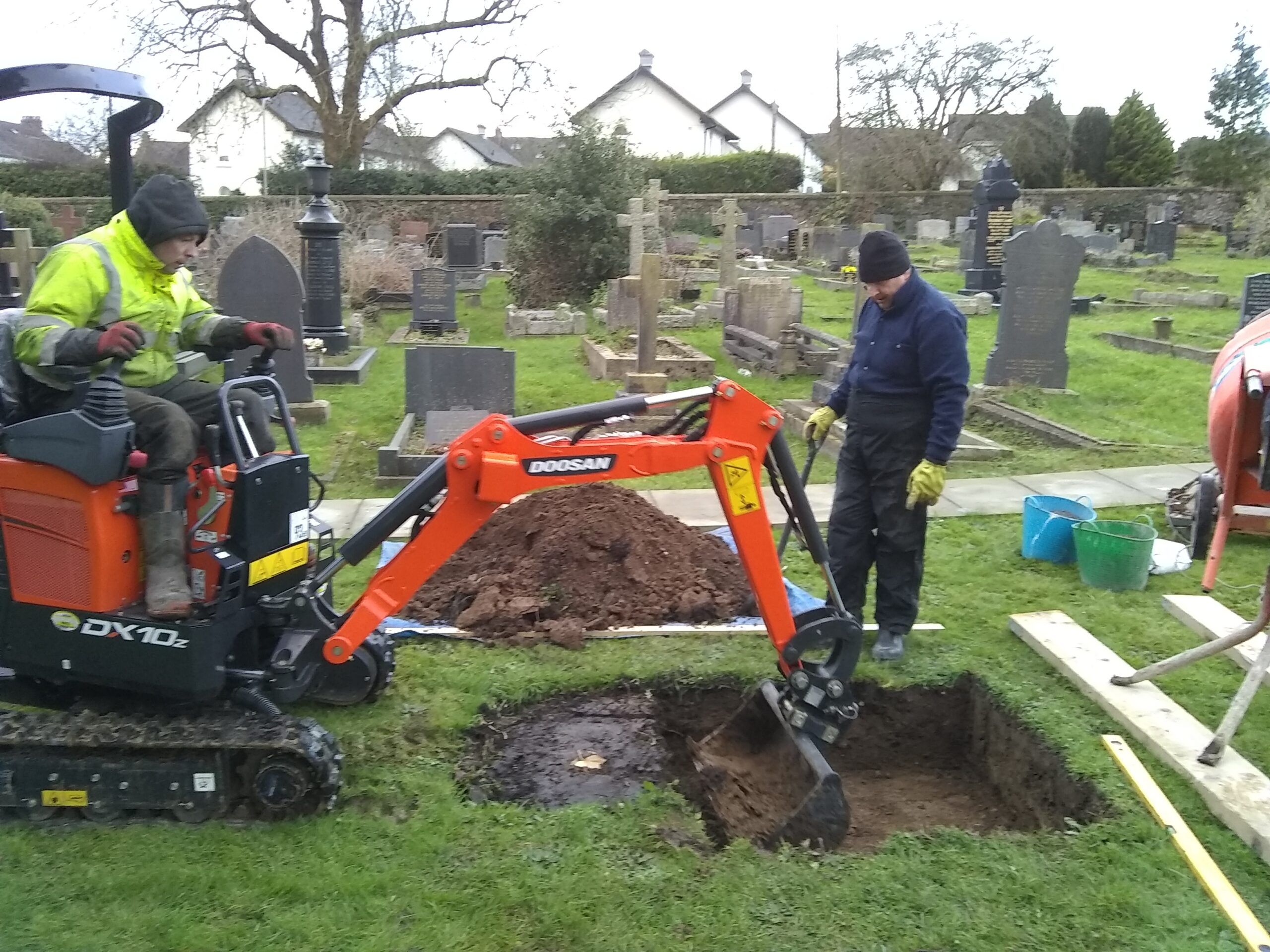
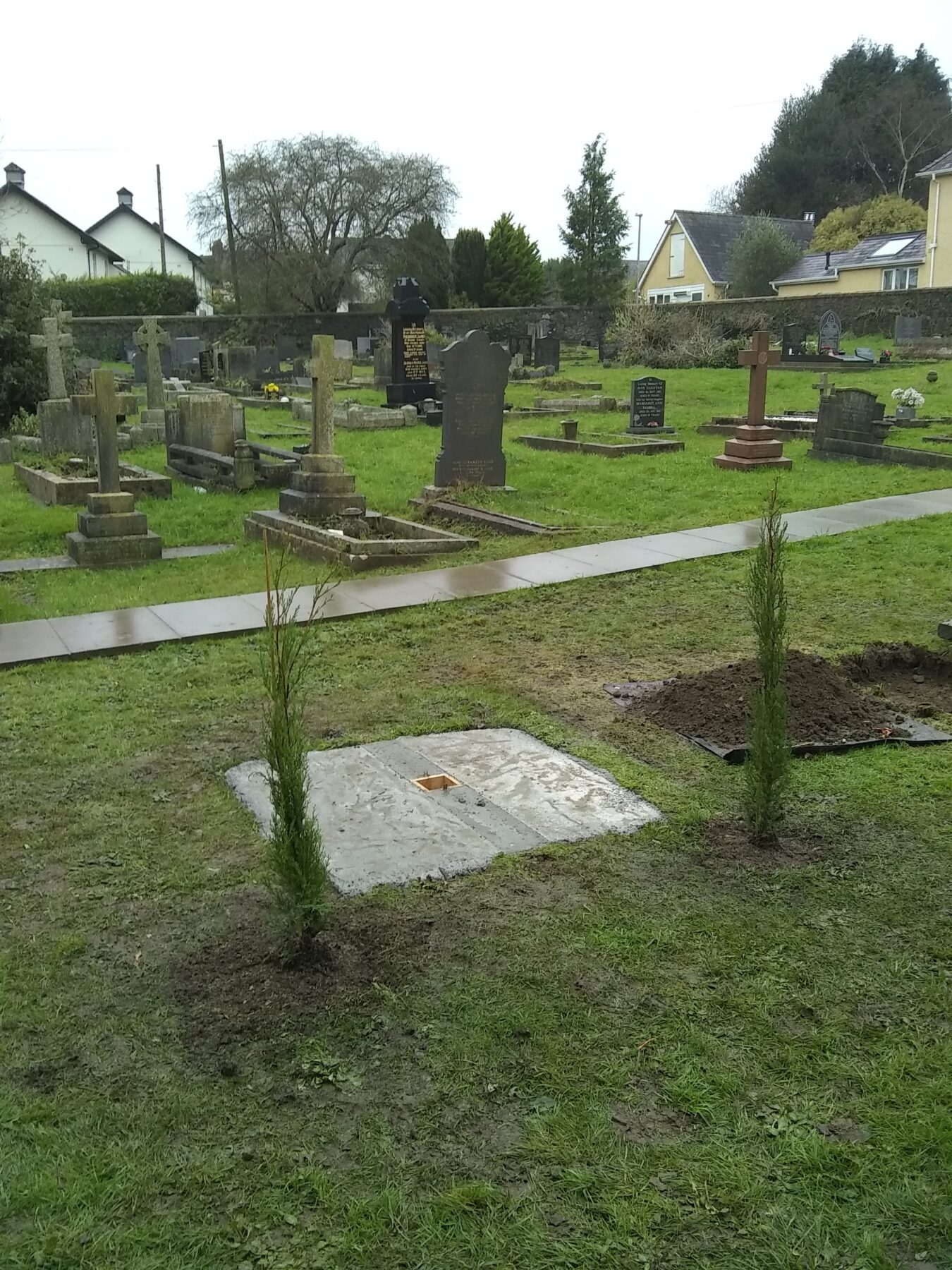
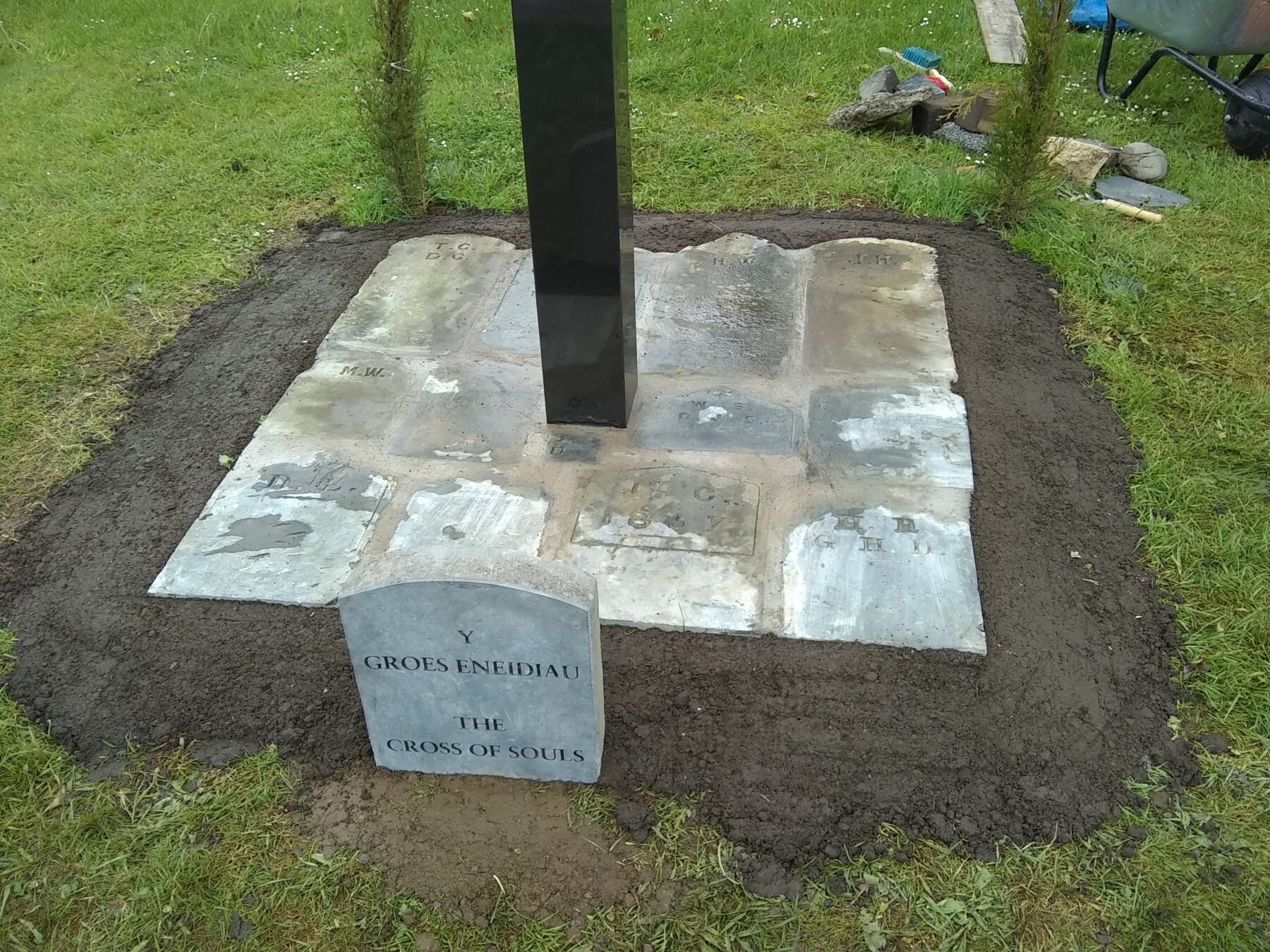
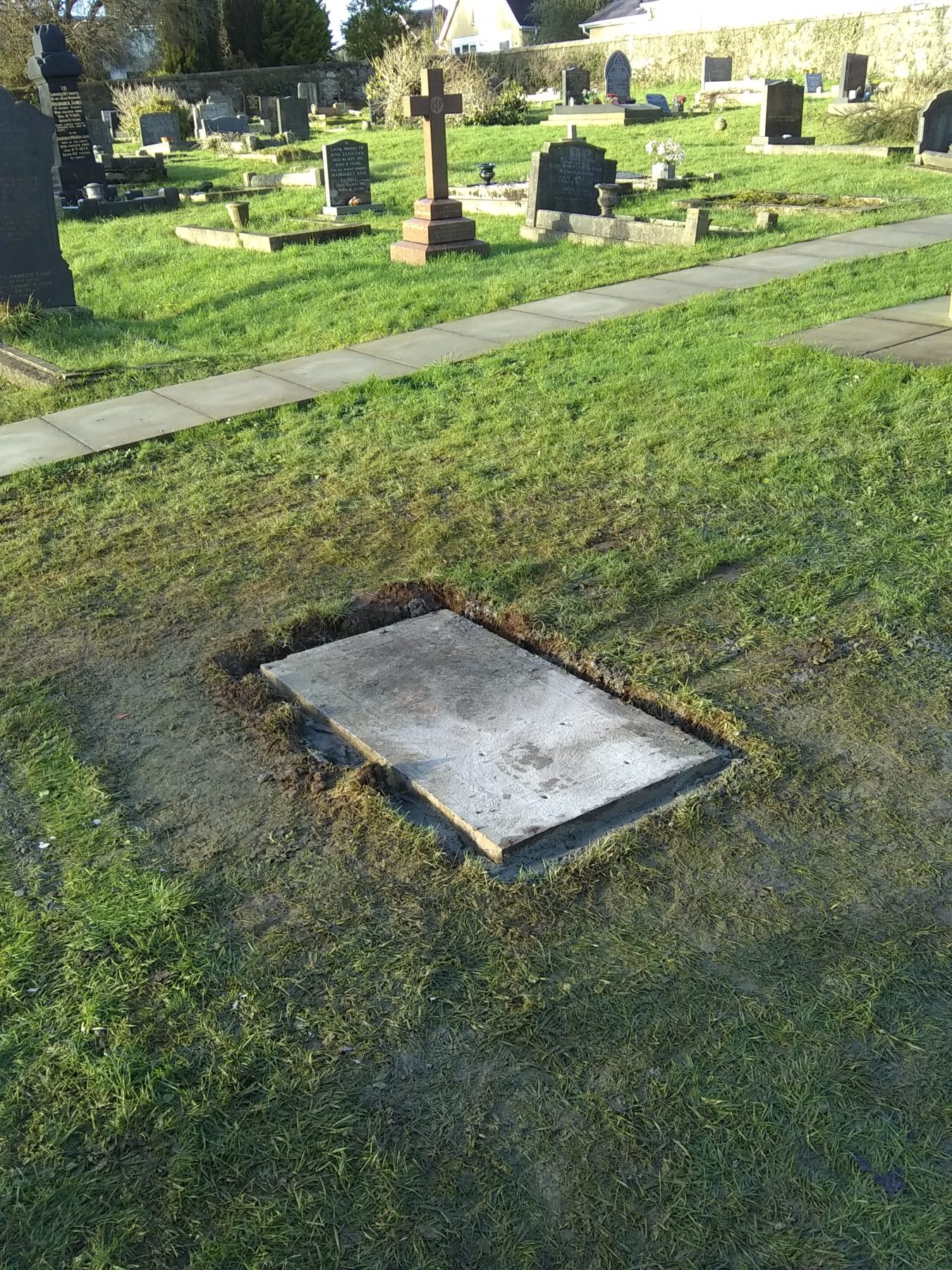
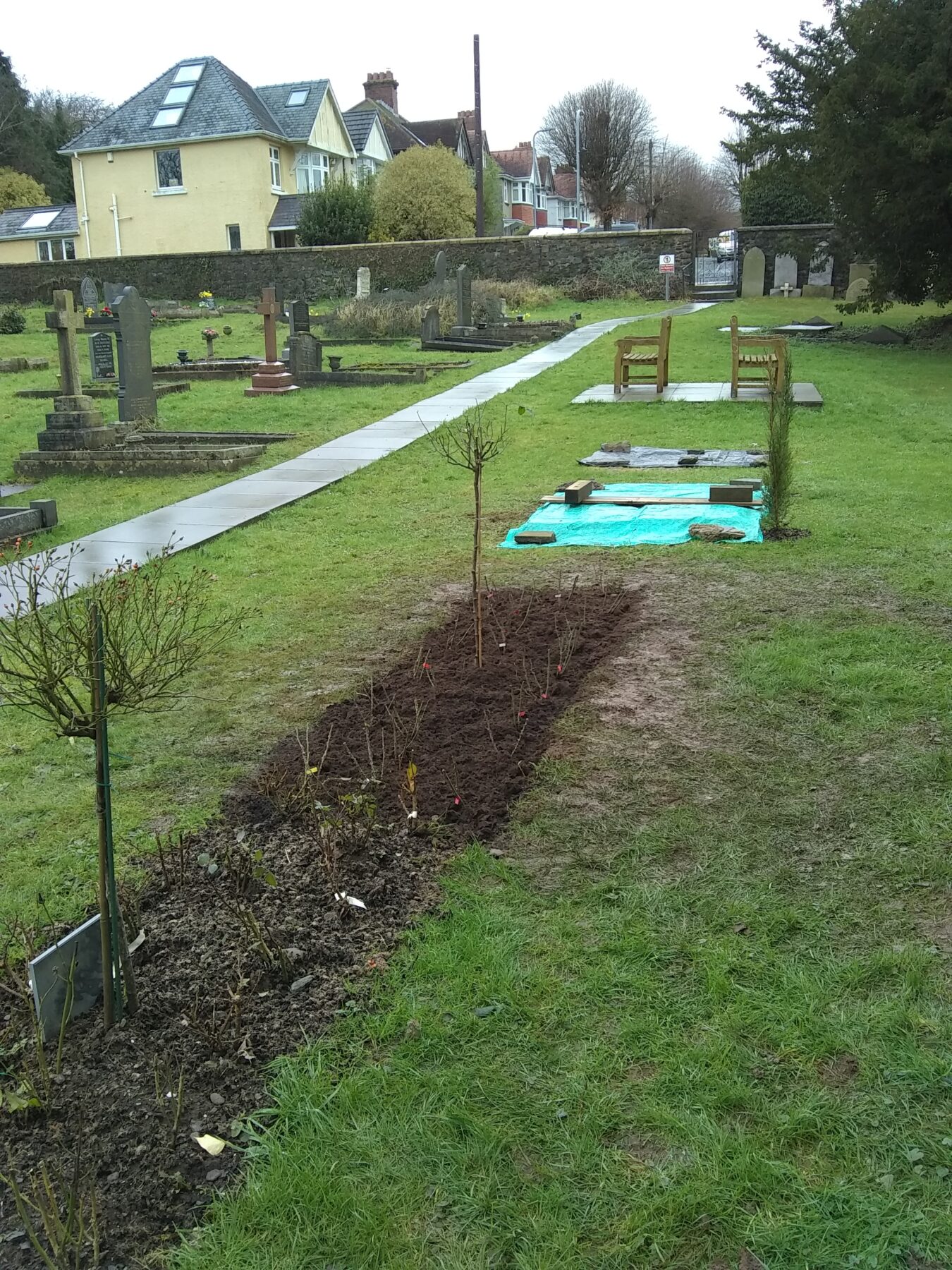
The photographs that follow tell the story of the construction of the memorial from start to finish.  The first photograph is an image taken by the Ground Penetrating Radar (GPR) courtesy of Leica Geo systems using the world’s latest technology. Before the mini digger arrived to dig the foundations a scan was taken by GPR of the area in question to ensure there were no burials in that area of the cemetery and when we were satisfied that this was the case, work then proceeded accordingly. It is interesting to note the image contains some bright orange areas of the cemetery and these represent “high density” patches likely to be either stone/marble or ironwork close to the surface, in all probability fallen memorials and railings. The deeper the scan the more detail the images provide. Most of the photographs speak for themselves in showing the progress of the work involved finally leading to its unveiling and consecration. It is worth pointing out also that the base of the cross has twelve discarded grave markers surrounding it, cut and cemented into position, some with initials and dates and some without. The thirteenth grave marker was re-engraved with the Cross of Souls inscription that lies in front of the memorial. The large stone base of the information panel that sits alongside the memorial was previously a side panel made for a “box tomb” that had long since collapsed and was specially chosen for this purpose. An image of the information panel itself is featured at the end of the photographic gallery. Grateful acknowledgement and thanks are also given to Mr Jeff Moreau who took the photographs of the unveiling and consecration.

Richard J Goodridge MBE

Chairman of the Thomas & Elizabeth Mayhook Charity.


In the beginning…. a “time slice” image of a GPRS (Ground Penetrating Radar Survey) scan of the area to be used for the construction of the memorial carried out by Leica Geosystems using the worlds most powerful and latest radar technology. The orange areas represent “high density” objects such as stone or metal & the white triangular area to the right is a family vault.

Where it all began……Richard Holmes of Holmes contracting carefully digs out the foundation for the memorial.

The concrete base, ready for the cross to be inserted (left) and Robert Goodridge(Trustee) inspecting the concrete foundation prior to the side panel of the box tomb being laid on top to form the base of the information panel.

The twelve grave markers found scattered around the cemetery (top left) being carefully laid out before cutting and positioning (right) and the thirteenth marker re-engraved at the front. The base of the information panel made from a collapsed side panel of a box tomb (bottom left) & the rose bed after it’s extension (right) with the base of the memorial under green sheeting beyond.

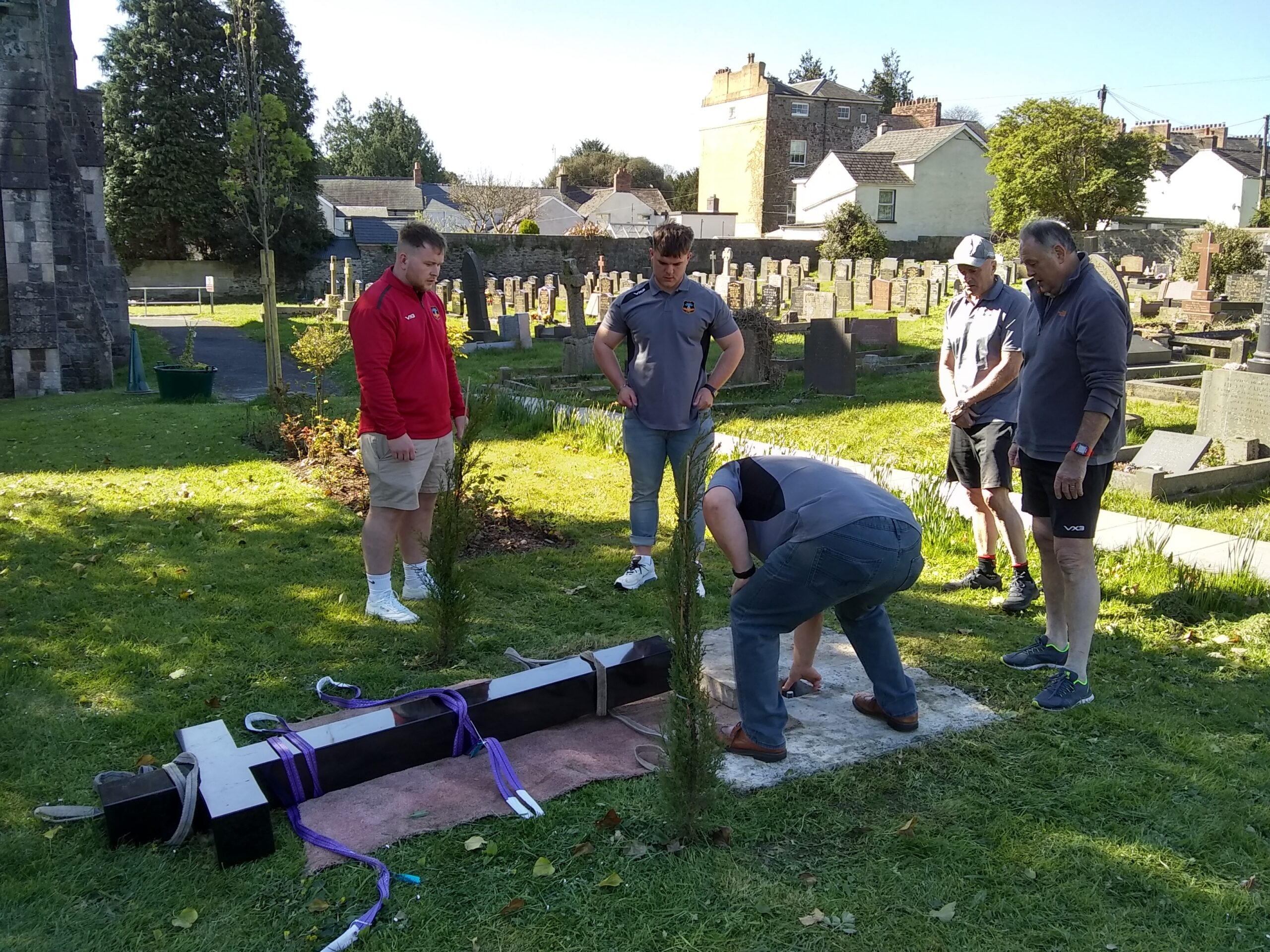
Members of the Carmarthen Athletic Rugby Club positioning themselves ready to insert the cross into the base.

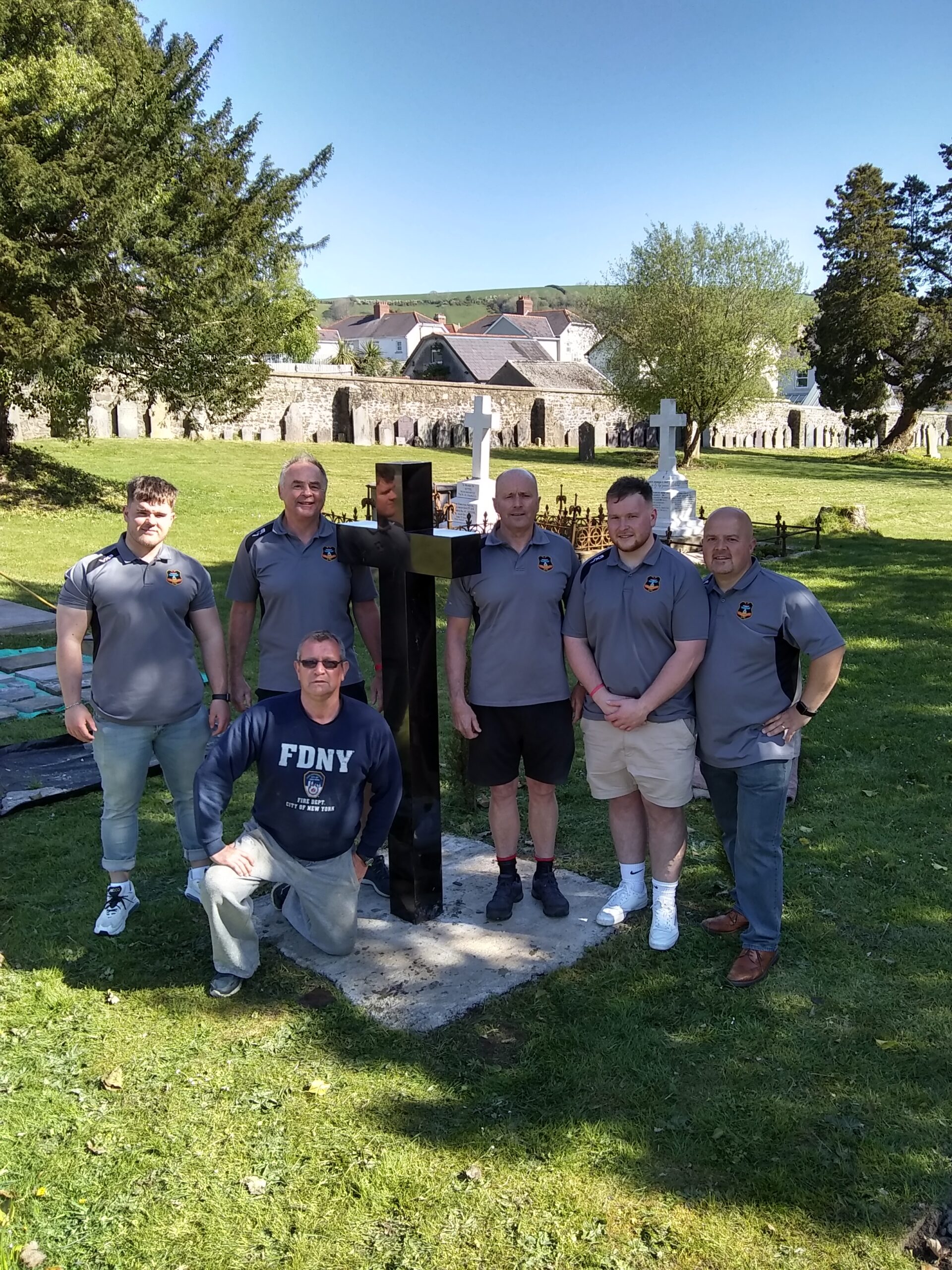
The “Athletic team” who carried the cross into position – namely Royston and Tom Massochi, Mike Edwards, James Nunian, and Brian Powell. Phillip Bowen of Tumble Memorials (kneeling) was the stonemason responsible for overseeing the positioning of the cross and securing it into the base.

Her Majesty’s Lord-Lieutenant of Dyfed , Sara Edwards unveils the memorial.

Her Majesty’s Lord-Lieutenant lays a basket of flowers at the memorial after unveiling it.

(R to L) The Right Honourable Mark Drakeford MS -First Minister of Wales, The Venerable Archdeacon of Carmarthen Dorrien Davies, Mrs Fiona Hughes, Tom Lloyd OBE.DL Wales Herald of Arms Extraordinary, & James Ross -Provincial Grand Master of the Masonic Province of West Wales, & Richard Holmes.

The First Minister of Wales lays a wreath on behalf of the people of Wales.

Professor Medwin Hughes, Vice Chancellor of Trinity St David’s University lays a wreath on behalf of the Friends of the charity.

Mrs Margaret Curtis lays a wreath on behalf of the Trustees of the charity.

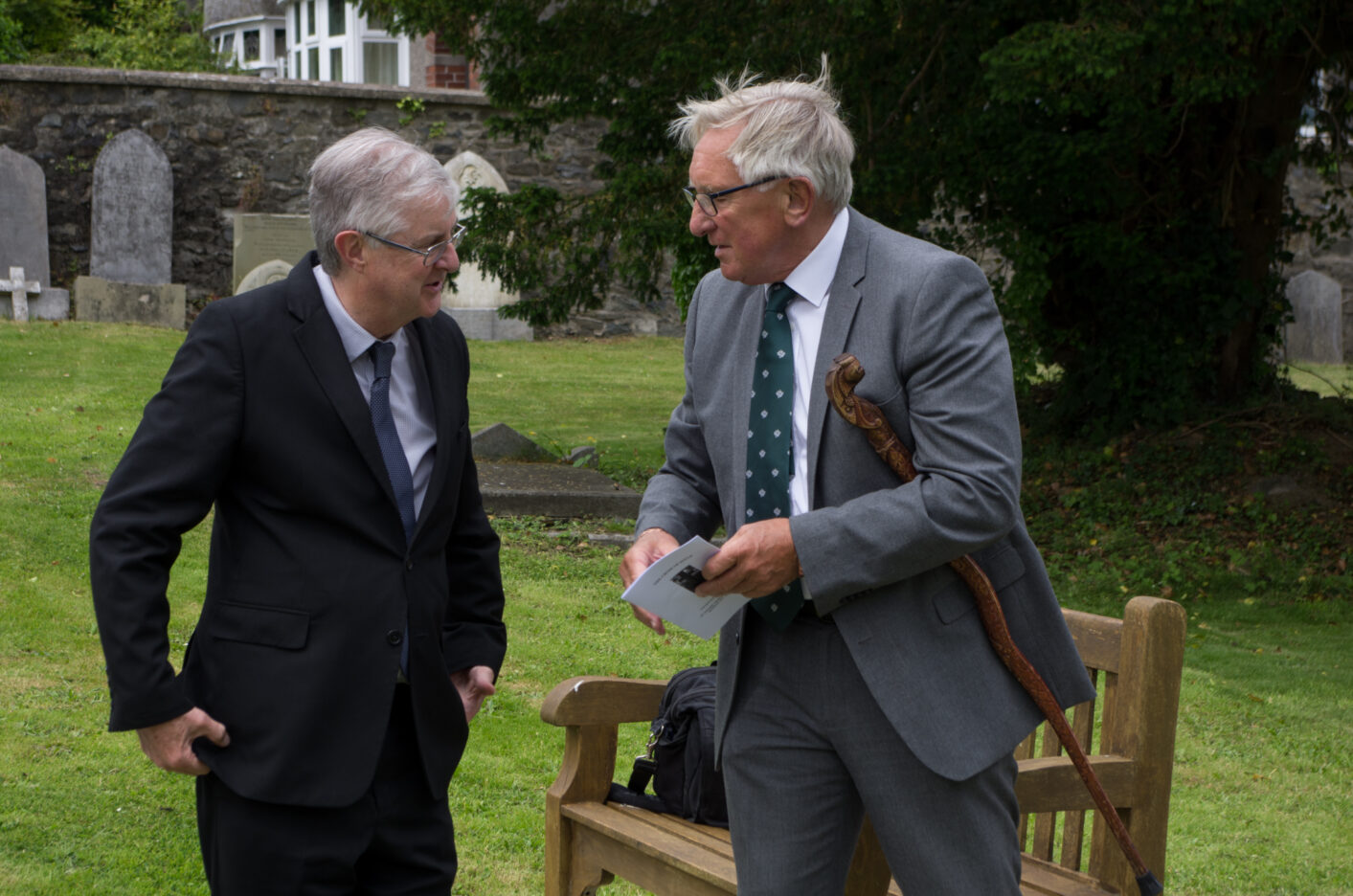
The First Minister of Wales in conversation with Roy Bergiers – Friend and supporter of the charity.

The Venerable Dorrien Davies – Archdeacon of Carmarthen blesses and consecrates the memorial.

The memorial in all its glory, a most fitting tribute.


In Memory of all those stillborn, unbaptised infants who lie buried in St David’s Cemetery.

In June 1863, the body of a still born male child, hidden by its mother for three days – wrapped up in newspaper, was buried in St David’s cemetery Carmarthen in an unmarked grave. Servant girl – Eliza Richards was six months pregnant when she gave birth to the boy but concealed his body in the fireplace of her bedroom. Here then is the brief story of a really sad and tragic event. The youngster as far as I can ascertain was never given a name. May he rest in peace. This is the 50th story to be published under the “What’s in a Name” series on this website and ironically there is no name to speak of in this instance. However, the Cross of Souls memorial to be unveiled and consecrated on Monday 21st June will finally address the matter of all those who have been buried at St David’s that have no known grave or memorial. This then – the 50th story on the eve of the consecration is probably the most poignant one that I have so far been able to publish, and in some ways the most important story of all. He may not have had a name, he was born prematurely but never survived and was buried unbaptised without ceremony, but most importantly of all he will finally be remembered for all time on 21st June. God rest his soul.

On Wednesday 19th June 1863 an inquest was held at the Shire Hall, before J. Hughes, Esq., coroner, on the body of a new born male child, which was found under the following circumstances Jane Davies, wife of John Davies, Friars’ Park, said “I am a charwoman. I go out regularly when required I have been accustomed to go to the house of Mr. Benjamin Thomas, in Lammas-street, for the last nine years. I do not go there regularly since they keep a servant. I was there last Monday, about eight in the morning. I had heard outside that the servant girl had been pregnant. The servant’s name is Eliza or Elizabeth Richards. She was in the house on Monday, in bed, when I went there. I was told before I went there that the girl was ill. When I first went to the house I saw James Thomas, in the back yard. James Thomas is the youngest son of Mr. Benjamin Thomas, and lives with his father. I asked him what was the matter with Eliza, the servant girl. He told me she had had a child, and that he wished me to tell them about it in the house, because he could not do so. He did not tell me when the child was born. Nothing else was said at that time. I next went upstairs to Eliza Richards, and found her in bed. I asked her if she had had a child, and she said “No,” very slowly. I then went down and told James Thomas what she had said. He sent me upstairs again and told me to ask her for the child. He did not tell me at that time where the child was. I went upstairs the second time, and found Eliza Richards in the same room, but partly dressed. I asked her to give me the child, and she gave it to me. She was standing by the fireplace. She pushed the fire screen back, and took the child out from the fireplace and gave it to me. The child was packed up in a newspaper. That was the child which was afterwards given up to the police, and the one now seen by the jury. No conversation took place between Eliza Richards and myself at that time. I gave the child back to her, and I then went down to the kitchen. I said nothing at that time; but in a few hours afterwards I told Miss Thomas, James Thomas’s sister, that Eliza Richards had had a child. She asked me how did I know. She was in a shocking way about it. I told her I knew where it was. She did not believe me at first, but when she found I was in earnest she immediately sent for Mr. Rowlands, surgeon. I was present when Mr. Rowlands came. I took the child from by the side of the fireplace in Eliza Richards’s bedroom and brought it to Mr. Rowlands into another room. It was then wrapped up in a newspaper. It was in the same place as she had put it in the afternoon when I returned it to her. Mr. Rowlands opened the package when I gave it to him. I did not open it when Eliza Richards gave it to me. There was a dead child in the package. There was also a chamber utensil in the fireplace packed up in a bundle. It contained blood, &c. Eliza Richards was in bed when I brought those things out from her room. We had no conversation then I again saw Eliza Richards in the evening, and she told me the child was born on the previous Thursday. She said nothing more about it” By the Jury …. “Was the package was wrapped up and tied”? David Williams, police-sergeant, said “I had the body of a dead child given me at the house of Benjamin Thomas, last night, by the last witness. I opened the package and examined the contents. I conveyed the child to Mr. Rowland’s surgery, and handed it over to Mr. Rowlands.” Mr. James Rowlands, surgeon, examined: “On, Monday I went to the house of Benjamin Thomas, in Lammas-street, between seven and eight o’clock in the evening. Jane Davies, the witness, brought me a bundle, which I opened. It contained a dead child wrapped up in a newspaper, and under the child was a calico chemise, covered with blood, and under that a chamber utensil containing some fluid blood, &c. I wrapped them up again. I cursorily examined the dead child and the contents of the chamber utensil, and packed them up again. That child was brought to my surgery last night about half-past 7 o’clock by the police sergeant. It was packed up in the same newspaper. I made an examination of the body this morning. It was a male child, and seemed to have been dead two or three days. It was free from decomposition. Its weight was 1 lb. 8 ozs and was 13  inches long. The body appeared flattened from side to side, as if compressed. The head was covered with silvery hair about quarter of an inch long. I am of opinion the child was about six months old – that is, it was born three months before its proper time. I do not know the cause of death. I cannot undertake to say that the child was born alive.-The jury, after consulting for a few minutes, said they were unanimously of opinion that the child was still-born, Verdict- ” Still-born and found dead.”
SAMUEL NEW CASSIN 1802 – 1873. THE MAN WHO SAVED THE OLD LADY OF THREADNEEDLE STREET.

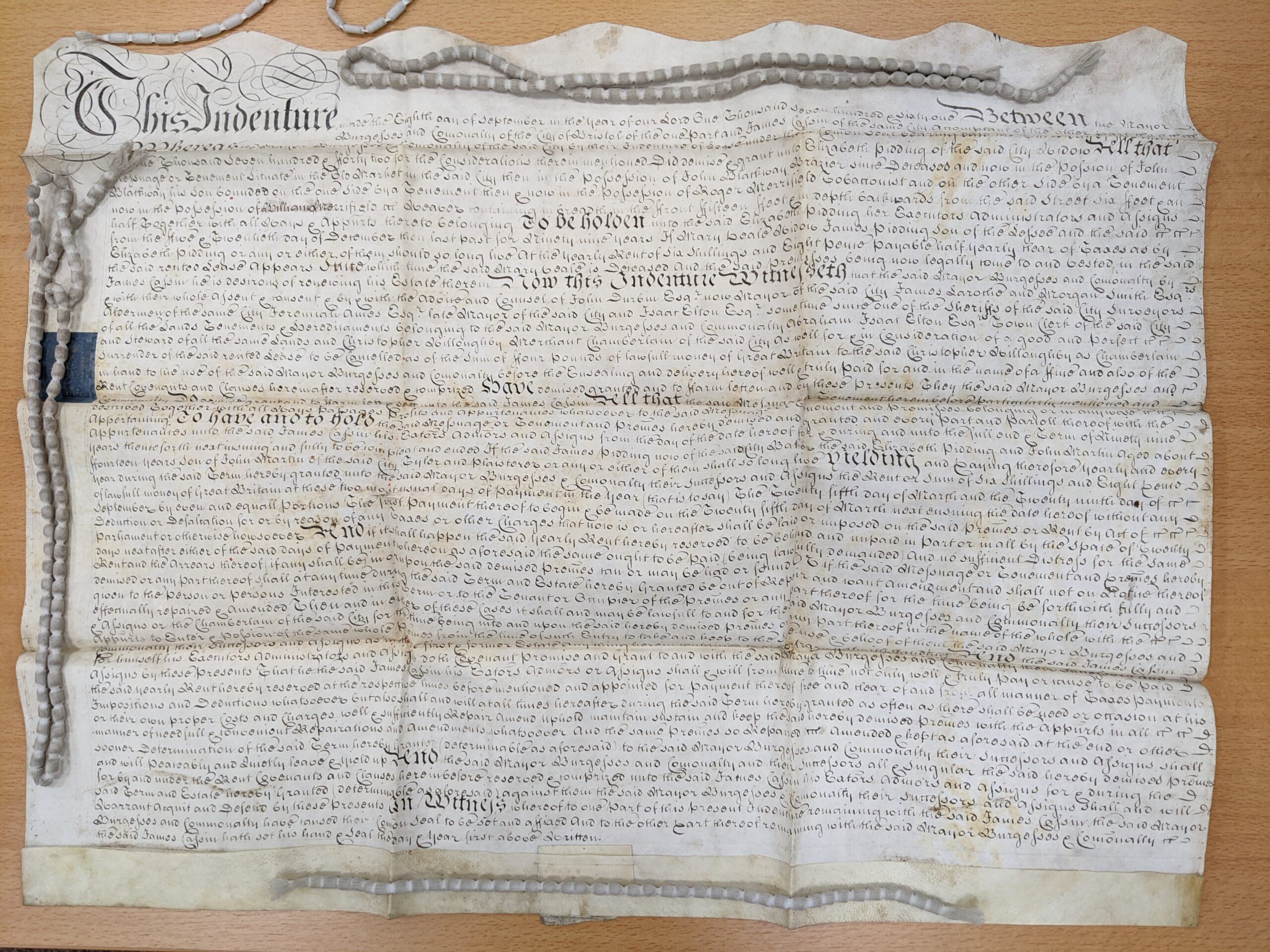
Samuel New Cassin was born in Bristol, his family amassed a great fortune through the importation and export of wines and spirits in particular sherry. Samuel’s grandfather James Cassin signed an ancient lease agreement with the city of Bristol in 1761 for land known as “The old market” and from there their futures were secured.

The Indenture agreement of 1761 between the City of Bristol and James Cassin (grandfather)

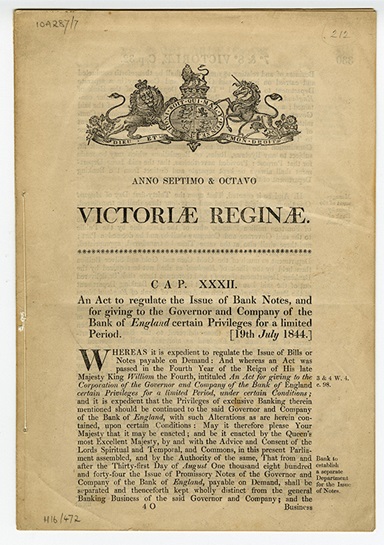
In November 1847, a little known event long since forgotten, took place that would even today, not be out of place in a Clint Eastwood spaghetti western movie such as a “Fistful of Dollars” …Samuel New Cassin, an imposing 6ft 2” man from Carmarthen – an Inland Revenue official, calmly rode, dressed in a black frock coat and top hat, on horseback into a small Welsh town called Cardigan, laden with golden guineas, sovereigns and silver coins, together with a large amount of paper money. Flanked by his officials, in a single transaction he deposited one of the largest ever single cash deposits ever recorded in a high street local bank, causing the cashier at the time to almost faint with excitement, unable to believe his luck or his eyes with the sight of so much money. The following article, written by one of the local reporters at the time gives a good description of the scene in question. It was however, an event that was to save the Bank of England from a very serious if not fatal blow had the panic stricken inhabitants of West Wales not been stopped from removing their life savings and thus spreading the panic nationwide. The Bank Charter Act of 1844 caused this situation to arise in the first place which gave the Bank of England a range of new powers and formalised the issuance of banknotes in the UK.

The Bank Charter Act that lit a fuse that never ignited

This Act of Parliament placed restrictions on any banks, companies or persons in England and Wales that issued their own banknotes, and stopped any new banks from starting to issue notes across the UK.  Perhaps when the next five, ten or twenty pound note is designed by the Bank of England it should feature SAMUEL NEW CASSIN as its saviour! God bless him and may he rest in peace. Here then is but a small part of that story, lost in the midst of time – until now.


HOW TO STOP A PANIC, & SAVE THE BANK OF ENGLAND!

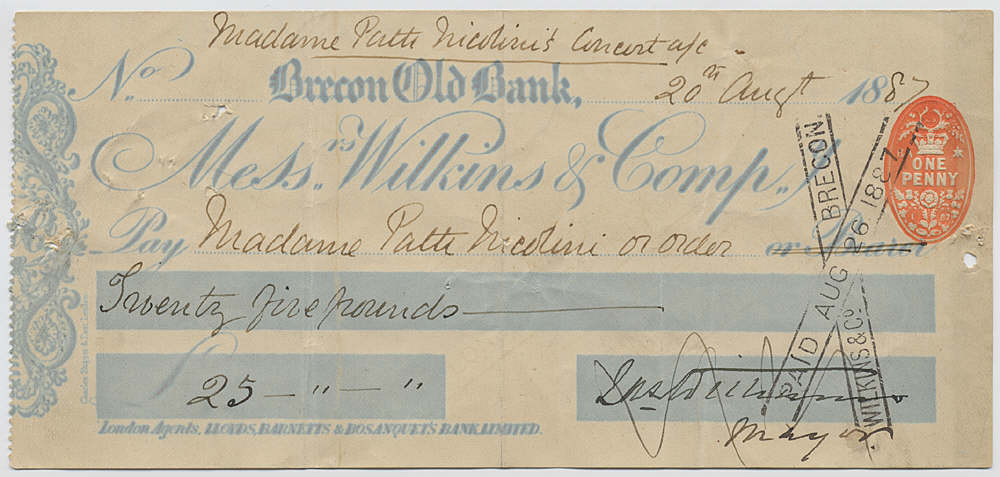
A useful lesson may be learned from the facts we are about to narrate, if the reader is of a philosophic or observant turn of mind. If otherwise, the gratification of his curiosity to learn the method by which the desirable result of “stopping a panic” can be arrived at, will be attained by the perusal of this paragraph. During the worst part of the late  “Crisis” in the Money Market,- that is to say, about ten or twelve days ago,- there existed in Cardiganshire, and portions of the adjoining counties of Carmarthen and Pembroke, a total want of confidence as regarded all kinds of paper money. Notes of every description were voted all but worthless, and, if they could but have spoken, would have exemplified the truth of the old song by exclaiming “you’ll find no change in (for) me.” Bank of England notes were even less respected than the notes of our local bankers, some of our rustic quid nuncs saying that as several directors had already failed, it was not at all improbable that their Bank would follow their example. Indeed we have it on good authority that £5 Bank of England notes were in two or three cases offered for disposal at £4 each. This was a dreadful state of affairs, “but it is a long lane that has no turning.” Upon the arrival of the Collector of Excise for the district, at Newcastle Emlyn, he found the inhabitants in a state of consternation at the position of affairs, and knowing well that he was standing upon safe ground, he at once determined on a course which he imagined would put a stop to the groundless panic which was fast taking possession of all classes, to the total exclusion of their reasoning faculties. After looking at his compeers for some time in evident consternation, one of the excise men ventured to ask the collector, “Do you take notes, Sir?”  “Notes!” exclaimed Mr Cassin, “to be sure I do, let me have as many as you can.” Joy lighted up the physiogs of all present, and the good news spread through the town and its environs like wild fire. “The Collector of Excise takes notes” one might be heard gladly exclaiming to another, and forthwith every publican who had money to pay to the Excise was requested to obtain change for his friends’ notes; many doubtless, chuckling and thinking that the Collector would eventually find himself “in the wrong box.” Still, however, the Collector continued to “change,” and “all went merry as a marriage bell”. Next morning the collector and suite departed for Cardigan, where he had scarcely arrived, when a horse-express followed him, with a note from a particular friend, assuring him “in confidence” that he had better not deposit his cash with any country bank, and expressing fears that he had acted wrong in changing so many on the previous day. The Collector immediately penned a reply saying that he had such reliance upon the stability of Messrs. Wilkins’ Bank, that he proposed at once depositing in it the whole amount that he had collected. Forthwith, the collector Mr Cassin, with a large bag of gold guineas and sovereigns in one hand and a bundle of notes in the other, together with two weighty bags of silver, slowly proceeded to Messrs. Wilkins’ bank in the sight of many of the population of Cardigan. (The Brecon Old Bank as it was originally known, was founded in Brecon in 1778 by Mr John Wilkins 1713-1784, who was highly regarded by the directors of the Bank of England)

A cheque payable to Adelina Patti (Nicolini) from Wilkins Bank.
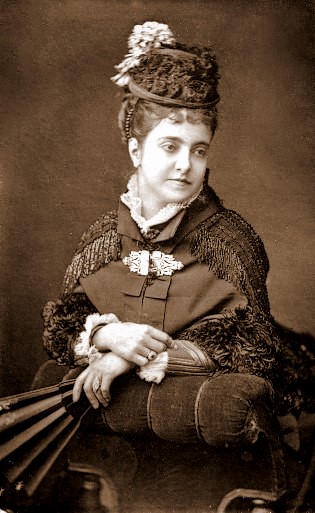
Adelina (Nicolini) in later life. World famous Welsh Opera Singer

On arrival, Mr Cassin dismounted from his horse, and with the help of his assistants proceeded to enter the bank whereupon the cashier Mr Jones took delivery of the money, beads of perspiration appearing on his brow as he did so. Amazement then seized upon all, as it had done upon the previous day at Newcastle Emlyn, and innumerable applications for “change for notes” were at once made and promptly acceded to. A similar scene transpired at Newport and Fishguard, and at each place did the Collector steadily persevere in his plan. The consequence in fact, was that confidence in the banks was in a great measure restored. Had, however, Mr Cassin refused to take notes in payment, “a run upon the banks” would have inevitably ensued, which would at all events have been productive of much unnecessary trouble and alarm, had no more disastrous results accrued. It is gratifying to learn that the Collector Mr Cassin lost nothing by the transaction, but we have no hesitation in saying that the bankers and commercial community in general are indebted to him for his energy and decision in arresting the panic, and saving the Bank of England from a serious if not fatal blow.

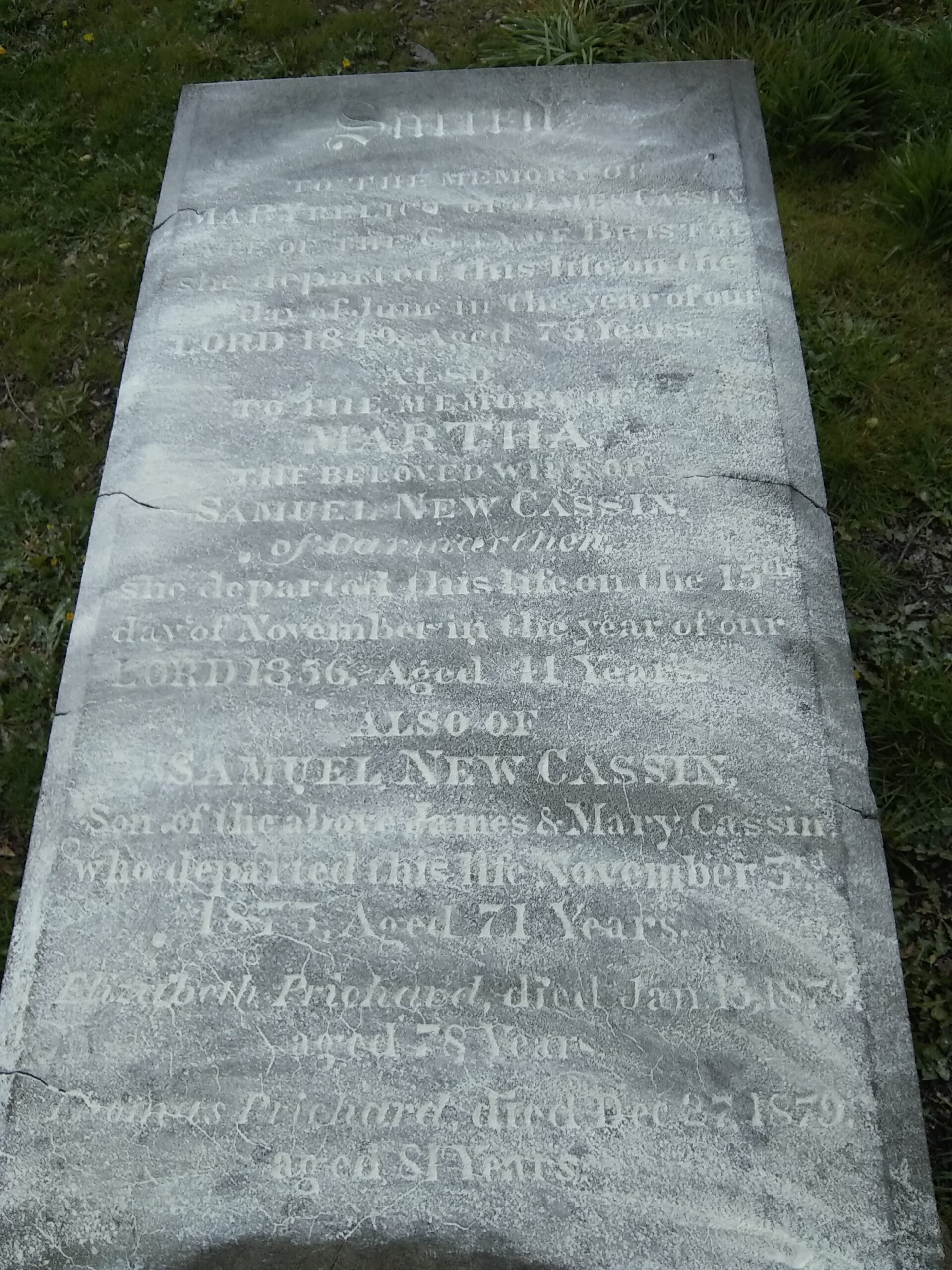
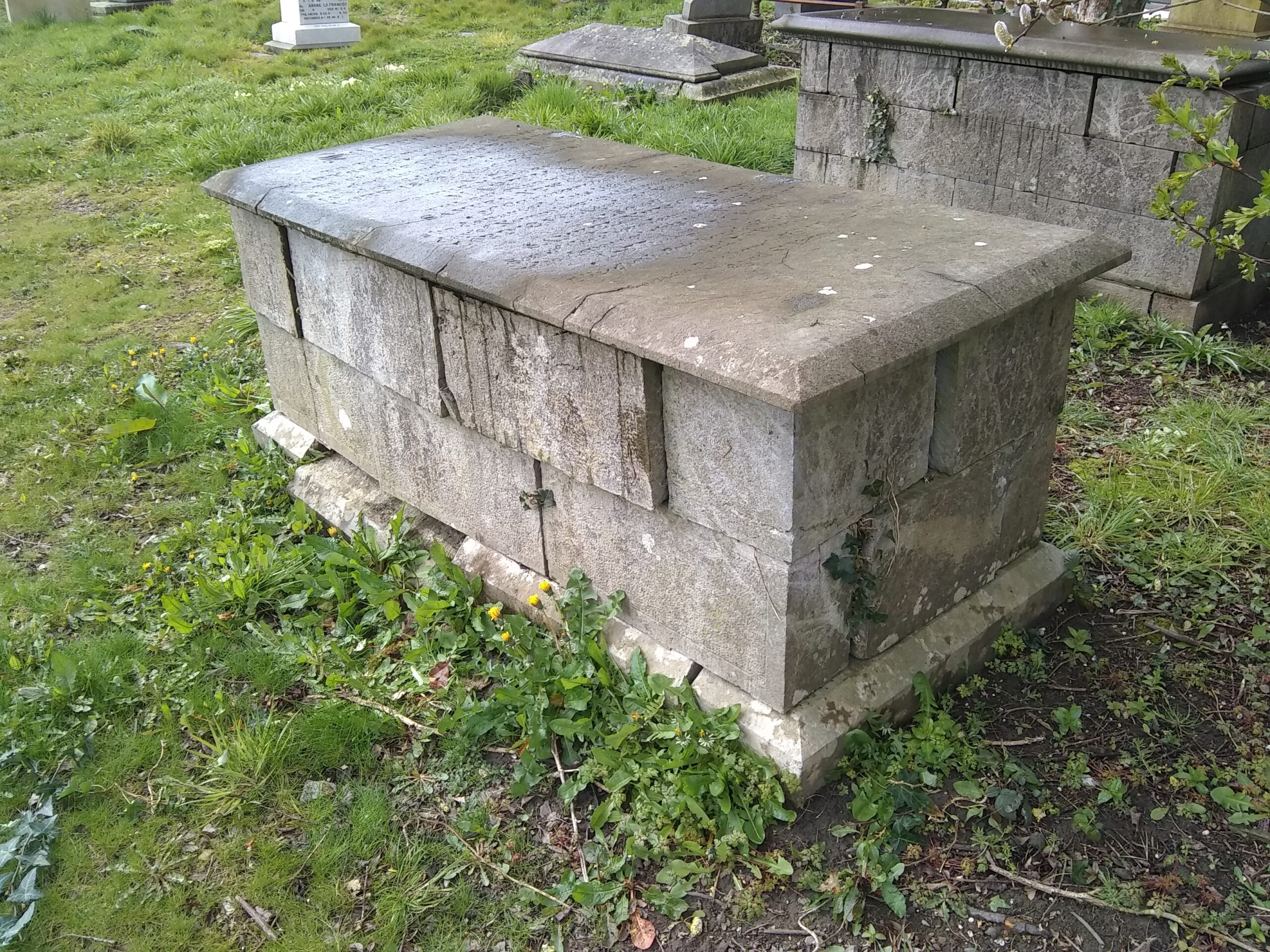
Samuel Cassin’s last resting place.
The text on the box tomb.


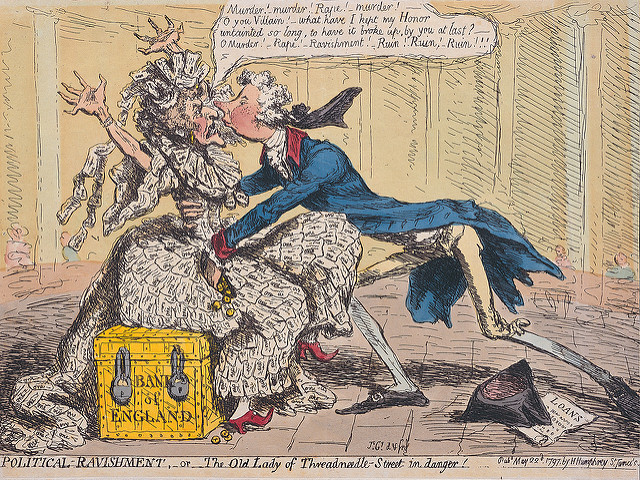
*** The “Nickname” of the Bank of England – commonly known as “The Old Lady of Threadneedle Street” owes its origin to Wales.

The cartoon below shows the Prime Minister of the day, William Pitt the Younger, pretending to woo an old lady, the personification of the Bank, but what he is really after is the Bank’s reserves, represented by the gold coin in her pocket, and the money-chest on which she is firmly seated. At the time, the Bank was a joint stock company operating under Royal Charter, and therefore essentially a private company – and so it was perceived as having been taken advantage of by the politicians. A series of events beginning with a landing in February 1797 by several hundred French troops at Fishguard on the Welsh coast and ending with an accusatory speech in the House of Commons by the opposition MP Richard Sheridan had prompted Gillray to produce the cartoon, forever known as the “Old Lady of Threadneedle Street”

Cartoon of the “Old Lady of Threadneedle Street”

Eleanor Children 1769 -1850 & her father Dr Charles Hutton FRS FRSE LLD

In continuing my research into those who are buried in this historic cemetery, I never cease to be utterly amazed at some of the most unexpected and remarkable storylines that emerge. Such is the case of Eleanor Children, who died in March 1850 aged 81 & who’s last resting place in St Davids remains known only to God, together with that of her husband George who died 28 years later in 1878. The ravages of time, abandonment, dereliction and decay have seen the disappearance of the memorial to this most interesting of families so they have no known grave.

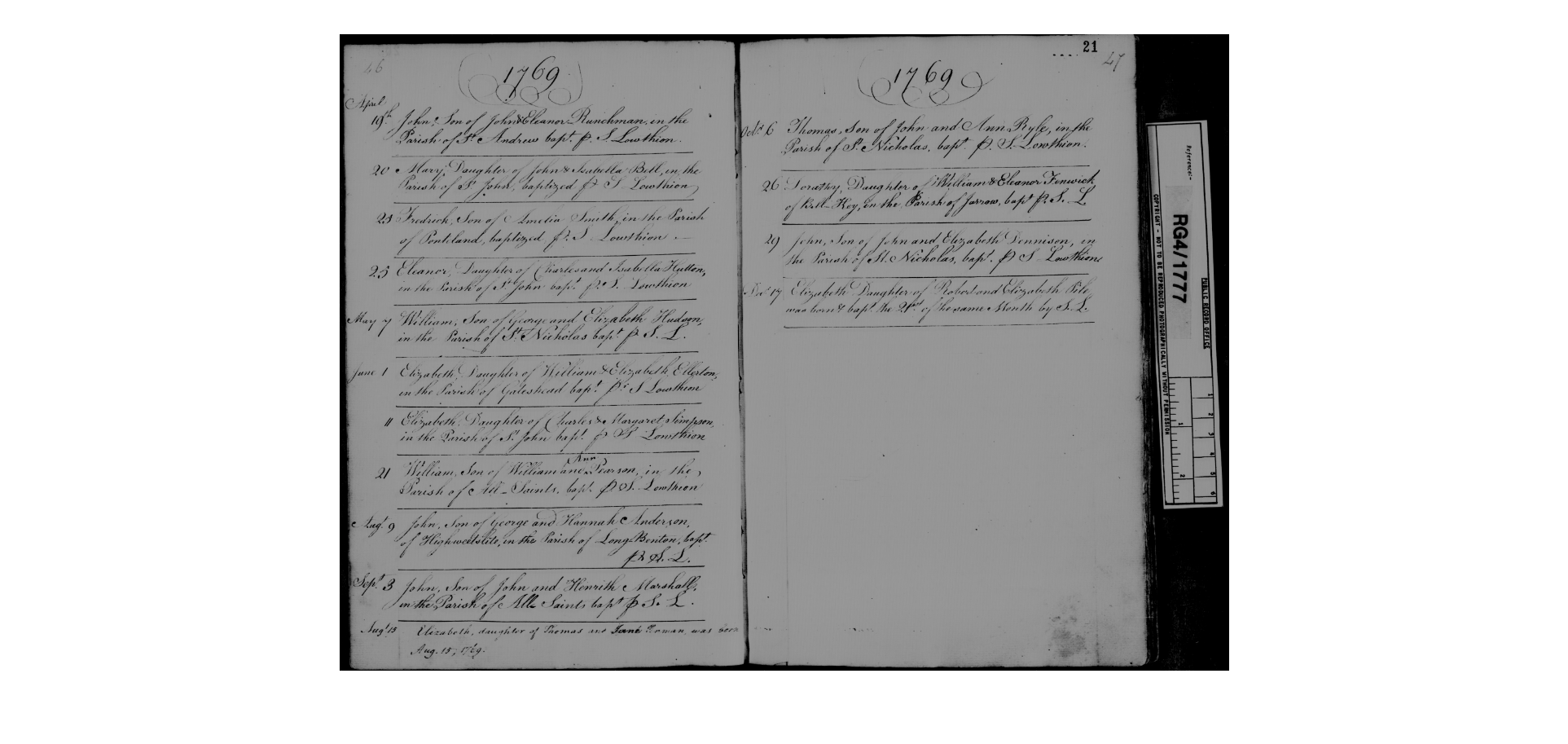
Eleanor’s Baptismal record

What is equally intriguing is why they came to Carmarthen in the first place, when they could have lived and retired to the most fashionable part of London. Even more fascinating is the fact that towards the end of his life George Children became the Innkeeper of the Railway Inn next to his house on what we now know as Jail Hill (on account of the former Goal being nearby) Indeed it must be the only time in history that an Innkeeper can claim to have had such a distinguished father in law!

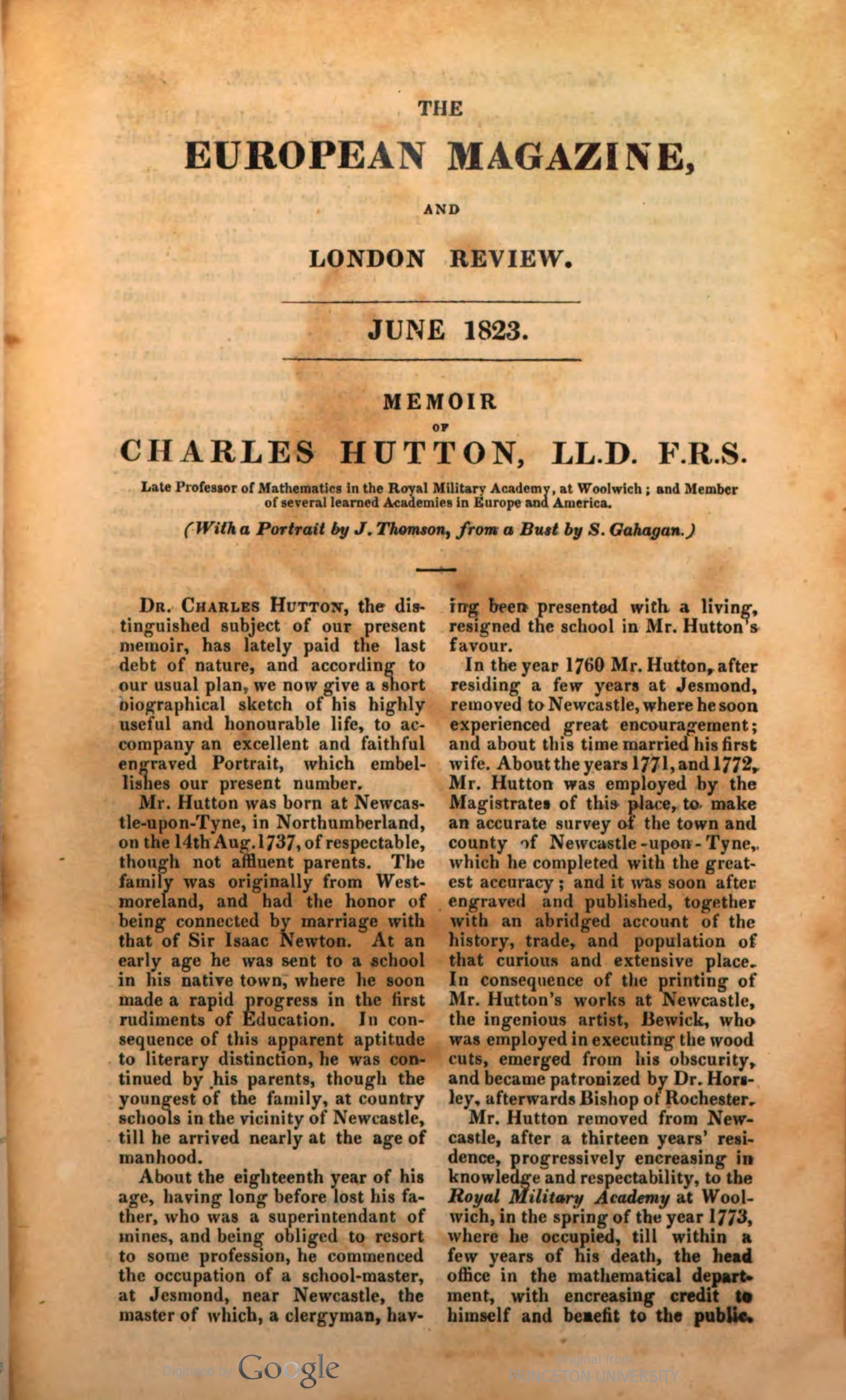
In fact, Eleanor’s father Charles Hutton FRS FRSE LLD was one of, if not the most eminent surveyor and brilliant mathematician of his day. In 1756 Charles Hutton, aged 18, dropped out of his career as a coal hewer on north Tyneside. He’d hurt his right arm in an accident years before, and it wasn’t strong enough for the coalface.

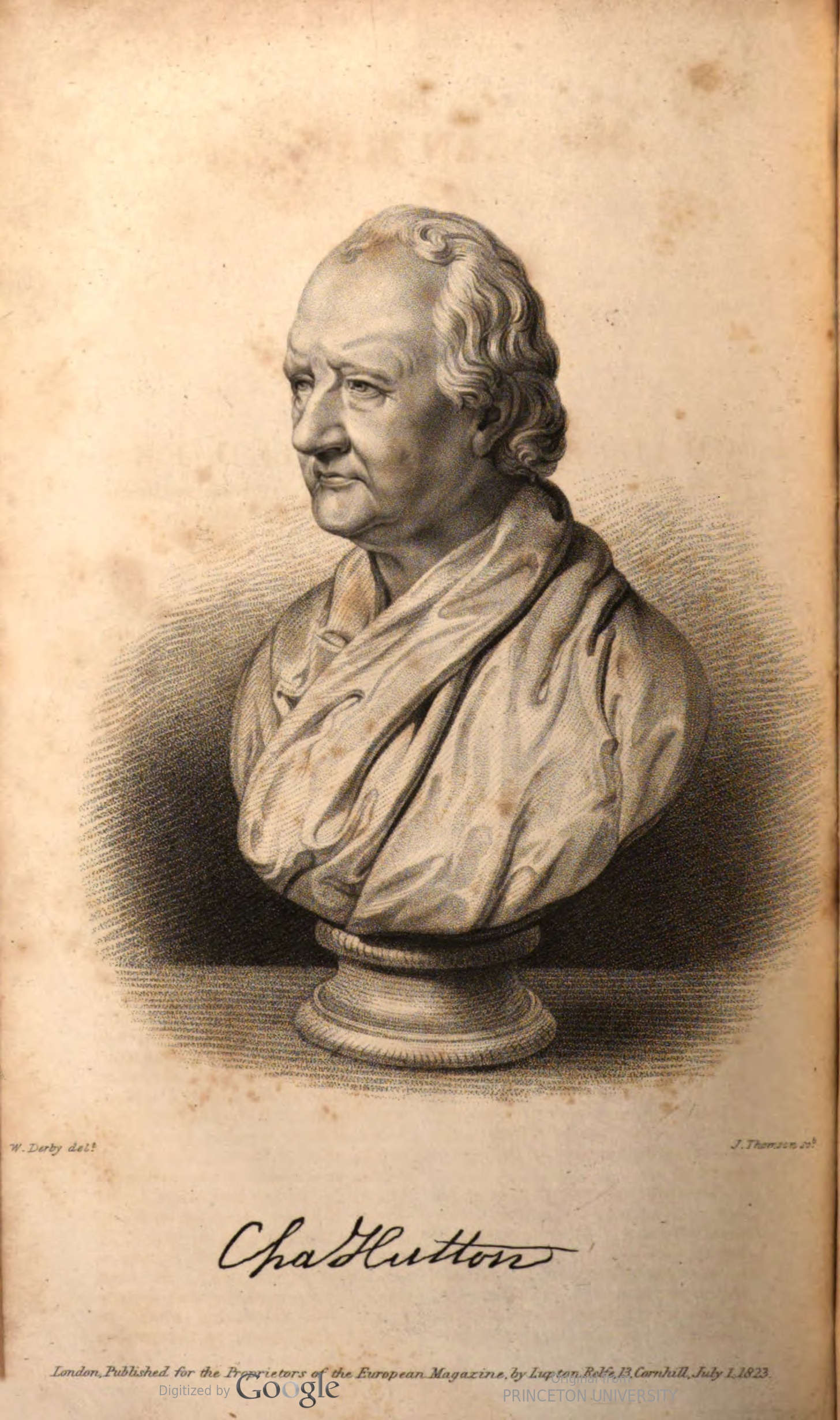
Dr Charles Hutton FRS FRSE LLD

He was a clever boy, and coincidence gave him the opportunity to take up teaching instead, in a local school. It was a momentous decision, and it took him on a journey he could never have imagined. By the end of his life the miner’s lad was Professor of Mathematics at the Royal Military Academy and a fellow of learned societies in four countries. Admired, loved, even revered by three generations of students, he’d successfully defied the Royal Society of London and become the leader and spokesman for British mathematicians. His books were read from Pennsylvania to Calcutta, and if a British cannon was pointed at you in America, France, Spain or India it was probably being pointed by one of Hutton’s students. When he died, the Duke of Wellington and the Lord Chancellor  led the tributes, saying that Britain would be forever in his debt.

 His brilliance and outstanding ability in the field of Trigonometry, Algebra and Logarithms led him to publish 18 volumes on the subject apart from many volumes on all aspects of mathematics. He was Professor of mathematics at the Royal Military Academy, Woolwich from 1773 to 1807. He is remembered for his calculation of the density of the earth from Nevil Maskelyne’s measurements collected during the Schiehallion experiment – a set of observations of the gravitational pull of a mountain in Perthshire made by the Astronomer Royal, Nevil Maskelyne. He was also awarded the Copley Medal in 1778, two years after Captain James Cook for his paper, entitled, “The force of Fired Gunpowder, and the initial velocity of Cannon Balls, determined by Experiments” The Copley Medal is an award given by the Royal Society, for outstanding achievements in research in any branch of science. It alternates between the physical sciences or mathematics and the biological sciences and is given every year, the medal is the oldest Royal Society medal awarded and the oldest surviving scientific award in the world.

Joseph Listers Copley Medal

Eleanor’s father retired from his professorship at Woolwich in 1807 at the age of seventy on a pension of £500 per year and went to live in Bedford Row, London. Shortly before his death he was consulted about the curves which should be adopted for the arches for the New London Bridge, the proposed structure having five semi elliptical stone arches. Construction of the bridge began in 1824, the year after Hutton’s death. Charles Hutton was buried in the family vault at Charlton in Kent. During the last year of his life a group of his friends set up a fund to pay to have a marble bust made of him. It was executed by the sculptor Sebastian Gahagan. The subscription exceeded the amount necessary, and a medal was also produced, engraved by Benjamin Wyon, showing Hutton’s head on one side and emblems representing his discoveries about the force of gunpowder, and the density of the earth on the other. Charles’ daughter Eleanor was born in Newcastle upon Tyne and was baptised on the 25th April 1769. Her mother was called Isabella. Her parents were devout Methodists. Before the introduction of civil registration in 1837, most people were baptised, married, and buried in their local Church of England parish, regardless of their beliefs. Historically, many “non-conformists” such as Methodists used their local parish church for registration purposes, despite their differences in belief. During the latter years of her father’s life, Eleanor helped to look after her father at Bedford Row in London (Her mother Isabella, having passed away in 1817) “where exemplary devotedness to her valued parent, and affectionate anticipation of all his wishes and wants he appreciated with commensurate affection” (Quote from a friend)

Bedford Row London. Hose with the black door. Home to Dr Hutton. By kind permission of ALondon inheritance.com

So when you next walk amongst the tombstones and open spaces of St Davids cemetery Carmarthen, spare a thought for Eleanor, for although she had a very distinguished, rich and famous father, with the world at her feet, she chose Carmarthen as the place to live her life, in quiet solitude and contemplation. May they rest in peace.


Historic Memorials restored & some unexpected results.

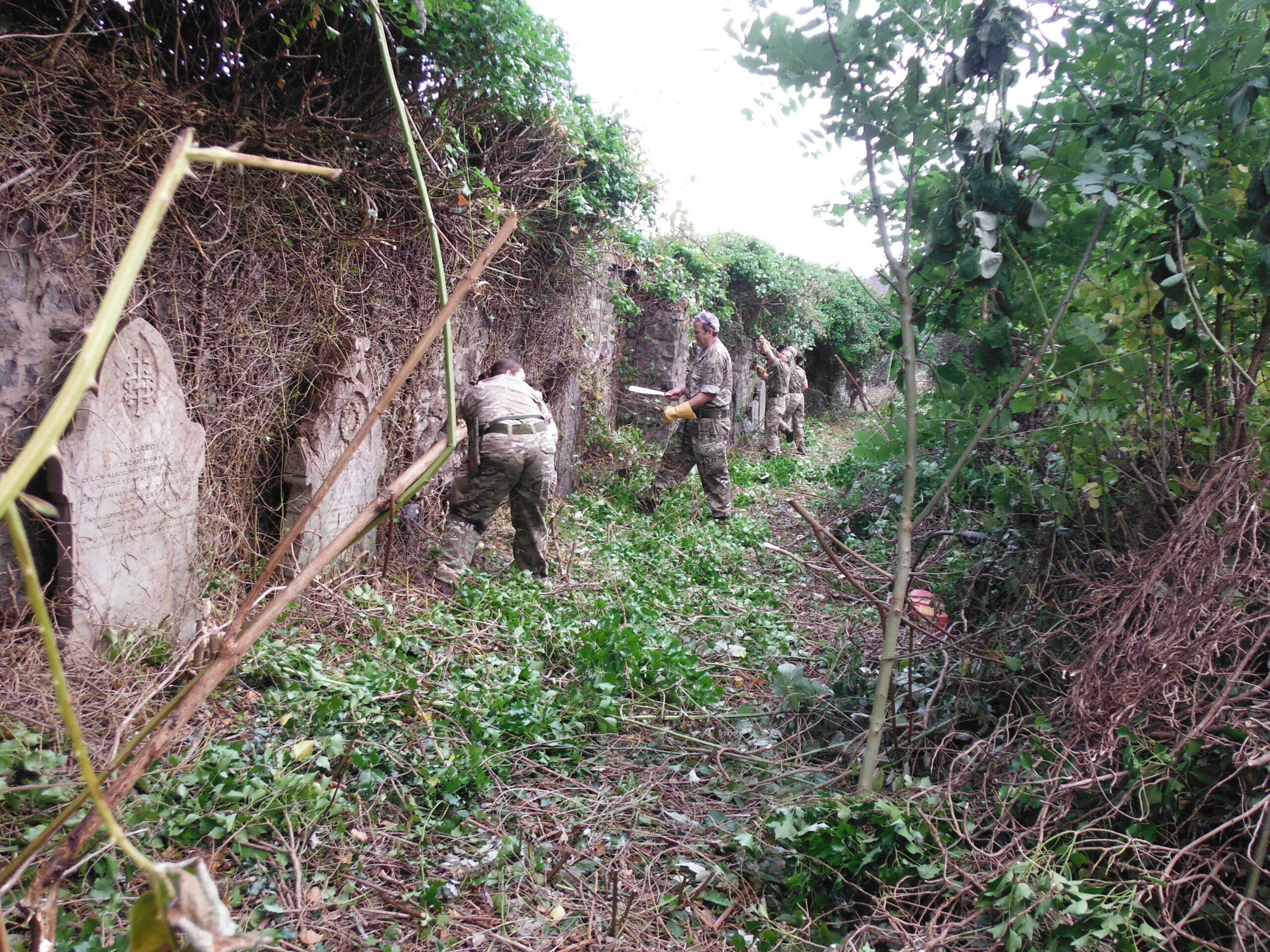
In the beginning we could see nothing, nothing except trees, bushes, brambles – oh brambles ! the sheer size of them ! and overgrowth seven feet tall. No memorial was visible. Indeed we did not know what if any memorial existed beyond the “dense jungle” that lay in front of us, the size of Cardiff Principality stadium rugby pitch…..but five years on we are nearing our goal of completing the restoration programme, thereby finally bringing peace and respect to the souls of those departed and of the descendants that now visit their ancestors last resting place. The following photographs lay testament to the remarkable transformation of what was an abandoned town centre cemetery to what is now a place enjoyed by many. The sheer volume of photographs are too many themselves to include here but I hope that the ones I have selected will show some of  what we have achieved in that time. Work carried out with great care, respect, and attention to detail.

In the beginning – before and after !


In the beginning.
As it is now, and ever shall be !


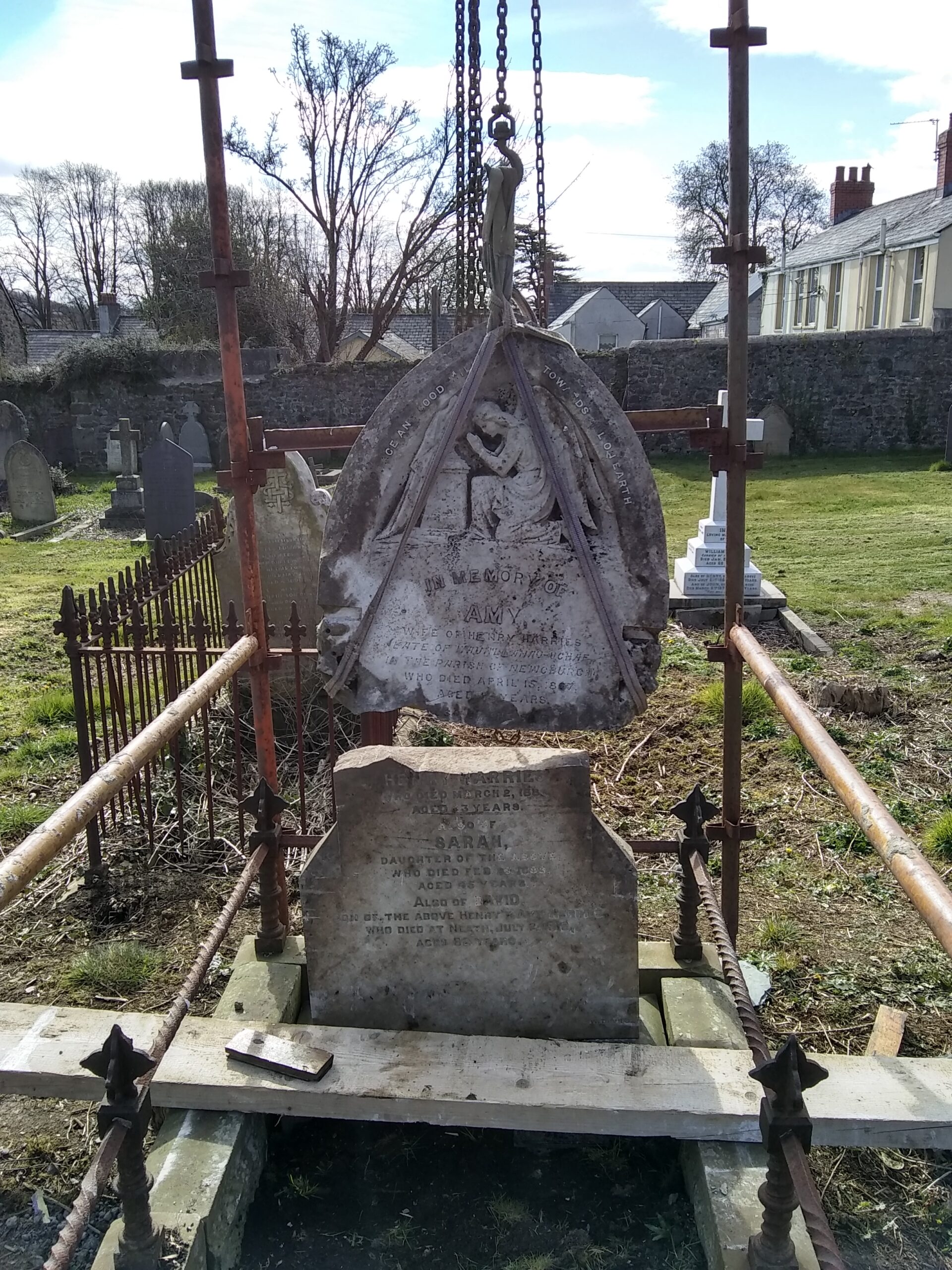
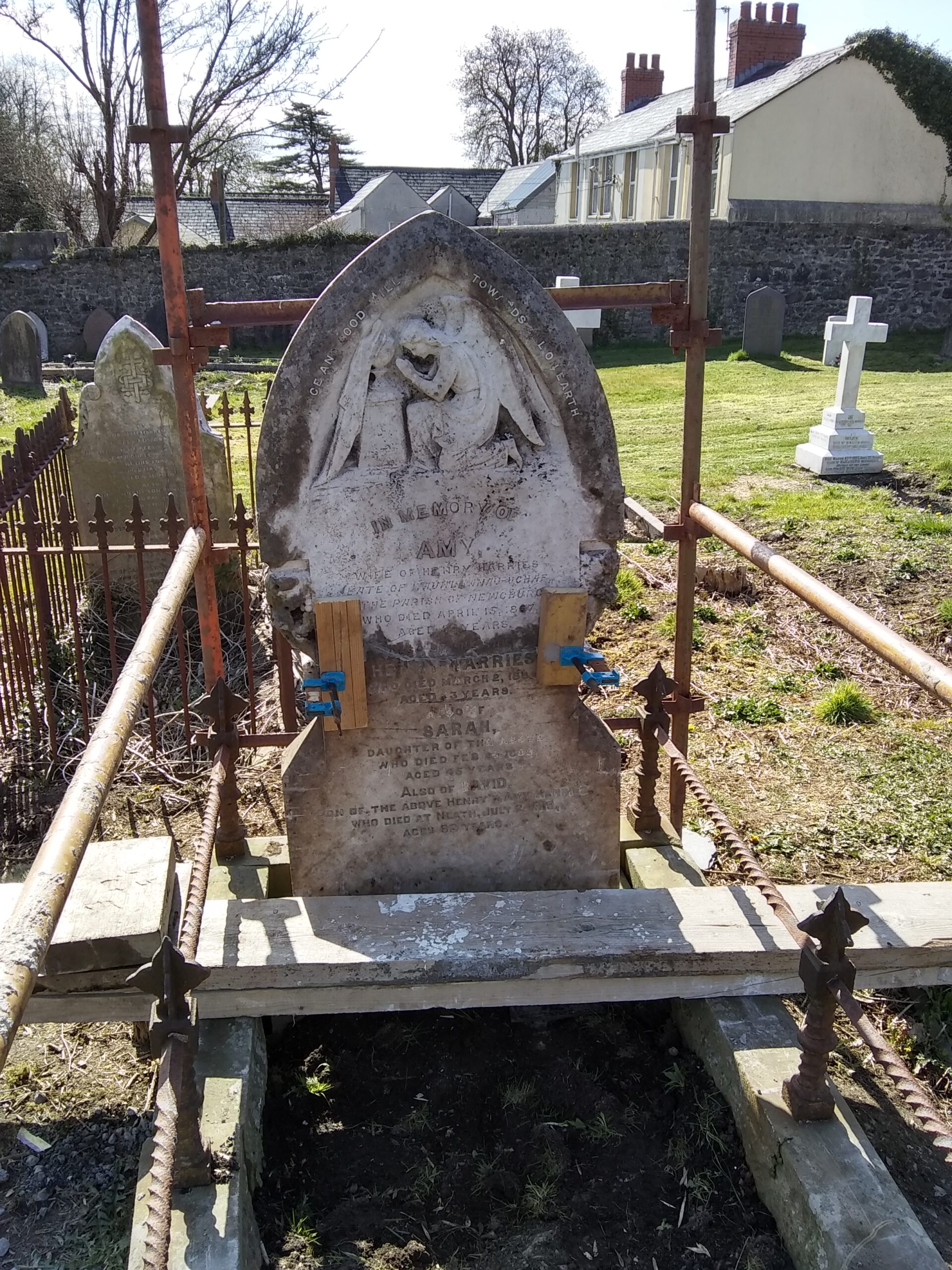
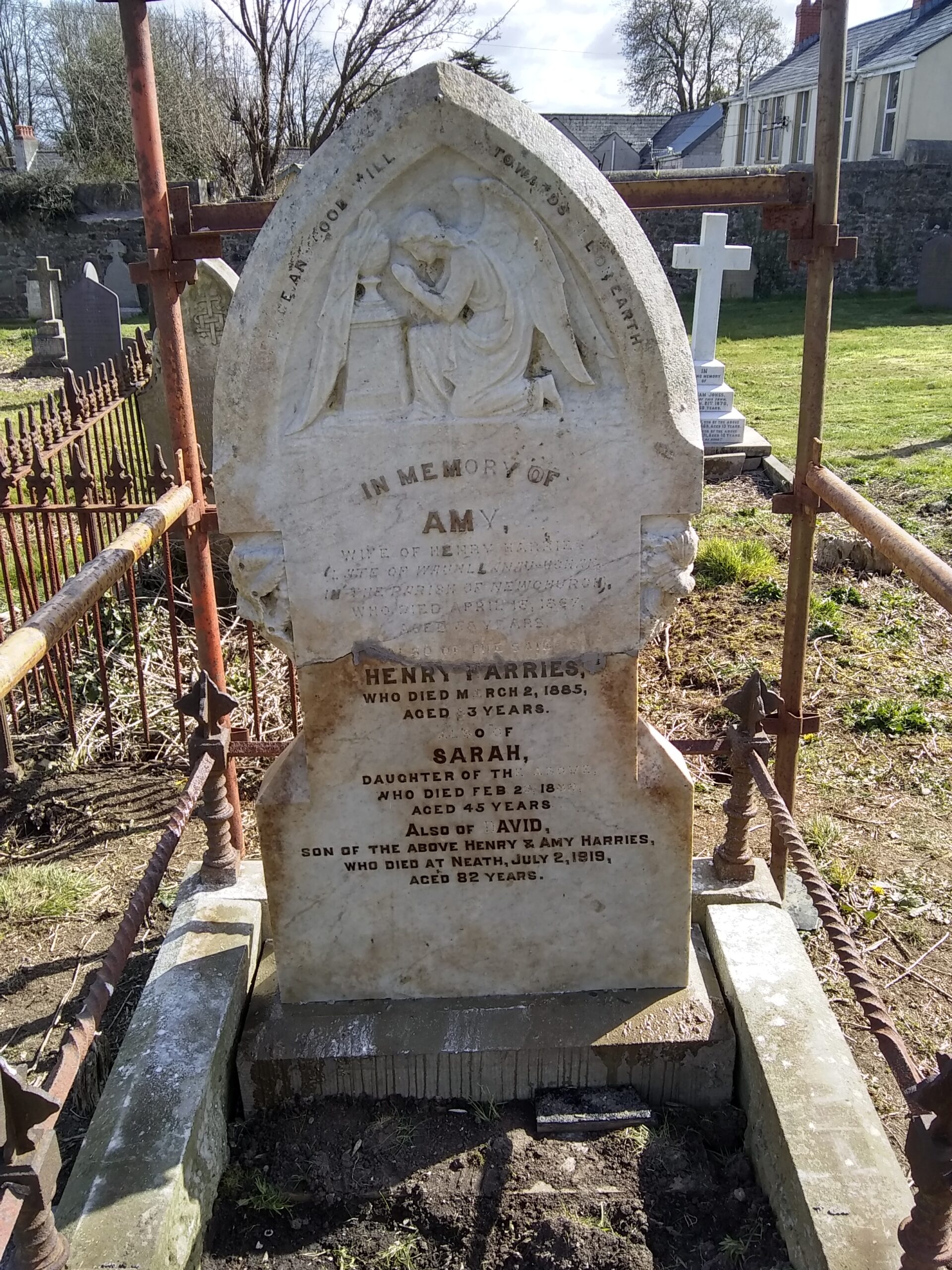
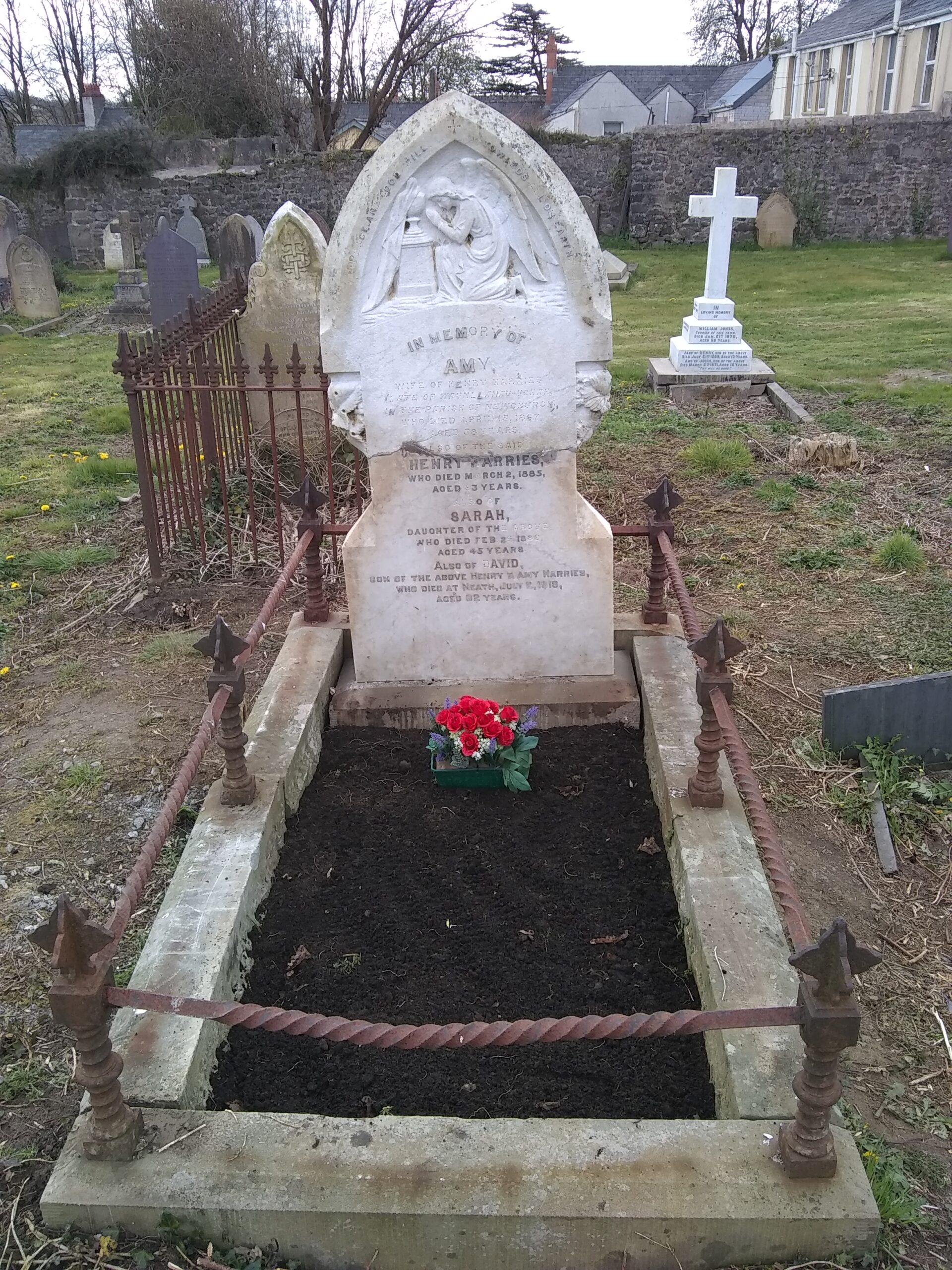
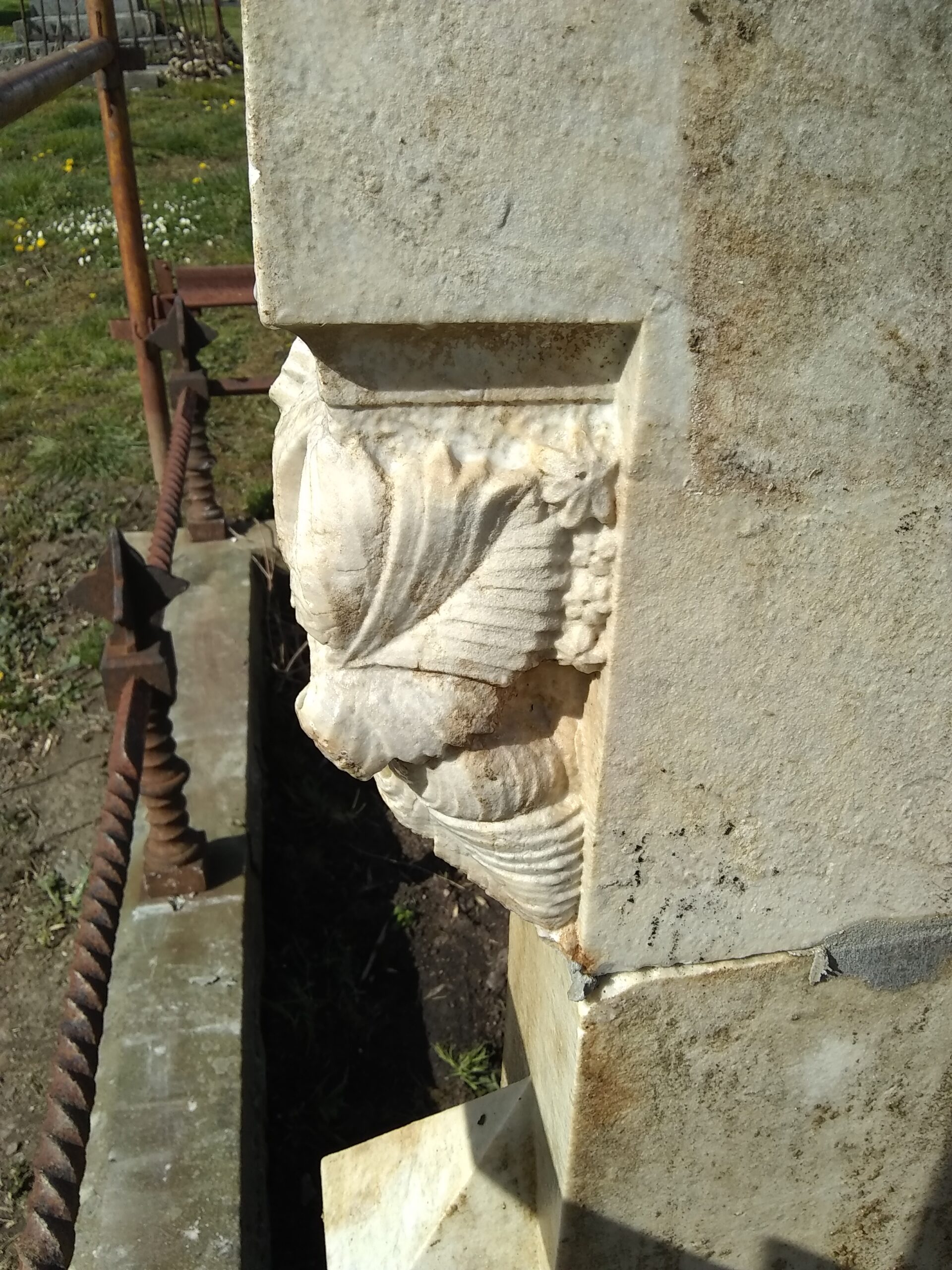
The half ton Marble Memorial to the HARRIES family, was for over 50 years broken in two, lying face down inside a stone kerb….not any more !

The wonderful and intricate floral engraving on the shoulder of the memorial


A small but important piece of restoration of a slate headstone cut in half.


Another small but important restoration.


The magnificent limestone memorial to Company Sergeant Major Morgan -the longest serving soldier in the United Kingdom -over 56 years continuously.

In the beginning


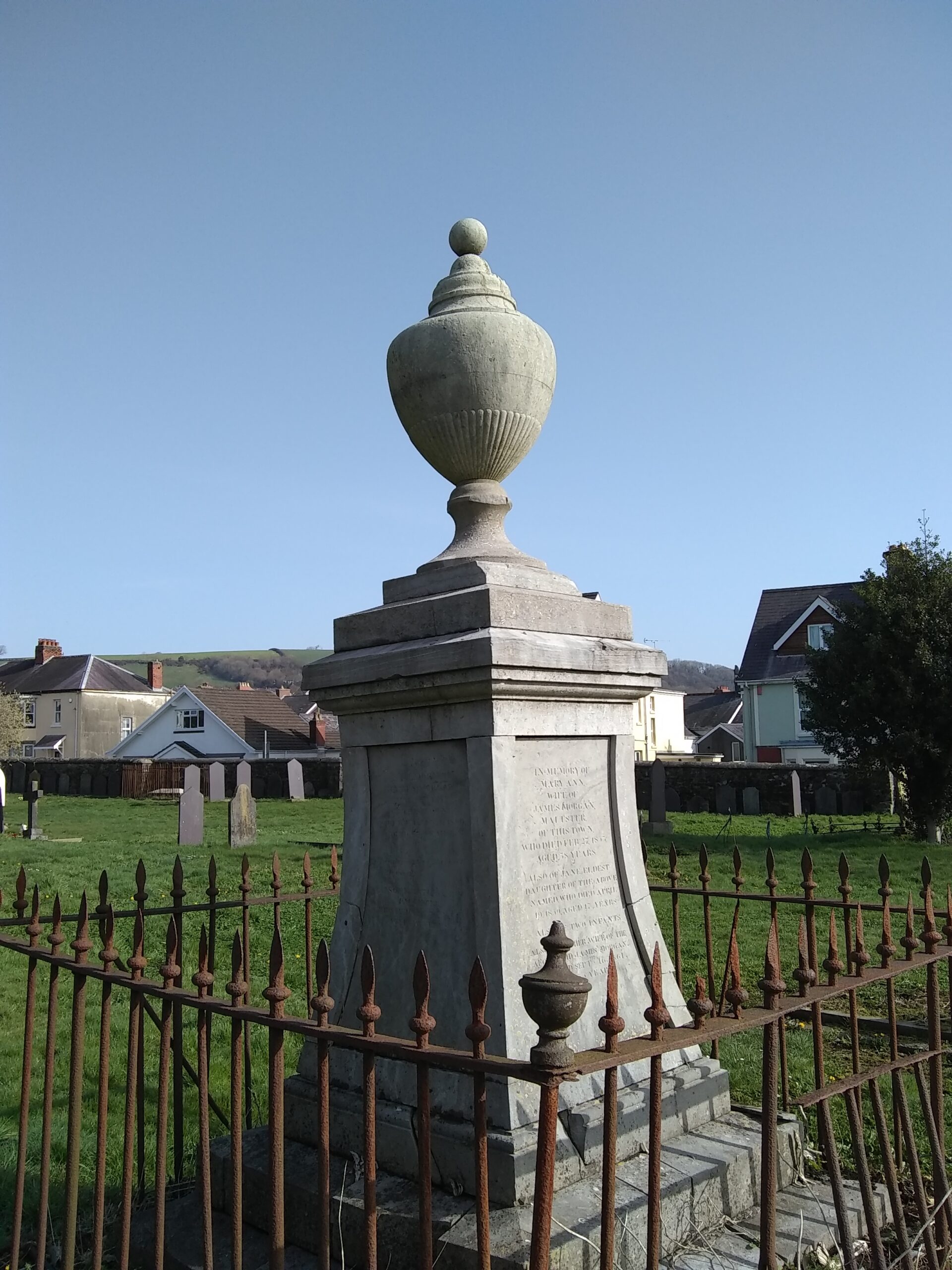
The magnificent memorial in all its glory


The restoration of the huge marble memorial to the founder of St David’s Church and Christchurch – The Venerable David Archard Williams

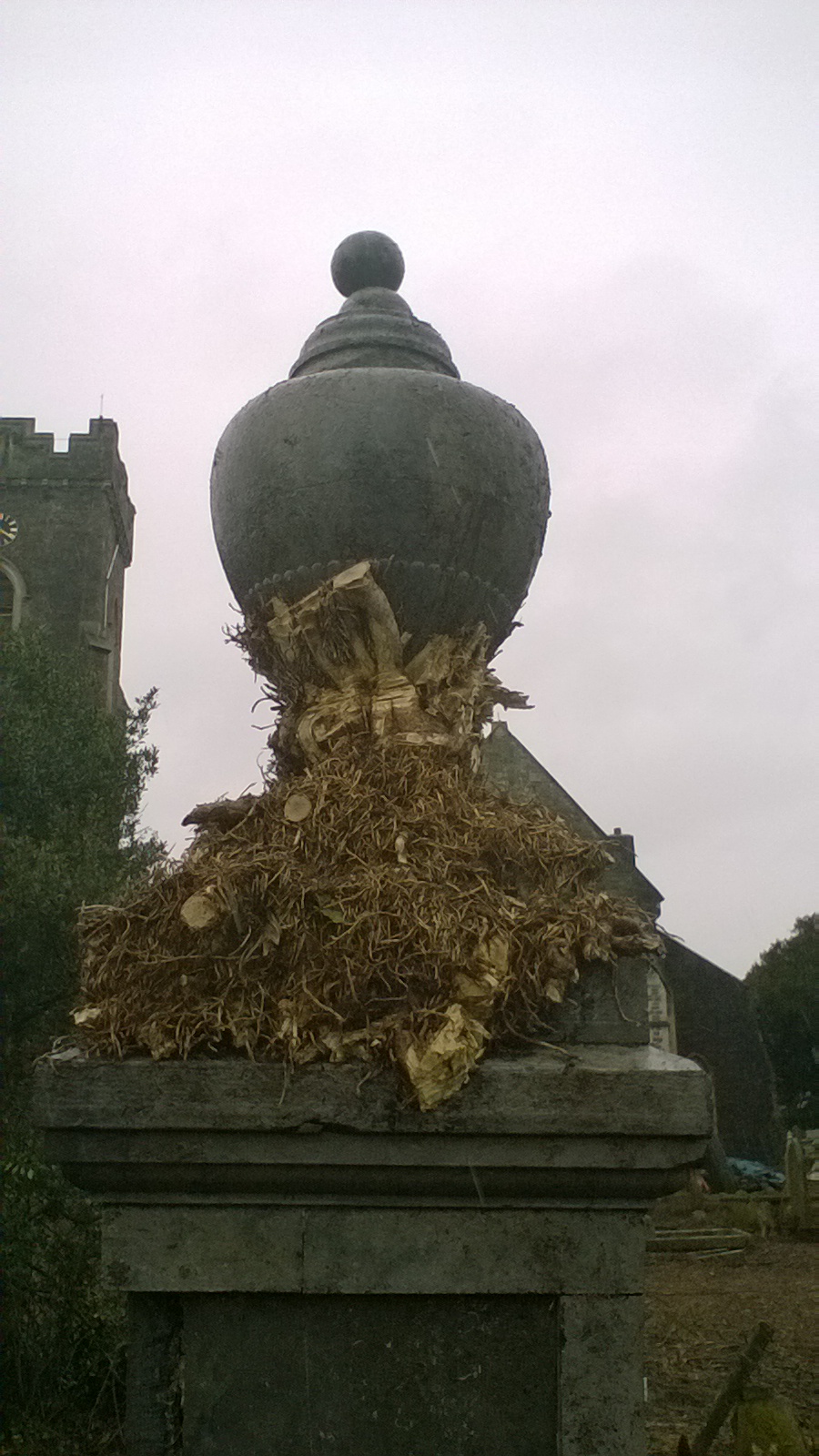
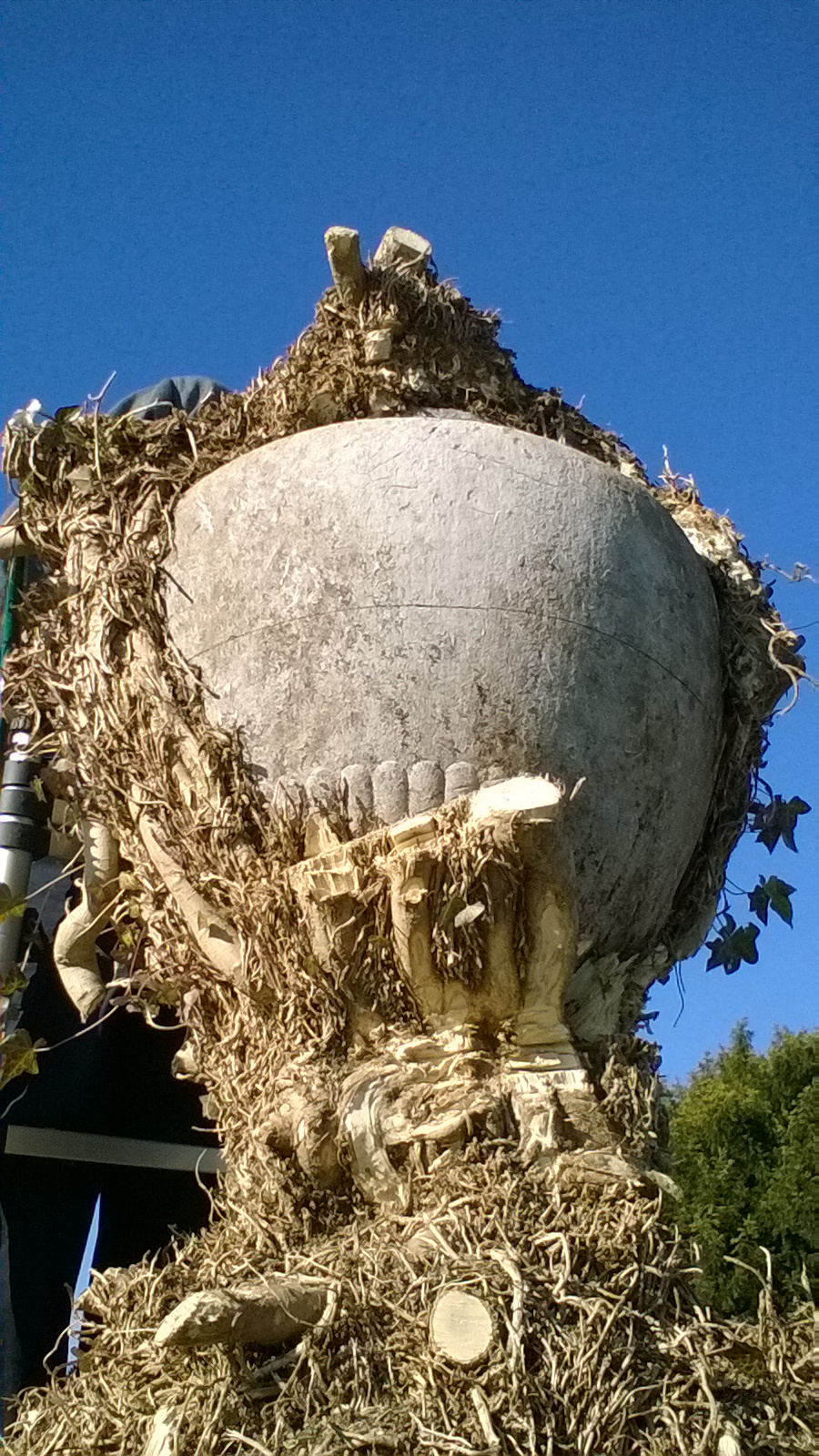
Completely covered in ivy
Uncovered
The completed restoration

Major restoration and minor repairs during the last 6 months -10 completed.

In the last six months the Charity has been very busy in carrying out some major restoration of memorials within the cemetery and as you will see from the photographs of before (some during) and after, the transformation has been outstanding. Not only that, it has revealed hitherto unknown information about a number of long forgotten Carmarthen residents. It is part of the Charities constitution to restore memorials where possible and I hope you will agree that we have achieved that goal which would not have been possible without the Friends of the Charities ongoing financial support. All the work has been undertaken by the Trustees of the Charity themselves saving what would otherwise be a considerable sum of money. Some work is still needed in the restoration of the soil levels around many of the memorials and we are waiting for soil to be delivered to complete them.

I have , for simplicity, arranged the photographs into separate groups.


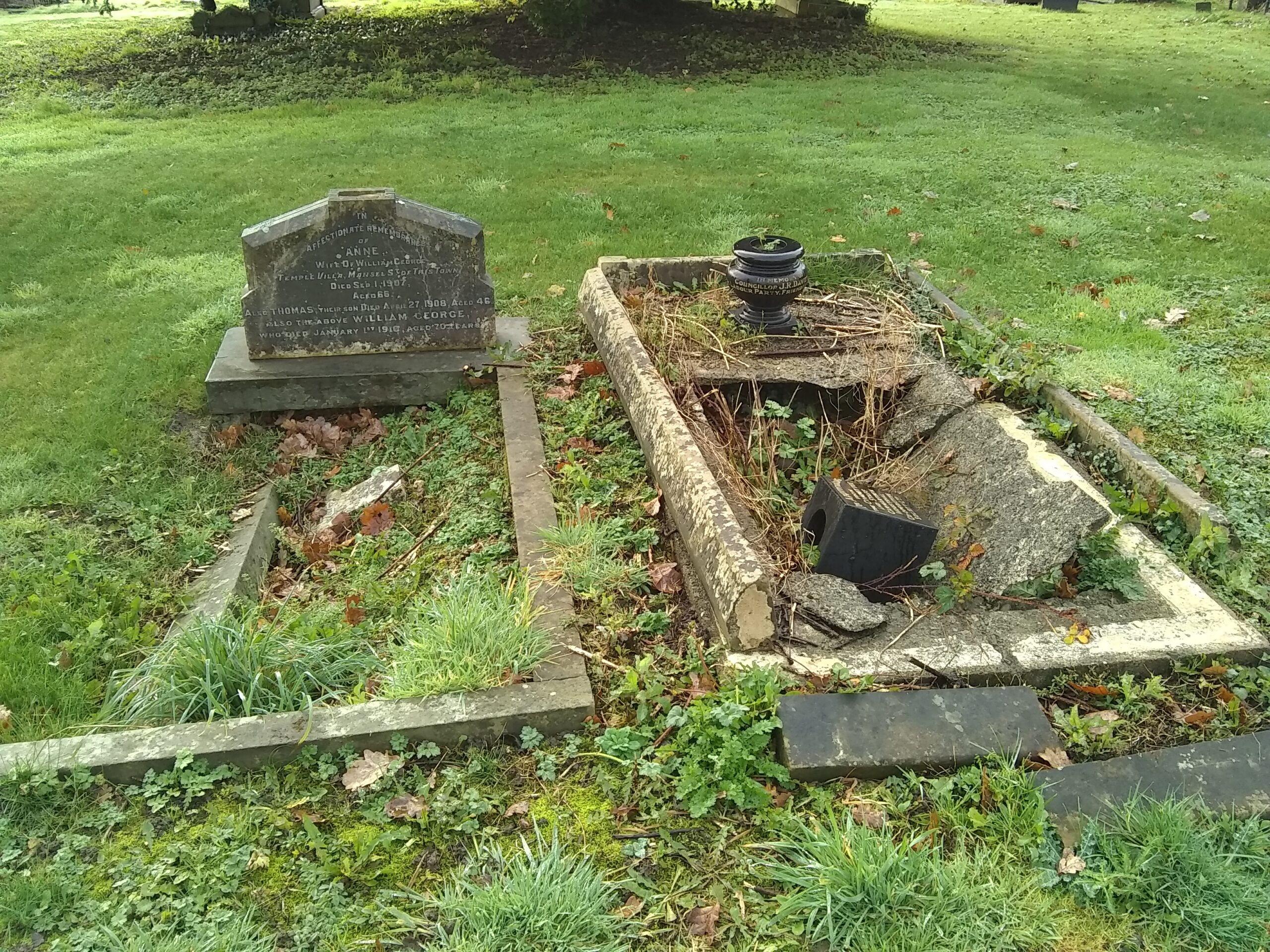
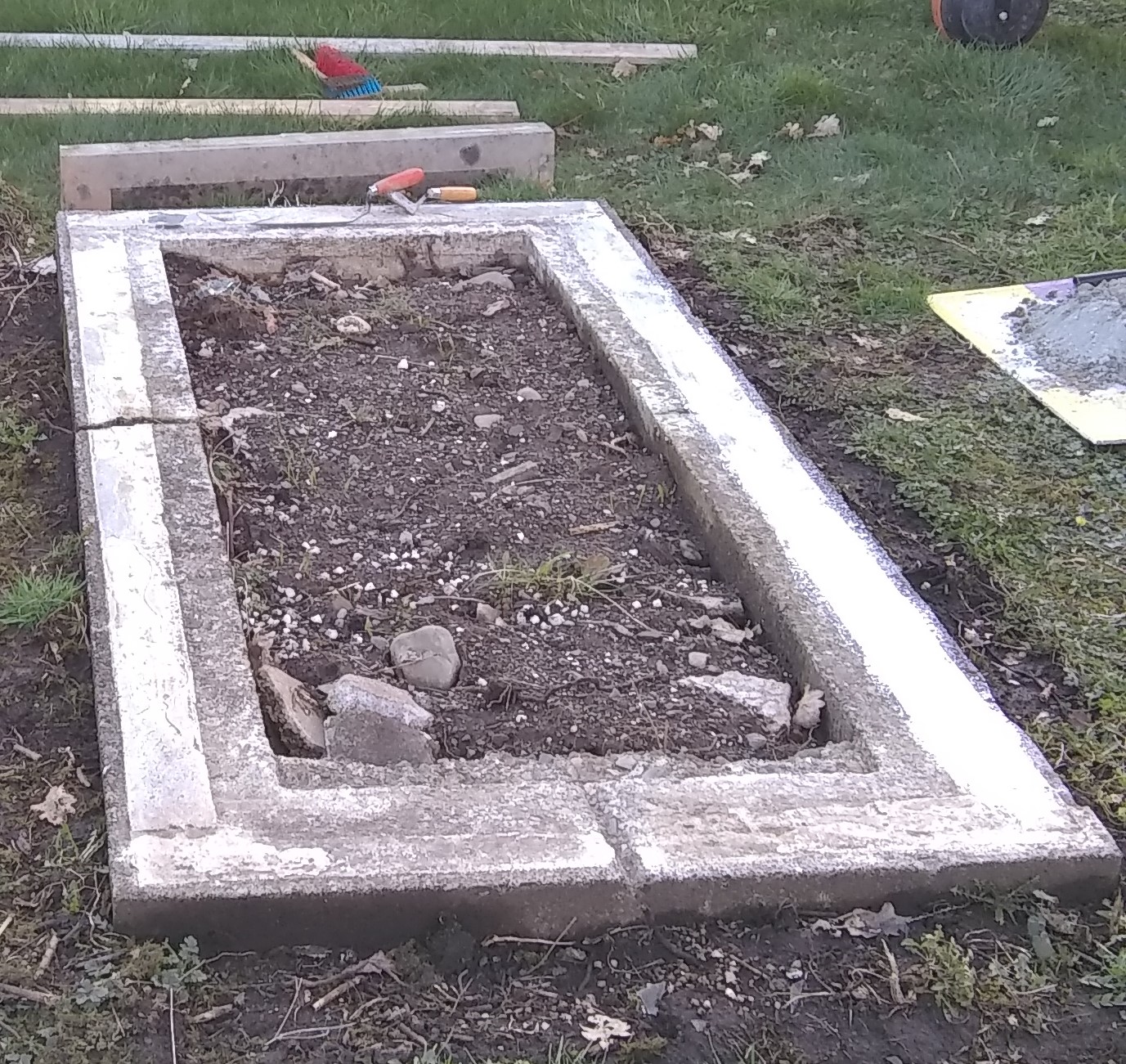
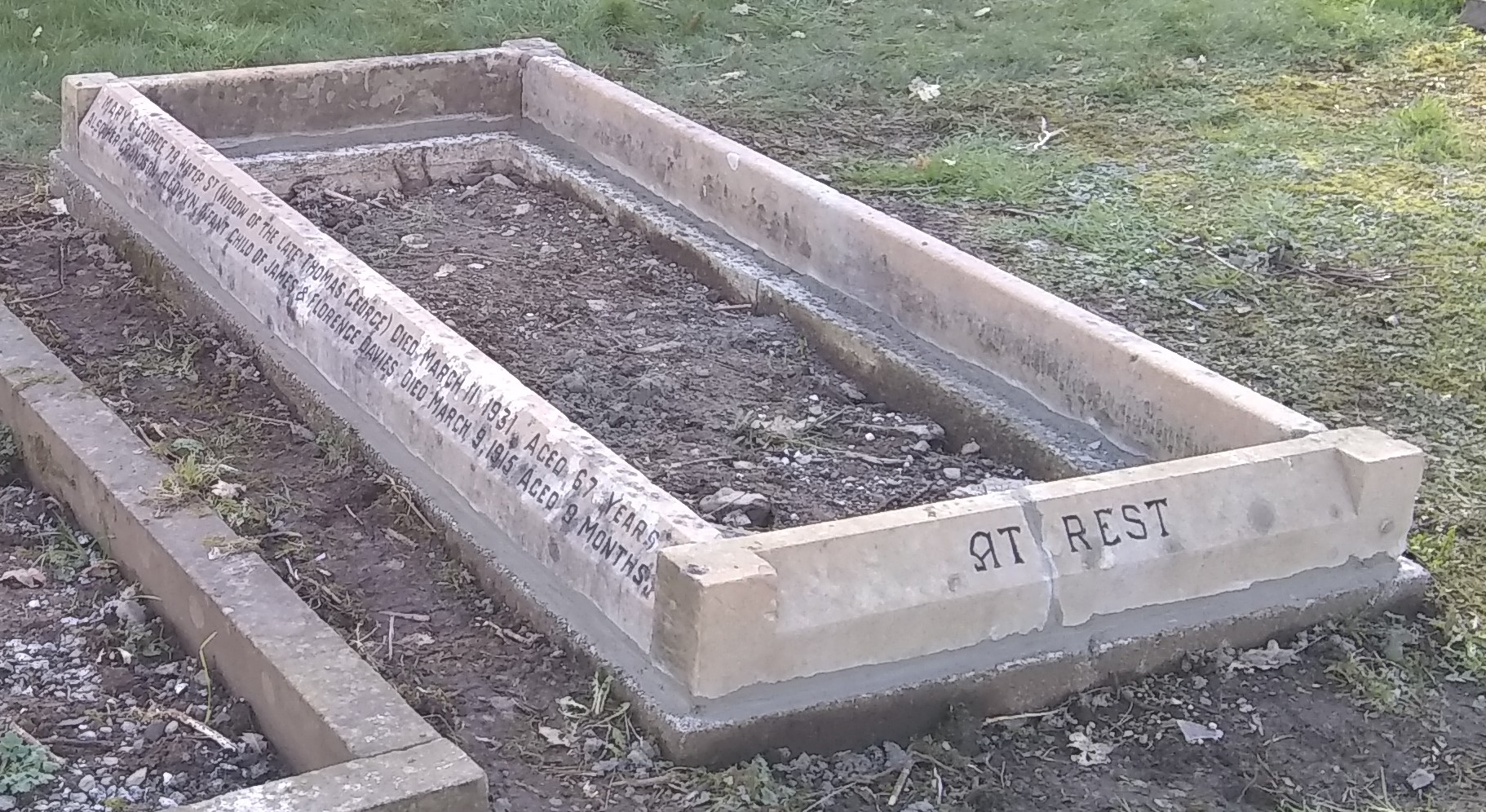
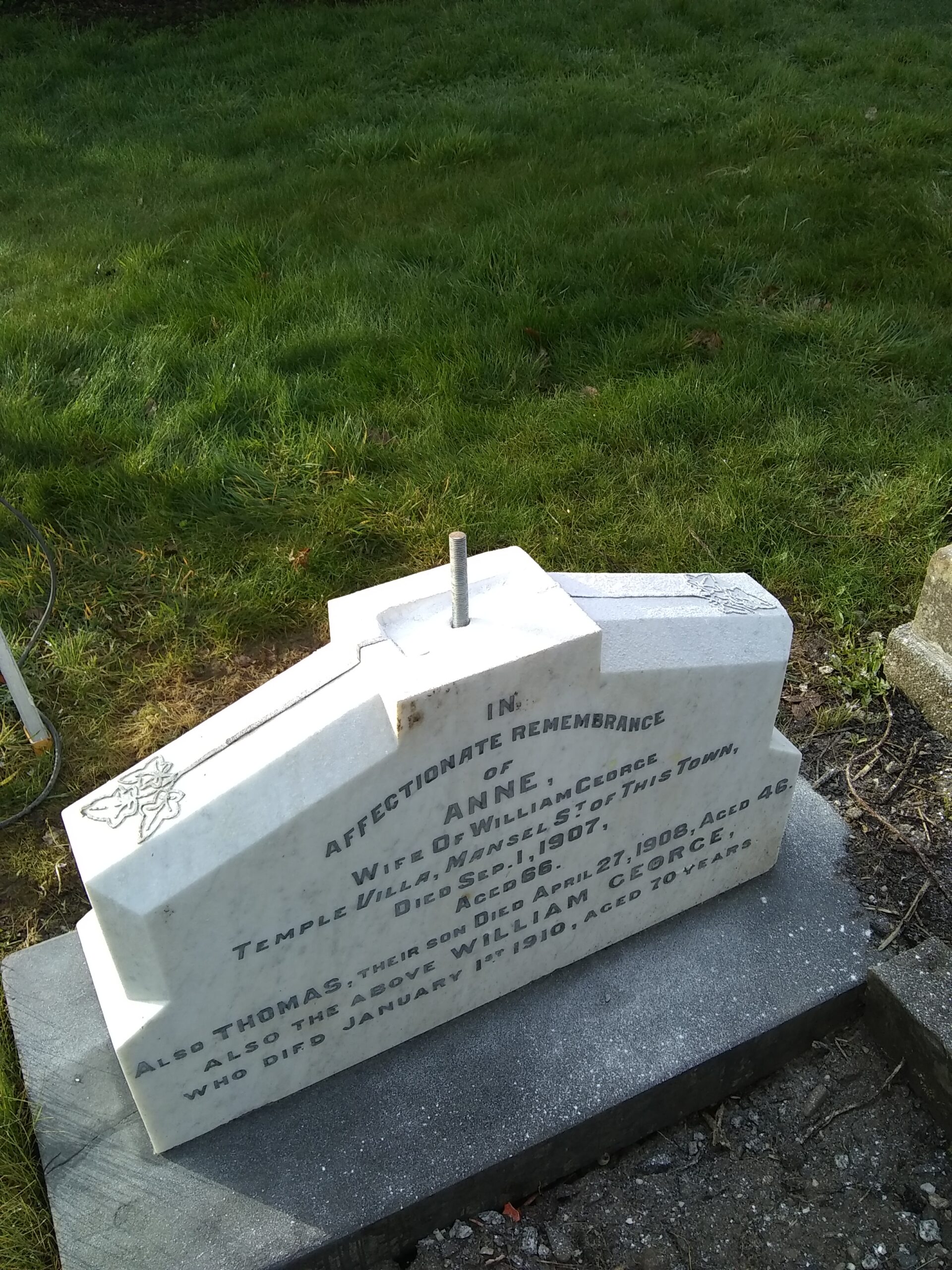
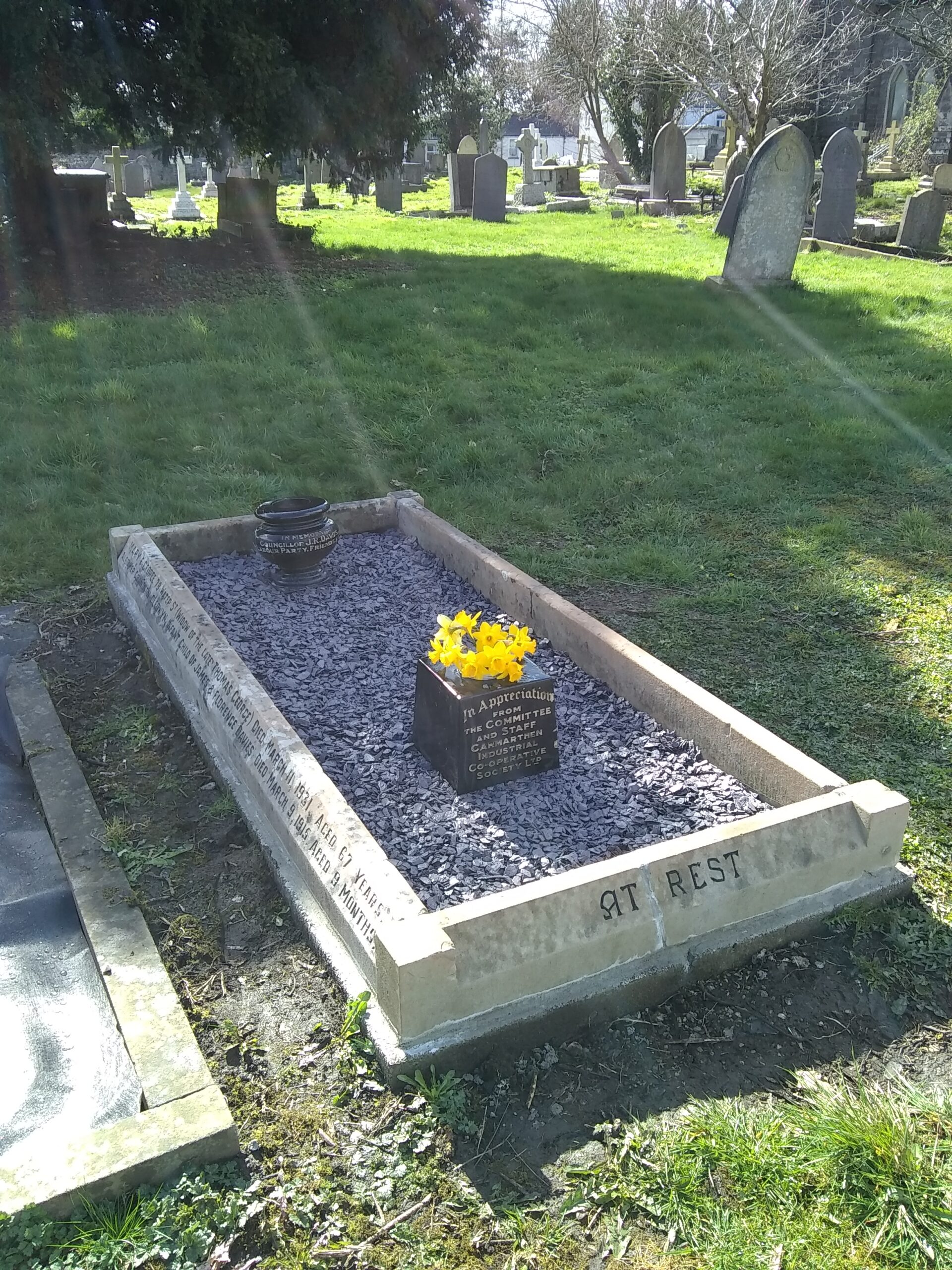
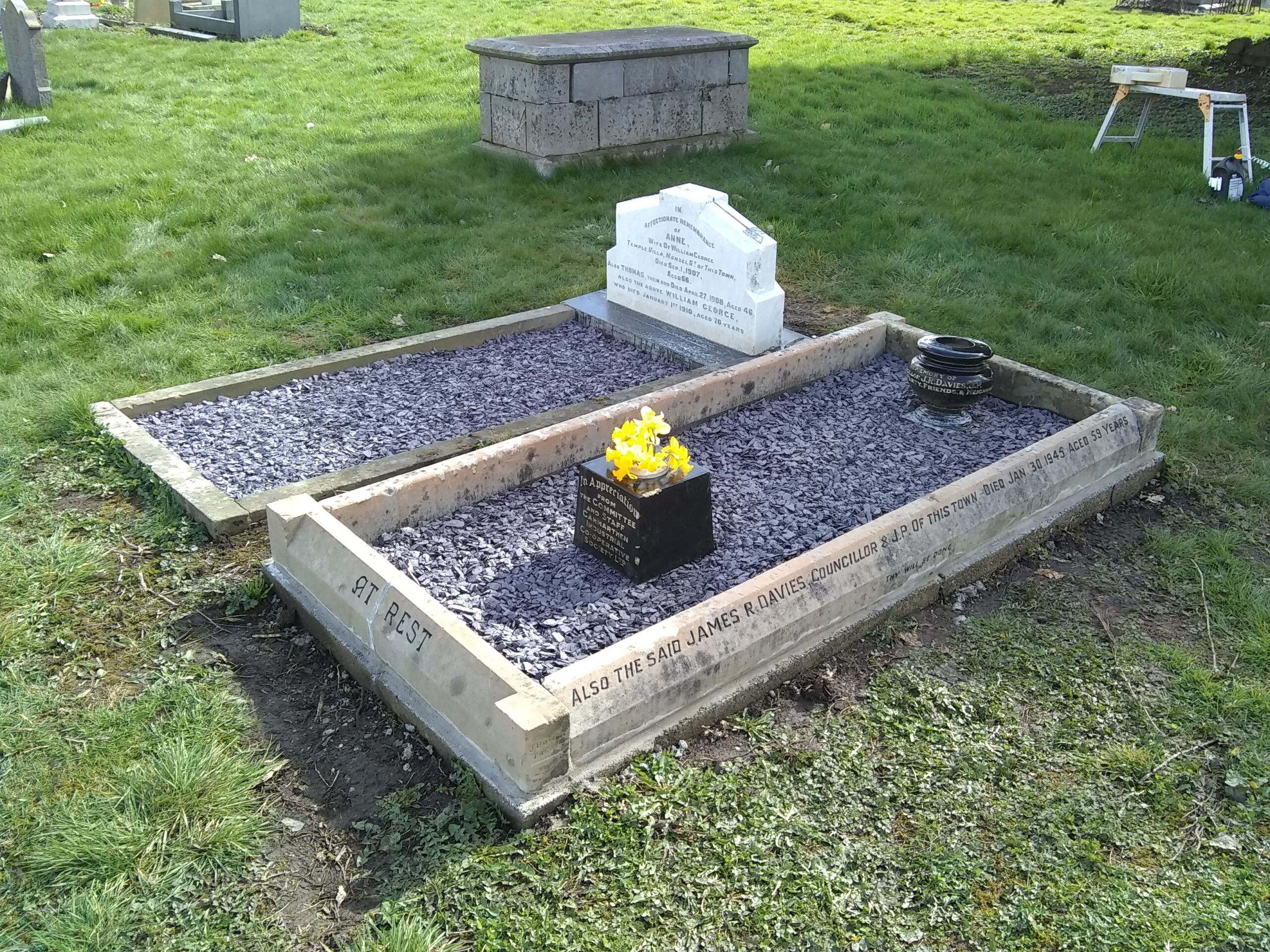
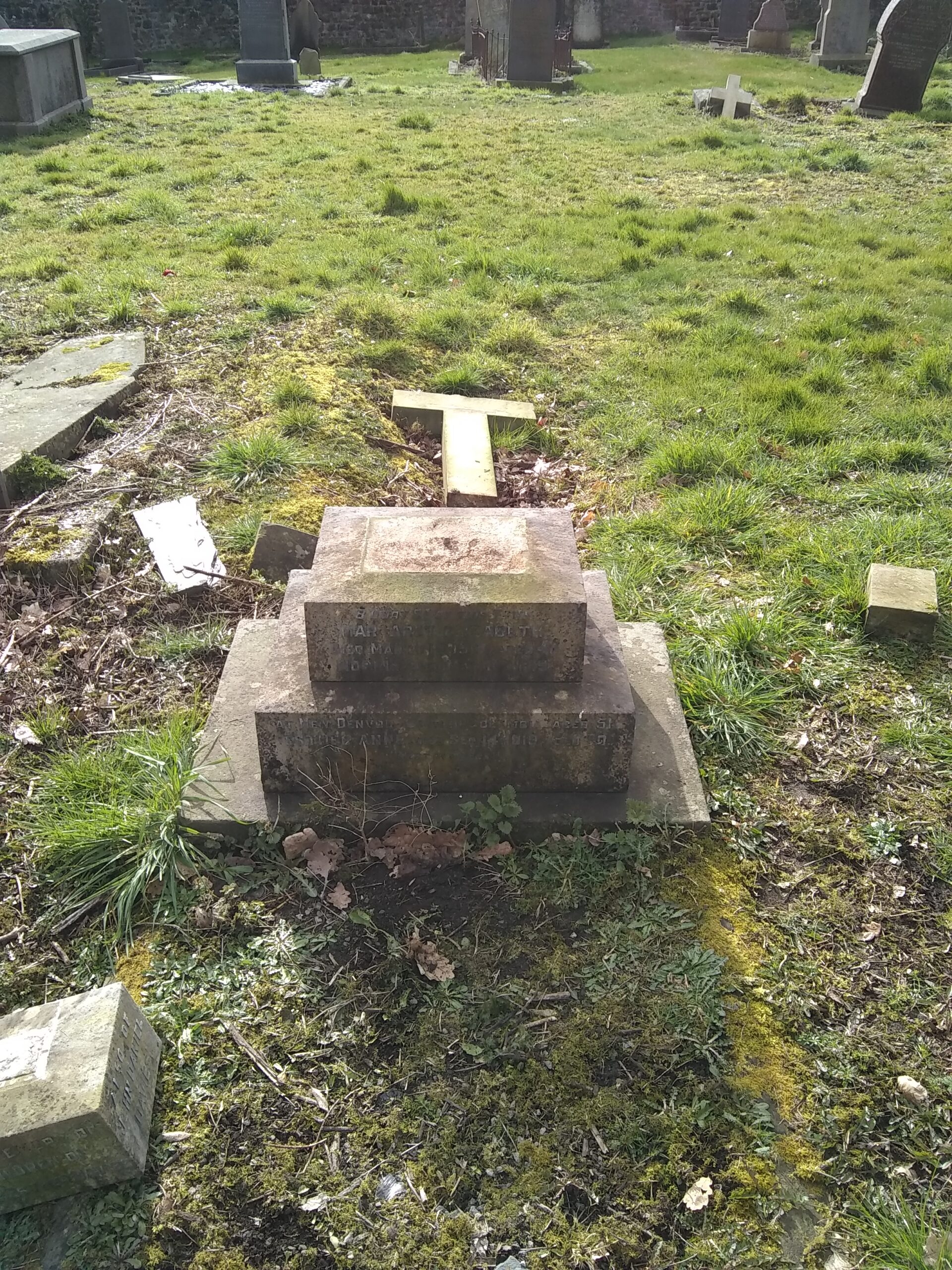
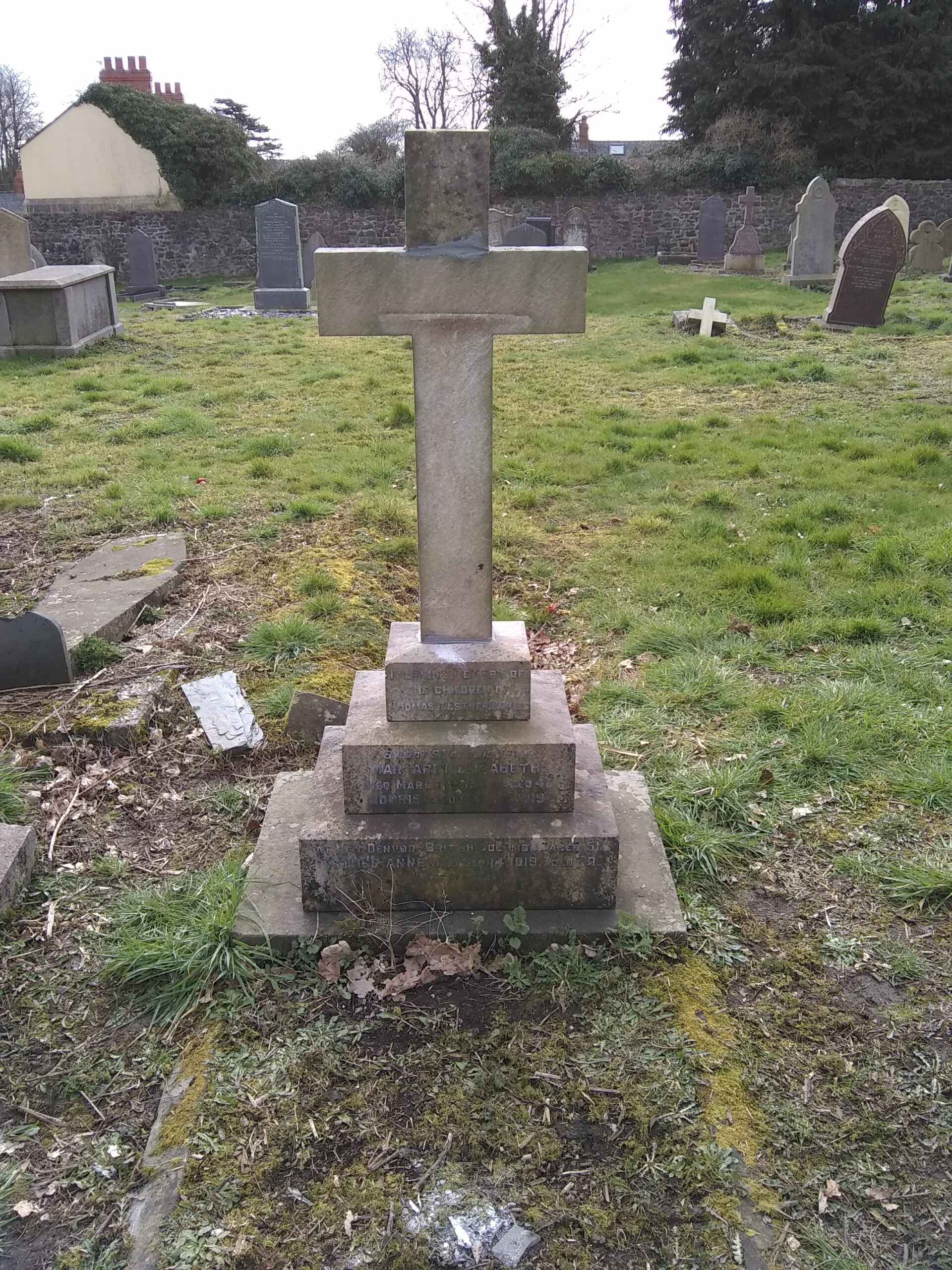
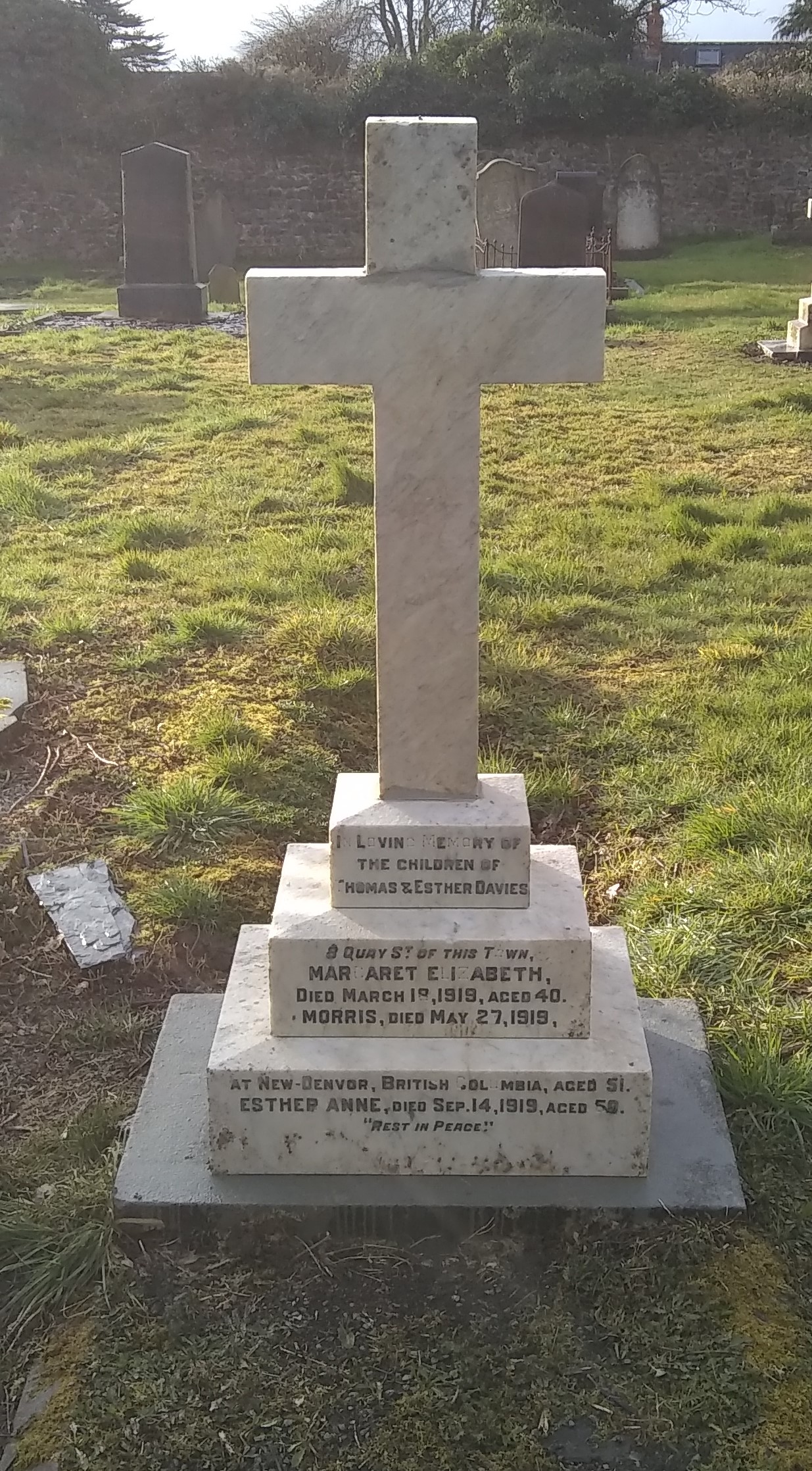
Councillor J R Davies JP & Family grave. These two graves have been fully restored except for the return of the white marble cross that sits upon the marble memorial (left). The cross has been damaged and the stem is missing. A new section of Italian Carrera Marble has been shipped from Italy, and when it arrives the cross will be erected and the memorial finally complete. All the restoration of all memorials has been undertaken by the Trustees themselves.


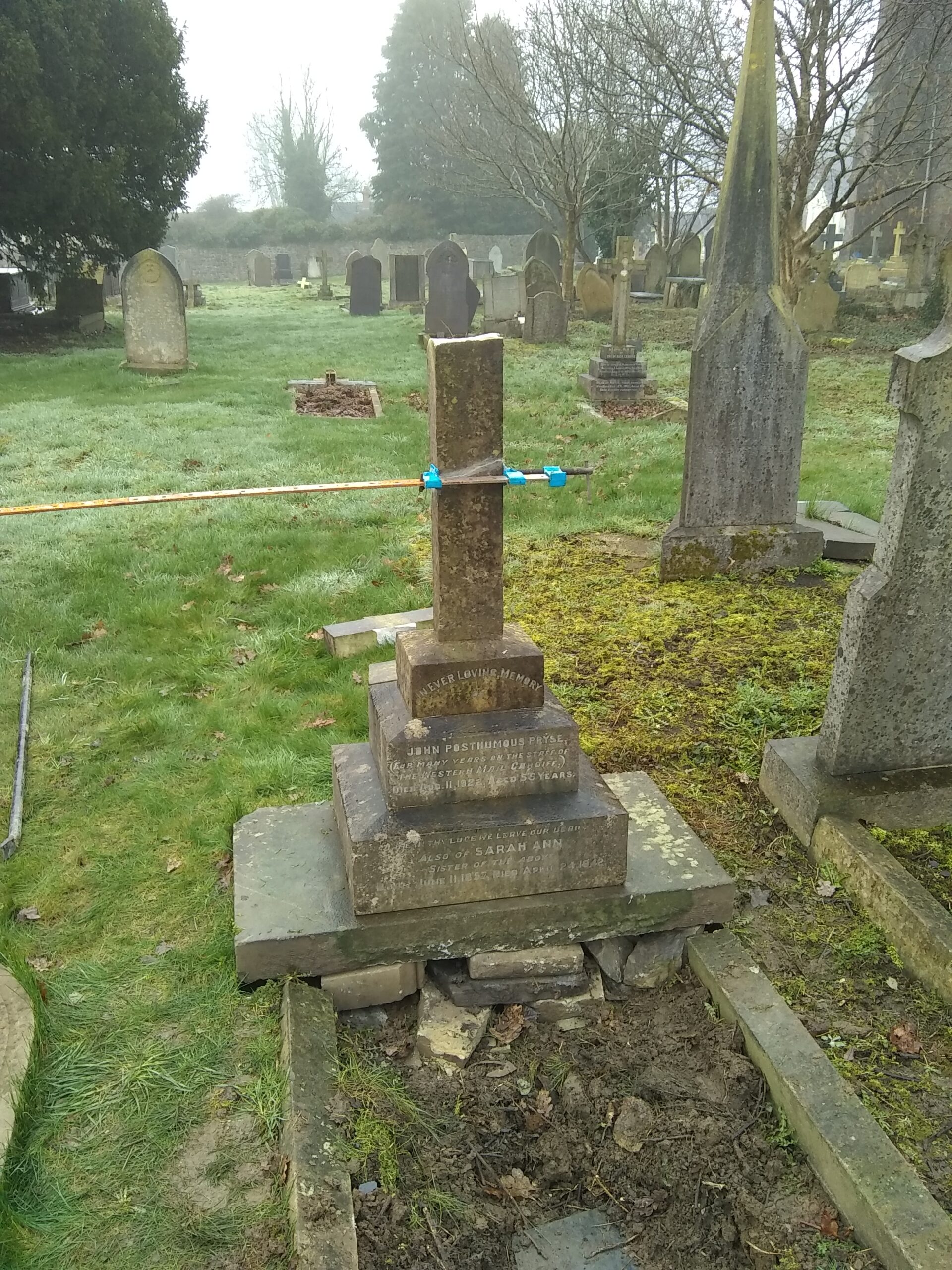
Mr John Posthumous Pryse                                                                                                                                                           


Thomas & Esther Davies & Family. 8 Quay Street Carmarthen


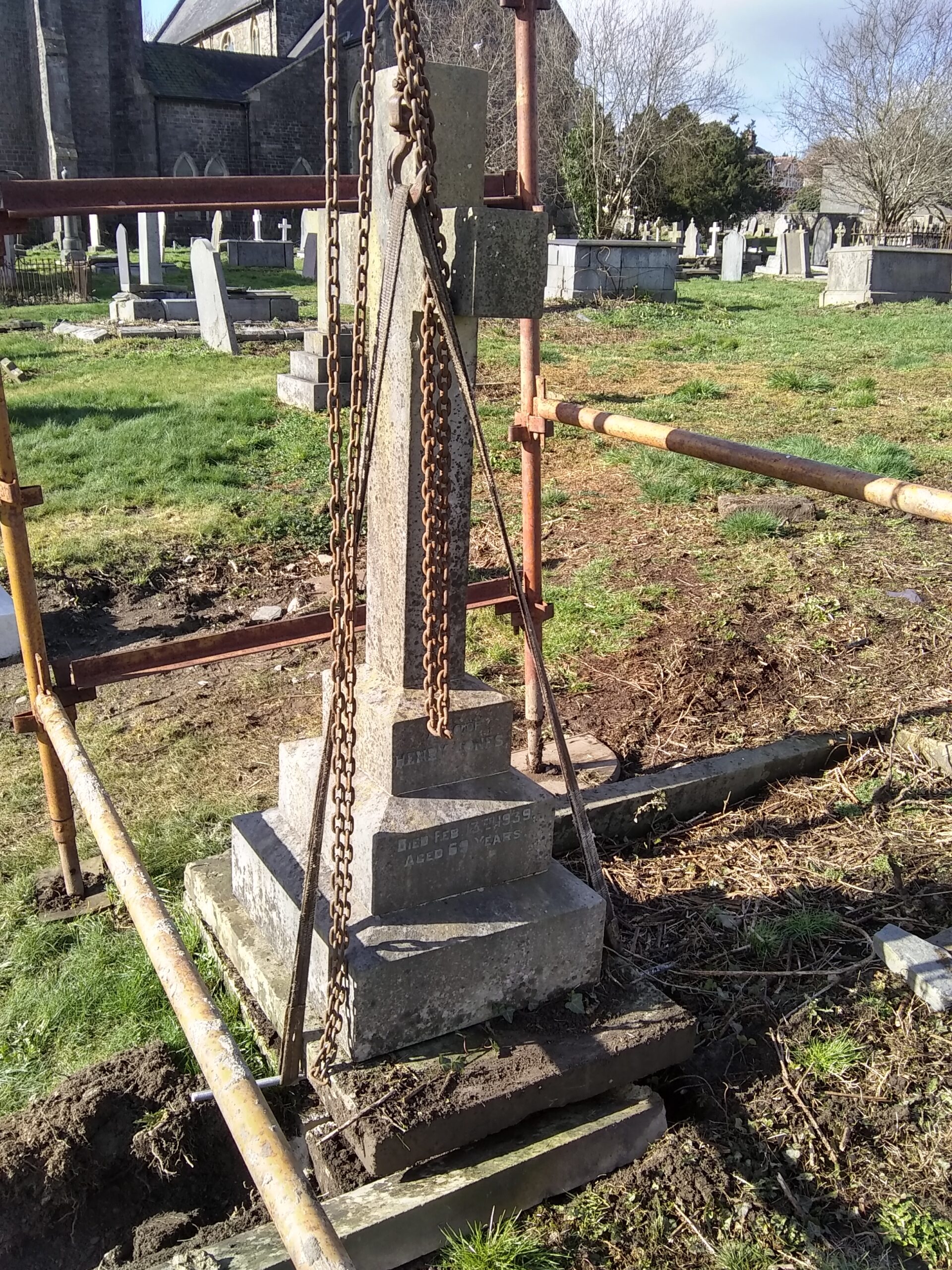
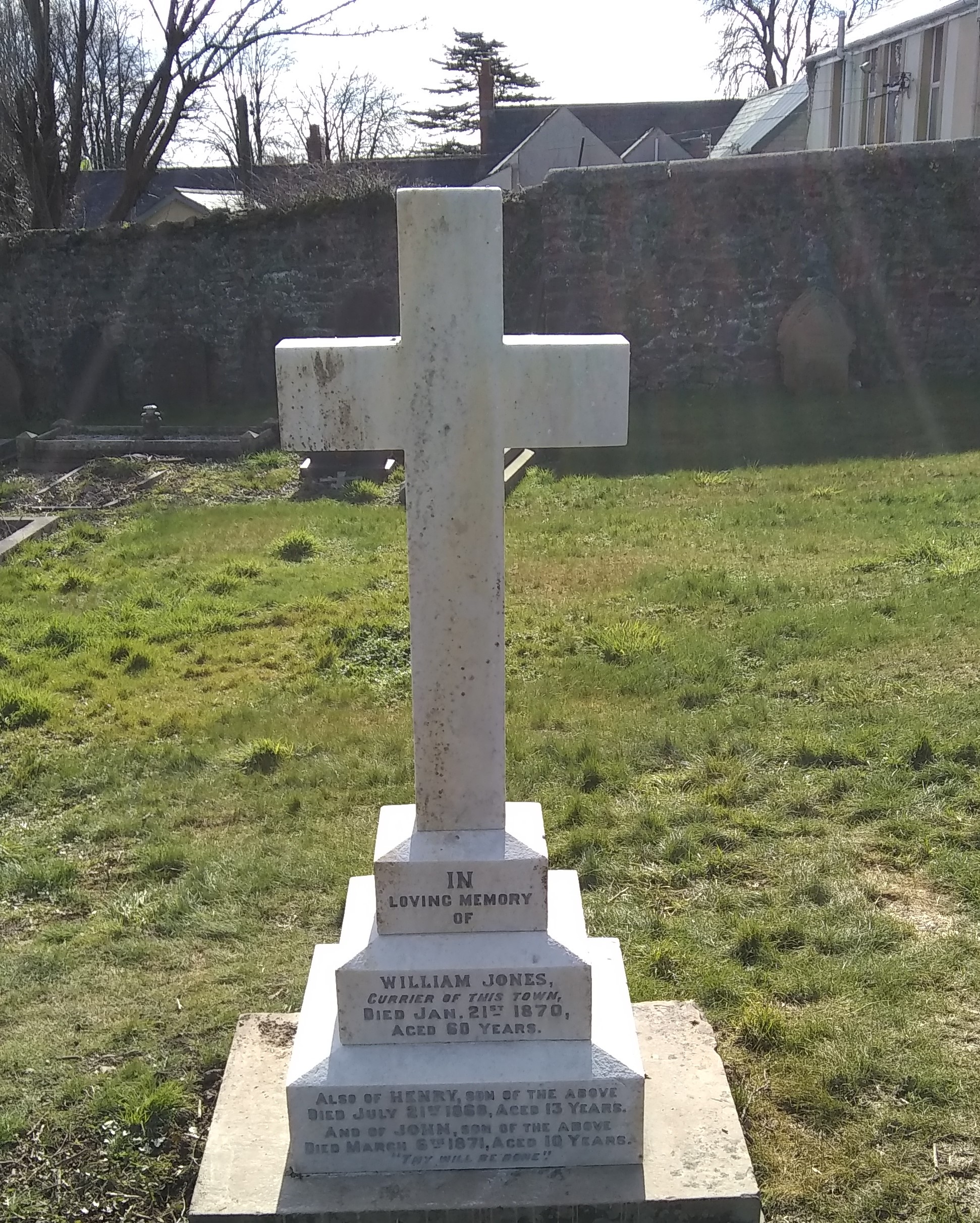
William Jones – Currier, and family.

The Leaning headstone of William Jones before making it level.
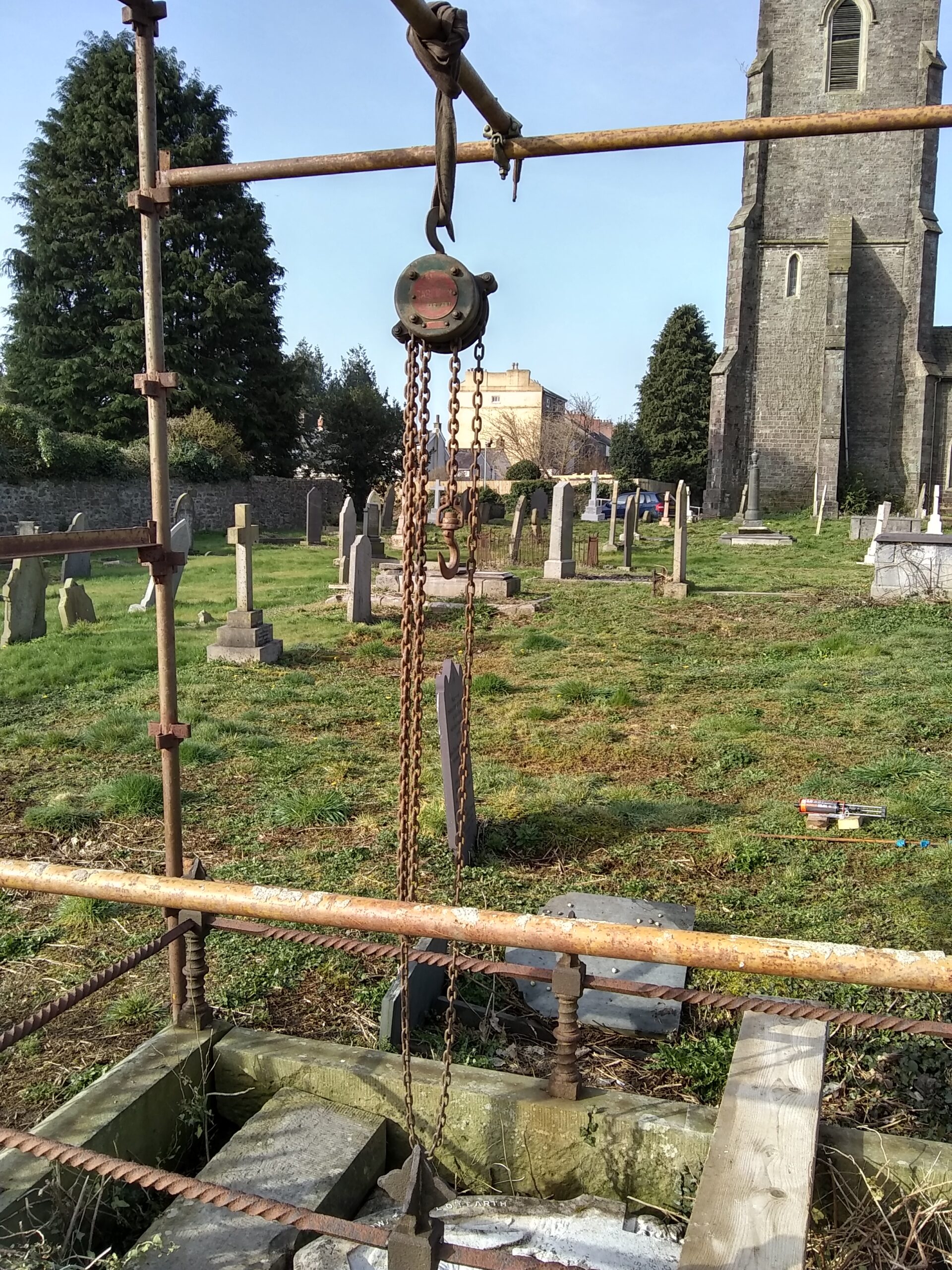
Using hydraulic lifting gear – itself 50 years old !
The completed restoration


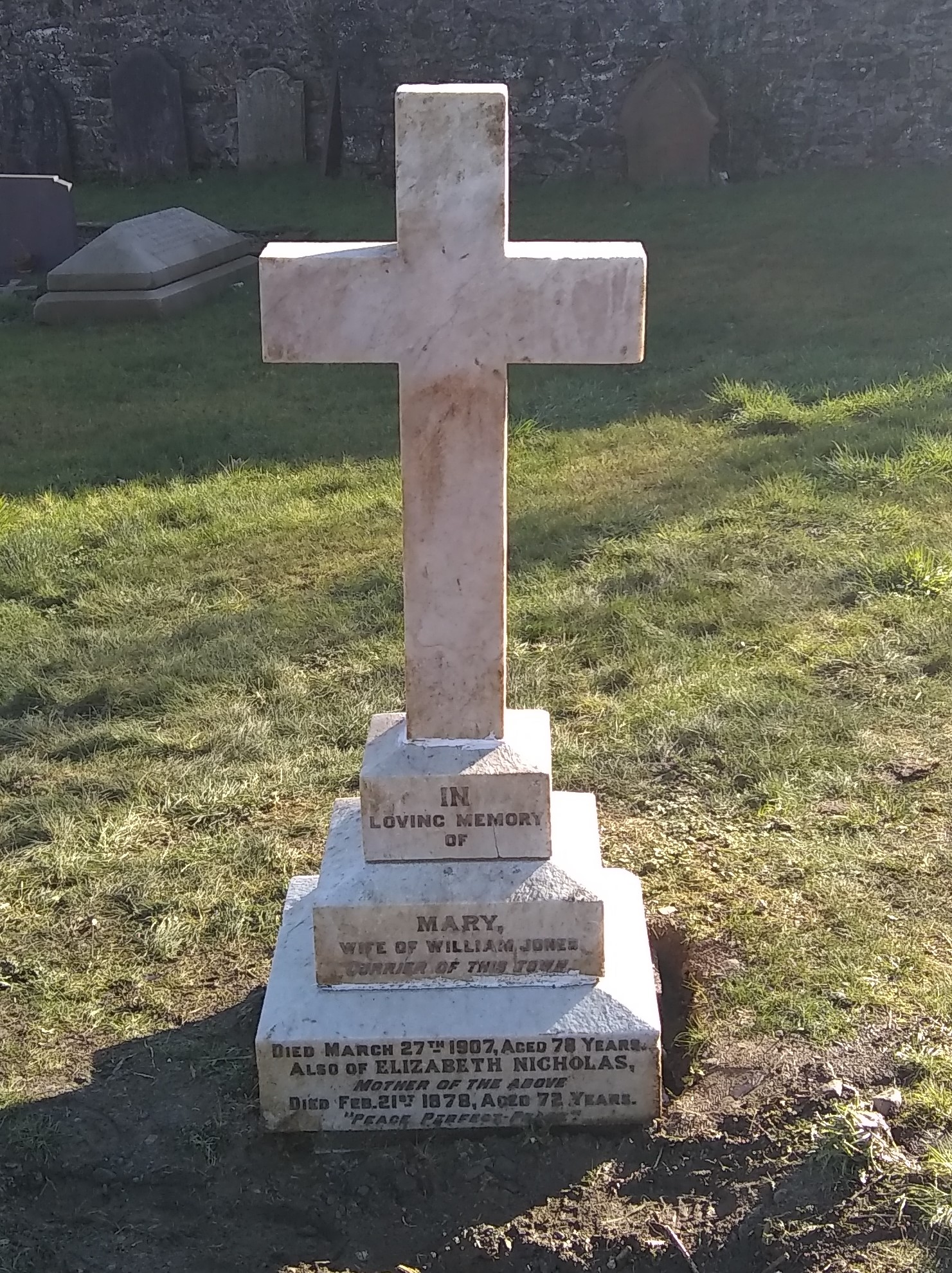
Mary Jones  & Family.

The memorial below shows just what restoration is all about, and epitomises all the hard work that goes into such restorations – a Phoenix rising from the ashes once again. The memorial is in fact the headstone of William Jones’ wife Mary , as featured in the  above set of photographs. The marble crosses now stand alongside each other  once again, – reunited at last.

Mary Jones’s memorial before.
and after.


A number of memorials requiring some TLC – before and after.

before
after


before
after


before
after


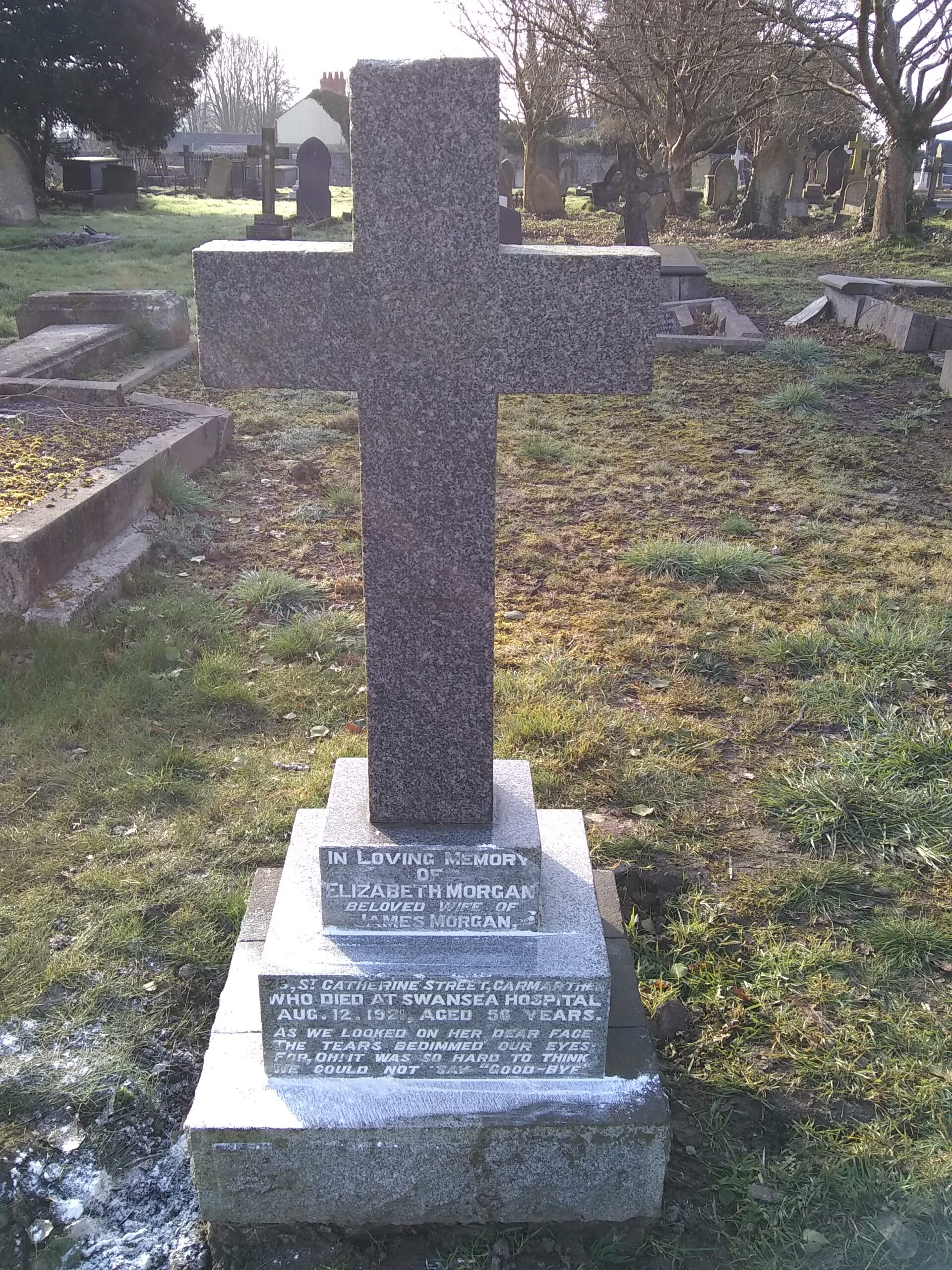
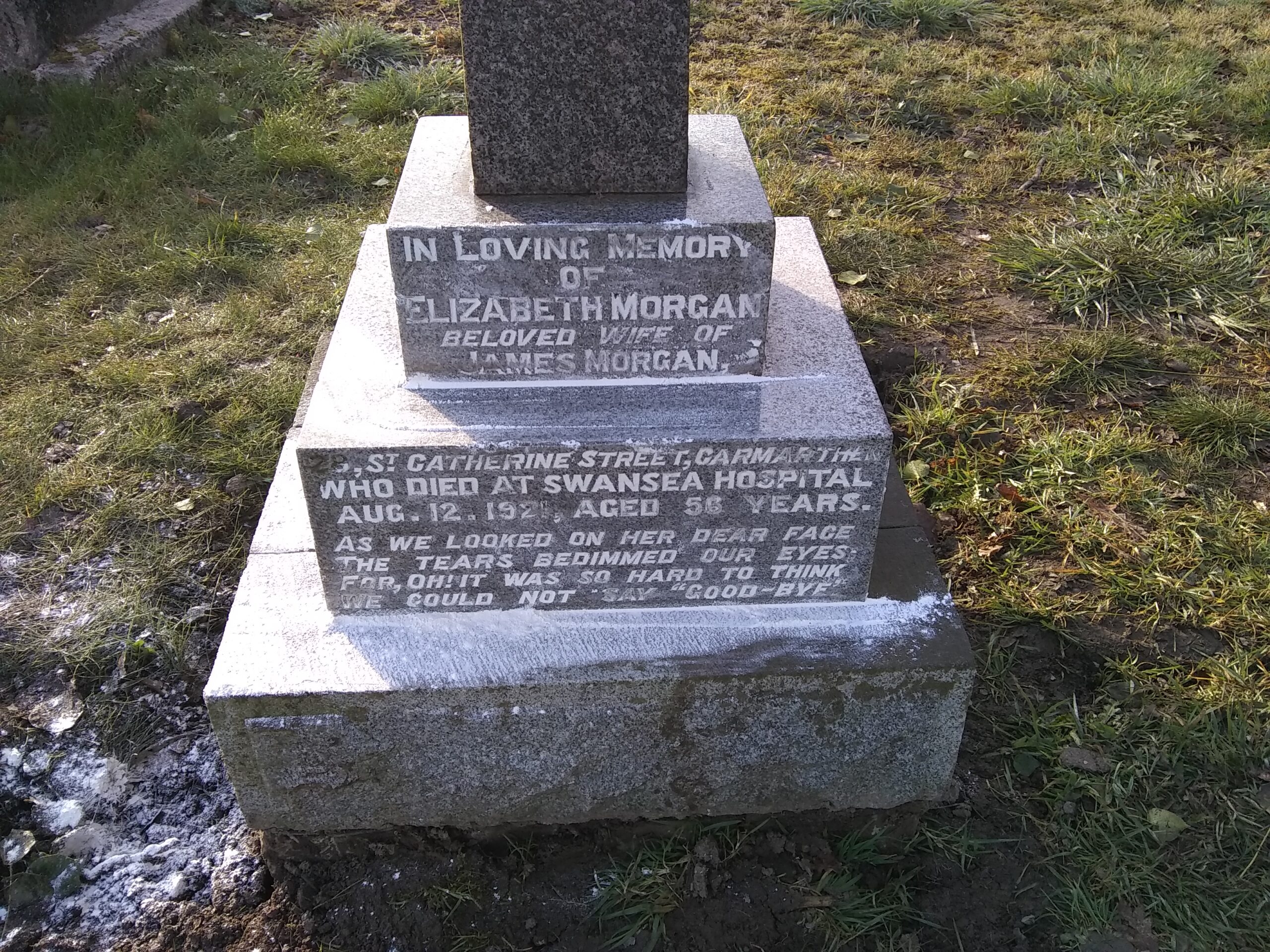
James & Elizabeth Morgan.

This base of this headstone needed to be reset and levelled before being fixed back into position. The inscription was unreadable, but the use of self raising flour brings out the wording perfectly. Though the inscription was written 100 years ago, what a very poignant and indeed apt epitaph of today given the heartache felt by so many during the last twelve months.


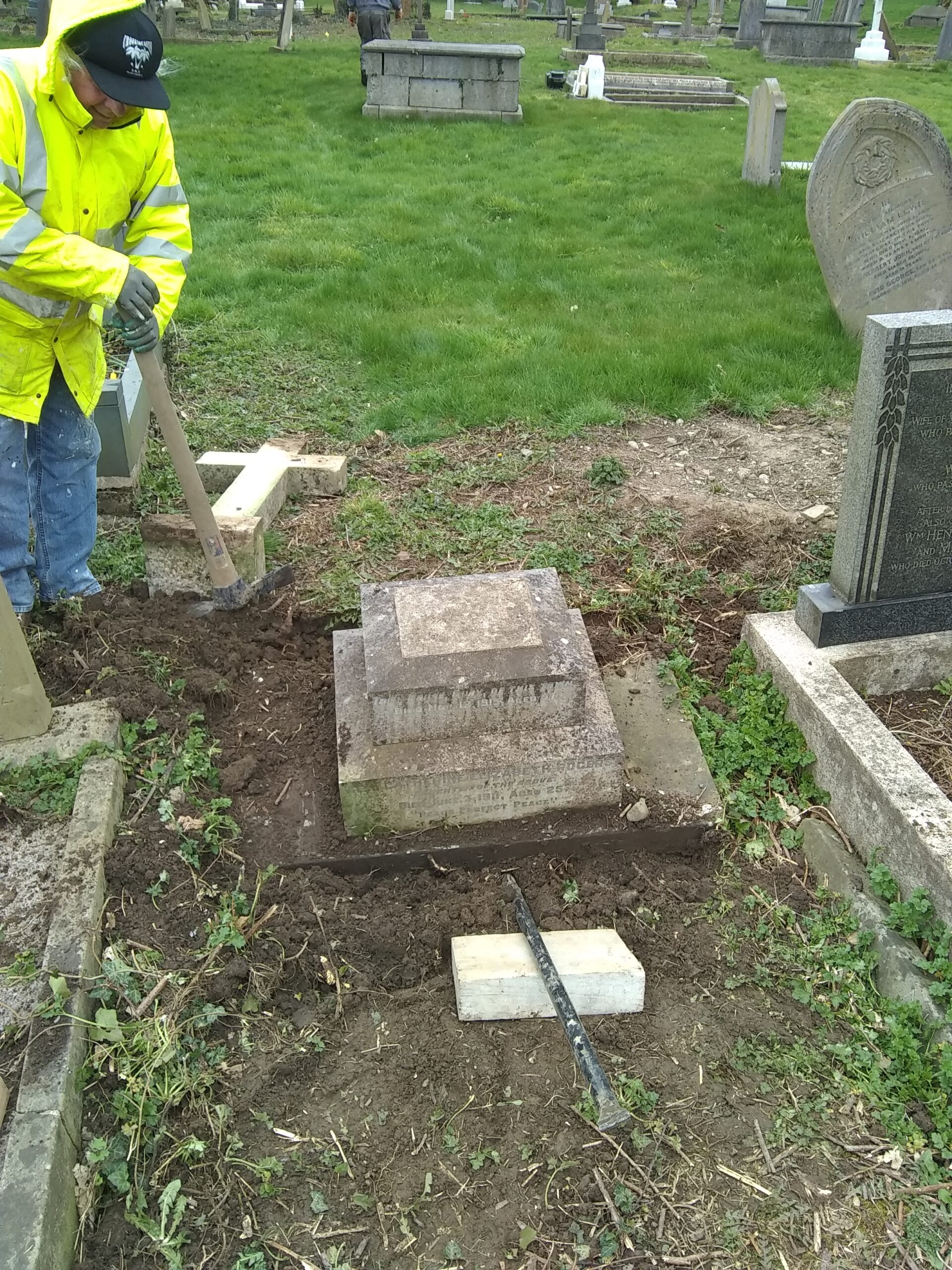
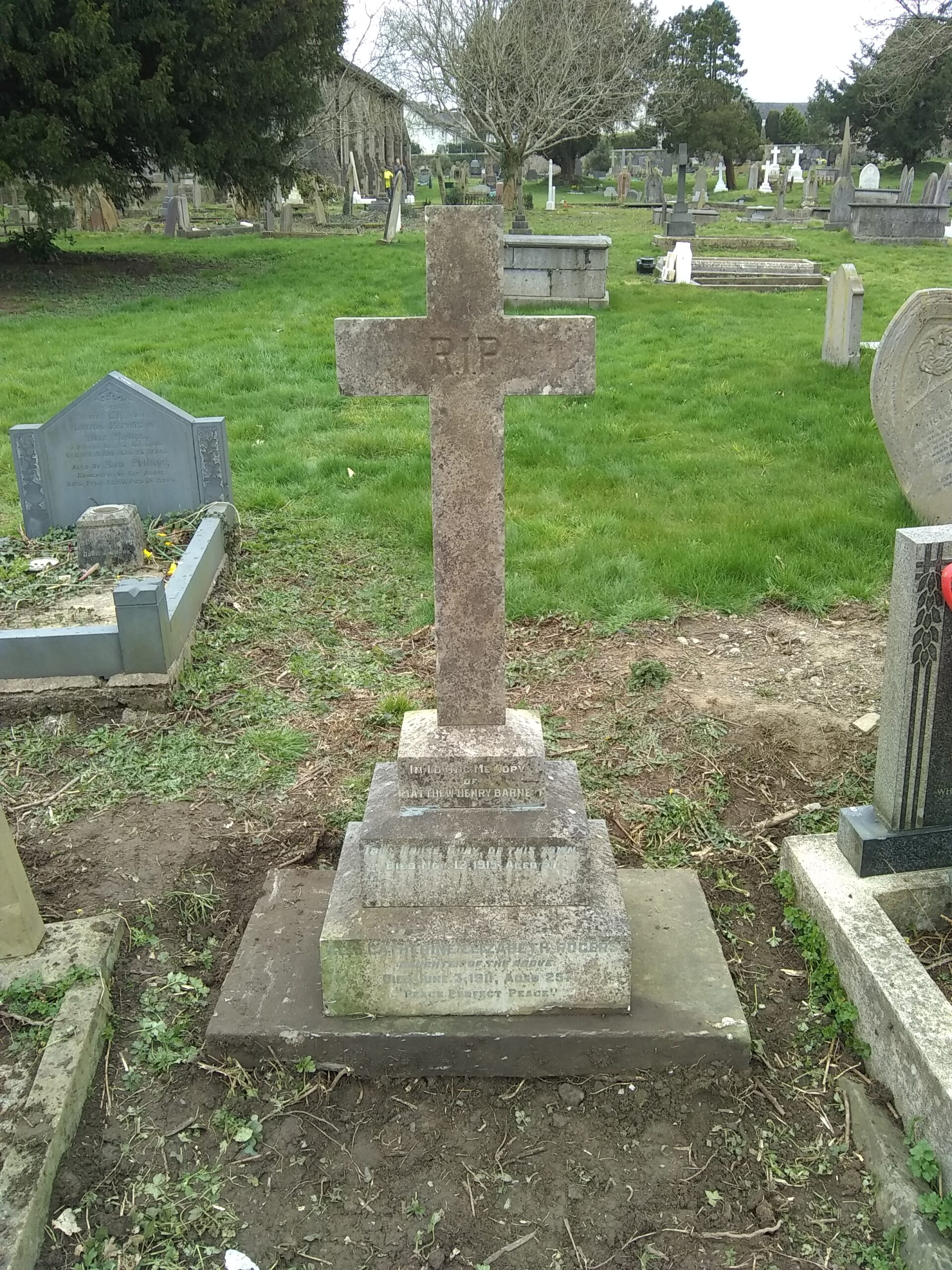
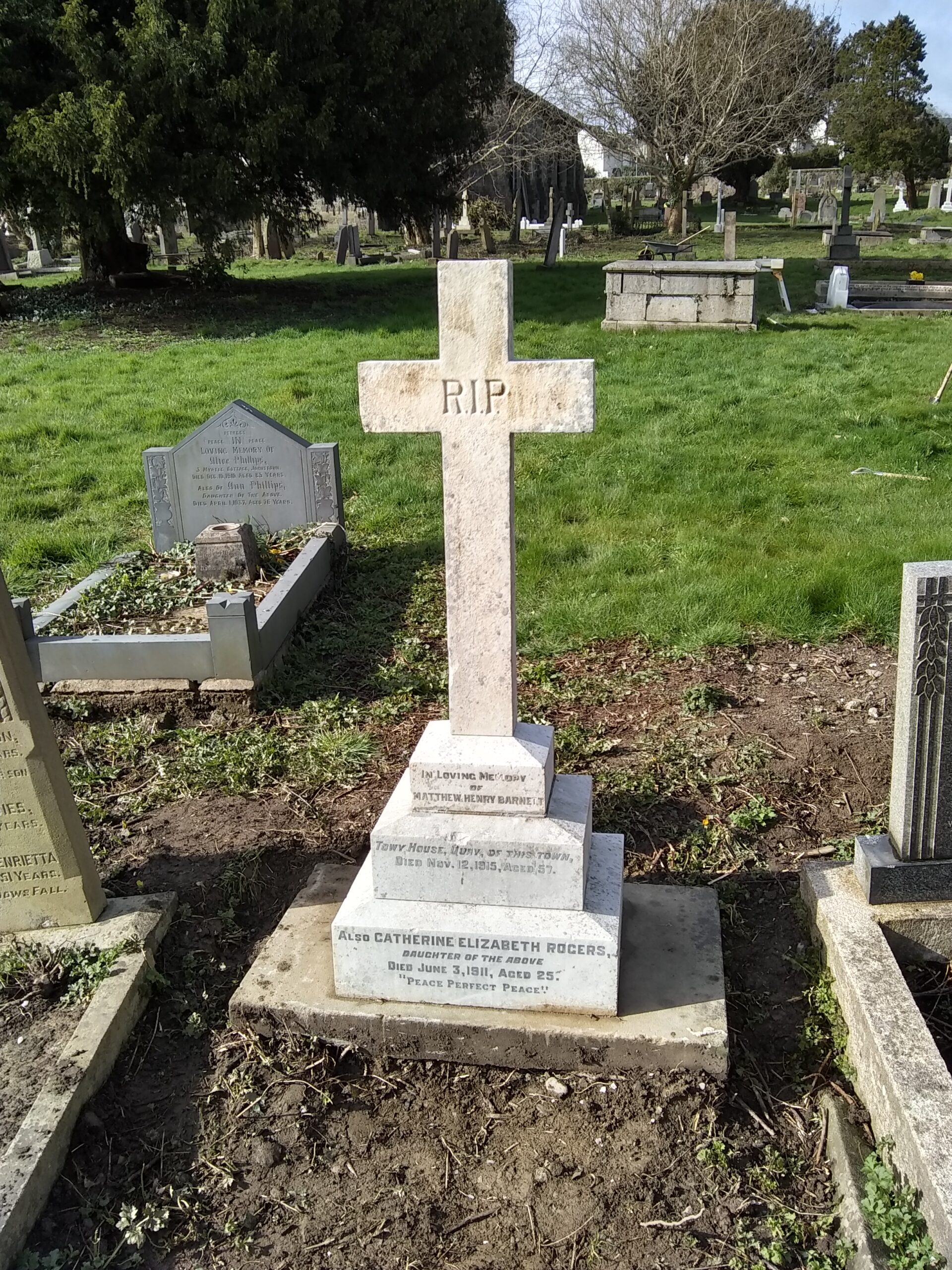
Matthew Henry Barnett & His Sister Catherine Rogers                                                                                                                                                                                                                 

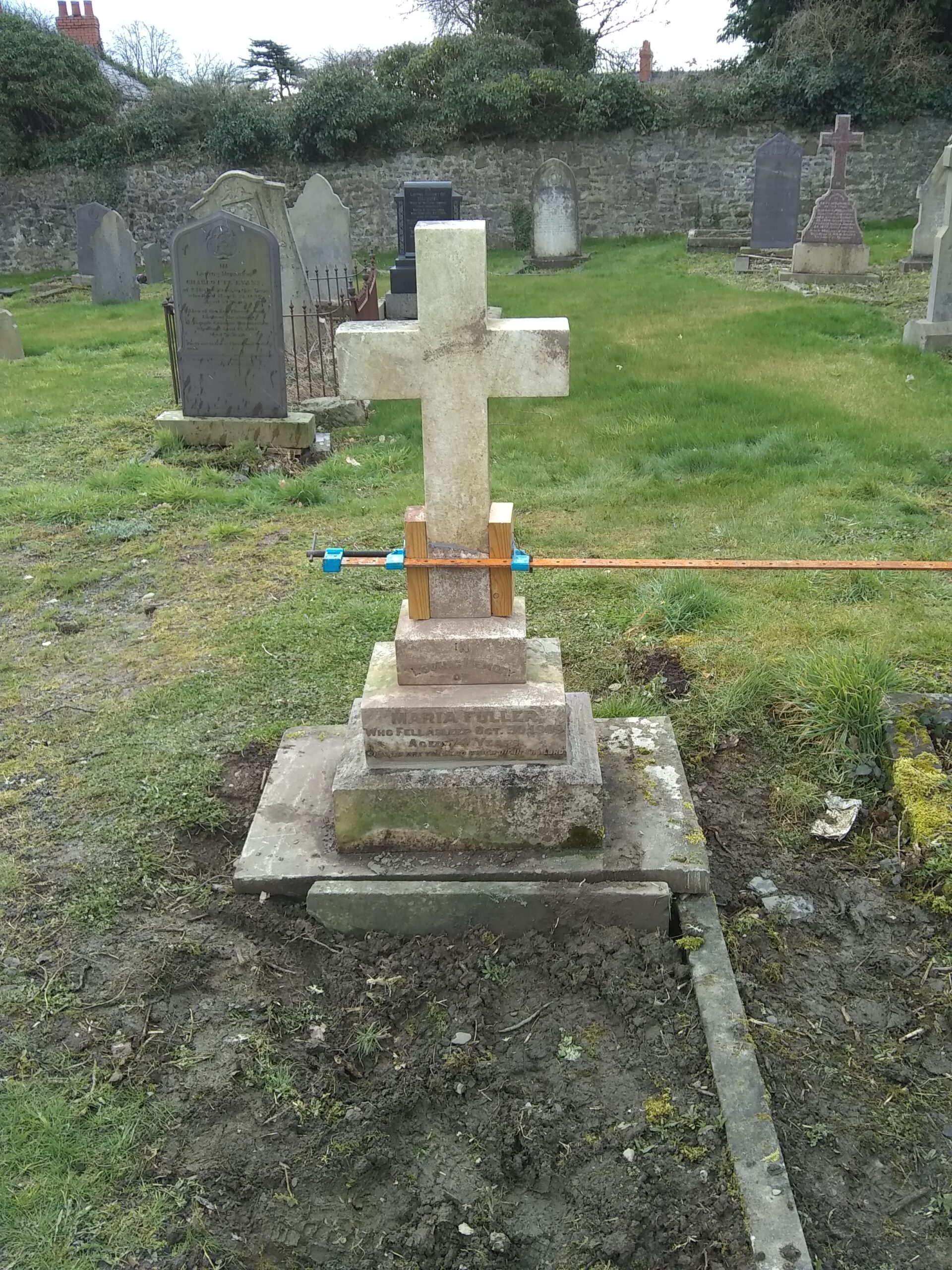
MARIA (JANE) FULLER 1836 -1909 AND HER REMARKABLE FAMILY

The following short but concise story is one that has given me great pleasure in researching and publishing, for it finally gives dignity to a lady, who as a grandmother living with ten grandchildren under the same roof – all boys must have had some strength of character! Not only that, but whose daughter and son in law produced one of Wales’ greatest artists, whose work even today fetches thousands of pounds at auction – Edward Morland Lewis, whose tragic end is mentioned below.

1901 Census. Edward was born the following year

With such a large family, I am certain that close relatives must still exist locally and further afield. It would be wonderful to be able to contact them to let them know what we have done in respect of their great (great) grandmother. May she rest in peace. Maria Jane Poucher, was born in Suffolk, and married John Robert Fuller on 31st December 1862 in Kentish Town, London. The following year their daughter Mary was born.

Maria’s Daughter Mary. Wife of BA Lewis and mother to 10 boys

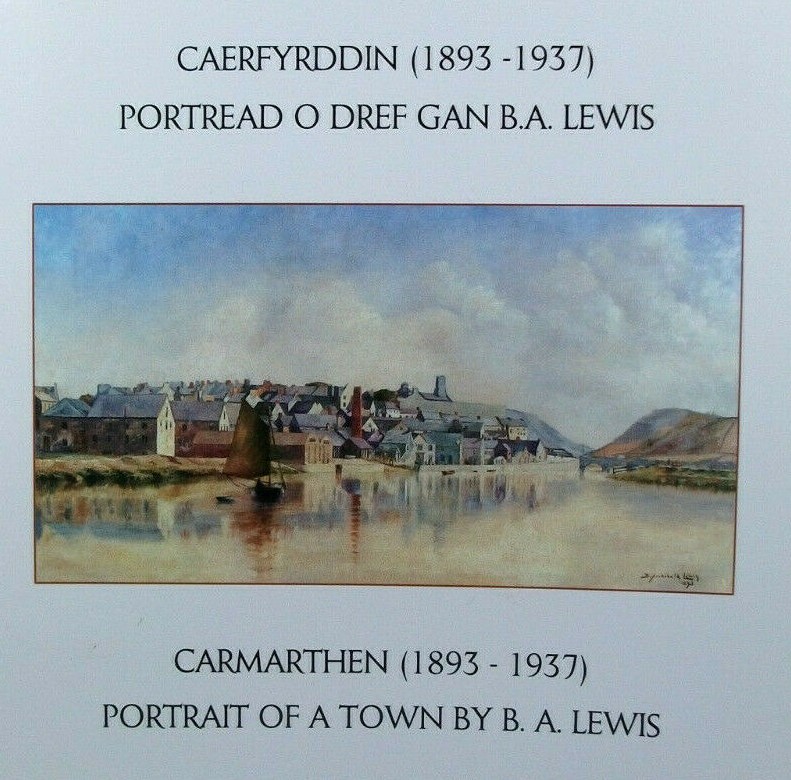
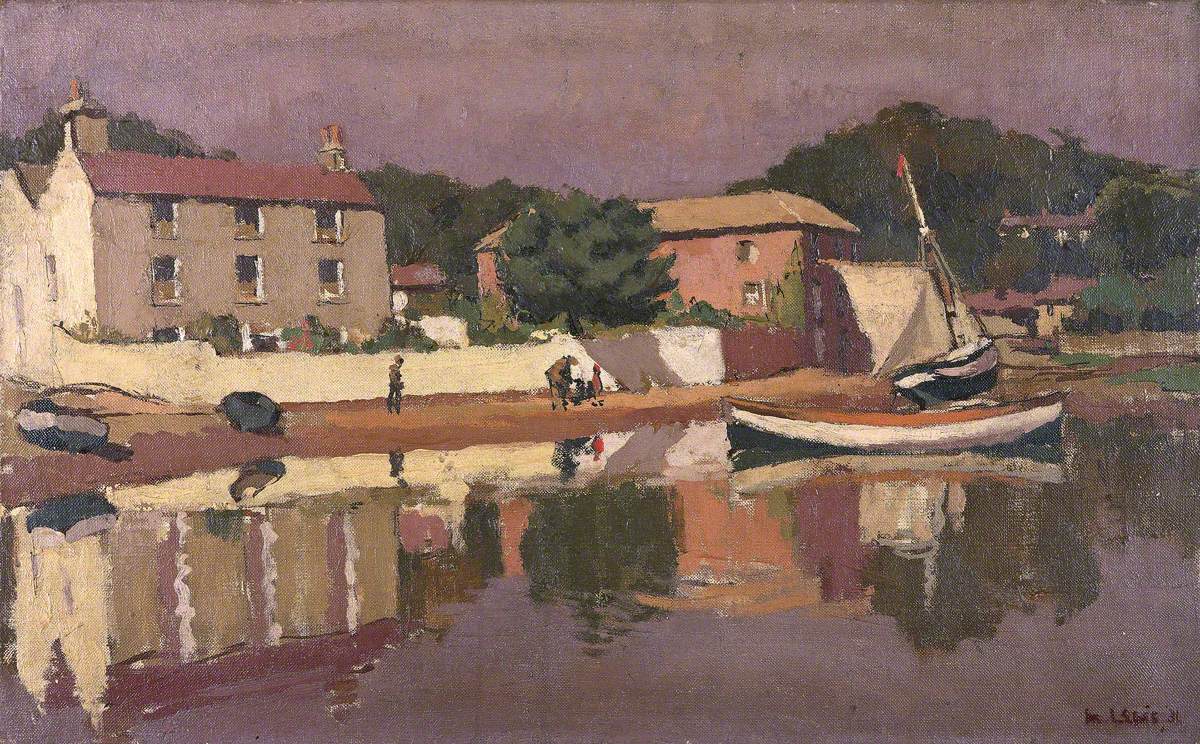
She in turn married Benjamin Archibald Lewis on the 18th December 1884 in Edmonton, Middlesex. Benjamin Archibald Lewis (1857-1946), was himself a talented, amateur artist. He was born in Carmarthen and his home town was always his favourite subject. He trained as a gas engineer – hence his affectionate nickname ‘Lewis the Gas’, although he was also known as B.A. Following a period of time working in South Africa, he returned to Carmarthen in 1894 and held the post of manager of the gas company until his retirement. He was a prolific artist and he also found time to study part time at Carmarthen School of Art during the 1890s.In 1930 he retired to Undercliff, Ferryside and continued to paint until his death in 1937. He was founder member of Carmarthen sketch club and he also attended Carmarthen school of Art. In all, Benjamin and Mary went on to have 10 sons, the youngest of all , born in 1902 – Edward Morland Lewis becoming famous as an artist of great repute, whose works even today fetch thousands of pounds. What it must have been like to share a house with ten boys is anyone’s guess, but I am sure that grandma Maria did a wonderful job. Ironically, Edward was the first to die. He was the youngest grandson of Maria Fuller trained at St John’s Wood School of Art and at the Royal Academy Schools, London where he met Sickert.  Morland Lewis promptly left the academy to work under Sickert as pupil and assistant. In 1930 he joined the London Artists’ Association and exhibited with this group until it disbanded in 1934. Many of his paintings were based on photographs he took himself. Like Sickert, he tended to paint patchwork areas of colour laid over warm under-painting. He concentrated on the seaside towns of South Wales, Ireland, Northern France and Spain. A comparison of one of his photographs with the painting of the same scene reveals how completely he transformed the information from one medium into the language of another. The main composition is faithfully transcribed, but the tonal relationships are slightly exaggerated. He joined the staff of Chelsea College of Art, where his colleagues included Henry Moore, Graham Sutherland and John Piper.

The Strand Laugharne, by EM Lewis
Edward Morland Lewis. Self Portrait. (NMW)

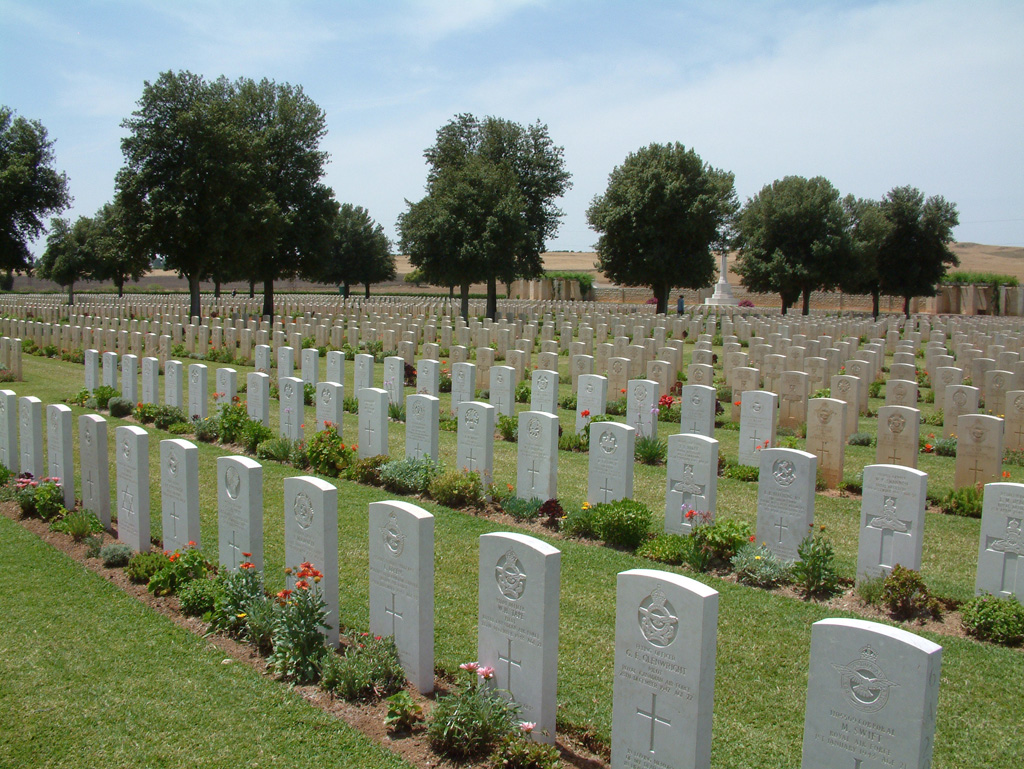
Tragically, he was killed in action in North Africa on the 4th August 1943 aged 40 with the rank of Captain while on active service as a camouflage officer, suffering fatal injuries in a bombardment by Rommel’s Afrika Corps. He was reburied twelve months later at Medjez el Bab War Cemetery on 22nd August 1944.

Maria Fuller’s name was not recorded on the list of memorials in St Davids Cemetery, when it was compiled in 1977, suggesting that even at that time the headstone was buried in the ground, covered in mud…until now of course, some 45 years later where at long last, and after some major restoration, the memorial and last resting place to a grandmother of one of Carmarthen’s most well known and famous families can once again be remembered with dignity and honour.

Translate »